REVIEW 3 major objections 4 minor 1 cited by
Constituent Quark Model and nucleon-Nucleon Potentials
T0 review · 3 major / 4 minor · reviewed 2026-08-11 · deepseek-v4-flash
Pith's one-line read The constituent quark model reproduces the operator structure of nucleon-meson vertices.
desk verdict A serious, systematic attempt to derive NN vertices from constituent quarks, but the central cancellations are reverse-engineered and one key Gaussian condition has a factor-of-2 error. read the letter →
The pith
A machine-rendered reading of the paper's core claim, the machinery that carries it, and where it could break.
The reading
What carries the argument
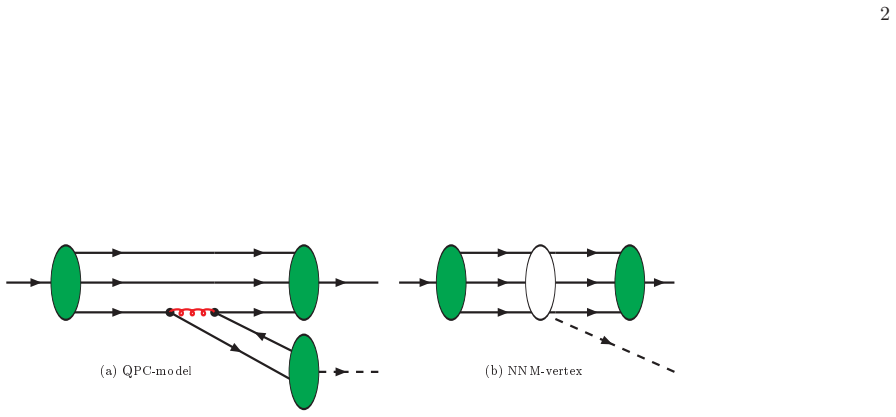
The object doing the work is the folded quark-quark-meson vertex: a Gaussian SU(6) three-quark wavefunction with nucleon radius parameter $R_N$ is integrated against a quark-level meson vertex, and the result is expanded in Pauli-spinor invariants. The comparison identity is that, after the CQM replacement $m_Q = \sqrt{M'M}/3$, the coefficients of the central, spin-spin, tensor, spin-orbit, and quadratic-spin-orbit operators must equal those of the phenomenological nucleon-level vertex. Extra quark-level derivative couplings and a Gaussian momentum distribution for the exchanged momentum $K$ are the mechanisms that cancel the unwanted $k^2/(M'M)$ and $1/(m_Q^2 R_N^2)$ terms, leaving the desired vertex ratios.
What would settle it
Compute the quark-level scalar, vector, and axial-vector three-point form factors at quark mass $m_Q = M_N/3$ and check the predicted ratios $g_2/g_1 = -8/9$, $f'_{1v}/F_{1v} = 4/9$, $f'_{2v}/F_{2v} = 4/9$, and $g''_a = -3g_a/(8(MR_N)^2)$; a form-factor calculation that does not show these ratios, or a measurement of NN scattering that conflicts with the resulting Pauli-invariant ratios, would falsify the central claim.
Extended reading notes
Core claim
The central claim is that the constituent quark model with $m_Q = M_N/3$ reproduces, up to order $1/(M'M)$, the Pauli-invariant structure of the nucleon-meson vertices for pseudoscalar, scalar, vector, and axial-vector exchange. The match is achieved by supplementing the standard quark couplings with extra interactions whose ratios are fixed numbers, such as $g_2/g_1 = -8/9$ for scalar mesons, $f'_{1v}/F_{1v} = 4/9$ and $f'_{2v}/F_{2v} = 4/9$ for vector mesons, and an axial-vector coupling $g''_a = -3g_a/(8(MR_N)^2)$ interpreted as the quark orbital angular momentum contribution to the nucleon spin. A momentum correlation between the active quark and the spectator pair, implemented as a Gaussian distribution, eliminates the spurious $1/R_N^2$ terms that would otherwise break the claimed ratio equality. The paper concludes that the conjecture that the ratios of spin-spin, tensor, spin-orbit, and central operators are independent of the nucleon's internal structure is realized in the constituent quark model.
Load-bearing premise
The construction leans on specific extra quark-level interactions and a Gaussian momentum correlation whose parameters are chosen so that the folded vertex equals the phenomenological one; if those ingredients have no independent justification, the match is an exercise in reverse engineering rather than a derivation.
Editorial extensions
If this is right
- The ratios among central, spin-spin, tensor, spin-orbit, and quadratic-spin-orbit terms in the NN potential are fixed by quark-level couplings with $m_Q = M_N/3$, so the CQM constrains the relative strengths of meson-exchange components.
- Scalar and vector exchange must be treated together: the extra scalar coupling $g_2/g_1 = -8/9$ and the vector couplings $f'_{1v}/F_{1v} = 4/9$, $f'_{2v}/F_{2v} = 4/9$ cancel the $k^2$ terms that each vertex produces separately.
- The axial-vector vertex requires an extra coupling tied to quark orbital angular momentum, linking the nucleon spin crisis to the axial-vector meson part of the nuclear force.
- The Gaussian momentum correlation that removes spurious $1/R_N^2$ terms makes the CQM vertex equivalent to the phenomenological vertex to order $1/(M'M)$, and the same construction can be extended to other baryons.
- The resulting quark-level interactions connect directly to the extended-soft-core meson-exchange potentials, providing a working input for mixed quark-nuclear matter calculations in neutron stars.
Reading between the lines
- A testable prediction left implicit in the notes is that the ratio conditions ($g_2/g_1=-8/9$, $f'_{1v}/F_{1v}=4/9$, $f'_{2v}/F_{2v}=4/9$, and $g''_a=-3g_a/(8(MR_N)^2)$) should emerge from any quark-level Lagrangian with the same derivative structure; lattice or Dyson-Schwinger three-point functions at $m_Q\simeq M_N/3$ could check them directly.
- The Gaussian momentum correlation with $\alpha = (3/8)R_N^2$ and $\beta = (3/4)R_N^2$ is effectively a model of the internal momentum distribution of the active quark, and could be confronted with light-front wave functions or generalized parton distributions.
- If the derivation holds, the same folding procedure would reduce the number of independent coupling constants in hyperon-nucleon and hyperon-hyperon extended-soft-core potentials, since the quark-level ratios would fix the baryon-level vertex ratios across the SU(3) octet.
- The paper's added couplings are chosen to match the phenomenological vertex; an independent derivation of those couplings from a chiral quark-meson Lagrangian would turn the demonstrated consistency into a full explanation rather than a parameterization.
Editorial analysis
A structured set of objections, weighed in public.
Referee Report
Summary. The paper aims to derive the meson-nucleon-nucleon (NNM) vertex structure of the extended-soft-core (ESC) potentials from meson exchange between constituent quarks. Quark-meson vertices are folded with the Gaussian SU(6) three-quark wavefunction of Le Yaouanc et al., with quark mass m_Q = M_N/3, and the resulting Pauli-spinor invariants are compared with the phenomenological NNM expansion. The pseudoscalar case is shown to match directly. For scalar, vector, and axial-vector mesons, the author introduces additional derivative couplings at the quark level, a Gaussian momentum distribution in the exchanged momentum K, and (for axial mesons) couplings interpreted as quark orbital angular momentum. The stated conclusion is that the CQM reproduces the ratios of central, spin-spin, tensor, spin-orbit, and quadratic-spin-orbit invariants of the ESC vertices up to order 1/(M'M).
Significance. If the construction were genuinely predictive, it would provide a quark-level foundation for the ESC nucleon-nucleon vertex structure and would connect the CQM to modern NN potentials and neutron-star applications. The Pauli-reduction algebra is set out carefully in the text and appendices, and the pseudoscalar matching in Sec. V is a clean, nontrivial success. The paper also makes the useful observation that the required quark-level ingredients include derivative couplings and a quark-spectator momentum correlation. However, the significance is substantially limited by the fact that the strengths of the additional interactions are fixed by the very NNM coefficients they are meant to explain, so the central claim is currently a consistency construction rather than a derivation. There is also a concrete algebraic inconsistency in the key K-integral condition that must be resolved before the scalar and vector matches are credible.
major comments (3)
- [Secs. IV, VI, VII (Eqs. (4.11), (6.6), (6.16), (7.14), (7.23))] The central claim that the CQM 'produces' the empirical Pauli-invariant ratios is weakened by the fact that the additional quark-level couplings are fixed by the NNM coefficients they are meant to reproduce. Eq. (4.11) sets g2/g1 = -8/9 to cancel the extra k^2/(16M'M) term in Eq. (4.8); Eqs. (6.6) and (6.16) set f'_1v/F1v = f'_2v/F2v = 4/9 for the same reason; and Eq. (7.23) fixes g''_a = -3g_a/(8(MR_N)^2) to obtain the required spin-orbit term. The K-distribution parameters in Eq. (4.18) are likewise chosen so that the integrals K1, K2, K3 satisfy the target conditions (4.17). Since no independent derivation or observable is given for these values, the manuscript demonstrates consistency by construction rather than a derivation. The abstract and conclusions should either be rephrased to state this explicitly, or the extra couplings should be derived from an independent physical principle.
- [Sec. IV C, Eqs. (4.15)-(4.18), (4.20)-(4.21)] The key condition (4.17)(ii) is not consistent with the Gaussian integral (4.15). With the stated values alpha = (3/8)R_N^2 and beta = (3/4)R_N^2, the coefficient of k^2 in the actual K2 integral is beta^2/(4alpha^2) = 1, whereas condition (4.17)(ii) requires beta^2/(2alpha^2) = 2. In addition, the exponent written in Eq. (4.20), containing the 9/4 k^2 term, gives gamma = (3/8)R_N^2 and hence gamma - beta^2/(4alpha) = 0, so K1 would not equal exp(-R_N^2 k^2/6) as required by (4.17)(i); it is the exponent in Eq. (4.19), with the 13/4 coefficient, that satisfies that condition. Consequently the removal of the 'spurious' 1/R_N^2 term and the k^2 coefficient quoted in Eq. (4.21) are not correctly derived as written. Because the same K-distribution is used for the scalar and vector matches, this affects both Sec. IV and Sec. VI.
- [Sec. VII, Eqs. (7.14), (7.22), (7.23)] The axial-vector spin-orbit matching appears to contain a numerical inconsistency. Equating the (q x k) coefficient in Eq. (7.14), -2 i g'_a/(M'M), with that in Eq. (7.22), i g''_a (4R_N^2/3), gives g''_a = -3g'_a/(2(MR_N)^2), which differs from the value g''_a = -3g_a/(8(MR_N)^2) quoted in Eq. (7.23). If the proportionality sign in Eq. (7.22) absorbs additional coefficients, they should be displayed explicitly; otherwise the axial-vector extra coupling is off by a factor of four. This needs to be reconciled before the axial-vector matching can be considered established.
minor comments (4)
- [Abstract and throughout] There are numerous typos and unfinished expressions (for example, 'ratio's' in the abstract, 'the 9NN)' in the abstract, 'LeYouanc' in the introduction, and the garbled condition (4.18b)); the manuscript needs a careful proofreading before resubmission.
- [Eq. (3.9b)] The integral J0(q) in Eq. (3.9b) is an integral over S but its exponential contains a q·Q term; this should presumably read q·S, as in Eq. (3.10b).
- [Eqs. (6.5) and (6.15)] The phrase 'determine for mu = 0' is confusing because mu is used both as a meson mass and as a Lorentz index; the authors presumably mean the massless-meson limit m = 0 of the form factor.
- [Sec. IV C, footnote 1] Footnote 1 compares the K-distribution to exp(-(K-k)^2/epsilon) with epsilon = 8/(3R_N^2), but the sign of the exponent in Eq. (4.20) differs from that in the defining distribution (4.14); the relation should be stated with consistent signs.
Circularity Check
Equality of CQM and NNM vertex coefficients is partly reverse-engineered: extra couplings and the Gaussian K-distribution are fixed by the equality they are meant to establish.
-
fitted input called prediction
[Sec. IV.A, Eq. (4.11)]
"Compared to Γ NN the quark vertex Γ CQM has an extra 8 k2/(16M′M)-term. This term can be canceled by tuning the g2-coupling. For that purpose we set −g2 9/(16M′M) = g1 8/(16M′M), g2/g1 = −8/9 ≈ −g1."
The scalar derivative-coupling ratio g2/g1 is not obtained from an independent principle or observable; it is explicitly 'tuned' so that the quark-level k² term cancels the difference between Γ_CQM and Γ_NN. The later claim that the CQM 'reproduces' the nucleon-level scalar vertex therefore rests on a parameter chosen to force that equality. The ratio is an input fitted to the target equality, not a prediction from the model.
-
fitted input called prediction
[Sec. VI.A.1.c, Eqs. (6.5)-(6.6)]
"This term can be canceled by introducing an extra QQV-interaction, similar to (4.1), ∆H_V^(1)= f′_{1,v}[□(ψ̄γ^μψ)/(2μ²)]V_μ, and determine for μ=0 the coupling from the condition f′_{1,v} 9/(8M′M) = F_{1,v} 8/(16M′M), f′_{1,v}/F_{1,v} = 4/9."
The new vector interaction is introduced ad hoc and its coupling strength f'_1v is 'determined from the condition' that the quark-level vertex match the nucleon-level vertex. This is reverse-engineering: the equality being claimed is used to define the strength of the extra interaction. The same construction is repeated for f'_2v in Eq. (6.16), so the vector-meson matching is imposed by construction.
2 more flagged steps
-
fitted input called prediction
[Sec. VII.A.4, after Eq. (7.14)]
"By choosing g′_a = ga, where ga is the axial coupling constant at the quark level, the axial-vertex becomes Γ_{5,CQM} ∼ Γ_{5,NN}."
The extra axial interaction ΔH (7.13) is introduced phenomenologically, and its strength g'_a is 'chosen' equal to ga precisely to make the spin-orbit part of the quark-level vertex match the nucleon-level one. Equation (7.23) then fixes g''_a = -3g_a/[8(MR_N)^2] so that the orbital-angular-momentum reinterpretation reproduces the already-fitted term. The claimed axial-vector agreement is therefore enforced by these choices rather than derived.
-
fitted input called prediction
[Sec. IV.C, Eqs. (4.17)-(4.19)]
"and require (i) K1(k2)=exp(−R_N² k²/6), (ii) K2(k2)=(4/R_N²+β²/(2α²)k²)K1(k²), K3,i(k²)=k_i K1(k²). These conditions give ... α=(3/8)R_N², β=(3/4)R_N², and γ=(13/24)R_N²."
The Gaussian K-distribution, representing momentum correlation, is introduced 'to produce a Γ_CQM without a spurious term', and its parameters α, β, γ are solved from conditions that force K1, K2, K3 to take the exact values needed to cancel the 1/R_N² terms and reproduce the desired Gaussian vertex. Thus the clean vertex (4.21) is an artifact of fitting the distribution to the target, not a consequence of the CQM wave function alone. Note also that the k² coefficient in condition (ii) is 2, whereas the Gaussian integral (4.15) gives coefficient 1; the claimed cancellation is not algebraically checked as written.
full rationale
There is real independent content in the paper: the pseudoscalar vertex (Sec. V) matches without extra couplings, the vector direct term Γ1 (Eqs. 6.9-6.10) follows from the CQM mass relation alone, and the SU(6) spin summation (App. C) is standard. No load-bearing self-citation chain was found; references to the author's ESC work serve as the phenomenological target, not as the derivation. However, the abstract's central claim covers scalar, vector, and axial-vector vertices, and for those the agreement is achieved by parameters fixed by requiring the quark-level vertex to equal the nucleon-level vertex: g2/g1 = -8/9 (4.11), f'_1v/F1v = f'_2v/F2v = 4/9 (6.6, 6.16), g'_a = ga (7.14), g''_a = -3ga/(8(MR_N)^2) (7.23), and α = (3/8)R_N², β = (3/4)R_N², γ = (13/24)R_N² (4.18). These are not independent predictions; they are solved from target conditions such as 'determine the coupling from the condition' and 'require K1=..., K2=...'. Additionally, the K2 condition (4.17)(ii) is internally inconsistent with the actual integral (4.15), so the spurious-term cancellation is not even established as written. The comparison is therefore partially circular: for the channels where the headline claim is strongest, the equality of vertex coefficients is imposed by construction rather than discovered. Score 7 reflects this partial reverse-engineering, not a full identity-by-definition of the entire derivation.
Assumptions & free parameters
free parameters (5)
- Scalar extra-derivative coupling ratio g2/g1 =
-8/9
- Vector direct extra-coupling ratio f'_1v/F1v =
4/9
- Vector derivative extra-coupling ratio f'_2v/F2v =
4/9
- Axial orbital-angular-momentum coupling strengths g'_a/g_a and g''_a/g_a =
1 and -3/(8(M R_N)^2)
- Nucleon radius parameter R_N =
about 1 fm
assumptions (6)
- domain assumption Constituent quark mass and non-relativistic spinors: m_Q = M_N/3 and E_i is approximately m_i, so quark Dirac spinors reduce to Pauli form with 1/2m_i factors.
- domain assumption Gaussian quark wavefunction for the nucleon: psi proportional to exp[-R_N^2/6 sum(pi-pj)^2].
- domain assumption SU(6) spin-flavor wavefunction and quark summation rule sum_i sigma_i = sigma_N.
- ad hoc to paper The conjecture that Pauli-invariant ratios are independent of the nucleon's internal structure.
- ad hoc to paper Momentum correlation between active quark and spectator pair, encoded as a Gaussian K-distribution with alpha=(3/8)R_N^2 and beta=(3/4)R_N^2.
- domain assumption Impulse approximation: only one quark per nucleon exchanges the meson; spectator quarks pass through unchanged.
invented entities (5)
-
Scalar derivative quark-meson coupling g2 square(bar psi psi)/(2 mu^2) sigma
-
Vector direct derivative quark coupling f'_1v square(bar psi gamma^mu psi)/(2 mu^2) V_mu
-
Vector derivative quark coupling f'_2v square(i bar psi partial^mu psi)/(2 mu^2) V_mu
-
Axial-vector orbital angular momentum coupling (g'_a and g''_a terms)
-
Gaussian momentum distribution replacing delta^3(K-k) at the QQM vertex
Cite this review
Pith. "Pith review of Constituent Quark Model and nucleon-Nucleon Potentials." pith.science (2026). https://pith.science/paper/KGS35PFZ
@misc{pith2026241219858,
  author       = {Pith},
  title        = {Pith review of: Constituent Quark Model and nucleon-Nucleon Potentials},
  year         = {2026},
  howpublished = {\url{https://pith.science/paper/KGS35PFZ}},
  note         = {Machine review of arXiv:2412.19858}
}
abstract
In these notes, while focusing on the meson-nucleon vertices, we give a derivation of the nucleon-nucleon 9NN) potentials from meson-exchange between quarks. To establish such a relation the quark-quark-meson (QQM) interactions are properly defined. Hitherto, the coefficients in the Pauli-spinor expansion of the meson-nucleon-nucleon (NNM) vertices are equated with those of the QQM-vertices. In these notes we employ the description of the nucleon with Dirac-spinors in the SU(6) semi-relativistic "constituent" quark-model (CQM) as formulated by LeYouanc, et al. It appears that the constituent quark model with $m_q= M_N/3$, is able to produce the same ratio's for the central-, spin-spin-, tensor-, spin-orbit-, and quadratic-spin-orbit Pauli-invariants as in the phenomenological NNM-vertices. In order to achieve this, the scalar-, magnetic-vector, and axial-vector interactions require, besides the standard ones, an extra coupling to the quarks without the introduction of new parameters. in the case of the axial-vector mesons an extra coupling to the quarks is necessary, which is related to the quark orbital angular momentum contribution to the nucleon spin. Furthermore, a momentum correlation between the quark that is coupled to the meson and the remaining quark pair, and a (gaussian) QQM form factor, are necessary to avoid "spurious" terms. From these results we have obtained a formulation of the QQ-interactions which is directly related to the NN extended-soft-core (ESC) interactions. This has been applied to mixed quark-nuclear matter in a study of (heavy) neutron stars.
Figures


Figures from the paper (2 more)


Forward citations
Cited by 1 Pith paper
-
Symmetry breaking effects in pion couplings to constituent quark currents
With unequal up and down quark masses, the neutral pion couples differently to up and down constituent quarks and acquires a tiny coupling to strange quarks, but matching the nucleon hierarchy needs an ad hoc rescalin...
Reference graph
Works this paper leans on
-
[1]
(6.2) Notice that the 1 /m2 i terms are the same as for scalar-exchange apart from the sign
Γ 0 1,CQM -vertex: The QQ-meson vertices are [ ¯ui(k′i)γ0ui(ki) ] = √ E′ i +m′ i 2m′ i Ei +mi 2mi ·χ′† i · [ 1 + σ i · k′i E′ i +mi σ i · ki Ei +mi ] ≈ χ′† i [ 1 + k′ i · ki 4m2 i + i 4m2 i σ i · k′ i × ki ] χi = χ′† i [ 1 + Q2 i − k2 16m2 i − i 8m2 i σ i · Qi × k ] χi. (6.2) Notice that the 1 /m2 i terms are the same as for scalar-exchange apart from the...
-
[2]
1: Meson-nucleon-nucleon coupling
Oi uN1(p1) uN2(p2) ] 2 /B4/CP/B5 /C9/C8/BV/B9/D1/D3 /CS/CT/D0 /B4/CQ/B5 /C6/C6/C5/B9/DA /CT/D6/D8/CT/DC FIG. 1: Meson-nucleon-nucleon coupling. where a complete set independent (t-channel) Lorentz-invariant s can be chosen as O1 = 1 ⊗ 1 O2 =γ5 ⊗γ 5 O3 =γµ ⊗γµ O4 =γ5γµ ⊗γ 5γµ O5 =σµν ⊗σµν O6 =i {γµK µ ⊗ 1 − 1 ⊗γµP µ}, where P = p1 + p′ 1,K = p2 + p′
-
[3]
We note that Oi = Γ 1,i ⊗ Γ 2,i and that in the meson-exchange contribution to the NN-amplitude the NNM-vertex is of the form ¯u(p′,s ′)Γu(p,s ). The Lorentz structure of the NN-amplitude and NNM-vertices given above is general and independent of the internal structure of the nucleon. Therefore, the QQM-exchange vertices folded with the nucleon quark wave...
-
[4]
(3.4) In (3.4) the γ’s denote the vertex functions
· ˜ψp1 (k1, k2, k3) ˜ψp2 (q1, q2, q3) · × δ3 (k′2 − k2) δ3 (k′3 − k3) δ3 (q′ 2 − q2) δ3 (q′ 3 − q3) · × γ (k;k′ 1,k 1) γ (k;q′ 1,q 1) k2 +m2 M ·δ3 (k − k′ 1 + k1) δ3 (k + q′ 1 − q1) . (3.4) In (3.4) the γ’s denote the vertex functions. Using the gaussian wave function o f equation (3.1), the overlap integral in Eq. (3.4) can be evaluated in a straightforw...
-
[5]
Γ 1,QQ-vertex: The QQ-meson vertices are [¯ui(k′i)γ iui(ki)] = √ E′ i +m′ i 2m′ i Ei +mi 2mi ·χ′† i · [ σ iσ i · ki Ei +mi + σ i · k′ i σ i E′ i +mi ] χi ≈ χ′† i · [ Qi 2mi + i 2mi (σ i × k) ] χi ⇒ χ′† i · [ q 3mi + i 2mi (σ i × k) ] χi (6.8) Summing over the quarks leads to Γ 1,CQM = ∑ i=1−3 [ ¯ui(k′i)γ iui(¯ki) ] =χ′† i · [ q mi + i 2mi (σ N × k) ] χi (...
-
[6]
Γ 0 2-vertex: From the analysis of the scalar coupling, see Eqns. (4.5)- (4.8), the QQ-meson vertices are ∑ i=1−3 (k′ i,0 +ki,0) [¯ui(k′ i) ui(ki)] ⇒ 6mQ [ 1 − ( 1 4m2 QR2 N + q2 36m2 Q ) + k2 16m2 Q + i 36m2 Q ∑ i σ i · q × k ] (6.12) The CQM replacement mQ ≈ √ M ′M/ 3, (M ′ +M )/6 leads to Γ 0 2,CQM ≈ (M ′ +M ) [ 1 − ( 1 4m2 QR2 N + q2 4M ′M ) + 9k2 16M...
-
[7]
So, with the results of the scalar and vector couplings, i.e
Γ 2-vertex: For this term we neglect the 1 /m2 Q ∼ 1/M′M -terms as in the NN-potential derivation, and therefore we get Γ 2,CQM = ∑ i=1−3 (k′ i + ki) [¯ui(k′i) ui(ki)] ⇒ 2 ∑ i Qi [¯ui(k′i) ui(ki)] ⇒ 2q, (6.17) showing that without scaling, as in the case of Γ 0 2,QQ, the NN-vertex is produced. So, with the results of the scalar and vector couplings, i.e. ...
-
[8]
Γ 0 5-vertex: The QQ-meson vertices are [ ¯ui(k′ i)γ0 iγ5ui(ki) ] = √ E′ i +m′ i 2m′ i Ei +mi 2mi ·χ′† i · [ σ i · ki Ei +mi + σ i · k′i E′ i +mi ] χi ≈ χ′† i [ σ i · Qi 2mi ] χi ⇒χ′† i [ σ i · q 3mi ] χi (7.2) 14 Summing over the quarks gives Γ 0 5,CQM = ∑ i=1−3 [ ¯ui(k′i)γ0 iγ5ui(ki) ] =χ′† N [ σ N · q 3mi ] χN ⇒ [ σ N · q√ M ′M ] . (7.3) It is clear th...
Show all 72 references
-
[9]
Γ 5-vertex: The QQ-meson vertices are [¯ui(k′ i)γ iγ5ui(ki)] = √ E′ i +m′ i 2m′ i Ei +mi 2mi ·χ′† i · [ σ i + σ i · k′i σ i σ i · ki (E′ i +mi)(Ei +mi) ] χi ≈χ′† i [ σ i + 1 4m2 i { k′ i(σ i · ki) + ki(σ i · k′ i) − (k′ i · ki)σ i −i(k′ i × ki) }] χi =χ′† i [ σ i + 1 16m2 i { ...
-
[10]
The current is J a µ =ga ¯ψγµγ5ψ + ifa M∂µ( ¯ψγ5ψ), (7.8) 15 and ∂ ·J A = 0 imposes the relation fa = ( m2 A1 2mQM )−1 ga
Γ 5-vertex(continued A): Next, we impose for the quarks the conse rvation of the axial current. The current is J a µ =ga ¯ψγµγ5ψ + ifa M∂µ( ¯ψγ5ψ), (7.8) 15 and ∂ ·J A = 0 imposes the relation fa = ( m2 A1 2mQM )−1 ga. (7.9) TakingmA1 = √ 2mρ ≈ 2 √ 2mQ the axial current become...
-
[11]
it measures the contribution of the quarks to the nucleon spin
Γ 5-vertex(continued B): We note that Γ =∑ 3 i=1 ¯uiγ iγ5ui ⟨¯uN Σ NuN ⟩ for non-relativistic quarks, i.e. it measures the contribution of the quarks to the nucleon spin. In the parton m odel it appeared that a large portion of the nucleon spin has to come from gluonic and qua...
-
[12]
The orbital angular momentum of the quarks is present for the non-forward matrix element, i.e
Orbital Angular Momentum interpretation : In the parton model it appeared that a large portion of the nucleon spin comes from orbital quark motion and gluonic contributio ns [22]. The orbital angular momentum of the quarks is present for the non-forward matrix element, i.e. p ...
-
[13]
(A2) In (A2) the γ’s denote the vertex functions
· ˜ψp1 (k1, k2, k3) ˜ψp2 (q1, q2, q3) · × δ3 (k′2 − k2) δ3 (k′3 − k3) δ3 (q′ 2 − q2) δ3 (q′ 3 − q3) · × γ (k;k′ 1,k 1) γ (k;q′ 1,q 1) k2 +m2 M ·δ3 (k − k′ 1 + k1) δ3 (k + q′ 1 − q1) . (A2) In (A2) the γ’s denote the vertex functions. Using the gaussian wave function o f equati...
-
[14]
(B3c) 21 /CZ /BF /CZ /BE /CZ /BD /CZ /BC /BF /CZ /BC /BE /CZ /BC /BD /CZ /D0 FIG
(B1) For meson-exchange with p′ −p ≡k, we have for the QQM-vertex ⟨p′|Γ |p⟩ = ∫ ∏ i=1,3 d3ki δ ( p − ∑ i ki ) · ∫ ∏ j=1,3 d3k′ j δ p′ − ∑ j k′j · × ˜ψ∗ p′ (k′1, k′2, k′3) · ˜ψp (k1, k2, k3) ·γ(k, l; k′1, k1) · × δ3 (k′3 + k′2 − k3 − k2 − l) δ3 (k − l − k′ 1 + k1) (B2) S...
-
[15]
We use the notations E =E +M and E ′ =E′ +M ′, where E =E(p,M ) and E′ =E(p′,M ′)
Pauli-reduction Dirac-spinor Γ -matrix elements The transition from Dirac spinors to Pauli spinors is given here, witho ut approximations. We use the notations E =E +M and E ′ =E′ +M ′, where E =E(p,M ) and E′ =E(p′,M ′). Also, we omit, on the right-hand side in the expression...
-
[16]
1/M-expansion Γ -matrix elements The exact transition from Dirac spinors to Pauli spinors is given in App endix D 1. From the expressions in D 1, keeping only terms up to order 1 /M, and setting the scaling mass M = M , we find that the vertex operators in Pauli-spinor space fo...
-
[17]
Meson-vertices in Pauli-spinor space The transition from Dirac spinors to Pauli spinors is reviewed in Appen dix C of [37]. Following this reference and keeping only terms up to order (1 /M)2, we find that the vertex operators in Pauli-spinor space for the QQm vertices are give...
-
[18]
Here, we review the OBE -potentials briefly, and give those potentials which are not included in the above references
One-Boson-Exchange Interactions in Momentum Space The OBE-potentials are the same as given in [28, 39], with the exceptio n of (i) the zero in the scalar form factor, and (ii) the axial-vector-meson potentials. Here, we review the OBE -potentials briefly, and give those potenti...
-
[19]
This except for the form factors where the full k2-dependence is kept throughout the calculations
We expand in 1 /M: E(p) = [ k2/4 + q2 +M 2] 1 2 ≈ M + k2/8M + q2/2M and keep only terms up to first order in k2/M and q2/M. This except for the form factors where the full k2-dependence is kept throughout the calculations. Notice that the gaussian form factors suppress the high...
-
[20]
In the meson propagators ( −(p1 −p3)2 +m2) ≈ (k2 +m2)
-
[21]
Due to the approximations we get only a linear dependence on q2 forV1
When two different baryons are involved at a BBM -vertex their average mass is used in the potentials and the non-zero component of the momentum transfer is accounted for by using an effective mass in the meson propagator (for details see [39]). Due to the approximations we get ...
-
[22]
This implies that we do not include contributions to the Pauli-invariants P7 and P8
Non-strange Meson-exchange For the non-strange mesons the mass differences at the vertices are neglected, we take at the YYM - and the NNM -vertex the average hyperon and the average nucleon mass resp ectively. This implies that we do not include contributions to the Pauli-inva...
-
[23]
This seems at first sight not to be true. Below the treatme nt of the axial-vector meson coupling will reveal that the /dieresis.ts1spin- crisis/dieresis.ts1suggests that most of the spin is not carried by the quarks, bu t by the gluons. However, in the constituent-quark model ...
-
[24]
1√ M2MyMn } . (F14) 30 (c) Scalar-meson exchange: Ω (S) 1 = −gs 13gs 24 ( 1 + k2 4MyMn − q2 2MyMn ) Ω (S) 1b = + gs 13gs 24 1 2MyMn , Ω (S) 4 = −gs 13gs 24 1 2MyMn Ω (S) 5 = gs 13gs 24 1 16M 2yM 2n , Ω (S) 6 = −gs 13gs 24 (M 2 n −M 2 y ) 4MyMn . (F15) (d) Axial-vector-exchange...
-
[25]
One-Boson-Exchange Interactions in Configuration Space I In configuration space the BB-interactions are described by pote ntials of the general form V = { VC (r) +Vσ(r)σ 1 · σ 2 +VT (r)S12 +VSO (r)L · S +VQ(r)Q12 +VASO (r) 1 2 (σ 1 − σ 2) · L − 1 2MyMn ( ∇2V n.l.(r) +V n.l.(r)∇2...
-
[26]
Strange Meson-exchange The rules for hypercharge nonzero exchange have been given in e.g . Ref. [46]. The potentials for non-zero hy- percharge exchange (K,K ∗,κ,K A,K B) are obtained from the expressions given in the previous subsectio ns for non- strange mesons by taking car...
1978
-
[27]
From the vertices Γ CQM for scalar, vector, and tensor exchange we get, with κT =fT/gT , VN N,sc ∼ − g2 S [ ( 1 − 1 4m2 QR2 N )2 − q2 + k2/4 2M 2 +
Cancellation (mQRN )−2 terms in NN-potential In the case one sticks to the δ3(K − k) the ”spurious” contributions to the central potentials can be (a lmost) completely eliminated by the inclusion of the tensor mesons, which is illus trated below. From the vertices Γ CQM for sc...
-
[28]
Rijken, Phys
Th.A. Rijken, Phys. Rev. C 73 (2006) 044007
2006
-
[29]
Nagels, Th.A
M.M. Nagels, Th.A. Rijken, and Y. Yamamoto, Extended-soft-core Baryon-Baryon Model ESC08c, I. Nucleo n-Nucleon Scattering , [arXiv:nucl-th/1408.4825]
-
[30]
Nagels, Th.A
M.M. Nagels, Th.A. Rijken, and Y. Yamamoto, Phys. Rev. C 99 , 044002 (2019)
2019
-
[31]
Le Yaouanc, L
A. Le Yaouanc, L. Oliver, O. P´ ene, and J.-C. Raynal, Phys . Rev. D 8 (1973) 2322; 9 (1974) 1415
1973
-
[32]
Nambu, Phys
Y. Nambu, Phys. Rev. Lett. 60 (1960) 380
1960
-
[33]
Nambu and G
Y. Nambu and G. Jona-Lasinio, Phys. Rev. 122 (1961) 345, and ibid 124 (1961) 246
1961
-
[34]
Manohar and H
A. Manohar and H. Georgi, Nucl. Phys. B234 (1984) 189
1984
-
[35]
Belavin, A.M
A.A. Belavin, A.M. Polyakov, A.S. Schwarz, and Yu.S. Tyu pkin, Phys. Lett. 59B (1975) 85
1975
-
[36]
Diakonov and V.Yu
D.I. Diakonov and V.Yu. Petrov, Nucl. Phys. B272 (1986) 457-489
1986
-
[37]
de Swart, M.M
J.J. de Swart, M.M. Nagels, T.A. Rijken, and P.A. Verhoe ven, Springer Tracts in Modern Physics, Vol. 60 (1971) 137
1971
-
[38]
Nagels, Th.A
M.M. Nagels, Th.A. Rijken, and J.J. de Swart, Phys. Rev. D 15 (1977) 2547
1977
-
[39]
Glozman and D.O
L.Ya. Glozman and D.O. Riska, Physics Reports, 268 (1996) 263-303
1996
-
[40]
Greenberg, Phys
O.W. Greenberg, Phys. Rev. Lett. 13 (1964) 598; J.J.J. Kokkedee, The quark model , W.A. Benjamin, New York, 1969
1964
-
[41]
Rijken, Compositeness and NN-potentoals II , IMAPP preprint, June 2014, 2014 (unpublished)
Th.A. Rijken, Compositeness and NN-potentoals II , IMAPP preprint, June 2014, 2014 (unpublished)
2014
-
[42]
Weinberg, Phys
S. Weinberg, Phys. Rev. D11 (1975) 3583
1975
-
[43]
’t Hooft, Phys
G. ’t Hooft, Phys. Rev. D14 (1976) 3432
1976
-
[44]
Diakonov and V.Yu
D.I. Diakonov and V.Yu. Petrov, Phys. Lett. 147B (1984) 351
1984
-
[45]
Diakonov and V.Yu
D.I. Diakonov and V.Yu. Petrov, Nucl. Phys. B245 (1984) 259-292
1984
-
[46]
Shuryak, Phys
E.V. Shuryak, Phys. Rep. C115 (1984) 152
1984
-
[47]
Shuryak, Nucl
E.V. Shuryak, Nucl. Phys. B203 (1982) 93-115
1982
-
[48]
Shiffman, A.I
M.A. Shiffman, A.I. Vainshtein, and V.I. Zakharov, Nucl . Phys. B147 (1979) 385, 448
1979
-
[49]
Leader and E
E. Leader and E. Predazzi, An introduction to gauge theories and modern particle physi cs, Cambridge University Press 1996, see Vol. 1, section 17.1.2
1996
-
[50]
The (-)-sign from i → −i is compensated by the antisymmetry of ǫµναβ = −ǫµνβα
The hermiticity of ∆ L ≡ ∆ J µ a ·Aµ follows from [(∂α ¯ψ)γν (∂βψ]† = [(∂β ¯ψ)γν (∂αψ]. The (-)-sign from i → −i is compensated by the antisymmetry of ǫµναβ = −ǫµνβα . The charge-conjugation properties follow from C[(∂α ¯ψ)γν (∂βψ]C−1 = −[(∂β ¯ψ)γν (∂αψ], and again this (-)-si...
-
[51]
For the axial isospin currents, ∂µJ 5,a µ = − g2 16π2ǫαβµν Gc αβ Gd µν ·tr[τ atctd], whereGc µν is a gluon field strength, τ a is an isospin matrix, tc is a color matrix
Note: The axial-vector vertex is also connected to the famous Adl er-Bell-Jackiw axial anomaly phenomenon [26]. For the axial isospin currents, ∂µJ 5,a µ = − g2 16π2ǫαβµν Gc αβ Gd µν ·tr[τ atctd], whereGc µν is a gluon field strength, τ a is an isospin matrix, tc is a color mat...
-
[52]
Peskin and D.V
M.E. Peskin and D.V. Schroeder, An Introduction to Quantum Field Theory , Addison-Wesley publ. Company, 1995. 38
1995
-
[53]
For the latter the ǫ-factor is important
The hermiticity of ∆ L′ follows from the combination of i → −i and partial integration. For the latter the ǫ-factor is important. The charge-conjugation properties follow from C[ ¯ψγνψ]C−1 = −[ ¯ψγνψ], and this (-)-sign is compensated by partial inte- gration to bring the diffe...
-
[54]
Nagels, Th.A
M.M. Nagels, Th.A. Rijken, and J.J. de Swart, Phys. Rev. D17 (1978) 768
1978
-
[55]
Rijken, M.M
Th.A. Rijken, M.M. Nagels, and Y. Yamamoto, Progres of T heoretical Physics Suppl. No. 185 (2010) 14
2010
-
[56]
Yamamoto, T
Y. Yamamoto, T. Furumoto, N. Yasutake, and Th.A. Rijken , Phys. Rev. C 88 (2013) 022801(R)
2013
-
[57]
Miller, Phys
G.A. Miller, Phys. Rev. C 39 (1989) 1563
1989
-
[58]
Wilson, et al., Phys
K.G. Wilson, et al., Phys. Rev. D49, 6720 (1994); R.J. Perry, arXiv:hep-th/9710175v1, 1997
1994 arXiv
-
[59]
Yamamoto, N
Y. Yamamoto, N. Yasutake, and Th.A. Rijken, Phys. Rev. C 105 015804 (2022)
2022
-
[60]
Yamamoto, N
Y. Yamamoto, N. Yasutake, and Th.A. Rijken, Phys. Rev. C 108 035811 (2023)
2023
-
[61]
Yamamoto, N
Y. Yamamoto, N. Yasutake, and Th.A. Rijken, Phys. Rev. C 110 025805 (2024)
2024
-
[62]
Close, An Introduction to Quarks and Partons , Academic Press, London New York San Francisco, 1979
F.E. Close, An Introduction to Quarks and Partons , Academic Press, London New York San Francisco, 1979
1979
-
[63]
Rijken, Ann
Th.A. Rijken, Ann. Phys. (N.Y.) 208 (1991) 253
1991
-
[64]
We use from now on the notations pi ≡ p, pf ≡ p′ for both on-shell and off-shell momenta
At this point it is suitable to change the notation of the initial and final momenta. We use from now on the notations pi ≡ p, pf ≡ p′ for both on-shell and off-shell momenta
-
[65]
Maessen, Th.A
P.M.M. Maessen, Th.A. Rijken, and J.J. de Swart, Phys. R ev. C 40 (1989) 2226
1989
-
[66]
Itzykson and J-B Zuber, ’Quantum Field Theory’, McGr aw-Hill Inc
C. Itzykson and J-B Zuber, ’Quantum Field Theory’, McGr aw-Hill Inc. 1980
1980
-
[67]
Nakanishi, Suppl
N. Nakanishi, Suppl. Progr. Theor. Phys. 51 (1972) 1
1972
-
[68]
Nakanishi and I
N. Nakanishi and I. Ojima, ’Covariant Operator Formali sm of Gauge Theories and quantum Gravity’, section 2.4.2, Wo rld Scientific Lecture Notes in Physics, Vol. 27, World Scientifi c Pub. Co 1990
1990
-
[69]
Bjorken and S.D
J.D. Bjorken and S.D. Drell, I. Relativistic Quantum Mechanics and II. Relativistic Quantum Fields , McGraw-Hill Pub- lishing Company 1965
1965
-
[70]
In momentum space ~fA(k2) is a smooth function of k2
Note that in this paper we suppose that fA does not contain the one-pion-pole etc. In momentum space ~fA(k2) is a smooth function of k2
-
[71]
Rijken, Phys
Th.A. Rijken, Phys. Rev. C73 (2006) 44007
2006
-
[72]
Rijken and Y
Th.A. Rijken and Y. Yamamoto, Phys. Rev. C73 (2006) 44008
2006
Reviewed August 11, 2026 · model on record in the stance chip above.
Discussion (0). Continue with ORCID to comment.