REVIEW 5 major objections 6 minor 105 references
Inpainting models that invent objects and shift colors can be fixed by injecting a reconstruction prior into the frozen backbone.
Reviewed by Pith at T0; open to challenge. T0 means a machine referee read the full paper against a public rubric. the ladder, T0–T4 →
ASUKA uses MAE priors and a harmonization VAE decoder to reduce hallucinated objects and color shifts in latent diffusion inpainting.
T0 review reviewed 2026-08-03 challenge →
load-bearing objection ASUKA-II is a credible, well-engineered follow-up to the authors' CVPR paper — the MAE-prior training trick has a real leakage concern, but the tables show it isn't the whole story; send to referees. the 5 major comments →
Aligned Stable Inpainting: Mitigating Unwanted Object Insertion and Preserving Color Consistency
The pith
A machine-rendered reading of the paper's core claim, the machinery that carries it, and where it could break.
The reading
Core claim
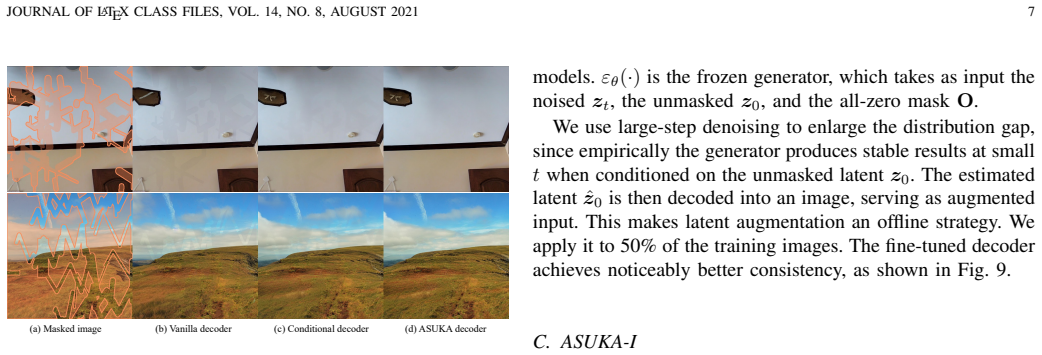
The central claim is that unwanted object insertion and color inconsistency in latent inpainting models come from (1) reliance on spurious semantic noise and text conditioning, and (2) the VAE decoder's low-frequency reconstruction loss and the gap between generated and real latents. ASUKA addresses the first by replacing text conditioning with a MAE-derived context-stable prior, aligned to the frozen generator's conditioning space via a linear dimension mapping plus self-attention distribution alignment; the second by fine-tuning the VAE decoder on color- and latent-augmented inputs, reformulating decoding as local harmonization. On Places2 and the new MISATO benchmark, ASUKA reports lower
What carries the argument
The two load-bearing components are (i) the MAE context-stable prior—a masked autoencoder fine-tuned on inpainting-style masks—whose predictions are aligned to the frozen generator by an alignment module (a linear layer for dimension matching followed by self-attention blocks), and (ii) a color-consistent decoder, a VAE decoder fine-tuned as a local harmonizer with color and latent augmentation. For transformer backbones, ASUKA-II adds cross-attention condition injection with LoRA and gating, and scaled positional encoding to map the low-resolution MAE grid onto the high-resolution latent.
Load-bearing premise
The training trick of Section IV-A, where the alignment module is trained on MAE reconstructions of the fully unmasked image with probability p decaying from 100% to 10%, assumes that the module's learned use of that leaked information transfers to the masked-only predicted prior at inference; if the frozen generator relies on content that only exists in the full-image reconstruction, hallucination suppression will weaken on genuinely novel masks.
What would settle it
A controlled experiment on a set of images where the masked object is semantically incongruent with the surroundings (e.g., a rare object in a common scene), comparing ASUKA with p decay vs. p=0 throughout training: if hallucination counts on these novel masks do not drop below the baseline, the leaked-prior training is load-bearing. More directly, ablation at inference with the reconstructed prior removed (i.e., only the masked-predicted prior available) should show whether the model still suppresses hallucination.
If this is right
- Object hallucination in frozen inpainting models can be suppressed by substituting a reconstruction-based prior for text conditioning, so the fix is plug-and-play and does not require re-training the generator.
- A single harmonizing decoder improves color consistency and transfers to text-guided inpainting, suggesting decoder-side corrections are a cheap, generalizable repair for latent generative models.
- The approach transfers from U-Net to MMDiT-style backbones with only lightweight modifications, indicating the same recipe may apply to future latent generators.
- The proposed VLM-based hallucination metric and G@e color metric provide evaluation protocols that are more aligned with human judgment than CLIP similarity and can be reused by the community.
Where Pith is reading between the lines
- The 'handle misalignment' training trick, which feeds the MAE reconstruction of the full unmasked image with probability decaying from 100% to 10%, may leak information about the masked region into the alignment module; if so, the reported hallucination suppression at inference could be optimistic on truly novel masks. This is an inference, not a claim proven in the paper.
- Because the backbone is frozen, the upper bound on quality is set by the original generator; ASUKA's improvements are corrections on top of that bound, so the framework will be most effective when the base model is already strong.
- The MAE prior is a mean estimate, so replacing it with a sharper reconstruction prior (e.g., a Diffusion prior or a learned regressor) might trade off hallucination suppression against texture fidelity—a direction the paper does not explore.
Editorial analysis
A structured set of objections, weighed in public.
Referee Report
Summary. The paper proposes ASUKA, a post-hoc framework to reduce unwanted object insertion and color inconsistency in latent inpainting models. It injects a Masked Auto-Encoder (MAE) reconstruction prior into frozen SD1.5 and FLUX.1-Fill-dev backbones via a lightweight alignment module (ASUKA-I-SD, ASUKA-I-FLUX, ASUKA-II-FLUX) and introduces a VAE decoder fine-tuned as a local harmonizer conditioned on the masked image. The paper also introduces a new evaluation set, MISATO, and two new metrics (G@e and a VLM-based hallucination judge). Experiments on Places2, MISATO, CelebA-HQ, and FFHQ report improvements over GAN, diffusion, and rectified-flow baselines on LPIPS/FID/IDS/G@e, reductions in VLM/human hallucination counts, and user-study preference.
Significance. If the results hold, this is a practical contribution: it shows that frozen latent inpainting backbones can be steered with a reconstruction prior to reduce hallucination while preserving generative quality, and that a harmonization-trained decoder can fix color shifts. The paper includes extensive ablations (decoder, alignment module, p-schedule, module contributions) and tests on a new multi-domain benchmark, which strengthens the empirical case. The p=0 control in Table VII is a good-faith check that the core idea has merit without the training leak. However, several load-bearing training and evaluation details are missing, and the training leakage from full-image MAE priors clouds the causal interpretation of the hallucination reduction. The proposed evaluation methodology (MISATO, VLM judge, G@e) is potentially useful but needs precise specification and validation.
major comments (5)
- [Section IV-A, Table VII] The alignment module is trained with the MAE reconstructed prior obtained by running MAE on the full unmasked image, with probability p decaying from 100% to 10% and then frozen. This prior has access to the masked-region content, whereas at inference only the masked-input predicted prior is available. The central claim is that a prior derived from the unmasked region suppresses hallucination, but a 10% leak remains at convergence. The p=0 ablation shows the method improves over SD without the leak, but Table VII does not report hallucination counts for p=0/p=1, and the gap between p=0 and Ours (U-IDS 0.403 vs 0.423; FID 11.804 vs 11.495) could be inflated by the leak. Please report VLM/human hallucination numbers for p=0, p=1, decay-to-0, and Ours, or remove the residual 10% leak.
- [Section V-A, Tables I-II] ASUKA-I-FLUX is absent from the main quantitative tables and appears only in Table III (VLM counts). The text claims ASUKA-I-FLUX 'consistently outperforms' FLUX-Fill, but no LPIPS/FID/IDS/G@e values are reported. Since ASUKA-II is motivated by the limitations of ASUKA-I-FLUX, the numerical case is incomplete. Please add full ASUKA-I-FLUX rows to Tables I and II (with error bars).
- [Section V, Object hallucination evaluation] The VLM protocol is the primary quantitative evidence for hallucination suppression, but it is under-specified. The manuscript does not give the exact prompt, the composite-image layout, output parsing, number of VLM calls, temperature, or whether counts are number of flagged images. No agreement statistic (e.g., Cohen's kappa) between VLM and human judgments is reported. Because the central claim rests on this metric, please provide the full protocol and validation.
- [Section V, Color-consistency evaluation (G@e)] The G@e definition is only verbal: 'average pixel gradient difference along the boundary of the masked region with respect to the ground-truth image.' The exact computation is absent, and the measure may reward blur (a smoothed boundary trivially lowers gradients). Please provide the formula, kernel/radius, normalization, and validate against the human CC preferences or a blurred baseline to show that G@e captures color consistency rather than boundary smoothness.
- [Tables I-X] All quantitative results are single-run, with no error bars or significance tests. For stochastic latent diffusion/flow models, small differences (e.g., Places2 LPIPS 0.174 vs 0.178; U-IDS 0.410 vs 0.403) may be within run-to-run noise. Please report mean±std over at least 3 seeds and, for main comparisons, paired significance tests, or explicitly state that the differences are not statistically assessed.
minor comments (6)
- [Abstract and Conclusion] The claim of 'outperforming existing diffusion- and rectified flow-based inpainting methods' is too broad; Table I shows FLUX-Fill beats ASUKA-I-SD on Places2 LPIPS (0.178 vs 0.183), and ASUKA-I-SD beats ASUKA-II-FLUX on Places2 FID and U-IDS. Qualify with 'on most metrics' and cite the tables.
- [Eq. (2)-(3)] The gate argument in Eq. (3) writes f_mae + f_task without layer indices i; align notation with Eq. (2).
- [Table III] Human judgment is reported only for FLUX-based models. Add a human-evaluated subset for SD baselines so the VLM-vs-human agreement can be assessed for the SD family too.
- [Tables I-II] G@e values differ by an order of magnitude between Places2 and MISATO; explain whether this reflects mask sizes, resolutions, or metric calibration.
- [Section IV-A] Specify which dataset(s) are used for MAE fine-tuning and the exact number of MAE fine-tuning steps; 'batch size 1024' alone is not sufficient for reproduction.
- [Section V, Implementation Details] The sentence 'set p as 100% and linearly decay it to 10% in the first 2K training steps and then freeze' is ambiguous: clarify whether p or the alignment module weights are frozen.
Circularity Check
No significant circularity: ASUKA's main claims are validated by external benchmarks, ablations, and independent evaluations; the disclosed train/inference mismatch in the MAE prior is a correctness risk, not a definitional or by-construction circularity.
full rationale
The paper's core derivation chain is an empirical post-training pipeline: an MAE prior is injected into frozen SD1.5/FLUX inpainting models via an alignment module, and a VAE decoder is fine-tuned as a local harmonizer. The claimed improvements are measured on held-out Places2, MISATO, CelebA-HQ, and FFHQ data against external baselines (LaMa, Co-Mod, MAT, MAE-FAR, SD-Repaint, FLUX-Fill, IP-Adapter, T2I-Adapter, CAEv2), plus VLM and human hallucination judgments and a user study. No prediction in the paper reduces by construction to a fitted parameter or to an input equation. The closest concern is the 'Handle misalignment' training trick (Section IV-A), where the alignment module is trained with probability p on the MAE reconstructed prior obtained by running MAE on the full unmasked image, which contains the masked-out content. This is an explicit train/inference distribution mismatch and is disclosed by the authors: 'The MAE reconstructed prior is obtained by running MAE on the full image without masking, so it has access to all information for reconstruction.' That is a legitimate correctness/leak concern about causal attribution, but it is not circularity: at inference only the masked-only predicted MAE prior is used, and the paper's own p=0 ablation (Table VII) still yields large gains over SD (FID 11.804 vs. 12.812 on MISATO), so the leak is not the sole driver and the final claim is not equivalent to its input by construction. Self-citations to the conference version [19], SEELE [73], and MAE-FAR [32] are present, but they are used as prior published building blocks or as baselines, not as unverified load-bearing uniqueness theorems. The result is therefore a self-contained empirical contribution with no significant circularity.
Axiom & Free-Parameter Ledger
free parameters (5)
- MAE-prior mixing probability p =
100% linear decay to 10% over 2K training steps, then frozen
- Mask sampling distribution for MAE/decoder training =
50% object-shape, 40% irregular, 10% regular; ratio [0.1,0.75] enlarged to 75%
- Color augmentation magnitudes =
brightness 0.15, contrast 0.2, saturation 0.1, hue 0.03
- Latent augmentation configuration =
applied to 50% of images; t sampled from [500,1000)
- Alignment module capacity =
4 self-attention blocks
axioms (5)
- domain assumption MAE trained with L2 loss produces a mean estimate of the masked region; this mean estimate acts as a context-stable prior that suppresses hallucination when guiding a frozen generative model.
- domain assumption The one-step latent augmentation z0_hat = (1/a)(zt - b eps_theta([zt; z0; O], t)) with true z0 and an all-zero mask approximates the distribution gap between generated and real latents.
- ad hoc to paper Training the alignment module with the MAE reconstructed prior (full-image MAE) at p=100% decaying to 10% transfers to inference with only the masked-input MAE predicted prior.
- domain assumption Qwen3-VL-235B pairwise VLM judgments are a valid proxy for human perception of object hallucination, and the relative rankings transfer.
- domain assumption The frozen SD1.5 and FLUX.1-Fill-dev generators can faithfully represent MAE-conditioned control without any backbone weight updates.
invented entities (6)
-
ASUKA alignment module (linear projection + self-attention blocks)
no independent evidence
-
Per-layer gated LoRA MAE-condition injection for DiT (ASUKA-II)
no independent evidence
-
ASUKA local-harmonization decoder
no independent evidence
-
MISATO benchmark
no independent evidence
-
Gradient@edge (G@e) metric
no independent evidence
-
VLM object-hallucination evaluation protocol
no independent evidence
Cite this review
Pith. "Pith review of Aligned Stable Inpainting: Mitigating Unwanted Object Insertion and Preserving Color Consistency." pith.science (2026). https://pith.science/paper/KGSZGTZO
@misc{pith2026260115368,
  author       = {Pith},
  title        = {Pith review of: Aligned Stable Inpainting: Mitigating Unwanted Object Insertion and Preserving Color Consistency},
  year         = {2026},
  howpublished = {\url{https://pith.science/paper/KGSZGTZO}},
  note         = {Machine review of arXiv:2601.15368}
}
read the original abstract
Generative image inpainting can produce realistic results even with large, irregular masks, but existing methods still suffer from two common problems: (1) Unwanted object insertion: hallucinate artifacts that do not match the surrounding context. (2) Color inconsistency: noticeable color shifts that lead to smeared textures. We analyze the causes of these issues and propose Aligned Stable inpainting with UnKnown Areas prior (ASUKA), a post-hoc framework for pre-trained inpainting models. To reduce unwanted object insertion, we use reconstruction-based priors to guide the generative model, suppressing hallucinated objects while preserving generative flexibility. To address color inconsistency, we design a specialized VAE decoder that formulates latent-to-image decoding as a local harmonization task. We implement ASUKA on both U-Net-based and DiT-based inpainting models with lightweight modifications. Experiments on Places2 and MISATO, our proposed benchmark, show that ASUKA effectively suppresses object hallucination and improves color consistency, outperforming existing diffusion- and rectified flow-based inpainting methods. The dataset, models, and code will be released on GitHub.
Figures




Reference graph
Works this paper leans on
-
[1]
Image in- painting,
M. Bertalmio, G. Sapiro, V . Caselles, and C. Ballester, “Image in- painting,” inProceedings of the 27th annual conference on Computer graphics and interactive techniques, 2000, pp. 417–424
2000
-
[2]
Object removal by exemplar- based inpainting,
A. Criminisi, P. P ´erez, and K. Toyama, “Object removal by exemplar- based inpainting,”2003 IEEE Computer Society Conference on Com- puter Vision and Pattern Recognition, 2003. Proceedings., vol. 2, pp. II–II, 2003
2003
-
[3]
Scene completion using millions of pho- tographs,
J. Hays and A. A. Efros, “Scene completion using millions of pho- tographs,”ACM Transactions on Graphics (ToG), vol. 26, no. 3, pp. 4–es, 2007
2007
-
[4]
Learning how to inpaint from global image statistics,
A. Levin, A. Zomet, and Y . Weiss, “Learning how to inpaint from global image statistics,”Proceedings Ninth IEEE International Con- ference on Computer Vision, pp. 305–312 vol.1, 2003
2003
-
[5]
Fields of experts: a framework for learning image priors,
S. Roth and M. J. Black, “Fields of experts: a framework for learning image priors,”2005 IEEE Computer Society Conference on Computer Vision and Pattern Recognition (CVPR’05), vol. 2, pp. 860–867 vol. 2, 2005
2005
-
[6]
Context encoders: Feature learning by inpainting,
D. Pathak, P. Krahenbuhl, J. Donahue, T. Darrell, and A. A. Efros, “Context encoders: Feature learning by inpainting,” inProceedings of the IEEE conference on computer vision and pattern recognition, 2016, pp. 2536–2544
2016
-
[7]
Edge- connect: Structure guided image inpainting using edge prediction,
K. Nazeri, E. Ng, T. Joseph, F. Qureshi, and M. Ebrahimi, “Edge- connect: Structure guided image inpainting using edge prediction,” in Proceedings of the IEEE/CVF International Conference on Computer Vision Workshops, 2019
2019
-
[8]
Guidance and evaluation: Semantic-aware image inpainting for mixed scenes,
L. Liao, J. Xiao, Z. Wang, C.-W. Lin, and S. Satoh, “Guidance and evaluation: Semantic-aware image inpainting for mixed scenes,” in Computer Vision–ECCV 2020: 16th European Conference, Glasgow, UK, August 23–28, 2020, Proceedings, Part XXVII 16. Springer, 2020, pp. 683–700
2020
-
[9]
Learning a sketch tensor space for image inpainting of man-made scenes,
C. Cao and Y . Fu, “Learning a sketch tensor space for image inpainting of man-made scenes,” inProceedings of the IEEE/CVF International Conference on Computer Vision, 2021, pp. 14 509–14 518
2021
-
[10]
Resolution-robust large mask inpainting with fourier convolutions,
R. Suvorov, E. Logacheva, A. Mashikhin, A. Remizova, A. Ashukha, A. Silvestrov, N. Kong, H. Goka, K. Park, and V . Lempitsky, “Resolution-robust large mask inpainting with fourier convolutions,” inProceedings of the IEEE/CVF winter conference on applications of computer vision, 2022, pp. 2149–2159
2022
-
[11]
High-fidelity pluralistic image completion with transformers,
Z. Wan, J. Zhang, D. Chen, and J. Liao, “High-fidelity pluralistic image completion with transformers,” inProceedings of the IEEE/CVF international conference on computer vision, 2021, pp. 4692–4701
2021
-
[12]
Large scale image completion via co-modulated generative adversarial networks,
S. Zhao, J. Cui, Y . Sheng, Y . Dong, X. Liang, I. Eric, C. Chang, and Y . Xu, “Large scale image completion via co-modulated generative adversarial networks,” inInternational Conference on Learning Rep- resentations, 2020
2020
-
[13]
Generative adversarial nets,
I. Goodfellow, J. Pouget-Abadie, M. Mirza, B. Xu, D. Warde-Farley, S. Ozair, A. Courville, and Y . Bengio, “Generative adversarial nets,” Advances in neural information processing systems, vol. 27, 2014
2014
-
[14]
Denoising diffusion probabilistic models,
J. Ho, A. Jain, and P. Abbeel, “Denoising diffusion probabilistic models,”Advances in neural information processing systems, vol. 33, pp. 6840–6851, 2020
2020
-
[15]
Taming transformers for high-resolution image synthesis,
P. Esser, R. Rombach, and B. Ommer, “Taming transformers for high-resolution image synthesis,” inProceedings of the IEEE/CVF Conference on Computer Vision and Pattern Recognition, 2021, pp. 12 873–12 883
2021
-
[16]
High-resolution image synthesis with latent diffusion models,
R. Rombach, A. Blattmann, D. Lorenz, P. Esser, and B. Ommer, “High-resolution image synthesis with latent diffusion models,” in Proceedings of the IEEE/CVF Conference on Computer Vision and Pattern Recognition (CVPR), June 2022, pp. 10 684–10 695
2022
-
[17]
B. F. Labs, “Flux.1,” 2024. [Online]. Available: https://blackforestlabs. ai/announcing-black-forest-labs/
2024
-
[18]
Masked autoencoders are scalable vision learners,
K. He, X. Chen, S. Xie, Y . Li, P. Doll ´ar, and R. Girshick, “Masked autoencoders are scalable vision learners,” inProceedings of the IEEE/CVF conference on computer vision and pattern recognition, 2022, pp. 16 000–16 009
2022
-
[19]
Towards enhanced image inpainting: Mitigating unwanted object insertion and preserving color consistency,
Y . Wang, C. Cao, J. Yu, K. Fan, X. Xue, and Y . Fu, “Towards enhanced image inpainting: Mitigating unwanted object insertion and preserving color consistency,” inProceedings of the Computer Vision and Pattern Recognition Conference, 2025, pp. 23 237–23 248
2025
-
[20]
Places: A 10 million image database for scene recognition,
B. Zhou, A. Lapedriza, A. Khosla, A. Oliva, and A. Torralba, “Places: A 10 million image database for scene recognition,”IEEE transactions on pattern analysis and machine intelligence, vol. 40, no. 6, pp. 1452– 1464, 2017
2017
-
[21]
Matterport3D: Learning from RGB- D data in indoor environments,
A. Chang, A. Dai, T. Funkhouser, M. Halber, M. Niessner, M. Savva, S. Song, A. Zeng, and Y . Zhang, “Matterport3D: Learning from RGB- D data in indoor environments,”International Conference on 3D Vision (3DV), 2017
2017
-
[22]
InfinityGAN: Towards infinite-pixel image synthesis,
C. H. Lin, Y .-C. Cheng, H.-Y . Lee, S. Tulyakov, and M.-H. Yang, “InfinityGAN: Towards infinite-pixel image synthesis,” inInternational Conference on Learning Representations, 2022. [Online]. Available: https://openreview.net/forum?id=ufGMqIM0a4b
2022
-
[23]
Megadepth: Learning single-view depth predic- tion from internet photos,
Z. Li and N. Snavely, “Megadepth: Learning single-view depth predic- tion from internet photos,” inComputer Vision and Pattern Recognition (CVPR), 2018
2018
-
[24]
Microsoft coco: Common objects in context,
T.-Y . Lin, M. Maire, S. Belongie, J. Hays, P. Perona, D. Ramanan, P. Doll ´ar, and C. L. Zitnick, “Microsoft coco: Common objects in context,” inEuropean conference on computer vision. Springer, 2014, pp. 740–755
2014
-
[25]
Region filling and object removal by exemplar-based image inpainting,
A. Criminisi, P. P ´erez, and K. Toyama, “Region filling and object removal by exemplar-based image inpainting,”IEEE Transactions on image processing, vol. 13, no. 9, pp. 1200–1212, 2004
2004
-
[26]
Patch- match: A randomized correspondence algorithm for structural image editing,
C. Barnes, E. Shechtman, A. Finkelstein, and D. B. Goldman, “Patch- match: A randomized correspondence algorithm for structural image editing,”ACM Trans. Graph., vol. 28, no. 3, p. 24, 2009
2009
-
[27]
A robust forgery detection algorithm for object removal by exemplar-based image inpainting,
D. Zhang, Z. Liang, G. Yang, Q. Li, L. Li, and X. Sun, “A robust forgery detection algorithm for object removal by exemplar-based image inpainting,”Multimedia Tools and Applications, vol. 77, pp. 11 823–11 842, 2018
2018
-
[28]
Nontexture inpainting by curvature-driven diffusions,
T. F. Chan and J. Shen, “Nontexture inpainting by curvature-driven diffusions,”Journal of visual communication and image representation, vol. 12, no. 4, pp. 436–449, 2001
2001
-
[29]
Simultaneous structure and texture image inpainting,
M. Bertalmio, L. Vese, G. Sapiro, and S. Osher, “Simultaneous structure and texture image inpainting,”IEEE transactions on image processing, vol. 12, no. 8, pp. 882–889, 2003
2003
-
[30]
Free- form image inpainting with gated convolution,
J. Yu, Z. Lin, J. Yang, X. Shen, X. Lu, and T. S. Huang, “Free- form image inpainting with gated convolution,” inProceedings of the IEEE/CVF International Conference on Computer Vision, 2019, pp. 4471–4480
2019
-
[31]
Mat: Mask-aware transformer for large hole image inpainting,
W. Li, Z. Lin, K. Zhou, L. Qi, Y . Wang, and J. Jia, “Mat: Mask-aware transformer for large hole image inpainting,” inProceedings of the IEEE/CVF Conference on Computer Vision and Pattern Recognition, 2022
2022
-
[32]
Learning prior feature and attention enhanced image inpainting,
C. Cao, Q. Dong, and Y . Fu, “Learning prior feature and attention enhanced image inpainting,” inEuropean Conference on Computer Vision. Springer, 2022, pp. 306–322
2022
-
[33]
Image inpainting for irregular holes using partial convolutions,
G. Liu, F. A. Reda, K. J. Shih, T.-C. Wang, A. Tao, and B. Catanzaro, “Image inpainting for irregular holes using partial convolutions,” in Proceedings of the European Conference on Computer Vision (ECCV), 2018, pp. 85–100
2018
-
[34]
Aggregated contextual transfor- mations for high-resolution image inpainting,
Y . Zeng, J. Fu, H. Chao, and B. Guo, “Aggregated contextual transfor- mations for high-resolution image inpainting,”IEEE Transactions on Visualization and Computer Graphics, 2022
2022
-
[35]
Generative image inpainting with contextual attention,
J. Yu, Z. Lin, J. Yang, X. Shen, X. Lu, and T. S. Huang, “Generative image inpainting with contextual attention,” inProceedings of the IEEE conference on computer vision and pattern recognition, 2018, pp. 5505–5514
2018
-
[36]
Contextual residual aggregation for ultra high-resolution image inpainting,
Z. Yi, Q. Tang, S. Azizi, D. Jang, and Z. Xu, “Contextual residual aggregation for ultra high-resolution image inpainting,” inProceedings of the IEEE/CVF Conference on Computer Vision and Pattern Recog- nition, 2020, pp. 7508–7517
2020
-
[37]
High- resolution image inpainting with iterative confidence feedback and guided upsampling,
Y . Zeng, Z. Lin, J. Yang, J. Zhang, E. Shechtman, and H. Lu, “High- resolution image inpainting with iterative confidence feedback and guided upsampling,” inEuropean Conference on Computer Vision. Springer, 2020, pp. 1–17
2020
-
[38]
Continuously masked transformer for image inpainting,
K. Ko and C.-S. Kim, “Continuously masked transformer for image inpainting,” inProceedings of the IEEE/CVF International Conference on Computer Vision, 2023, pp. 13 169–13 178
2023
-
[39]
Image completion with heterogeneously filtered spectral hints,
X. Xu, S. Navasardyan, V . Tadevosyan, A. Sargsyan, Y . Mu, and H. Shi, “Image completion with heterogeneously filtered spectral hints,” in Proceedings of the IEEE/CVF Winter Conference on Applications of Computer Vision, 2023, pp. 4591–4601
2023
-
[40]
Rethinking fast fourier convolution in image inpainting,
T. Chu, J. Chen, J. Sun, S. Lian, Z. Wang, Z. Zuo, L. Zhao, W. Xing, and D. Lu, “Rethinking fast fourier convolution in image inpainting,” in Proceedings of the IEEE/CVF International Conference on Computer Vision, 2023, pp. 23 195–23 205. JOURNAL OF LATEX CLASS FILES, VOL. 14, NO. 8, AUGUST 2021 15
2023
-
[41]
Image inpainting with cascaded modulation gan and object-aware training,
H. Zheng, Z. Lin, J. Lu, S. Cohen, E. Shechtman, C. Barnes, J. Zhang, N. Xu, S. Amirghodsi, and J. Luo, “Image inpainting with cascaded modulation gan and object-aware training,” inEuropean Conference on Computer Vision. Springer, 2022, pp. 277–296
2022
-
[42]
Palette: Image-to-image diffusion models,
C. Saharia, W. Chan, H. Chang, C. Lee, J. Ho, T. Salimans, D. Fleet, and M. Norouzi, “Palette: Image-to-image diffusion models,” inACM SIGGRAPH 2022 Conference Proceedings, 2022, pp. 1–10
2022
-
[43]
Kandinsky 3.0 technical report,
V . Arkhipkin, A. Filatov, V . Vasilev, A. Maltseva, S. Azizov, I. Pavlov, J. Agafonova, A. Kuznetsov, and D. Dimitrov, “Kandinsky 3.0 technical report,” 2023
2023
-
[44]
Scaling rectified flow transformers for high-resolution image synthesis,
P. Esser, S. Kulal, A. Blattmann, R. Entezari, J. M ¨uller, H. Saini, Y . Levi, D. Lorenz, A. Sauer, F. Boeselet al., “Scaling rectified flow transformers for high-resolution image synthesis,” inForty-first International Conference on Machine Learning, 2024
2024
-
[45]
Sdedit: Guided image synthesis and editing with stochastic differential equations,
C. Meng, Y . He, Y . Song, J. Song, J. Wu, J.-Y . Zhu, and S. Ermon, “Sdedit: Guided image synthesis and editing with stochastic differential equations,” inInternational Conference on Learning Representations, 2021
2021
-
[46]
An image is worth one word: Personal- izing text-to-image generation using textual inversion,
R. Gal, Y . Alaluf, Y . Atzmon, O. Patashnik, A. H. Bermano, G. Chechik, and D. Cohen-or, “An image is worth one word: Personal- izing text-to-image generation using textual inversion,” inThe Eleventh International Conference on Learning Representations, 2022
2022
-
[47]
Lora: Low-rank adaptation of large language models,
E. J. Hu, P. Wallis, Z. Allen-Zhu, Y . Li, S. Wang, L. Wang, W. Chen et al., “Lora: Low-rank adaptation of large language models,” in International Conference on Learning Representations, 2021
2021
-
[48]
Adding conditional control to text-to-image diffusion models,
L. Zhang, A. Rao, and M. Agrawala, “Adding conditional control to text-to-image diffusion models,” inProceedings of the IEEE/CVF international conference on computer vision, 2023, pp. 3836–3847
2023
-
[49]
Openai’s consistency decoder,
OpenAI, “Openai’s consistency decoder,” 2023
2023
-
[50]
F. Luo, J. Xiang, J. Zhang, X. Han, and W. Yang, “Image super- resolution via latent diffusion: A sampling-space mixture of ex- perts and frequency-augmented decoder approach,”arXiv preprint arXiv:2310.12004, 2023
Pith/arXiv arXiv 2023
-
[51]
Designing a better asymmetric vqgan for stablediffusion,
Z. Zhu, X. Feng, D. Chen, J. Bao, L. Wang, Y . Chen, L. Yuan, and G. Hua, “Designing a better asymmetric vqgan for stablediffusion,” arXiv preprint arXiv:2306.04632, 2023
Pith/arXiv arXiv 2023
-
[52]
Beit: Bert pre-training of image trans- formers,
H. Bao, L. Dong, and F. Wei, “Beit: Bert pre-training of image trans- formers,” inInternational Conference on Learning Representations, 2022
2022
-
[53]
Simmim: A simple framework for masked image modeling,
Z. Xie, Z. Zhang, Y . Cao, Y . Lin, J. Bao, Z. Yao, Q. Dai, and H. Hu, “Simmim: A simple framework for masked image modeling,” inProceedings of the IEEE/CVF Conference on Computer Vision and Pattern Recognition, 2022, pp. 9653–9663
2022
-
[54]
Context autoencoder for self-supervised representation learning,
X. Chen, M. Ding, X. Wang, Y . Xin, S. Mo, Y . Wang, S. Han, P. Luo, G. Zeng, and J. Wang, “Context autoencoder for self-supervised representation learning,”International Journal of Computer Vision, pp. 1–16, 2023
2023
-
[55]
Masked feature prediction for self-supervised visual pre-training,
C. Wei, H. Fan, S. Xie, C.-Y . Wu, A. Yuille, and C. Feichtenhofer, “Masked feature prediction for self-supervised visual pre-training,” in Proceedings of the IEEE/CVF Conference on Computer Vision and Pattern Recognition, 2022, pp. 14 668–14 678
2022
-
[56]
Mvp: Multimodality- guided visual pre-training,
L. Wei, L. Xie, W. Zhou, H. Li, and Q. Tian, “Mvp: Multimodality- guided visual pre-training,” inEuropean Conference on Computer Vision. Springer, 2022, pp. 337–353
2022
-
[57]
Deep image harmonization,
Y .-H. Tsai, X. Shen, Z. Lin, K. Sunkavalli, X. Lu, and M.-H. Yang, “Deep image harmonization,” inProceedings of the IEEE conference on computer vision and pattern recognition, 2017, pp. 3789–3797
2017
-
[58]
Learning a discriminative model for the perception of realism in composite images,
J.-Y . Zhu, P. Krahenbuhl, E. Shechtman, and A. A. Efros, “Learning a discriminative model for the perception of realism in composite images,” inProceedings of the IEEE International Conference on Computer Vision, 2015, pp. 3943–3951
2015
-
[59]
Dovenet: Deep image harmonization via domain verification,
W. Cong, J. Zhang, L. Niu, L. Liu, Z. Ling, W. Li, and L. Zhang, “Dovenet: Deep image harmonization via domain verification,” in Proceedings of the IEEE/CVF conference on computer vision and pattern recognition, 2020, pp. 8394–8403
2020
-
[60]
Intrinsic image harmonization,
Z. Guo, H. Zheng, Y . Jiang, Z. Gu, and B. Zheng, “Intrinsic image harmonization,” inProceedings of the ieee/cvf conference on computer vision and pattern recognition, 2021, pp. 16 367–16 376
2021
-
[61]
High-resolution image harmonization via collaborative dual transfor- mations,
W. Cong, X. Tao, L. Niu, J. Liang, X. Gao, Q. Sun, and L. Zhang, “High-resolution image harmonization via collaborative dual transfor- mations,” inProceedings of the IEEE/CVF Conference on Computer Vision and Pattern Recognition, 2022, pp. 18 470–18 479
2022
-
[62]
Transformer for image harmonization and beyond,
Z. Guo, Z. Gu, B. Zheng, J. Dong, and H. Zheng, “Transformer for image harmonization and beyond,”IEEE transactions on pattern analysis and machine intelligence, vol. 45, no. 11, pp. 12 960–12 977, 2022
2022
-
[63]
Deep image harmonization with learnable augmentation,
L. Niu, J. Cao, W. Cong, and L. Zhang, “Deep image harmonization with learnable augmentation,” inProceedings of the IEEE/CVF Inter- national Conference on Computer Vision, 2023, pp. 7482–7491
2023
-
[64]
Semi- supervised parametric real-world image harmonization,
K. Wang, M. Gharbi, H. Zhang, Z. Xia, and E. Shechtman, “Semi- supervised parametric real-world image harmonization,” inProceed- ings of the IEEE/CVF Conference on Computer Vision and Pattern Recognition, 2023, pp. 5927–5936
2023
-
[65]
Lemart: Label-efficient masked region transform for image harmonization,
S. Liu, C. P. Huynh, C. Chen, M. Arap, and R. Hamid, “Lemart: Label-efficient masked region transform for image harmonization,” in Proceedings of the IEEE/CVF Conference on Computer Vision and Pattern Recognition, 2023, pp. 18 290–18 299
2023
-
[66]
High- resolution image harmonization with adaptive-interval color transfor- mation,
Q. Meng, L. Qinglin, Z. Li, X. Lan, S. Zhang, and L. Nie, “High- resolution image harmonization with adaptive-interval color transfor- mation,”Advances in Neural Information Processing Systems, vol. 37, pp. 13 769–13 793, 2024
2024
-
[67]
Relightful harmonization: Lighting-aware portrait back- ground replacement,
M. Ren, W. Xiong, J. S. Yoon, Z. Shu, J. Zhang, H. Jung, G. Gerig, and H. Zhang, “Relightful harmonization: Lighting-aware portrait back- ground replacement,” inProceedings of the IEEE/CVF Conference on Computer Vision and Pattern Recognition, 2024, pp. 6452–6462
2024
-
[68]
Shape-guided object inpainting,
Y . Zeng, Z. Lin, and V . M. Patel, “Shape-guided object inpainting,” arXiv preprint arXiv:2204.07845, 2022
Pith/arXiv arXiv 2022
-
[69]
Smartbrush: Text and shape guided object inpainting with diffusion model,
S. Xie, Z. Zhang, Z. Lin, T. Hinz, and K. Zhang, “Smartbrush: Text and shape guided object inpainting with diffusion model,” inProceedings of the IEEE/CVF conference on computer vision and pattern recognition, 2023, pp. 22 428–22 437
2023
-
[70]
Imagen editor and editbench: Advancing and evaluating text-guided image inpainting,
S. Wang, C. Saharia, C. Montgomery, J. Pont-Tuset, S. Noy, S. Pel- legrini, Y . Onoe, S. Laszlo, D. J. Fleet, R. Soricutet al., “Imagen editor and editbench: Advancing and evaluating text-guided image inpainting,” inProceedings of the IEEE/CVF conference on computer vision and pattern recognition, 2023, pp. 18 359–18 369
2023
-
[71]
Erasedraw: Learning to insert objects by erasing them from images,
A. Canberk, M. Bondarenko, E. Ozguroglu, R. Liu, and C. V ondrick, “Erasedraw: Learning to insert objects by erasing them from images,” inEuropean Conference on Computer Vision. Springer, 2024, pp. 144–160
2024
-
[72]
Brush2prompt: Contextual prompt genera- tor for object inpainting,
M. T. Chiu, Y . Zhou, L. Zhang, Z. Lin, C. Barnes, S. Amirghodsi, E. Shechtman, and H. Shi, “Brush2prompt: Contextual prompt genera- tor for object inpainting,” inProceedings of the IEEE/CVF Conference on Computer Vision and Pattern Recognition, 2024, pp. 12 636–12 645
2024
-
[73]
Repositioning the subject within image,
Y . Wang, C. Cao, K. Fan, Q. Dong, Y . Li, X. Xue, and Y . Fu, “Repositioning the subject within image,”Transactions on Machine Learning Research, 2024
2024
-
[74]
A task is worth one word: Learning with task prompts for high-quality versatile image inpainting,
J. Zhuang, Y . Zeng, W. Liu, C. Yuan, and K. Chen, “A task is worth one word: Learning with task prompts for high-quality versatile image inpainting,” inEuropean Conference on Computer Vision. Springer, 2024, pp. 195–211
2024
-
[75]
Improving text-guided object inpainting with semantic pre-inpainting,
Y . Chen, J. Chen, Y . Pan, Y . Li, T. Yao, Z. Chen, and T. Mei, “Improving text-guided object inpainting with semantic pre-inpainting,” inEuropean Conference on Computer Vision. Springer, 2024, pp. 110–126
2024
-
[76]
Brushnet: A plug-and-play image inpainting model with decomposed dual-branch diffusion,
X. Ju, X. Liu, X. Wang, Y . Bian, Y . Shan, and Q. Xu, “Brushnet: A plug-and-play image inpainting model with decomposed dual-branch diffusion,” inEuropean Conference on Computer Vision. Springer, 2024, pp. 150–168
2024
-
[77]
Invi: Object insertion in videos us- ing off-the-shelf diffusion models,
N. Saini, N. Bodla, A. Shrivastava, A. Ravichandran, X. Zhang, A. Shrivastava, and B. Singh, “Invi: Object insertion in videos us- ing off-the-shelf diffusion models,”arXiv preprint arXiv:2407.10958, 2024
Pith/arXiv arXiv 2024
-
[78]
Leftrefill: Filling right canvas based on left reference through generalized text-to-image diffusion model,
C. Cao, Y . Cai, Q. Dong, Y . Wang, and Y . Fu, “Leftrefill: Filling right canvas based on left reference through generalized text-to-image diffusion model,” inProceedings of the IEEE/CVF Conference on Computer Vision and Pattern Recognition, 2024, pp. 7705–7715
2024
-
[79]
Magiceraser: Erasing any objects via semantics-aware control,
F. Li, Z. Zhang, Y . Huang, J. Liu, R. Pei, B. Shao, and S. Xu, “Magiceraser: Erasing any objects via semantics-aware control,” in European Conference on Computer Vision. Springer, 2024, pp. 215– 231
2024
-
[80]
Placing objects in context via inpainting for out-of-distribution segmentation,
P. de Jorge, R. V olpi, P. K. Dokania, P. H. Torr, and G. Rogez, “Placing objects in context via inpainting for out-of-distribution segmentation,” inEuropean Conference on Computer Vision. Springer, 2024, pp. 456–473
2024
This paper was first reviewed by deepseek-v4-flash on August 3, 2026.
discussion (0)
Sign in with ORCID, Apple, or X to comment. Anyone can read and Pith papers without signing in.