REVIEW 2 major objections 5 minor 63 references
The Count Is There, but Misaligned: Understanding and Correcting Counting Failures in VLMs
T0 review · 2 major / 5 minor · reviewed 2026-07-13 · grok-4.5
Pith's one-line read VLMs often already know the correct object count inside their activations; the failure is a misaligned readout that simple probes can detect and selectively correct.
desk verdict Solid multi-probe extension of Sun et al. to VLM counting: count is often present but misaligned, with causal steering and selective re-prompt gains up to 15.6 pp that hold on CountBench. read the letter →
The pith
A machine-rendered reading of the paper's core claim, the machinery that carries it, and where it could break.
The reading
What carries the argument
Multi-probe activation analysis (ground-truth count probe, output-count probe, and binary error detector) together with weight-space SVCCA comparison of their readout subspaces and detector-gated re-prompting at the best detector layer.
What would settle it
If error detectors trained on the same activations fail to predict counting mistakes better than chance on held-out real images, or if steering along the recovered count direction never improves accuracy above random-direction controls across models and datasets, the claim that the count is present but misaligned would be falsified.
Extended reading notes
Core claim
Nonlinear probes on intermediate VLM activations can recover the true object count and detect counting errors even when the model utters the wrong number; the ground-truth and output readout subspaces are partially shared but misaligned, and strengthening the count direction (by steering or selective re-prompting) improves counting performance without any weight updates.
Load-bearing premise
High probe accuracy and successful steering at the single best layer chosen by held-out F1 truly reflect causally relevant count representations rather than dataset correlations or post-hoc layer selection.
Editorial analysis
A structured set of objections, weighed in public.
Referee Report
Summary. The paper argues that VLM counting failures often reflect a misalignment between internal count representations and verbalized outputs rather than absent knowledge. Across four VLMs and five datasets (four synthetic regimes plus CountBench), nonlinear probes on intermediate activations recover ground-truth counts and detect errors even when the model is wrong. SVCCA on probe weight matrices shows that ground-truth and output readout subspaces are only partially shared and often misaligned, especially for nonlinear probes. Causal activation steering along the ground-truth probe direction improves accuracy on synthetic data for InternVL2-1B (with random-direction controls), and a detector-guided selective re-prompting method yields up to +15.6 absolute percentage points without parameter updates, outperforming budget-matched random intervention and correlating with detector F1.
Significance. If the result holds, the work supplies both a practical inference-time correction tool for a known VLM weakness and a mechanistic account of the internal-knowledge vs. output gap. Strengths include multi-model and multi-dataset evaluation, three random seeds, random-steering and Random-K/Always-Reprompt baselines, explicit correlation between detector quality and correction gain, and extension of the multi-probe arithmetic framework of Sun et al. (2025) to VLMs. The combination of probing, subspace comparison, causal intervention, and selective correction is a coherent contribution for the field.
major comments (2)
- Section 4 and Figure 4 report the only causal steering experiment, and only for InternVL2-1B on the four synthetic datasets. The central claim that recovered directions are causally relevant count subspaces (not merely predictive or dataset-specific) therefore rests on a narrow intervention. The manuscript should either extend steering to at least one larger model and/or CountBench, or substantially qualify the causal claim and treat steering as supporting evidence for InternVL2-1B only.
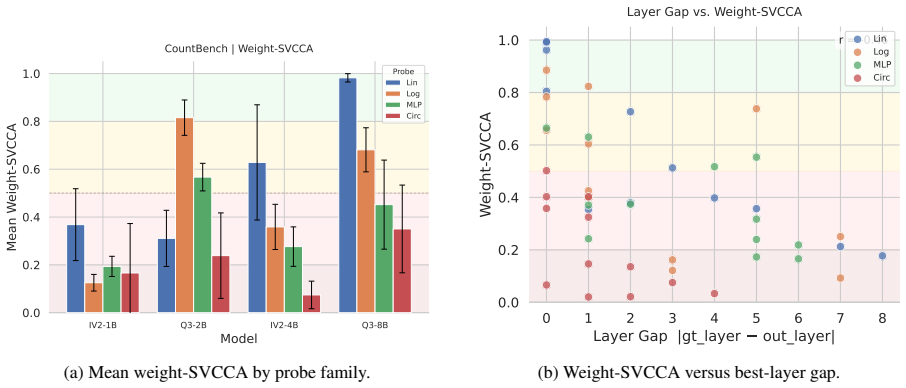
- Section 3.3 selects the best layer l* by held-out F1 for each probe/detector, and all subsequent SVCCA, steering, and correction results use that post-hoc choice. Combined with Appendix C’s own admission that vision-encoder error detectors can exploit scene-complexity confounds, this leaves open whether high probe F1 and the Table 1 gains partly reflect selection of layers where count co-varies with other visual statistics. A fixed-layer or early-stopped protocol (or an ablation showing gains persist under non-oracle layer choice) is needed to make the “count is there but misaligned” claim robust.
minor comments (5)
- Abstract and §1 state “up to 15.6% absolute percentage points”; Table 1 correctly uses percentage points. Standardize the wording.
- Figure 1 caption and pipeline text are dense; a short legend distinguishing the three probe targets (gt / output / error) would help.
- τ is fixed at 0.5 (§5) with no sensitivity analysis; a brief threshold sweep or ROC-style note would strengthen the method section.
- Limitations (§7) correctly flag the 1–9 range, model size, and single-model steering; these should be echoed more clearly when interpreting Table 1 gains for Qwen models, which are already strong.
- Typographical inconsistencies (e.g., “V o et al.”, mixed “15.6%” vs “15.6 absolute percentage points”) should be cleaned in a revision.
Circularity Check
No load-bearing circularity: probes, SVCCA, steering, and detector-guided gains are empirical measurements against held-out ground truth, not reductions of outputs to fitted inputs by construction.
full rationale
The paper's chain is an empirical analysis pipeline, not a derivation that closes on its own definitions. Probes (circular/linear/logistic/MLP) are trained with cross-entropy or smooth-L1 on ground-truth counts y, model outputs ŷ, or binary error e = I[ŷ ≠ y] using activations from a train split; performance is reported as held-out F1 (Fig. 2, Sec. 3.3–3.4). SVCCA compares the principal singular-vector subspaces of independently trained weight matrices W_gt and W_out (Eqs. 4–8, Sec. 3.2, Fig. 3); the low scores for nonlinear probes are an observed geometric fact, not forced by the definition of either probe. Causal steering adds a scaled probe-derived direction d = (w_y − w_ŷ)/‖…‖ at the best layer and measures accuracy change versus an unsteered baseline and a random-direction control (Eq. 1, Sec. 4, Fig. 4); improvement is an experimental outcome, not an algebraic identity. Detector-guided re-prompting thresholds the error-probe score s and re-queries only when s ≥ τ, then reports absolute accuracy lift versus Always-Reprompt and Random-K baselines on the same ground-truth labels (Eqs. 2–3, Table 1, Sec. 5). Layer selection by validation F1 and the narrow scope of the steering experiment (InternVL2-1B, synthetic data) are methodological limitations that affect causal generality, but they do not make any reported number equal to a fitted constant by construction. The sole self-citations (extension of Sun et al. 2025 multi-probe setup; related numeracy geometry work) supply methodological precedent and are not uniqueness theorems that forbid alternatives or close the loop on the counting results. Against external ground-truth benchmarks the pipeline is self-contained; score remains near zero.
Assumptions & free parameters
free parameters (4)
- best layer l*
- steering strength α
- error-detector threshold τ
- probe architecture hyperparameters
assumptions (3)
- domain assumption Linear or mildly nonlinear probes can recover information that is linearly (or near-linearly) encoded in frozen activations without the probe itself solving the task from scratch.
- ad hoc to paper SVCCA on probe weight matrices (rather than activations) measures geometric alignment of supervision-specific readout subspaces.
- domain assumption Greedy decoding and zero-shot prompting produce representative counting behavior for the four evaluated VLMs.
Cite this review
Pith. "Pith review of The Count Is There, but Misaligned: Understanding and Correcting Counting Failures in VLMs." pith.science (2026). https://pith.science/paper/KHIB5STM
@misc{pith2026260709544,
  author       = {Pith},
  title        = {Pith review of: The Count Is There, but Misaligned: Understanding and Correcting Counting Failures in VLMs},
  year         = {2026},
  howpublished = {\url{https://pith.science/paper/KHIB5STM}},
  note         = {Machine review of arXiv:2607.09544}
}
read the original abstract
Despite strong performance on many multimodal tasks, vision-language models (VLMs) still struggle with basic object counting. We investigate whether this reflects missing internal knowledge or a gap between internal representations and verbalized outputs. Training simple probes on activations from four VLMs across five counting datasets reveals that nonlinear probes can reliably detect counting errors, suggesting that VLMs often encode the correct count even when they output the wrong answer. SVCCA analysis shows that probes trained on ground-truth counts and probes trained on model outputs occupy a partially shared activation subspace but read out along misaligned directions. We further validate our findings using a causal steering intervention, proving that strengthening the direction of count-identified probes does improve model counting performance. Motivated by this result, we propose a detector-guided self-correction method that selectively re-prompts the model only when an internal error detector predicts failure. This simple inference-time intervention improves counting accuracy by up to 15.6 absolute percentage points, without any parameter updates. Our results establish activation-based error probing as both a practical tool for improving VLM counting and a mechanistic lens on the gap between internal knowledge and model outputs.
Figures


Figures from the paper (13 more)




Reference graph
Works this paper leans on
-
[1]
Aho and Jeffrey D
Alfred V. Aho and Jeffrey D. Ullman , title =. 1972
1972
-
[2]
Publications Manual , year = "1983", publisher =
1983
-
[3]
Ashok K. Chandra and Dexter C. Kozen and Larry J. Stockmeyer , year = "1981", title =. doi:10.1145/322234.322243
-
[4]
Scalable training of
Andrew, Galen and Gao, Jianfeng , booktitle=. Scalable training of
-
[5]
Dan Gusfield , title =. 1997
1997
-
[6]
Tetreault , title =
Mohammad Sadegh Rasooli and Joel R. Tetreault , title =. Computing Research Repository , volume =. 2015 , url =
2015
-
[7]
A Framework for Learning Predictive Structures from Multiple Tasks and Unlabeled Data , Volume =
Ando, Rie Kubota and Zhang, Tong , Issn =. A Framework for Learning Predictive Structures from Multiple Tasks and Unlabeled Data , Volume =. Journal of Machine Learning Research , Month = dec, Numpages =
-
[8]
Attention is All you Need , url =
Vaswani, Ashish and Shazeer, Noam and Parmar, Niki and Uszkoreit, Jakob and Jones, Llion and Gomez, Aidan N and Kaiser, ukasz and Polosukhin, Illia , booktitle =. Attention is All you Need , url =
Show all 63 references
-
[9]
2019 , doi =
Acharya, Manoj and Kafle, Kushal and Kanan, Christopher , booktitle =. 2019 , doi =
2019
-
[10]
Proceedings of the IEEE Conference on Computer Vision and Pattern Recognition (CVPR) , pages =
Counting Everyday Objects in Everyday Scenes , author =. Proceedings of the IEEE Conference on Computer Vision and Pattern Recognition (CVPR) , pages =
-
[11]
Teaching
Paiss, Roni and Ephrat, Ariel and Tov, Omer and Zada, Shiran and Mosseri, Inbar and Irani, Michal and Dekel, Tali , booktitle =. Teaching
-
[12]
2023 , eprint=
Teaching CLIP to Count to Ten , author=. 2023 , eprint=
2023
-
[13]
Computational Linguistics , volume =
Probing Classifiers: Promises, Shortcomings, and Advances , author =. Computational Linguistics , volume =. 2022 , publisher =
2022
-
[14]
2019 , address =
Tenney, Ian and Das, Dipanjan and Pavlick, Ellie , booktitle =. 2019 , address =
2019
-
[15]
Proceedings of the 2019 Conference of the North
A Structural Probe for Finding Syntax in Word Representations , author =. Proceedings of the 2019 Conference of the North. 2019 , address =
2019
-
[16]
Locating and Editing Factual Associations in
Meng, Kevin and Bau, David and Andonian, Alex and Belinkov, Yonatan , booktitle =. Locating and Editing Factual Associations in. 2022 , publisher =
2022
-
[17]
2017 , publisher =
Raghu, Maithra and Gilmer, Justin and Yosinski, Jason and Sohl-Dickstein, Jascha , booktitle =. 2017 , publisher =
2017
-
[18]
Proceedings of the 36th International Conference on Machine Learning , pages =
Similarity of Neural Network Representations Revisited , author =. Proceedings of the 36th International Conference on Machine Learning , pages =. 2019 , volume =
2019
-
[19]
Advances in Neural Information Processing Systems , volume =
Inference-Time Intervention: Eliciting Truthful Answers from a Language Model , author =. Advances in Neural Information Processing Systems , volume =. 2023 , publisher =
2023
-
[20]
Advances in Neural Information Processing Systems , volume =
Self-Refine: Iterative Refinement with Self-Feedback , author =. Advances in Neural Information Processing Systems , volume =. 2023 , publisher =
2023
-
[21]
Advances in Neural Information Processing Systems , volume =
Reflexion: Language Agents with Verbal Reinforcement Learning , author =. Advances in Neural Information Processing Systems , volume =. 2023 , publisher =
2023
-
[22]
2025 , eprint=
Probing for Arithmetic Errors in Language Models , author=. 2025 , eprint=
2025
-
[23]
Do Large Language Models Know What They Don
Cao, Ruidi and others , journal =. Do Large Language Models Know What They Don. 2024 , note =
2024
-
[24]
arXiv preprint , year=
Probing the Difficulty Perception Mechanism of Large Language Models , author=. arXiv preprint , year=
-
[25]
arXiv preprint , year=
Reasoning Models Know When They're Right: Probing Hidden States for Self-Verification , author=. arXiv preprint , year=
-
[26]
arXiv preprint , year=
Less is More: Improving LLM Reasoning with Minimal Test-Time Intervention , author=. arXiv preprint , year=
-
[27]
The Geometry of Numerical Reasoning: Language Models Compare Numeric Properties in Linear Subspaces
El-Shangiti, Ahmed Oumar and Hiraoka, Tatsuya and AlQuabeh, Hilal and Heinzerling, Benjamin and Inui, Kentaro. The Geometry of Numerical Reasoning: Language Models Compare Numeric Properties in Linear Subspaces. Proceedings of the 2025 Conference of the Nations of the Americas...
2025 doi
-
[28]
Monotonic Representation of Numeric Attributes in Language Models
Heinzerling, Benjamin and Inui, Kentaro. Monotonic Representation of Numeric Attributes in Language Models. Proceedings of the 62nd Annual Meeting of the Association for Computational Linguistics (Volume 2: Short Papers). 2024. doi:10.18653/v1/2024.acl-short.18
2024 doi
-
[29]
2025 , eprint=
Your Vision-Language Model Can't Even Count to 20: Exposing the Failures of VLMs in Compositional Counting , author=. 2025 , eprint=
2025
-
[30]
2017 , eprint=
Adam: A Method for Stochastic Optimization , author=. 2017 , eprint=
2017
-
[31]
International Conference on Learning Representations (ICLR) Workshop , year =
Understanding Intermediate Layers Using Linear Classifier Probes , author =. International Conference on Learning Representations (ICLR) Workshop , year =
-
[32]
Advances in Neural Information Processing Systems , volume =
Insights on Representational Similarity in Neural Networks with Canonical Correlation , author =. Advances in Neural Information Processing Systems , volume =. 2018 , publisher =
2018
-
[33]
Proceedings of the 40th International Conference on Machine Learning , series =
BLIP-2: Bootstrapping Language-Image Pre-training with Frozen Image Encoders and Large Language Models , author =. Proceedings of the 40th International Conference on Machine Learning , series =. 2023 , publisher =
2023
-
[34]
Advances in Neural Information Processing Systems , volume =
Visual Instruction Tuning , author =. Advances in Neural Information Processing Systems , volume =
-
[35]
Evaluating Object Hallucination in Large Vision-Language Models: The
Li, Yifan and Du, Yifan and Zhou, Kun and Wang, Jinpeng and Zhao, Wayne Xin and others , journal =. Evaluating Object Hallucination in Large Vision-Language Models: The
-
[36]
Fu, Chaoyou and Dai, Yujie and Luo, Yinpeng and Li, Liang and Ren, Shuhuai and Zhang, Runpeng and Wang, Zihan and Zhou, Chenyang and Shen, Yadong and Zhang, Meng and others , journal =
-
[37]
Liu, Yang and Du, Wenhai and Zhang, Kai and Li, Xiaoxin and Hu, Jinghao and Liu, Xiang and Zhou, Zicheng and He, Yuan and Qiu, Zejun and others , journal =
-
[38]
Yu, Wenhao and Chen, Yiming and Wu, Xiang and He, Zhen and Liu, Yuhang and Zhao, Xu and others , journal =
-
[39]
Yue, Xi and Ni, Yuan and Zhang, Kai and Zheng, Tong and Liu, Yang and Gao, Wenxuan and others , journal =
-
[40]
arXiv preprint arXiv:2207.05221 , year =
Language Models (Mostly) Know What They Know , author =. arXiv preprint arXiv:2207.05221 , year =
-
[41]
arXiv preprint arXiv:2212.03827 , year =
Discovering Latent Knowledge in Language Models Without Supervision , author =. arXiv preprint arXiv:2212.03827 , year =
-
[42]
International Conference on Learning Representations , year =
Self-Consistency Improves Chain of Thought Reasoning in Language Models , author =. International Conference on Learning Representations , year =
-
[43]
arXiv preprint arXiv:2305.10601 , year =
Tree of Thoughts: Deliberate Problem Solving with Large Language Models , author =. arXiv preprint arXiv:2305.10601 , year =
-
[44]
Yao, Shunyu and Zhao, Jeffrey and Yu, Dian and Du, Nan and Shafran, Izhak and Narasimhan, Karthik and Cao, Yuan , booktitle =
-
[45]
Proceedings of the IEEE/CVF Conference on Computer Vision and Pattern Recognition , pages=
Internvl: Scaling up vision foundation models and aligning for generic visual-linguistic tasks , author=. Proceedings of the IEEE/CVF Conference on Computer Vision and Pattern Recognition , pages=
-
[46]
2025 , eprint=
Qwen3-VL Technical Report , author=. 2025 , eprint=
2025
-
[47]
Advances in Neural Information Processing Systems , volume =
PyTorch: An Imperative Style, High-Performance Deep Learning Library , author =. Advances in Neural Information Processing Systems , volume =
-
[48]
Proceedings of the 2020 Conference on Empirical Methods in Natural Language Processing: System Demonstrations , pages =
Transformers: State-of-the-Art Natural Language Processing , author =. Proceedings of the 2020 Conference on Empirical Methods in Natural Language Processing: System Demonstrations , pages =
2020
-
[49]
Proceedings of the 2025 Conference on Empirical Methods in Natural Language Processing , year =
The Validation Gap: A Mechanistic Analysis of How Language Models Compute Arithmetic but Fail to Validate It , author =. Proceedings of the 2025 Conference on Empirical Methods in Natural Language Processing , year =. doi:10.18653/v1/2025.emnlp-main.1495 , url =
2025 doi
-
[50]
Proceedings of the IEEE/CVF International Conference on Computer Vision (ICCV) , year =
VisNumBench: Evaluating Number Sense of Multimodal Large Language Models , author =. Proceedings of the IEEE/CVF International Conference on Computer Vision (ICCV) , year =
-
[51]
2025 , eprint=
[De|Re]constructing VLMs' Reasoning in Counting , author=. 2025 , eprint=
2025
-
[52]
2025 , eprint=
Understanding Counting Mechanisms in Large Language and Vision-Language Models , author=. 2025 , eprint=
2025
-
[53]
2025 , eprint=
Vision Language Models are Biased , author=. 2025 , eprint=
2025
-
[54]
2025 , eprint=
Can Vision-Language Models Count? A Synthetic Benchmark and Analysis of Attention-Based Interventions , author=. 2025 , eprint=
2025
-
[55]
2024 , eprint=
VisualWebArena: Evaluating Multimodal Agents on Realistic Visual Web Tasks , author=. 2024 , eprint=
2024
-
[56]
2024 , eprint=
MathVista: Evaluating Mathematical Reasoning of Foundation Models in Visual Contexts , author=. 2024 , eprint=
2024
-
[57]
2023 , eprint=
Visual Instruction Tuning , author=. 2023 , eprint=
2023
-
[58]
Golub , journal =
Åke Björck and Gene H. Golub , journal =. Numerical Methods for Computing Angles Between Linear Subspaces , urldate =
-
[59]
2022 , eprint=
Toy Models of Superposition , author=. 2022 , eprint=
2022
-
[60]
2025 , eprint=
Inside-Out: Hidden Factual Knowledge in LLMs , author=. 2025 , eprint=
2025
-
[61]
2025 , eprint=
LLMs Know More Than They Show: On the Intrinsic Representation of LLM Hallucinations , author=. 2025 , eprint=
2025
-
[62]
S tate A ct: Enhancing LLM Base Agents via Self-prompting and State-tracking
Rozanov, Nikolai and Rei, Marek. S tate A ct: Enhancing LLM Base Agents via Self-prompting and State-tracking. Proceedings of the 1st Workshop for Research on Agent Language Models (REALM 2025). 2025. doi:10.18653/v1/2025.realm-1.27
2025 doi
-
[63]
2019 , eprint=
Designing and Interpreting Probes with Control Tasks , author=. 2019 , eprint=
2019
Reviewed July 13, 2026 · model on record in the stance chip above.
Discussion (0). Sign in to comment.