REVIEW 2 major objections 4 minor
Magnetic reconstruction of the altermagnet {\alpha}-MnTe(0001) surface driven by ligand holes
T0 review · 2 major / 4 minor · reviewed 2026-08-15 · deepseek-v4-flash
Pith's one-line read The clean (0001) surface of the altermagnet α-MnTe reverses its outermost Mn bilayer to ferromagnetic order, driven by a single stoichiometric ligand hole on the mediating Te.
desk verdict Solid first-principles prediction of a surface magnetic reconstruction in α-MnTe(0001), with a clean ligand-hole mechanism and honest caveats; the quantitative margin needs a functional cross-check. read the letter →
The pith
A machine-rendered reading of the paper's core claim, the machinery that carries it, and where it could break.
The reading
What carries the argument
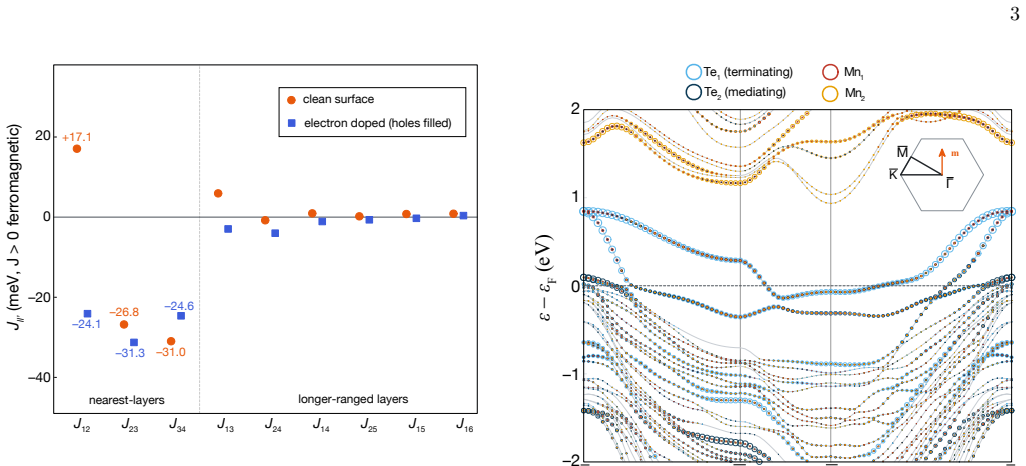
The central object is the ligand hole created by the polar termination: one hole per $1\times1$ surface, fixed by stoichiometry, residing on the Te $5p$ shell because α-MnTe is a charge-transfer insulator. The argument is carried by two pieces of machinery. The first is the layer-resolved spin model $E = E_0 - \sum_{l<l'} J_{ll'}\sigma_l\sigma_{l'}$, fitted to the complete enumeration of 32 collinear interlayer configurations, which isolates $J_{12}=+17.1$ meV as the only ferromagnetic interlayer bond against antiferromagnetic subsurface bonds. The second is the hole-mediated exchange principle: a half-filled $d^5$ Mn fills the ligand hole with a majority-spin electron, so both Mn neighbors of the hole-bearing Te must have parallel moments, and filling the anion shell closes that channel, returning the bond to the antiferromagnetic coupling of the bulk — which is why the electron-doped slab reverts to A-type order.
What would settle it
Two measurements would settle it. Scanning-probe magnetometry on a clean, uncapped Te-terminated α-MnTe(0001) film should find an in-plane uncompensated moment of order 8.7 $\mu_B$ per surface cell, present only on the hole-bearing termination; and a photon-energy-dependent ARPES scan across the Γ pockets should show no $k_z$ dispersion if they are the surface states the reconstruction predicts, with the surface petal sheets rotated relative to the bulk A-type stacking.
Extended reading notes
Core claim
Enumerating all 32 inequivalent collinear interlayer spin configurations of a six-Mn-layer Te-terminated slab, the ground state is not the bulk-continued A-type stacking but the stacking obtained by reversing the outermost Mn plane at each surface, so the two outermost Mn planes couple ferromagnetically while the interior keeps the A-type order; relaxed in its own geometry the reconstructed state lies 17.1 meV per $1\times1$ surface below the A-type slab, and the ordering survives slabs of 8 and 10 Mn layers and surface $U_{\rm eff}$ from 2 to 5 eV. Fitting the enumeration to the layer-resolved model $E = E_0 - \sum_{l<l'} J_{ll'}\sigma_l\sigma_{l'}$ gives a ferromagnetic $J_{12}=+17.1$ meV against antiferromagnetic subsurface bonds ($J_{23}=-26.8$, $J_{34}=-31.0$ meV), with a residual of 0.8 meV over a 238 meV ladder. The reversal is traced to the ligand hole: electron counting fixes one hole per surface cell on the dangling Te bonds, the near-Fermi states carry 83% of their weight on Te, and the Te mediating the $J_{12}$ bond is the most hole-rich mediator in the slab. Refilling the hole electronically turns the reconstruction energy positive (+43.8 meV per surface) and moves $J_{12}$ by $-41.2$ meV while every other exchange constant changes by at most 8.9 meV, so the carrier acts on the one bond whose mediating Te carries it.
Load-bearing premise
The ordering that decides the ground state — 17.1 meV per surface cell — is computed with a single approximation, PBE+U at $U_{\rm eff} = 4$ eV, whose error for surface energy differences of this size can be tens of meV, and no other functional or dispersion correction is tested.
Editorial extensions
If this is right
- Surface- and interface-derived transport in α-MnTe films — conduction that beyond a few unit cells belongs to surface states — must be analyzed with the reconstructed surface order rather than the bulk A-type order continued to the surface.
- The compensated altermagnet acquires an uncompensated in-plane moment of about 8.68 $\mu_B$ per $1\times1$ surface, exchange-coupled to the Néel vector and confined to the termination, giving surface-sensitive probes a direct handle on an order parameter no magnetic field couples to.
- Across the reversed outermost bond the two spin sublattices are parallel rather than antiparallel, so the rotation relation that defines altermagnetism fails at the surface.
- The computed constant-energy contours reproduce the surface-sensitive photoemission pockets labeled α and α₁ with no adjustable quantity, and a photon-energy scan across the Γ pockets would test their surface character directly.
- Experimental support already exists: Li doping, which makes the crystal more hole-rich, weakens the antiferromagnetic interlayer exchange by 8% in inelastic neutron scattering.
Reading between the lines
- A reversible control knob suggests itself: gating, adsorbates, or photoexcitation that fills or depletes the surface hole should toggle the surface between ferromagnetic bilayer and bulk A-type order, switching the sign of the surface spin splitting without disturbing the bulk Néel vector.
- The mechanism is not specific to MnTe: any polar chalcogenide termination whose dangling bonds leave a half-filled anion shell on the mediator of a magnetic bond could reconstruct magnetically, so surface magnetic order should be enumerated rather than assumed to continue the bulk.
- The two surface magnon branches expelled above the bulk band (up to 62 meV against a measured bulk top near 36 meV) are a spectroscopic fingerprint; surface-sensitive neutron or electron scattering on films could observe surface excitations above the bulk continuum.
- If the 17 meV ordering survives a functional without +U tuning, the reconstructed surface offers a controlled platform for studying altermagnetic symmetry breaking at an interface, since it breaks the bulk sublattice relation while preserving the lattice periodicity.
Signed reviews
Editorial analysis
A structured set of objections, weighed in public.
Referee Report
Summary. The paper uses DFT+U (PBE, Dudarev scheme, U_eff = 4 eV) to study the Te-terminated (0001) surface of altermagnetic α-MnTe. It reports that the surface magnetic ground state is not the bulk-continued A-type stacking but a reconstructed stacking in which the outermost Mn bilayer at each surface is ferromagnetic, lying 17.1 meV per 1×1 surface below the A-type state. The mechanism is attributed to the ligand hole in the Te dangling bonds: the hole is localized on the Te that mediates the exchange between the two outermost Mn planes, and it reverses that bond ferromagnetically. Electron doping, modeled by adding one electron per surface with a uniform background at frozen geometry, restores the A-type ordering. The authors also compute constant-energy photoemission contours and show consistency with published surface-sensitive maps, while explicitly noting that those maps do not discriminate between the reconstructed and A-type stackings. Additional checks reported include slab-thickness dependence, a sweep of the surface Hubbard U, a layer-resolved exchange fit, a spin-cluster expansion stability test, and one-face passivation calculations.
Significance. If the central ordering survives closer scrutiny, this is an important and somewhat surprising result for altermagnet surfaces: the surface magnetic order differs from the bulk, with direct consequences for surface-dominated transport, spectroscopy, and magnetometry, and it produces an uncompensated surface moment exchange-coupled to the Néel vector. The paper is methodologically transparent in several respects: it enumerates all 32 inequivalent interlayer configurations, reports a layer-model fit with sub-meV residual, tests slab thickness and surface U_eff, provides a spin-wave stability check, and states honestly that the photoemission comparison is non-discriminating. These are genuine strengths. The main weakness is that the central 17 meV-scale energy difference is computed with a single exchange-correlation functional, and the only causal control (electron doping) uses a charged-cell setup whose robustness is not established.
major comments (2)
- [Methods; Surface magnetic reconstruction; SM S2] The central claim, that the reconstructed stacking lies 17.1 meV per 1×1 surface below the bulk-continued A-type state, is computed only with PBE+U at U_eff = 4 eV. The robustness check in SM S2 varies U_eff only on the outermost Mn plane and changes the margin from -9.8 to -19.1 meV per surface, a spread comparable to the quoted effect. No hybrid functional, SCAN, self-consistent U, or dispersion correction is tested. Because α-MnTe is a charge-transfer insulator and the hole is mostly on Te, the relative Te 5p / Mn 3d energetics is exactly the part of the functional most in doubt for this ordering. Please add at least one independent functional cross-check (for example SCAN or a hybrid calculation on a representative slab) or provide an explicit uncertainty analysis that justifies quoting a 10 meV-scale surface energy difference.
- [Layer-resolved exchange; SM S4] The electron-doping control that fills the ligand hole is performed in a charged slab with a uniform compensating background at frozen geometry, and it is the only calculation that reverses the energy ordering (+43.8 meV per surface) and shifts J_12 by -41.2 meV. Total energies of charged supercells with jellium background are not thermodynamically well-defined and can depend on cell shape and vacuum size, and the frozen-geometry approximation omits the relaxation channel that is part of the clean-surface result. The related one-face-passivated calculation in SM S4 reports 23.0 meV per surface for the same surface reversal, whereas the clean symmetric slab gives 17.1 meV per surface; this discrepancy is not discussed. Please validate the electron-doping control with a local charge-compensation scheme or with varying slab/vacuum sizes, allow relaxation, and clarify the origin of the 23.0 versus 17.1 meV difference.
minor comments (4)
- [Abstract; Constant-energy contours; SM S5] The abstract and conclusion state that the computed constant-energy contours are 'consistent with photoemission maps'; the text itself correctly notes that the reconstructed and A-type petal patterns differ only in azimuthal orientation and that the published maps do not fix it. Please make this non-discriminating character explicit in the abstract and conclusion so that the wording is not read as validation of the reconstruction.
- [Fig. 1(b)] The horizontal axis label 'Number of Mn layer' should be 'Number of Mn layers'.
- [Layer-resolved exchange; SM S1] The sentence 'The residual is 0.8 meV on a configuration set spanning 238 meV' should specify whether this is an RMSE or a maximum error; SM S1 reports an RMSE of 0.82 meV, so the main text should match that definition.
- [Data availability] The statement that data are available from the first author upon reasonable request would be strengthened by depositing slab structures, input files, and convergence data in a public repository, especially since the paper makes quantitative surface-energy claims that others may want to reproduce.
Circularity Check
No significant circularity: the surface reconstruction is established by explicit DFT total-energy differences, not by a fitted or self-cited input.
full rationale
The central claim—that Te-terminated α-MnTe(0001) favors a ferromagnetic outermost Mn bilayer over the bulk-continued A-type stacking—is obtained by enumerating all 32 collinear interlayer spin configurations and comparing their self-consistent total energies. This is a direct ab initio energy ordering, not a derived quantity from a fitted model. The layer-resolved J constants are fitted to those same 32 energies after the fact and are used only to interpret the ordering; the paper explicitly notes that the numerical agreement between J12 and the reconstruction energy is a coincidence, so the J fit is not masquerading as a prediction. The electron-doping control (adding one electron per surface) is a separate DFT recomputation at fixed geometry and reverses the sign of the reconstruction energy; it is not forced by the layer model. The spin-cluster expansion cited from the authors' prior work appears only in Supplemental Material S6 for a spin-wave stability check, is fitted to new constrained noncollinear DFT data, and its model quality is checked against those data; it is not the source of the ground-state ordering. The photoemission comparison is explicitly described as non-discriminating between the reconstructed and A-type surfaces, so it is not being used as evidence that could make the argument circular. No step reduces by definition to an input, no fitted parameter is renamed as a prediction, and no load-bearing self-citation was found. The main caveat is the use of a single exchange-correlation approximation (PBE+U, U_eff = 4 eV) for a ~17 meV energy difference, but that is a correctness/robustness concern, not circularity.
Assumptions & free parameters
free parameters (1)
- U_eff (Mn 3d, Dudarev scheme) =
4.0 eV
assumptions (5)
- domain assumption PBE+U with U_eff = 4 eV provides total-energy differences accurate enough to order the surface magnetic states.
- domain assumption A Te-terminated (0001) surface of α-MnTe carries exactly one ligand hole per 1x1 surface cell (electron counting).
- domain assumption α-MnTe is a charge-transfer insulator, so the hole resides on Te rather than on Mn.
- domain assumption A half-filled Mn d5 shell can only supply majority-spin electrons to fill the ligand hole, making the interlayer exchange ferromagnetic (Zener double exchange).
- domain assumption Collinear interlayer configurations contain the magnetic ground state; in-plane and noncollinear deviations do not lower it.
Cite this review
Pith. "Pith review of Magnetic reconstruction of the altermagnet {\alpha}-MnTe(0001) surface driven by ligand holes." pith.science (2026). https://pith.science/paper/KHON4K5C
@misc{pith2026260812878,
  author       = {Pith},
  title        = {Pith review of: Magnetic reconstruction of the altermagnet \alpha-MnTe(0001) surface driven by ligand holes},
  year         = {2026},
  howpublished = {\url{https://pith.science/paper/KHON4K5C}},
  note         = {Machine review of arXiv:2608.12878}
}
read the original abstract
We show from first principles that the altermagnet {\alpha}-MnTe reconstructs its magnetic order at the Te-terminated (0001) surface. The ground state has a ferromagnetic outermost Mn bilayer in place of the bulk-continued stacking. The driver is the holes that the surface leaves on the Te mediating the exchange within that bilayer. The computed constant-energy contours agree with photoemission maps of the surface metal. Filling the holes restores the bulk order: the carrier density can control the strength of the surface coupling and, by reversing its sign, the surface magnetic order itself.
Figures


Reviewed August 15, 2026 · model on record in the stance chip above.
Discussion (0). Continue with ORCID to comment.