REVIEW 3 major objections 6 minor 27 references
Core Context Aware Transformers for Long Context Language Modeling
T0 review · 3 major / 6 minor · reviewed 2026-08-11 · deepseek-v4-flash
Pith's one-line read Core Context Aware Attention replaces self-attention in pretrained LLMs with a plug-and-play two-branch module — group-wise pooling into core tokens plus a local window — reducing complexity to linear, KV cache to O(L/g + s), and…
desk verdict Useful attention-replacement idea with real speedups, but the 'linear complexity' claim is wrong as stated and the comparison protocol is unfair; still worth a referee's time. read the letter →
The pith
A machine-rendered reading of the paper's core claim, the machinery that carries it, and where it could break.
The reading
What carries the argument
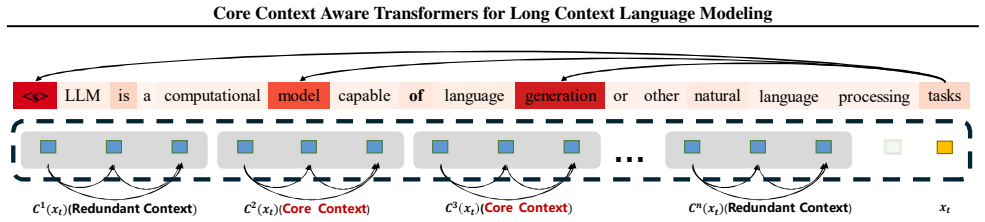
The load-bearing object is the group-wise weighted pooling of Eqn. (2): the query vector of a block's last token scores every token in the block, a softmax turns those scores into pooling weights, and the core token is the weighted sum of the block's token embeddings; that one token then stands in for the whole block in the global attention branch. The locality-preserving module, which keeps the preceding s tokens in full resolution, supplies the fine-grained detail the pooling discards, and the differentiable fusion of Eqn. (5) concatenates global and local key-value pairs into a single softmax so the two sources of evidence are weighted against each other within one attention computation. The supporting theoretical result is the reachability argument of Proposition 1, which expands the fused attention element-wise into the structure of full attention and shows every earlier token contributes, through its block's core token, to every later query.
What would settle it
Build a multi-document question-answering set with known answer sentences and move an answer-bearing sentence from the end of its group to the beginning, then compare CCA's exact-match score with full self-attention's; if CCA's score drops sharply while full attention's stays flat, the last-token importance measure of Eqn. (2) is discarding exactly the tokens that matter. Running the same experiment across group sizes g would bracket where the method's ceiling sits.
Extended reading notes
Core claim
The central discovery the paper argues for is that a pretrained LLM's dense attention can be replaced by a sparser structure that keeps the information full attention uses: divide the sequence into blocks of g tokens, judge each block's important content by the attention its last token pays within the block (the weighted pooling of Eqn. 2), and use the resulting core tokens as keys and values for a global branch, while a local branch keeps the most recent s tokens in full detail. Concatenating the two branches' keys and values into one causal softmax (Eqn. 5) gives every query a positive attention weight toward every preceding token — the reachability property proved in Proposition 1 — so the compression cannot sever long-range dependencies even as it drops what the paper calls redundant context. On this basis the authors report that, after minimal continued training, CCA versions of LLaMA2-7B, LLaMA3.1-8B, and Qwen2.5-7B match or beat the efficient-attention baselines on LongBench-E and RULER, beat full self-attention at 64K-128K on multi-document question answering, and prefill at 128K runs 7.9x faster with roughly one-fourteenth the KV cache.
Load-bearing premise
Everything rests on the premise that the last token of each group is a reliable judge of which tokens in the group matter for all future queries, because that single token's attention scores decide how the group is compressed into one core token, and the paper supports this premise only with attention-map visualizations.
Editorial extensions
If this is right
- Long-context prefill and decoding both become sub-quadratic: O(Lm + Ls) for fixed-length inputs and O(L^2/g + Ls) for autoregressive generation, with KV cache storage cut from O(L) to O(L/g + s).
- A single trained CCA checkpoint can be served at different group sizes g and window sizes s at inference time, trading a little accuracy for large throughput gains as traffic changes.
- The self-attention replacement transfers across model families — LLaMA2, LLaMA3.1, and Qwen2.5 — with the same minimal fine-tuning budget, and it is orthogonal to RoPE-based context-extension methods.
- At 64K-128K contexts the authors report CCA matching or beating full self-attention on multi-document QA, implying that compressing redundant context helps rather than hurts very-long-context reasoning.
- Because it cuts KV cache memory as well as compute, CCA's gains extend to the decoding stage, where baselines such as MInference fall back to full attention.
Reading between the lines
- An implication the paper leaves implicit: the last-token-as-judge principle could be replaced by other importance measures at equal cost, such as the average query of the group or a learned importance head, and whether accuracy improves would isolate whether the pooling premise or the compression idea is doing the work.
- Because core tokens are produced for every block, they double as a readable summary of the context; checking whether their pooling weights concentrate on entities, numbers, or verbs would show whether CCA can also serve as an attribution tool for long-context QA.
- The reachability proof guarantees influence but not information retention; quantifying how much block-level signal survives the g-to-1 pooling would predict the context lengths and task types where CCA diverges from full attention.
- The inference-time dial between g and s implies a deployment pattern — one checkpoint serving multiple latency targets — that fixed-pattern sparse attention methods cannot offer.
Signed reviews
Editorial analysis
A structured set of objections, weighed in public.
Referee Report
Summary. The paper proposes Core Context Aware (CCA) Attention, a plug-and-play replacement for the self-attention module in pretrained LLMs. The mechanism partitions the input into groups of size g, compresses each group into a single 'core' token using an attention-weighted pooling driven by the group's last token, and then computes attention over the resulting core tokens while also attending to a local window of preceding tokens. The authors claim linear-time complexity, reduced KV cache, minimal fine-tuning, and superior long-context modeling, reporting up to a 7.9x first-token latency speedup at 128K context on LLaMA2-7B-80K. Experiments cover LongBench-E, RULER, multi-document EM, MMLU, and models LLaMA2, LLaMA3.1, and Qwen2.5.
Significance. If the stated complexity and accuracy claims held, the method would be a practical low-cost retrofit for long-context inference. The paper's strengths include a simple architecture, public source code, and evaluation across several benchmarks and model families. However, the central 'linear complexity' claim is internally inconsistent with the paper's own complexity analysis, and the aggregate accuracy results do not support 'superior' long-context modeling over vanilla self-attention. The contribution is best viewed as a subquadratic approximation with large constant-factor speedups, pending corrective revisions.
major comments (3)
- [Section 3.6, Eqn. (2), Table 8, Abstract] The abstract and Section 1 state that CCA-Attention 'reduces computational complexity to linear complexity,' but Section 3.6 derives O(L^2/g + Ls) for autoregressive decoding when the group size g is a constant, and the experiments use g=16 (Table 8). Because m = floor(L/g) in Eqn. (2), the global-attention term is Theta(L^2/g), which is quadratic for any fixed g; the 7.9x speedup reported in Table 3 is a constant-factor reduction rather than a change of asymptotic class. The fixed-length case O(Lm + Ls) is only linear if m is treated as a constant, which contradicts the definition of m and the implemented setting. The efficiency claims should be restated for two regimes: fixed g (subquadratic, O(L^2/g + Ls)) and fixed m (linear, O(Lm + Ls)), with the latter requiring g to grow with L and a separate validation.
- [Tables 1 and 3, Section 4.2, Abstract] The abstract claims 'superiority of our method in both long-context modeling and computational efficiency,' and Section 4.2 claims CCA-LLM 'attains the highest average score' on LongBench-E, but the tables show the opposite. In Table 1, the CCA-LLM average is 21.86 vs 22.11 for vanilla self-attention on LLaMA2-7B-32K and 22.24 vs 22.42 on LLaMA2-7B-80K; in Table 3 the average EM score at 4K-128K is 34.4 vs 36.0 for vanilla attention. The specific claim in Section 4.2 that 'our CCA-LLM consistently achieves the highest EM score' for short contexts is also contradicted at 4K (39.3 vs 39.4). The modeling-superiority claim should be replaced by a competitive-accuracy claim, or supported by significance tests at the lengths (e.g., 64K/128K) where the paper claims improvement.
- [Section C.4, Eqn. (2), Table 7] The globality-aware pooling in Eqn. (2) uses the last token of each group as the query to assign importance weights to the group's tokens. This choice is load-bearing because the pooled core tokens are the only global information channel for all later queries; an unreliable importance measure would discard context needed downstream. The paper motivates this choice solely with attention-map visualizations on a single 32-token sentence (Section C.4). The authors should either quantify how well the last token's attention predicts the attention of later positions (e.g., by computing the correlation across a sample of long documents) or add an ablation that varies the query token (first, middle, group-average, or a learned query), since the existing Table 7 ablation varies only the pooling strategy, not the query source.
minor comments (6)
- [Section 4.2] Section 4.2 contains several typos: 'ur CCA-LLM' should read 'Our CCA-LLM,' 'MInferencce' should read 'MInference,' and 'accerlerate' should read 'accelerate.'
- [Section 3.6] Section 3.6 states that the locality-preserving module's upper bound is O(L(s+g)) but then reports the total as O(Lm+Ls); the g-dependent term should be included or explicitly absorbed, for example as O(Lm + L(s+g)).
- [Table 3 caption] The Table 3 caption says 'FTL denotes the latency to generate the first token,' but this is the prefill latency, not the per-token generation latency; labeling it 'prefill latency' or 'time to first token' would avoid confusion with the inter-token latency reported elsewhere.
- [Section 4.2] The sentence in Section 4.2 claiming that 'our CCA-LLM consistently achieves the highest EM score' for short contexts is not supported by Table 3, where CCA-LLM scores 39.3 versus 39.4 for vanilla self-attention at 4K.
- [Section 3.5] Calling the fine-tuning costs 'minimal' may be misleading, as Section B.2 reports 2.1B tokens for 32K and 5B tokens for 80K; please clarify the comparison baseline or rephrase the claim.
- [Section 3.2] The phrase 'tokens in close proximity to the query Qi are likely to be more relevant' should specify 'preceding tokens within the local window,' since causal masking prevents attending to future tokens.
Circularity Check
Headline 'linear complexity' claim is forced by redefining the group count m as constant, contradicting Eqn. (2)'s m = L/g; empirical benchmark claims are independent and non-circular.
-
self definitional
[Section 3.6 'Computational and Storage Complexity Analysis' (also abstract, Contribution bullet 1, and Section C.3); m is defined in Section 3.2, Eqn. (2)]
"we segment the input sequence X, each group containing g tokens, in total m=L/g groups ... For tasks with fixed-length sequences ... our CCA-Attention exhibits a linear computational complexity of O(Lm + Ls) ... Here, we define the number of group m as a constant."
By the paper's own definitions the linearity claim is stipulated, not derived: Section 3.2/Eqn. (2) fixes m = L/g, so the globality module cost O(Lm) (Figure 2) equals O(L^2/g) for any fixed g, which is quadratic in L. Section 3.6 obtains 'linear' only by adding 'Here, we define the number of group m as a constant,' a redefinition contradicted by Eqn. (2) and by the implemented regime (g=16 default, Table 8; Section C.5 sweeps g=2..64). The same section's variable-length analysis fixes g and honestly reports O(L^2/g + Ls), still quadratic.
full rationale
One definition-forced step was found, and it is load-bearing for the paper's headline efficiency claim. In Section 3.6 the paper claims 'our CCA-Attention exhibits a linear computational complexity of O(Lm + Ls)' and obtains this by stipulating 'Here, we define the number of group m as a constant,' while Section 3.2/Eqn. (2) defines m = floor(L/g). With the paper's own definitions, the globality module costs O(Lm) = O(L^2/g), which is quadratic for the fixed group sizes used in every experiment (default g=16, Table 8); the paper's own autoregressive analysis states O(L^2/g + Ls), also quadratic. The 'linear' conclusion therefore follows only from redefining m, i.e., the central complexity-class claim is forced by definition rather than derived from the method. This constitutes partial circularity, not a fully circular paper: all modeling-accuracy claims rest on external benchmarks (LongBench-E, multi-document EM, RULER, MMLU, Proof-pile PPL), hyperparameters g and s are selected by PPL ablations (Tables 8 and 9) rather than fit to target results, the measured speedups and memory savings are empirical constant-factor gains, and no fitted-input-called-prediction pattern appears. No self-citation appears in the reference list, so the self-citation and uniqueness-import patterns do not apply. The reachability proof (Proposition 1) is a formal restatement of the construction (positive softmax weights over prefix groups plus local window) and is not circular, though its binary notion of 'access' via a g-way pooled proxy is much weaker than full self-attention, which is a scope caveat rather than a circularity. Apart from the complexity-class claim, the derivation chain is self-contained and the empirical claims are independently grounded.
Assumptions & free parameters
free parameters (4)
- group size g =
16 (default)
- local window size s =
1024 (default)
- number of groups m (for fixed-length tasks) =
set to a constant in MMLU experiments; exact value not reported
- RoPE base frequency =
500000
assumptions (4)
- standard math softmax attention weights are positive and normalize to 1
- domain assumption Attention scores in pretrained LLMs are highly sparse, with a few tokens receiving most mass
- domain assumption The last token of a group is a sufficient query to measure the importance of all tokens in that group for future tokens
- domain assumption Fine-tuning for 1000 steps on SlimPajama preserves pretrained knowledge and adapts the model to CCA-Attention
Cite this review
Pith. "Pith review of Core Context Aware Transformers for Long Context Language Modeling." pith.science (2026). https://pith.science/paper/KHVCRWAB
@misc{pith2026241212465,
  author       = {Pith},
  title        = {Pith review of: Core Context Aware Transformers for Long Context Language Modeling},
  year         = {2026},
  howpublished = {\url{https://pith.science/paper/KHVCRWAB}},
  note         = {Machine review of arXiv:2412.12465}
}
read the original abstract
Transformer-based Large Language Models (LLMs) have exhibited remarkable success in extensive tasks primarily attributed to self-attention mechanism, which requires a token to consider all preceding tokens as its context to compute attention. However, when the context length L becomes very large (e.g., 128K), the amount of potentially redundant information in the context tends to increase. The redundant context not only hampers the modeling representation performance but also incurs unnecessary computational and storage overhead. In this paper, we propose a plug-and-play Core Context Aware (CCA) Attention for efficient long-context modeling, comprising two complementary modules: 1) Globality-aware pooling module groups input tokens and dynamically compresses each group into one core token based on their significance. In this way, our method automatically focuses and strengthens core context while diminishing redundancy during the learning process, leading to effective long-term dependency modeling. 2) Locality-preserving module incorporates neighboring tokens to preserve local context for detailed representation. Notably, our CCA-Attention is able to replace the self-attention module in existing LLMs with minimal fine-tuning cost. Extensive experimental results show the superiority of our method in both long-context modeling and computational efficiency over state-of-the-art methods.
Figures


Figures from the paper (3 more)


Reference graph
Works this paper leans on
-
[1]
Same as demonstrated in existing methods (Beltagy et al., 2020; Xiao et al., 2024b)
As shown in the figure, these attention scores show consistent sparsity from shallow to deep layers. Same as demonstrated in existing methods (Beltagy et al., 2020; Xiao et al., 2024b). 17 Core Context Aware Transformers for Long Context Language Modeling Figure
work page 2020
-
[4]
Extending context window of large language models via positional interpolation
Chen, S., Wong, S., Chen, L., and Tian, Y . Extending context window of large language models via positional interpolation. arXiv preprint arXiv:2306.15595,
-
[5]
Masked language modeling for proteins via linearly scalable long-context transformers
Choromanski, K., Likhosherstov, V ., Dohan, D., Song, X., Gane, A., Sarlos, T., Hawkins, P., Davis, J., Belanger, D., Colwell, L., et al. Masked language modeling for proteins via linearly scalable long-context transformers. arXiv preprint arXiv:2006.03555,
arXiv 2006
-
[6]
Longnet: Scaling transformers to 1,000,000,000 tokens
Ding, J., Ma, S., Dong, L., Zhang, X., Huang, S., Wang, W., Zheng, N., and Wei, F. Longnet: Scaling transformers to 1,000,000,000 tokens. arXiv preprint arXiv:2307.02486,
-
[7]
Data engineering for scaling language models to 128k context.arXiv preprint arXiv:2402.10171,
Fu, Y ., Panda, R., Niu, X., Yue, X., Hajishirzi, H., Kim, Y ., and Peng, H. Data engineering for scaling language models to 128k context.arXiv preprint arXiv:2402.10171,
-
[8]
Deepseek-r1: In- centivizing reasoning capability in llms via reinforcement learning
Guo, D., Yang, D., Zhang, H., Song, J., Zhang, R., Xu, R., Zhu, Q., Ma, S., Wang, P., Bi, X., et al. Deepseek-r1: In- centivizing reasoning capability in llms via reinforcement learning. arXiv preprint arXiv:2501.12948,
-
[9]
Effect of local window size s. s 256 512 1024 2048 4096 PPL ↓ 2.98 2.92 2.86 2.79 2.73 Latency ↓ (ms) 457.4 460.1 461.4 462.8 473.1 Effect of Different Updating Strategies. As mentioned in Section 3.4, we have two updating strategies:
-
[12]
Mu, J., Li, X., and Goodman, N. D. Learning to com- press prompts with gist tokens. In Oh, A., Naumann, T., Globerson, A., Saenko, K., Hardt, M., and Levine, S. (eds.), Advances in Neural Information Processing Systems 36: Annual Conference on Neural Information Processing Systems 2023, NeurIPS 2023, New Orleans, LA, USA, December 10 - 16, 2023,
work page 2023
Show all 27 references
- [13]
-
[15]
Llama: Open and efficient foundation language models
Touvron, H., Lavril, T., Izacard, G., Martinet, X., Lachaux, M., Lacroix, T., Rozi `ere, B., Goyal, N., Hambro, E., Azhar, F., Rodriguez, A., Joulin, A., Grave, E., and Lam- ple, G. Llama: Open and efficient foundation language models. arXiv preprint arXiv:2302.13971, 2023a. T...
-
[16]
Yang, A., Yang, B., Zhang, B., Hui, B., Zheng, B., Yu, B., Li, C., Liu, D., Huang, F., Wei, H., et al. Qwen2. 5 technical report. arXiv preprint arXiv:2412.15115,
-
[17]
The MMLU benchmark spans 57 diverse subjects, ranging from elementary mathematics to professional law
dataset is designed to assess the capabilities of language models across a wide array of subjects, delving deeper into their academic and professional understanding. The MMLU benchmark spans 57 diverse subjects, ranging from elementary mathematics to professional law. The ques...
2021
-
[18]
base frequency
dataset, an open-source replication of the LLaMA pretraining data mixture. This dataset comprises 82% web data, split between 67% from CommonCrawl and 15% from C4, alongside 4.5% from GitHub code, 4.5% from Wikipedia, 4.5% from books, 2.5% from Arxiv, and 2.0% from Stack Excha...
2024
-
[19]
This enables us to integrate our CCA-Attention as a standalone, cache-friendly operator, effectively eliminating redundant computations
to perform low-level operator fusion between our globality-aware pooling and locality-preserving modules. This enables us to integrate our CCA-Attention as a standalone, cache-friendly operator, effectively eliminating redundant computations. Compared Methods. We conduct compr...
2023
-
[20]
Our experiments are based on the LLaMA-2 7B model fine-tuned on sequences of length 32K and 80K (Fu et al., 2024)
benchmarks. Our experiments are based on the LLaMA-2 7B model fine-tuned on sequences of length 32K and 80K (Fu et al., 2024). For StreamingLLM (Xiao et al., 2024b), we use the official implementation, adjusting the attention sink to 4 and setting the attention context size to
2024
-
[22]
16 Core Context Aware Transformers for Long Context Language Modeling C
In the case of MInference (Jiang et al., 2024), we also employ the official code implementations, configured with the official settings. 16 Core Context Aware Transformers for Long Context Language Modeling C. More Experimental Results C.1. Experiments on More Long Context Ben...
2024
-
[23]
67.78 65.32 61.43 52.77 61.83 CCA-LLM (Ours) 68.15 66.31 60.89 54.88 62.56 C.2. Comparisons with More Efficient Attention Methods To further evaluate our method, we compare it with LongLoRA (Chen et al., 2024), a recently proposed training-based approach with PI techniques. As...
2024
-
[25]
Strategy Mean Pooling Max Pooling CCA-Attention (Ours) PPL ↓ 2.99 2.99 2.85 Effect of Group Size g
Effect of pooling strategy. Strategy Mean Pooling Max Pooling CCA-Attention (Ours) PPL ↓ 2.99 2.99 2.85 Effect of Group Size g. To investigate the effect of different group sizesg, we implement the proposed CCA-Attention with different g ∈ {2, 4, 8, 16, 32, 64}. In Table 8, as...
-
[27]
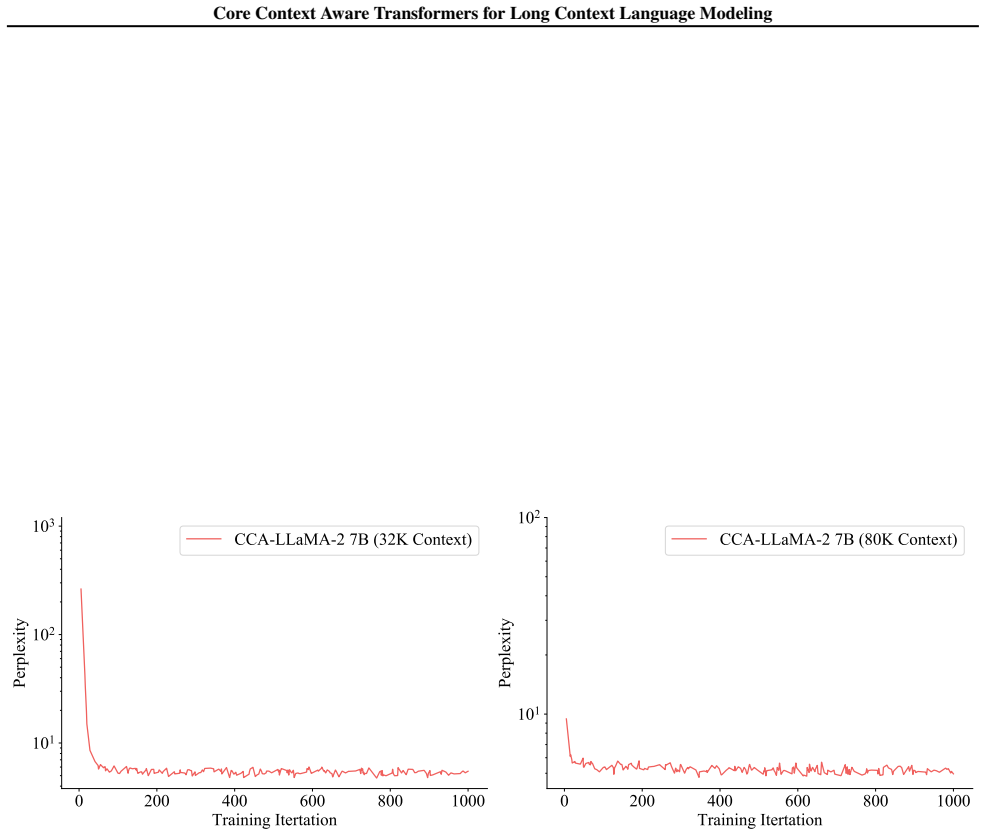
The perplexity rapidly converges within approximately the first 100 iterations and remains stable over 1,000 iterations
From the results, by minimizing the training loss, both LLaMA2-7B-32K and LLaMA2-7B-80K models are able to converge very fast. The perplexity rapidly converges within approximately the first 100 iterations and remains stable over 1,000 iterations. These results not only demons...
2024
-
[2000]
Similarly, for LM-infinite (Han et al., 2023), we follow the official code, configuring the local branch size to 1024 and the global branch size to
2023
-
[2019]
Deepseek- v3 technical report
Liu, A., Feng, B., Xue, B., Wang, B., Wu, B., Lu, C., Zhao, C., Deng, C., Zhang, C., Ruan, C., et al. Deepseek- v3 technical report. arXiv preprint arXiv:2412.19437, 2024a. 10 Core Context Aware Transformers for Long Context Language Modeling Liu, N. F., Lin, K., Hewitt, J., P...
-
[2020]
Retentive network: A successor to transformer for large language models
Sun, Y ., Dong, L., Huang, S., Ma, S., Xia, Y ., Xue, J., Wang, J., and Wei, F. Retentive network: A successor to transformer for large language models. arXiv preprint arXiv:2307.08621,
-
[2021]
Ruler: What’s the real context size of your long-context language models? arXiv preprint arXiv:2404.06654,
Hsieh, C.-P., Sun, S., Kriman, S., Acharya, S., Rekesh, D., Jia, F., Zhang, Y ., and Ginsburg, B. Ruler: What’s the real context size of your long-context language models? arXiv preprint arXiv:2404.06654,
-
[2022]
Longbench: A bilingual, multitask benchmark for long context understanding
Bai, Y ., Lv, X., Zhang, J., Lyu, H., Tang, J., Huang, Z., Du, Z., Liu, X., Zeng, A., Hou, L., Dong, Y ., Tang, J., and Li, J. Longbench: A bilingual, multitask benchmark for long context understanding. arXiv preprint arXiv:2308.14508,
-
[2023]
E., and Cohan, A
Beltagy, I., Peters, M. E., and Cohan, A. Long- former: The long-document transformer. arXiv preprint arXiv:2004.05150,
2004 arXiv
-
[2024]
Chang, Y ., Wang, X., Wang, J., Wu, Y ., Yang, L., Zhu, K., Chen, H., Yi, X., Wang, C., Wang, Y ., Ye, W., Zhang, Y ., Chang, Y ., Yu, P
Accessed: 2025-01-20. Chang, Y ., Wang, X., Wang, J., Wu, Y ., Yang, L., Zhu, K., Chen, H., Yi, X., Wang, C., Wang, Y ., Ye, W., Zhang, Y ., Chang, Y ., Yu, P. S., Yang, Q., and Xie, X. A survey on evaluation of large language models. ACM Transactions on Intelligent Systems an...
2025
-
[2025]
LM-infinite: Simple on-the-fly length generalization for large language models
Han, C., Wang, Q., Xiong, W., Chen, Y ., Ji, H., and Wang, S. LM-infinite: Simple on-the-fly length generalization for large language models. arXiv preprint arXiv:2308.16137,
Reviewed August 11, 2026 · model on record in the stance chip above.
Discussion (0). Continue with ORCID to comment.