REVIEW 3 major objections 4 minor 69 references
Creation of domain-wall skyrmions in chiral magnets with Landau-Lifshitz-Gilbert dynamics and demagnetization
T0 review · 3 major / 4 minor · reviewed 2026-08-03 · deepseek-v4-flash
Pith's one-line read An unstable domain wall can act as a one-dimensional Kibble-Zurek source that creates skyrmion–antiskyrmion pairs while absorbing, repelling, or annihilating an incoming bulk skyrmion.
desk verdict The qualitative LLG story — capture, annihilation, repulsion, and Kibble-line pair creation — is credible and worth referee time, but the quantitative phase diagram is not established: one run per point on one box, with the authors' own box-size caveat. read the letter →
The pith
A machine-rendered reading of the paper's core claim, the machinery that carries it, and where it could break.
The reading
What carries the argument
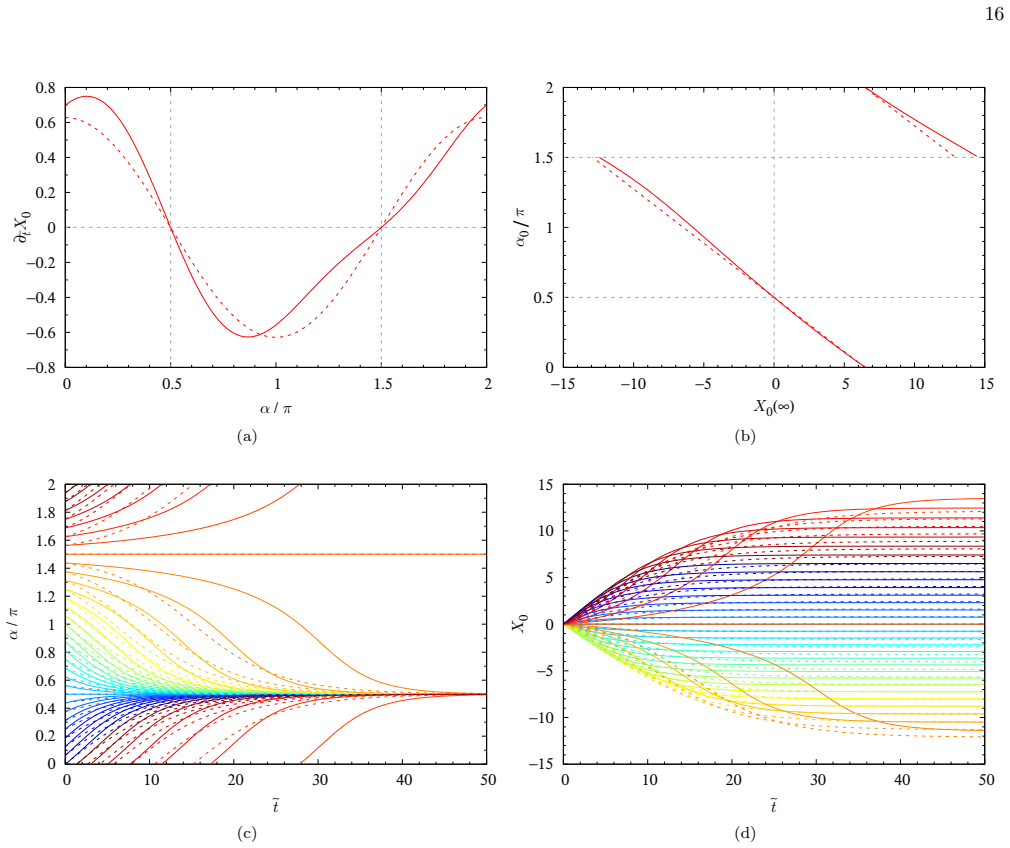
The Landau-Lifshitz-Gilbert equation, reduced to dimensionless form with three parameters (DMI coupling κ, demagnetization coupling η, Gilbert damping α_G), is integrated numerically with a conjugate-gradient solver for the magnetostatic Poisson equation at every step. The central analytical objects are Thiele (moduli-space) equations for the domain wall's collective coordinates—the phase α and the wall position X0—which describe how the wall drifts while relaxing to its ground state. The 'Kibble line' is the unstable fixed point of the phase dynamics; its existence turns a single wall into a source of skyrmion–antiskyrmion pairs.
What would settle it
A micromagnetic experiment or simulation that includes the time-dependent switching of the external field, preparing a Bloch wall at α=3π/2 (or a Néel wall at α=π) with a skyrmion at distance |X0|≈4, and checking whether domain-wall-skyrmion/anti-skyrmion pairs appear; if the wall never reaches the unstable phase, the Kibble-line predictions would be absent.
Extended reading notes
Core claim
The central result is a set of complete phase diagrams—for Bloch and Néel DMI, with and without demagnetization—showing which initial wall phase α and skyrmion-to-wall distance |X0| lead to (i) absorption into a domain-wall skyrmion, (ii) repulsion of the bulk skyrmion, or (iii) annihilation via the skyrmion's shrinking instability. When the wall is prepared at its unstable fixed point (α=3π/2 for Bloch DMI, α=π for Néel DMI), the wall's phase relaxation is unstable to perturbations and drives a one-dimensional Kibble-Zurek process: cusps nucleate on the wall and develop into domain-wall-skyrmion/anti-domain-wall-skyrmion pairs, most of which annihilate but some of which survive. The demagne
Load-bearing premise
The paper assumes an external magnetic field from electromagnets and nanowires (Eq. 48) can prepare the domain wall at any phase α, including the unstable values that trigger the Kibble mechanism, and that switching that field off at t=0 leaves exactly the free-evolution initial state used in the simulations; this preparation dynamics is not modeled.
Editorial extensions
If this is right
- A bulk skyrmion can be captured onto a domain wall and converted into a one-dimensional bound soliton whose motion is confined to the wall, provided the initial wall phase and separation fall in the creation window of the phase diagram.
- Outside the creation window the skyrmion is repelled or collapses—the latter occurring when its DMI energy ceases to be negative—so the diagrams give concrete operating margins for controlled absorption.
- The unstable wall (Kibble line) produces multiple skyrmion–antiskyrmion pairs in a one-dimensional analogue of the Kibble-Zurek mechanism; many pairs annihilate but a few survive, yielding a simple route to multi-soliton states on a single wall.
- The Thiele/moduli-space equations quantitatively predict the wall's motion during relaxation, explaining why LLG dynamics gives capture windows about twice as wide as static energy-minimization.
- For Néel DMI, demagnetization acts like an increased anisotropy, shrinking all solitons by roughly 12% at η=0.3 and possibly shifting the wall's ground-state phase at small DMI; in the Bloch case it leaves isolated solitons untouched but changes the composite wall-bound skyrmion and the Kibble process.
Reading between the lines
- A practical testable extension is to simulate the full time-dependent Zeeman-field preparation (Eq. 48) rather than instant switch-off; if the wall does not land exactly on the unstable phase, the Kibble-line bands in the phase diagrams would smear or shift, an effect an experiment could detect.
- The one-dimensional Kibble mechanism on a domain wall provides a miniature testbed for cosmological defect-formation statistics; measuring how the number of surviving pairs scales with the quench rate could be compared with Kibble-Zurek scaling predictions.
- Adding currents to the LLG evolution, which the authors list as future work, could selectively drive the wall or skyrmion and make absorption efficient without needing an unstable initial phase, or could be used to separate the created pairs once formed.
- The same moduli-space treatment likely applies to recently proposed three-dimensional composites—skyrmion strings attached to Néel walls—allowing prediction of their dynamical formation from LLG flows with demagnetization, an open direction the authors flag.
Signed reviews
Editorial analysis
A structured set of objections, weighed in public.
Referee Report
Summary. The paper studies, by numerical LLG dynamics, the capture, annihilation, or repulsion of an isolated bulk skyrmion incident on an empty chiral domain wall, for Bloch- and Néel-type DMI, with and without demagnetization. It also examines the unstable-domain-wall configuration, where a one-dimensional Kibble-Zurek mechanism can create domain-wall skyrmion pairs. The authors provide analytic Thiele/moduli equations for the motion of a perturbed DW and compare them with full LLG simulations. The main deliverable is a set of phase diagrams in the (α, X0) plane for the four DMI/demagnetization cases, plus a discussion of the 'Kibble line' and its outcomes.
Significance. If the quantitative results are robust, this is a useful contribution to the mesoscopic magnetism literature: it extends earlier arrested-Newton-flow work of the same group to physically realistic LLG dynamics, includes the demagnetization field in a nontrivial way, and identifies a concrete mechanism for creating skyrmion-anti-skyrmion pairs on domain walls. The analytic Thiele equations are a genuine addition, and the model parameters κ=0.4, η=0.3, α_G=0.3 are taken from material constants rather than fitted to the phase diagrams. The claim of a 1D Kibble-Zurek line is interesting and falsifiable. However, the central quantitative claim -- a 'full phase diagram' for capture/annihilation/repulsion -- is not yet supported by the evidence presented, because the numerical phase diagrams are single-trajectory points in one simulation box with no convergence checks, and the authors themselves identify box-size-dependent artifacts.
major comments (3)
- [Sec. VII C, Figs. 10-12] The phase diagrams are the quantitative core of the paper, but each (α, X0) point is a single LLG trajectory on a single 682^2 lattice with no box-size or boundary-condition study. The authors state in Sec. VII A that 'the minute details of which final states appear... depend on the size of the magnetic material... as well as on the boundary conditions,' and in Sec. VII C they explicitly identify the red region 1.2π≲α<3π/2, X0≲3 as an artifact of the DW-skyrmion leaving the finite simulation box. Because the claimed 'full phase diagram' therefore contains at least one known finite-box artifact and no demonstrated robustness of the other phase boundaries, the quantitative determination of capture/annihilation/repulsion windows is not established. A convergence study with two or more box sizes, boundary-condition variations, and ideally a small ensemble of trajectories per point is needed
- [Sec. V, Eq. (48)] The initial condition u_composite = u_sk + u_DW assumes the DW can be prepared at an arbitrary phase α, including the unstable values α=3π/2 (Bloch) or α=π (Néel), and that switching off the proposed Zeeman field at t=0 leaves exactly this free-LLG initial state. The actual preparation protocol is only sketched with hand-waving ('We trust our friends in the engineering department'), and the paper does not model the ramp-down dynamics or the back-action of the localized field on the skyrmion and DW position. Since the entire Kibble-line scenario and parts of the phase diagrams depend on this initial condition, the experimental route to those outcomes is not yet demonstrated. A concrete treatment of the pulse shape and its switching-off, or an explicit argument that the composite state is reached in the adiabatic limit, is required.
- [Sec. VII D, Kibble line] The Kibble-line outcomes are described as 'most likely chaotic' and highly box-size-dependent. The paper presents selected representative trajectories (Figs. 13-16) and states that many pairs annihilate, but it does not provide any statistical characterization: no probability distribution of final states, no number of produced pairs as a function of distance or noise, and no comparison across realizations. Given the chaotic nature admitted in the text, the claim that this provides a controllable 'theoretical possibility' of creating skyrmion-anti-skyrmion pairs would be strengthened significantly by either an ensemble analysis or at least a demonstration that the number of surviving pairs is reproducible within controlled perturbations.
minor comments (4)
- [Introduction, Sec. I] The phrase 'magnetization effect' appears where 'demagnetization effect' is meant; please check the wording in the introductory paragraph.
- [Appendix A] The Kibble-Zurek mechanism is consistently misspelled as 'Kibble-Zurich' in the appendix heading and text; this should be corrected.
- [Sec. VI] The numerical section gives lattice size, time step, and spatial step, but no test of numerical convergence in time or space, nor a conservation check (e.g., energy decay rate or topological-charge evolution). A brief convergence statement would increase confidence in the reported phase boundaries.
- [Fig. 17] The random-noise simulation in the appendix is described only qualitatively; the noise amplitude and the exact realizations used are not specified, making the figure hard to reproduce. This is presentation-level but should be fixed.
Circularity Check
No significant circularity: the phase diagrams are outputs of LLG simulations with material-constant parameters, and the self-citations to the authors' prior work are supporting analytic results, not load-bearing reductions.
full rationale
The paper's central quantitative content—the capture/annihilation/repulsion phase diagrams, the demagnetization rescaling, and the Kibble-line dynamics—is produced by LLG evolution from a specified composite initial state, not by fitting outputs back into inputs. The model parameters (κ = 0.4, η = 0.3, α_G = 0.3) are fixed from physical constants close to Pt/Co/Ta (Eq. 12) and are not tuned to reproduce any final-state pattern. The demagnetization effects are derived analytically: integrating the Poisson equation gives ∂rΦ = sin f and ∂xΦ = sin f (Eqs. 36, 40), leading to the effective mass rescaling and κ → κ/√(1+η); the critical κcrit in Eq. (46) follows from an energy comparison. The Thiele equations (51–56) are derived by promoting α and X0 in the sine-Gordon DW solution and integrating the LLG equation, and the paper checks them against full numerics. The repeated citations to the authors' own Ref. [55] supply the analytic asymptotic repulsion between a ground-state skyrmion and a ground-state DW and motivate why α must be perturbed; that prior result is parameter-free and not equivalent to the LLG phase diagrams, so it is supporting evidence rather than a circular reduction. The paper explicitly flags finite-box-size and boundary-condition dependence of the fine details and admits that the red region for 1.2π ≲ α < 3π/2 is a simulation-box artifact; these are robustness limitations, not circularity, and they do not make any prediction reduce to an input by construction. Overall, no load-bearing step equates a predicted quantity to a fitted or self-cited input.
Assumptions & free parameters
free parameters (4)
- κ (effective DMI coupling) =
0.4
- η (demagnetization coupling) =
0.3
- α_G (Gilbert damping) =
0.3
- Noise amplitude δX0 =
[-0.01, 0.01]
assumptions (8)
- domain assumption The Landau-Lifshitz-Gilbert equation without currents (Eqs. 5-8) governs the magnetization dynamics.
- domain assumption Magnetostatic scalar-potential approximation: ∇·H_demag = -∇·m, with induced currents neglected.
- domain assumption Thin-film limit ∂₃n = 0, i.e. no dependence on the third spatial coordinate.
- ad hoc to paper The superposition ansatz u_composite = u_sk + u_DW (Eq. 47) is a valid initial condition.
- ad hoc to paper A localized external Zeeman field (electromagnets/nanowires, Eq. 48) can prepare the DW at a chosen phase α, including the unstable values, and switching it off at t=0 leaves the free-LLG initial state unchanged.
- domain assumption The finite simulation box (682², h=0.0587; Dirichlet left/right, Neumann top/bottom) is representative of the unbounded thin film.
- standard math Principle of symmetric criticality for reducing the variational equations to radial or x-dependent ODEs.
- domain assumption Harmonic solutions Φ=0 are the energy-minimizing choices for the unsourced Poisson equations in the Bloch case.
Cite this review
Pith. "Pith review of Creation of domain-wall skyrmions in chiral magnets with Landau-Lifshitz-Gilbert dynamics and demagnetization." pith.science (2026). https://pith.science/paper/KHXC3IBP
@misc{pith2026251221880,
  author       = {Pith},
  title        = {Pith review of: Creation of domain-wall skyrmions in chiral magnets with Landau-Lifshitz-Gilbert dynamics and demagnetization},
  year         = {2026},
  howpublished = {\url{https://pith.science/paper/KHXC3IBP}},
  note         = {Machine review of arXiv:2512.21880}
}
read the original abstract
Absorption of an isolated bulk magnetic skyrmion into an empty domain wall in a chiral ferromagnetic system is studied using the Landau-Lifshitz-Gilbert equation with and without the demagnetization effect taken into account. The full phase diagram of creation versus repulsion or annihilation is mapped out in case of both Bloch-type and N\'eel-type DMI, with and without demagnetization. Finally, the unstable domain wall, realizable with a setup of several external magnets, contains the theoretical possibility of producing a 1-dimensional version of the Kibble-Zurek mechanism, which in turn can create a number of skyrmion-anti-skyrmion pairs engulfed in the domain wall: We denote them domain-wall-skyrmion-anti-domain-wall-skyrmion pairs.
Figures


Figures from the paper (14 more)




Reference graph
Works this paper leans on
-
[1]
A. N. Bogdanov and D. A. Yablonskii, JETP68, 101 (1989)
1989
-
[2]
Bogdanov, JETP Letters62, 247 (1995)
A. Bogdanov, JETP Letters62, 247 (1995)
1995
-
[3]
mass term
+ηn· e∇Φ d2 ˜x, eE= Z Ed 2 ˜x,(7) with the LLG and Poisson equations ∂˜tn=n× δ eE δn −α G δ eE δn ,(8) e∇2Φ = e∇ ·n,(9) where we have fixed the length and time units as λ= r A K , τ= Msat(1 +α 2 G) 2T Aγ ,(10) 4 as well as the model parameters κ= D 2 √ AK , η= µ0M 2 sat 4K .(11) The model depends only on three parameters, the effective DMI couplingκ, the ...
-
[4]
Nagaosa and Y
N. Nagaosa and Y. Tokura, Nat. Nanotechnol.8, 899 (2013). 26 FIG. 17. LLG flow of the unstable DW with random noise introduced to the DW position variable,X 0, in the case of Bloch DMIwithoutdemagnetization. For details of the figure, see the caption of Fig. 13. This particular Kibble line configuration ends up in the green final state, viz. a DW-skyrmion...
2013
-
[5]
A. Fert, V. Cros, and J. Sampaio, Nat. Nanotechnol.8, 152 (2013)
2013
-
[6]
C. Back, V. Cros, H. Ebert, K. Everschor-Sitte, A. Fert, M. Garst, T. Ma, S. Mankovsky, T. L. Monchesky, M. Mostovoy, N. Nagaosa, S. S. P. Parkin, C. Pfleiderer, N. Reyren, A. Rosch, Y. Taguchi, Y. Tokura, K. von Bergmann, and J. Zang, J. Phys. D53, 363001 (2020)
2020
-
[7]
M¨ uhlbauer, B
S. M¨ uhlbauer, B. Binz, F. Jonietz, C. Pfleiderer, A. Rosch, A. Neubauer, R. Georgii, and P. B¨ oni, Science323, 915 (2009)
2009
-
[8]
X. Z. Yu, Y. Onose, N. Kanazawa, J. H. Park, J. H. Han, Y. Matsui, N. Nagaosa, and Y. Tokura, Nature465, 901 (2010)
2010
Show all 69 references
-
[9]
S. S. P. Parkin, M. Hayashi, and L. Thomas, Science320, 190 (2008)
2008
-
[10]
Kumar, T
D. Kumar, T. Jin, R. Sbiaa, M. Kl¨ aui, S. Bedanta, S. Fukami, D. Ravelosona, S.-H. Yang, X. Liu, and S. Piramanayagam, Phys. Rep.958, 1 (2022), domain Wall Memory: Physics, Materials, and Devices
2022
-
[11]
G. H. Derrick, J. Math. Phys.5, 1252 (1964)
1964
-
[12]
Dzyaloshinsky, J
I. Dzyaloshinsky, J. Phys. Chem. Solids4, 241 (1958)
1958
-
[13]
Moriya, Phys
T. Moriya, Phys. Rev.120, 91 (1960)
1960
-
[14]
J. Zang, M. Mostovoy, J. H. Han, and N. Nagaosa, Phys. Rev. Lett.107, 136804 (2011)
2011
-
[15]
Jiang, X
W. Jiang, X. Zhang, G. Yu, W. Zhang, X. Wang, M. Benjamin Jungfleisch, J. E. Pearson, X. Cheng, O. Heinonen, K. L. Wang, Y. Zhou, A. Hoffmann, and S. G. E. Te Velthuis, Nat. Phys.13, 162 (2017)
2017
-
[16]
Chen, Nat
G. Chen, Nat. Phys.13, 112 (2017)
2017
-
[17]
S. K. Kim and Y. Tserkovnyak, Phys. Rev. Lett.119, 047202 (2017)
2017
-
[18]
Cheng, M
R. Cheng, M. Li, A. Sapkota, A. Rai, A. Pokhrel, T. Mewes, C. Mewes, D. Xiao, M. De Graef, and V. Sokalski, Phys. Rev. B99, 184412 (2019)
2019
-
[19]
Lepadatu, Phys
S. Lepadatu, Phys. Rev. B102, 094402 (2020)
2020
-
[20]
V. M. Kuchkin, B. Barton-Singer, F. N. Rybakov, S. Bl¨ ugel, B. J. Schroers, and N. S. Kiselev, Phys. Rev. B102, 144422 (2020)
2020
-
[21]
Ross and M
C. Ross and M. Nitta, Phys. Rev. B107, 024422 (2023)
2023
-
[22]
S. Lee, K. Nakata, O. Tchernyshyov, and S. K. Kim, Phys. Rev. B107, 184432 (2023)
2023
-
[23]
Amari and M
Y. Amari and M. Nitta, JHEP11, 212 (2023)
2023
-
[24]
Amari, C
Y. Amari, C. Ross, and M. Nitta, Phys. Rev. B109, 104426 (2024)
2024
-
[25]
Nitta, Phys
M. Nitta, Phys. Rev. D86, 125004 (2012)
2012
-
[26]
Kobayashi and M
M. Kobayashi and M. Nitta, Phys. Rev. D87, 085003 (2013)
2013
-
[27]
Jennings and P
P. Jennings and P. Sutcliffe, J. Phys. A46, 465401 (2013)
2013
-
[28]
Bychkov, M
V. Bychkov, M. Kreshchuk, and E. Kurianovych, Int. J. Mod. Phys. A33, 1850111 (2018)
2018
-
[29]
Nitta, Phys
M. Nitta, Phys. Rev. D87, 025013 (2013)
2013
-
[30]
Nitta, Nucl
M. Nitta, Nucl. Phys. B872, 62 (2013)
2013
-
[31]
S. B. Gudnason and M. Nitta, Phys. Rev. D89, 085022 (2014)
2014
-
[32]
S. B. Gudnason and M. Nitta, Phys. Rev. D90, 085007 (2014)
2014
-
[33]
Eto and M
M. Eto and M. Nitta, Phys. Rev. D91, 085044 (2015)
2015
-
[34]
Nitta, Phys
M. Nitta, Phys. Rev. D105, 105006 (2022)
2022
-
[35]
M. Eto, K. Nishimura, and M. Nitta, Phys. Rev. Lett.134, 181902 (2025)
2025
-
[36]
M. Eto, K. Nishimura, and M. Nitta, JHEP12, 032 (2023)
2023
-
[37]
M. Eto, K. Nishimura, and M. Nitta, JHEP03, 019 (2024)
2024
-
[38]
Amari, M
Y. Amari, M. Nitta, and R. Yokokura, JHEP02, 171 (2025), arXiv:2406.14419 [hep-th]
2025 arXiv
- [39]
-
[40]
Nagaseet al., Nat
T. Nagaseet al., Nat. Commun.12, 3490 (2021)
2021
-
[41]
M. Li, A. Rai, A. Pokhrel, A. Sapkota, C. Mewes, T. Mewes, D. Xiao, M. De Graef, and V. Sokalski, J. Appl. Phys.130, 153903 (2021)
2021
-
[42]
K. Yang, K. Nagase, Y. Hirayama, T. D. Mishima, M. B. Santos, and H. Liu, Nat. Commun.12, 6006 (2021)
2021
-
[43]
S. U. Han, W. Kim, S. K. Kim, and S.-G. Je, Phys. Rev. B109, 014404 (2024)
2024
-
[44]
J. Chen, L. Shen, H. An, X. Zhang, H. Zhang, H. Du, X. Li, and Y. Zhou, Applied Physics Letters126(2025), 10.1063/5.0249927
2025 doi
-
[45]
H. Nie, Z. Li, X. Wang, and Z. Wang, Applied Physics Letters126(2025), 10.1063/5.0250430
2025 doi
-
[46]
A.-P. Xiao, L. Xiong, C. Yang, J.-Y. Jiang, and B. Zheng, Phys. Rev. B111, 024402 (2025)
2025
-
[47]
W. Kim, J. S. Seo, and S. K. Kim, Phys. Rev. B112, 014454 (2025)
2025
-
[48]
Current-induced dynamics of bloch domain-wall bimerons,
J. Chen, L. Shen, Y. Zhou, O. A. Tretiakov, and X. Li, “Current-induced dynamics of bloch domain-wall bimerons,” (2025), arXiv:2505.00959 [cond-mat.mes-hall]
2025 arXiv
-
[49]
C. Saji, E. Saavedra, R. E. Troncoso, M. A. Castro, S. Allende, and A. S. Nunez, Physical Review B111(2025), 10.1103/physrevb.111.174401
2025 doi
-
[50]
Domain wall skyrmion-based magnonic crystal,
Z. Wang, X. Zheng, Z. Li, Z. Zhang, and X. Wang, “Domain wall skyrmion-based magnonic crystal,” (2025), arXiv:2509.19741 [cond-mat.mes-hall]
2025
-
[51]
M¨ uller, J
J. M¨ uller, J. Rajeswari, P. Huang, Y. Murooka, H. M. Rønnow, F. Carbone, and A. Rosch, Phys. Rev. Lett.119, 137201 (2017)
2017
-
[52]
Y. A. Kharkov, O. P. Sushkov, and M. Mostovoy, Phys. Rev. Lett.119, 207201 (2017)
2017
-
[53]
G¨ obel, A
B. G¨ obel, A. Mook, J. Henk, I. Mertig, and O. A. Tretiakov, Phys. Rev. B99, 060407 (2019)
2019
-
[54]
Mukai and A
N. Mukai and A. O. Leonov, Phys. Rev. B106, 224428 (2022)
2022
-
[55]
S. Lee, T. Fujimori, M. Nitta, and S. K. Kim, Phys. Rev. B112, 064422 (2025), arXiv:2407.04007 [cond-mat.mes-hall]
2025
-
[56]
S. B. Gudnason, Y. Amari, and M. Nitta, Nucl. Phys. B1019, 117106 (2025), arXiv:2406.19056 [cond-mat.mes-hall]. 28
2025
-
[57]
T. W. B. Kibble, J. Phys. A9, 1387 (1976)
1976
-
[58]
T. W. B. Kibble, Phys. Rept.67, 183 (1980)
1980
-
[59]
W. H. Zurek, Nature317, 505 (1985)
1985
-
[60]
J. D. Jackson,Classical Electrodynamics, 3rd ed. (Wiley, 1999)
1999
-
[61]
Qin and Y
R. Qin and Y. Wang, New Journal of Physics20, 063029 (2018)
2018
-
[62]
Leask and M
P. Leask and M. Speight, (2025), arXiv:2504.17772 [cond-mat.mes-hall]
2025
-
[63]
S. Woo, K. Litzius, B. Kr¨ uger, M.-Y. Im, L. Caretta, K. Richter, M. Mann, A. Krone, R. M. Reeve, M. Weigand, P. Agrawal, I. Lemesh, M.-A. Mawass, P. Fischer, M. Kl¨ aui, and G. S. D. Beach, Nat. Mater.15, 501 (2016)
2016
-
[64]
R. S. Palais, Commun. Math. Phys.69, 19 (1979)
1979
-
[65]
Coleman,Aspects of Symmetry(Cambridge University Press, 1985)
S. Coleman,Aspects of Symmetry(Cambridge University Press, 1985)
1985
-
[66]
S. B. Gudnason and J. M. Speight, JHEP07, 184 (2020), arXiv:2004.12862 [hep-th]
2020 arXiv
-
[67]
Harland, P
D. Harland, P. Leask, and M. Speight, JHEP06, 116 (2024), arXiv:2404.11287 [hep-th]
2024 arXiv
-
[68]
N. S. Manton, Phys. Lett. B110, 54 (1982)
1982
-
[69]
S. B. Gudnason and M. Nitta, (2025), arXiv:2510.14689 [cond-mat.mes-hall]
2025
Reviewed August 3, 2026 · model on record in the stance chip above.
Discussion (0). Continue with ORCID to comment.