REVIEW 2 major objections 4 minor 1 cited by
Ad-hoc modifications of hadronic interactions are now validated in full 3D air-shower simulations, enabling radial muon predictions for sparse ground arrays.
Reviewed by Pith at T0; open to challenge. T0 means a machine referee read the full paper against a public rubric. the ladder, T0–T4 →
T0 review · deepseek-v4-flash
2026-08-03 09:47 UTC pith:KIO23BET
load-bearing objection A thorough validation of CONEX 3D as a general tool for modified hadronic interactions; the shared-resampling caveat is real but minor, and the paper deserves serious refereeing. the 2 major comments →
Modified hadronic interactions in 3-dimensional simulations
The pith
A machine-rendered reading of the paper's core claim, the machinery that carries it, and where it could break.
Core claim
The central discovery is a validated method for applying resampling-based modifications of hadronic interactions—scaling the cross section, the elasticity (energy fraction of the leading particle), and the multiplicity (number of secondaries) by energy-dependent factors—within the CONEX 3D hybrid simulation option of CORSIKA. The modification factor grows logarithmically with energy above a threshold E_thr, reaching a chosen value f_19 at 10 EeV. The authors port the resampling code from the 1D CONEX package, extend it to allow independent thresholds and simultaneous modification of multiple parameters, and validate the result against 1D CONEX and pure CORSIKA simulations for proton and iron
What carries the argument
The key machinery is the resampling algorithm that modifies secondary particles in each hadronic interaction to reach target elasticity and multiplicity values, combined with a pre-interaction scaling of the cross section, and the energy-dependent modification factor f(E)=1+(f_19-1)*log10(E/E_thr)/log10(10 EeV/E_thr) that determines the magnitude of each modification as a function of energy. This algorithm was ported from the 1D CONEX code into the CONEX 3D hybrid mode inside CORSIKA, where after a configurable threshold the full 3D shower is tracked. The port enables independent threshold energies and simultaneous modifications of several parameters, which was not previously possible.
Load-bearing premise
The resampling code ported from CONEX is assumed correct; the validation only demonstrates that CONEX 3D reproduces the 1D code's results, so any error in the original algorithm would be inherited without detection.
What would settle it
A direct comparison of modified 3D simulations against an independent implementation, e.g., native modifications inside CORSIKA without the CONEX resampling, or against measured lateral distributions of muons above 5 GeV far from the core, where the framework's fluctuations are known to deviate by more than 10%; if the deviations also appear in the mean or in a broader energy range, the central claim would be weakened.
If this is right
- Predictions for sparse ground arrays, which register particles at finite distances from the shower core, can now be computed directly under modified hadronic interactions, replacing an extrapolation from total muon numbers.
- The observed muon excess and the deeper-than-expected shower maximum can be probed simultaneously in 3D, testing whether a single set of parameter modifications explains both discrepancies.
- Parallel modifications of cross section, elasticity, and multiplicity yield predictions that differ from linearly combined individual effects at the percent level in muon number and up to 10 g/cm^2 in X_max, so joint scans are needed for precision comparisons.
- The validation establishes that the hybrid CONEX 3D scheme is reliable even with a very low Monte-Carlo-to-cascade-equation threshold of 10^13 eV, extending the usable energy range for modified-interaction studies.
Where Pith is reading between the lines
- The framework opens a path to treating ad-hoc parameter modifications as a surrogate model: a dense library of modified 3D simulations could be interpolated to scan the hadronic parameter space against experimental data, effectively converting the ad-hoc approach into a data-driven constraint on interaction models.
- The identified weakness in high-energy muon fluctuations far from the axis suggests that the hybrid handover point or the cascade-equation treatment of very forward muon production may need refinement; a targeted fix could remove the main limitation for ground-array comparisons.
- Because the modification factor is defined per nucleon for nuclear primaries, the effects are diluted for heavy nuclei; this energy-per-nucleon scaling implies that combined fits to composition and interaction modifications will need 3D simulations for each primary species, which is now feasible but computationally expensive.
- The method could be extended to other parameters such as pion charge ratio or inelasticity, and the independent-threshold feature allows testing scenarios where the high-energy physics above 10^16 eV deviates from accelerator-based extrapolations.
Editorial analysis
A structured set of objections, weighed in public.
Referee Report
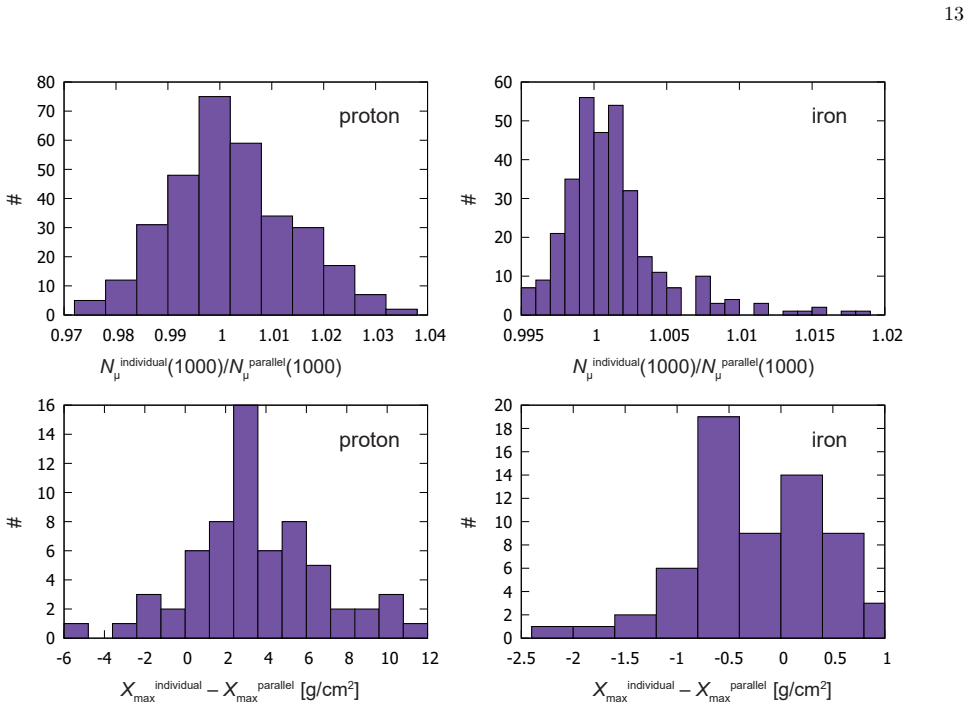
Summary. This paper presents a method for implementing ad-hoc modifications of hadronic interaction parameters (cross section, elasticity, multiplicity) in CONEX 3D, a fully three-dimensional air-shower simulation framework that interfaces CONEX with CORSIKA. The modifications follow a logarithmic interpolation above a threshold energy E_thr, with independent thresholds and magnitudes for each parameter. The paper extensively validates the framework by comparing longitudinal and lateral observables, means and fluctuations, against CONEX and CORSIKA for proton and iron primaries at 5 EeV, using large statistics (7,000 showers per 3D setup; 100,000 for 1D). It then compares longitudinal profiles between CONEX and CONEX 3D under individual modifications, demonstrates the value of 3D information for muon lateral distributions, and tests the commutativity and additivity of parallel modifications. The central claim is that the implementation is 'mature enough for physics conclusions' provided the identified limitations in high-energy muon fluctuations are respected.
Significance. If the result holds, this work provides the cosmic-ray community with a tested 3D simulation tool for studying modified hadronic interactions, enabling physically meaningful comparisons with sparse ground-array data and multi-parameter interaction scenarios. The paper's strengths include unusually thorough validation statistics, open data availability, validation of the unmodified framework against independent CORSIKA simulations, and explicit acknowledgment of the limitations in muon fluctuations. The main residual risk is that the modified-interaction validation relies entirely on a consistency check with the 1D CONEX implementation, which shares the same resampling code, and the quantitative modified-interaction check is only presented for proton primaries.
major comments (2)
- [III D, Figs. 12-13] The quantitative reproducibility check of the modifications is shown only for primary protons; the equivalent comparison for iron nuclei is absent. This is particularly relevant because Section II states that the nuclear cross-section modification uses a different parameterization than the original CONEX implementation. Without an iron benchmark, the central claim that the modified implementation is 'mature enough for physics conclusions' is not fully supported for nuclear primaries, which are part of the intended composition range. Please either add the missing iron comparison or explicitly restrict the claim to proton primaries.
- [III D and VI] The modified-interaction consistency check compares CONEX and CONEX 3D, but both frameworks use the same resampling code ported from [9]. Agreement therefore establishes that the 3D port is faithful, but it does not independently validate that the resampling physically realizes the intended modifications (e.g., energy conservation when scaling elasticity, correct leading-particle exclusion, target f19 distributions). Since the conclusion asserts maturity for physics conclusions, the authors should either add unit-level validation of the resampling against analytical or independent Monte Carlo expectations, or explicitly qualify the conclusion as consistency with the existing 1D implementation rather than absolute physical correctness.
minor comments (4)
- [III C, Fig. 10 and Fig. 11 captions] The text identifies Fig. 10 as the proton case and Fig. 11 as the iron case, but both figure captions state 'for primary iron nuclei.' The captions appear to be swapped; please correct this to avoid ambiguity.
- [Throughout] The notation 'Conex', 'CONEX', and 'Conex 3D' is used inconsistently; please standardize the capitalization and formatting of the framework names.
- [V, Table II] The column descriptions in the caption are unclear: 'The fourth and sixth columns express the values in units of the statistical uncertainty' — specify which columns are meant (e.g., third and fifth) and define the statistical uncertainty used (standard error of the mean?).
- [III B] The 'kink around 1300 g/cm2' attributed to the forced handover of particles to CORSIKA is given only a qualitative explanation. A brief quantitative description of the handover condition would strengthen the interpretation.
Circularity Check
No significant circularity: validation is a port-fidelity/consistency check, not a fitted prediction; self-citations are not load-bearing.
full rationale
The paper's core deliverable is a 3D implementation of previously defined ad-hoc modifications of hadronic interaction parameters (cross section, elasticity, multiplicity). The modification formula (Eqs. 1–2) and the chosen values of f19 and Ethr are inherited from prior work [5,9] as inputs; they are not fitted to the observables claimed to be reproduced. The unmodified CONEX 3D framework is validated against independent CORSIKA simulations for longitudinal profiles, Xmax, and lateral distributions, providing external benchmarks. The modified-interaction validation in Sec. III D compares CONEX and CONEX 3D, but both share the same ported resampling code from [9]; agreement there demonstrates port fidelity and internal consistency, not independent physical correctness. This is a soundness limitation explicitly acknowledged in the paper's structure ('we show that the implementations ... are consistent with the previous one-dimensional simulations'), not a circular derivation in which an output is defined in terms of the claimed prediction or a fitted parameter is relabeled as a prediction. The resampling code from [9] is cited with overlapping authorship (R. Ulrich), and the paper relies on the prior claim that it is 'extensively tested'; this is a minor self-citation that is not load-bearing for the central independent content, which is the 3D port and its comparisons. No step in the derivation chain reduces by construction to its own input.
Axiom & Free-Parameter Ledger
free parameters (5)
- f19 (cross-section) =
0.8 and 1.2 (validation extremes)
- f19 (elasticity) =
0.6 and 1.5
- f19 (multiplicity) =
0.6 and 1.7
- E_thr (per-variable thresholds) =
Not explicitly restated; constraints discussed in Sec. III (cross-section ~≥10^16 eV, elasticity ≥10^14 eV, multiplicity
- E_CE (CONEX Monte Carlo cutoff) =
2e-6 E0 = 10^13 eV for hadrons
axioms (5)
- ad hoc to paper Ad-hoc modification prescription f(E,f19)=1+(f19−1)F(E), F=0 below E_thr, logarithmic interpolation to 10 EeV (Eqs. 1-2)
- domain assumption Sibyll 2.3d superposition model for nuclear projectiles
- domain assumption Correctness of the resampling code ported from CONEX [9]
- domain assumption CORSIKA accurately represents unmodified air showers
- domain assumption Hybrid cascade equations below E_CE remain valid under modifications
read the original abstract
We present a method to test the impact of ad-hoc modifications of some of the generic parameters of hadronic interactions -- cross section, elasticity, and multiplicity -- on any observable quantity using full 3-dimensional simulations of extensive air showers induced by ultra-high-energy cosmic rays. Our approach not only extends the existing 1-dimensional tools to three dimensions, but also introduces more flexible features to better respond to the needs of both theory and experiment. We first thoroughly validate the \conexD framework for the simulation of both longitudinal and lateral features of air showers, in particular for a non-standard configuration of the framework in which different energy thresholds for modifications are applied. Moreover, we show that the implementations of the ad-hoc modifications in this configuration are consistent with the previous one-dimensional simulations. Lastly, we discuss the importance of studying the interaction modifications in three dimensions and the effects of parallel modifications of multiple parameters.
Figures


Forward citations
Cited by 1 Pith paper
-
Proton-air interaction properties at $\sqrt{s} \simeq 100$ TeV from shower-depth measurements with the Pierre Auger Observatory and their connection to the Muon Puzzle
Using a universal relation found across hadronic interaction models, Auger's deeper-than-predicted shower maxima imply increased elasticity and hadronic energy fraction in proton–air collisions, needing 2.8–4.6× ampli...
Reference graph
Works this paper leans on
-
[1]
D. Soldin (EAS-MSU, IceCube, KASCADE-Grande, NEVOD-DECOR, Pierre Auger, SUGAR, Telescope Array, Yakutsk EAS Array), Update on the Com- bined Analysis of Muon Measurements from Nine Air Shower Experiments, PoSICRC2021, 349 (2021), arXiv:2108.08341 [astro-ph.HE]
Pith/arXiv arXiv 2021
-
[2]
J. C. Arteaga Velazquez, A report by the WHISP working group on the combined analysis of muon data at cosmic- ray energies above 1 PeV, inProceedings of 38th Interna- tional Cosmic Ray Conference — PoS(ICRC2023), Vol. 444 (2023) p. 466
2023
-
[3]
A. Abdul Halimet al.(Pierre Auger), Testing hadronic- model predictions of depth of maximum of air-shower profiles and ground-particle signals using hybrid data of the Pierre Auger Observatory, Phys. Rev. D109, 102001 (2024), arXiv:2401.10740 [astro-ph.HE]
Pith/arXiv arXiv 2024
-
[4]
V ´ ıcha, A
J. V ´ ıcha, A. Bakalov´ a, A. L. M¨ uller, O. Tkachenko, and M. K. Stadelmaier, A heavy-metal scenario of ultra-high- energy cosmic rays, The Astrophysical Journal Letters 986, L34 (2025)
2025
-
[5]
Blazek, J
J. Blazek, J. Vicha, J. Ebr, R. Ulrich, T. Pierog, and P. Travnicek, Modified Characteristics of Hadronic In- teractions, PoSICRC2021, 441 (2021)
2021
-
[6]
J. Blazek, J. Ebr, J. Vicha, T. Pierog, and P. Travnicek, A Study of Modified Characteristics of Hadronic Interactions, EPJ Web Conf.283, 05005 (2023), arXiv:2303.15911 [astro-ph.HE]
Pith/arXiv arXiv 2023
-
[7]
J. Ebr, J. Blaˇ zek, J. V ´ ıcha, T. Pierog, E. Santos, P. Tr´ avn ´ ıcek, and N. Denner, Impact of modified char- acteristics of hadronic interactions on cosmic-ray observ- ables for proton and nuclear primaries, PoSICRC2023, 245 (2023)
2023
-
[8]
J. Ebr, J. Blazek, J. Vicha, T. Pierog, E. Santos, P. Travnicek, N. Denner, and R. Ulrich, Modified Char- acteristics of Hadronic Interactions in Ultra-High-Energy Cosmic-Ray Showers, Ukr. J. Phys.69, 786 (2024), arXiv:2410.15699 [astro-ph.HE]
Pith/arXiv arXiv 2024
-
[9]
R. Ulrich, R. Engel, and M. Unger, Hadronic Mul- tiparticle Production at Ultra-High Energies and Ex- tensive Air Showers, Phys. Rev. D83, 054026 (2011), arXiv:1010.4310 [hep-ph]
Pith/arXiv arXiv 2011
-
[10]
T. Bergmann, R. Engel, D. Heck, N. N. Kalmykov, S. Ostapchenko, T. Pierog, T. Thouw, and K. Werner, One-dimensional Hybrid Approach to Extensive Air Shower Simulation, Astropart. Phys.26, 420 (2007), arXiv:astro-ph/0606564 [astro-ph]
Pith/arXiv arXiv 2007
-
[11]
D. Heck, J. Knapp, J. N. Capdevielle, G. Schatz, and T. Thouw, CORSIKA: A Monte Carlo code to simulate extensive air showers, FZKA report (1998)
1998
-
[12]
Pierog, R
T. Pierog, R. Engel, and D. Heck, 3D air shower simu- lations using CONEX in CORSIKA, 31st International Cosmic Ray Conference, ICRC 2009 (2009)
2009
-
[13]
S. Acharyaet al.(ALICE), Production ofπ 0 andη mesons up to high transverse momentum in pp colli- sions at 2.76 TeV, Eur. Phys. J. C77, 339 (2017), arXiv:1702.00917 [hep-ex]
Pith/arXiv arXiv 2017
-
[14]
H. Adhikaryet al.(NA61/SHINE), Evidence of isospin-symmetry violation in high-energy collisions of atomic nuclei, Nature Commun.16, 2849 (2025), arXiv:2312.06572 [nucl-ex]
Pith/arXiv arXiv 2025
-
[15]
Navaset al.(Particle Data Group Collaboration), Review of particle physics, Phys
S. Navaset al.(Particle Data Group Collaboration), Review of particle physics, Phys. Rev. D110, 030001 (2024)
2024
-
[16]
G. Antchevet al., First measurement of elastic, inelas- tic and total cross-section at √s= 13 tev by totem and overview of cross-section data at lhc energies (2018), arXiv:1712.06153 [hep-ex]
Pith/arXiv arXiv 2018
-
[17]
Aaboudet al., Measurement of the total cross section from elastic scattering in pp collisions at √s= 8 TeV with the ATLAS detector, Physics Letters B761, 158 (2016)
M. Aaboudet al., Measurement of the total cross section from elastic scattering in pp collisions at √s= 8 TeV with the ATLAS detector, Physics Letters B761, 158 (2016)
2016
-
[18]
G. Aadet al.(ATLAS), Measurement of the total cross section andρ-parameter from elastic scattering in pp col- lisions at √s= 13 TeV with the ATLAS detector, Eur. Phys. J. C83, 441 (2023), arXiv:2207.12246 [hep-ex]
Pith/arXiv arXiv 2023
-
[19]
Malarg¨ ue GDAS model for May after Will/Keilhauer
and Telescope Array [20] measurements at higher energies come with large uncertainties. For elasticity, due to the lack of precise forward measurements, al- ready the current models show large differences in pre- dictions across a wide range of energies; for technical reasons however, we do not consider values lower than Ethr = 1014 eV. For multiplicity, ...
2000
-
[20]
P. Abreuet al.(Pierre Auger), Measurement of the proton-air cross-section at √s= 57 TeV with the Pierre Auger Observatory, Phys. Rev. Lett.109, 062002 (2012), arXiv:1208.1520 [hep-ex]
Pith/arXiv arXiv 2012
-
[21]
R. Abbasiet al., Measurement of the proton-air cross sec- tion with Telescope Array’s Middle Drum detector and surface array in hybrid mode, PRD92, 032007 (2015), arXiv:1505.01860 [astro-ph.HE]
Pith/arXiv arXiv 2015
-
[22]
F. Riehn, R. Engel, A. Fedynitch, T. K. Gaisser, and T. Stanev, Hadronic interaction model Sibyll 2.3d and extensive air showers, Phys. Rev. D102, 063002 (2020), arXiv:1912.03300 [hep-ph]
Pith/arXiv arXiv 2020
-
[23]
Ostapchenko, Monte Carlo treatment of hadronic in- teractions in enhanced Pomeron scheme: I
S. Ostapchenko, Monte Carlo treatment of hadronic in- teractions in enhanced Pomeron scheme: I. QGSJET-II model, Phys. Rev. D83, 014018 (2011), arXiv:1010.1869 [hep-ph]
Pith/arXiv arXiv 2011
-
[24]
T. Pierog, I. Karpenko, J. M. Katzy, E. Yatsenko, and K. Werner, EPOS LHC: Test of collective hadronization with data measured at the CERN Large Hadron Collider, Phys. Rev. C92, 034906 (2015), arXiv:1306.0121 [hep- ph]
Pith/arXiv arXiv 2015
-
[25]
Sj¨ ostrand, The PYTHIA Event Generator: Past, Present and Future, Comput
T. Sj¨ ostrand, The PYTHIA Event Generator: Past, Present and Future, Comput. Phys. Commun.246, 106910 (2020), arXiv:1907.09874 [hep-ph]
Pith/arXiv arXiv 2020
-
[26]
Fedynitch, H
A. Fedynitch, H. Dembinski, A. Prosekin, S. El Hadri, and K. Watanabe, Chromo: Cosmic ray and hadronic interaction monte- carlo frontend (2025)
2025
-
[27]
G. Aadet al., Measurement of the total cross section andρ-parameter from elastic scattering in pp collisions at √s= 13 tev with the atlas detector, The European Physical Journal C83, 10.1140/epjc/s10052-023-11436-8 (2023)
-
[28]
A. M. Botti, I. A. Goos, M. Perlin, and T. Pierog, Study of the muon component in the core-corona model us- ing CONEX 3D, Journal of Cosmology and Astroparticle Physics2025(01), 119
-
[29]
Bleicher, E
M. Bleicher, E. Zabrodin, C. Spieles, S. A. Bass, C. Ernst, S. Soff, L. Bravina, M. Belkacem, H. Weber, H. St¨ ocker, and W. Greiner, Relativistic hadron-hadron 15 collisions in the ultra-relativistic quantum molecular dy- namics model, Journal of Physics G: Nuclear and Particle Physics25, 1859–1896 (1999)
1999
-
[30]
Montanus, An extended Heitler–Matthews model for the full hadronic cascade in cosmic air showers, Astropar- ticle Physics59, 4 (2014)
J. Montanus, An extended Heitler–Matthews model for the full hadronic cascade in cosmic air showers, Astropar- ticle Physics59, 4 (2014)
2014
-
[31]
Aabet al.(Pierre Auger), The Pierre Auger Cos- mic Ray Observatory, Nucl
A. Aabet al.(Pierre Auger), The Pierre Auger Cos- mic Ray Observatory, Nucl. Instrum. Meth. A798, 172 (2015), arXiv:1502.01323 [astro-ph.IM]
Pith/arXiv arXiv 2015
-
[32]
J. Ebr, J. Blaˇ zek, and J. Vicha, Data for Modi- fied hadronic interactions in 3-dimensional simulations , 10.5281/zenodo.18282786 (2026)
discussion (0)
Sign in with ORCID, Apple, or X to comment. Anyone can read and Pith papers without signing in.