REVIEW 2 major objections 4 minor 1 cited by
Quantum spin Hall effects in van der Waals materials
T0 review · 2 major / 4 minor · reviewed 2026-08-07 · deepseek-v4-flash
Pith's one-line read Van der Waals monolayers and moiré stacks — WTe₂, TaIrTe₄, and twisted transition-metal dichalcogenides — now host quantum spin Hall states that intertwine with excitonic, charge-density-wave, and superconducting phases, the review argues.
desk verdict A timely, well-referenced review of QSH in vdW materials that sells the two-terminal transport evidence a little harder than the data warrant; fix the caveat and it is a useful reference. read the letter →
The pith
A machine-rendered reading of the paper's core claim, the machinery that carries it, and where it could break.
The reading
What carries the argument
The load-bearing object is the QSH state itself: a two-dimensional insulator whose band inversion produces one-dimensional helical edge states with spin-momentum locking, protected by time-reversal symmetry and conducting exactly e²/h per edge. The review's machinery adds the Z₂ topological invariant — computed by parity eigenvalues at time-reversal-invariant momenta (the TRIM method), Wannier charge centers, or lattice field-strength sums (the n-field method) — and the two band-inversion routes: Type 1, driven by crystal structure and orbital interactions (as in the distorted 1T′ lattices of WTe₂ and TaIrTe₄), and Type 2, driven purely by spin-orbit coupling. A subsidiary mechanism is the moiré flat band: twisted TMD homobilayers map onto a Kane–Mele–Hubbard model whose strong correlations drive the cascade from integer QSH through QAH to fractional states, and whose Ising spin conservation (S_z) can protect edge quantization independently of time-reversal symmetry.
What would settle it
Measure the two-terminal conductance of a roughly 100 nm gate-defined channel in monolayer TaIrTe₄ (or WTe₂) while rotating an in-plane magnetic field and reversing the current direction: spin-momentum-locked helical edges predict an anisotropic suppression tied to a fixed spin axis (for WTe₂, 40±2° to the layer normal) and a nonlocal spin-valve hysteresis that flips when the current reverses. An isotropic field response, or a hysteresis that does not flip with current reversal, would show the channels are not helical QSH edges.
Extended reading notes
Core claim
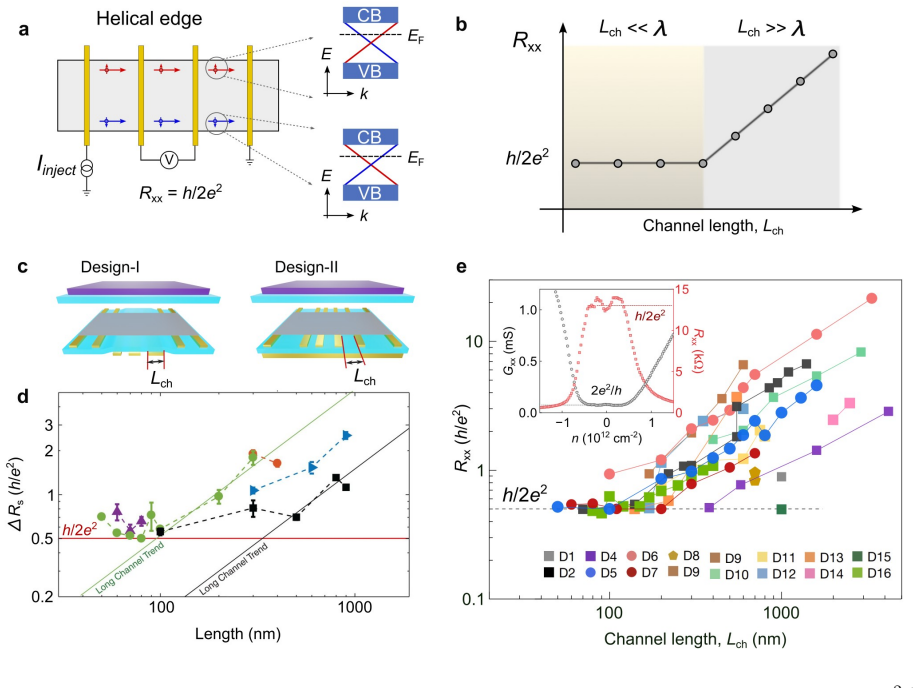
On the paper's own terms, the central discovery is that the quantum spin Hall state, first imagined in graphene and first realized in HgTe quantum wells, has become a working van der Waals physics: monolayer WTe₂ and TaIrTe₄ show quantized helical edge conductance of e²/h per edge in short (100–200 nm) gate-defined channels, with spectroscopic and microscopic confirmation of the inverted bulk gap and edge-localized states. The review's stronger claim is that in these materials topology does not sit alone: in WTe₂ the topological gap appears to be an excitonic condensation gap that also borders a gate-tunable superconducting phase, and in TaIrTe₄ a second, correlation-driven QSH state emerges at finite doping near van Hove singularities, likely aided by a charge density wave. In twisted TMD moirés, flat bands generate integer, double, and triple QSH states, magnetic-field-driven transitions from QSH to quantum anomalous Hall states, and — at special fillings — fractionalized QAH and QSH states. The paper presents these intertwined phases not as noise around the QSH effect but as its defining feature.
Load-bearing premise
The review's central picture depends on the assumption that the quantized conductance and enhanced nonlocal signals measured in short channels (under about 100–200 nm) genuinely come from the helical edge states of a topological insulator, rather than from trivial edge channels, leakage currents, or artifacts of the gate-defined geometry.
Editorial extensions
If this is right
- Monolayer WTe₂ and TaIrTe₄ are established QSH platforms: their edge conduction is verified spectroscopically and by quantized transport, and it can be gated, switched, and interfaced with magnetic and superconducting layers.
- In WTe₂, topology, an excitonic insulating gap, and gate-induced superconductivity coexist in one monolayer, so a single material can host topological and superconducting regions side by side.
- TaIrTe₄'s dual QSH state shows that a correlation-driven gap (likely CDW-assisted) can inherit the band topology and form topological flat minibands, a route to fractionalized phases without moiré.
- Moiré TMDs provide a tunable ladder — single, double, and triple QSH states, field-driven QSH-to-QAH transitions, and fractional QAH and QSH states — making the twist angle and displacement field control knobs for topology.
- If the synthesis is right, QSH-derived nonlinear Hall rectifiers can harvest microwave and THz energy, and fractionalized QSH and QAH states offer a path to measurement-based topological quantum computing.
Reading between the lines
- A design rule the paper leaves implicit: any near-miss narrow-gap semiconductor with van Hove singularities near the Fermi level is a candidate dual QSH insulator; the isoelectronic NbIrTe₄ and other MM′Te₄ members are the immediate test cases.
- Because quantization currently dies out beyond roughly 100–200 nm, the practical bet is that edge quality, not the topological invariant, sets the ballistic length; isotopically pure, atomically sharp-edged (ideally quasi-1D) samples should push quantization to micrometers — a testable prediction.
- If moiré QSH protection is really S_z conservation rather than full time-reversal symmetry, then the same edge that ignores out-of-plane magnetic disorder should localize under any in-plane exchange field; a tilted-field transport experiment in twisted MoTe₂ or WSe₂ could separate the two protection mechanisms.
- The claim that nonlinear-Hall rectification is gapless and works at arbitrarily small power implies a QSH-material rectifier should have no threshold voltage; comparing its low-power conversion efficiency against a conventional Schottky rectenna at matched impedance would quantify the advantage.
Editorial analysis
A structured set of objections, weighed in public.
Referee Report
Summary. This review article surveys the quantum spin Hall (QSH) effect in van der Waals materials, concentrating on monolayer 1T'-MX2 (represented by WTe2), MM'Te4 (represented by TaIrTe4), and twisted transition-metal dichalcogenide moiré systems. It covers the theoretical design of QSH insulators, computational methods for topological invariants, experimental characterization via ARPES, STM/STS, microwave impedance microscopy, and transport, and the intertwining of QSH with correlated phases such as excitonic insulators, charge density waves, and superconductivity. It also discusses fractional QSH and fractional Chern insulators, nonlinear Hall and circular photogalvanic effects, interfacing QSH layers with magnetic and superconducting materials, and potential applications including energy harvesting and topological quantum computing. The central thesis is that van der Waals monolayers and moiré systems host robust QSH states that are intertwined with or in close proximity to correlated quantum phases.
Significance. This is a timely and comprehensive review that brings together a rapidly expanding literature on quantum spin Hall effects in van der Waals materials. Its strengths include broad coverage of theoretical design principles, computational approaches, a suite of experimental probes, and recent developments such as fractional Chern and fractional spin Hall states in moiré TMDs, plus explicit caveats about edge robustness in Sec. 9.1. If the transport evidence for WTe2 and TaIrTe4 is accepted, the review makes a strong case that these families are established QSH platforms with rich correlated-phase physics. However, the central claim is sensitive to the interpretation of the two-terminal quantized conductance, which the current text presents too confidently, and the unresolved nature of the fractional QSH state is understated in the abstract.
major comments (2)
- [§3.2 and §4.1/4.2] The review states in Sec. 3.2 that the quantized conductance of e²/h per edge 'provides unambiguous evidence of the QSH effect, distinguishing it from conventional edge transport.' This claim is load-bearing because the entire synthesis rests on WTe2 and TaIrTe4 being robust QSH platforms. However, the highlighted plateaus in Refs. [27] and [29] were measured in two-terminal, short-channel devices whose channel length is defined by gates or contacts. In such devices, a two-terminal resistance plateau can be produced by contact resistance or by trivial edge channels along gate-defined boundaries, rather than by helical edge states. The review does not discuss four-terminal conductance measurements or other controls that would exclude these alternatives; the only spin-sensitive check described is the ferromagnetic-contact spin valve in TaIrTe4. I recommend that the authors add a critical paragraph in Sec. 3.2 (or Sec. 9.1) that explicitly addresses this alternative interpretation and states what additional measurements (e.g., four-terminal quantized resistance, edge-selective contacts) would settle it.
- [§5 and Abstract] The abstract states that 'fractionalized QAH and QSH states have recently been observed in moiré systems,' and Sec. 5 opens with 'the fractional QSH and fractional Chern insulator has been realized.' Yet later in Sec. 5 the review admits that the precise nature of the ν=-3 state in twisted MoTe2 remains under investigation, citing magneto-circular dichroism evidence of apparent time-reversal symmetry breaking [146]. Because time-reversal symmetry is the defining protection of a QSH phase, calling this state a fractional QSH while acknowledging TRS breaking is internally inconsistent unless the review explains how the two observations can coexist. Please either soften the abstract and Sec. 5 wording to present the fractional QSH as a candidate state with unresolved symmetry properties, or directly address the TRS-breaking evidence in the text.
minor comments (4)
- [Table I] Table I lists experimental gap values for WTe2 as '5, 56±14, 60' meV, while Sec. 3.1 reports an ARPES gap of ~45±20 meV and STM gaps of 47–91 meV; these numbers should be reconciled or labeled with their corresponding measurement techniques.
- [Fig. 5 caption] The caption of Fig. 5 contains two typos: 'TaIrTe2' should be 'TaIrTe4,' and in panel c the field labeled 'B∥' is described as 'parallel' but should be 'perpendicular' (or the notation corrected).
- [§8.3 and §8.1] In Sec. 8.3, 'bogoliuvbov quasiparticle' is a typo for 'Bogoliubov quasiparticle'; also 'Kondou et. al.' in Sec. 8.1 should be 'Kondou et al.'
- [§2.2] The Fu–Kane formula in Sec. 2.2 appears garbled: the product over occupied bands and TRIMs is written as 'QN i=1 Q m ξm(Γi)' without the Γ index in the first product; please correct the typography so the formula matches Ref. [80].
Circularity Check
No circularity: the review's synthesis is a survey of independent experimental and computational results, with no derivation that reduces to its inputs.
full rationale
This is a review article, not a derivation or fitting paper. Its central claims—that WTe2, TaIrTe4, and twisted TMD moiré systems host QSH states—are presented as summaries of previously published experimental and first-principles results (e.g., Fei et al. Nature Physics 2017; Wu et al. Science 2018; Tang et al. Nature 2024; Kang et al. Nature 2024), not as predictions derived within this paper. The review contains no equations in which an output quantity is defined in terms of the quantity it is supposed to predict, and no parameter is fitted to data and then renamed as a prediction. Self-citations (e.g., Qian et al. 2014, Tang et al. 2024, Wang and Qian 2019) are used to attribute specific results to the work where they were originally established; these are externally published, experimentally or computationally falsifiable results, and the review does not invoke any uniqueness theorem or ansatz from the authors' prior work to forbid alternatives. The paper even acknowledges limitations, such as the short quantization length and the delicacy of helical edge conduction under time-reversal-breaking scattering (Section 9.1), which further indicates that the review is not forcing its conclusion by construction. Accordingly, no circular step can be exhibited, and the appropriate score is 0.
Assumptions & free parameters
assumptions (4)
- domain assumption The results and interpretations of the cited experimental and computational papers are accurate as summarized.
- standard math Bulk-boundary correspondence and the Z2 classification of time-reversal-invariant insulators provide a valid description of the QSH phase.
- standard math The Berry curvature dipole and nonlinear Hall effect formalism correctly describes the observed nonlinear responses in WTe2 and TaIrTe4.
- domain assumption Moiré flat-band models and interaction Hamiltonians (e.g., tight-binding Hubbard models) capture the physics of twisted TMD systems.
Cite this review
Pith. "Pith review of Quantum spin Hall effects in van der Waals materials." pith.science (2026). https://pith.science/paper/KJDFOP72
@misc{pith2026250518335,
  author       = {Pith},
  title        = {Pith review of: Quantum spin Hall effects in van der Waals materials},
  year         = {2026},
  howpublished = {\url{https://pith.science/paper/KJDFOP72}},
  note         = {Machine review of arXiv:2505.18335}
}
abstract
The quantum spin Hall (QSH) effect, first predicted in graphene by Kane and Mele in 2004, has emerged as a prototypical platform for exploring spin-orbit coupling, topology, and electronic interactions. Initially realized experimentally in quantum wells exhibiting characteristic QSH signatures, the field has since expanded with the discovery of van der Waals (vdW) materials. This review focuses on vdW systems, which offer unique advantages: their exposed surfaces enable a combination of surface-sensitive spectroscopic and microscopic tools for comprehensive detection of the QSH state; mechanical stacking with other vdW layers facilitates symmetry engineering and proximity effects; and moir\'e engineering introduces layer skyrmion topological phases and strong correlation effects. We highlight two monolayer families, 1T$^\prime$-MX$_2$ and MM$^\prime$X$_4$, represented by WTe$_2$ and TaIrTe$_4$, respectively. These materials exhibit QSH phases intertwined with or in close proximity to other quantum phases, such as excitonic insulators, charge density waves, and superconductivity. Their low crystal symmetry and topology enable rich quantum geometrical responses, ranging from nonlinear Hall effects to circular photogalvanic effects. We also discuss moir\'e systems, which combine topology with flatband physics and enhanced correlations, driving spontaneous symmetry breaking and transitions from QSH to quantum anomalous Hall (QAH) states. Remarkably, fractionalized QAH and QSH states have recently been observed in moir\'e systems, significantly advancing the field of condensed matter physics. Finally, we explore emerging applications of QSH and derived materials, such as using nonlinear Hall effects for quantum rectification in microwave energy harvesting and harnessing fractional anomalous states for topological quantum computing.
Figures


Figures from the paper (9 more)


Forward citations
Cited by 1 Pith paper
-
Theory of off-diagonal disorder in multilayer topological insulator
A single random interlayer hopping defect creates an in-gap bound state that crosses mid-gap only in the trivial phase, and random interlayer tunneling can close the gap and degrade quantized edge conductance.
Reference graph
Works this paper leans on
-
[27]
Observation of the quantum spin Hall effect up to 100 kelvin in a monolayer crystal.Science, 359(6371):76–79, 2018
Sanfeng Wu, Valla Fatemi, Quinn D Gibson, Kenji Watanabe, Takashi Taniguchi, Robert J Cava, and Pablo Jarillo-Herrero. Observation of the quantum spin Hall effect up to 100 kelvin in a monolayer crystal.Science, 359(6371):76–79, 2018
2018
-
[29]
Bell, Ziqiang Wang, Liang Fu, Yang Zhang, Xiaofeng Qian, Kenneth S
Jian Tang, Thomas Siyuan Ding, Hongyu Chen, Anyuan Gao, Tiema Qian, Zumeng Huang, Zhe Sun, Xin Han, Alex Strasser, Jiangxu Li, Michael Geiwitz, Mohamed Shehabeldin, Vsevolod Belosevich, Zihan Wang, Yiping Wang, Kenji Watanabe, Takashi Taniguchi, David C. Bell, Ziqiang Wang, Liang Fu, Yang Zhang, Xiaofeng Qian, Kenneth S. Burch, Youguo Shi, Ni Ni, Guoqing ...
2024
-
[146]
Kaifei Kang, Yichen Qiu, Bowen Shen, Kihong Lee, Zhengchao Xia, Yihang Zeng, Kenji Watanabe, Takashi Taniguchi, Jie Shan, and Kin Fai Mak. Time-reversal symmetry breaking fractional quantum spin Hall insulator in moir´ e MoTe2.arXiv preprint arXiv:2501.02525, 2025
arXiv 2025
-
[1]
Quantum spin Hall effect in graphene.Physical Review Letters, 95(22):226801, 2005
Charles L Kane and Eugene J Mele. Quantum spin Hall effect in graphene.Physical Review Letters, 95(22):226801, 2005
2005
-
[2]
Quantum spin Hall effect and topological phase transition in HgTe quantum wells.Science, 314(5806):1757–1761, 2006
B Andrei Bernevig, Taylor L Hughes, and Shou-Cheng Zhang. Quantum spin Hall effect and topological phase transition in HgTe quantum wells.Science, 314(5806):1757–1761, 2006
2006
-
[3]
The quantum spin Hall effect and topological insu- lators.Physics Today, 63(1):33–38, 2010
Xiao-Liang Qi and Shou-Cheng Zhang. The quantum spin Hall effect and topological insu- lators.Physics Today, 63(1):33–38, 2010
2010
-
[4]
The quantum spin Hall effect
Joseph Maciejko, Taylor L Hughes, and Shou-Cheng Zhang. The quantum spin Hall effect. Annual Review of Condensed Matter Physics, 2(1):31–53, 2011
2011
-
[5]
Resonance microwave measurements of an intrinsic spin-orbit coupling gap in graphene: a possible indication of a topological state.Physical Review Letters, 122(4):046403, 2019
J Sichau, M Prada, T Anlauf, TJ Lyon, B Bosnjak, L Tiemann, and RH Blick. Resonance microwave measurements of an intrinsic spin-orbit coupling gap in graphene: a possible indication of a topological state.Physical Review Letters, 122(4):046403, 2019
2019
Show all 209 references
-
[6]
Tunable symmetry breaking and helical edge transport in a graphene quantum spin Hall state.Nature, 505(7484):528–532, 2014
AF Young, JD Sanchez-Yamagishi, B Hunt, SH Choi, K Watanabe, T Taniguchi, RC Ashoori, and P Jarillo-Herrero. Tunable symmetry breaking and helical edge transport in a graphene quantum spin Hall state.Nature, 505(7484):528–532, 2014
2014
-
[7]
Helical quantum Hall phase in graphene on SrTiO 3.Science, 367(6479):781–786, 2020
Louis Veyrat, Corentin D´ eprez, Alexis Coissard, Xiaoxi Li, Fr´ ed´ eric Gay, Kenji Watanabe, Takashi Taniguchi, Zheng Han, Benjamin A Piot, Hermann Sellier, et al. Helical quantum Hall phase in graphene on SrTiO 3.Science, 367(6479):781–786, 2020
2020
-
[8]
Spin-filtered edge states and quantum Hall effect in graphene.Physical Review Letters, 96(17):176803, 2006
Dmitry A Abanin, Patrick A Lee, and Leonid S Levitov. Spin-filtered edge states and quantum Hall effect in graphene.Physical Review Letters, 96(17):176803, 2006
2006
-
[9]
Maxim Kharitonov, Stefan Juergens, and Bj¨ orn Trauzettel. Interplay of topology and in- teractions in quantum Hall topological insulators: U(1) symmetry, tunable Luttinger liquid, and interaction-induced phase transitions.Physical Review B, 94(3):035146, 2016
2016
-
[10]
Helical edge states and fractional quantum Hall effect in a graphene electron-hole bilayer.Nature Nan- otechnology, 12(2):118–122, 2017
Javier D Sanchez-Yamagishi, Jason Y Luo, Andrea F Young, Benjamin M Hunt, Kenji Watanabe, Takashi Taniguchi, Raymond C Ashoori, and Pablo Jarillo-Herrero. Helical edge states and fractional quantum Hall effect in a graphene electron-hole bilayer.Nature Nan- otechnology, 12(2):...
2017
-
[11]
Quantum spin Hall insulator state in HgTe quantum wells.Science, 318(5851):766–770, 2007
Markus Konig, Steffen Wiedmann, Christoph Brune, Andreas Roth, Hartmut Buhmann, Laurens W Molenkamp, Xiao-Liang Qi, and Shou-Cheng Zhang. Quantum spin Hall insulator state in HgTe quantum wells.Science, 318(5851):766–770, 2007
2007
-
[12]
Evidence for helical edge modes in inverted InAs/GaSb quantum wells.Physical Review Letters, 107(13):136603, 2011
Ivan Knez, Rui-Rui Du, and Gerard Sullivan. Evidence for helical edge modes in inverted InAs/GaSb quantum wells.Physical Review Letters, 107(13):136603, 2011
2011
-
[13]
Quantum spin Hall effect in two-dimensional transition metal dichalcogenides.Science, 346(6215):1344–1347, 2014
Xiaofeng Qian, Junwei Liu, Liang Fu, and Ju Li. Quantum spin Hall effect in two-dimensional transition metal dichalcogenides.Science, 346(6215):1344–1347, 2014
2014
-
[14]
van der waals stacking- induced topological phase transition in layered ternary transition metal chalcogenides.Nano Letters, 17(1):467–475, 2017
Junwei Liu, Hua Wang, Chen Fang, Liang Fu, and Xiaofeng Qian. van der waals stacking- induced topological phase transition in layered ternary transition metal chalcogenides.Nano Letters, 17(1):467–475, 2017
2017
-
[15]
Room temperature quantum spin Hall insulators with a buckled square lattice.Nano Letters, 15(5):3230–3235, 2015
Wei Luo and Hongjun Xiang. Room temperature quantum spin Hall insulators with a buckled square lattice.Nano Letters, 15(5):3230–3235, 2015
2015
-
[16]
Large-gap quantum spin Hall insulator in single layer bismuth monobromide Bi 4Br4.Nano Letters, 14(8):4767–4771, 2014
Jin-Jian Zhou, Wanxiang Feng, Cheng-Cheng Liu, Shan Guan, and Yugui Yao. Large-gap quantum spin Hall insulator in single layer bismuth monobromide Bi 4Br4.Nano Letters, 14(8):4767–4771, 2014
2014
-
[17]
Weak Topological Insu- lators and Composite Weyl Semimetals:β-Bi 4X4 (X=Br, I).Physical Review Letters, 39 116(6):066801, 2016
Cheng-Cheng Liu, Jin-Jian Zhou, Yugui Yao, and Fan Zhang. Weak Topological Insu- lators and Composite Weyl Semimetals:β-Bi 4X4 (X=Br, I).Physical Review Letters, 39 116(6):066801, 2016
2016
-
[18]
Cochran, Daniel Multer, Xian P
Nana Shumiya, Md Shafayat Hossain, Jia-Xin Yin, Zhiwei Wang, Maksim Litskevich, Chiho Yoon, Yongkai Li, Ying Yang, Yu-Xiao Jiang, Guangming Cheng, Yen-Chuan Lin, Qi Zhang, Zi-Jia Cheng, Tyler A. Cochran, Daniel Multer, Xian P. Yang, Brian Casas, Tay-Rong Chang, Titus Neupert, ...
2022
-
[19]
A novel quasi-one- dimensional topological insulator in bismuth iodideβ-Bi 4I4.Nature Materials, 15(2):154–158, 2016
Gabriel Aut` es, Anna Isaeva, Luca Moreschini, Jens C Johannsen, Andrea Pisoni, Ryo Mori, Wentao Zhang, Taisia G Filatova, Alexey N Kuznetsov, L´ aszl´ o Forr´ o, et al. A novel quasi-one- dimensional topological insulator in bismuth iodideβ-Bi 4I4.Nature Materials, 15(2):154–...
2016
-
[20]
Realization of monolayer ZrTe 5 topological insulators with wide band gaps.Nature Communications, 15(1):4784, 2024
Yong-Jie Xu, Guohua Cao, Qi-Yuan Li, Cheng-Long Xue, Wei-Min Zhao, Qi-Wei Wang, Li- Guo Dou, Xuan Du, Yu-Xin Meng, Yuan-Kun Wang, et al. Realization of monolayer ZrTe 5 topological insulators with wide band gaps.Nature Communications, 15(1):4784, 2024
2024
-
[21]
Transition-metal pentatelluride ZrTe5 and HfTe5: A paradigm for large-gap quantum spin Hall insulators.Physical Review X, 4(1):011002, 2014
Hongming Weng, Xi Dai, and Zhong Fang. Transition-metal pentatelluride ZrTe5 and HfTe5: A paradigm for large-gap quantum spin Hall insulators.Physical Review X, 4(1):011002, 2014
2014
-
[22]
Evidence for topological edge states in a large energy gap near the step edges on the surface of ZrTe 5.Physical Review X, 6(2):021017, 2016
R Wu, J-Z Ma, S-M Nie, L-X Zhao, Xuejie Huang, J-X Yin, B-B Fu, P Richard, G-F Chen, Zhong Fang, et al. Evidence for topological edge states in a large energy gap near the step edges on the surface of ZrTe 5.Physical Review X, 6(2):021017, 2016
2016
-
[23]
Experimental observation of topological edge states at the surface step edge of the topological insulator ZrTe 5.Physical Review Letters, 116(17):176803, 2016
Xiang-Bing Li, Wen-Kai Huang, Yang-Yang Lv, Kai-Wen Zhang, Chao-Long Yang, Bin-Bin Zhang, YB Chen, Shu-Hua Yao, Jian Zhou, Ming-Hui Lu, et al. Experimental observation of topological edge states at the surface step edge of the topological insulator ZrTe 5.Physical Review Lette...
2016
-
[24]
Two-Dimensional Quantum Hall Effect and Zero Energy State in Few-Layer ZrTe5.Nano Letters, 21(14):5998–6004, 2021
Fangdong Tang, Peipei Wang, Mingquan He, Masahiko Isobe, Genda Gu, Qiang Li, Liyuan Zhang, and Jurgen H Smet. Two-Dimensional Quantum Hall Effect and Zero Energy State in Few-Layer ZrTe5.Nano Letters, 21(14):5998–6004, 2021
2021
-
[25]
Quasi-one-dimensional higher- order topological insulators, 2020
Chiho Yoon, Cheng-Cheng Liu, Hongki Min, and Fan Zhang. Quasi-one-dimensional higher- order topological insulators, 2020
2020
-
[26]
Edge conduction in monolayer WTe2.Nature Physics, 13(7):677–682, 2017
Zaiyao Fei, Tauno Palomaki, Sanfeng Wu, Wenjin Zhao, Xinghan Cai, Bosong Sun, Paul Nguyen, Joseph Finney, Xiaodong Xu, and David H Cobden. Edge conduction in monolayer WTe2.Nature Physics, 13(7):677–682, 2017
2017
-
[28]
Fran- cisco, Di Wu, Zhi-Xun Shen, Xiaodong Xu, David H
Yanmeng Shi, Joshua Kahn, Ben Niu, Zaiyao Fei, Bosong Sun, Xinghan Cai, Brian A. Fran- cisco, Di Wu, Zhi-Xun Shen, Xiaodong Xu, David H. Cobden, and Yong-Tao Cui. Imaging quantum spin Hall edges in monolayer WTe 2.Science Advances, 5(2):eaat8799, 2019
2019
-
[30]
Moore, Chan-Cuk Hwang, Choongyu Hwang, Zahid 40 Hussain, Yulin Chen, Miguel M
Shujie Tang, Chaofan Zhang, Dillon Wong, Zahra Pedramrazi, Hsin-Zon Tsai, Chunjing Jia, Brian Moritz, Martin Claassen, Hyejin Ryu, Salman Kahn, Juan Jiang, Hao Yan, Makoto Hashimoto, Donghui Lu, Robert G. Moore, Chan-Cuk Hwang, Choongyu Hwang, Zahid 40 Hussain, Yulin Chen, Mig...
2017
-
[31]
Alexandre Cevallos, Michael Onyszczak, Nadezhda Fishchenko, Xiaomeng Liu, Gelareh Farahi, Fang Xie, Yuanfeng Xu, Kenji Watanabe, Takashi Taniguchi, B
Yanyu Jia, Pengjie Wang, Cheng-Li Chiu, Zhida Song, Guo Yu, Berthold J¨ ack, Shiming Lei, Sebastian Klemenz, F. Alexandre Cevallos, Michael Onyszczak, Nadezhda Fishchenko, Xiaomeng Liu, Gelareh Farahi, Fang Xie, Yuanfeng Xu, Kenji Watanabe, Takashi Taniguchi, B. Andrei Bernevi...
2022
-
[32]
Samaneh Ataei, Daniele Varsano, Maurizia Palummo, Elisa Molinari, Massimo Rontani, and David H
Bosong Sun, Wenjin Zhao, Tauno Palomaki, Zaiyao Fei, Elliott Runburg, Paul Malinowski, Xiong Huang, John Cenker, Yong-Tao Cui, Jiun-Haw Chu, Xiaodong Xu, S. Samaneh Ataei, Daniele Varsano, Maurizia Palummo, Elisa Molinari, Massimo Rontani, and David H. Cob- den. Evidence for e...
2022
-
[33]
Topological excitons.Nature Physics, 18(1):6–7, 2022
Vitor M Pereira. Topological excitons.Nature Physics, 18(1):6–7, 2022
2022
-
[34]
Charge-neutral electronic excitations in quantum insulators.Nature, 635(8038):301– 310, 2024
Sanfeng Wu, Leslie M Schoop, Inti Sodemann, Roderich Moessner, Robert J Cava, and NP Ong. Charge-neutral electronic excitations in quantum insulators.Nature, 635(8038):301– 310, 2024
2024
-
[35]
Prediction of dual quantum spin Hall insulator in NbIrTe4 monolayer.Chinese Physics Letters, 42(3):037302, 2025
Xiangyang Liu, Junwen Lai, Jie Zhan, Tianye Yu, Wujun Shi, Peitao Liu, Xing-Qiu Chen, and Yan Sun. Prediction of dual quantum spin Hall insulator in NbIrTe4 monolayer.Chinese Physics Letters, 42(3):037302, 2025
2025
-
[36]
Hubbard model physics in transition metal dichalcogenide moir´ e bands.Physical Review Letters, 121(2):026402, 2018
Fengcheng Wu, Timothy Lovorn, Emanuel Tutuc, and Allan H MacDonald. Hubbard model physics in transition metal dichalcogenide moir´ e bands.Physical Review Letters, 121(2):026402, 2018
2018
-
[37]
Topo- logical insulators in twisted transition metal dichalcogenide homobilayers.Physical Review Letters, 122(8):086402, 2019
Fengcheng Wu, Timothy Lovorn, Emanuel Tutuc, Ivar Martin, and AH MacDonald. Topo- logical insulators in twisted transition metal dichalcogenide homobilayers.Physical Review Letters, 122(8):086402, 2019
2019
-
[38]
Magic in twisted transition metal dichalcogenide bilayers.Nature Communications, 12(1):6730, 2021
Trithep Devakul, Valentin Cr´ epel, Yang Zhang, and Liang Fu. Magic in twisted transition metal dichalcogenide bilayers.Nature Communications, 12(1):6730, 2021
2021
-
[39]
Fractional quantum anomalous Hall states in twisted bilayer MoTe 2 and WSe 2.Physical Review B, 108(8):085117, 2023
Aidan P Reddy, Faisal Alsallom, Yang Zhang, Trithep Devakul, and Liang Fu. Fractional quantum anomalous Hall states in twisted bilayer MoTe 2 and WSe 2.Physical Review B, 108(8):085117, 2023
2023
-
[40]
Cheng Xu, Jiangxu Li, Yong Xu, Zhen Bi, and Yang Zhang. Maximally localized Wannier functions, interaction models, and fractional quantum anomalous Hall effect in twisted bilayer MoTe2.Proceedings of the National Academy of Sciences, 121(8):e2316749121, 2024
2024
-
[41]
Fractional Chern Insulator in Twisted Bilayer MoTe2.Physical Review Letters, 132(3):036501, 2024
Chong Wang, Xiao-Wei Zhang, Xiaoyu Liu, Yuchi He, Xiaodong Xu, Ying Ran, Ting Cao, and Di Xiao. Fractional Chern Insulator in Twisted Bilayer MoTe2.Physical Review Letters, 132(3):036501, 2024
2024
-
[42]
Signatures of fractional quantum anomalous Hall states in twisted MoTe2.Nature, 622(7981):63–68, 2023
Jiaqi Cai, Eric Anderson, Chong Wang, Xiaowei Zhang, Xiaoyu Liu, William Holtzmann, Yinong Zhang, Fengren Fan, Takashi Taniguchi, Kenji Watanabe, Ying Ran, Ting Cao, Liang Fu, Di Xiao, Wang Yao, and Xiaodong Xu. Signatures of fractional quantum anomalous Hall states in twisted...
2023
-
[43]
Thermodynamic evidence of fractional Chern insulator in moir´ e MoTe2.Nature, 622(7981):69–73, 2023
Yihang Zeng, Zhengchao Xia, Kaifei Kang, Jiacheng Zhu, Patrick Kn¨ uppel, Chirag Vaswani, Kenji Watanabe, Takashi Taniguchi, Kin Fai Mak, and Jie Shan. Thermodynamic evidence of fractional Chern insulator in moir´ e MoTe2.Nature, 622(7981):69–73, 2023
2023
-
[44]
Observation of fractionally quantized anomalous hall effect.Nature, 622(7981):74–79, 2023
Heonjoon Park, Jiaqi Cai, Eric Anderson, Yinong Zhang, Jiayi Zhu, Xiaoyu Liu, Chong Wang, William Holtzmann, Chaowei Hu, Zhaoyu Liu, Takashi Taniguchi, Kenji Watanabe, 41 Jiun-Haw Chu, Ting Cao, Liang Fu, Wang Yao, Cui-Zu Chang, David Cobden, Di Xiao, and Xiaodong Xu. Observat...
2023
-
[45]
Observation of integer and fractional quantum anoma- lous Hall effects in twisted bilayer MoTe 2.Physical Review X, 13(3):031037, 2023
Fan Xu, Zheng Sun, Tongtong Jia, Chang Liu, Cheng Xu, Chushan Li, Yu Gu, Kenji Watan- abe, Takashi Taniguchi, Bingbing Tong, Jinfeng Jia, Zhiwen Shi, Shengwei Jiang, Yang Zhang, Xiaoxue Liu, and Tingxin Li. Observation of integer and fractional quantum anoma- lous Hall effects...
2023
-
[46]
Evidence of the fractional quantum spin Hall effect in moir´ e MoTe2.Nature, 628(8008):522–526, 2024
Kaifei Kang, Bowen Shen, Yichen Qiu, Yihang Zeng, Zhengchao Xia, Kenji Watanabe, Takashi Taniguchi, Jie Shan, and Kin Fai Mak. Evidence of the fractional quantum spin Hall effect in moir´ e MoTe2.Nature, 628(8008):522–526, 2024
2024
-
[47]
Magnetic proxim- ity and nonreciprocal current switching in a monolayer WTe2 helical edge.Nature Materials, 19(5):503–507, 2020
Wenjin Zhao, Zaiyao Fei, Tiancheng Song, Han Kyou Choi, Tauno Palomaki, Bosong Sun, Paul Malinowski, Michael A McGuire, Jiun-Haw Chu, Xiaodong Xu, et al. Magnetic proxim- ity and nonreciprocal current switching in a monolayer WTe2 helical edge.Nature Materials, 19(5):503–507, 2020
2020
-
[48]
N´ eel-type skyrmion in WTe2/Fe3GeTe2 van der Waals heterostructure.Nature Communications, 11(1):3860, 2020
Yingying Wu, Senfu Zhang, Junwei Zhang, Wei Wang, Yang Lin Zhu, Jin Hu, Gen Yin, Kin Wong, Chi Fang, Caihua Wan, et al. N´ eel-type skyrmion in WTe2/Fe3GeTe2 van der Waals heterostructure.Nature Communications, 11(1):3860, 2020
2020
-
[49]
Proximity-induced superconducting gap in the quantum spin Hall edge state of monolayer WTe2.Nature Physics, 16(5):526–530, 2020
Felix L¨ upke, Dacen Waters, Sergio C de la Barrera, Michael Widom, David G Mandrus, Ji- aqiang Yan, Randall M Feenstra, and Benjamin M Hunt. Proximity-induced superconducting gap in the quantum spin Hall edge state of monolayer WTe2.Nature Physics, 16(5):526–530, 2020
2020
-
[50]
Control of spin–orbit torques through crystal symmetry in WTe2/ferromagnet bilayers.Nature Physics, 13(3):300–305, 2017
D MacNeill, GM Stiehl, MHD Guimaraes, RA Buhrman, J Park, and DC Ralph. Control of spin–orbit torques through crystal symmetry in WTe2/ferromagnet bilayers.Nature Physics, 13(3):300–305, 2017
2017
-
[51]
Deterministic switching of a perpendic- ularly polarized magnet using unconventional spin–orbit torques in WTe2.Nature Materials, 21(9):1029–1034, 2022
I-Hsuan Kao, Ryan Muzzio, Hantao Zhang, Menglin Zhu, Jacob Gobbo, Sean Yuan, Daniel Weber, Rahul Rao, Jiahan Li, James H Edgar, et al. Deterministic switching of a perpendic- ularly polarized magnet using unconventional spin–orbit torques in WTe2.Nature Materials, 21(9):1029–1...
2022
-
[52]
Field-free switching of perpendicular magnetization at room temperature using out-of-plane spins from TaIrTe 4
Yakun Liu, Guoyi Shi, Dushyant Kumar, Taeheon Kim, Shuyuan Shi, Dongsheng Yang, Jiantian Zhang, Chenhui Zhang, Fei Wang, Shuhan Yang, et al. Field-free switching of perpendicular magnetization at room temperature using out-of-plane spins from TaIrTe 4. Nature Electronics, 6(10...
2023
-
[53]
Yu Zhang, Hongjun Xu, Ke Jia, Guibin Lan, Zhiheng Huang, Bin He, Congli He, Qiming Shao, Yizhan Wang, Mingkun Zhao, et al. Room temperature field-free switching of per- pendicular magnetization through spin-orbit torque originating from low-symmetry type II Weyl semimetal.Scie...
2023
-
[54]
Large out-of-plane spin– orbit torque in topological Weyl semimetal TaIrTe 4.Nature Communications, 15(1):4649, 2024
Lakhan Bainsla, Bing Zhao, Nilamani Behera, Anamul Md Hoque, Lars Sj¨ ostr¨ om, Anna Mar- tinelli, Mahmoud Abdel-Hafiez, Johan ˚Akerman, and Saroj P Dash. Large out-of-plane spin– orbit torque in topological Weyl semimetal TaIrTe 4.Nature Communications, 15(1):4649, 2024
2024
-
[55]
Manipulating topological phase transition by strain.Crystal Structure Communications, 70(2):118–122, 2014
Junwei Liu, Yong Xu, Jian Wu, Bing-Lin Gu, SB Zhang, and Wenhui Duan. Manipulating topological phase transition by strain.Crystal Structure Communications, 70(2):118–122, 2014
2014
-
[56]
Fermi-level-dependent charge-to-spin current conversion by dirac surface states of topological insulators.Nature Physics, 12(11):1027–1031, 2016
K Kondou, R Yoshimi, A Tsukazaki, Y Fukuma, J Matsuno, KS Takahashi, M Kawasaki, Y Tokura, and Y Otani. Fermi-level-dependent charge-to-spin current conversion by dirac surface states of topological insulators.Nature Physics, 12(11):1027–1031, 2016. 42
2016
-
[57]
High-efficiency energy harvesting based on a nonlinear hall rectifier.Physical Review B, 110(7):075122, 2024
Yugo Onishi and Liang Fu. High-efficiency energy harvesting based on a nonlinear hall rectifier.Physical Review B, 110(7):075122, 2024
2024
-
[58]
Band-structure topologies of graphene: Spin-orbit coupling effects from first princi- ples.Physical Review B, 80(23):235431, 2009
Martin Gmitra, Sergej Konschuh, Christian Ertler, Claudia Ambrosch-Draxl, and Jaroslav Fabian. Band-structure topologies of graphene: Spin-orbit coupling effects from first princi- ples.Physical Review B, 80(23):235431, 2009
2009
-
[59]
First-principles calculation of the spin-orbit splitting in graphene.Physical Review B, 75(12):121402, 2007
JC Boettger and SB Trickey. First-principles calculation of the spin-orbit splitting in graphene.Physical Review B, 75(12):121402, 2007
2007
-
[60]
Yazyev, and Michael F
Miguel M Ugeda, Artem Pulkin, Shujie Tang, Hyejin Ryu, Quansheng Wu, Yi Zhang, Dillon Wong, Zahra Pedramrazi, Ana Mart ´ ın-Recio, Yi Chen, Feng Wang, Zhi-Xun Shen, Sung- Kwan Mo, Oleg V. Yazyev, and Michael F. Crommie. Observation of topologically pro- tected states at crysta...
2018
-
[61]
Large quantum-spin-Hall gap in single-layer 1T’ WSe 2.Nature Communications, 9(1):2003, 2018
Peng Chen, Woei Wu Pai, Y-H Chan, W-L Sun, C-Z Xu, D-S Lin, MY Chou, A-V Fe- dorov, and T-C Chiang. Large quantum-spin-Hall gap in single-layer 1T’ WSe 2.Nature Communications, 9(1):2003, 2018
2003
-
[62]
On the Quantum Spin Hall Gap of Monolayer 1T’-WTe 2.Advanced Materials, 28:4845–4851, 2016
Feipeng Zheng, Chaoyi Cai, Shaofeng Ge, Xuefeng Zhang, Xin Liu, Hong Lu, Yudao Zhang, Jun Qiu, Takashi Taniguchi, Kenji Watanabe, Shuang Jia, Jingshan Qi, Jian-Hao Chen, Dong Sun, and Ji Feng. On the Quantum Spin Hall Gap of Monolayer 1T’-WTe 2.Advanced Materials, 28:4845–4851, 2016
2016
-
[63]
Epitaxial Growth of Single-Phase 1T’-WSe2 Monolayer with Assistance of Enhanced Interface Interaction.Advanced Materials, 33(7), 2020
Wang Chen, Mengli Hu, Junyu Zong, Xuedong Xie, Qinghao Meng, Fan Yu, Li Wang, Wei Ren, Aixi Chen, Gan Liu, Xiaoxiang Xi, Fang-Sen Li, Jian Sun, Junwei Liu, and Yi Zhang. Epitaxial Growth of Single-Phase 1T’-WSe2 Monolayer with Assistance of Enhanced Interface Interaction.Advan...
2020
-
[64]
Alexandre Cevallos, Shiming Lei, Sebastian Klemenz, Kenji Watanabe, Takashi Taniguchi, Robert J
Pengjie Wang, Guo Yu, Yanyu Jia, Michael Onyszczak, F. Alexandre Cevallos, Shiming Lei, Sebastian Klemenz, Kenji Watanabe, Takashi Taniguchi, Robert J. Cava, Leslie M. Schoop, and Sanfeng Wu. Landau quantization and highly mobile fermions in an insulator.Nature, 589(7841):225–...
2021
-
[65]
Large-gap quantum spin Hall insulators in tin films.Physical Review Letters, 111(13):136804, 2013
Yong Xu, Binghai Yan, Hai-Jun Zhang, Jing Wang, Gang Xu, Peizhe Tang, Wenhui Duan, and Shou-Cheng Zhang. Large-gap quantum spin Hall insulators in tin films.Physical Review Letters, 111(13):136804, 2013
2013
-
[66]
Stanene cyanide: a novel candidate of Quantum Spin Hall insulator at high temperature.Scientific Reports, 5(1):18604, 2015
Wei-Xiao Ji, Chang-wen Zhang, Meng Ding, Ping Li, Feng Li, Miao-juan Ren, Pei-ji Wang, Shu-jun Hu, and Shi-shen Yan. Stanene cyanide: a novel candidate of Quantum Spin Hall insulator at high temperature.Scientific Reports, 5(1):18604, 2015
2015
-
[67]
Topological and electronic transitions in a Sb(111) nanofilm: The interplay between quantum confinement and surface effect.Physical Review B, 85(20):201410, 2012
PengFei Zhang, Zheng Liu, Wenhui Duan, Feng Liu, and Jian Wu. Topological and electronic transitions in a Sb(111) nanofilm: The interplay between quantum confinement and surface effect.Physical Review B, 85(20):201410, 2012
2012
-
[68]
Quantum spin Hall effect and enhanced magnetic response by spin-orbit coupling.Physical Review Letters, 97(23):236805, 2006
Shuichi Murakami. Quantum spin Hall effect and enhanced magnetic response by spin-orbit coupling.Physical Review Letters, 97(23):236805, 2006
2006
-
[69]
Bismuthene on a sic substrate: A candidate for a high-temperature quantum spin hall material.Science, 357(6348):287–290, 2017
Felix Reis, Gang Li, Lenart Dudy, M Bauernfeind, Stefan Glass, Werner Hanke, Ronny Thomale, Joerg Schaefer, and Ralph Claessen. Bismuthene on a sic substrate: A candidate for a high-temperature quantum spin hall material.Science, 357(6348):287–290, 2017
2017
-
[70]
Realization of 2D metals at the ˚ angstr¨ om thickness limit.Nature, 639:354–359, 2025
Jiaojiao Zhao, Lu Li, Peixuan Li, Liyan Dai, Jingwei Dong, et al. Realization of 2D metals at the ˚ angstr¨ om thickness limit.Nature, 639:354–359, 2025
2025
-
[71]
Prediction of large-gap two-dimensional topological insu- lators consisting of bilayers of group III elements with Bi.Nano Letters, 14(5):2505–2508, 43 2014
Feng-Chuan Chuang, Liang-Zi Yao, Zhi-Quan Huang, Yu-Tzu Liu, Chia-Hsiu Hsu, Tanmoy Das, Hsin Lin, and Arun Bansil. Prediction of large-gap two-dimensional topological insu- lators consisting of bilayers of group III elements with Bi.Nano Letters, 14(5):2505–2508, 43 2014
2014
-
[72]
New family of quantum spin Hall insulators in two-dimensional transition-metal halide with large nontrivial band gaps.Nano Letters, 15(12):7867–7872, 2015
Liujiang Zhou, Liangzhi Kou, Yan Sun, Claudia Felser, Feiming Hu, Guangcun Shan, Sean C Smith, Binghai Yan, and Thomas Frauenheim. New family of quantum spin Hall insulators in two-dimensional transition-metal halide with large nontrivial band gaps.Nano Letters, 15(12):7867–7872, 2015
2015
-
[73]
Quantum spin Hall insulators and quantum valley Hall insulators of BiX/SbX (X= H, F, Cl and Br) monolayers with a record bulk band gap
Zhigang Song, Cheng-Cheng Liu, Jinbo Yang, Jingzhi Han, Meng Ye, Botao Fu, Yingchang Yang, Qian Niu, Jing Lu, and Yugui Yao. Quantum spin Hall insulators and quantum valley Hall insulators of BiX/SbX (X= H, F, Cl and Br) monolayers with a record bulk band gap. NPG Asia Materia...
2014
-
[74]
Two-dimensional rectangular tantalum carbide halides TaCX (X= Cl, Br, I): novel large-gap quantum spin Hall insulators.2D Materials, 3(3):035018, 2016
Liujiang Zhou, Wujun Shi, Yan Sun, Bin Shao, Claudia Felser, Binghai Yan, and Thomas Frauenheim. Two-dimensional rectangular tantalum carbide halides TaCX (X= Cl, Br, I): novel large-gap quantum spin Hall insulators.2D Materials, 3(3):035018, 2016
2016
-
[75]
Stable two-dimensional dumbbell stanene: A quantum spin Hall insulator.Physical Review B, 90(12):121408, 2014
Peizhe Tang, Pengcheng Chen, Wendong Cao, Huaqing Huang, Seymur Cahangirov, Lede Xian, Yong Xu, Shou-Cheng Zhang, Wenhui Duan, and Angel Rubio. Stable two-dimensional dumbbell stanene: A quantum spin Hall insulator.Physical Review B, 90(12):121408, 2014
2014
-
[76]
Prediction of a large-gap and switchable Kane-Mele quantum spin Hall insulator.Physical Review Letters, 120(11):117701, 2018
Antimo Marrazzo, Marco Gibertini, Davide Campi, Nicolas Mounet, and Nicola Marzari. Prediction of a large-gap and switchable Kane-Mele quantum spin Hall insulator.Physical Review Letters, 120(11):117701, 2018
2018
-
[77]
Relative abundance ofZ 2 topological order in exfoliable two-dimensional insulators.Nano Letters, 19(12):8431–8440, 2019
Antimo Marrazzo, Marco Gibertini, Davide Campi, Nicolas Mounet, and Nicola Marzari. Relative abundance ofZ 2 topological order in exfoliable two-dimensional insulators.Nano Letters, 19(12):8431–8440, 2019
2019
-
[78]
A monolayer transition-metal dichalcogenide as a topological excitonic insulator.Nature Nanotechnology, 15(5):367–372, 2020
Daniele Varsano, Maurizia Palummo, Elisa Molinari, and Massimo Rontani. A monolayer transition-metal dichalcogenide as a topological excitonic insulator.Nature Nanotechnology, 15(5):367–372, 2020
2020
-
[79]
Physical Review Letters, 95(14):146802, 2005
Charles L Kane and Eugene J Mele.Z 2 topological order and the quantum spin Hall effect. Physical Review Letters, 95(14):146802, 2005
2005
-
[80]
Topological insulators with inversion symmetry.Physical Review B, 76(4):045302, 2007
Liang Fu and Charles L Kane. Topological insulators with inversion symmetry.Physical Review B, 76(4):045302, 2007
2007
-
[81]
Equivalent expression of Z2 topological invariant for band insulators using the non-Abelian Berry connection.Physical Review B, 84(7):075119, 2011
Rui Yu, Xiao Liang Qi, Andrei Bernevig, Zhong Fang, and Xi Dai. Equivalent expression of Z2 topological invariant for band insulators using the non-Abelian Berry connection.Physical Review B, 84(7):075119, 2011
2011
-
[82]
Computing topological invariants without inver- sion symmetry.Physical Review B, 83(23):235401, 2011
Alexey A Soluyanov and David Vanderbilt. Computing topological invariants without inver- sion symmetry.Physical Review B, 83(23):235401, 2011
2011
-
[83]
Wannier center sheets in topological insulators.Physical Review B, 89(11):115102, 2014
Maryam Taherinejad, Kevin F Garrity, and David Vanderbilt. Wannier center sheets in topological insulators.Physical Review B, 89(11):115102, 2014
2014
-
[84]
Chern numbers in discretized Bril- louin zone: Efficient method of computing (spin) Hall conductances.Journal of the Physical Society of Japan, 74(6):1674–1677, 2005
Takahiro Fukui, Yasuhiro Hatsugai, and Hiroshi Suzuki. Chern numbers in discretized Bril- louin zone: Efficient method of computing (spin) Hall conductances.Journal of the Physical Society of Japan, 74(6):1674–1677, 2005
2005
-
[85]
Quantum spin Hall effect in three dimensional ma- terials: Lattice computation ofZ 2 topological invariants and its application to Bi and Sb
Takahiro Fukui and Yasuhiro Hatsugai. Quantum spin Hall effect in three dimensional ma- terials: Lattice computation ofZ 2 topological invariants and its application to Bi and Sb. Journal of the Physical Society of Japan, 76(5):053702, 2007
2007
-
[86]
Time reversal polarization and aZ 2 adiabatic spin pump
Liang Fu and Charles L Kane. Time reversal polarization and aZ 2 adiabatic spin pump. Physical Review B, 74(19):195312, 2006
2006
-
[87]
Maximally localized generalized Wannier functions for composite energy bands.Physical Review B, 56(20):12847, 1997
Nicola Marzari and David Vanderbilt. Maximally localized generalized Wannier functions for composite energy bands.Physical Review B, 56(20):12847, 1997
1997
-
[88]
Maximally localized Wannier functions 44 for entangled energy bands.Physical Review B, 65(3):035109, 2001
Ivo Souza, Nicola Marzari, and David Vanderbilt. Maximally localized Wannier functions 44 for entangled energy bands.Physical Review B, 65(3):035109, 2001
2001
-
[89]
Max- imally localized Wannier functions: Theory and applications.Reviews of Modern Physics, 84(4):1419–1475, 2012
Nicola Marzari, Arash A Mostofi, Jonathan R Yates, Ivo Souza, and David Vanderbilt. Max- imally localized Wannier functions: Theory and applications.Reviews of Modern Physics, 84(4):1419–1475, 2012
2012
-
[90]
Representation of electronic structures in crystals in terms of highly localized quasiatomic minimal basis orbitals.Physical Review B, 70(4):041101, 2004
Wen-Cai Lu, Cai-Zhuang Wang, Tzu-Liang Chan, Klaus Ruedenberg, and Kai-Ming Ho. Representation of electronic structures in crystals in terms of highly localized quasiatomic minimal basis orbitals.Physical Review B, 70(4):041101, 2004
2004
-
[91]
Quasiatomic orbitals for ab initio tight-binding analysis.Physical Review B, 78(24):245112, 2008
Xiaofeng Qian, Ju Li, Liang Qi, Cai-Zhuang Wang, Tzu-Liang Chan, Yong-Xin Yao, Kai- Ming Ho, and Sidney Yip. Quasiatomic orbitals for ab initio tight-binding analysis.Physical Review B, 78(24):245112, 2008
2008
-
[92]
Control of valley polarization in monolayer MoS2 by optical helicity.Nature Nanotechnology, 7(8):494–498, 2012
Kin Fai Mak, Keliang He, Jie Shan, and Tony F Heinz. Control of valley polarization in monolayer MoS2 by optical helicity.Nature Nanotechnology, 7(8):494–498, 2012
2012
-
[93]
Moir´ e fractional Chern insulators
Yujin Jia, Jiabin Yu, Jiaxuan Liu, Jonah Herzog-Arbeitman, Ziyue Qi, Hanqi Pi, Nicolas Regnault, Hongming Weng, B Andrei Bernevig, and Quansheng Wu. Moir´ e fractional Chern insulators. I. First-principles calculations and continuum models of twisted bilayer MoTe 2. Physical R...
2024
-
[94]
Polarization-driven band topology evolution in twisted MoTe 2 and WSe 2.Nature Com- munications, 15(1):4223, 2024
Xiao-Wei Zhang, Chong Wang, Xiaoyu Liu, Yueyao Fan, Ting Cao, and Di Xiao. Polarization-driven band topology evolution in twisted MoTe 2 and WSe 2.Nature Com- munications, 15(1):4223, 2024
2024
-
[95]
Transfer learning relaxation, electronic structure and continuum model for twisted bilayer MoTe2.Communications Physics, 7(1):262, 2024
Ning Mao, Cheng Xu, Jiangxu Li, Ting Bao, Peitao Liu, Yong Xu, Claudia Felser, Liang Fu, and Yang Zhang. Transfer learning relaxation, electronic structure and continuum model for twisted bilayer MoTe2.Communications Physics, 7(1):262, 2024
2024
-
[96]
Multiple Chern bands in twisted MoTe2 and possible non-Abelian states.Physical Review Letters, 134(6):066601, 2025
Cheng Xu, Ning Mao, Tiansheng Zeng, and Yang Zhang. Multiple Chern bands in twisted MoTe2 and possible non-Abelian states.Physical Review Letters, 134(6):066601, 2025
2025
-
[97]
Higher Landau-Level Analogs and Signatures of Non-Abelian States in Twisted Bilayer MoTe 2
Chong Wang, Xiao-Wei Zhang, Xiaoyu Liu, Jie Wang, Ting Cao, and Di Xiao. Higher Landau-Level Analogs and Signatures of Non-Abelian States in Twisted Bilayer MoTe 2. Physical Review Letters, 134(7):076503, 2025
2025
-
[98]
Interaction-driven topological phase diagram of twisted bilayer MoTe 2.Physical Review X, 13(4):041026, 2023
Wen-Xuan Qiu, Bohao Li, Xun-Jiang Luo, and Fengcheng Wu. Interaction-driven topological phase diagram of twisted bilayer MoTe 2.Physical Review X, 13(4):041026, 2023
2023
-
[99]
Microwave impedance microscopy and its application to quantum materials.Nature Reviews Physics, 4(1):61–74, 2022
Mark E Barber, Eric Yue Ma, and Zhi-Xun Shen. Microwave impedance microscopy and its application to quantum materials.Nature Reviews Physics, 4(1):61–74, 2022
2022
-
[100]
A microscopic perspective on moir´ e materials.Nature Reviews Materials, 9(7):460–480, 2024
Kevin P Nuckolls and Ali Yazdani. A microscopic perspective on moir´ e materials.Nature Reviews Materials, 9(7):460–480, 2024
2024
-
[101]
Strong electron–phonon coupling in magic-angle twisted bilayer graphene.Nature, 636(8042):342–347, 2024
Cheng Chen, Kevin P Nuckolls, Shuhan Ding, Wangqian Miao, Dillon Wong, Myungchul Oh, Ryan L Lee, Shanmei He, Cheng Peng, Ding Pei, et al. Strong electron–phonon coupling in magic-angle twisted bilayer graphene.Nature, 636(8042):342–347, 2024
2024
-
[102]
High-resolution tunnelling spectroscopy of fractional quantum hall states.Nature Physics, pages 1–8, 2025
Yuwen Hu, Yen-Chen Tsui, Minhao He, Umut Kamber, Taige Wang, Amir S Mohammadi, Kenji Watanabe, Takashi Taniguchi, Zlatko Papi´ c, Michael P Zaletel, et al. High-resolution tunnelling spectroscopy of fractional quantum hall states.Nature Physics, pages 1–8, 2025
2025
-
[103]
Nuckolls, Michael G
Kevin P. Nuckolls, Michael G. Scheer, Dillon Wong, Myungchul Oh, Ryan L. Lee, Jonah Herzog-Arbeitman, Kenji Watanabe, Takashi Taniguchi, Biao Lian, and Ali Yazdani. Spec- troscopy of the fractal Hofstadter energy spectrum.Nature, 639(8053):60–66, 2025
2025
-
[104]
Unexpected edge conduction in mercury telluride quantum wells under broken time-reversal symmetry.Nature Communications, 6(1):7252, 2015
Eric Yue Ma, M Reyes Calvo, Jing Wang, Biao Lian, Mathias M¨ uhlbauer, Christoph Br¨ une, Yong-Tao Cui, Keji Lai, Worasom Kundhikanjana, Yongliang Yang, et al. Unexpected edge conduction in mercury telluride quantum wells under broken time-reversal symmetry.Nature Communicatio...
2015
-
[105]
A gate-tunable ambipolar quantum phase transition in a topological excitonic insulator.Advanced Materials, 36(7):2309356, 2024
Yande Que, Yang-Hao Chan, Junxiang Jia, Anirban Das, Zhengjue Tong, Yu-Tzu Chang, Zhenhao Cui, Amit Kumar, Gagandeep Singh, Shantanu Mukherjee, et al. A gate-tunable ambipolar quantum phase transition in a topological excitonic insulator.Advanced Materials, 36(7):2309356, 2024
2024
-
[106]
Correlated insulating states at fractional fillings of the WS 2/WSe2 moir´ e lattice.Nature Physics, 17(6):715–719, 2021
Xiong Huang, Tianmeng Wang, Shengnan Miao, Chong Wang, Zhipeng Li, Zhen Lian, Takashi Taniguchi, Kenji Watanabe, Satoshi Okamoto, Di Xiao, Su-Fei Shi, and Yong-Tao Cui. Correlated insulating states at fractional fillings of the WS 2/WSe2 moir´ e lattice.Nature Physics, 17(6):7...
2021
-
[107]
Local probe of bulk and edge states in a fractional chern insulator.Nature, 635(8039):578–583, 2024
Zhurun Ji, Heonjoon Park, Mark E Barber, Chaowei Hu, Kenji Watanabe, Takashi Taniguchi, Jiun-Haw Chu, Xiaodong Xu, and Zhi-Xun Shen. Local probe of bulk and edge states in a fractional chern insulator.Nature, 635(8039):578–583, 2024
2024
-
[108]
Optical bulk-boundary di- chotomy in a quantum spin Hall insulator.Science Bulletin, 68(4):417–423, 2023
Junfeng Han, Pengcheng Mao, Hailong Chen, Jia-Xin Yin, Maoyuan Wang, Dongyun Chen, Yongkai Li, Jingchuan Zheng, Xu Zhang, Dashuai Ma, et al. Optical bulk-boundary di- chotomy in a quantum spin Hall insulator.Science Bulletin, 68(4):417–423, 2023
2023
-
[109]
Determination of the spin axis in quantum spin hall insulator candidate monolayer WTe 2.Physical Review X, 11(4):041034, 2021
Wenjin Zhao, Elliott Runburg, Zaiyao Fei, Joshua Mutch, Paul Malinowski, Bosong Sun, Xiong Huang, Dmytro Pesin, Yong-Tao Cui, Xiaodong Xu, et al. Determination of the spin axis in quantum spin hall insulator candidate monolayer WTe 2.Physical Review X, 11(4):041034, 2021
2021
-
[110]
Realization of the Haldane Chern insulator in a moir´ e lattice.Nature Physics, 20(2):275–280, 2024
Wenjin Zhao, Kaifei Kang, Yichi Zhang, Patrick Kn¨ uppel, Zui Tao, Lizhong Li, Charles L Tschirhart, Evgeny Redekop, Kenji Watanabe, Takashi Taniguchi, et al. Realization of the Haldane Chern insulator in a moir´ e lattice.Nature Physics, 20(2):275–280, 2024
2024
-
[111]
Canted persistent spin texture and quantum spin Hall effect in WTe 2.Physical Review Letters, 125(25):256603, 2020
Jose H Garcia, Marc Vila, Chuang-Han Hsu, Xavier Waintal, Vitor M Pereira, and Stephan Roche. Canted persistent spin texture and quantum spin Hall effect in WTe 2.Physical Review Letters, 125(25):256603, 2020
2020
-
[112]
Double Quantum Spin Hall Phase in Moir´ e WSe2.Nano Letters, 24(46):14901–14907, 2024
Kaifei Kang, Yichen Qiu, Kenji Watanabe, Takashi Taniguchi, Jie Shan, and Kin Fai Mak. Double Quantum Spin Hall Phase in Moir´ e WSe2.Nano Letters, 24(46):14901–14907, 2024
2024
-
[113]
Electrically tunable low-density superconductivity in a monolayer topological insulator.Science, 362(6417):926–929, 2018
Valla Fatemi, Sanfeng Wu, Yuan Cao, Landry Bretheau, Quinn D Gibson, Kenji Watanabe, Takashi Taniguchi, Robert J Cava, and Pablo Jarillo-Herrero. Electrically tunable low-density superconductivity in a monolayer topological insulator.Science, 362(6417):926–929, 2018
2018
-
[114]
Gate-induced super- conductivity in a monolayer topological insulator.Science, 362(6417):922–925, 2018
Ebrahim Sajadi, Tauno Palomaki, Zaiyao Fei, Wenjin Zhao, Philip Bement, Christian Olsen, Silvia Luescher, Xiaodong Xu, Joshua A Folk, and David H Cobden. Gate-induced super- conductivity in a monolayer topological insulator.Science, 362(6417):922–925, 2018
2018
-
[115]
Uzan-Narovlansky, Michael Onyszczak, Kenji Watanabe, Takashi Taniguchi, Robert J
Tiancheng Song, Yanyu Jia, Guo Yu, Yue Tang, Pengjie Wang, Ratnadwip Singha, Xin Gui, Ayelet J. Uzan-Narovlansky, Michael Onyszczak, Kenji Watanabe, Takashi Taniguchi, Robert J. Cava, Leslie M. Schoop, N. P. Ong, and Sanfeng Wu. Unconventional supercon- ducting quantum critica...
2024
-
[116]
Symmetry engineering in twisted bilayer WTe 2.Nano Letters, 23(20):9280–9286, 2023
Yijin Zhang, Keisuke Kamiya, Takato Yamamoto, Masato Sakano, Xiaohan Yang, Satoru Masubuchi, Shota Okazaki, Keisuke Shinokita, Tongmin Chen, Kohei Aso, et al. Symmetry engineering in twisted bilayer WTe 2.Nano Letters, 23(20):9280–9286, 2023
2023
-
[117]
One-dimensional luttinger liquids in a two-dimensional moir´ e lattice.Nature, 605(7908):57–62, 2022
Pengjie Wang, Guo Yu, Yves H Kwan, Yanyu Jia, Shiming Lei, Sebastian Klemenz, F Alexan- dre Cevallos, Ratnadwip Singha, Trithep Devakul, Kenji Watanabe, et al. One-dimensional luttinger liquids in a two-dimensional moir´ e lattice.Nature, 605(7908):57–62, 2022
2022
-
[118]
Evidence for two dimensional anisotropic luttinger liquids at millikelvin temperatures.Nature Communi- cations, 14(1):7025, 2023
Guo Yu, Pengjie Wang, Ayelet J Uzan-Narovlansky, Yanyu Jia, Michael Onyszczak, Rat- nadwip Singha, Xin Gui, Tiancheng Song, Yue Tang, Kenji Watanabe, et al. Evidence for two dimensional anisotropic luttinger liquids at millikelvin temperatures.Nature Communi- cations, 14(1):70...
2023
-
[119]
Quantum spin Hall effect in monolayer and bilayer TaIrTe4.Physical Review B, 102(4):041109, 2020
Peng-Jie Guo, Xiao-Qin Lu, Wei Ji, Kai Liu, and Zhong-Yi Lu. Quantum spin Hall effect in monolayer and bilayer TaIrTe4.Physical Review B, 102(4):041109, 2020
2020
-
[120]
Signatures of exciton condensation in a transition metal dichalcogenide.Science, 358(6368):1314–1317, 2017
Anshul Kogar, Melinda S Rak, Sean Vig, Ali A Husain, Felix Flicker, Young Il Joe, Luc Venema, Greg J MacDougall, Tai C Chiang, Eduardo Fradkin, et al. Signatures of exciton condensation in a transition metal dichalcogenide.Science, 358(6368):1314–1317, 2017
2017
-
[121]
Zero- gap semiconductor to excitonic insulator transition in Ta 2NiSe5.Nature Communications, 8(1):14408, 2017
YF Lu, H Kono, TI Larkin, A W Rost, T Takayama, A V Boris, B Keimer, and H Takagi. Zero- gap semiconductor to excitonic insulator transition in Ta 2NiSe5.Nature Communications, 8(1):14408, 2017
2017
-
[122]
Recent advances in 2d superconductors.Advanced Materials, 33(18):2006124, 2021
Dong Qiu, Chuanhui Gong, SiShuang Wang, Miao Zhang, Chao Yang, Xianfu Wang, and Jie Xiong. Recent advances in 2d superconductors.Advanced Materials, 33(18):2006124, 2021
2021
-
[123]
Topological superconduc- tivity in monolayer transition metal dichalcogenides.Nature Communications, 8(1):14985, 2017
Yi-Ting Hsu, Abolhassan Vaezi, Mark H Fischer, and Eun-Ah Kim. Topological superconduc- tivity in monolayer transition metal dichalcogenides.Nature Communications, 8(1):14985, 2017
2017
-
[124]
The detection of unconventional quantum oscillations in insulating 2D materials
Sanfeng Wu. The detection of unconventional quantum oscillations in insulating 2D materials. 2D Materials, 11(3):033004, 2024
2024
-
[125]
Quantum oscillations in the activated conductivity in excitonic insulators: Possible application to monolayer WTe 2.Physical Review B, 103(4):L041101, 2021
Patrick A Lee. Quantum oscillations in the activated conductivity in excitonic insulators: Possible application to monolayer WTe 2.Physical Review B, 103(4):L041101, 2021
2021
-
[126]
Quantum oscillation of thermally activated conductivity in a monolayer WTe2-like excitonic insulator.Physical Review B, 104(4):L041110, 2021
Wen-Yu He and Patrick A Lee. Quantum oscillation of thermally activated conductivity in a monolayer WTe2-like excitonic insulator.Physical Review B, 104(4):L041110, 2021
2021
-
[127]
Quantum oscil- lations in two-dimensional insulators induced by graphite gates.Physical Review Letters, 127(24):247702, 2021
Jiacheng Zhu, Tingxin Li, Andrea F Young, Jie Shan, and Kin Fai Mak. Quantum oscil- lations in two-dimensional insulators induced by graphite gates.Physical Review Letters, 127(24):247702, 2021
2021
-
[128]
Uzan, Michael Onyszczak, Ratnadwip Singha, Xin Gui, Kenji Watanabe, Takashi Taniguchi, Robert J
Yue Tang, Tiancheng Song, Haosen Guan, Yanyu Jia, Guo Yu, Zhaoyi Joy Zheng, Ayelet J. Uzan, Michael Onyszczak, Ratnadwip Singha, Xin Gui, Kenji Watanabe, Takashi Taniguchi, Robert J. Cava, Leslie M. Schoop, N. P. Ong, and Sanfeng Wu. Sign-alternating thermoelec- tric quantum o...
2024 arXiv
-
[129]
Observation of topological edge states at the step edges on the surface of type-II Weyl semimetal TaIrTe 4.ACS Nano, 13(8):9571–9577, 2019
Xu Dong, Maoyuan Wang, Dayu Yan, Xianglin Peng, Ji Li, Wende Xiao, Qinsheng Wang, Junfeng Han, Jie Ma, Youguo Shi, et al. Observation of topological edge states at the step edges on the surface of type-II Weyl semimetal TaIrTe 4.ACS Nano, 13(8):9571–9577, 2019
2019
-
[130]
Observation of superconductivity in the pressurized Weyl- semimetal candidate TaIrTe4.Physical Review B, 99(2):020503, 2019
Shu Cai, Eve Emmanouilidou, Jing Guo, Xiaodong Li, Yanchun Li, Ke Yang, Aiguo Li, Qi Wu, Ni Ni, and Liling Sun. Observation of superconductivity in the pressurized Weyl- semimetal candidate TaIrTe4.Physical Review B, 99(2):020503, 2019
2019
-
[131]
Surface superconductivity in the type II Weyl semimetal TaIrTe4.National Science Review, 7(3):579–587, 2020
Ying Xing, Zhibin Shao, Jun Ge, Jiawei Luo, Jinhua Wang, Zengwei Zhu, Jun Liu, Yong Wang, Zhiying Zhao, Jiaqiang Yan, et al. Surface superconductivity in the type II Weyl semimetal TaIrTe4.National Science Review, 7(3):579–587, 2020
2020
-
[132]
Strong-coupling anisotropic s-wave superconductivity in the type-II Weyl semimetal TaIrTe4.Physical Review B, 103(17):174508, 2021
Diandong Tang, Yan Chen, Meng Yang, Qiming Wang, Yuxiao Zou, Xin Wang, Zezhong Li, Changjiang Yi, Youguo Shi, Xiangmu Kong, et al. Strong-coupling anisotropic s-wave superconductivity in the type-II Weyl semimetal TaIrTe4.Physical Review B, 103(17):174508, 2021
2021
-
[133]
Quantum nonlinear Hall effect induced by Berry curvature dipole in time-reversal invariant materials.Physical Review Letters, 115(21):216806, 2015
Inti Sodemann and Liang Fu. Quantum nonlinear Hall effect induced by Berry curvature dipole in time-reversal invariant materials.Physical Review Letters, 115(21):216806, 2015
2015
-
[134]
Mier Valdivia, Sanfeng Wu, Zongzheng Du, Chuang-Han Hsu, Shiang Fang, Quinn D
Qiong Ma, Su-Yang Xu, Huitao Shen, David MacNeill, Valla Fatemi, Tay-Rong Chang, Andr´ es M. Mier Valdivia, Sanfeng Wu, Zongzheng Du, Chuang-Han Hsu, Shiang Fang, Quinn D. Gibson, Kenji Watanabe, Takashi Taniguchi, Robert J. Cava, Efthimios Kaxiras, Hai-Zhou Lu, Hsin Lin, Lian...
2019
-
[135]
Nonlinear anomalous Hall effect in few-layer WTe2.Nature Materials, 18(4):324–328, 2019
Kaifei Kang, Tingxin Li, Egon Sohn, Jie Shan, and Kin Fai Mak. Nonlinear anomalous Hall effect in few-layer WTe2.Nature Materials, 18(4):324–328, 2019
2019
-
[136]
Giant spin Hall effect in AB-stacked MoTe2/WSe2 bilayers.Nature Nanotechnology, 19(1):28–33, 2024
Zui Tao, Bowen Shen, Wenjin Zhao, Nai Chao Hu, Tingxin Li, Shengwei Jiang, Lizhong Li, Kenji Watanabe, Takashi Taniguchi, Allan H MacDonald, et al. Giant spin Hall effect in AB-stacked MoTe2/WSe2 bilayers.Nature Nanotechnology, 19(1):28–33, 2024
2024
-
[137]
The complete quantum hall trio.Science, 340(6129):153–154, 2013
Seongshik Oh. The complete quantum hall trio.Science, 340(6129):153–154, 2013
2013
-
[138]
Quan- tum anomalous Hall effect in Hg 1−yMnyTe quantum wells.Physical Review Letters, 101(14):146802, 2008
Chao-Xing Liu, Xiao-Liang Qi, Xi Dai, Zhong Fang, and Shou-Cheng Zhang. Quan- tum anomalous Hall effect in Hg 1−yMnyTe quantum wells.Physical Review Letters, 101(14):146802, 2008
2008
-
[139]
Ferromagnetism and topology of the higher flat band in a fractional chern insulator.Nature Physics, pages 1–7, 2025
Heonjoon Park, Jiaqi Cai, Eric Anderson, Xiao-Wei Zhang, Xiaoyu Liu, William Holtzmann, Weijie Li, Chong Wang, Chaowei Hu, Yuzhou Zhao, et al. Ferromagnetism and topology of the higher flat band in a fractional chern insulator.Nature Physics, pages 1–7, 2025
2025
-
[140]
Interplay between topology and correlations in the second moir´ e band of twisted bilayer MoTe2.Nature Physics, pages 1–7, 2025
Fan Xu, Xumin Chang, Jiayong Xiao, Yixin Zhang, Feng Liu, Zheng Sun, Ning Mao, Nikolai Peshcherenko, Jiayi Li, Kenji Watanabe, et al. Interplay between topology and correlations in the second moir´ e band of twisted bilayer MoTe2.Nature Physics, pages 1–7, 2025
2025
-
[141]
Superconductivity in twisted bilayer WSe 2.Nature, 637(8047):833–838, 2025
Yiyu Xia, Zhongdong Han, Kenji Watanabe, Takashi Taniguchi, Jie Shan, and Kin Fai Mak. Superconductivity in twisted bilayer WSe 2.Nature, 637(8047):833–838, 2025
2025
-
[142]
Supercon- ductivity in 5.0°twisted bilayer WSe 2.Nature, 637(8047):839–845, 2025
Yinjie Guo, Jordan Pack, Joshua Swann, Luke Holtzman, Matthew Cothrine, Kenji Watan- abe, Takashi Taniguchi, David G Mandrus, Katayun Barmak, James Hone, et al. Supercon- ductivity in 5.0°twisted bilayer WSe 2.Nature, 637(8047):839–845, 2025
2025
-
[143]
Signatures of unconventional superconductivity near reentrant and fractional quantum anomalous Hall insulators.arXiv preprint arXiv:2504.06972, 2025
Fan Xu, Zheng Sun, Jiayi Li, Ce Zheng, Cheng Xu, Jingjing Gao, Tongtong Jia, Kenji Watanabe, Takashi Taniguchi, Bingbing Tong, Li Lu, Jinfeng Jia, Zhiwen Shi, Shengwei Jiang, Yuanbo Zhang, Yang Zhang, Shiming Lei, Xiaoxue Liu, and Tingxin Li. Signatures of unconventional super...
2025 arXiv
-
[144]
Fractional quantum anomalous Hall effect in multilayer graphene.Nature, 626(8000):759–764, 2024
Zhengguang Lu, Tonghang Han, Yuxuan Yao, Aidan P Reddy, Jixiang Yang, Junseok Seo, Kenji Watanabe, Takashi Taniguchi, Liang Fu, and Long Ju. Fractional quantum anomalous Hall effect in multilayer graphene.Nature, 626(8000):759–764, 2024
2024
-
[145]
Extended quantum anomalous Hall states in graphene/hBN moir´ e superlattices.Nature, 637:1090–1095, 2025
Zhengguang Lu, Tonghang Han, Yuxuan Yao, Zach Hadjri, Jixiang Yang, Junseok Seo, Lihan Shi, Shenyong Ye, Kenji Watanabe, Takashi Taniguchi, and Long Ju. Extended quantum anomalous Hall states in graphene/hBN moir´ e superlattices.Nature, 637:1090–1095, 2025
2025
-
[147]
Quantized circular photogalvanic effect in Weyl semimetals.Nature Communications, 8(1):15995, 2017
Fernando De Juan, Adolfo G Grushin, Takahiro Morimoto, and Joel E Moore. Quantized circular photogalvanic effect in Weyl semimetals.Nature Communications, 8(1):15995, 2017
2017
-
[148]
Electrically switchable Berry curvature dipole in the monolayer topological insulator WTe 2.Nature Physics, 14(9):900–906, 2018
Su-Yang Xu, Qiong Ma, Huitao Shen, Valla Fatemi, Sanfeng Wu, Tay-Rong Chang, Guoqing Chang, Andr´ es M Mier Valdivia, Ching-Kit Chan, Quinn D Gibson, et al. Electrically switchable Berry curvature dipole in the monolayer topological insulator WTe 2.Nature Physics, 14(9):900–906, 2018
2018
-
[149]
Room-temperature nonlinear Hall effect and wireless radiofrequency rectification in Weyl semimetal TaIrTe4.Nature Nanotech- 48 nology, 16(4):421–425, 2021
Dushyant Kumar, Chuang-Han Hsu, Raghav Sharma, Tay-Rong Chang, Peng Yu, Junyong Wang, Goki Eda, Gengchiau Liang, and Hyunsoo Yang. Room-temperature nonlinear Hall effect and wireless radiofrequency rectification in Weyl semimetal TaIrTe4.Nature Nanotech- 48 nology, 16(4):421–425, 2021
2021
-
[150]
Ferroelectric nonlinear anomalous Hall effect in few-layer WTe2.npj Computational Materials, 5(1):119, 2019
Hua Wang and Xiaofeng Qian. Ferroelectric nonlinear anomalous Hall effect in few-layer WTe2.npj Computational Materials, 5(1):119, 2019
2019
-
[151]
Jun Xiao, Ying Wang, Hua Wang, C. D. Pemmaraju, Siqi Wang, Philipp Muscher, Edbert J. Sie, Clara M. Nyby, Thomas P. Devereaux, Xiaofeng Qian, Xiang Zhang, and Aaron M. Lindenberg. Berry curvature memory through electrically driven stacking transitions.Nature Physics, 16(10):10...
2020
-
[152]
Ferroicity-driven nonlinear photocurrent switching in time- reversal invariant ferroic materials.Science Advances, 5(8):eaav9743, 2019
Hua Wang and Xiaofeng Qian. Ferroicity-driven nonlinear photocurrent switching in time- reversal invariant ferroic materials.Science Advances, 5(8):eaav9743, 2019
2019
-
[153]
Experimental observation of the quantum anomalous Hall effect in a magnetic topological insulator.Science, 340(6129):167–170, 2013
Cui-Zu Chang, Jinsong Zhang, Xiao Feng, Jie Shen, Zuocheng Zhang, Minghua Guo, Kang Li, Yunbo Ou, Pang Wei, Li-Li Wang, Zhong-Qing Ji, Yang Feng, Shuaihua Ji, Xi Chen, Jinfeng Jia, Xi Dai, Zhong Fang, Shou-Cheng Zhang, Ke He, Yayu Wang, Li Lu, Xu-Cun Ma, and Qi-Kun Xue. Experi...
2013
-
[154]
Quantum anomalous Hall effect in intrinsic magnetic topological insulator MnBi2Te4.Science, 367(6480):895–900, 2020
Yujun Deng, Yijun Yu, Meng Zhu Shi, Zhongxun Guo, Zihan Xu, Jing Wang, Xian Hui Chen, and Yuanbo Zhang. Quantum anomalous Hall effect in intrinsic magnetic topological insulator MnBi2Te4.Science, 367(6480):895–900, 2020
2020
-
[155]
Robust axion insulator and chern insulator phases in a two-dimensional antiferromagnetic topological insulator.Nature Materials, 19(5):522–527, 2020
Chang Liu, Yongchao Wang, Hao Li, Yang Wu, Yaoxin Li, Jiaheng Li, Ke He, Yong Xu, Jinsong Zhang, and Yayu Wang. Robust axion insulator and chern insulator phases in a two-dimensional antiferromagnetic topological insulator.Nature Materials, 19(5):522–527, 2020
2020
-
[156]
Large unidirectional magnetoresistance in a magnetic topological insulator
Kenji Yasuda, Atsushi Tsukazaki, Ryutaro Yoshimi, KS Takahashi, Masashi Kawasaki, and Yoshinori Tokura. Large unidirectional magnetoresistance in a magnetic topological insulator. Physical Review Letters, 117(12):127202, 2016
2016
-
[157]
Unidirectional spin-Hall and Rashba-Edelstein magnetoresistance in topological insulator-ferromagnet layer heterostructures.Nature Communications, 9(1):111, 2018
Yang Lv, James Kally, Delin Zhang, Joon Sue Lee, Mahdi Jamali, Nitin Samarth, and Jian- Ping Wang. Unidirectional spin-Hall and Rashba-Edelstein magnetoresistance in topological insulator-ferromagnet layer heterostructures.Nature Communications, 9(1):111, 2018
2018
-
[158]
Nonreciprocal responses from non-centrosymmetric quantum materials.Nature Communications, 9(1):3740, 2018
Yoshinori Tokura and Naoto Nagaosa. Nonreciprocal responses from non-centrosymmetric quantum materials.Nature Communications, 9(1):3740, 2018
2018
-
[159]
Unidirectional magneto-resistance in modulation- doped magnetic topological insulators.Nano Letters, 19(2):692–698, 2019
Yabin Fan, Qiming Shao, Lei Pan, Xiaoyu Che, Qinglin He, Gen Yin, Cheng Zheng, Guoqiang Yu, Tianxiao Nie, Massoud R Masir, et al. Unidirectional magneto-resistance in modulation- doped magnetic topological insulators.Nano Letters, 19(2):692–698, 2019
2019
-
[160]
Observation of giant non-reciprocal charge transport from quantum Hall states in a topological insulator.Nature Materials, 23(9):1208– 1213, 2024
Chunfeng Li, Rui Wang, Shuai Zhang, Yuyuan Qin, Zhe Ying, Boyuan Wei, Zheng Dai, Fengyi Guo, Wei Chen, Rong Zhang, et al. Observation of giant non-reciprocal charge transport from quantum Hall states in a topological insulator.Nature Materials, 23(9):1208– 1213, 2024
2024
-
[161]
New directions in the pursuit of majorana fermions in solid state systems
Jason Alicea. New directions in the pursuit of majorana fermions in solid state systems. Reports on Progress in Physics, 75(7):076501, 2012
2012
-
[162]
Exploring topological superconductivity in topological materials
Yupeng Li and Zhu-An Xu. Exploring topological superconductivity in topological materials. Advanced Quantum Technologies, 2(9):1800112, 2019
2019
-
[163]
Proximity-magnetized quantum spin Hall insulator: monolayer 1T’ WTe 2/Cr2Ge2Te6.Nature Communications, 13(1):5134, 2022
Junxue Li, Mina Rashetnia, Mark Lohmann, Jahyun Koo, Youming Xu, Xiao Zhang, Kenji Watanabe, Takashi Taniguchi, Shuang Jia, Xi Chen, et al. Proximity-magnetized quantum spin Hall insulator: monolayer 1T’ WTe 2/Cr2Ge2Te6.Nature Communications, 13(1):5134, 2022
2022
-
[164]
Unconventional unidirec- 49 tional magnetoresistance in heterostructures of a topological semimetal and a ferromagnet
I-Hsuan Kao, Junyu Tang, Gabriel Calderon Ortiz, Menglin Zhu, Sean Yuan, Rahul Rao, Jiahan Li, James H Edgar, Jiaqiang Yan, David G Mandrus, et al. Unconventional unidirec- 49 tional magnetoresistance in heterostructures of a topological semimetal and a ferromagnet. Nature Mat...
2025
-
[165]
Dynamical spin-to-charge conver- sion on the edge of quantum spin Hall insulator.Physical Review Research, 2(2):023195, 2020
Yasufumi Araki, Takahiro Misawa, and Kentaro Nomura. Dynamical spin-to-charge conver- sion on the edge of quantum spin Hall insulator.Physical Review Research, 2(2):023195, 2020
2020
-
[166]
Recent progress of wireless power transfer via sub-THz wave
Sei Mizojiri and Kohei Shimamura. Recent progress of wireless power transfer via sub-THz wave. In2019 IEEE Asia-Pacific Microwave Conference (APMC), pages 705–707. IEEE, 2019
2019
-
[167]
Wireless networks with RF energy harvesting: A contemporary survey.IEEE Communications Surveys & Tutorials, 17(2):757–789, 2014
Xiao Lu, Ping Wang, Dusit Niyato, Dong In Kim, and Zhu Han. Wireless networks with RF energy harvesting: A contemporary survey.IEEE Communications Surveys & Tutorials, 17(2):757–789, 2014
2014
-
[168]
Towards low-power high-efficiency RF and microwave energy harvesting.IEEE transactions on microwave theory and techniques, 62(4):965–976, 2014
Simon Hemour, Yangping Zhao, Carlos Henrique Petzl Lorenz, Dimitri Houssameddine, Yongsheng Gui, Can-Ming Hu, and Ke Wu. Towards low-power high-efficiency RF and microwave energy harvesting.IEEE transactions on microwave theory and techniques, 62(4):965–976, 2014
2014
-
[169]
Compact rectennas for ultra- low-power wireless transmission applications.IEEE Transactions on Microwave Theory and Techniques, 67(5):1697–1707, 2019
Abderrahim Okba, Alexandru Takacs, and Herv´ e Aubert. Compact rectennas for ultra- low-power wireless transmission applications.IEEE Transactions on Microwave Theory and Techniques, 67(5):1697–1707, 2019
2019
-
[170]
Terahertz detection based on nonlinear Hall effect without mag- netic field.Proceedings of the National Academy of Sciences, 118(21):e2100736118, 2021
Yang Zhang and Liang Fu. Terahertz detection based on nonlinear Hall effect without mag- netic field.Proceedings of the National Academy of Sciences, 118(21):e2100736118, 2021
2021
-
[171]
Nonlinear photocurrent in quantum materials for broadband photode- tection.Progress in Quantum Electronics, page 100535, 2024
Yulin Shen, Louis Primeau, Jiangxu Li, Tuan-Dung Nguyen, David Mandrus, Yuxuan Cosmi Lin, and Yang Zhang. Nonlinear photocurrent in quantum materials for broadband photode- tection.Progress in Quantum Electronics, page 100535, 2024
2024
-
[172]
Giant nonlinear Hall and wireless rectification effects at room temperature in the elemental semiconductor tellurium.Nature Communications, 15(1):5513, 2024
Bin Cheng, Yang Gao, Zhi Zheng, Shuhang Chen, Zheng Liu, Ling Zhang, Qi Zhu, Hui Li, Lin Li, and Changgan Zeng. Giant nonlinear Hall and wireless rectification effects at room temperature in the elemental semiconductor tellurium.Nature Communications, 15(1):5513, 2024
2024
-
[173]
Oppor- tunities and challenges of ambient radio-frequency energy harvesting.Joule, 4(6):1148–1152, 2020
Xu Zhang, Jesus Grajal, Marisa L´ opez-Vallejo, Elaine McVay, and Tomas Palacios. Oppor- tunities and challenges of ambient radio-frequency energy harvesting.Joule, 4(6):1148–1152, 2020
2020
-
[174]
Progress in thz rectifier technology: Research and perspectives.Nanomaterials, 12(14):2479, 2022
Rocco Citroni, Franco Di Paolo, and Patrizia Livreri. Progress in thz rectifier technology: Research and perspectives.Nanomaterials, 12(14):2479, 2022
2022
-
[175]
Two-dimensional MoS 2- enabled flexible rectenna for Wi-Fi-band wireless energy harvesting.Nature, 566(7744):368– 372, 2019
Xu Zhang, Jes´ us Grajal, Jose Luis Vazquez-Roy, Ujwal Radhakrishna, Xiaoxue Wang, Win- ston Chern, Lin Zhou, Yuxuan Lin, Pin-Chun Shen, Xiang Ji, et al. Two-dimensional MoS 2- enabled flexible rectenna for Wi-Fi-band wireless energy harvesting.Nature, 566(7744):368– 372, 2019
2019
-
[176]
Nonlinear transport and radio frequency rectification in bitebr at room temperature.Nature Communications, 15(1):245, 2024
Xiu Fang Lu, Cheng-Ping Zhang, Naizhou Wang, Dan Zhao, Xin Zhou, Weibo Gao, Xian Hui Chen, KT Law, and Kian Ping Loh. Nonlinear transport and radio frequency rectification in bitebr at room temperature.Nature Communications, 15(1):245, 2024
2024
-
[177]
Quantum Rectification Based on Room Temperature Multidirectional Nonlinearity in Bi2Te3
Dushyant Kumar, Raghav Sharma, Fei Wang, Yakun Liu, Shishun Zhao, and Hyunsoo Yang. Quantum Rectification Based on Room Temperature Multidirectional Nonlinearity in Bi2Te3. Nano Letters, 24(40):12545–12551, 2024
2024
-
[178]
A tunable room-temperature nonlinear hall effect in elemental bismuth thin films.Nature Electronics, 7(3):207–215, 2024
Pavlo Makushko, Sergey Kovalev, Yevhen Zabila, Igor Ilyakov, Alexey Ponomaryov, Atiqa Arshad, Gulloo Lal Prajapati, Thales V AG de Oliveira, Jan-Christoph Deinert, Paul Chekhonin, et al. A tunable room-temperature nonlinear hall effect in elemental bismuth thin films.Nature El...
2024
-
[179]
Room-temperature field-tunable radiofrequency rectification in epitaxial SrIrO 3 films.arXiv preprint arXiv:2502.16812, 2025
Liang Zhou, Zongzheng Du, Jinhua Wang, Pingbo Chen, Bicong Ye, Tao Feng, Jiahao Yang, Zehao Xiao, Meng Yang, Junxue Li, et al. Room-temperature field-tunable radiofrequency rectification in epitaxial SrIrO 3 films.arXiv preprint arXiv:2502.16812, 2025
2025 arXiv
-
[180]
A symmetric theory of electrons and positrons.Scientific Papers of Ettore Majorana: A New Expanded Edition, pages 113–128, 2020
Ettore Majorana. A symmetric theory of electrons and positrons.Scientific Papers of Ettore Majorana: A New Expanded Edition, pages 113–128, 2020
2020
-
[181]
Nonabelions in the fractional quantum Hall effect.Nu- clear Physics B, 360(2-3):362–396, 1991
Gregory Moore and Nicholas Read. Nonabelions in the fractional quantum Hall effect.Nu- clear Physics B, 360(2-3):362–396, 1991
1991
-
[182]
Unpaired Majorana fermions in quantum wires.Physics-uspekhi, 44(10S):131, 2001
A Yu Kitaev. Unpaired Majorana fermions in quantum wires.Physics-uspekhi, 44(10S):131, 2001
2001
-
[183]
Hunting for majo- ranas.Science, 380(6651):eade0850, 2023
Ali Yazdani, Felix Von Oppen, Bertrand I Halperin, and Amir Yacoby. Hunting for majo- ranas.Science, 380(6651):eade0850, 2023
2023
-
[184]
Electron teleportation via majorana bound states in a mesoscopic superconductor
Liang Fu. Electron teleportation via majorana bound states in a mesoscopic superconductor. Physical Review Letters, 104(5):056402, 2010
2010
-
[185]
Teleportation-based quantum information processing with majo- rana zero modes.Physical Review B, 94(23):235446, 2016
Sagar Vijay and Liang Fu. Teleportation-based quantum information processing with majo- rana zero modes.Physical Review B, 94(23):235446, 2016
2016
-
[186]
Scalable designs for quasiparticle-poisoning-protected topological quantum computation with majorana zero modes.Physical Review B, 95(23):235305, 2017
Torsten Karzig, Christina Knapp, Roman M Lutchyn, Parsa Bonderson, Matthew B Hast- ings, Chetan Nayak, Jason Alicea, Karsten Flensberg, Stephan Plugge, Yuval Oreg, et al. Scalable designs for quasiparticle-poisoning-protected topological quantum computation with majorana zero ...
2017
-
[187]
Parity-controlled 2πJosephson effect mediated by Majo- rana Kramers pairs.Physical Review Letters, 120(26):267002, 2018
Constantin Schrade and Liang Fu. Parity-controlled 2πJosephson effect mediated by Majo- rana Kramers pairs.Physical Review Letters, 120(26):267002, 2018
2018
-
[188]
Measurement-only topological quantum computation.Physical Review Letters, 101(1):010501, 2008
Parsa Bonderson, Michael Freedman, and Chetan Nayak. Measurement-only topological quantum computation.Physical Review Letters, 101(1):010501, 2008
2008
-
[189]
Tonghang Han, Zhengguang Lu, Zach Hadjri, Lihan Shi, Zhenghan Wu, Wei Xu, Yuxuan Yao, Armel A. Cotten, Omid Sharifi Sedeh, Henok Weldeyesus, Jixiang Yang, Junseok Seo, Shenyong Ye, Muyang Zhou, Haoyang Liu, Gang Shi, Zhenqi Hua, Kenji Watanabe, Takashi Taniguchi, Peng Xiong, D...
2024 arXiv
-
[190]
Chiral superconductivity from spin polarized Chern band in twisted MoTe2
Cheng Xu, Nianlong Zou, Nikolai Peshcherenko, Ammar Jahin, Tingxin Li, Shi-Zeng Lin, and Yang Zhang. Chiral superconductivity from spin polarized Chern band in twisted MoTe2. arXiv preprint arXiv:2504.07082, 2025
2025
-
[191]
Microscopic theory of superconduc- tivity.Physical Review, 106(1):162, 1957
John Bardeen, Leon N Cooper, and J Robert Schrieffer. Microscopic theory of superconduc- tivity.Physical Review, 106(1):162, 1957
1957
-
[192]
Superconducting proximity effect and majorana fermions at the surface of a topological insulator.Physical Review Letters, 100(9):096407, 2008
Liang Fu and Charles L Kane. Superconducting proximity effect and majorana fermions at the surface of a topological insulator.Physical Review Letters, 100(9):096407, 2008
2008
-
[193]
Chuanwei Zhang, Sumanta Tewari, Roman M Lutchyn, and S Das Sarma.p x +ip y Superfluid from s-wave interactions of fermionic cold atoms.Physical Review Letters, 101(16):160401, 2008
2008
-
[194]
Chiral topological superconductor from the quantum hall state.Physical Review B, 82(18):184516, 2010
Xiao-Liang Qi, Taylor L Hughes, and Shou-Cheng Zhang. Chiral topological superconductor from the quantum hall state.Physical Review B, 82(18):184516, 2010
2010
-
[195]
Helical liquids and majorana bound states in quantum wires.Physical Review Letters, 105(17):177002, 2010
Yuval Oreg, Gil Refael, and Felix Von Oppen. Helical liquids and majorana bound states in quantum wires.Physical Review Letters, 105(17):177002, 2010
2010
-
[196]
Majorana fermions and a topological phase transition in semiconductor- superconductor heterostructures.Physical Review Letters, 110(077001):10–1103, 2013
G Zhang et al. Majorana fermions and a topological phase transition in semiconductor- superconductor heterostructures.Physical Review Letters, 110(077001):10–1103, 2013
2013
-
[197]
Splitting of a cooper pair by a pair of majorana bound states.Physical Review Letters, 101(12):120403, 2008
Johan Nilsson, AR Akhmerov, and CWJ Beenakker. Splitting of a cooper pair by a pair of majorana bound states.Physical Review Letters, 101(12):120403, 2008. 51
2008
-
[198]
Josephson current and noise at a superconductor/quantum- spin-Hall-insulator/superconductor junction.Physical Review B, 79(16):161408, 2009
Liang Fu and Charles L Kane. Josephson current and noise at a superconductor/quantum- spin-Hall-insulator/superconductor junction.Physical Review B, 79(16):161408, 2009
2009
-
[199]
A modular functor which is universal for quantum computation.Communications in Mathematical Physics, 227:605– 622, 2002
Michael H Freedman, Michael Larsen, and Zhenghan Wang. A modular functor which is universal for quantum computation.Communications in Mathematical Physics, 227:605– 622, 2002
2002
-
[200]
Superconducting proximity effect on the edge of fractional topological insula- tors.Physical Review B, 86(19):195126, 2012
Meng Cheng. Superconducting proximity effect on the edge of fractional topological insula- tors.Physical Review B, 86(19):195126, 2012
2012
-
[201]
Evidence for a strain-tuned topological phase transition in ZrTe 5.Science Advances, 5(8):eaav9771, 2019
Joshua Mutch, Wei-Chih Chen, Preston Went, Tiema Qian, Ilham Zaky Wilson, Anton Andreev, Cheng-Chien Chen, and Jiun-Haw Chu. Evidence for a strain-tuned topological phase transition in ZrTe 5.Science Advances, 5(8):eaav9771, 2019
2019
-
[202]
Visualization of the strain-induced topological phase transition in a quasi-one-dimensional superconductor TaSe3.Nature Materials, 20(8):1093–1099, 2021
Chun Lin, Masayuki Ochi, Ryo Noguchi, Kenta Kuroda, Masahito Sakoda, Atsushi Nomura, Masakatsu Tsubota, Peng Zhang, Cedric Bareille, Kifu Kurokawa, et al. Visualization of the strain-induced topological phase transition in a quasi-one-dimensional superconductor TaSe3.Nature Ma...
2021
-
[203]
Con- trollable strain-driven topological phase transition and dominant surface-state transport in HfTe5.Nature Communications, 15(1):332, 2024
Jinyu Liu, Yinong Zhou, Sebastian Yepez Rodriguez, Matthew A Delmont, Robert A Welser, Triet Ho, Nicholas Sirica, Kaleb McClure, Paolo Vilmercati, Joseph W Ziller, et al. Con- trollable strain-driven topological phase transition and dominant surface-state transport in HfTe5.Na...
2024
-
[204]
Continuously tunable uniaxial strain control of van der waals heterostructure devices.Journal of Applied Physics, 135(20):204306, 2024
Zhaoyu Liu, Xuetao Ma, John Cenker, Jiaqi Cai, Zaiyao Fei, Paul Malinowski, Joshua Mutch, Yuzhou Zhao, Kyle Hwangbo, Zhong Lin, Arnab Manna, Jihui Yang, David Cobden, Xi- aodong Xu, Matthew Yankowitz, and Jiun-Haw Chu. Continuously tunable uniaxial strain control of van der wa...
2024
-
[205]
Strain tuning of vestigial three-state potts nematicity in a correlated antiferromagnet.Nature Physics, 20(12):1888–1895, 2024
Kyle Hwangbo, Elliott Rosenberg, John Cenker, Qianni Jiang, Haidan Wen, Di Xiao, Jiun- Haw Chu, and Xiaodong Xu. Strain tuning of vestigial three-state potts nematicity in a correlated antiferromagnet.Nature Physics, 20(12):1888–1895, 2024
2024
-
[206]
The quantum twisting microscope
Alon Inbar, John Birkbeck, Jiewen Xiao, Takashi Taniguchi, Kenji Watanabe, Binghai Yan, Yuval Oreg, Ady Stern, Erez Berg, and Shahal Ilani. The quantum twisting microscope. Nature, 614(7949):682–687, 2023
2023
-
[207]
Birkbeck, J
J. Birkbeck, J. Xiao, A. Inbar, T. Taniguchi, K. Watanabe, E. Berg, L. Glazman, F. Guinea, F. von Oppen, and S. Ilani. Quantum twisting microscopy of phonons in twisted bilayer graphene.Nature, pages 1–7, 2025
2025
-
[208]
Imaging the sub-moir´ e potential landscape using an atomic single electron transistor.arXiv preprint arXiv:2410.22277, 2024
Dahlia R Klein, Uri Zondiner, Amit Keren, John Birkbeck, Alon Inbar, Jiewen Xiao, Mariia Sidorova, Mohammed M Al Ezzi, Liangtao Peng, Kenji Watanabe, et al. Imaging the sub-moir´ e potential landscape using an atomic single electron transistor.arXiv preprint arXiv:2410.22277, 2024
-
[209]
On-chip multi-degree-of- freedom control of two-dimensional materials.Nature, 632(8027):1038–1044, 2024
Haoning Tang, Yiting Wang, Xueqi Ni, Kenji Watanabe, Takashi Taniguchi, Pablo Jarillo- Herrero, Shanhui Fan, Eric Mazur, Amir Yacoby, and Yuan Cao. On-chip multi-degree-of- freedom control of two-dimensional materials.Nature, 632(8027):1038–1044, 2024. 52
2024
Reviewed August 7, 2026 · model on record in the stance chip above.
Discussion (0). Continue with ORCID to comment.