REVIEW 2 major objections 5 minor 65 references
Pinning the contact line in a vibrated cylinder couples independently evolving radial modes, so the fastest-growing interface disturbance becomes a superposition of Rayleigh–Taylor-unstable and Faraday-stable components.
Reviewed by Pith at T0; open to challenge. T0 means a machine referee read the full paper against a public rubric. the ladder, T0–T4 →
A Floquet stability analysis predicts coupled Rayleigh-Taylor and Faraday instability onset and mode structure in vibrated cylinders, including hybrid modes when the contact line is pinned.
T0 review reviewed 2026-08-03 challenge →
load-bearing objection A well-validated Floquet framework for coupled RT–Faraday instabilities in cylinders; the pinned-contact-line coupling holds up, and the reader's free-sliding concern dissolves under scrutiny. the 2 major comments →
Coupled Rayleigh--Taylor and Faraday instabilities in vertically vibrated cylindrical containers
The pith
A machine-rendered reading of the paper's core claim, the machinery that carries it, and where it could break.
The reading
Core claim
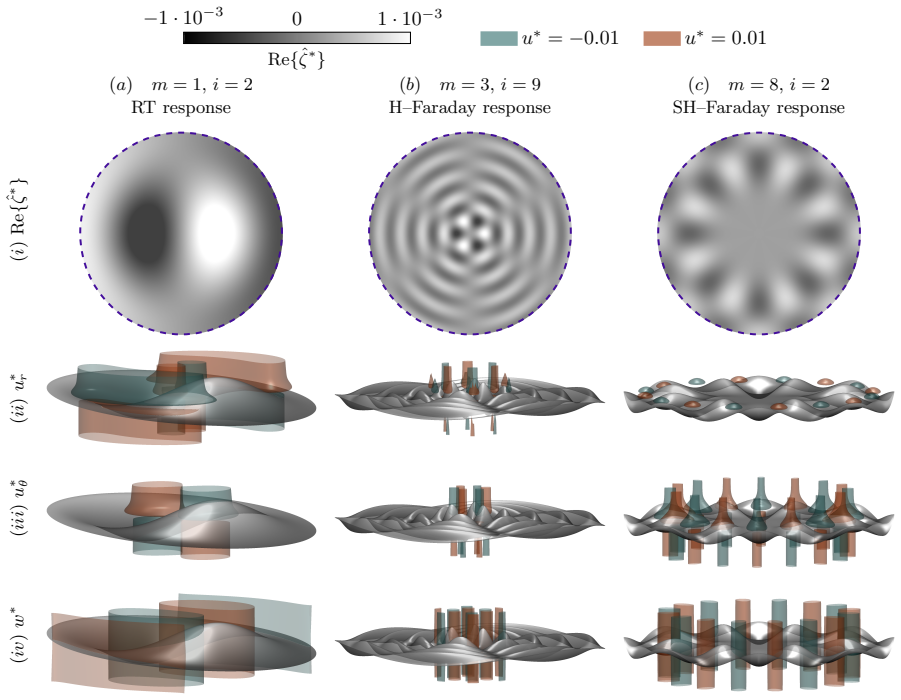
The central claim is that in a vertically vibrated cylindrical container the two instabilities do not simply add or compete; lateral confinement and the contact-line condition determine whether they can be treated independently. With a free-sliding interface, increasing vibration amplitude drives a documented sequence—RT-dominated harmonic growth, then subharmonic Faraday response, then harmonic Faraday response—and confinement can stabilize RT modes that would remain unstable in an unbounded domain. With a pinned contact line, the zero-displacement condition at the rim couples radial Bessel modes, and the admissible onset mode is a superposition of RT-unstable and Faraday-stable components.
What carries the argument
The analysis rests on a Floquet decomposition of the interface and velocity field into azimuthal wavenumbers, radial Bessel modes (indexed by radial wavenumbers satisfying the no-penetration wall condition), and Floquet harmonics. The central objects are generalized eigenvalue problems that determine the leading Floquet exponent for each mode. For the free-sliding case the radial modes decouple; for the pinned case the rim condition is imposed through a projection that mixes the homogeneous capillary solution (modified Bessel functions) with the particular Bessel solutions. That mixing is the mechanism that couples RT-unstable and Faraday-stable components.
Load-bearing premise
The load-bearing premise in the free-sliding analysis is that the homogeneous capillary contribution to the interface displacement can be set to zero; if the pressure-jump condition requires a nonzero homogeneous solution even when the contact line is free, the predicted mode-by-mode RT-to-Faraday transition sequence would change.
What would settle it
One concrete check is to solve the full free-sliding pressure-jump condition without imposing ζ^(H)=0 and compare the resulting Floquet exponents with the paper's predictions; if nonzero homogeneous solutions shift the stabilization amplitudes, the transition sequence fails. A second check is experimental: in a vibrated cylinder with an adverse density contrast and pinned rim, measure the onset frequencies and radial ring counts and test whether they match the predicted RT-unstable/Faraday-stable superpositions rather than any free-sliding single mode.
If this is right
- In a free-sliding cylinder, each initially unstable RT mode has a finite vibration-amplitude window in which it is dynamically stabilized before subharmonic Faraday growth takes over; the sequence RT, subharmonic Faraday, harmonic Faraday holds for low-lying radial modes.
- Because the smallest admissible radial wavenumber is bounded away from zero in a confined cylinder, one finite vibration amplitude can stabilize all RT-unstable radial modes; this is impossible in an unbounded domain, where arbitrarily long wavelengths remain unstable.
- With a pinned rim, the lowest onset mode can show more than three radial rings even at first instability, whereas Faraday-only pinned onsets typically show a single ring.
- The predicted linear velocity fields give a complete spatiotemporal picture—radial, azimuthal, and axial components—including interfacial shear and azimuthal motion that top-view imaging cannot capture.
- The same Floquet formulation reproduces the measured critical frequencies of pinned Faraday waves across several container geometries, indicating that the machinery is reliable in the regimes where independent experiments exist.
Where Pith is reading between the lines
- If the pinned-rim superposition picture is right, a direct experimental test is available: in an adverse-density-contrast cylinder with a pinned rim, the onset pattern's radial ring count and phase dynamics should not match any single free-sliding Bessel mode, and the ring count should change with vibration amplitude even at onset.
- The same linear machinery could be extended to weakly nonlinear analysis to ask whether the RT-unstable/Faraday-stable superposition seeds different pattern selection or mode competition beyond onset than either instability alone.
- The free-sliding stabilization window is occupied by other Faraday modes in the configurations studied; the analysis implies that achieving a truly stable regime would require increasing viscosity or tailoring confinement so that Faraday-stable and RT-stable regions overlap.
- A numerical test of the free-sliding assumption itself—solving the full pressure-jump condition without dropping the homogeneous capillary term—would show whether the predicted RT-stabilization thresholds are robust or need revision.
Editorial analysis
A structured set of objections, weighed in public.
Referee Report
Summary. The manuscript develops a linear Floquet stability analysis of a two-fluid interface in a vertically vibrated cylinder, resolving disturbances into azimuthal Fourier modes, radial Bessel modes, and Floquet harmonics. Two contact-line models are considered: free-sliding and pinned. The free-sliding analysis shows that increasing vibration amplitude can stabilize RT-unstable radial modes and produces a sequence from RT-dominated harmonic response to subharmonic and then harmonic Faraday response; confinement discretizes the radial spectrum and allows complete stabilization of individual RT modes. The pinned analysis enforces zero displacement at the rim, which couples Bessel modes; the resulting onset mode is a superposition of RT-unstable and Faraday-stable components. The formulation is validated against classical RT and damped-Mathieu Faraday limits and against pinned Faraday experiments from three groups, with most frequency errors below 2%. Code is available.
Significance. If correct, this is a valuable unified treatment of two usually separate instabilities in a canonical confined geometry. The paper contains no parameter fitting: all fluid and geometrical parameters come from the experimental configurations. The clean recovery of the classical limits and the independent experimental validation for the pinned Faraday case are strong points. The qualitative predictions — confinement-induced stabilization of discrete RT modes and pinning-mediated coupling between RT and Faraday components — are original and testable. The velocity-field reconstruction is a useful complement to imaging diagnostics.
major comments (2)
- [§3.2, Eqs. (18)–(20)] The Floquet phase of the homogeneous capillary subsystem, cos φ_{m,n,k}, is left undetermined by the harmonic-coupling relation and is then closed by the ad hoc choice cos φ = -1 ("smallest positive capillary length"). This choice enters the projection coefficients λ (A.9) and therefore the pinned-mode eigenvalue problem (35)-(36) and all pinned onset predictions in Sec. 4.2 (Figs. 9 and 11, Table 3). The Faraday-only validation in Table 3 is encouraging, but the mixed Faraday–RT pinned predictions in Sec. 4.2.2 have no independent experimental check. Because the quantitative onset values depend on this closure, the paper should either derive the physical selection of the band edge or provide a sensitivity analysis over cos φ ∈ [-1,1] showing that the predicted critical frequencies and, more importantly, the qualitative superposition mechanism are unchanged. Without this, the specificity
- [§3 and Appendix A] The sums over Floquet harmonics n and radial modes i in Eq. (10) are infinite, but the numerical implementation requires truncation. The manuscript does not state the truncation sizes or provide a convergence test. The reported growth rates and critical accelerations (Figs. 2–11) are numerical results of a truncated system; reproducibility and confidence in the quantitative predictions require this information. The agreement with classical limits and experiments suggests the truncation is adequate, but the paper should make the truncation explicit and include a brief convergence check.
minor comments (5)
- [§3.1] The statement that the homogeneous contribution vanishes, ζ^(H)=0, is asserted without proof. This is correct: it follows from the kinematic condition (8), the velocity expansion (13), and the no-penetration condition (A.4), since w is a sum of Bessel modes with J'_m(β/ξ)=0, so ζ = w/γ has the same radial dependence and an I_m homogeneous term would violate the sidewall condition. Please add this one-line justification to avoid the appearance of an ad hoc decoupling.
- [Table 3] The phrase "deviations below 2% in most comparisons" is imprecise. Ten of the fifteen listed deviations are below 2%; the Zhang et al. cases exceed 4%. Please state the count explicitly or qualify the sentence.
- [Figs. 2 and 3] The quantity plotted as arctan Re{ζ^*} is not defined in the captions. Clarify that this is the argument (phase) of the complex interface displacement and why it is used.
- [Throughout] Several symbols are used without definition at first appearance: f†_LFST, i⋆, W⊥, and the hat notation for Floquet harmonic amplitudes. Please define these in the text or in a notation table.
- [Eq. (26)] The Hadamard product notation with vectors of different lengths may be confusing. Please define the operation explicitly or write out the component equations.
Circularity Check
No significant circularity: the Floquet derivation is self-contained and validated against independent experiments.
full rationale
The central derivation starts from the linearized Navier–Stokes equations (5)–(9) and a standard Floquet/Bessel ansatz (10)–(15). The free-sliding case sets ζ(H)=0; this is not an ad hoc decoupling: the vertical-velocity expansion is built from Bessel modes satisfying J'=0 (A.4)–(A.5), and Eq. (8) ties ζ to w, so an I-type homogeneous interface component would require a velocity field incompatible with the sidewall no-penetration condition. The pinned-contact-line coupling is a direct consequence of imposing ζ=0 at r=1/ξ (28) and the representation (17), giving (29)–(31); it is not an imported uniqueness result. No parameter is fitted to the predicted thresholds: all inputs are the experimental fluid/geometry parameters of Table 2, and the comparisons with Shao et al., Henderson & Miles, Zhang et al., and Wolf are external validations. The band-edge closure cos φ=-1 is a stated modeling choice that selects the strongest capillary restoring effect, not a fitted value, and the self-citation [64] is used for context and for the unbounded-domain long-wavelength statement, which Appendix A.3 re-derives independently via the Mathieu threshold. The single-Floquet-exponent assumption for the pinned onset is acknowledged in Section 5.1 as an approximation valid at neutral stability, not a circular step. Therefore the derivation chain is self-contained and no prediction reduces to its inputs by construction.
Axiom & Free-Parameter Ledger
free parameters (1)
- Floquet phase closure cos φ =
-1 (band edge)
axioms (5)
- domain assumption Interface displacement remains single-valued and linearizable
- domain assumption Lateral wall is free-slip: only no-penetration ∂r w'=0 enforced; no-slip tangential conditions neglected
- ad hoc to paper Free-sliding homogeneous contribution ζ(H)=0
- ad hoc to paper Band-edge closure cos φ=-1
- domain assumption Pinned contact line: single Floquet exponent for all coupled radial modes at onset
Cite this review
Pith. "Pith review of Coupled Rayleigh--Taylor and Faraday instabilities in vertically vibrated cylindrical containers." pith.science (2026). https://pith.science/paper/KJXF6UOU
@misc{pith2026260728932,
  author       = {Pith},
  title        = {Pith review of: Coupled Rayleigh--Taylor and Faraday instabilities in vertically vibrated cylindrical containers},
  year         = {2026},
  howpublished = {\url{https://pith.science/paper/KJXF6UOU}},
  note         = {Machine review of arXiv:2607.28932}
}
read the original abstract
Interfacial instabilities govern the mixing in confined multiphase flows. Yet, the two mechanisms that drive them are usually studied independently: the pressure-gradient-driven Rayleigh--Taylor (RT) instability, which amplifies long-wavelength modes, and the parametrically forced Faraday instability, which selects shorter-wavelength harmonic or subharmonic modes. When an adverse density contrast and vertical vibration act together, the two compete, and neither alone describes the response. We use Floquet analysis to characterize the onset, growth, modal structure, and velocity fields of Faraday--RT waves in a vertically vibrated cylinder, resolved by azimuthal wavenumber, radial (Bessel) mode, and Floquet harmonic. The formulation recovers the classical RT and Faraday limits and reproduces the instability onset at the frequencies measured experimentally. For a free-sliding interface, increasing the vibration amplitude shifts the dominant instability mechanism from RT growth to subharmonic and then harmonic Faraday responses. Lateral confinement can also stabilize individual RT modes, which is not possible in an unbounded domain, although other Faraday modes may remain unstable. Pinning the contact line couples radial modes that otherwise evolve independently, allowing the unstable mode to be a superposition of RT-unstable and Faraday-stable components. This superposition alters the instability mechanism, producing a richer radial pattern. Reconstruction of the unstable modes shows the (linear) velocity fields that imaging cannot access and demonstrates how the instabilities can change the flow more broadly.
Figures




Reference graph
Works this paper leans on
-
[1]
James, B
A. James, B. Vukasinovic, M. K. Smith, A. Glezer, Vibration-induced drop atomization and bursting, J. Fluid Mech.476(2003) 1–28
2003
-
[2]
Vukasinovic, M
B. Vukasinovic, M. K. Smith, A. Glezer, Dynamics of a sessile drop in forced vibration, J. Fluid Mech.587(2007) 395–423
2007
-
[3]
R. A. Ibrahim, Liquid Sloshing Dynamics: Theory and Applications, Cambridge university press, 2005
2005
-
[4]
R. S. Craxton, K. S. Anderson, T. R. Boehly, V. N. Goncharov, D. R. Harding, J. P. Knauer, R. L. McCrory, P. W. McKenty, D. D. Meyerhofer, J. F. Myatt, et al., Direct-drive inertial confinement fusion: A review, Phys. Plasmas22(2015)
2015
-
[5]
Betti, O
R. Betti, O. A. Hurricane, Inertial-confinement fusion with lasers, Nat. Phys.12(2016) 435–448
2016
-
[6]
Mohammad Karim, A review of physics of moving contact line dynamics models and its applications in interfacial science, J
A. Mohammad Karim, A review of physics of moving contact line dynamics models and its applications in interfacial science, J. Appl. Phys.132(2022)
2022
-
[7]
J. H. Snoeijer, B. Andreotti, Moving contact lines: scales, regimes, and dynamical transitions, Annu. Rev. Fluid Mech.45(2013) 269–292
2013
-
[8]
H. R. Holmes, K. F. B¨ ohringer, Transporting droplets through surface anisotropy, Microsyst. Nanoeng.1(2015) 1–8
2015
-
[9]
Faraday, Xvii
M. Faraday, Xvii. On a peculiar class of acoustical figures; and on certain forms assumed by groups of particles upon vibrating elastic surfaces, Phil. Trans. R. Soc. (1831) 299–340
-
[10]
Rayleigh, Investigation of the character of the equilibrium of an incompressible heavy fluid of variable density, Proc
L. Rayleigh, Investigation of the character of the equilibrium of an incompressible heavy fluid of variable density, Proc. London Math. Soc.1(1882) 170–177
-
[11]
G. I. Taylor, The instability of liquid surfaces when accelerated in a direction perpendicular to their planes. i, Phil. Trans. R. Soc. A201(1950) 192–196
1950
-
[12]
Miles, D
J. Miles, D. Henderson, Parametrically forced surface waves, Annu. Rev. Fluid Mech.22(1990) 143–165
1990
-
[13]
Kull, Theory of the Rayleigh–Taylor instability, Phys
H.-J. Kull, Theory of the Rayleigh–Taylor instability, Phys. Rep.206(1991) 197–325
1991
-
[14]
Apffel, F
B. Apffel, F. Novkoski, A. Eddi, E. Fort, Floating under a levitating liquid, Nat.585(2020) 48–52
2020
-
[15]
Pototsky, M
A. Pototsky, M. Bestehorn, Faraday instability of a two-layer liquid film with a free upper surface, Phys. Rev. Fluids1(2016) 023901
2016
-
[16]
Sterman-Cohen, M
E. Sterman-Cohen, M. Bestehorn, A. Oron, Rayleigh–Taylor instability in thin liquid films subjected to harmonic vibration, Phys. Fluids29(2017). 35
2017
-
[17]
J. Gao, S. Zhu, L. Brandt, J. Tao, Q. Fu, L. Yang, Marangoni modulation of coupled Rayleigh-Taylor and Faraday instabilities in vertically oscillated liquid films, arXiv preprint arXiv:2604.19132 (2026)
Pith/arXiv arXiv 2026
-
[18]
T. B. Benjamin, F. J. Ursell, The stability of the plane free surface of a liquid in vertical periodic motion, Phil. Trans. R. Soc. A225(1954) 505–515
1954
-
[19]
L. D. Landau, E. M. Lifshitz, Mechanics, volume 1, Pergamon Press, Oxford, 1976
1976
-
[20]
Kumar, L
K. Kumar, L. S. Tuckerman, Parametric instability of the interface between two fluids, J. Fluid Mech.279(1994) 49–68
1994
-
[21]
Kumar, Linear theory of Faraday instability in viscous liquids, Proc
K. Kumar, Linear theory of Faraday instability in viscous liquids, Proc. R. Soc. Lond. A452 (1996) 1113–1126
1996
-
[22]
W. S. Edwards, S. Fauve, Patterns and quasi-patterns in the Faraday experiment, J. Fluid Mech.278(1994) 123–148
1994
-
[23]
Zhang, J
W. Zhang, J. Vi˜ nals, Secondary instabilities and spatiotemporal chaos in parametric surface waves, Phys. Rev. Lett.74(1995) 690
1995
-
[24]
Daudet, V
L. Daudet, V. Ego, S. Manneville, J. Bechhoefer, Secondary instabilities of surface waves on viscous fluids in the Faraday instability, Europhys. Lett.32(1995) 313
1995
-
[25]
Zhang, J
W. Zhang, J. Vi˜ nals, Square patterns and quasipatterns in weakly damped Faraday waves, Phys. Rev. E53(1996) R4283
1996
-
[26]
P. Chen, J. Vi˜ nals, Pattern selection in Faraday waves, Phys. Rev. Lett.79(1997) 2670
1997
-
[27]
P. Chen, J. Vi˜ nals, Amplitude equation and pattern selection in Faraday waves, Phys. Rev. E 60(1999) 559–570
1999
-
[28]
Westra, D
M.-T. Westra, D. J. Binks, W. Van De Water, Patterns of Faraday waves, J. Fluid Mech.496 (2003) 1–32
2003
-
[29]
Panda, L
D. Panda, L. Kahouadji, L. S. Tuckerman, S. Shin, J. Chergui, D. Juric, O. K. Matar, Marangoni-driven patterns, ridges and hills in surfactant-covered parametric surface waves, J. Fluid Mech.1008(2025) R4
2025
-
[30]
A. Castillo-Castellanos, B.-J. Gr´ ea, A. Briard, L. Gostiaux, Mixing induced by Faraday surface waves, arXiv preprint arXiv:2512.15536 (2025)
Pith/arXiv arXiv 2025
-
[31]
J. W. Miles, Surface-wave damping in closed basins, Proc. R. Soc. Lond. Ser. A Math. Phys. Sci.297(1967) 459–475
1967
-
[32]
J. W. Miles, Nonlinear surface waves in closed basins, J. Fluid Mech.75(1976) 419–448
1976
-
[33]
J. W. Miles, Nonlinear Faraday resonance, J. Fluid Mech.146(1984) 285–302
1984
-
[34]
Batson, F
W. Batson, F. Zoueshtiagh, R. Narayanan, The Faraday threshold in small cylinders and the sidewall non-ideality, J. Fluid Mech.729(2013) 496–523. 36
2013
-
[35]
Dinesh, J
B. Dinesh, J. Livesay, I. Ignatius, R. Narayanan, Pattern formation in Faraday instabil- ity—experimental validation of theoretical models, Philos. Trans. R. Soc. A381(2023) 20220081
2023
-
[36]
Henderson, J
D. Henderson, J. Miles, Surface-wave damping in a circular cylinder with a fixed contact line, J. Fluid Mech.275(1994) 285–299
1994
-
[37]
Kidambi, Inviscid Faraday waves in a brimful circular cylinder, J
R. Kidambi, Inviscid Faraday waves in a brimful circular cylinder, J. Fluid Mech.724(2013) 671–694
2013
-
[38]
X. Shao, P. Wilson, J. Saylor, J. Bostwick, Surface wave pattern formation in a cylindrical container, J. Fluid Mech.915(2021) A19
2021
-
[39]
Zhang, A
S. Zhang, A. G. Borthwick, Z. Lin, Pattern evolution and modal decomposition of Faraday waves in a brimful cylinder, J. Fluid Mech.974(2023) A56
2023
-
[40]
S. Gregory, S. Schiattarella, V. S. Barroso, D. I. Kaiser, A. Avgoustidis, S. Weinfurtner, Tracking the nonlinear formation of an interfacial wave spectral cascade from one to few to many, arXiv preprint arXiv:2410.08842 (2024)
Pith/arXiv arXiv 2024
-
[41]
Zhang, Z
S. Zhang, Z. Lin, Transitional response of double-mode Faraday waves in a brimful container, Phys. Rev. Fluids10(2025) 034003
2025
-
[42]
Bongarzone, F
A. Bongarzone, F. Viola, S. Camarri, F. Gallaire, Subharmonic parametric instability in nearly brimful circular cylinders: a weakly nonlinear analysis, J. Fluid Mech.947(2022) A24
2022
-
[43]
Kumar, Mechanism for the Faraday instability in viscous liquids, Phys
S. Kumar, Mechanism for the Faraday instability in viscous liquids, Phys. Rev. E62(2000) 1416
2000
-
[44]
Wright, S
J. Wright, S. Yon, C. Pozrikidis, Numerical studies of two-dimensional Faraday oscillations of inviscid fluids, J. Fluid Mech.402(2000) 1–32
2000
-
[45]
W. J. Harrison, The influence of viscosity on the oscillations of superposed fluids, Proc. London Math. Soc.2(1908) 396–405
1908
-
[46]
Bellman, R
R. Bellman, R. H. Pennington, Effects of surface tension and viscosity on Taylor instability, Q. Appl. Math.12(1954) 151–162
1954
-
[47]
M. S. Plesset, C. G. Whipple, Viscous effects in Rayleigh–Taylor instability, Phys. Fluids17 (1974) 1
1974
-
[48]
Chandrasekhar, Hydrodynamic and Hydromagnetic Stability, Oxford University Press, 1961
S. Chandrasekhar, Hydrodynamic and Hydromagnetic Stability, Oxford University Press, 1961
1961
-
[49]
D. H. Sharp, Overview of Rayleigh–Taylor instability, Technical Report, Los Alamos National Laboratory (LANL), 1983
1983
-
[50]
A. R. Piriz, O. D. Cort´ azar, J. J. L´ opez Cela, N. A. Tahir, The Rayleigh–Taylor instability, Am. J. Phys.74(2006) 1095–1098
2006
-
[51]
Batchelor, J
G. Batchelor, J. Nitsche, Instability of stratified fluid in a vertical cylinder, J. Fluid Mech. 252(1993) 419–448. 37
1993
-
[52]
S. H. Vanaparthy, E. Meiburg, D. Wilhelm, Density-driven instabilities of miscible fluids in a capillary tube: linear stability analysis, J. Fluid Mech.497(2003) 99–121
2003
-
[53]
M. Payr, S. Vanaparthy, E. Meiburg, Influence of variable viscosity on density-driven instabilities in capillary tubes, J. Fluid Mech.525(2005) 333–353
2005
-
[54]
Sweeney, R
H. Sweeney, R. Kerswell, T. Mullin, Rayleigh–Taylor instability in a finite cylinder: linear stability analysis and long-time fingering solutions, J. Fluid Mech.734(2013) 338–362
2013
-
[55]
Zheng, Y
Y. Zheng, Y. Lai, Y. Hu, S. Cai, Rayleigh–Taylor instability in a confined elastic soft cylinder, J. Mech. Phys. Solids131(2019) 221–229
2019
-
[56]
A. Bret, A. DeVault, S. Dannhoff, M. Gatu Johnson, C. Li, J. Frenje, Linear Rayleigh-Taylor instability with foams, Phys. Rev. E113(2026) 065409
2026
-
[57]
G. H. Wolf, The dynamic stabilization of the Rayleigh–Taylor instability and the corresponding dynamic equilibrium, Z. Physik227(1969) 291–300
1969
-
[58]
G. H. Wolf, Dynamic stabilization of the interchange instability of a liquid-gas interface, Phys. Rev. Lett.24(1970) 444
1970
-
[59]
Troyon, R
F. Troyon, R. Gruber, Theory of the dynamic stabilization of the Rayleigh–Taylor instability, Phys. Fluids14(1971) 2069–2073
1971
-
[60]
A. R. Piriz, G. Rodriguez P., I. Munoz D., J. J. Lopez C., N. A. Tahir, Dynamic stabilization of Rayleigh–Taylor instability in Newtonian fluids, Phys. Rev. E82(2010) 026317
2010
-
[61]
Lapuerta, F
V. Lapuerta, F. J. Mancebo, J. M. Vega, Control of Rayleigh–Taylor instability by vertical vibration in large aspect ratio containers, Phys. Rev. E64(2001) 016318
2001
-
[62]
Haimovich, A
O. Haimovich, A. Oron, Nonlinear dynamics of a thin liquid film on an axially oscillating cylindrical surface, Phys. Fluids22(2010)
2010
-
[63]
Liang, X
Y. Liang, X. Luo, Experimental investigation of cylindrically divergent Rayleigh–Taylor instability on a water–air interface, J Fluid Mech.1016(2025) R2
2025
-
[64]
T. Chu, B. Wilfong, T. Koehler, R. M. McMullen, S. H. Bryngelson, Competing mechanisms at vibrated interfaces of density-contrast fluids, Phys. Rev. Fluids10(2025) 093904
2025
-
[65]
Floquet, Sur les ´ equations diff´ erentielles lin´ eaires ` a coefficients p´ eriodiques, in: Ann
G. Floquet, Sur les ´ equations diff´ erentielles lin´ eaires ` a coefficients p´ eriodiques, in: Ann. Sci. Ecole. Norm. S., volume 12, 1883, pp. 47–88. 38
This paper was first reviewed by deepseek-v4-flash on August 3, 2026.
discussion (0)
Sign in with ORCID, Apple, or X to comment. Anyone can read and Pith papers without signing in.