REVIEW 2 major objections 5 minor
Hybrid photonic lanterns plus a transformer network raise the fraction of starlight injected into a kernel-nuller by 28 percent in simulation, tightening the path to high-contrast H-band interferometry.
Reviewed by Pith at T0; open to challenge. T0 means a machine referee read the full paper against a public rubric. the ladder, T0–T4 →
T0 review · grok-4.5
2026-07-12 03:34 UTC pith:KJYIQLCE
load-bearing objection Solid Asgard instrument update: open-loop 28% lantern injection gain is cleanly simulated, but remains idealized and not yet closed-loop or lab-validated. the 2 major comments →
Seidr update: photonic 'black magic' for high-contrast interferometry using kernel-nulling and photonic lanterns
The pith
A machine-rendered reading of the paper's core claim, the machinery that carries it, and where it could break.
Core claim
Open-loop wavefront estimation that uses the intensity outputs of hybrid mode-selective photonic lanterns can increase the mean power ratio in the mode-selective core by 28 percent (0.55 to 0.71) under Von Kármán seeing, thereby improving light injection into a kernel-nulling photonic chip and reducing residual intensity fluctuations that set the null depth.
What carries the argument
The hybrid mode-selective photonic lantern (HMS-PL) transfer matrix that maps pupil-plane phase into six single-mode core powers, together with a transformer network that inverts those powers into a deformable-mirror command maximizing the fundamental-mode core.
Load-bearing premise
That open-loop, noise-free simulations of lantern powers already capture the residual non-common-path aberrations, detector noise and closed-loop dynamics that will exist between the fringe tracker, the deformable mirror and Seidr on the sky.
What would settle it
On-sky or closed-loop laboratory measurements that show the mode-selective-core power ratio remaining near 0.55 after the transformer correction is applied, or that show no narrowing of the kernel-output distributions when intensity fluctuations are reduced.
Editorial analysis
A structured set of objections, weighed in public.
Referee Report
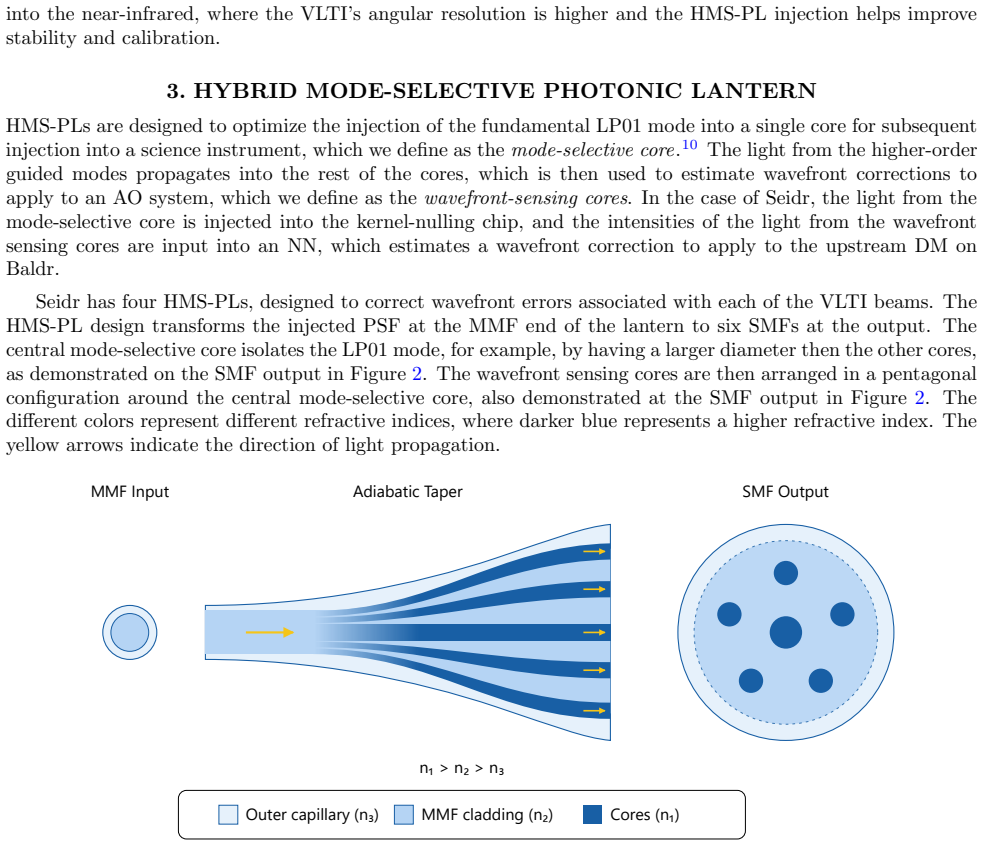
Summary. This instrument-update paper describes Seidr, an H-band kernel-nulling beam combiner for the Asgard suite at the VLTI. It combines four hybrid mode-selective photonic lanterns (HMS-PLs) for simultaneous science injection and wavefront sensing with a photonic kernel-nulling chip. The authors present a finite-difference BPM transfer matrix for a 6-core HMS-PL, open-loop transformer-NN wavefront estimation that raises the mean mode-selective-core power ratio from 0.55 to 0.71 under Von Kármán seeing (r0 = 0.4 m), and simulations of kernel-output distributions under residual phase and intensity noise. The work positions Seidr as complementary to Nott and reliant on Heimdallr/Baldr infrastructure.
Significance. If the HMS-PL + NN injection scheme survives closed-loop and on-sky conditions, Seidr would provide a practical route to deeper H-band nulls at the VLTI by reducing non-common-path intensity fluctuations that limit kernel-nulling contrast. The paper supplies a concrete transfer-matrix characterization, a quantified open-loop injection gain (Fig. 6), and a clear link between intensity stabilization and kernel-output narrowing (Fig. 8). These are useful design milestones for the Asgard community even though they remain simulation-only. The architecture itself (mode-selective lanterns feeding a kernel-nuller with NN feedback to Baldr) is a coherent and novel instrument concept.
major comments (2)
- Section 4 and Fig. 6: the central numerical claim (mean mode-selective-core power ratio rising from 0.55 to 0.71) is obtained from open-loop, noise-free transfer-matrix simulations. The authors themselves state that the ratio “does not represent a closed-loop AO system” and does not account for overall light injected into the chip. Residual NCPA between Heimdallr/Baldr and Seidr, photon/read noise on the five WFS cores, and the SNR degradation that accompanies concentration of light into the mode-selective core are therefore untested. Without at least a closed-loop residual or a noise-injection study, the 28 % figure cannot be taken as a reliable predictor of on-sky null depth.
- Section 5 and Fig. 8: the claimed narrowing of kernel-output distributions for σ_I = 0.05 and 0.02 is presented as a potential improvement offered by the HMS-PLs, yet no quantitative mapping from the open-loop lantern correction of §4 to these σ_I values is given. The link between the demonstrated injection gain and the assumed intensity-noise reductions remains illustrative rather than demonstrated; a short calculation or Monte-Carlo chain connecting the two would make the contrast argument load-bearing.
minor comments (5)
- Equation (1): the mixing operator M is written with a free phase offset θ that is never specified numerically; a brief statement of the value used (or that results are independent of θ) would aid reproducibility.
- Table 2 and Fig. 3: the lantern is characterized only at λ = 1550 nm; a short remark on chromatic behaviour across the H-band would strengthen the design claim.
- Figure 4 caption and surrounding text: the example phase screen is shown without stating the corresponding r0 or residual RMS; adding these numbers would make the illustration quantitative.
- Section 2: the interaction with Bifrost’s C-RED One camera and the routing of the bright nuller output into the same NN are mentioned only briefly; a one-sentence clarification of the optical path would help readers unfamiliar with Asgard.
- References: several Asgard companion papers are cited as SPIE proceedings; ensuring the most recent arXiv or journal versions are listed would improve accessibility.
Circularity Check
No load-bearing circularity; open-loop NN injection gain and kernel narrowing are measured outcomes of independent transfer-matrix + Von Kármán simulations, not tautologies or forced fits.
full rationale
The paper is an instrument-design update whose central numerical claims (mean mode-selective-core power ratio rising from 0.55 to 0.71 under stated Von Kármán parameters; narrowing of kernel-output distributions under reduced σ_I) are generated by forward simulation: a finite-difference BPM transfer matrix A for the 6-core HMS-PL, injection of known phase screens, training of a transformer NN on the resulting (P_out, wavefront) pairs, open-loop application of the estimated correction, and re-measurement of the power ratio (Fig. 6) and kernel statistics (Fig. 8). These steps do not reduce by construction to their inputs; the improvement is an empirical outcome of the trained model on held-out turbulence realizations. Kernel-nulling operators M and K are taken from the independent literature (Martinache & Ireland 2018; Chingaipe et al. 2023) and are not redefined here. Self-citations to the Asgard suite papers and to the authors’ companion SPIE abstract [14] supply context and defer detailed NN architecture, but are not used to justify uniqueness or to forbid alternatives; the numerical results stand on the simulations presented. No fitted parameter is re-labeled a prediction, no uniqueness theorem is imported, and no ansatz is smuggled. Minor self-citation of the instrument suite is normal and non-load-bearing, yielding a score of 1.
Axiom & Free-Parameter Ledger
free parameters (6)
- Fried parameter r0 =
0.4 m
- outer scale L0 =
10 m
- transverse wind speed =
10 m/s
- residual phase error sigma_phi =
50 nm / 25 nm
- relative intensity fluctuation sigma_I =
0.10, 0.05, 0.02
- kernel phase offset theta
axioms (4)
- domain assumption Von Kármán turbulence spectrum plus Taylor frozen-flow hypothesis adequately models residual wavefronts after GPAO/NAOMI+Baldr.
- domain assumption Light propagation through the HMS-PL is a linear complex transfer matrix A obtained by finite-difference BPM.
- domain assumption Kernel operator K annihilates second-order instrumental phase errors (K·Θ = 0).
- ad hoc to paper Open-loop correction of the estimated wavefront fully translates into the reported mode-selective power gain.
invented entities (1)
-
Seidr instrument (HMS-PL + kernel-nuller + TNN architecture)
no independent evidence
read the original abstract
Seidr is a new interferometric beam combiner within the Asgard Suite, utilizing infrastructure common to the BIFROST instrument at the Very Large Telescope Interferometer. Seidr combines hybrid mode-selective photonic lantern injection modules with a kernel-nulling photonic chip backend to enable deep H-band nulling for high-contrast studies of exoplanets, exomoons, and circumstellar dust. This instrument update summarizes Seidr's current design maturity and recent simulations of the point source - to - lantern outputs. We also outline progress on our neural network-based wavefront estimation scheme, which uses the photonic lantern outputs to sense phase fluctuations, designed to feed back to Baldr's deformable mirror, and improve nuller light injection.
Figures



discussion (0)
Sign in with ORCID, Apple, or X to comment. Anyone can read and Pith papers without signing in.