Zero modes of non-abelian Dirac operator in topologically non-trivial band insulator
Pith reviewed 2026-07-01 15:55 UTC · model grok-4.3
The pith
Local gauge invariance of the quantum geometric tensor in Bloch momentum space implies zero modes of the non-abelian Dirac operator for N-level band insulators.
A machine-rendered reading of the paper's core claim, the machinery that carries it, and where it could break.
Core claim
Local gauge-invariance of the quantum geometric tensor defined in the Bloch-momentum space of a generic N-level band insulator implies the existence of zero modes of the non-abelian Dirac operator in such momentum space. Solutions of these zero-mode equations in the two-dimensional Brillouin zone torus, written in terms of Jacobi theta functions, determine the probability amplitudes associated with the N-component ground-state wave function under the adiabatic approximation. Subjected to normalization, these solutions define a CP^{N-1} space whenever one or more degeneracy points exist in the dispersion. The non-abelian generalization of the vortexability criterion of Chern bands follows dir
What carries the argument
Zero-mode equations of the non-abelian Dirac operator in Bloch momentum space, obtained directly from local gauge invariance of the quantum geometric tensor.
If this is right
- Solutions expressed with Jacobi theta functions fix the probability amplitudes of the N-component ground state.
- Normalized solutions span a CP^{N-1} space in the presence of degeneracy points.
- The non-abelian vortexability criterion for Chern bands follows automatically from the zero-mode equations.
- The equations recover the momentum-space algebra of the lowest Landau level.
- The non-interacting sector of fractional Chern insulator models is recovered for the lattice Dirac and rhombohedral graphene Hamiltonians.
Where Pith is reading between the lines
- The same zero-mode structure may supply a model-independent route to effective actions for any topologically nontrivial band.
- Mappings between momentum-space Dirac zero modes and real-space Landau-level physics could be tested by comparing spectra of twisted bilayer systems with known fractional Chern insulator candidates.
Load-bearing premise
The adiabatic approximation is used to define the probability amplitudes of the N-component ground-state wave function.
What would settle it
A concrete band-insulator model in which the quantum geometric tensor remains locally gauge-invariant yet the associated non-abelian Dirac operator possesses no zero modes on the Brillouin zone torus.
Figures
read the original abstract
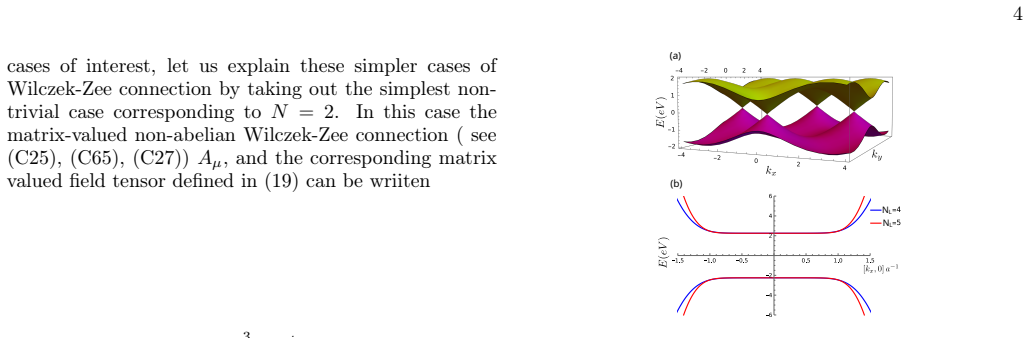
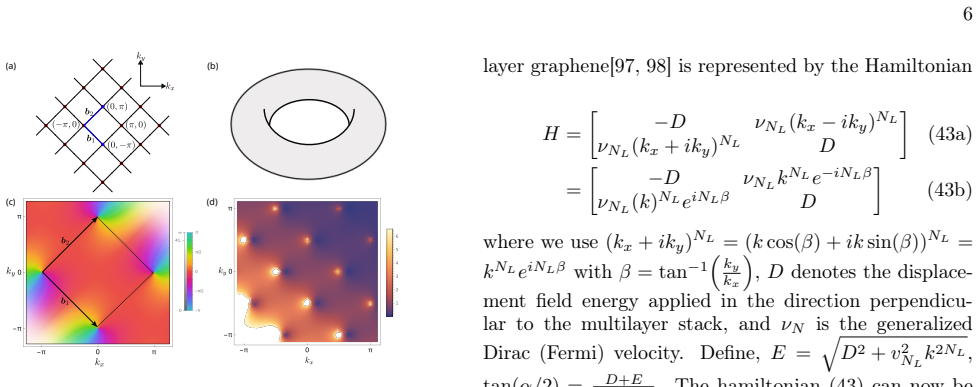
We show that the local gauge-invariance of the quantum geometric tensor (QGT) defined in the Block-momentum space of a generic $N$-level (sublattice degrees of freedom) band insulator implies the existence of zero modes of non-abelian Dirac operator in such momentum space. Solutions of these zero modes equations in the two-dimensional Brillouin zone torus, in terms of Jacobi Theta function determine the probability amplitudes associated with the $N$-component ground state wave-function under adiabatic approximation in this Hilbert space. These solutions subjected to normalization, defines a complex projective ($CP$) space of $N-1$ dimension ($CP^{N-1}$ space) when one or more degeneracy points exist in the dispersion spectrum of such band-isulator. We show how the non-abelian generalization of the vortexability criterion of Chern bands automatically follows from these zero-mode equations, and also demonstrate their connection with momentum space-version of Lowest landau level algebra. Subsequently we write an Euclidean action from which these zero mode equations follow. We point out that the non-interacting part of different paradigms used to understand fractional Chern insulator(FCI) like phases in a host of two-dimensional material can be understood within this approach. We analyse two effective hamiltonian : lattice Dirac (QZW) model and two-band model for rhombohedral $N$-layer graphene in our propsoed framework and obtain important conclusions.
Editorial analysis
A structured set of objections, weighed in public.
Referee Report
Summary. The paper claims that local U(N) gauge invariance of the quantum geometric tensor (QGT) in Bloch-momentum space of a generic N-level band insulator implies the existence of zero modes of a non-abelian Dirac operator on the 2D Brillouin zone torus. Solutions expressed via Jacobi theta functions determine the N-component ground-state probability amplitudes (under adiabatic approximation), define a CP^{N-1} geometry at degeneracy points, automatically yield the non-abelian vortexability criterion for Chern bands, and recover the momentum-space lowest-Landau-level algebra. The framework is asserted to capture the non-interacting sector of multiple FCI paradigms and is applied to the lattice Dirac (QZW) model and the two-band model for rhombohedral N-layer graphene.
Significance. If the central implication from QGT gauge invariance to the Dirac-operator kernel is established with explicit derivations, the work would supply a geometric route connecting quantum geometry of band insulators to zero-mode structures and LLL-like algebras, potentially unifying aspects of topological band theory and FCI descriptions. Concrete application to two effective Hamiltonians provides testable content.
major comments (3)
- [§2 (and abstract)] The central claim (abstract and §2) asserts that local U(N) gauge invariance of the QGT directly implies the existence and form of zero modes of a non-abelian Dirac operator, yet the explicit map from the covariant-constancy/flatness condition on the matrix-valued QGT to the kernel of the postulated Dirac operator is not derived from first principles for generic N. The operator appears introduced by ansatz rather than constructed, rendering the implication unsupported as written.
- [§3] For N>2 the non-abelian connection and metric enter the QGT in matrix form; §3 does not supply the auxiliary identification (e.g., Clifford representation) needed to equate the kernel condition with a first-order Dirac operator. Without this step the claimed implication does not hold automatically.
- [abstract, §4] The adiabatic approximation is invoked only after the zero-mode solutions are obtained (abstract and §4); the derivation of the Dirac operator itself must stand independently of this approximation if the gauge-invariance implication is to be load-bearing.
minor comments (2)
- [abstract] Typos: “Block-momentum” → “Bloch-momentum”; “propsoed” → “proposed”.
- [§2] Notation for the non-abelian connection A_μ and the precise definition of the Dirac operator (e.g., which Clifford generators are used) should be stated explicitly before the zero-mode equations are written.
Simulated Author's Rebuttal
We thank the referee for the careful and constructive report. We address each major comment below, providing clarifications on the derivations while committing to revisions that strengthen the explicit mappings without altering the core claims.
read point-by-point responses
-
Referee: [§2 (and abstract)] The central claim (abstract and §2) asserts that local U(N) gauge invariance of the QGT directly implies the existence and form of zero modes of a non-abelian Dirac operator, yet the explicit map from the covariant-constancy/flatness condition on the matrix-valued QGT to the kernel of the postulated Dirac operator is not derived from first principles for generic N. The operator appears introduced by ansatz rather than constructed, rendering the implication unsupported as written.
Authors: Section 2 begins from the local U(N) gauge invariance of the QGT, which enforces covariant constancy (flatness) of the matrix-valued tensor on the Brillouin zone torus. The non-abelian Dirac operator is then constructed as the first-order operator whose kernel precisely encodes the zero-mode solutions satisfying this flatness condition for generic N. While the logical steps are present, we agree that an expanded, line-by-line derivation from the flatness equation to the explicit Dirac form would improve clarity. We will revise §2 accordingly. revision: yes
-
Referee: [§3] For N>2 the non-abelian connection and metric enter the QGT in matrix form; §3 does not supply the auxiliary identification (e.g., Clifford representation) needed to equate the kernel condition with a first-order Dirac operator. Without this step the claimed implication does not hold automatically.
Authors: For N>2 the matrix structure of the QGT is retained, and the Dirac operator is defined via the natural representation of the non-abelian connection and metric that generalizes the Clifford algebra action on the N-component spinor. We will add an explicit auxiliary identification (including the relevant Clifford representation or equivalent) in §3 to make the equivalence between the kernel condition and the first-order operator fully transparent for arbitrary N. revision: yes
-
Referee: [abstract, §4] The adiabatic approximation is invoked only after the zero-mode solutions are obtained (abstract and §4); the derivation of the Dirac operator itself must stand independently of this approximation if the gauge-invariance implication is to be load-bearing.
Authors: The construction of the Dirac operator and the proof that its kernel follows from QGT gauge invariance are carried out in §§2–3 without reference to the adiabatic approximation; the latter is introduced only in §4 to interpret the theta-function solutions as probability amplitudes of the ground state. We will revise the abstract and §4 to state this separation explicitly so that the gauge-invariance implication stands independently. revision: partial
Circularity Check
No significant circularity detected; derivation chain remains independent of its inputs
full rationale
The central claim asserts that local U(N) gauge invariance of the QGT on the Bloch torus implies zero modes of a non-abelian Dirac operator whose solutions furnish the N-component amplitudes under adiabatic approximation. No quoted equation or step reduces this implication to a self-definition, a fitted parameter renamed as prediction, or a load-bearing self-citation chain; the zero-mode equations are introduced and solved (via Jacobi theta functions) to obtain CP^{N-1} structure and vortexability generalizations, but these outputs are not shown to be identical to the QGT invariance condition by construction. Connections to LLL algebra and FCI paradigms are presented as subsequent demonstrations rather than reductions. The paper is therefore self-contained against external benchmarks for the purpose of circularity analysis.
Axiom & Free-Parameter Ledger
axioms (2)
- domain assumption Local gauge-invariance of the quantum geometric tensor in Block-momentum space
- domain assumption Adiabatic approximation for the N-component ground state wave-function
Reference graph
Works this paper leans on
-
[1]
Neupert, L
T. Neupert, L. Santos, C. Chamon, and C. Mudry, Frac- tional quantum hall states at zero magnetic field, Phys. Rev. Lett. 106, 236804 (2011)
2011
-
[2]
Regnault and B
N. Regnault and B. A. Bernevig, Fractional chern insu- lator, Phys. Rev. X1, 021014 (2011)
2011
-
[3]
K. Sun, Z. Gu, H. Katsura, and S. Das Sarma, Nearly flatbands with nontrivial topology, Phys. Rev. Lett. 106, 236803 (2011)
2011
-
[4]
Y. Xie, A. T. Pierce, J. M. Park, D. E. Parker, E. Kha- laf, P. Ledwith, Y. Cao, S. H. Lee, S. Chen, P. R. Forrester, K. Watanabe, T. Taniguchi, A. Vishwanath, P. Jarillo-Herrero, and A. Yacoby, Fractional chern insu- lators in magic-angle twisted bilayer graphene, Nature 600, 439 (2021)
2021
-
[5]
H. Park, J. Cai, E. Anderson, Y. Zhang, J. Zhu, X. Liu, C. Wang, W. Holtzmann, C. Hu, Z. Liu, T. Taniguchi, K. Watanabe, J.-H. Chu, T. Cao, L. Fu, W. Yao, C.-Z. Chang, D. Cobden, D. Xiao, and X. Xu, Observation of fractionally quantized anomalous hall effect, Nature 622, 74 (2023)
2023
-
[6]
J. Cai, E. Anderson, C. Wang, X. Zhang, X. Liu, W. Holtzmann, Y. Zhang, F. Fan, T. Taniguchi, K. Watanabe, Y. Ran, T. Cao, L. Fu, D. Xiao, W. Yao, and X. Xu, Signatures of fractional quantum anomalous hall states in twisted mote2, Nature622, 63 (2023)
2023
-
[7]
Y. Zeng, Z. Xia, K. Kang, J. Zhu, P. Knüppel, C.Vaswani, K.Watanabe, T.Taniguchi, K.F.Mak,and J. Shan, Thermodynamic evidence of fractional chern insulator in moiré mote2, Nature622, 69 (2023)
2023
-
[8]
F. Xu, Z. Sun, T. Jia, C. Liu, C. Xu, C. Li, Y. Gu, K. Watanabe, T. Taniguchi, B. Tong, J. Jia, Z. Shi, S. Jiang, Y. Zhang, X. Liu, and T. Li, Observation of integer and fractional quantum anomalous hall effects in twisted bilayermote2, Phys. Rev. X13, 031037 (2023)
2023
-
[9]
R. Su, D. Waters, B. Zhou, K. Watanabe, T. Taniguchi, Y.-H. Zhang, M. Yankowitz, and J. Folk, Moiré-driven topological electronic crystals in twisted graphene, Na- ture 637, 1084 (2025)
2025
-
[10]
J. Xie, Z. Huo, X. Lu, Z. Feng, Z. Zhang, W. Wang, Q. Yang, K. Watanabe, T. Taniguchi, K. Liu, Z. Song, X. C. Xie, J. Liu, and X. Lu, Tunable fractional chern insulators in rhombohedral graphene superlattices, Na- ture Materials 10.1038/s41563-025-02225-7 (2025)
-
[11]
T. Han, Z. Lu, Z. Hadjri, L. Shi, Z. Wu, W. Xu, Y. Yao, A. A. Cotten, O. Sharifi Sedeh, H. Weldeyesus, J. Yang, J. Seo, S. Ye, M. Zhou, H. Liu, G. Shi, Z. Hua, K. Watanabe, T. Taniguchi, P. Xiong, D. M. Zumbühl, L. Fu, and L. Ju, Signatures of chiral superconductivity in rhombohedral graphene, Nature643, 654 (2025)
2025
-
[12]
Stripe Order in the Metallic and Superconducting Phases of Rhombohedral Hexalayer Graphene
P. Qin, H.-T. Wu, R. Q. Nguyen, E. Morissette, N. J. Zhang, K. Watanabe, T. Taniguchi, and J. I. A. Li, Extreme anisotropy in the metallic and superconduct- ing phases of rhombohedral hexalayer graphene (2026), arXiv:2504.05129 [cond-mat.mes-hall]
work page internal anchor Pith review Pith/arXiv arXiv 2026
-
[13]
Shiva and Y
G. Shiva and Y. Oreg, Quantum geometry and stabi- lization of fractional chern insulators far from the ideal limit, Phys. Rev. Lett.133, 156504 (2024)
2024
-
[14]
J. P. Provost and G. Vallee, Riemannian structure on manifolds of quantum states, Communications in Math- ematical Physics 76, 289 (1980)
1980
-
[15]
Resta, The insulating state of matter: a geometri- cal theory, The European Physical Journal B79, 121 (2011)
R. Resta, The insulating state of matter: a geometri- cal theory, The European Physical Journal B79, 121 (2011)
2011
-
[16]
Roy, Band geometry of fractional topological insula- tors, Phys
R. Roy, Band geometry of fractional topological insula- tors, Phys. Rev. B90, 165139 (2014)
2014
-
[17]
J. Wang, J. Cano, A. J. Millis, Z. Liu, and B. Yang, Ex- act landau level description of geometry and interaction in a flatband, Phys. Rev. Lett.127, 246403 (2021)
2021
-
[18]
J. Wang, S. Klevtsov, and Z. Liu, Origin of model frac- tional chern insulators in all topological ideal flatbands: Explicit color-entangled wave function and exact den- sity algebra, Phys. Rev. Res.5, 023167 (2023)
2023
-
[19]
P. J. Ledwith, A. Vishwanath, and D. E. Parker, Vor- texability: A unifying criterion for ideal fractional chern insulators, Phys. Rev. B108, 205144 (2023)
2023
-
[20]
Wilczek and A
F. Wilczek and A. Zee, Appearance of gauge structure in simple dynamical systems, Phys. Rev. Lett.52, 2111 (1984)
1984
-
[21]
Brouder, G
C. Brouder, G. Panati, M. Calandra, C. Mourougane, and N. Marzari, Exponential localization of wannier functions in insulators, Phys. Rev. Lett. 98, 046402 (2007)
2007
-
[22]
X.-L.Qi,Genericwave-functiondescriptionoffractional quantum anomalous hall states and fractional topolog- ical insulators, Phys. Rev. Lett.107, 126803 (2011)
2011
-
[23]
R. Yu, X. L. Qi, A. Bernevig, Z. Fang, and X. Dai, Equivalent expression of 𭟋2 topological invariant for band insulators using the non-abelian berry connection, Phys. Rev. B84, 075119 (2011)
2011
-
[24]
Neupert, C
T. Neupert, C. Chamon, and C. Mudry, Measuring the quantum geometry of bloch bands with current noise, Phys. Rev. B87, 245103 (2013)
2013
-
[25]
T. S. Jackson, G. Möller, and R. Roy, Geometric sta- bility of topological lattice phases, Nature Communica- tions 6, 8629 (2015)
2015
-
[26]
C. H. Lee, M. Claassen, and R. Thomale, Band struc- ture engineering of ideal fractional chern insulators, Phys. Rev. B96, 165150 (2017). 8
2017
-
[27]
S. H. Simon and M. S. Rudner, Contrasting lattice ge- ometry dependent versus independent quantities: Ram- ifications for berry curvature, energy gaps, and dynam- ics, Phys. Rev. B102, 165148 (2020)
2020
-
[28]
Y.-Q. Ma, S. Chen, H. Fan, and W.-M. Liu, Abelian and non-abelian quantum geometric tensor, Phys. Rev. B 81, 245129 (2010)
2010
-
[29]
Nielsen and M
H. Nielsen and M. Ninomiya, Absence of neutrinos on a lattice: (i). proof by homotopy theory, Nuclear Physics B 185, 20 (1981)
1981
-
[30]
S.Ryu, A.P.Schnyder, A.Furusaki,andA.W.W.Lud- wig, Topological insulators and superconductors: ten- fold way and dimensional hierarchy, New Journal of Physics 12, 065010 (2010)
2010
-
[31]
Mera and T
B. Mera and T. Ozawa, Uniqueness of landau levels and their analogs with higher chern numbers, Phys. Rev. Res. 6, 033238 (2024)
2024
-
[32]
W. K. Wootters, Statistical distance and hilbert space, Phys. Rev. D23, 357 (1981)
1981
-
[33]
CP^n, or, entanglement illustrated
I. BENGTSSON, J. BRÄNNLUND, and K. ŻY- CZKOWSKI, Cpn, or, entanglement illustrated, Inter- national Journal of Modern Physics A17, 4675 (2002), https://doi.org/10.48550/arXiv.quant-ph/0108064
work page internal anchor Pith review Pith/arXiv arXiv doi:10.48550/arxiv.quant-ph/0108064 2002
-
[34]
Quantum Geometric Tensor (Fubini-Study Metric) in Simple Quantum System: A pedagogical Introduction
R. Cheng, Quantum geometric tensor (fubini-study metric) in simple quantum system: A pedagogical in- troduction (2013), arXiv:1012.1337 [quant-ph]
work page internal anchor Pith review Pith/arXiv arXiv 2013
-
[35]
T. T. Wu and C. N. Yang, Concept of nonintegrable phase factors and global formulation of gauge fields, Phys. Rev. D12, 3845 (1975)
1975
-
[36]
Dalibard, F
J. Dalibard, F. Gerbier, G. Juzeli¯ unas, and P. Öh- berg, Colloquium: Artificial gauge potentials for neutral atoms, Rev. Mod. Phys.83, 1523 (2011)
2011
-
[37]
J. Yu, B. A. Bernevig, R. Queiroz, E. Rossi, P. Törmä, and B.-J. Yang, Quantum geometry in quantum mate- rials, npj Quantum Materials10, 101 (2025)
2025
-
[38]
B.BradlynandM.Iraola,LecturenotesonBerryphases and topology, SciPost Phys. Lect. Notes , 51 (2022)
2022
-
[39]
Dobardžić, M
E. Dobardžić, M. Dimitrijević, and M. V. Milovanović, Effective description of chern insulators, Phys. Rev. B 89, 235424 (2014)
2014
-
[40]
Peotta and P
S. Peotta and P. Törmä, Superfluidity in topologically nontrivial flat bands, Nature Communications6, 8944 (2015)
2015
-
[41]
Ozawa and B
T. Ozawa and B. Mera, Relations between topology and the quantum metric for chern insulators, Phys. Rev. B 104, 045103 (2021)
2021
-
[42]
A. A. Belavin and A. M. Polyakov, Metastable states of two-dimensional isotropic ferromagnets, JETP Lett. 22, 245 (1975)
1975
-
[43]
Rajaraman, Solitons and Instantons: An Introduc- tion to Solitons and Instantons in Quantum Field The- ory, North-Holland Personal Library, Vol
R. Rajaraman, Solitons and Instantons: An Introduc- tion to Solitons and Instantons in Quantum Field The- ory, North-Holland Personal Library, Vol. 15 (North- Holland Publishing Company, Amsterdam, New York, 1982)
1982
-
[44]
Fukui, Gradient flow and bogomolny bounds for quantum metric actions, Phys
T. Fukui, Gradient flow and bogomolny bounds for quantum metric actions, Phys. Rev. B 112, 245162 (2025)
2025
-
[45]
Julia and A
B. Julia and A. Zee, Poles with both magnetic and elec- tric charges in non-abelian gauge theory, Phys. Rev. D 11, 2227 (1975)
1975
-
[46]
H. J. de Vega, Fermions and vortex solutions in abelian and non-abelian gauge theories, Phys. Rev. D18, 2932 (1978)
1978
-
[47]
P. J. Ledwith, G. Tarnopolsky, E. Khalaf, and A. Vish- wanath, Fractional chern insulator states in twisted bi- layergraphene: Ananalyticalapproach,Phys.Rev.Res. 2, 023237 (2020)
2020
-
[48]
Mera and T
B. Mera and T. Ozawa, Engineering geometrically flat chern bands with fubini-study kähler structure, Phys. Rev. B 104, 115160 (2021)
2021
-
[49]
Mera and T
B. Mera and T. Ozawa, Kähler geometry and chern in- sulators: Relations between topology and the quantum metric, Phys. Rev. B104, 045104 (2021)
2021
-
[50]
Okuma, Constructing vortex functions and basis states of chern insulators: Ideal condition, inequality from index theorem, and coherentlike states on the von neumann lattice, Phys
N. Okuma, Constructing vortex functions and basis states of chern insulators: Ideal condition, inequality from index theorem, and coherentlike states on the von neumann lattice, Phys. Rev. B110, 245112 (2024)
2024
-
[51]
Z. Lu, T. Han, Y. Yao, A. P. Reddy, J. Yang, J. Seo, K. Watanabe, T. Taniguchi, L. Fu, and L. Ju, Fractional quantum anomalous hall effect in multilayer graphene, Nature 626, 759 (2024)
2024
-
[52]
A. Kerelsky, C. Rubio-Verdú, L. Xian, D. M. Kennes, D. Halbertal, N. Finney, L. Song, S. Turkel, L. Wang, K. Watanabe, T. Taniguchi, J. Hone, C. Dean, D. N. Basov, A. Rubio, and A. N. Pasupathy, Moiré- less correlations in abca graphene, Proceedings of the National Academy of Sciences118, e2017366118 (2021), https://www.pnas.org/doi/pdf/10.1073/pnas.2017366118
-
[53]
Z. Dong, A. S. Patri, and T. Senthil, Theory of quan- tum anomalous hall phases in pentalayer rhombohedral graphenemoiréstructures,Phys.Rev.Lett. 133,206502 (2024)
2024
-
[54]
Culcer, Y
D. Culcer, Y. Yao, and Q. Niu, Coherent wave-packet evolution in coupled bands, Phys. Rev. B72, 085110 (2005)
2005
-
[55]
Palumbo, Non-abelian tensor berry connections in multiband topological systems, Phys
G. Palumbo, Non-abelian tensor berry connections in multiband topological systems, Phys. Rev. Lett. 126, 246801 (2021)
2021
-
[56]
F. D. M. Haldane, Many-particle translational symme- tries of two-dimensional electrons at rational landau- level filling, Phys. Rev. Lett.55, 2095 (1985)
2095
-
[57]
A. M. Perelomov, Generalized Coherent States and Their Applications (Springer-Verlag, Berlin Heidelberg, 1986)
1986
-
[58]
Ferrari, Two-dimensional electrons in a strong mag- netic field: A basis for single-particle states, Phys
R. Ferrari, Two-dimensional electrons in a strong mag- netic field: A basis for single-particle states, Phys. Rev. B 42, 4598 (1990)
1990
-
[59]
F. D. M. Haldane, The origin of holomorphic states in landau levels from non-commutative ge- ometry and a new formula for their overlaps on the torus, Journal of Mathematical Physics 59, 081901 (2018), https://pubs.aip.org/aip/jmp/article- pdf/doi/10.1063/1.5046122/14801597/0819011online.pd f
work page doi:10.1063/1.5046122/14801597/0819011online.pd 2018
-
[60]
Z. Liu, B. Mera, M. Fujimoto, T. Ozawa, and J. Wang, Theory of generalized landau levels and its implications for non-abelian states, Phys. Rev. X15, 031019 (2025)
2025
-
[61]
Jackiw and C
R. Jackiw and C. Rebbi, Solitons with fermion number ½, Phys. Rev. D13, 3398 (1976)
1976
-
[62]
Aharonov and A
Y. Aharonov and A. Casher, Ground state of a spin- ½ charged particle in a two-dimensional magnetic field, Phys. Rev. A19, 2461 (1979)
1979
-
[63]
Jackiw and P
R. Jackiw and P. Rossi, Zero modes of the vortex- fermion system, Nuclear Physics B190, 681 (1981)
1981
-
[64]
Jackiw, Fractional charge and zero modes for pla- nar systems in a magnetic field, Phys
R. Jackiw, Fractional charge and zero modes for pla- nar systems in a magnetic field, Phys. Rev. D29, 2375 (1984)
1984
-
[65]
L. F. Cugliandolo and G. Lozano, Zero modes of the vortex-fermion system: The non-abelian case, Phys. 9 Rev. D 39, 3093 (1989)
1989
-
[66]
Tenjinbayashi, H
Y. Tenjinbayashi, H. Igarashi, and T. Fujiwara, Dirac operator zero-modes on a torus, Annals of Physics322, 460 (2007)
2007
-
[67]
G. W. Semenoff, V. Semenoff, and F. Zhou, Domain walls in gapped graphene, Phys. Rev. Lett.101, 087204 (2008)
2008
-
[68]
Goswami and Q
P. Goswami and Q. Si, Dynamic zero modes of dirac fermions and competing singlet phases of antiferromag- netic order, Phys. Rev. B95, 224438 (2017)
2017
-
[69]
Y. Wu, H. Jiang, J. Liu, H. Liu, and X. C. Xie, Non- abelian braiding of dirac fermionic modes using topolog- ical corner states in higher-order topological insulator, Phys. Rev. Lett.125, 036801 (2020)
2020
-
[70]
M. F. Atiyah and R. Bott, Yang-mills and bundles over algebraic curves, Proceedings of the Indian Academy of Sciences, Mathematical Sciences90, 11 (1981)
1981
-
[71]
Estienne, N
B. Estienne, N. Regnault, and V. Crépel, Ideal chern bands as landau levels in curved space, Phys. Rev. Res. 5, L032048 (2023)
2023
-
[72]
S. M. Girvin, A. H. MacDonald, and P. M. Platzman, Collective-excitation gap in the fractional quantum hall effect, Phys. Rev. Lett.54, 581 (1985)
1985
-
[73]
Wang and S
Z. Wang and S. H. Simon, Closed band-projected den- sity algebra must be girvin-macdonald-platzman, Phys. Rev. Lett. 134, 136502 (2025)
2025
-
[74]
H. M. Price, T. Ozawa, and I. Carusotto, Quantum mechanics with a momentum-space artificial magnetic field, Phys. Rev. Lett.113, 190403 (2014)
2014
-
[75]
Ozawa, H
T. Ozawa, H. M. Price, and I. Carusotto, Quantum hall effect in momentum space, Phys. Rev. B 93, 195201 (2016)
2016
-
[76]
Claassen, C
M. Claassen, C. H. Lee, R. Thomale, X.-L. Qi, and T. P. Devereaux, Position-momentum duality and fractional quantum hall effect in chern insulators, Phys. Rev. Lett. 114, 236802 (2015)
2015
-
[77]
E. T. Whittaker and G. N. Watson,A Course of Modern Analysis, 4th ed. (Cambridge University Press, 1927)
1927
-
[78]
Ramanujan, On certain arithmetical functions, Transactions of the Cambridge Philosophical Society 22, 159 (1916)
S. Ramanujan, On certain arithmetical functions, Transactions of the Cambridge Philosophical Society 22, 159 (1916)
1916
-
[79]
Chang-Young and H
E. Chang-Young and H. Kim, Theta vectors and quan- tum theta functions, Journal of Physics A: Mathemati- cal and General38, 4255 (2005)
2005
-
[80]
F. D. M. Haldane, A modular-invariant modi- fied weierstrass sigma-function as a building block for lowest-landau-level wavefunctions on the torus, Journal of Mathematical Physics 59, 071901 (2018), https://pubs.aip.org/aip/jmp/article- pdf/doi/10.1063/1.5042618/15971731/0719011online.pd f
work page doi:10.1063/1.5042618/15971731/0719011online.pd 2018
discussion (0)
Sign in with ORCID, Apple, or X to comment. Anyone can read and Pith papers without signing in.