REVIEW 4 major objections 5 minor 47 references
Dynamical Spreading and Memory Retention Under Power Law Potential
T0 review · 4 major / 5 minor · reviewed 2026-08-08 · deepseek-v4-flash
Pith's one-line read A dense suspension of particles repelling via $U\propto 1/r^k$ spreads self-similarly with radius $R\sim t^{1/(k+2)}$ in any dimension, and below $k=d-2$ the initial pattern persists at the perimeter.
desk verdict The t^{1/(k+2)} spreading law is well supported by experiment and simulation, but the memory-retention regime for k<d-2 rests on a hypothesized profile and an equilibrium analogy that need real derivation work. read the letter →
The pith
A machine-rendered reading of the paper's core claim, the machinery that carries it, and where it could break.
The reading
What carries the argument
The central object is the self-similar ansatz $\rho(r,t)=A t^{-d/(k+2)} f(r/t^{1/(k+2)})$, inserted into the coarse-grained continuity equation and the corresponding integral equation for the rescaled density. Requiring the rescaled equation to be independent of time fixes $\beta=1/(k+2)$ from the pair-force scaling $v\sim 1/r^{k+1}$, so the growth exponent contains no $d$. The argument then splits: for short-range interactions ($k>d$) a Taylor expansion in the integral equation yields the compact profile $f(\eta)=(1-\eta^2)^{d/k}$; for $k<d$ the paper hypothesizes $f(\eta)\propto(1-\eta^2)^{(k+2-d)/2}$, which is constant at $k=d-2$ and boundary-centered below it. The equilibrium 'Evaporation Catastrophe' classification is invoked to name the $k<d-2$ regime and to motivate the memory-retention claim.
What would settle it
Track the width of the particle-free zone between two colliding suspensions for $k<d-2$ (for example, $k=-1/2$ in two dimensions) over many decades in time and check its decay: if the zone closes exponentially, or the density maximum migrates from the rim back to the center before the steady state, the memory-retention claim is refuted.
Extended reading notes
Core claim
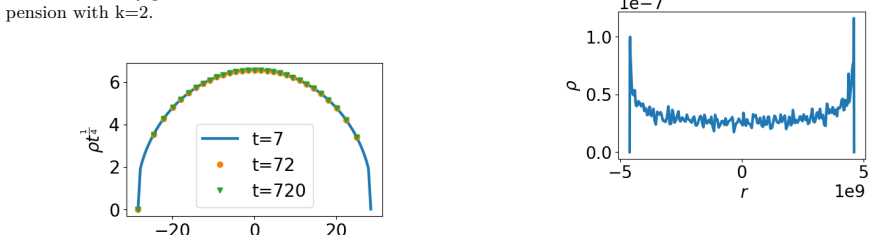
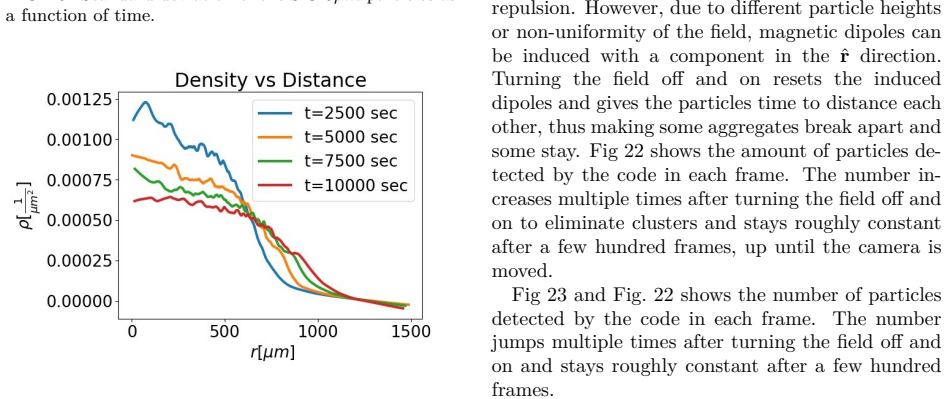
The paper establishes that an overdamped, unconfined suspension of particles with repulsive pair potential $U(r)\propto 1/r^k$ spreads in a self-similar way, with radius $R(t)\propto t^{1/(k+2)}$ and density $\rho(r,t)=A t^{-d/(k+2)} f(r/t^{1/(k+2)})$, and that this growth exponent is independent of the spatial dimension $d$. It confirms this with experiments on perpendicularly magnetized colloids in quasi-2D, whose dipolar repulsion gives $k=3$ and hence $R\sim t^{1/5}$, and with molecular dynamics simulations for $k=-1$, $0$, $1$, and $3$. The paper further divides the possible density profiles by the power $k$: origin-centered for $k>d-2$, flat for $k=d-2$, and boundary-centered for $k<d-2$, where particles accumulate at the rim. In collisions of two or more suspensions, the boundary-centered regime relaxes to the isotropic steady state by a slow power law, retaining a long-lived memory of the initial drop geometry.
Load-bearing premise
The boundary-centered memory claim assumes that the equilibrium 'Evaporation Catastrophe' classification still governs the density profile while the suspension is spreading out of equilibrium; the paper asserts that transfer rather than deriving it.
Editorial extensions
If this is right
- Any repulsive power-law suspension should spread with radius $R\sim t^{1/(k+2)}$, so the interaction exponent alone, not the dimension, sets the growth rate.
- The density profiles should collapse onto universal master curves under the rescaling $\rho t^{d/(k+2)}$ versus $r/t^{1/(k+2)}$, a testable fingerprint in colloid experiments.
- For $k<d-2$, two colliding suspensions should form a long-lived particle-free boundary zone and relax to the isotropic steady state by a power law in time, rather than exponentially.
- At $k=d-2$, the spreading suspension should develop a flat density profile; the simulations indicate an accompanying hyperuniform structure.
- In the $k=0$ logarithmic case the spreading is diffusive ($R\sim t^{1/2}$), while $k=-1$ is ballistic ($R\sim t$), giving a dynamic classification from subdiffusive to superdiffusive as $k$ decreases.
Reading between the lines
- The dimension-free exponent suggests the same scaling class may appear in other power-law-driven ensembles, such as plasmas or Rydberg gases, so long as the motion is overdamped and the pair force is a pure power law.
- Because the long-range profile is only hypothesized and verified numerically, a direct derivation from the integral equation would also produce a predicted exponent for the power-law relaxation rate in the collision-memory regime; the paper does not give that prediction.
- The particle-free corridors formed when drops collide resemble soap-film interfaces but arise from repulsion rather than surface tension, so one could use the initial drop geometry to write persistent patterns into a colloidal suspension.
- The apparent hyperuniformity at $k=d-2$ suggests that a logarithmic repulsion could serve as a route to disordered materials with suppressed density fluctuations, although the paper only notes the observation.
Editorial analysis
A structured set of objections, weighed in public.
Referee Report
Summary. The paper studies the overdamped spreading of a dense suspension of particles interacting via a repulsive power-law pair potential U ~ 1/r^k. Coarse-graining the equations of motion and adopting a self-similar ansatz, the authors predict that the suspension's radius grows as t^{1/(k+2)}, independent of the spatial dimension d. They confirm this prediction experimentally using magnetized colloidal particles with dipolar repulsion (k=3) in quasi-2D, and with molecular dynamics simulations for k=3 and other values of k. The paper further claims a dynamical phase boundary at k = d-2: for k > d-2 the density is origin-centered, at k = d-2 it is constant, and for k < d-2 particles accumulate at the perimeter and collisions of two or more suspensions retain a long-lived memory of the initial pattern, relaxing via a power law. The long-range density profile for k < d is, however, introduced as a hypothesis (Eq. 8) rather than derived from the self-similar integral equation (Eq. 6), and the memory regime is interpreted using an analogy to the equilibrium 'Evaporation Catastrophe.'
Significance. If correct, the paper establishes a remarkably simple, dimension-independent spreading exponent for a broad class of repulsive power-law suspensions, and the k=3 experimental confirmation with magnetized colloids is a genuine, nontrivial result that will be of interest to the soft-matter and statistical-physics communities. The predicted crossover at k = d-2 and the associated memory phenomenon are intriguing and, if substantiated rigorously, would constitute a new dynamical phase transition in a deterministic out-of-equilibrium setting. The analysis also connects to known results for short-range interactions (nonlinear diffusion with a compactly supported profile) and to recent work on long-range Riesz gases. However, the theoretical support for the k < d-2 regime is considerably weaker than for the spreading exponent: the long-range density profile is explicitly presented as a hypothesis, the self-similar integral equation is not solved for d>1, and the 'Evaporation Catastrophe' analogy is invoked after the fact rather than derived.
major comments (4)
- [Density for long-ranged interactions, Eq. (8)] The central theoretical claim for the k < d-2 regime rests on the hypothesized density profile f(η) ∝ (1-η^2)^{(k+2-d)/2}. The paper explicitly states 'We have yet to solve Eq. 6 for other values of k < d' and calls Eq. 8 a hypothesis, without demonstrating that this profile solves the self-similar integral equation Eq. 6 for d>1 or that it is the attractor of the dynamics. Since the boundary-centered profile, the k = d-2 constant profile, and the memory-retention phenomenon all depend on this expression, the analytic grounding for the claimed phase boundary is missing. The authors should either provide a derivation of Eq. 8 from Eq. 5-6, or test Eq. 8 directly by computing the velocity integral in Eq. 5 from simulation data and checking consistency with the assumed self-similar form. As it stands, the k < d-2 regime is a numerical observation, not a prediction of the continuum theory.
- [Memory in Colliding drops] The interpretation of the k < d-2 regime in terms of the equilibrium 'Evaporation Catastrophe' (Ref. [40]) is invoked after the fact to explain the simulation results. No argument is given for why an equilibrium classification of Riesz gases should transfer to the out-of-equilibrium, self-similar spreading state described by Eq. 2. This transfer is load-bearing for the memory-retention claim: without it, the paper offers no mechanism for why the initial pattern is encoded in the long-time structure. The authors should either provide a dynamical derivation of the memory regime or explicitly frame the memory effect as a simulation-based observation that currently lacks a rigorous theoretical explanation. The latter would require softening the abstract's assertion that this is a prediction.
- [Density for short-ranged interactions, Eq. (7) and prefactors A, B] The short-range derivation uses an ad hoc cutoff r_exc = α f^{-1/d} with free parameter α, and the self-similar prefactors A and B are not determined by the theory. The spreading exponent t^{1/(k+2)} is parameter-free, but the full density profile in Eq. 7 depends on α and on the undetermined constants A and B, and the constants are effectively fit to the simulation/experimental data. The paper should acknowledge that the comparison with data for the full profile is not a parameter-free prediction, even though the scaling exponent and the functional form (up to normalization) are.
- [Abstract and Discussion] The abstract states as a prediction that for k < d-2 'particles accumulate at the perimeter and retain a long-lived memory of their original pattern.' This overstates the theoretical status: the paper's own text labels the underlying density profile as a hypothesis. To avoid misleading readers, the claims should be rephrased to distinguish derived results (spreading exponent, short-range profile for k > d, and the constant profile at k = d-2 via Ref. [45]) from hypothesized or simulation-supported results (the long-range profile Eq. 8 and the memory regime). This distinction is important for the paper's contribution to be assessed accurately.
minor comments (5)
- [Discussion (text after Eq. 8)] The sentence 'The density profile is given by At^{d/(k+2)}f(η)' has the wrong sign in the exponent; Eq. 1 defines γ = -βd, so the prefactor should be A t^{-d/(k+2)}. This typo appears in the Discussion and could confuse readers.
- [Introduction, paragraph 1] The word 'includsing' is a typo for 'including' in the sentence listing long-ranged interaction examples.
- [Fig. 2 caption] The caption of Fig. 2C-E states 'Bright blue dots give the theoretical predictions given in Eq. 8. A single curve can be seen, but it is, in fact, ten plots at different times that collapse to a single curve.' This sentence is confusing: it is unclear whether the dots are the simulation data or the theoretical curve, and how the ten plots relate to the dots. Please rephrase to clearly distinguish the simulation curves, the times, and the theoretical prediction.
- [Continuum Model, paragraph 4] For k=0 the text says 'U(r)∝ log(r)', which is the logarithmic potential, but Eq. 2 uses U ~ 1/r^k with k=0 giving a constant potential. The mapping to the log-gas should be stated explicitly (e.g., as a limit or a separate interaction), to avoid an apparent contradiction.
- [SI, velocity scaling] The SI states 'In order to have dynamical similarity, the velocity must be proportional to the radius' and shows this in Fig. 13. This is a direct consequence of the self-similar ansatz v = β r/t, not an additional assumption; the paper could state this more clearly in the main text.
Circularity Check
No significant circularity: the spreading exponent and short-range profile are derived from the continuum equations and externally confirmed, while the long-range profile Eq. 8 is explicitly labeled a hypothesis whose simulation check is a rigor limitation rather than a circular reduction.
full rationale
The paper's core analytic claim, the spreading exponent β=1/(k+2) with γ=−βd, is obtained from the coarse-grained continuity equation (Eq. 3) and the interaction integral (Eq. 5) through the self-similar ansatz (Eq. 1): requiring the rescaled equation to be time-independent gives γ=−βd, and matching the interaction integral's time dependence fixes β=1/(k+2) in Eq. 6. This is a genuine consistency derivation, not a fit; the k=3 experiment and independent 1D/2D MD simulations confirm the exponent without being used to set it. The short-range density profile f=(1−η²)^{d/k} (Eq. 7) is derived from a Taylor expansion of the interaction integral following Ref. [41], with the divergence cutoff set by a mean-interparticle-distance argument, and it is verified against both experiment and simulation. The long-range profile f∝(1−η²)^{(k+2−d)/2} (Eq. 8) is not derived in the paper; the authors state 'We have yet to solve Eq. 6 for other values of k < d' and 'We hypothesize that a generalization to any dimension will have the following form.' Checking this hypothesis against the same simulations that motivated the boundary-centered classification is a legitimate but weak form of validation, and it is a rigor limitation, not a circular reduction: the simulations are generated from Eq. 2, not from Eq. 8, and no fitted exponent is renamed as a prediction. The k<d−2 memory and slow-relaxation claims rest on direct MD observations and an external equilibrium analogy (Ref. [40], the 'Evaporation Catastrophe') invoked for interpretation, not as the derivation. Self-citations (e.g., Ref. [34]) are not load-bearing; the constant-density result and 1D solution are attributed to independent works (Refs. [45] and [4]). No step of the derivation is equivalent to its input by construction, so the paper is not circular.
Assumptions & free parameters
free parameters (2)
- Cutoff parameter α (regularization scale rexc = α f^{-1/d}) =
Not stated; absorbed into prefactor B
- Self-similar prefactors A and B =
Chosen to collapse data; linked to total particle number and initial radius
assumptions (5)
- domain assumption Overdamped deterministic dynamics, v = μF; thermal diffusion neglected.
- domain assumption Continuum mean-field replacement of the discrete sum by the integral in Eq 5.
- standard math Self-similar ansatz ρ = A t^γ f(Br/t^β) with γ=-βd.
- ad hoc to paper The equilibrium 'Evaporation Catastrophe' classification (Ref [40]) applies to the out-of-equilibrium self-similar state.
- standard math For k=d-2 the constant density profile is taken from Ref [45].
Cite this review
Pith. "Pith review of Dynamical Spreading and Memory Retention Under Power Law Potential." pith.science (2026). https://pith.science/paper/KL2F72P4
@misc{pith2026250206256,
  author       = {Pith},
  title        = {Pith review of: Dynamical Spreading and Memory Retention Under Power Law Potential},
  year         = {2026},
  howpublished = {\url{https://pith.science/paper/KL2F72P4}},
  note         = {Machine review of arXiv:2502.06256}
}
read the original abstract
We study the overdamped dynamic spreading of a suspension of particles under a repulsive power law potential. We predict that the suspension spreads in a self-similar form, with its radius growing in time with a power independent of the dimension. We confirm this prediction experimentally using magnetized colloids with dipolar repulsion. Numerical simulations corroborate the experiments and further predict a categorically different behavior at a critical power, below which the initial distribution is no longer concentrated at the origin. Instead, particles accumulate at the perimeter and retain a long-lived memory of their original pattern. Below this threshold, the initial distribution seeds the resulting pattern, encoding the future structure of a dynamically evolving system.
Figures


Figures from the paper (18 more)






Reference graph
Works this paper leans on
-
[45]
Expansion into the vacuum of stochastic gases with long-range interactions
P. Krapivsky and K. Mallick, arXiv preprint arXiv:2412.14875 (2024)
work page Pith review arXiv 2024
-
[40]
Gallavotti, Statistical mechanics: A short treatise (Springer Science & Business Media, 1999)
G. Gallavotti, Statistical mechanics: A short treatise (Springer Science & Business Media, 1999)
work page 1999
-
[1]
R. H. French, V. A. Parsegian, R. Podgornik, R. F. Rajter, A. Jagota, J. Luo, D. Asthagiri, M. K. Chaudhury, Y.-m. Chiang, S. Granick, et al. , Re- views of Modern Physics 82, 1887 (2010)
work page 2010
-
[2]
E. M. Purcell, Electricity and magnetism (Cam- bridge university press, 2013)
work page 2013
- [3]
-
[4]
S. Agarwal, A. Dhar, M. Kulkarni, A. Kundu, S. N. Majumdar, D. Mukamel, and G. Schehr, Phys. Rev. Lett. 123, 100603 (2019)
work page 2019
-
[5]
R. Dandekar, P. Krapivsky, and K. Mallick, Phys- ical Review E 107, 044129 (2023)
work page 2023
-
[6]
W. T. Irvine, V. Vitelli, and P. M. Chaikin, Nature 468, 947 (2010)
work page 2010
Show all 47 references
-
[7]
R. E. Guerra, C. P. Kelleher, A. D. Hollingsworth, and P. M. Chaikin, Nature 554, 346 (2018)
2018
-
[8]
Zahn and G
K. Zahn and G. Maret, Physical Review Letters 85, 3656 (2000)
2000
-
[9]
Dillmann, G
P. Dillmann, G. Maret, and P. Keim, The European Physical Journal Special Topics 222, 2941 (2013)
2013
-
[10]
Ispolatov and P
I. Ispolatov and P. Krapivsky, Physical Review E 53, 3154 (1996)
1996
-
[11]
V. V. Ginzburg, L. Radzihovsky, and N. A. Clark, Physical Review E 55, 395 (1997)
1997
-
[12]
Marcos, A
B. Marcos, A. Gabrielli, and M. Joyce, Physical Review E 96, 032102 (2017)
2017
-
[13]
Flack, P
A. Flack, P. Le Doussal, S. N. Majumdar, and G. Schehr, Physical Review E 107, 064105 (2023)
2023
-
[14]
Bouchet, S
F. Bouchet, S. Gupta, and D. Mukamel, Physica A: Statistical Mechanics and its Applications 389, 4389 (2010)
2010
-
[15]
Lewin, Journal of Mathematical Physics 63 (2022)
M. Lewin, Journal of Mathematical Physics 63 (2022). 7
2022
-
[16]
Lectures on coulomb and riesz gases,
S. Serfaty, “Lectures on coulomb and riesz gases,” (2024), arXiv:2407.21194 [math-ph]
2024 arXiv
-
[17]
M. A. Baranov, Physics Reports 464, 71 (2008)
2008
-
[18]
L. D. Landau, J. S. Bell, M. Kearsley, L. Pitaevskii, E. Lifshitz, and J. Sykes, Electrodynamics of con- tinuous media, Vol. 8 (elsevier, 2013)
2013
-
[19]
T. F. Gallagher, Reports on Progress in Physics 51, 143 (1988)
1988
-
[20]
J. J. Binney, N. J. Dowrick, A. J. Fisher, and M. E. Newman, The theory of critical phenomena: an introduction to the renormalization group (Ox- ford University Press, 1992)
1992
-
[21]
Campa, T
A. Campa, T. Dauxois, and S. Ruffo, Physics Re- ports 480, 57 (2009)
2009
-
[22]
D. R. Nicholson and D. R. Nicholson, Introduction to plasma theory , Vol. 1 (Wiley New York, 1983)
1983
-
[23]
J. M. Kosterlitz and D. J. Thouless, in Basic No- tions Of Condensed Matter Physics (CRC Press,
-
[24]
Zhang, G
J. Zhang, G. Pagano, P. W. Hess, A. Kyprianidis, P. Becker, H. Kaplan, A. V. Gorshkov, Z.-X. Gong, and C. Monroe, Nature 551, 601 (2017)
2017
-
[25]
F. J. Dyson, Journal of Mathematical Physics 3, 1191 (1962)
1962
-
[26]
R. D. Deegan, O. Bakajin, T. F. Dupont, G. Huber, S. R. Nagel, and T. A. Witten, Nature 389, 827 (1997)
1997
-
[27]
N. C. Keim, J. D. Paulsen, Z. Zeravcic, S. Sastry, and S. R. Nagel, Reviews of Modern Physics 91, 035002 (2019)
2019
-
[28]
Shohat, Y
D. Shohat, Y. Friedman, and Y. Lahini, Nature Physics 19, 1890 (2023)
2023
-
[29]
Mukamel, S
D. Mukamel, S. Ruffo, and N. Schreiber, Physical review letters 95, 240604 (2005)
2005
-
[30]
Gupta and D
S. Gupta and D. Mukamel, Physical review letters 105, 040602 (2010)
2010
-
[31]
K. Zahn, R. Lenke, and G. Maret, Physical review letters 82, 2721 (1999)
1999
-
[32]
Rosenau and J
P. Rosenau and J. M. Hyman, Physical Review Let- ters 70, 564 (1993)
1993
-
[33]
A. A. Moreira, C. M. Vieira, H. A. Carmona, J. S. Andrade, and C. Tsallis, Phys. Rev. E 98, 032138 (2018)
2018
-
[34]
M. Y. Ben Zion and N. Oppenheimer, Physical Re- view Letters 132, 238201 (2024)
2024
-
[35]
soft-matter/trackpy: v0.6.4,
D. B. Allan, T. Caswell, N. C. Keim, C. M. van der Wel, and R. W. Verweij, “soft-matter/trackpy: v0.6.4,” (2024)
2024
-
[36]
Wigner, Phys
E. Wigner, Phys. Rev. 46, 1002 (1934)
1934
-
[37]
P. M. Anderson, J. P. Hirth, and J. Lothe, Theory of dislocations (Cambridge University Press, 2017)
2017
-
[38]
C. P. Kelleher, A. Wang, G. I. Guerrero-Garc´ ıa, A. D. Hollingsworth, R. E. Guerra, B. J. Krish- natreya, D. G. Grier, V. N. Manoharan, and P. M. Chaikin, Physical Review E - Statistical, Nonlinear, and Soft Matter Physics 92, 1 (2015), arXiv:1701.08801
2015 arXiv
-
[39]
Minnhagen, Reviews of Modern Physics 59, 1001 (1987)
P. Minnhagen, Reviews of Modern Physics 59, 1001 (1987)
1987
-
[41]
C. M. Vieira, H. A. Carmona, J. S. Andrade, and A. A. Moreira, Phys. Rev. E 93, 060103 (2016)
2016
-
[42]
G. I. Barenblatt, Prikl. Mat. Makh. 16, 67 (1952)
1952
-
[43]
Stone, in Nonlinear PDE’s in Condensed Matter and Reactive Flows (Springer, 2002) pp
H. Stone, in Nonlinear PDE’s in Condensed Matter and Reactive Flows (Springer, 2002) pp. 297–312
2002
-
[44]
L. G. Leal, Advanced transport phenomena: fluid mechanics and convective transport processes, Vol. 7 (Cambridge University Press, 2007)
2007
-
[46]
A. J. Liu and S. R. Nagel, Annu. Rev. Condens. Matter Phys. 1, 347 (2010)
2010
-
[47]
Morgan, Rev
F. Morgan, Rev. Mod. Phys. 79, 821 (2007). Supplementary Information This supplementary material presents results from molecular dynamics simulations in one dimension. We also provide additional results for two di- mensions, including the distribution of the bond- orientation ...
2007
Reviewed August 8, 2026 · model on record in the stance chip above.
Discussion (0). Continue with ORCID to comment.