REVIEW 3 major objections 4 minor 2 cited by
Living dangerously with decoupled first/second generation scalars: SUSY prospects at the LHC
T0 review · 3 major / 4 minor · reviewed 2026-08-12 · deepseek-v4-flash
Pith's one-line read The paper claims that a string-landscape draw to large soft masses selects first/second generation scalars at 20-40 TeV, stops at 1-2 TeV, and gluinos above 4.5 TeV, while excluding the low-mass region searched at the LHC through…
desk verdict The NUHM3 landscape scan is a concrete, testable scenario, but the load-bearing CCB veto rests on a tachyonic-mass criterion, not a vacuum stability calculation. read the letter →
The pith
A machine-rendered reading of the paper's core claim, the machinery that carries it, and where it could break.
The reading
What carries the argument
The argument is carried by the two-loop renormalization-group $\beta$ functions for soft scalar masses: the terms $\sigma_1$, $\sigma_2$, $\sigma_3$ in Eq. (6)-(9) contain traces over all scalar masses, so when first/second generation scalars are very heavy they feed into the running of third-generation soft masses with positive coefficients and push them downward. This suppresses the top-squark masses and therefore lowers the dominant electroweak finetuning term $\Sigma_u^u(\tilde t_{1,2})$, making the model more natural as $m_0(1,2)$ grows to tens of TeV. The same downward push can drive stop soft masses tachyonic, creating charge- and color-breaking (CCB) minima; the paper vetoes vacua with such minima as unlivable. A landscape prior $f_{SUSY} \sim m_{soft}^{2n_F+n_D-1}$ draws soft terms toward large values, and the anthropic weak-scale window stops them just short of this boundary, so the favored parameter space sits 'living dangerously' at the edge of CCB instability.
What would settle it
The central claim would be falsified by an LHC observation of a gluino below about 4.5 TeV with standard decays, or a top squark above about 2 TeV in an otherwise natural spectrum, since the paper predicts those masses lie outside the surviving parameter space. It would also be falsified by discovery of a first/second generation squark or slepton below about 20 TeV, which contradicts the predicted 20-40 TeV decoupled peak; a direct calculation showing that the 'CCB' minima are actually safe and not catastrophic would remove the exclusion that does most of the work.
Extended reading notes
Core claim
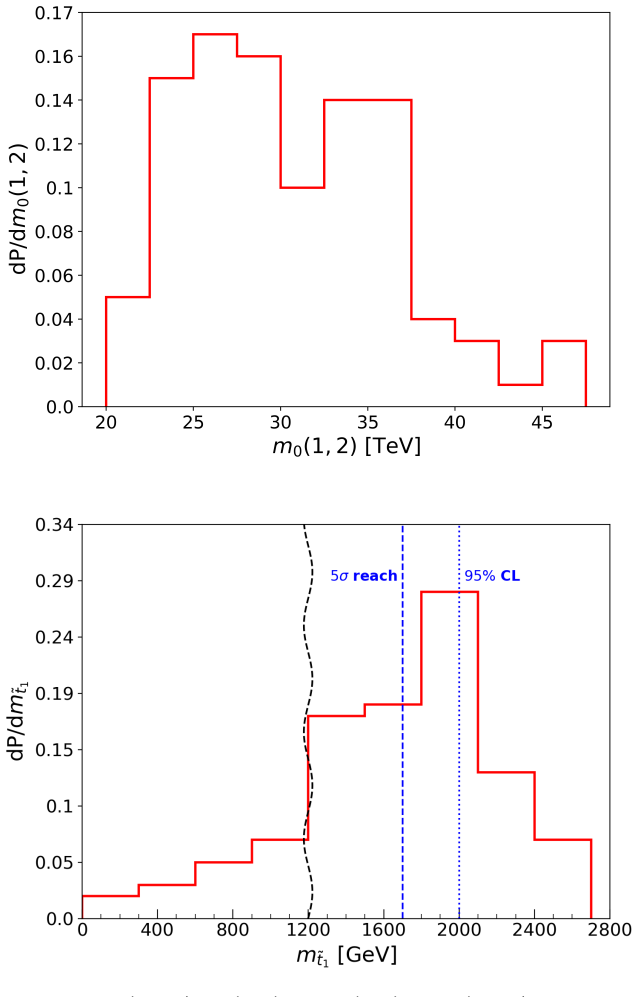
Within the NUHM3 gravity-mediated model (the three-extra-parameter non-universal Higgs model), the paper claims that the landscape prior with a power-law draw to large soft terms and an anthropic veto on the weak scale produces an inverted scalar mass hierarchy: first/second generation scalar masses peak near $m_0(1,2)\sim 25$-$35$ TeV, top squarks peak near $m_{\tilde t_1}\sim 2$ TeV, gluinos sit near or above $\sim 4.5$ TeV, higgsinos sit near $\sim 200$ GeV for $\mu=200$ GeV, and $m_h\sim 124.5$-$125$ GeV with $\Delta_{EW}<30$. It then shows that the parameter-space regions with smaller scalar and gaugino masses, the regions probed so far by the LHC, fall mostly into CCB-excluded territory, so the surviving natural regions lie adjacent to the CCB boundary and the model is 'living dangerously'. The bottom line is that SUSY has not been found because the accessible low-mass parameter space is unstable, while the favored spectrum has stops just beyond current bounds but within HL-LHC reach and higgsinos that could appear in pair-production searches.
Load-bearing premise
The load-bearing premise is that the multiverse weights larger supersymmetry-breaking masses by a specific power law and that first/second generation scalar masses are scanned between 20 and 50 TeV; if that weighting or that range is wrong, the predicted mass peak and the exclusions from unstable minima would move or vanish.
Editorial extensions
If this is right
- If the paper is right, the LHC should not see gluinos or winos at accessible masses; the favored region has $\tilde g \gtrsim 4.5$ TeV and electroweak gauginos in the several-TeV range.
- Top squarks in the favored band lie at $m_{\tilde t_1}\sim 1$-$2$ TeV, just above present simplified-model limits and within the projected $\sim 1.7$-$2$ TeV reach of HL-LHC with $3000$ fb$^{-1}$.
- Light higgsinos near $\mu\sim 200$ GeV remain the other discovery channel, through higgsino pair production, since they are not decoupled.
- The 125 GeV Higgs mass is reproduced with $A_0\sim -m_0(3)$ and $m_0(3)\sim 6$ TeV, so the landscape-selected spectra should show $m_h$ near 125 GeV rather than a lower value.
- The flavor and CP problems are solved by decoupling plus quasi-degeneracy of first/second generation scalars, so flavor-changing and CP-violating observables should stay close to Standard Model predictions.
Reading between the lines
- My inference: if the CCB veto is taken literally, the LHC null results become a positive, quantitative check of the landscape prior: the observed absence of light superpartners is exactly what the prior plus instability veto predicts.
- My inference: the same two-loop suppression mechanism should operate in any gravity-mediated model with non-universal first/second generation scalar masses, so the predicted mass ordering and CCB boundary are generic rather than specific to NUHM3.
- My inference: a precise calculation of the lifetime of the near-boundary vacua would sharpen the prediction; if tunneling from the metastable electroweak vacuum to CCB minima is fast, the allowed band narrows further, whereas slow tunneling could permit some of the excluded region.
- My inference: direct searches at a future 100 TeV collider would be needed to cover the predicted gluino and first/second generation squark masses, which are otherwise out of LHC reach.
Signed reviews
Editorial analysis
A structured set of objections, weighed in public.
Referee Report
Summary. This paper studies the NUHM3 supersymmetric model with first/second generation scalars decoupled at high masses, motivated by a string-landscape power-law draw toward large soft terms. The central mechanism is that two-loop RG effects from heavy first/second generation scalars suppress third-generation soft masses, lowering the electroweak fine-tuning measure Delta_EW and pushing m_h toward 125 GeV. The authors scan the NUHM3 parameter space with Isajet 7.91, apply the ABDS anthropic window and a Delta_EW < 30 requirement, and identify regions excluded by charge/color-breaking (CCB) minima. They conclude that the favored spectra have m0(1,2) in the 20-40 TeV range, top squarks near 1-2 TeV, gluinos above about 4.5 TeV, higgsinos near 200 GeV, and that the absence of LHC SUSY signals is explained because the low-mass parameter space is CCB-excluded, with the surviving natural region 'living dangerously' near the CCB boundary.
Significance. If the central claims hold, the paper provides a concrete and falsifiable mapping of the landscape-decoupling idea onto LHC phenomenology: it predicts a specific inverted scalar mass hierarchy, a near-125 GeV Higgs, and HL-LHC-accessible stop and higgsino signatures while explaining the null results of Run 2. The paper is explicit about its inputs, uses a standard spectrum generator, and presents benchmark spectra and reach comparisons, which are useful strengths. However, the two most load-bearing ingredients, the landscape prior and the CCB veto, are assumed rather than derived, and the fixed value of mu is an input that directly produces the claimed light-higgsino spectrum. The paper's falsifiable predictions and clear presentation make it a worthwhile contribution, but the robustness of the headline conclusions to these assumptions needs to be demonstrated.
major comments (3)
- [Sec. 3 and Sec. 3.2, Figs. 5-8] The CCB veto that excludes the low-mass parameter space is implemented as 'spectra become tachyonic and thus CCB minima occur' (Sec. 3.2) and 'the m2_U3 soft term can be driven to tachyonic values leading to CCB minima' (Sec. 3). A negative running soft mass-squared is not equivalent to an unstable vacuum: the full scalar potential can still have a bounded metastable minimum, and even when a deeper charge/color-breaking minimum exists along a D-flat direction, the observed false vacuum can be cosmologically long-lived. Since the paper's headline conclusion, that small scalar and gaugino masses are excluded and the surviving region lives dangerously next to CCB minima, rests on this veto, the authors should replace the tachyonic-mass criterion with an actual vacuum stability and metastability analysis, or demonstrate that their qualitative conclusions survive a conservative veto that only excludes absolutely unstable vacua.
- [Sec. 2 and Sec. 3, Eq. (1)] The landscape prior f_SUSY ~ m_soft^(2 n_F + n_D - 1) is assumed without derivation from a specific string construction, and the scan range for m0(1,2) is fixed by hand to 20-50 TeV. Consequently, the claimed 20-40 TeV interval for first/second generation scalars is partly built into the input: no point with m0(1,2) below 20 TeV is generated, so the distribution cannot reveal whether the landscape actually selects this mass range. The authors should lower the scan boundary well below 20 TeV, test the robustness of the peak under alternative priors (e.g., n=2 or a flat draw), and raise the upper bound to ensure the plotted distributions are not truncated by the scan window. Without such tests, the central mass-range 'prediction' is to a significant extent a restatement of the scan range.
- [Sec. 3, Table 1, and Conclusions] The scan fixes mu = 200 GeV, and the reported finding of higgsinos near 200 GeV then follows by construction. Since mu is a dimensionful parameter that would itself be drawn from some distribution in a landscape setting, or determined by the assumed solution to the mu problem, the paper should either scan mu over a plausible range consistent with the ABDS window and Delta_EW < 30, or state explicitly that all light-higgsino statements are conditional on this fixed input. As written, the light-higgsino part of the 'favored spectrum' is an assumption rather than an output of the landscape scan.
minor comments (4)
- [Sec. 4.1, Sec. 3.1, Sec. 3.2] There are several typos: 'gneration' in the Sec. 4.1 title, 'arond' in Sec. 3.1, and 'apears' in Sec. 3.2 should be corrected.
- [Sec. 3 and Figs. 2, 5-8] The notation m0(1,2) is used for an average of m0(1) and m0(2), but the scan is performed on this average rather than on the two masses separately; the paper should state clearly that first/second-generation quasi-degeneracy is assumed in the scan, and should quantify how large a splitting is compatible with the claimed solution to the SUSY flavor and CP problems.
- [Fig. 2b and Sec. 4] The 'wavy line' representing current LHC Run 2 top-squark limits should be tied to a specific ATLAS or CMS search and a specific simplified-model assumption, since the limits depend strongly on the assumed stop decay mode and the quoted mass value.
- [Sec. 3] The statement that the scan range upper limits must lie beyond the ABDS-allowed region is not accompanied by any convergence test; increasing the m1/2 upper limit beyond 3.5 TeV and the m0(3) upper limit beyond 15 TeV would demonstrate that the plotted distributions are not artificially truncated by the boundaries.
Circularity Check
One predicted quantity (light higgsinos/small mu) is the fixed scan input mu=200 GeV restated, while the decoupled-scalar and CCB analysis is an independent RG/potential calculation.
-
self definitional
[Sec. 3 scan inputs (fixed mu=200 GeV); Abstract; Sec. 5 Conclusions]
"for fixed µ = 200 GeV (since µ is not a soft term but arises from whatever solution to the SUSY µ problem is assumed) ... The expected spectra is that of radiatively-driven natural SUSY with light higgsinos ∼ 100 − 350 GeV"
The scan fixes µ = 200 GeV as an input and performs no landscape draw over µ, yet the Abstract lists 'rather small µ' and the Conclusions list 'light higgsinos ∼ 100 − 350 GeV' among the expected, derived characteristics of the allowed parameter space. The claimed light-higgsino prediction is therefore the fixed input µ = 200 GeV restated: it is not obtained from the scan and would be identical for any other choices of the scanned soft parameters. This part of the claimed prediction reduces to its input by construction.
full rationale
The central derivation is not circular: the 20–40 TeV first/second-generation scalar range emerges from the assumed landscape prior Eq. (1) combined with the ABDS weak-scale veto and the CCB veto, not from fitting data; the two-loop RG suppression of third-generation soft masses and the resulting stop spectrum are computed with standard equations; and the CCB-excluded low-m0(3)/low-m1/2 regions follow from the stated tachyonic-mass criterion. The prior and the scan range m0(1,2)=20–50 TeV are explicit model assumptions rather than derived results, so their role is a model-dependence concern rather than a derivation loop. The one clear input-called-prediction is the fixed value µ=200 GeV: no scan or derivation over µ is performed, yet the paper advertises 'rather small µ' and 'light higgsinos ∼100−350 GeV' as characteristics of the favored region. Self-citations to prior landscape work supply context and the assumed prior, but the load-bearing RG and CCB calculation is carried out in this paper. The identification of CCB with tachyonic soft masses is a physics-approximation caveat, not a circular step, and no load-bearing uniqueness claim rests on a self-citation chain. Overall partial circularity score 5.
Assumptions & free parameters
free parameters (4)
- Landscape draw exponent (linear, n=1) =
2 n_F + n_D - 1 = 1
- Scan range for m0(1,2) =
20-50 TeV
- Naturalness cutoff Delta_EW <= 30 =
30
- Fixed mu = 200 GeV =
200 GeV
assumptions (6)
- domain assumption String landscape power-law prior favoring large soft SUSY breaking scales
- domain assumption ABDS anthropic window for the weak scale
- domain assumption CCB minima are catastrophic and must be vetoed
- standard math Two-loop RG equations of Martin and Vaughn correctly describe soft mass running
- domain assumption Delta_EW is a valid measure of electroweak naturalness
- domain assumption Isajet 7.91 provides reliable sparticle masses, Higgs masses, and CCB detection
Cite this review
Pith. "Pith review of Living dangerously with decoupled first/second generation scalars: SUSY prospects at the LHC." pith.science (2026). https://pith.science/paper/KLUBUULQ
@misc{pith2026241113541,
  author       = {Pith},
  title        = {Pith review of: Living dangerously with decoupled first/second generation scalars: SUSY prospects at the LHC},
  year         = {2026},
  howpublished = {\url{https://pith.science/paper/KLUBUULQ}},
  note         = {Machine review of arXiv:2411.13541}
}
read the original abstract
The string landscape statistical draw to large scalar soft masses leads to a mixed quasi-degeneracy/decoupling solution to the SUSY flavor and CP problems where first/second generation matter scalars lie in the 20-40 TeV range. With increasing first/second generation scalars, SUSY models actually become more natural due to two-loop RG effects which suppress the corresponding third generation soft masses. This can also lead to substantial parameter space regions which are forbidden by the presence of charge and/or color breaking (CCB) minima of the scalar potential. We outline the allowed SUSY parameter space for the gravity-mediated three extra-parameter-non-universal Higgs model NUHM3. The natural regions with m_h~ 125 GeV, \Delta_{EW}<~ 30 and decoupled first/second generation scalar are characterized by rather heavy gluinos and EW gauginos, but with rather small \mu and top-squarks not far beyond LHC Run 2 limits. This scenario also explains why SUSY has so far eluded discovery at LHC in that the parameter space with small scalar and gaugino masses is all excluded by the presence of CCB minima.
Figures


Figures from the paper (5 more)


Forward citations
Cited by 2 Pith papers
-
Can blind spots save neutralino dark matter in natural supersymmetry models?
Direct-detection blind spots fail to rescue stable light higgsino dark matter in electroweak-natural NUHM2/NUHM3 models once LZ, LHC soft-dilepton, and Higgs-mass constraints are imposed.
-
Implications of Higgs mass for hidden sector SUSY breaking
The 125 GeV Higgs mass, under naturalness and landscape priors, favors gravity mediation through hidden sector singlets with large A-terms over charged hidden sector models with loop-suppressed A-terms.
Reference graph
Works this paper leans on
-
[1]
H. Murayama, Supersymmetry phenomenology, in: ICTP Summer School in Particle Physics, 2000, pp. 296–335. arXiv:hep-ph/0002232
work page Pith review arXiv 2000
-
[2]
E. Cremmer, S. Ferrara, L. Girardello, A. Van Proeyen, Yang-Mills Theories with Local Supersymmetry: Lagrangian, Transformation Laws and SuperHiggs Effect, Nucl. Phys. B 212 (1983) 413. doi:10.1016/0550-3213(83)90679-X
-
[3]
The Development of Supergravity Grand Unification: Circa 1982-85
R. Arnowitt, A. H. Chamseddine, P. Nath, The Development of Supergravity Grand Unification: Circa 1982-85, Int. J. Mod. Phys. A 27 (2012) 1230028, [Er- ratum: Int.J.Mod.Phys.A 27, 1292009 (2012)]. arXiv:1206.3175, doi:10.1142/ S0217751X12300281
work page Pith review arXiv 2012
-
[4]
Witten, Dynamical Breaking of Supersymmetry, Nucl
E. Witten, Dynamical Breaking of Supersymmetry, Nucl. Phys. B 188 (1981) 513. doi: 10.1016/0550-3213(81)90006-7
-
[5]
R. K. Kaul, Gauge Hierarchy in a Supersymmetric Model, Phys. Lett. B 109 (1982) 19–24. doi:10.1016/0370-2693(82)90453-1
-
[6]
H. Baer, V. Barger, M. Savoy, Upper bounds on sparticle masses from naturalness or how to disprove weak scale supersymmetry, Phys. Rev. D 93 (3) (2016) 035016. arXiv: 1509.02929, doi:10.1103/PhysRevD.93.035016. 14
arXiv 2016
-
[7]
R. Barbieri, G. F. Giudice, Upper Bounds on Supersymmetric Particle Masses, Nucl. Phys. B 306 (1988) 63–76. doi:10.1016/0550-3213(88)90171-X
-
[8]
M. Dine, A. E. Nelson, Y. Nir, Y. Shirman, New tools for low-energy dynamical su- persymmetry breaking, Phys. Rev. D 53 (1996) 2658–2669. arXiv:hep-ph/9507378, doi:10.1103/PhysRevD.53.2658
arXiv 1996
Show all 56 references
-
[9]
Randall, R
L. Randall, R. Sundrum, Out of this world supersymmetry breaking, Nucl. Phys. B 557 (1999) 79–118. arXiv:hep-th/9810155, doi:10.1016/S0550-3213(99)00359-4
1999 arXiv
-
[10]
Schmaltz, W
M. Schmaltz, W. Skiba, Minimal gaugino mediation, Phys. Rev. D 62 (2000) 095005. arXiv:hep-ph/0001172, doi:10.1103/PhysRevD.62.095005
2000 arXiv
-
[11]
M. Dine, R. G. Leigh, A. Kagan, Flavor symmetries and the problem of squark degeneracy, Phys. Rev. D 48 (1993) 4269–4274. arXiv:hep-ph/9304299, doi:10.1103/PhysRevD.48. 4269
1993 arXiv
-
[12]
A. G. Cohen, D. B. Kaplan, A. E. Nelson, The More minimal supersymmetric stan- dard model, Phys. Lett. B 388 (1996) 588–598. arXiv:hep-ph/9607394, doi:10.1016/ S0370-2693(96)01183-5
1996 arXiv
-
[13]
H. Baer, S. Kraml, A. Lessa, S. Sekmen, X. Tata, Effective Supersymmetry at the LHC, JHEP 10 (2010) 018. arXiv:1007.3897, doi:10.1007/JHEP10(2010)018
2010 arXiv
-
[14]
J. A. Bagger, J. L. Feng, N. Polonsky, R.-J. Zhang, Superheavy supersymmetry from scalar mass: A parameter fixed points, Phys. Lett. B 473 (2000) 264–271. arXiv:hep-ph/ 9911255, doi:10.1016/S0370-2693(99)01501-4
2000 doi
-
[15]
H. Baer, M. Brhlik, M. A. Diaz, J. Ferrandis, P. Mercadante, P. Quintana, X. Tata, Yukawa unified supersymmetric SO(10) model: Cosmology, rare decays and collider searches, Phys. Rev. D 63 (2000) 015007. arXiv:hep-ph/0005027, doi:10.1103/PhysRevD.63.015007
2000 arXiv
-
[16]
Arbey, M
A. Arbey, M. Battaglia, A. Djouadi, F. Mahmoudi, J. Quevillon, Implications of a 125 GeV Higgs for supersymmetric models, Phys. Lett. B 708 (2012) 162–169. arXiv:1112.3028, doi:10.1016/j.physletb.2012.01.053
2012 arXiv
-
[17]
H. Baer, V. Barger, D. Mickelson, M. Padeffke-Kirkland, SUSY models under siege: LHC constraints and electroweak fine-tuning, Phys. Rev. D 89 (11) (2014) 115019. arXiv: 1404.2277, doi:10.1103/PhysRevD.89.115019
2014 arXiv
-
[18]
Gabbiani, E
F. Gabbiani, E. Gabrielli, A. Masiero, L. Silvestrini, A Complete analysis of FCNC and CP constraints in general SUSY extensions of the standard model, Nucl. Phys. B 477 (1996) 321–352. arXiv:hep-ph/9604387, doi:10.1016/0550-3213(96)00390-2
1996 arXiv
-
[19]
Arkani-Hamed, S
N. Arkani-Hamed, S. Dimopoulos, Supersymmetric unification without low energy su- persymmetry and signatures for fine-tuning at the LHC, JHEP 06 (2005) 073. arXiv: hep-th/0405159, doi:10.1088/1126-6708/2005/06/073. 15
2005 arXiv
-
[20]
Arkani-Hamed, S
N. Arkani-Hamed, S. Dimopoulos, G. F. Giudice, A. Romanino, Aspects of split super- symmetry, Nucl. Phys. B 709 (2005) 3–46. arXiv:hep-ph/0409232, doi:10.1016/j. nuclphysb.2004.12.026
2005 arXiv
-
[21]
Arvanitaki, N
A. Arvanitaki, N. Craig, S. Dimopoulos, G. Villadoro, Mini-Split, JHEP 02 (2013) 126. arXiv:1210.0555, doi:10.1007/JHEP02(2013)126
2013 arXiv
-
[22]
Arkani-Hamed, H
N. Arkani-Hamed, H. Murayama, Can the supersymmetric flavor problem decouple?, Phys. Rev. D 56 (1997) R6733–R6737. arXiv:hep-ph/9703259, doi:10.1103/PhysRevD.56. R6733
1997 arXiv
-
[23]
Bousso, J
R. Bousso, J. Polchinski, Quantization of four form fluxes and dynamical neutralization of the cosmological constant, JHEP 06 (2000) 006. arXiv:hep-th/0004134, doi:10.1088/ 1126-6708/2000/06/006
2000 arXiv
-
[24]
M. R. Douglas, S. Kachru, Flux compactification, Rev. Mod. Phys. 79 (2007) 733–796. arXiv:hep-th/0610102, doi:10.1103/RevModPhys.79.733
2007 arXiv
-
[25]
Ashok, M
S. Ashok, M. R. Douglas, Counting flux vacua, JHEP 01 (2004) 060. arXiv:hep-th/ 0307049, doi:10.1088/1126-6708/2004/01/060
2004 doi
-
[26]
Weinberg, Anthropic Bound on the Cosmological Constant, Phys
S. Weinberg, Anthropic Bound on the Cosmological Constant, Phys. Rev. Lett. 59 (1987)
1987
-
[27]
Denef, M
F. Denef, M. R. Douglas, Distributions of flux vacua, JHEP 05 (2004) 072. arXiv:hep-th/ 0404116, doi:10.1088/1126-6708/2004/05/072
2004 doi
-
[28]
M. R. Douglas, Statistical analysis of the supersymmetry breaking scale (5 2004). arXiv: hep-th/0405279
2004 arXiv
-
[29]
H. Baer, V. Barger, S. Salam, D. Sengupta, String landscape guide to soft SUSY breaking terms, Phys. Rev. D 102 (7) (2020) 075012. arXiv:2005.13577, doi:10.1103/PhysRevD. 102.075012
2020 arXiv
-
[30]
Susskind, Supersymmetry breaking in the anthropic landscape, in: From Fields to Strings: Circumnavigating Theoretical Physics: A Conference in Tribute to Ian Kogan, 2004, pp
L. Susskind, Supersymmetry breaking in the anthropic landscape, in: From Fields to Strings: Circumnavigating Theoretical Physics: A Conference in Tribute to Ian Kogan, 2004, pp. 1745–1749. arXiv:hep-th/0405189, doi:10.1142/9789812775344_0040
2004 arXiv
-
[31]
Arkani-Hamed, S
N. Arkani-Hamed, S. Dimopoulos, S. Kachru, Predictive landscapes and new physics at a TeV (1 2005). arXiv:hep-th/0501082
2005 arXiv
-
[32]
Candelas, G
P. Candelas, G. T. Horowitz, A. Strominger, E. Witten, Vacuum configurations for super- strings, Nucl. Phys. B 258 (1985) 46–74. doi:10.1016/0550-3213(85)90602-9
1985 doi
-
[33]
K. J. Bae, H. Baer, V. Barger, D. Sengupta, Revisiting the SUSY µ problem and its solutions in the LHC era, Phys. Rev. D 99 (11) (2019) 115027. arXiv:1902.10748, doi: 10.1103/PhysRevD.99.115027. 16
2019 arXiv
-
[34]
H. Baer, V. Barger, P. Huang, D. Mickelson, A. Mustafayev, X. Tata, Radiative natural supersymmetry: Reconciling electroweak fine-tuning and the Higgs boson mass, Phys. Rev. D 87 (11) (2013) 115028. arXiv:1212.2655, doi:10.1103/PhysRevD.87.115028
2013 arXiv
-
[35]
S. R. Coleman, E. J. Weinberg, Radiative Corrections as the Origin of Spontaneous Sym- metry Breaking, Phys. Rev. D 7 (1973) 1888–1910. doi:10.1103/PhysRevD.7.1888
1973 doi
-
[36]
Agrawal, S
V. Agrawal, S. M. Barr, J. F. Donoghue, D. Seckel, Viable range of the mass scale of the standard model, Phys. Rev. D 57 (1998) 5480–5492. arXiv:hep-ph/9707380, doi: 10.1103/PhysRevD.57.5480
1998 arXiv
-
[37]
H. Baer, V. Barger, P. Huang, A. Mustafayev, X. Tata, Radiative natural SUSY with a 125 GeV Higgs boson, Phys. Rev. Lett. 109 (2012) 161802. arXiv:1207.3343, doi: 10.1103/PhysRevLett.109.161802
2012 arXiv
-
[38]
H. Baer, V. Barger, H. Serce, K. Sinha, Higgs and superparticle mass predictions from the landscape, JHEP 03 (2018) 002. arXiv:1712.01399, doi:10.1007/JHEP03(2018)002
2018 arXiv
-
[39]
S. P. Martin, M. T. Vaughn, Two loop renormalization group equations for soft supersym- metry breaking couplings, Phys. Rev. D 50 (1994) 2282, [Erratum: Phys.Rev.D 78, 039903 (2008)]. arXiv:hep-ph/9311340, doi:10.1103/PhysRevD.50.2282
1994 arXiv
-
[40]
H. Baer, C. Balazs, P. Mercadante, X. Tata, Y. Wang, Viable supersymmetric models with an inverted scalar mass hierarchy at the GUT scale, Phys. Rev. D 63 (2001) 015011. arXiv:hep-ph/0008061, doi:10.1103/PhysRevD.63.015011
2001 arXiv
-
[41]
H. Baer, V. Barger, D. Sengupta, Landscape solution to the SUSY flavor and CP problems, Phys. Rev. Res. 1 (3) (2019) 033179. arXiv:1910.00090, doi:10.1103/ PhysRevResearch.1.033179
2019 arXiv
-
[42]
F. E. Paige, S. D. Protopopescu, H. Baer, X. Tata, ISAJET 7.69: A Monte Carlo event generator for pp, anti-p p, and e+e- reactions (12 2003). arXiv:hep-ph/0312045
2003 arXiv
-
[43]
H. Baer, V. Barger, J. Dutta, D. Sengupta, K. Zhang, Top squarks from the landscape at high luminosity LHC, Phys. Rev. D 108 (7) (2023) 075027. arXiv:2307.08067, doi: 10.1103/PhysRevD.108.075027
2023 arXiv
-
[44]
J. L. Feng, K. T. Matchev, T. Moroi, Multi - TeV scalars are natural in minimal super- gravity, Phys. Rev. Lett. 84 (2000) 2322–2325. arXiv:hep-ph/9908309, doi:10.1103/ PhysRevLett.84.2322
2000 arXiv
-
[45]
Kitano, Y
R. Kitano, Y. Nomura, Supersymmetry, naturalness, and signatures at the LHC, Phys. Rev. D 73 (2006) 095004. arXiv:hep-ph/0602096, doi:10.1103/PhysRevD.73.095004
2006 arXiv
-
[46]
Aad, et al., Search for a scalar partner of the top quark in the all-hadronict¯t plus missing transverse momentum final state at √s = 13 TeV with the ATLAS detector, Eur
G. Aad, et al., Search for a scalar partner of the top quark in the all-hadronict¯t plus missing transverse momentum final state at √s = 13 TeV with the ATLAS detector, Eur. Phys. J. C 80 (8) (2020) 737. arXiv:2004.14060, doi:10.1140/epjc/s10052-020-8102-8 . 17
2020 arXiv
-
[47]
G. Aad, et al., Search for new phenomena with top quark pairs in final states with one lepton, jets, and missing transverse momentum in pp collisions at √s = 13 TeV with the ATLAS detector, JHEP 04 (2021) 174. arXiv:2012.03799, doi:10.1007/JHEP04(2021) 174
2021 arXiv
-
[48]
A. M. Sirunyan, et al., Search for top squark production in fully-hadronic final states in proton-proton collisions at √s = 13 TeV, Phys. Rev. D 104 (5) (2021) 052001. arXiv: 2103.01290, doi:10.1103/PhysRevD.104.052001
2021 arXiv
-
[49]
Search for squarks and gluinos in final states with jets and missing transverse momentum using 139 fb −1 of √s =13 TeV pp collision data with the ATLAS detector (8 2019)
2019
-
[50]
Canepa, Searches for Supersymmetry at the Large Hadron Collider, Rev
A. Canepa, Searches for Supersymmetry at the Large Hadron Collider, Rev. Phys. 4 (2019) 100033. doi:10.1016/j.revip.2019.100033
2019
-
[51]
Aad, et al., The quest to discover supersymmetry at the ATLAS experiment (3 2024)
G. Aad, et al., The quest to discover supersymmetry at the ATLAS experiment (3 2024). arXiv:2403.02455
2024 arXiv
-
[52]
H. Baer, V. Barger, P. Huang, Hidden SUSY at the LHC: the light higgsino-world scenario and the role of a lepton collider, JHEP 11 (2011) 031. arXiv:1107.5581, doi:10.1007/ JHEP11(2011)031
2011 arXiv
-
[53]
Z. Han, G. D. Kribs, A. Martin, A. Menon, Hunting quasidegenerate Higgsinos, Phys. Rev. D 89 (7) (2014) 075007. arXiv:1401.1235, doi:10.1103/PhysRevD.89.075007
2014 arXiv
-
[54]
H. Baer, A. Mustafayev, X. Tata, Monojet plus soft dilepton signal from light higgsino pair production at LHC14, Phys. Rev. D 90 (11) (2014) 115007. arXiv:1409.7058, doi: 10.1103/PhysRevD.90.115007
2014 arXiv
-
[55]
H. Baer, V. Barger, D. Sengupta, X. Tata, New angular and other cuts to improve the Higgsino signal at the LHC, Phys. Rev. D 105 (9) (2022) 095017. arXiv:2109.14030, doi:10.1103/PhysRevD.105.095017. 18
2022 arXiv
-
[2607]
doi:10.1103/PhysRevLett.59.2607
Reviewed August 12, 2026 · model on record in the stance chip above.
Discussion (0). Continue with ORCID to comment.