REVIEW 2 major objections 4 minor 92 references
Riemann surfaces for KPZ with periodic boundaries
T0 review · 2 major / 4 minor · reviewed 2026-08-14 · deepseek-v4-flash
Pith's one-line read This paper claims that the exact finite-volume KPZ height probabilities for flat, wedge, and stationary initial conditions are traces of holomorphic differentials on one infinite-genus Riemann surface, and that two independent derivations…
desk verdict Careful Riemann-surface reformulation of known KPZ formulas with a genuinely new equivalence proof between Prolhac and Baik-Liu; one explicitly-flagged uniqueness conjecture is load-bearing for half of that equivalence. read the letter →
The pith
A machine-rendered reading of the paper's core claim, the machinery that carries it, and where it could break.
The reading
What carries the argument
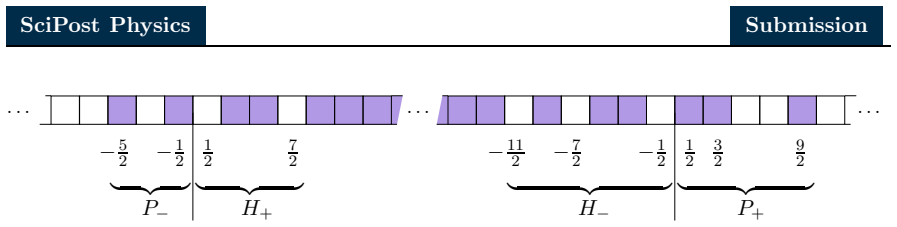
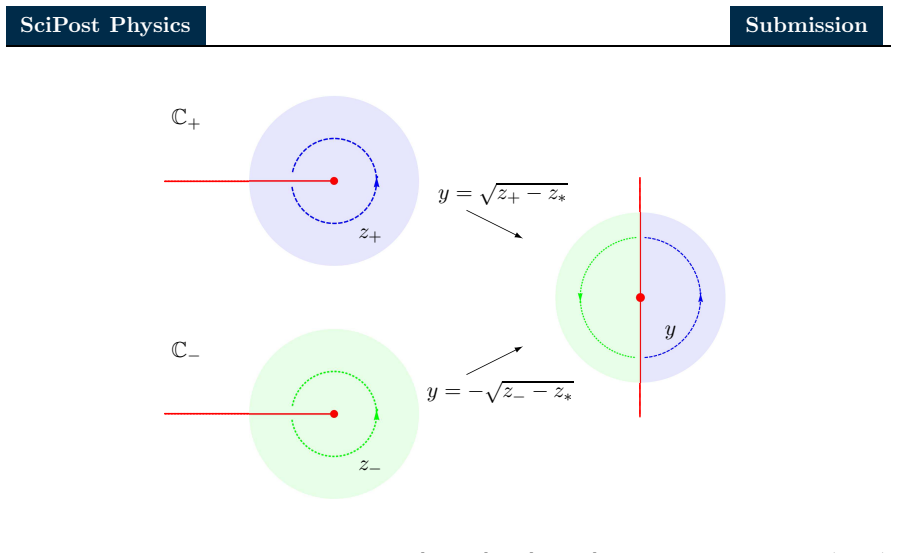
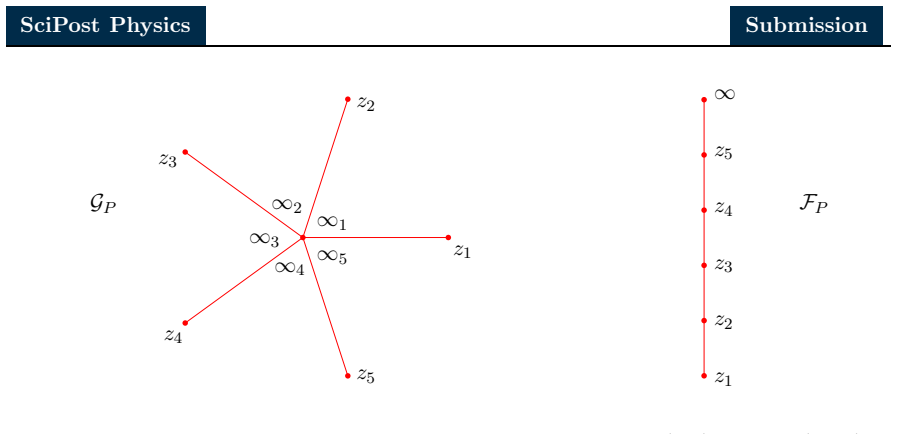
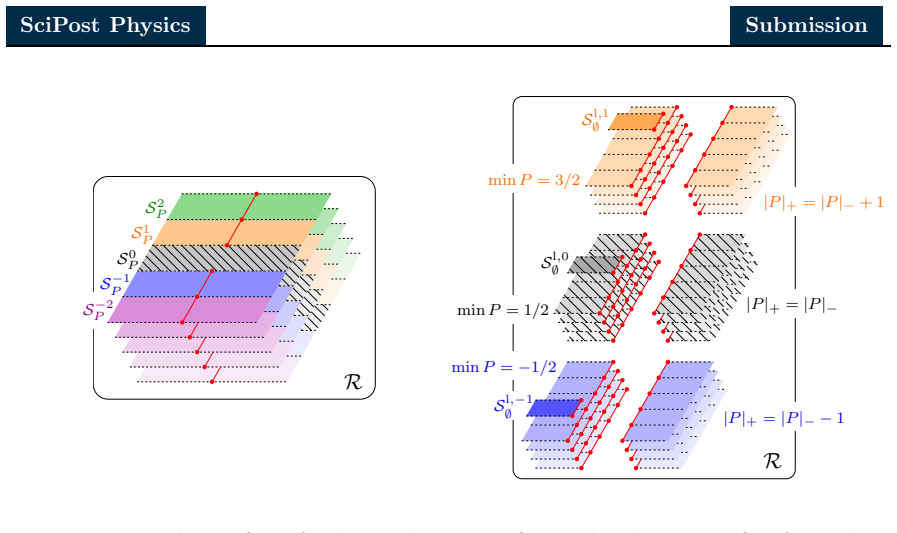
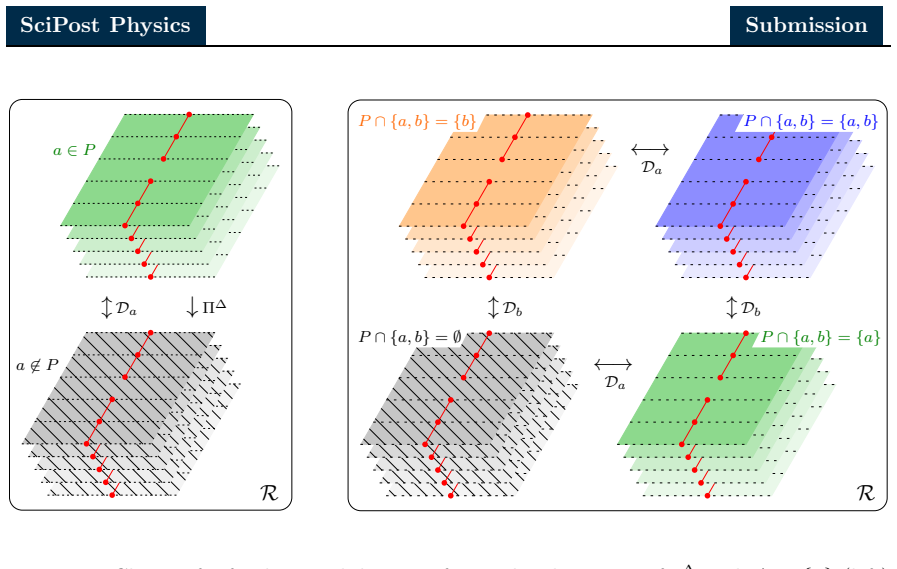
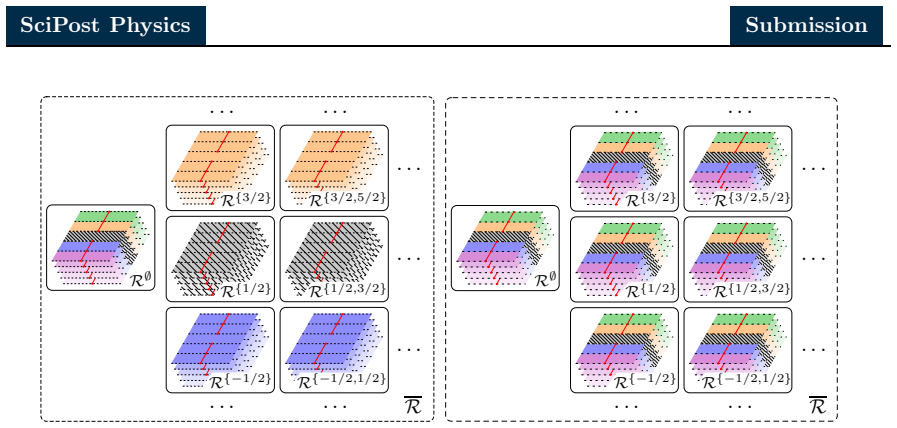
The Riemann surface $R$ is the natural single-valued domain of the half-integer polylogarithm $\chi_{\emptyset}(\nu)=-\mathrm{Li}_{5/2}(-e^{\nu})/\sqrt{2\pi}$; its sheets are indexed by finite subsets of $\mathbb{Z}+1/2$, which gives it the topology of an infinite-dimensional hypercube. Quotients by translation automorphisms produce $\check{R}$, while quotients by involutions that remove chosen branch points produce $R_{\Delta}$. The key operation is the trace of a holomorphic differential over the covering map to the cylinder $C$, $(\mathrm{tr}_{\rho}\,\omega)(q)=\sum_{p:\rho(p)=q}\omega(p)$; because the trace of a holomorphic differential is holomorphic on $C$, the loop of integration in the probability formula may be moved freely. The paper proves that the exponential building blocks $e^{2I}$, $e^{I+J}$, $e^{2J}$, and $e^{2K}$ are well-defined meromorphic functions on these surfaces once the Vandermonde determinants and powers of $i/4$ are supplied by analytic continuation.
What would settle it
Find one finite set $P\subset\mathbb{Z}+1/2$ and one $s>0$ for which $\chi'_P(\nu)=s$ has two distinct solutions with $\mathrm{Re}\,\nu>0$, or none; that would falsify the conjectured uniqueness behind (122) and require modifying the contour deformation leading to (4). Short of that, truncating the sheet sum in (4) at increasing $|P|$ and checking that the $c<0$ and $c>0$ evaluations agree, or comparing with Monte Carlo data for TASEP on a ring at intermediate times, would test the claimed equivalence numerically.
Extended reading notes
Core claim
Equations (1), (6), (11), and (13) are claimed to be exactly equivalent to the known formulas of [39]–[42]. The mechanism is that the finite subsets of half-integers labelling the sheets of $\check{R}$ and $R_{\Delta}$ are the same objects as the particle-hole excitation sets in the Bethe-ansatz sums, so what looked like a discrete sum over excitations is actually a trace over a covering map from the Riemann surface to the cylinder $C$. Carrying out the trace reproduces the earlier formulas, and comparing the two choices of fundamental domain shows that the expressions in [39] and [40] agree, a fact that had previously only been checked numerically. The paper also rewrites the multiple-time formula (13) from [42] and analyses the pole structure of the integrand, showing that poles occur exactly when two points coincide on the same Riemann surface.
Load-bearing premise
The load-bearing premise is that for every sheet $P$ and every $s>0$ the equation $\chi'_P(\nu_P(s))=s$ has exactly one solution with $\mathrm{Re}\,\nu_P(s)>0$—a uniqueness property the paper states as conjectured, not proved.
Editorial extensions
If this is right
- The flat formula (4) and the wedge formula (10) are provably the same whether one starts from the derivation in [39] or the derivation in [40], closing the previous gap.
- For sharp wedge initial condition, the particle-hole constraints $|P|_+=|H|_-$ and $|P|_-=|H|_+$ emerge automatically from the sheet structure of $R_{\Delta}$, rather than being imposed by hand.
- The flat probability is an $N=\infty$ KdV soliton tau function, and the integration variable $\nu$ is the common soliton velocity; higher KdV time variables appear as derivatives of $\chi_{\emptyset}$.
- The stationary-initial-condition probability costs only the factor $-\sqrt{2\pi}e^{-\nu}\partial_u$ applied to the wedge differential, so the same Riemann-surface machinery covers it.
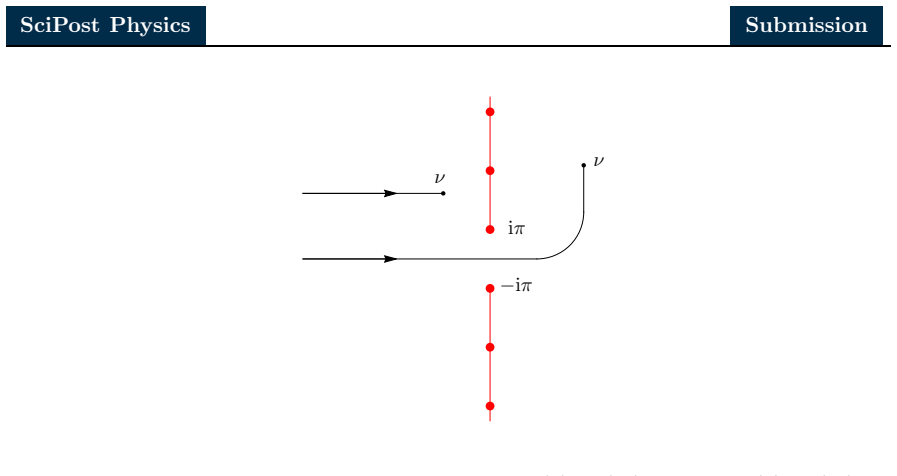
- In the multiple-time formula, poles in $\nu_{\ell+1}=\nu_{\ell}+2i\pi m$ appear exactly when $\Delta_{\ell+1}=\Delta_{\ell}+m$ and $P_{\ell+1}=P_{\ell}+m$, i.e. when the points coincide on the same Riemann surface.
Reading between the lines
- If the paper's picture holds, the entire finite-time transition probability is an analytic continuation of stationary large-deviation data, making the excited-state spectrum a derived object rather than an input.
- A direct numerical check at small time that the KdV tau function approaches the Painlevé II scaling solution would test the soliton-gas interpretation of the flat probability.
- The trace formalism looks transferable to other solvable exclusion processes and to finite asymmetry, with the half-integer polylogarithm replaced by the corresponding special function.
Signed reviews
Editorial analysis
A structured set of objections, weighed in public.
Referee Report
Summary. The paper proposes a unified geometric reformulation of exact finite-volume KPZ fluctuation formulas with periodic boundary conditions. It constructs infinite-genus Riemann surfaces R, ˇR, and R∆ associated with half-integer polylogarithms, defines meromorphic functions χ, χ′, χ′′, e^{2J}, e^{2K}, etc. on these surfaces, and expresses the one-point probabilities for flat, sharp wedge, and stationary initial conditions, as well as the multiple-time joint distribution for sharp wedge initial condition, as integrals of traces of holomorphic differentials over the covering maps to an infinite cylinder. In Section 5, these formulas are shown to be equivalent to the earlier Bethe-ansatz-based expressions of [39]–[42], with the additional claim that the distinct formulas of [39] and [40] agree once their sheet sums are reinterpreted as traces on the same Riemann surface. The paper also discusses connections to stationary large deviations, particle-hole excitations, and KdV/KP soliton tau functions.
Significance. If the claimed equivalences hold, the paper gives a genuinely unifying picture of exact finite-volume KPZ results: complicated sums over particle-hole excitations become traces of holomorphic differentials over sheets of ramified coverings, and the previously separate [39] and [40] derivations appear as different choices of fundamental domain. The analytic-continuation identities are derived in detail in the appendices, and the manipulations from the known formulas are transparent and largely self-contained once the ingredients of [39]–[42] are accepted. The main caveat is that one direction of the equivalence relies on an unproved and explicitly labeled conjecture about the uniqueness of the solutions of χ′_P(ν)=s. This does not affect the reformulation itself, but it does affect the strength of the claimed proof that the [39] and [40] formulas agree.
major comments (2)
- [§5.1.1, Eq. (122)] The passage from the generating function (122) to the probability formula (123), and hence to (4) for c>0, requires that for every finite P the equation χ′_P(ν_P(s))=s have a unique solution with Re ν_P(s)>0 when s>0. The manuscript states at (122) that this is “conjectured to be unique” and does not supply a proof or a reference to one. The change of variables s=−iχ′_P(ν) is a bijective substitution only under this uniqueness; if multiple roots exist, the deformed contour {c+iℝ} is not the image of the s-integration contour, and extra contributions can appear. Consequently the claimed equivalence between the [39] expression and (4) for c>0 is not fully established, and the subsequent conclusion that the [39] and [40] flat-initial-condition formulas agree is conditional on this conjecture. This is a load-bearing gap that should be resolved by a proof, a precise citation of a proof, or a clearly stated weakening of the claim.
- [§5.2.1, Eq. (131)] The same unproved uniqueness issue appears for sharp wedge initial condition: ν_{P,H}(s) is defined as the solution of χ′_{P,H}(ν)=s and is again stated to be “conjectured to be unique.” The derivation of (133) from (131) and the later identification of (10) with the [39] formula for c>0 depend on this conjecture. The direct derivation from [40] in §5.2.2 gives (10) only for c<0. Since the paper’s stated goal includes showing that the [39] and [40] sharp-wedge expressions agree, this second instance of the same unresolved assumption should also be addressed explicitly. The manuscript would be strengthened either by proving the conjecture or by making the conditional nature of the [39]=[40] statement prominent throughout Section 5.
minor comments (4)
- [§2.2, Eq. (4)] The definition of I0 is split across the text and depends on the sign of c, but this is stated only parenthetically in the paragraph after the display. Since (4) is claimed for both c<0 and c>0, a displayed convention for I0 with explicit branch choices would improve clarity.
- [§3.8.2] The sentence describing the automorphism T says that the map is a homeomorphism and “hence an automorphism since it is locally holomorphic.” Strictly speaking one should also note that the inverse is holomorphic, or cite the standard fact that a bijective locally biholomorphic map between Riemann surfaces is a biholomorphism.
- [§5.1.2] The sentence “The rest of the section is essentially a more detailed version of the derivation of equation (22), run backwards” is vague because equation (22) is presented later in §2.6.3. A forward reference and a one-sentence explanation of the logical structure would help the reader.
- [General] The manuscript contains numerous small typographical and spacing issues, such as missing spaces around mathematical expressions in prose (e.g., “R∆”, “χ∆P”, “S0P”). A careful copyedit would noticeably improve readability.
Circularity Check
No circular reduction: the Riemann-surface formulas are explicitly derived from independent Bethe-ansatz results [39,40], with no fitted parameter renamed as a prediction.
full rationale
The paper is a reformulation paper: Eqs. (1), (6), (11), and (13) are introduced as equivalent to known results from [39-42], and Section 5 proves the equivalence by direct manipulation of the earlier formulas. The Riemann surfaces R, R^Δ, and the traced differentials are constructed in Sections 3-4 from the analytic structure of half-integer polylogarithms, independently of the KPZ formulas; the comparison in Section 5 then matches them to [39] and [40] through Cauchy determinants, regularized integrals, and analytic-continuation identities. No parameter is fitted to a data subset and then called a prediction: coefficients such as V_P, Ξ_x^Δ, and W_P are fixed by the requirement that the integrands be single-valued on the relevant Riemann surfaces, and they coincide with the previously known Bethe-ansatz factors only after explicit evaluation. The claimed agreement between [39] and [40] is supported by showing that both reduce to the same integral representation (4) or (10), with two independent routes: [40] supplies a derivation for Re ν < 0, and [39] supplies one for Re ν > 0. Although [39] is the author's own earlier work, it is a peer-reviewed Bethe-ansatz result used as an external benchmark, and the equivalence also uses the non-overlapping work [40]. The main caveat is a correctness risk rather than circularity: at eq. (122), and in the sharp-wedge analogue (131), the change of variables s = -iχ'_P(ν) relies on the statement that χ'_P(ν_P(s)) = s has a unique solution with Re ν_P(s) > 0, which the paper explicitly labels as 'conjectured to be unique'. If that conjecture fails, the c > 0 direction of the equivalence would require additional contour arguments, but this is an unproved assumption inherited from [39], not a reduction of the target identity to itself by construction. The derivation chain does not define any target quantity in terms of itself, nor does it replace proof by a self-citation chain, so no significant circularity is present.
Assumptions & free parameters
assumptions (4)
- domain assumption The exact one-point and multi-point formulas of [39-42] for TASEP/KPZ in finite volume are correct.
- ad hoc to paper For each sheet P, the equation chi'_P(nu_P(s)) = s has a unique solution with Re nu_P(s) > 0 for s > 0.
- domain assumption The Bethe ansatz for TASEP on a ring is complete and its KPZ-scaling asymptotics are valid for the relevant initial conditions.
- standard math Standard results on compact Riemann surfaces, ramified coverings and traces of differentials extend to the infinite-genus limit considered here.
Cite this review
Pith. "Pith review of Riemann surfaces for KPZ with periodic boundaries." pith.science (2026). https://pith.science/paper/KLUE6HNO
@misc{pith2026190808907,
  author       = {Pith},
  title        = {Pith review of: Riemann surfaces for KPZ with periodic boundaries},
  year         = {2026},
  howpublished = {\url{https://pith.science/paper/KLUE6HNO}},
  note         = {Machine review of arXiv:1908.08907}
}
read the original abstract
The Riemann surface for polylogarithms of half-integer index, which has the topology of an infinite dimensional hypercube, is studied in relation to one-dimensional KPZ universality in finite volume. Known exact results for fluctuations of the KPZ height with periodic boundaries are expressed in terms of meromorphic functions on this Riemann surface, summed over all the sheets of a covering map to an infinite cylinder. Connections to stationary large deviations, particle-hole excitations and KdV solitons are discussed.
Figures

Figures from the paper (22 more)









Reference graph
Works this paper leans on
-
[39]
Prolhac, Finite-time fluctuations for the totally asymmetric exclus ion process, Phys
S. Prolhac, Finite-time fluctuations for the totally asymmetric exclus ion process, Phys. Rev. Lett. 116, 090601 (2016), doi:10.1103/PhysRevLett.116.090601
-
[40]
J. Baik and Z. Liu, Fluctuations of TASEP on a ring in relaxation time scale , Comm. Pure Appl. Math. 71, 0747 (2018), doi:10.1002/cpa.21702
-
[42]
J. Baik and Z. Liu, Multi-point distribution of periodic TASEP , J. Amer. Math. Soc. 32, 609-674 (2019), doi:10.1090/jams/915
doi:10.1090/jams/915 2019
-
[1]
T. Halpin-Healy and Y.-C. Zhang, Kinetic roughening phenomena, stochastic growth, directed polymers and all that. Aspects of multidisciplina ry statistical mechanics , Phys. Rep. 254, 215 (1995), doi:10.1016/0370-1573(94)00087-J
-
[2]
T. Kriecherbauer and J. Krug, A pedestrian ’s view on interacting particle systems, KPZ universality and random matrices , J. Phys. A: Math. Theor. 43, 403001 (2010), doi:10.1088/1751-8113/43/40/403001
-
[3]
I. Corwin, The Kardar-Parisi-Zhang equation and universality class , Random Matrices: Theory and Applications 1, 1130001 (2011), doi:10.1142/S2010326311300014
-
[4]
A. Borodin and V. Gorin, Lectures on integrable probability (2012), https://arxiv.org/abs/1212.3351
arXiv 2012
-
[5]
J. Quastel and H. Spohn, The one-dimensional KPZ equation and its universality class , J. Stat. Phys. 160, 965 (2015), doi:10.1007/s10955-015-1250-9
Show all 92 references
-
[6]
Halpin-Healy and K
T. Halpin-Healy and K. Takeuchi, A KPZ cocktail-shaken, not stirred... , J. Stat. Phys. 160, 794 (2015), doi:10.1007/s10955-015-1282-1
2015 doi
-
[7]
Spohn, The Kardar-Parisi-Zhang equation - a statistical physics pe rspective (2016), https://arxiv.org/abs/1601.00499
H. Spohn, The Kardar-Parisi-Zhang equation - a statistical physics pe rspective (2016), https://arxiv.org/abs/1601.00499
2016 arXiv
-
[8]
Takeuchi, An appetizer to modern developments on the Kardar-Parisi-Z hang univer- sality class , Physica A 504, 77 (2018), doi:10.1016/j.physa.2018.03.009
K. Takeuchi, An appetizer to modern developments on the Kardar-Parisi-Z hang univer- sality class , Physica A 504, 77 (2018), doi:10.1016/j.physa.2018.03.009
2018 doi
-
[9]
Saenz, The KPZ universality class and related topics (2019), https://arxiv.org/abs/1904.03319
A. Saenz, The KPZ universality class and related topics (2019), https://arxiv.org/abs/1904.03319
2019 arXiv
-
[10]
Takeuchi, M
K. Takeuchi, M. Sano, T. Sasamoto and H. Spohn, Growing interfaces uncover universal fluctuations behind scale invariance , Sci. Rep. 1, 34 (2011), doi:10.1038/srep00034. 75 SciPost Physics Submission
2011 doi
-
[11]
Somoza, M
A. Somoza, M. Ortu˜ no and J. Prior, Universal distribution functions in two-dimensional localized systems , Phys. Rev. Lett. 99, 116602 (2007), doi:10.1103/PhysRevLett.99.116602
2007 doi
-
[12]
van Beijeren, Exact results for anomalous transport in one-dimensional H amiltonian systems, Phys
H. van Beijeren, Exact results for anomalous transport in one-dimensional H amiltonian systems, Phys. Rev. Lett. 108, 180601 (2012), doi:10.1103/PhysRevLett.108.180601
2012 doi
-
[13]
Spohn, Nonlinear fluctuating hydrodynamics for anharmonic chains , J
H. Spohn, Nonlinear fluctuating hydrodynamics for anharmonic chains , J. Stat. Phys. 154, 1191 (2014), doi:10.1007/s10955-014-0933-y
2014 doi
-
[14]
Popkov, A
V. Popkov, A. Schadschneider, J. Schmidt and G. Sch¨ utz , Fibonacci family of dynamical universality classes , Proc. Natl. Acad. Sci. USA 112, 12645 (2015), doi:10.1073/pnas.1512261112
2015 doi
-
[15]
Kulkarni, D
M. Kulkarni, D. Huse and H. Spohn, Fluctuating hydrodynamics for a discrete Gross- Pitaevskii equation: Mapping onto the Kardar-Parisi-Zhan g universality class , Phys. Rev. A 92, 043612 (2015), doi:10.1103/PhysRevA.92.043612
2015 doi
-
[16]
Nahum, J
A. Nahum, J. Ruhman, S. Vijay and J. Haah, Quantum entanglement growth under ran- dom unitary dynamics , Phys. Rev. X 7, 031016 (2017), doi:10.1103/PhysRevX.7.031016
2017 doi
-
[17]
Ljubotina, M
M. Ljubotina, M. ˇZnidariˇ c and T. Prosen, Kardar-Parisi-Zhang physics in the quantum Heisenberg magnet , Phys. Rev. Lett. 122, 210602 (2019), doi:10.1103/PhysRevLett.122.210602
2019 doi
-
[18]
de Gier, A
J. de Gier, A. Schadschneider, J. Schmidt and G. Sch¨ utz , Kardar-Parisi-Zhang universality of the Nagel-Schreckenberg model , Phys. Rev. E 100, 052111 (2019), doi:10.1103/PhysRevE.100.052111
2019 doi
-
[19]
Kardar, G
M. Kardar, G. Parisi and Y.-C. Zhang, Dynamic scaling of growing interfaces , Phys. Rev. Lett. 56, 889 (1986), doi:10.1103/PhysRevLett.56.889
1986 doi
-
[20]
Hairer, Solving the KPZ equation , Ann
M. Hairer, Solving the KPZ equation , Ann. Math. 178, 559 (2013), doi:10.4007/annals.2013.178.2.4
2013 doi
-
[21]
Kupiainen, Renormalization group and stochastic PDEs , Annales Henri Poincar´ e17, 497 (2016), doi:10.1007/s00023-015-0408-y
A. Kupiainen, Renormalization group and stochastic PDEs , Annales Henri Poincar´ e17, 497 (2016), doi:10.1007/s00023-015-0408-y
2016 doi
-
[22]
Gubinelli and N
M. Gubinelli and N. Perkowski, KPZ reloaded, Commun. Math. Phys. 349, 165 (2017), doi:10.1007/s00220-016-2788-3
2017 doi
-
[23]
Johansson, Shape fluctuations and random matrices , Commun
K. Johansson, Shape fluctuations and random matrices , Commun. Math. Phys. 209, 437 (2000), doi:10.1007/s002200050027
2000 doi
-
[24]
Baik and E
J. Baik and E. Rains, Limiting distributions for a polynuclear growth model with e xternal sources, J. Stat. Phys. 100, 523 (2000), doi:10.1023/A:1018615306992
2000 doi
-
[25]
Pr¨ ahofer and H
M. Pr¨ ahofer and H. Spohn, Scale invariance of the PNG droplet and the Airy process , J. Stat. Phys. 108, 1071 (2002), doi:10.1023/A:1019791415147
2002 doi
-
[26]
Sasamoto, Spatial correlations of the 1D KPZ surface on a flat substrate , J
T. Sasamoto, Spatial correlations of the 1D KPZ surface on a flat substrate , J. Phys. A: Math. Gen. 38, L549 (2005), doi:10.1088/0305-4470/38/33/L01. 76 SciPost Physics Submission
2005 doi
-
[27]
Ferrari and H
P. Ferrari and H. Spohn, Scaling limit for the space-time covariance of the station- ary totally asymmetric simple exclusion process , Commun. Math. Phys. 265, 1 (2006), doi:10.1007/s00220-006-1549-0
2006 doi
-
[28]
Borodin, P
A. Borodin, P. Ferrari, M. Pr¨ ahofer and T. Sasamoto, Fluctuation properties of the TASEP with periodic initial configuration , J. Stat. Phys. 129, 1055 (2007), doi:10.1007/s10955-007-9383-0
2007 doi
-
[29]
Tracy and H
C. Tracy and H. Widom, Total current fluctuations in the asymmetric simple exclusi on process, J. Math. Phys. 50, 095204 (2009), doi:10.1063/1.3136630
2009 doi
-
[30]
J. Baik, P. Ferrari and S. P´ ech´ e,Limit process of stationary TASEP near the character- istic line , Comm. Pure Appl. Math. 63, 1017 (2010), doi:10.1002/cpa.20316
2010 doi
-
[31]
Borodin, I
A. Borodin, I. Corwin and V. Gorin, Stochastic six-vertex model , Duke Math. J. 165, 563 (2016), doi:10.1215/00127094-3166843
2016 doi
-
[32]
Matetski, J
K. Matetski, J. Quastel and D. Remenik, The KPZ fixed point (2017), https://arxiv.org/abs/1701.00018
2017 arXiv
-
[33]
Johansson and M
K. Johansson and M. Rahman, Multi-time distribution in discrete polynuclear growth (2019), https://arxiv.org/abs/1906.01053
2019 arXiv
-
[34]
Liu, Multi-time distribution of TASEP (2019), https://arxiv.org/abs/1907.09876
Z. Liu, Multi-time distribution of TASEP (2019), https://arxiv.org/abs/1907.09876
2019 arXiv
-
[35]
Tracy and H
C. Tracy and H. Widom, Level-spacing distributions and the Airy kernel , Commun. Math. Phys. 159, 151 (1994), doi:10.1007/BF02100489
1994 doi
-
[36]
Derrida and J
B. Derrida and J. Lebowitz, Exact large deviation function in the asymmetric exclusion process, Phys. Rev. Lett. 80, 209 (1998), doi:10.1103/PhysRevLett.80.209
1998 doi
-
[37]
Brunet and B
E. Brunet and B. Derrida, Probability distribution of the free energy of a directed po lymer in a random medium , Phys. Rev. E 61, 6789 (2000), doi:10.1103/PhysRevE.61.6789
2000 doi
-
[38]
Mallick and S
K. Mallick and S. Prolhac, Brownian bridges for late time asymptotics of KPZ fluctua- tions in finite volume , J. Stat. Phys. 173, 322 (2018), doi:10.1007/s10955-018-2136-4
2018 doi
-
[41]
Liu, Height fluctuations of stationary TASEP on a ring in relaxati on time scale , Ann
Z. Liu, Height fluctuations of stationary TASEP on a ring in relaxati on time scale , Ann. Inst. H. Poincar´ e Probab. Statist. 54, 1031 (2018), doi:10.1214/17-AIHP831
2018 doi
-
[43]
Gorissen, A
M. Gorissen, A. Lazarescu, K. Mallick and C. Vanderzand e, Exact current statistics of the asymmetric simple exclusion process with open boundari es, Phys. Rev. Lett. 109, 170601 (2012), doi:10.1103/PhysRevLett.109.170601. 77 SciPost Physics Submission
2012 doi
-
[44]
Gwa and H
L.-H. Gwa and H. Spohn, Six-vertex model, roughened surfaces, and an asymmetric sp in Hamiltonian, Phys. Rev. Lett. 68, 725 (1992), doi:10.1103/PhysRevLett.68.725
1992 doi
-
[45]
Prolhac, Spectrum of the totally asymmetric simple exclusion proces s on a pe- riodic lattice - first excited states , J
S. Prolhac, Spectrum of the totally asymmetric simple exclusion proces s on a pe- riodic lattice - first excited states , J. Phys. A: Math. Theor. 47, 375001 (2014). doi:10.1088/1751-8113/47/37/375001
2014 doi
-
[46]
Blythe and M
R. Blythe and M. Evans, Nonequilibrium steady states of matrix-product form: a sol ver’s guide, J. Phys. A: Math. Theor. 40, R333 (2007), doi:10.1088/1751-8113/40/46/R01
2007 doi
-
[47]
Lazarescu and K
A. Lazarescu and K. Mallick, An exact formula for the statistics of the current in the TASEP with open boundaries , J. Phys. A: Math. Theor. 44, 315001 (2011), doi:10.1088/1751-8113/44/31/315001
2011 doi
-
[48]
Gauti´ e, P
T. Gauti´ e, P. Le Doussal, S. Majumdar and G. Schehr, Non-crossing Brownian paths and Dyson Brownian motion under a moving boundary , J. Stat. Phys. (2019), doi:10.1007/s10955-019-02388-z
2019 doi
-
[49]
Bender and T
C. Bender and T. Wu, Anharmonic oscillator , Phys. Rev. 184, 1231 (1969), doi:10.1103/PhysRev.184.1231
1969 doi
-
[50]
Klassen and E
T. Klassen and E. Melzer, The thermodynamics of purely elastic scattering theories and conformal perturbation theory , Nucl. Phys. B 350, 635 (1991), doi:10.1016/0550-3213(91)90159-U
1991 doi
-
[51]
Dorey and R
P. Dorey and R. Tateo, Excited states by analytic continuation of TBA equations , Nucl. Phys. B 482, 639 (1996), doi:10.1016/S0550-3213(96)00516-0
1996 doi
-
[52]
Voros, The return of the quartic oscillator
A. Voros, The return of the quartic oscillator. The complex WKB method, Annales de l’I.H.P. Physique th´ eorique 39, 211 (1983). http://www.numdam.org/item/AIHPA_1983__39_3_211_0/
1983
-
[53]
Prolhac, Current fluctuations and large deviations for periodic TASEP on the relaxation scale , J
S. Prolhac, Current fluctuations and large deviations for periodic TASEP on the relaxation scale , J. Stat. Mech. 2015, P11028 (2015), doi:10.1088/1742-5468/2015/11/P11028
2015 doi
-
[54]
Motegi, K
K. Motegi, K. Sakai and J. Sato, Long time asymptotics of the totally asym- metric simple exclusion process , J. Phys. A: Math. Theor. 45, 465004 (2012), doi:10.1088/1751-8113/45/46/465004
2012 doi
-
[55]
Belokolos, A
E. Belokolos, A. Bobenko, V. Enolski, A. Its and V. Matve ev, Algebro-geometric Approach in the Theory of Integrable Equations , Springer Series in Nonlinear Dynamics. Springer, Berlin, doi:10.1007/s00220-007-0235-1 (1994)
1994 doi
-
[56]
Babelon, D
O. Babelon, D. Bernard and M. Talon, Introduction to Classical Integrable Systems , Cambridge University Press, doi:10.1017/CBO97805115350 24 (2003)
2003 doi
-
[57]
Zabrodin, Lectures on nonlinear integrable equations and their solut ions (2018), https://arxiv.org/abs/1812.11830
A. Zabrodin, Lectures on nonlinear integrable equations and their solut ions (2018), https://arxiv.org/abs/1812.11830
2018 arXiv
-
[58]
Fogedby, Nonequilibrium dynamics of a growing interface , J
H. Fogedby, Nonequilibrium dynamics of a growing interface , J. Phys.: Condens. Matter 14, 1557 (2002), doi:10.1088/0953-8984/14/7/313. 78 SciPost Physics Submission
2002 doi
-
[59]
Janas, A
M. Janas, A. Kamenev and B. Meerson, Dynamical phase transition in large-deviation statistics of the Kardar-Parisi-Zhang equation , Phys. Rev. E 94, 032133 (2016), doi:10.1103/PhysRevE.94.032133
2016 doi
-
[60]
Baik and Z
J. Baik and Z. Liu, TASEP on a ring in sub-relaxation time scale , J. Stat. Phys. 165, 1051 (2016), doi:10.1007/s10955-016-1665-y
2016 doi
-
[61]
Joshi, The second Painlev´ e hierarchy and the stationary KdV hierar chy, Publ
N. Joshi, The second Painlev´ e hierarchy and the stationary KdV hierar chy, Publ. Res. Inst. Math. Sci. 40, 1039 (2004), doi:10.2977/prims/1145475502
2004
-
[62]
A. Zabrodin, Canonical and grand canonical partition functions of Dyson g ases as tau- functions of integrable hierarchies and their fermionic re alization, Complex Analysis and Operator Theory 4, 497 (2010), doi:10.1007/s11785-010-0063-8
2010 doi
-
[63]
Quastel and D
J. Quastel and D. Remenik, KP governs random growth off a one dimensional substrate (2019), https://arxiv.org/abs/1908.10353
2019 arXiv
-
[64]
Feldman, H
J. Feldman, H. Kn¨ orrer and E. Trubowitz, Riemann Surfaces of Infinite Genus, CRM Monograph Series 20. American Mathematical Society, P rovidence, doi:10.1090/crmm/020 (2003)
2003 doi
-
[65]
Krajenbrink, P
A. Krajenbrink, P. Le Doussal and S. Prolhac, Systematic time expansion for the Kardar- Parisi-Zhang equation, linear statistics of the GUE at the e dge and trapped fermions , Nucl. Phys. B 936, 239 (2018), doi:10.1016/j.nuclphysb.2018.09.019
2018 doi
-
[66]
Le Doussal, S
P. Le Doussal, S. Majumdar, A. Rosso and G. Schehr, Exact short-time height distri- bution in the one-dimensional Kardar-Parisi-Zhang equati on and edge fermions at high temperature, Phys. Rev. Lett. 117, 070403 (2016), doi:10.1103/PhysRevLett.117.070403
2016 doi
-
[67]
Prolhac, Tree structures for the current fluctuations in the exclusio n process, J
S. Prolhac, Tree structures for the current fluctuations in the exclusio n process, J. Phys. A: Math. Theor. 43, 105002 (2010), doi:10.1088/1751-8113/43/10/105002
2010 doi
-
[68]
Prolhac, Perturbative solution for the spectral gap of the weakly asy mmetric exclusion process, J
S. Prolhac, Perturbative solution for the spectral gap of the weakly asy mmetric exclusion process, J. Phys. A: Math. Theor. 50, 315001 (2017), doi:10.1088/1751-8121/aa77de
2017 doi
-
[69]
Prolhac, Extrapolation methods and Bethe ansatz for the asymmetric e xclusion process, J
S. Prolhac, Extrapolation methods and Bethe ansatz for the asymmetric e xclusion process, J. Phys. A: Math. Theor. 49, 454002 (2016), doi:10.1088/1751-8113/49/45/454002
2016 doi
-
[70]
Z. Liu, A. Saenz and D. Wang, Integral formulas of ASEP and q-TAZRP on a ring (2019), https://arxiv.org/abs/1905.02987
2019 arXiv
-
[71]
Kenyon and D
R. Kenyon and D. Wilson, Critical resonance in the non-intersecting lattice path mod el, Probab. Theor. Rel. Fields 130, 289 (2004), doi:10.1007/s00440-003-0293-z
2004 doi
-
[72]
Poplavskyi, R
M. Poplavskyi, R. Tribe and O. Zaboronski, On the distribution of the largest real eigenvalue for the real Ginibre ensemble , Ann. Appl. Probab. 27, 1395 (2017), doi:10.1214/16-AAP1233
2017 doi
-
[73]
Baik and T
J. Baik and T. Bothner, The largest real eigenvalue in the real Ginibre ensemble and i ts relation to the Zakharov-Shabat system (2018), https://arxiv.org/abs/1808.02419. 79 SciPost Physics Submission
2018 arXiv
-
[74]
Derrida and A
B. Derrida and A. Gerschenfeld, Current fluctuations of the one dimensional symmet- ric simple exclusion process with step initial condition , J. Stat. Phys. 136, 1 (2009), doi:10.1007/s10955-009-9772-7
2009 doi
-
[75]
St´ ephan, Return probability after a quench from a domain wall initial state in the spin-1/2 XXZ chain , J
J.-M. St´ ephan, Return probability after a quench from a domain wall initial state in the spin-1/2 XXZ chain , J. Stat. Mech. 2017, 103108 (2017), doi:10.1088/1742-5468/aa8c19
2017 doi
-
[76]
Brattain, N
E. Brattain, N. Do and A. Saenz, The completeness of the Bethe ansatz for the periodic ASEP (2015), https://arxiv.org/abs/1511.03762
2015 arXiv
-
[77]
Langlands and Y
R. Langlands and Y. Saint-Aubin, Algebro-geometric aspects of the Bethe equations , In Strings and Symmetries , vol. 447 of Lecture Notes in Physics, pp. 40–53. Berlin: Springer, doi:10.1007/3-540-59163-X 254 (1995)
1995 doi
-
[78]
Langlands and Y
R. Langlands and Y. Saint-Aubin, Aspects combinatoires des ´ equations de Bethe , In Advances in Mathematical Sciences: CRM’s 25 Years , vol. 11 of CRM Proceedings and Lecture Notes, pp. 231–302. Amer. Math. Soc., doi:10.1090/crmp/011 (199 7)
-
[79]
Motegi and K
K. Motegi and K. Sakai, Vertex models, TASEP and Grothendieck polynomials , J. Phys. A: Math. Theor. 46, 355201 (2013), doi:10.1088/1751-8113/46/35/355201
2013 doi
-
[80]
Motegi and K
K. Motegi and K. Sakai, K-theoretic boson-fermion correspondence and melting cry stals, J. Phys. A: Math. Theor. 47, 445202 (2014), doi:10.1088/1751-8113/47/44/445202
2014 doi
-
[81]
Bobenko, Introduction to Compact Riemann Surfaces , vol
A. Bobenko, Introduction to Compact Riemann Surfaces , vol. 2013 of Lecture Notes in Mathematics, Springer, Berlin, Heidelberg, doi:10.1007/978-3-642-1 7413-1 1 (2013)
2013 doi
-
[82]
Cavalieri and E
R. Cavalieri and E. Miles, Riemann Surfaces and Algebraic Curves: A First Course in Hurwitz Theory, Cambridge University Press, doi:10.1017/CBO9781316569 252 (2016)
2016 doi
-
[83]
Eynard, Lectures notes on compact Riemann surfaces (2018), https://arxiv.org/abs/1805.06405
B. Eynard, Lectures notes on compact Riemann surfaces (2018), https://arxiv.org/abs/1805.06405
2018 arXiv
-
[84]
Beineke and F
L. Beineke and F. Harary, The genus of the n-cube , Canadian Journal of Mathematics 17, 494 (1965), doi:10.4153/CJM-1965-048-6
1965 doi
-
[85]
Springer, Introduction to Riemann surfaces , Addison-Wesley (1957)
G. Springer, Introduction to Riemann surfaces , Addison-Wesley (1957)
1957
-
[86]
Costin and S
O. Costin and S. Garoufalidis, Resurgence of the fractional polylogarithms , Math. Res. Lett. 16, 817 (2009), doi:10.4310/MRL.2009.v16.n5.a5
2009 doi
-
[87]
Golinelli and K
O. Golinelli and K. Mallick, Spectral gap of the totally asymmetric exclusion process at ar- bitrary filling , J. Phys. A: Math. Gen. 38, 1419 (2005), doi:10.1088/0305-4470/38/7/001
2005 doi
-
[88]
N. Bogoliubov, Determinantal representation of the time-dependent stati onary correla- tion function for the totally asymmetric simple exclusion m odel, SIGMA 5, 052 (2009), doi:10.3842/SIGMA.2009.052
2009 doi
-
[89]
Motegi, K
K. Motegi, K. Sakai and J. Sato, Exact relaxation dynamics in the totally asymmetric sim- ple exclusion process, Phys. Rev. E 85, 042105 (2012), doi:10.1103/PhysRevE.85.042105
2012 doi
-
[90]
Prolhac, Asymptotics for the norm of Bethe eigenstates in the periodi c totally asym- metric exclusion process, J
S. Prolhac, Asymptotics for the norm of Bethe eigenstates in the periodi c totally asym- metric exclusion process, J. Stat. Phys. 160, 926 (2015), doi:10.1007/s10955-015-1230-0. 80 SciPost Physics Submission
2015 doi
-
[91]
Priezzhev, Exact nonstationary probabilities in the asymmetric exclu sion process on a ring , Phys
V. Priezzhev, Exact nonstationary probabilities in the asymmetric exclu sion process on a ring , Phys. Rev. Lett 91, 050601 (2003), doi:10.1103/PhysRevLett.91.050601
2003 doi
-
[92]
Tracy and H
C. Tracy and H. Widom, Integral formulas for the asymmetric simple exclusion proce ss, Commun. Math. Phys. 279, 815 (2008), doi:10.1007/s00220-008-0443-3. 81
2008 doi
Reviewed August 14, 2026 · model on record in the stance chip above.
Discussion (0). Continue with ORCID to comment.