REVIEW 5 major objections 5 minor 56 references
Trustable and Automated Machine Learning Running with Blockchain and Its Applications
T0 review · 5 major / 5 minor · reviewed 2026-08-14 · deepseek-v4-flash
Pith's one-line read A Capsule Network's masked reconstruction, tweaked during scoring, manufactures synthetic fraud records that improve a gradient-boosted fraud detector on real credit-card transactions.
desk verdict A plausible CapsNet synthetic-data idea with no numeric evidence behind its central claim; the ASTORE half is an honest but thin application note. read the letter →
The pith
A machine-rendered reading of the paper's core claim, the machinery that carries it, and where it could break.
The reading
What carries the argument
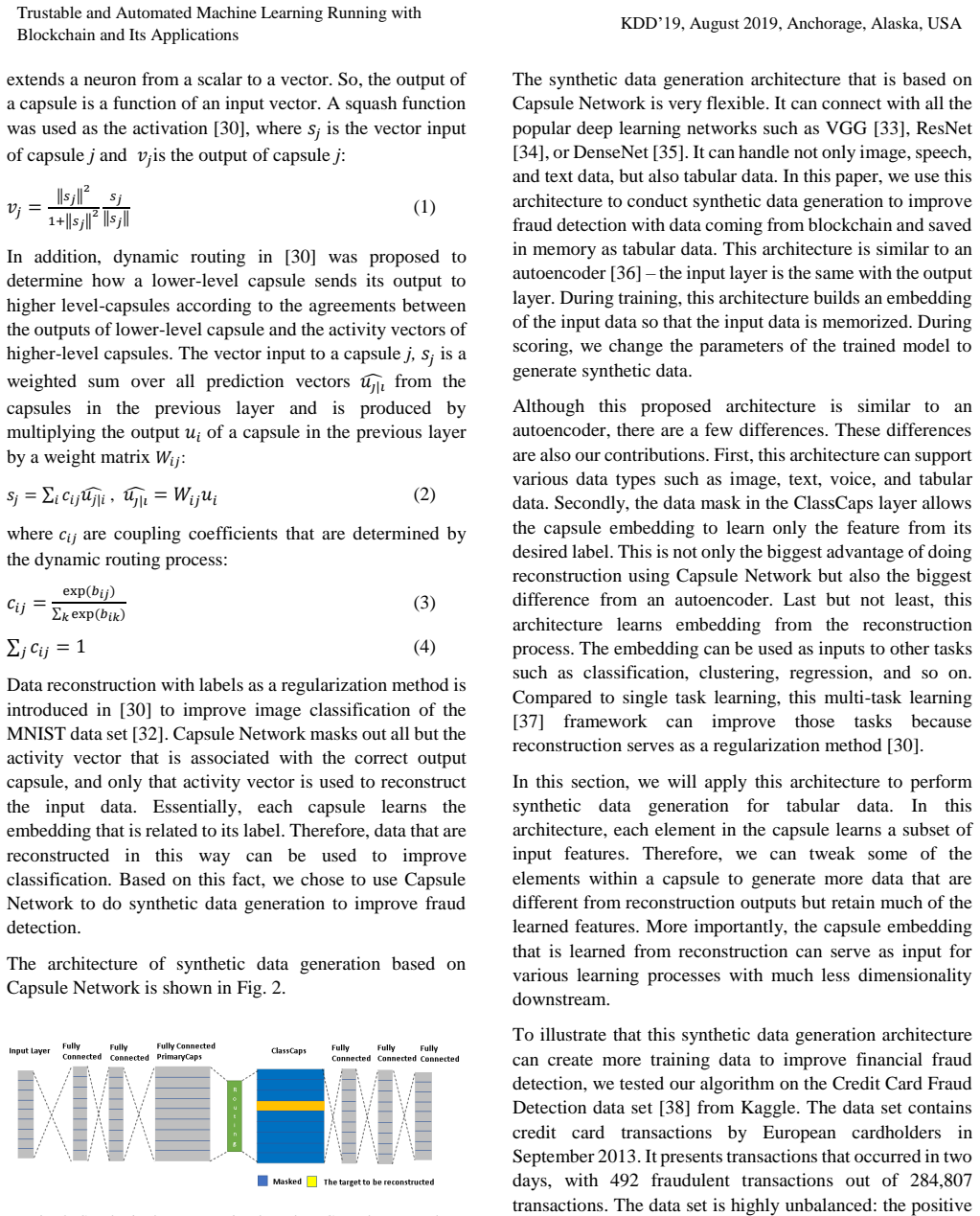
The machinery that carries the argument is the Capsule Network used as a reconstruction autoencoder. A capsule is a group of neurons whose vector output represents the instantiation parameters of an entity; dynamic routing determines coupling coefficients, and a mask in the ClassCaps layer suppresses all activity vectors except the one for the target label. That masked embedding is decoded back to input space, and at scoring time the embedding is tweaked with the same parameter ratio so the decoded output is not the original record but a synthetic variant of the rare class. These variants are what enrich the downstream training set. The companion mechanism for deployment is ASTORE, a platform-independent binary model format with a cryptographic store key, which packs the trained model, score functions, and variable metadata into a blob that an edge device can load and score online.
What would settle it
Compare the capsule-generated fraud samples with held-out real fraud samples in feature space using a two-sample distance or a classifier trained to tell synthetic from real; if the two sets are easily separable, or if a detector trained only on synthetic fraud performs near chance on real fraud, the claimed mechanism fails. Rerunning the experiment while sweeping the undefined same parameter ratio would also show whether the reported gain depends on a fine-tuned value rather than on the method itself.
Extended reading notes
Core claim
On its own terms, the paper's central discovery is that a Capsule Network's reconstruction path can be turned into a synthetic-data engine for rare-event tabular data. A capsule is a group of neurons whose activity vector encodes instantiation parameters, and dynamic routing sends lower-level outputs to higher-level capsules according to agreement; the ClassCaps mask keeps only the activity vector for the target label, so the decoder learns a label-specific embedding of the input. During scoring, the authors tweak the trained model's capsule embedding by the same parameter ratio to make the reconstruction diverge from the exact input, generating new samples that retain much of the learned features. On the Credit Card Fraud Detection data set, the authors train a gradient-boosted tree on the original oversampled data, on data enriched with capsule-generated fraud samples, and on data enriched with random fraud samples; they report that the capsule-enriched model performs better than the other two in balancing catching frauds and avoiding false alerts across precision-recall, F1, and ROC curves for cutoffs between 0 and 10 percent. The paper also claims ASTORE, a compact binary model format, solves the edge-deployment half of the problem by letting a server-trained model score streaming data directly.
Load-bearing premise
The method assumes that slightly changing the internal feature descriptions learned from real fraud transactions produces new fake fraud records that look enough like real fraud to help a detector; the paper does not verify that resemblance directly.
Editorial extensions
If this is right
- A fraud detector can be improved without collecting new labeled fraud cases: capsule-generated minority-class samples are added to the training set, and the reported experiments show better precision-recall, F1, and ROC behavior than no-synthetic and random-synthetic baselines.
- A model trained on a powerful server can be serialized as an ASTORE blob and score incoming transactions in real time on memory-limited streaming or edge devices, without retraining there.
- The capsule reconstruction architecture accepts image, text, speech, and tabular inputs, so the same synthetic-data mechanism can in principle enrich training sets beyond financial fraud.
- Synthetic labels from the generator are exact by construction, which removes the labeling bottleneck that makes rare-event training data scarce.
- For blockchain-stored financial transactions, the two contributions connect into a pipeline: immutable data feed a server-trained model, the model travels as an ASTORE blob to the streaming layer, and capsule-generated synthetic fraud addresses the small-label problem.
Reading between the lines
- If the reported gain is real, the same masked-reconstruction trick should transfer to other rare-event tabular problems, such as network intrusion, loan default, or rare disease, whenever a capsule can learn a class-specific embedding; rerunning the pipeline on a second public data set would test that directly.
- The paper leaves the same parameter ratio undefined, so a natural next experiment is to sweep that ratio and check whether the fraud-detection gain is stable or depends on one carefully chosen value; practitioners would need this before trusting the method.
- Because an ASTORE blob's store key changes whenever any bit changes, the blob could double as an on-chain model fingerprint that records which model version scored a transaction; the paper describes compatibility with blockchain but does not implement this audit trail.
Signed reviews
Editorial analysis
A structured set of objections, weighed in public.
Referee Report
Summary. The paper makes two contributions within a blockchain-based 'trustable and automated' machine-learning framework. First, it proposes using the ASTORE binary format to serialize machine-learning models on a server layer and then deploy them on resource-limited streaming (edge) devices, arguing that this format is unique, immutable, and resistant to reverse engineering. Second, it proposes a Capsule Network (CapsNet) based synthetic data generation method that is said to enrich scarce training data for fraud detection. The method trains a CapsNet on an oversampled credit-card fraud dataset, then 'tweaks' capsule embeddings during scoring with an unspecified 'same parameter ratio' to generate synthetic fraud samples. These samples are added to the training set of a gradient-boosted tree, and the resulting model is compared against a no-synthetic baseline and a random-synthetic baseline using precision-recall, F1, and ROC curves. The paper reports qualitative improvements but provides no numerical metrics, confidence intervals, or statistical tests.
Significance. If the synthetic data generation method were rigorously validated, it would offer a practical tool for rare-event classification with limited labeled data, which is a genuine and widely relevant problem. The ASTORE contribution, however, is mostly a descriptive account of a proprietary binary format; the paper provides no formal security analysis, no benchmark comparisons with existing formats such as PMML/PFA/ONNX, and no evidence of the claimed uniqueness or reverse-engineering resistance. The most valuable part of the paper, the CapsNet-based synthetic data generation, is currently under-specified and under-validated. The paper includes pseudocode for ASTORE scoring and a clear architecture diagram for the CapsNet, which are helpful for understanding the intended pipeline, but these do not compensate for the lack of empirical support for the central claim.
major comments (5)
- [Section 4, architecture description] The 'same parameter ratio' introduced to tweak the capsule embedding is never defined. This parameter is load-bearing: the paper states that during scoring 'we also introduced the same parameter ratio to tweak the capsule embedding in the model so that the generated data sets can present more diversity,' yet no value, range, or operational definition is given. Without this definition, the method is not reproducible, and the claimed improvement cannot be attributed to a well-specified procedure.
- [Section 4, experimental results (Figs. 3-5)] The experimental evidence consists solely of precision-recall, F1, and ROC curves with no numeric values, no error bars, no repeated runs, and no statistical tests. The statement that 'overall the model that used synthetic data from Capsule Network performed better' is qualitative. Furthermore, the paper does not state how many synthetic samples were added to the training set for Model 2 or Model 3, so it is impossible to determine whether any apparent advantage comes from the quality of the generated samples or simply from the increased size of the minority class.
- [Section 4, synthetic data fidelity] The paper never checks whether the synthetic fraud data resemble real fraud data in the 29-dimensional feature space. There is no distributional comparison (e.g., MMD, per-feature statistics, PCA/t-SNE visualization) between real and generated samples. The claim that tweaking capsule embeddings produces samples that 'retain much of the learned features' is therefore an assertion without supporting evidence. This is a central gap because the entire hypothesis is that the synthetic samples are useful for training a fraud detector.
- [Section 3, ASTORE security and uniqueness claims] The claims that ASTORE is 'unique and immutable' and that it is 'almost impossible to reverse-engineer' are not backed by formal analysis. The paper states that 'if one bit of data is changed, the store key is changed too,' but this property alone does not establish cryptographic uniqueness or immutability; no hash function, collision-resistance argument, or threat model is provided. Similarly, the assertion that binary formats prevent reverse engineering is a security claim that requires analysis, especially in financial applications where adversarial reverse engineering is a realistic concern.
- [Section 4, baseline and ablation] The baseline model is trained after oversampling the rare events, and Model 3 adds random synthetic rare events. There is no ablation that separates the effect of adding CapsNet-generated samples from the effect of adding more minority-class samples in general (which Model 3 also does). Without such an ablation, the comparison does not demonstrate that the CapsNet generation is superior to simpler oversampling or random synthesis; it may simply be adding more data, an effect that is confounded with sample quality.
minor comments (5)
- [Throughout] The manuscript contains several typos and inconsistent spellings: 'ASOTRE' for ASTORE in Section 3, 'retrived' in references [32] and [54], 'Thampson' for Thompson in [56], 'MINST' for MNIST in [32], and 'reciever' in the title of reference [44]. Please correct these.
- [Section 2 and Figure 1] The text references 'Fig. 1' to visualize the analytical framework, but the figure is not included in the manuscript. Either include the figure or adjust the reference.
- [Section 5] There is an incomplete sentence: 'Some We have seen some efforts such as using the IPFS...' This appears to be a typographical error and should be rephrased.
- [Section 4] The connection between the synthetic data generation experiments and the blockchain framework is not made explicit. The experiments are run on a standard Kaggle dataset, not on data retrieved from a blockchain, so the reader is left to infer how this method integrates with the trustable/automation framework proposed in the introduction.
- [Section 3] The paper claims that ASTORE is 'unique' but does not specify the universe over which uniqueness is defined. If the store key is a hash of the model contents, uniqueness is a collision-resistance property, but this is not stated. Clarify the intended meaning.
Circularity Check
No significant circularity: the fraud-detection experiment is an external holdout comparison; the blockchain-framework self-citation is not load-bearing for the synthetic-data result.
full rationale
The paper's central quantitative claim is the synthetic-data-augmentation result in Section 4. The claim is empirical, not a derivation: the CapsNet-generated rare events are added to the training set, a gradient-boosted tree is trained, and the result is compared on the stratified Kaggle holdout with the 'exact same gradient boosted tree' baseline and with random rare-event augmentation. Because the comparison is made on an external holdout set and the baseline does not use generated data, the reported improvement is not defined in terms of the fitted outputs; the evaluation is self-contained against an outside benchmark. The architecture in Fig. 2 follows Sabour et al. [30]'s CapsNet reconstruction idea, and ASTORE is an existing SAS binary format [21]; neither is a renamed version of the paper's own experimental output. The one notable self-citation is [24] (T. Wang's prior unified framework), which supplies the blockchain trustability/automation framing and motivates the two open questions; however, Sections 3 and 4's claims (compact model deployment and synthetic fraud data) do not reduce to [24], and no equation or uniqueness theorem is imported from that prior work to force the fraud-detection conclusion. Weaknesses such as the undefined 'same parameter ratio,' the absence of numeric precision/recall/F1/ROC values, and the lack of a distributional-fidelity check for the synthetic fraud samples are correctness and rigor concerns, not circularity: they indicate that the claimed 'very effective' result is under-supported, but they do not show that the result is equivalent by definition to its inputs. No circular step meeting the quote-and-reduction standard was found.
Assumptions & free parameters
free parameters (5)
- Capsule embedding tweak ratio =
Not reported.
- CapsNet architecture dimensions =
100-neuron dense layer, 10 capsules of 10 neurons, 2 capsules of 16 neurons.
- Training epochs =
250.
- Gradient boosted tree hyperparameters =
Not reported.
- Oversampling ratio =
Not reported.
assumptions (4)
- standard math The dynamic routing and squash equations from CapsNet [30] are correct and behave as described.
- domain assumption The Kaggle Credit Card Fraud Detection labels are accurate and the dataset is representative of blockchain financial fraud detection.
- domain assumption The ASTORE store key changes whenever any bit changes, making the blob immutable and unique.
- ad hoc to paper Tweaking capsule embeddings with a parameter ratio yields synthetic data that preserve class-relevant features.
Cite this review
Pith. "Pith review of Trustable and Automated Machine Learning Running with Blockchain and Its Applications." pith.science (2026). https://pith.science/paper/KMKCKSUE
@misc{pith2026190805725,
  author       = {Pith},
  title        = {Pith review of: Trustable and Automated Machine Learning Running with Blockchain and Its Applications},
  year         = {2026},
  howpublished = {\url{https://pith.science/paper/KMKCKSUE}},
  note         = {Machine review of arXiv:1908.05725}
}
read the original abstract
Machine learning algorithms learn from data and use data from databases that are mutable; therefore, the data and the results of machine learning cannot be fully trusted. Also, the machine learning process is often difficult to automate. A unified analytical framework for trustable machine learning has been presented in the literature. It proposed building a trustable machine learning system by using blockchain technology, which can store data in a permanent and immutable way. In addition, smart contracts on blockchain are used to automate the machine learning process. In the proposed framework, a core machine learning algorithm can have three implementations: server layer implementation, streaming layer implementation, and smart contract implementation. However, there are still open questions. First, the streaming layer usually deploys on edge devices and therefore has limited memory and computing power. How can we run machine learning on the streaming layer? Second, most data that are stored on blockchain are financial transactions, for which fraud detection is often needed. However, in some applications, training data are hard to obtain. Can we build good machine learning models to do fraud detection with limited training data? These questions motivated this paper; which makes two contributions. First, it proposes training a machine learning model on the server layer and saving the model with a special binary data format. Then, the streaming layer can take this blob of binary data as input and score incoming data online. The blob of binary data is very compact and can be deployed on edge devices. Second, the paper presents a new method of synthetic data generation that can enrich the training data set. Experiments show that this synthetic data generation is very effective in applications such as fraud detection in financial data.
Figures


Reference graph
Works this paper leans on
-
[24]
A unified analytical framework for trustable machine learning and automation running with blockchain
T. Wang, “A unified analytical framework for trustable machine learning and automation running with blockchain”, IEEE BigData Conference workshops, 2018
work page 2018
-
[1]
Bitcoin: A peer -to-peer electronic cash system,
S. Nakamoto, “Bitcoin: A peer -to-peer electronic cash system,” retrieved online, May 2018
work page 2018
-
[2]
A next generation smart contract and decentralized application platform,
V. Buterin, “A next generation smart contract and decentralized application platform,” retrieved online, May 2018
work page 2018
-
[3]
The Byzantine Generals Problem,
L. Lamport, R. Shostak, and M. Pease, “The Byzantine Generals Problem,” ACM Trans. on Programming Languages and Systems, vol. 4, no. 3, pp. 382–401, 1982
work page 1982
-
[4]
Combating double -spending using cooperative P2P systems,
I. Osipkov, E. Vasserman, N. Hopper, and Y. Kim, “Combating double -spending using cooperative P2P systems,” doi:10.1109/ICDCS.2007.91, 2007
-
[5]
Distributed double -spending prevention,
J. Hoepman, “Distributed double -spending prevention,” arXiv:0802.0832v1, 2008
arXiv 2008
- [6]
-
[7]
R3 Corda, https://www.r3.com/, retrieved online, May 2018
work page 2018
Show all 56 references
-
[8]
Chain, https://chain.com/, retrieved online, May 2018
2018
-
[9]
BigChainDB, https://www.bigchaindb.com/, retrieved online, May 2018
2018
-
[10]
Hyperledger, https://www.hyperledger.org/, retrieved online, May 2018
2018
-
[11]
Mining association rules between sets of items in large databases,
R. Agrawal, T. Imieliński, and A. Swami, “Mining association rules between sets of items in large databases,” Proceedings of the 1993 ACM SIGMOD International Conference on Management of Data, SIGMOD 1993
1993
-
[12]
IPFS, https://github.com/ipfs/ipfs, retrieved June 2019
2019
-
[13]
Approximate frequency counts over data streams,
G. Manku and R. Motwani, “Approximate frequency counts over data streams,” in Proceedings of the 2002 International KDD’19 Workshops, August 2019, Anchorage, Alaska, USA T. Wang, X. Wu and T. He Conference on Very Large Data Bases (VLDB ’02), Hong Kong, pp. 346–357
2002
-
[14]
A simple algorithm for finding frequent elements in streams and bags,
R. Karp, C. Papadimitriou, and S. Shenker, “A simple algorithm for finding frequent elements in streams and bags,” ACM Trans. Database Syst., vol. 28, pp. 51–55, 2003
2003
-
[15]
Finding recent frequent itemsets adaptively over online data streams,
J. Chang and W. Lee, “Finding recent frequent itemsets adaptively over online data streams,” KDD ’03, Washington, DC, pp. 487–492
-
[16]
False positive or false negative: Mining frequent itemsets from high speed transactional data streams,
J. Yu, Z. Chong, H. Lu, and A. Zhou, “False positive or false negative: Mining frequent itemsets from high speed transactional data streams,” VLDB ’04
-
[17]
https://en.wikipedia.org/wiki/Raft_(computer_science), retrieved 2018
2018
-
[18]
The management and mining of multiple predictive models using the predictive modeling markup language,
R. Grossman, S. Bailey, A. Ramu, and X. Qin, “The management and mining of multiple predictive models using the predictive modeling markup language,” Information and Software Technology, vol. 41, no. 9, pp. 589–595, 2002, DOI: 10.1016/S0950-5849(99)00022-1
2002 doi
-
[19]
Deploying analytics with the Portable Format for Analytics (PFA),
J. Pivarski, C. Bennett, and R. Grossman, “Deploying analytics with the Portable Format for Analytics (PFA),” KDD ’16
-
[20]
Applied machine learning at Facebook: A datacenter infrastructure perspective,
K. Hazelwood, et al., “Applied machine learning at Facebook: A datacenter infrastructure perspective,” International Symposium o n High -Performance Computer Architecture (HPCA), 2018
2018
-
[21]
An overview of SAS Visual Data Mining and Machine Learning on SAS Viya,
J. Wexler, S. Haller, and R. Myneni, “An overview of SAS Visual Data Mining and Machine Learning on SAS Viya,” SAS Global Forum, 2017
2017
-
[22]
Trustless machine learning contracts: Evaluating and exchanging machine learning models on the Ethereum blockchain,
A. Kurtulmus and K. Daniel, “Trustless machine learning contracts: Evaluating and exchanging machine learning models on the Ethereum blockchain,” arXiv:1802.10185, 2018
2018 arXiv
-
[23]
Security analysis of SHA-256 and Sisters,
H. Gilbert and H. Handschuh, “Security analysis of SHA-256 and Sisters,” Selected Areas in Cryptography, 2003, pp. 175– 193
2003
-
[25]
Morgan Interbank Information Network, https://www.jpmorgan.com/country/US/en/detail/132057013 5560, retrieved in 2019
J.P. Morgan Interbank Information Network, https://www.jpmorgan.com/country/US/en/detail/132057013 5560, retrieved in 2019
2019
-
[26]
The synthetic data vault
N. Patki, R. Wedge, K. Veeramachaneni, “The synthetic data vault”, Data Science and Advanced Analytics (DSAA) 2016
2016
-
[27]
Self-driving cars can learn a lot by playing grand theft auto
W. Knight, “Self-driving cars can learn a lot by playing grand theft auto", https://www.technologyreview.com/s/602317/self-driving- cars-can-learn-a-lot-by-playing-grand-theft-auto/, Retrieved in 2019
2019
-
[28]
Toward geometric deep SLAM
D. De Tone, T. Malisiewicz, A. Rabinovich, “Toward geometric deep SLAM”, arXiv:1707.07410 [cs.CV], 2017
2017 arXiv
-
[29]
Domain randomization for transferring deep neural networks from simulation to the real world
J. Tobin, R. Fong, A. Ray, J. Schneider, W. Zaremba, P. Abbeel, “Domain randomization for transferring deep neural networks from simulation to the real world”, arXiv:1703.06907 [cs.RO], 2017
2017 arXiv
-
[30]
Dynamic routing between capsules
S. Sabour, N. Frosst and G. Hinton, “Dynamic routing between capsules”, arXiv:1710.09829 (2017)
2017 arXiv
-
[31]
Capsule Network Performance on Complex Data
E. Xi, S. Bing and Y. Jin , “Capsule Network Performance on Complex Data”, arXiv:1712.03480 [stat.ML], 2017
2017 arXiv
-
[32]
The MINST Database of HandWritten Digits
Y. LeCun, C. Cortes and C. J. C. Burges, “The MINST Database of HandWritten Digits", http://yann.lecun.com/exdb/mnist/, retrived in 2019
2019
-
[33]
Very Deep Convolutional Networks for Large -Scale Image Recognition
K. Simonyan and A. Zisserman, “Very Deep Convolutional Networks for Large -Scale Image Recognition ”, arXiv:1409.1556 [cs.CV], 2014
2014 arXiv
-
[34]
Deep Residual Learning for Image Recognition
K. He, X. Zhang, S. Ren, J. Sun, “Deep Residual Learning for Image Recognition”, arXiv:1512.03385 [cs.CV], 2015
2015 arXiv
-
[35]
Densely Connected Convolutional Networks
G. Huang, Z. Liu, L. van der Maaten, K. Q. Weinberger, “Densely Connected Convolutional Networks ”, arXiv:1608.06993 [cs.CV], 2016
2016 arXiv
-
[36]
Autoencoder for words
C. Liou, W. Cheng, J. Liou, D. Liou, “Autoencoder for words", Neurocomputing, 139: 84–96, doi:10.1016/j.neucom.2013.09.055, 2014
2013 doi
-
[37]
Multi-task learning
R. Caruana, “Multi-task learning”, Machine Learning, 28: 41– 75, doi:10.1023/A:1007379606734, 1997
1997 doi
-
[38]
https://www.kaggle.com/mlg-ulb/creditcardfraud, retrieved in 2019
2019
-
[39]
Efficient Top Rank Optimization with Gradient Boosting for Supervised Anomaly Detection,
J. Frery, A. Habrard A, M.Sebban, O. Caelen, L. He-Guelton L. “Efficient Top Rank Optimization with Gradient Boosting for Supervised Anomaly Detection,” In: Ceci M., Hollmén J., Todorovski L., Vens C., Džeroski S. (eds) Machine Learning and Knowledge Discovery in Databases. EC...
2017
-
[40]
XGBoost: A Scalable Tree Boosting System
T. Chen and C. Guestrin, “XGBoost: A Scalable Tree Boosting System”, KDD 2016
2016
-
[41]
ADAM: a method for stochastic optimization
D. P. Kingma and J. L. Ba, “ADAM: a method for stochastic optimization”, ICLR 2015
2015
-
[42]
https://en.wikipedia.org/wiki/Precision_and_recall, retrrived in 2019
2019
-
[43]
https://en.wikipedia.org/wiki/F1_score, retrieved in 2019
2019
-
[44]
https://en.wikipedia.org/wiki/Receiver_operating_characteris tic, retrieved in 2019
2019
-
[45]
http://dmg.org, retrieved in 2019
2019
-
[46]
http://onnx.ai, retrieved in 2019
2019
-
[47]
Information-theoretic measures for anomaly detection
W. Lee and D. Xiang , “Information-theoretic measures for anomaly detection ”, In Proceedings of the 2001 IEEE Symposium on Security and Privacy, May 2001
2001
-
[48]
Determining the operational limits of an anomaly -based intrusion detector
K. Tan and R. Maxion, “Determining the operational limits of an anomaly -based intrusion detector ”, IEEE Journal on Selected Areas in Communication, 21(1), Jan. 2003
2003
-
[49]
The role of a reference synthetic data generator within the field of learning analytics
A. Berg, S. Mol, G. Kismihok, “The role of a reference synthetic data generator within the field of learning analytics”, Journal of Learning Analytics, 3(1), 107–128. http://dx.doi.org/10.18608/jla.2016.31.7
2016 doi
-
[50]
Benchmarking anomaly -based detection systems. In International Conference on Dependable Systems and Networks
R. Maxion and K. Tan, “Benchmarking anomaly -based detection systems. In International Conference on Dependable Systems and Networks ”, New York, New York, June 2000. IEEE Computer Society Press
2000
-
[51]
A synthetic fraud data generation methodology
E. Lundin, H. Kvarnstrom, and E. Jonsson. “A synthetic fraud data generation methodology”. In Lecture Notes in Computer Science, ICICS 2002, Laboratories for Information Technology, Singapore, Dec. 2002. Springer Verlag
2002
-
[52]
Synthesizing test data for fraud detection systems
E. Barse, H. Kvarnstrom , and E. Jonsson, “Synthesizing test data for fraud detection systems ”, 19th Annual Computer Security Applications Conference, 2003. Proceedings., Las Vegas, NV, USA, 2003, pp. 384-394
2003
-
[53]
IPDB, https://github.com/ipdb/website, retrieved June 2019
2019
-
[54]
The impossible triangle, https://blog.bigchaindb.com/the-dcs- triangle-5ce0e9e0f1dc, retrived online, June 2019
2019
-
[55]
Flexible Database Generators,
N. Bruno and S. Chaudhuri. “Flexible Database Generators,” Proceedings of the 31st VLDB Conference, pp.1097 -1107, 2005
2005
-
[56]
A parallel general -purpose synthetic data generator
J. Hoag and C. Thampson. “A parallel general -purpose synthetic data generator ”, SIGMOD Record, 36, pp.19 -24, 2007
2007
Reviewed August 14, 2026 · model on record in the stance chip above.
Discussion (0). Continue with ORCID to comment.