Irreversibility Enhances Quantum-Enhanced Markov-Chain Monte Carlo
Pith reviewed 2026-06-26 06:38 UTC · model grok-4.3
The pith
State-dependent proposals that break detailed balance improve quantum-enhanced Monte Carlo sampling on spin glasses.
A machine-rendered reading of the paper's core claim, the machinery that carries it, and where it could break.
Core claim
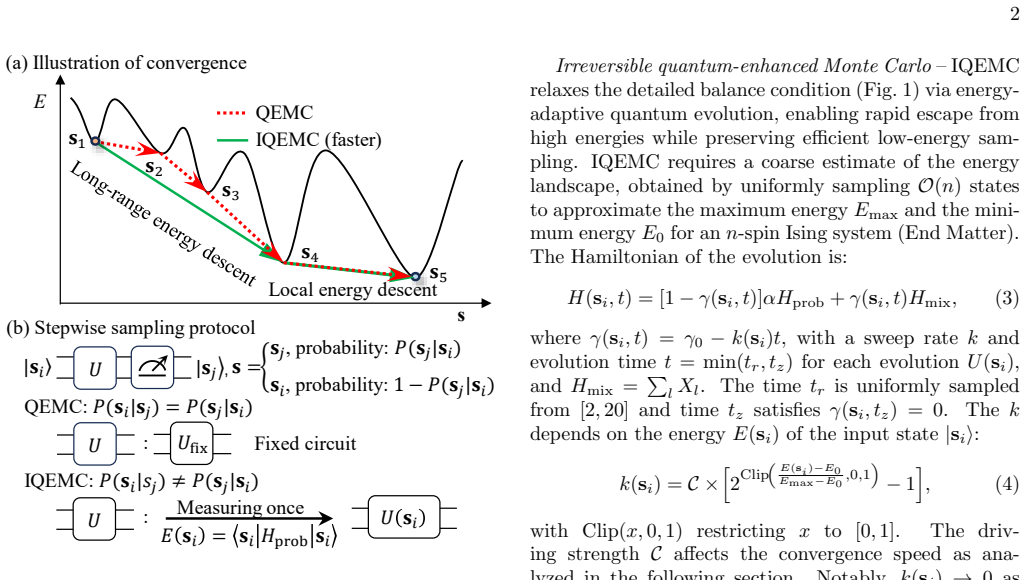
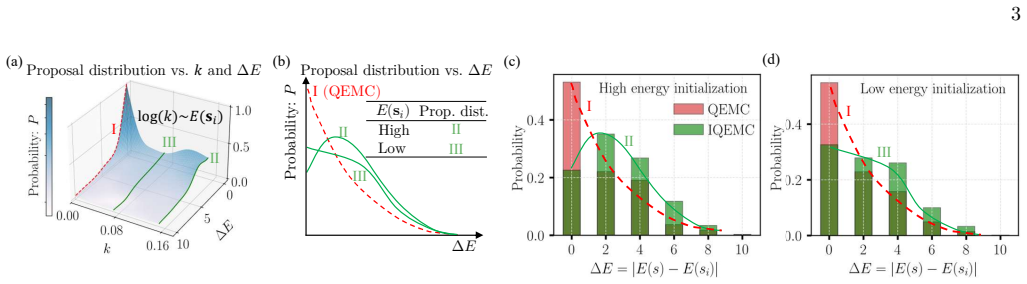
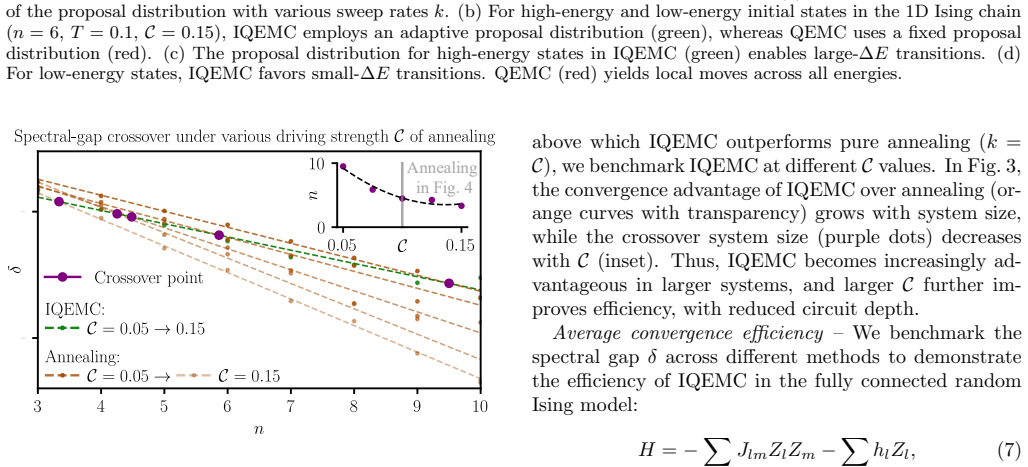
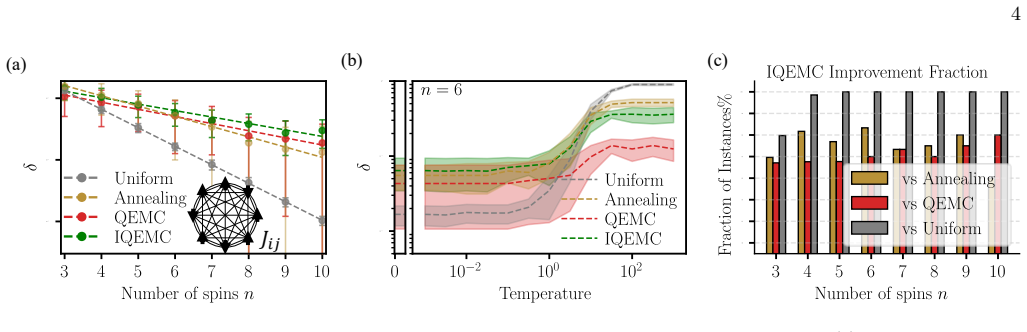
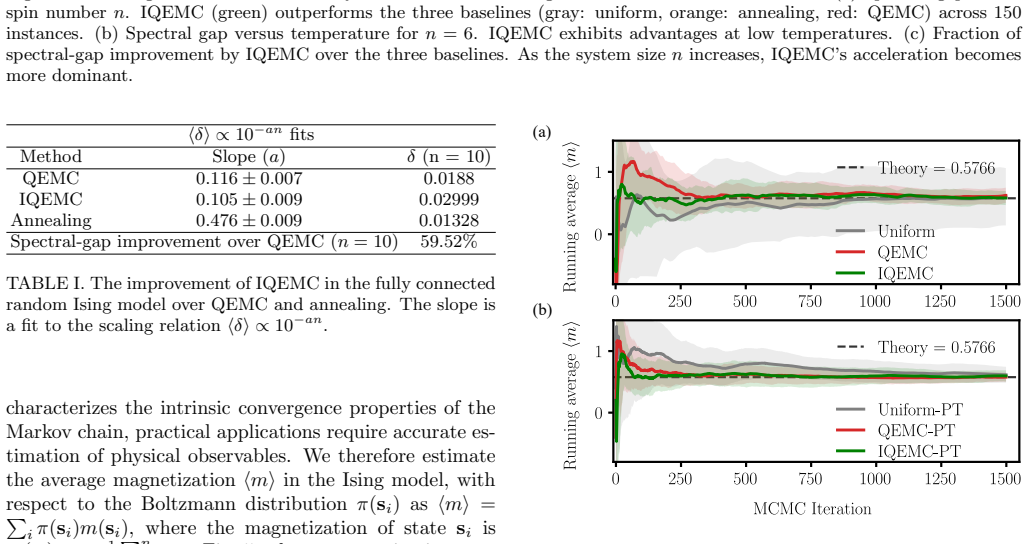
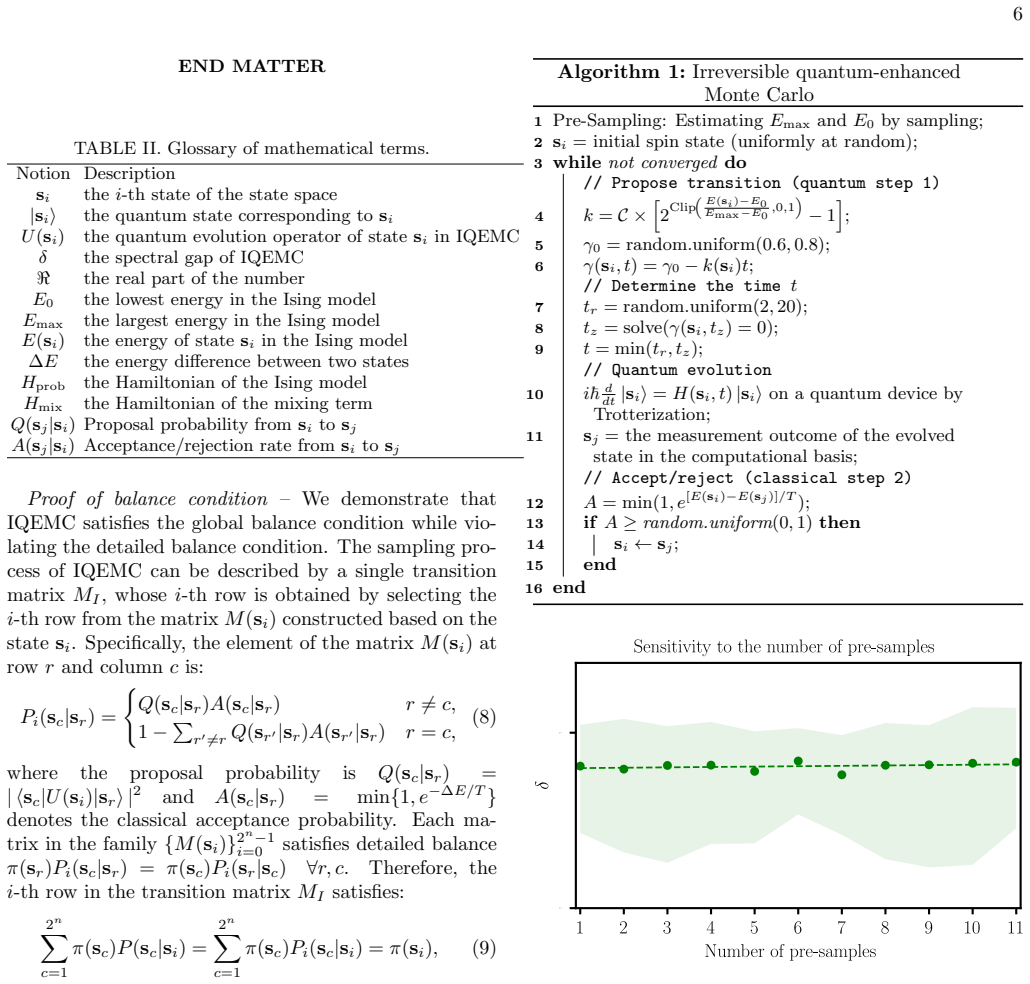
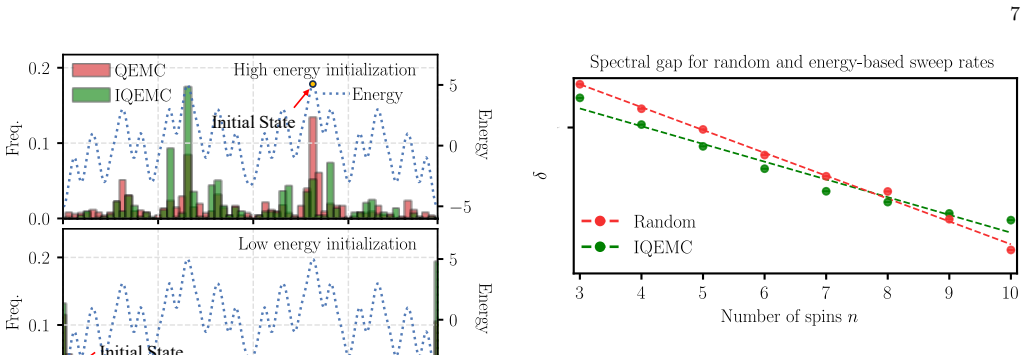
By introducing state-dependent proposals that break detailed balance while preserving the target stationary distribution, we develop an irreversible quantum-enhanced Monte Carlo (IQEMC). Guided by Landau-Zener transitions, IQEMC promotes large energy descents from high-energy states while maintaining stable transitions near low-energy states. On spin-glass benchmarks, IQEMC outperforms QEMC without increasing computational complexity and, unlike the annealing baseline, exhibits a spectral gap that increases with system size and annealing speed.
What carries the argument
State-dependent proposals guided by Landau-Zener transitions that break detailed balance while preserving the target stationary distribution.
If this is right
- IQEMC samples spin-glass problems more efficiently than reversible QEMC at fixed computational cost.
- The spectral gap of IQEMC grows with system size and annealing speed, unlike standard annealing schedules.
- Irreversibility supplies a physically motivated route to improve any quantum MCMC method that combines quantum proposals with classical acceptance.
- The same state-dependent construction can be applied to other energy landscapes without changing the overall algorithmic complexity.
Where Pith is reading between the lines
- The irreversibility mechanism could be tested on continuous-variable or non-Ising models to check whether the spectral-gap scaling persists outside discrete spin glasses.
- Combining the same proposal rule with different quantum proposal engines might produce further speed-ups in hybrid classical-quantum samplers.
- If the Landau-Zener guidance can be replaced by a cheaper classical rule that still breaks detailed balance, the method could be run on purely classical hardware while retaining the performance gain.
Load-bearing premise
The chosen state-dependent proposals can be built so that they break detailed balance yet leave the exact target distribution as the unique stationary state without adding bias or extra computational cost on the tested instances.
What would settle it
Running IQEMC on larger spin-glass instances and finding that its spectral gap stops growing with system size or that the generated samples deviate from the target distribution would falsify the claimed enhancement.
Figures
read the original abstract
Detailed balance underlies conventional Markov-chain Monte Carlo (MCMC) algorithms. Yet in classical systems, breaking detailed balance generates irreversible probability currents and can accelerate sampling. Whether irreversibility can similarly enhance quantum MCMC remains an intriguing question. Here we show that irreversibility provides a new route to improving the recent quantum-enhanced MCMC (QEMC), which combines quantum proposals with classical acceptance. By introducing state-dependent proposals that break detailed balance while preserving the target stationary distribution, we develop an irreversible quantum-enhanced Monte Carlo (IQEMC). Guided by Landau-Zener transitions, IQEMC promotes large energy descents from high-energy states while maintaining stable transitions near low-energy states. On spin-glass benchmarks, IQEMC outperforms QEMC without increasing computational complexity and, unlike the annealing baseline, exhibits a spectral gap that increases with system size and annealing speed. These results establish irreversibility as a physically grounded mechanism for enhancing quantum MCMC.
Editorial analysis
A structured set of objections, weighed in public.
Referee Report
Summary. The paper introduces irreversible quantum-enhanced Monte Carlo (IQEMC) by replacing the reversible proposals of prior QEMC with state-dependent kernels guided by Landau-Zener physics. These kernels are asserted to break detailed balance while exactly preserving the target Boltzmann distribution π, yielding faster mixing on spin-glass instances: IQEMC outperforms QEMC at equal cost and shows a spectral gap that grows with system size and annealing speed, in contrast to standard annealing baselines.
Significance. If the global-balance construction holds and the reported scaling is reproducible, the work supplies a physically motivated route to irreversible quantum MCMC that could improve sampling in rugged landscapes without added classical overhead. The claim of a spectral gap that increases with system size is particularly noteworthy if independently verified against exact diagonalization or established MCMC benchmarks.
major comments (2)
- [§3] §3 (IQEMC construction): the transition rates are stated to be chosen from Landau-Zener descent probabilities, yet no explicit equation or appendix demonstrates that the resulting kernel P satisfies global balance ∑_y π(x)P(x,y)=π(y)P(y,x) for arbitrary frustrated instances. Without this identity or an accompanying Metropolis-Hastings correction, the stationary distribution may deviate from the target measure on spin-glass landscapes.
- [Figure 4] Figure 4 / Table 2 (spectral-gap scaling): the reported increase of the gap with N and annealing speed is central to the superiority claim over annealing, but the gap is extracted from finite-length trajectories; no comparison to the exact second eigenvalue of the transition matrix or to an independent reversible baseline with identical proposal cost is provided.
minor comments (2)
- [§3] Notation for the state-dependent rate matrix is introduced without a compact equation number; a single displayed equation defining P(x,y) would improve readability.
- [Introduction] The abstract and introduction cite "spin-glass benchmarks" but do not list the precise instance sizes, disorder realizations, or temperature schedule used; these details belong in the main text or a methods table.
Simulated Author's Rebuttal
We thank the referee for the careful reading and constructive comments. We address each major point below.
read point-by-point responses
-
Referee: [§3] §3 (IQEMC construction): the transition rates are stated to be chosen from Landau-Zener descent probabilities, yet no explicit equation or appendix demonstrates that the resulting kernel P satisfies global balance ∑_y π(x)P(x,y)=π(y)P(y,x) for arbitrary frustrated instances. Without this identity or an accompanying Metropolis-Hastings correction, the stationary distribution may deviate from the target measure on spin-glass landscapes.
Authors: The IQEMC kernel in §3 is constructed so that the Landau-Zener descent probabilities yield a transition matrix P that satisfies global balance with the target Boltzmann measure π by design: the state-dependent rates are chosen to produce equal net probability flow into and out of each state under π, while the asymmetry in forward versus reverse moves breaks detailed balance. This holds for the frustrated spin-glass instances examined. We will add an explicit appendix deriving the identity ∑_y π(x) P(x,y) = π(y) for the general form of the kernel. revision: yes
-
Referee: [Figure 4] Figure 4 / Table 2 (spectral-gap scaling): the reported increase of the gap with N and annealing speed is central to the superiority claim over annealing, but the gap is extracted from finite-length trajectories; no comparison to the exact second eigenvalue of the transition matrix or to an independent reversible baseline with identical proposal cost is provided.
Authors: Spectral gaps for the system sizes of interest are obtained from the integrated autocorrelation time of the energy, a standard estimator that converges to the true second eigenvalue for ergodic chains; exact diagonalization is infeasible beyond small N. Direct comparisons to the reversible QEMC baseline are already performed at identical proposal cost. We will add exact eigenvalue computations for N ≤ 12 in a new appendix and an additional classical irreversible MCMC baseline with matched cost to strengthen the scaling claim. revision: partial
Circularity Check
No circularity: methodological proposal with independent construction
full rationale
The provided abstract and context describe a new algorithm (IQEMC) whose core step is the explicit construction of state-dependent proposals that are asserted to break detailed balance while preserving the target distribution. No equations, fitting procedures, self-citations, or ansatzes are shown that reduce the claimed spectral-gap improvement or performance gain to the input data or prior results by construction. The derivation chain is therefore self-contained as an algorithmic design whose validity rests on external verification of the balance condition rather than on any internal renaming or self-referential prediction.
Axiom & Free-Parameter Ledger
axioms (1)
- domain assumption Detailed balance is sufficient but not necessary to guarantee the correct stationary distribution in MCMC
Reference graph
Works this paper leans on
-
[1]
Metropolis, A
N. Metropolis, A. W. Rosenbluth, M. N. Rosenbluth, A. H. Teller, and E. Teller, Equation of state calcula- tions by fast computing machines, J. Chem. Phys.21, 1087 (1953)
1953
-
[2]
W. K. Hastings, Monte Carlo sampling methods using Markov chains and their applications, Biometrika57, 97 (1970)
1970
-
[3]
V. I. Manousiouthakis and M. W. Deem, Strict detailed balance is unnecessary in Monte Carlo simulation, J. Chem. Phys.110, 2753 (1999)
1999
-
[4]
Y.-A. Ma, T. Chen, and E. B. Fox, A complete recipe for stochastic gradient MCMC, arXiv: 1506.04696 (2015)
work page internal anchor Pith review Pith/arXiv arXiv 2015
-
[5]
Ao, T.-Q
P. Ao, T.-Q. Chen, and J.-H. Shi, Dynamical decomposi- tion of Markov processes without detailed balance, Chin. Phys. Lett.30, 070201 (2013)
2013
-
[6]
K. S. Turitsyn, M. Chertkov, and M. Vucelja, Irreversible Monte Carlo algorithms for efficient sampling, Phys. D: Nonlinear Phenom.240, 410 (2011)
2011
-
[7]
E. P. Bernard, W. Krauth, and D. B. Wilson, Event- chain Monte Carlo algorithms for hard-sphere systems, Phys. Rev. E80, 056704 (2009)
2009
-
[8]
Suwa and S
H. Suwa and S. Todo, Markov chain Monte Carlo method without detailed balance, Phys. Rev. Lett.105, 120603 (2010)
2010
-
[9]
H. Hu, X. Chen, and Y. Deng, Irreversible Markov chain Monte Carlo algorithm for self-avoiding walk, Front. Phys.12, 120503 (2017)
2017
-
[10]
Ghimenti, L
F. Ghimenti, L. Berthier, G. Szamel, and F. van Wijland, Irreversible Boltzmann samplers in dense liquids: Weak- coupling approximation and mode-coupling theory, Phys. Rev. E110, 034604 (2024)
2024
-
[11]
Ghimenti, L
F. Ghimenti, L. Berthier, and F. van Wijland, Irreversible Monte Carlo algorithms for hard disk glasses: From event-chain to collective swaps, Phys. Rev. Lett.133, 028202 (2024)
2024
-
[12]
Xu, Z.-S
W.-B. Xu, Z.-S. Shen, Y. Tang, and P. Zhang, Com- binatorial optimization with dual mean-field dynamics, Commun. Theor. Phys.77, 125604 (2025)
2025
-
[14]
Szegedy, Quantum speed-up of Markov chain based algorithms, 45th FOCS , 32 (2004)
M. Szegedy, Quantum speed-up of Markov chain based algorithms, 45th FOCS , 32 (2004)
2004
-
[15]
P. C. Richter, Quantum speedup of classical mixing pro- cesses, Phys. Rev. A76, 042306 (2007)
2007
-
[16]
Montanaro, Quantum speedup of Monte Carlo meth- ods, Proc
A. Montanaro, Quantum speedup of Monte Carlo meth- ods, Proc. R. Soc. A471, 20150301 (2015)
2015
-
[17]
Lemieux, B
J. Lemieux, B. Heim, D. Poulin, K. Svore, and M. Troyer, Efficient quantum walk circuits for Metropolis-Hastings algorithm, Quantum4, 287 (2020)
2020
-
[18]
Arunachalam, V
S. Arunachalam, V. Havlicek, G. Nannicini, K. Temme, and P. Wocjan, Simpler (classical) and faster (quantum) algorithms for Gibbs partition functions, Quantum6, 789 (2022)
2022
-
[19]
Preskill, Quantum computing in the NISQ era and beyond, Quantum2, 79 (2018)
J. Preskill, Quantum computing in the NISQ era and beyond, Quantum2, 79 (2018)
2018
-
[20]
Wocjan and A
P. Wocjan and A. Abeyesinghe, Speedup via quantum sampling, Phys. Rev. A78, 042336 (2008)
2008
-
[21]
Yung and A
M.-H. Yung and A. Aspuru-Guzik, A quantum–quantum Metropolis algorithm, Proc. Natl. Acad. Sci.109, 754 (2012)
2012
-
[22]
Layden, G
D. Layden, G. Mazzola, R. V. Mishmash, M. Motta, P. Wocjan, J.-S. Kim, and S. Sheldon, Quantum- enhanced Markov chain Monte Carlo, Nature619, 282 (2023)
2023
-
[24]
Nakano, K
Y. Nakano, K. N. Okada, and K. Fujii, Neural-network- assisted Monte Carlo sampling trained by quantum ap- proximate optimization algorithm, PRX Quantum7, 010338 (2026)
2026
-
[25]
N. V. Vitanov, Transition times in the Landau-Zener model, Phys. Rev. A59, 988 (1999)
1999
-
[26]
Wittig, The Landau-Zener formula, J
C. Wittig, The Landau-Zener formula, J. Phys. Chem. B 109, 8428 (2005)
2005
-
[27]
Lucas, Ising formulations of many NP problems, Front
A. Lucas, Ising formulations of many NP problems, Front. Phys.2, 5 (2014)
2014
-
[29]
Orfi and D
A. Orfi and D. Sels, Bounding the speedup of the quantum-enhanced Markov-chain Monte Carlo algo- rithm, Phys. Rev. A110, 052414 (2024)
2024
-
[31]
Zener, Non-adiabatic crossing of energy levels, Proc
C. Zener, Non-adiabatic crossing of energy levels, Proc. A137, 696 (1932)
1932
-
[32]
See Supplemental Material at [url will be inserted by pub- lisher] for details on the numerical simulation, proof of convergence and autocorrelation, discussion on spectral gap of non-reversible chain
-
[33]
R. H. Swendsen and J.-S. Wang, Replica Monte Carlo simulation of spin-glasses, Phys. Rev. Lett.57, 2607 (1986)
1986
-
[34]
C. J. Geyer, Markov chain Monte Carlo maximum likeli- hood, IFNA , 156 (1991)
1991
-
[35]
D. J. Earl and M. W. Deem, Parallel tempering: Theory, applications, and new perspectives, Phys. Chem. Chem. Phys.7, 3910 (2005)
2005
-
[36]
H. Lu and Y. Tang, Steering dynamical regimes of diffusion models by breaking detailed balance, arXiv:2602.15914 (2026). 6 END MA TTER TABLE II. Glossary of mathematical terms. Notion Description si thei-th state of the state space |si⟩the quantum state corresponding tos i U(s i) the quantum evolution operator of states i in IQEMC δthe spectral gap of IQE...
-
[37]
D. A. Levin and Y. Peres,Markov chains and mixing times, Vol. 107 (American Mathematical Soc., 2017)
2017
-
[38]
R. V. Craiu, D. Vats, G. L. Jones, S. Brooks, A. Gelman, and X.-L. Meng, eds.,Handbook of Markov Chain Monte Carlo, 2nd ed. (Chapman and Hall/CRC, Boca Raton, FL, 2026)
2026
-
[39]
J. J. Sakurai and J. Napolitano,Modern Quantum Mechanics, 3rd ed. (Cambridge University Press, 2020)
2020
-
[40]
A. Javadi-Abhari, M. Treinish, K. Krsulich, C. J. Wood, J. Lishman, J. Gacon, S. Martiel, P. D. Nation, L. S. Bishop, and A. W. Cross, Quantum computing with Qiskit, arXiv:2405.08810 (2024)
work page internal anchor Pith review Pith/arXiv arXiv 2024
-
[41]
Layden, G
D. Layden, G. Mazzola, R. V. Mishmash, M. Motta, P. Wocjan, J.-S. Kim, and S. Sheldon, Quantum-enhanced Markov chain Monte Carlo, Nature619, 282 (2023)
2023
-
[42]
Arai and T
S. Arai and T. Kadowaki, Quantum annealing enhanced Markov-chain Monte Carlo, Sci. Rep.15, 21427 (2025)
2025
-
[43]
Orfi and D
A. Orfi and D. Sels, Barriers to efficient mixing of quantum-enhanced Markov chains, Phys. Rev. A110, 052434 (2024)
2024
-
[44]
Ichiki and M
A. Ichiki and M. Ohzeki, Violation of detailed balance accelerates relaxation, Phys. Rev. E88, 020101 (2013)
2013
-
[45]
Claudon, J.-P
B. Claudon, J.-P. Piquemal, and P. Monmarch´ e, Quantum speedup for nonreversible Markov chains, Nat. Commun.16, 10732 (2025)
2025
discussion (0)
Sign in with ORCID, Apple, or X to comment. Anyone can read and Pith papers without signing in.