REVIEW 2 major objections 2 minor 22 references
Towards Autonomous Accelerator Design: FPGA Accelerator Generation with SECDA
T0 review · 2 major / 2 minor · reviewed 2026-06-27 · grok-4.3
Pith's one-line read SECDA-DSE uses LLMs with retrieval and chain-of-thought to generate FPGA accelerator designs that synthesize and execute on hardware.
desk verdict SECDA-DSE now shows end-to-end FPGA runs for three kernels but still lacks any performance numbers or comparisons. read the letter →
The pith
A machine-rendered reading of the paper's core claim, the machinery that carries it, and where it could break.
The reading
What carries the argument
The SECDA-DSE framework, which embeds an LLM Stack for reasoning-guided design space exploration inside the SECDA SystemC-to-FPGA co-design environment.
What would settle it
Generating a new set of accelerator designs for an additional kernel and finding that they either fail to synthesize on the target FPGA or do not exhibit the expected kernel-specific trade-offs when executed.
Extended reading notes
Core claim
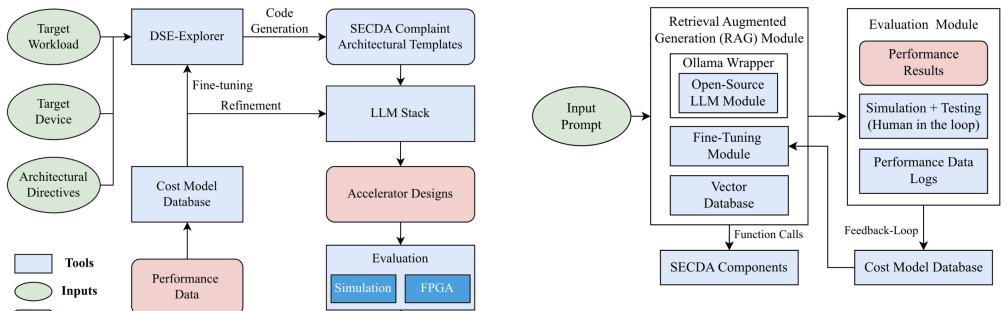
SECDA-DSE integrates a structured DSE Explorer with an LLM Stack that performs reasoning-guided exploration via retrieval-augmented generation, chain-of-thought prompting, and a feedback loop. When tested on three kernels, the framework produces SECDA-compliant accelerator designs that are successfully synthesized and executed on FPGA hardware while capturing kernel-specific trade-offs between compute parallelism and data movement.
Load-bearing premise
Large language models equipped with retrieval-augmented generation and chain-of-thought prompting can perform effective reasoning about hardware design parameters and produce valid, efficient accelerator configurations.
Editorial extensions
If this is right
- The framework produces accelerator designs for vector multiplication, 2D convolution, and matrix transpose that successfully synthesize and run on FPGA hardware.
- Generated designs reflect kernel-specific balances between compute parallelism and data movement.
- The LLM-guided process reduces exploration time and the need for extensive human domain knowledge.
- The method adapts architectural configurations across diverse AI workloads within the SECDA ecosystem.
Reading between the lines
- If the LLM stack scales to larger design spaces, it could support automated generation for entire neural network layers rather than single kernels.
- Combining the approach with existing performance models might allow direct optimization for latency or energy rather than manual trade-off inspection.
- The feedback loop could be extended to incorporate real FPGA execution measurements for closed-loop refinement without additional human intervention.
Editorial analysis
A structured set of objections, weighed in public.
Referee Report
Summary. The manuscript presents SECDA-DSE, a framework integrating LLMs (via retrieval-augmented generation, chain-of-thought prompting, and a feedback loop) into the SECDA ecosystem to automate design space exploration for FPGA accelerators. It extends prior work by generating SECDA-compliant designs for three kernels (element-wise vector multiplication, 2D convolution, matrix transpose), demonstrating their successful synthesis and execution on FPGA hardware while capturing kernel-specific trade-offs between compute parallelism and data movement.
Significance. If the results hold, the work provides a concrete end-to-end demonstration of LLM-guided DSE producing synthesizable and executable FPGA designs across multiple kernels. This is a strength for an empirical framework paper; however, the absence of any quantitative metrics, resource numbers, latency figures, or comparisons means the significance is limited to a proof-of-concept rather than a quantified advance in automation or performance.
major comments (2)
- [Evaluation] Evaluation section: the central claim that the generated designs 'capture kernel-specific trade-offs between compute parallelism and data movement' is asserted without any supporting data, tables, or figures showing how these trade-offs were measured or observed for the three kernels.
- [Abstract] Abstract and evaluation: the manuscript asserts 'successful synthesis and execution on FPGA hardware' but supplies no quantitative metrics (resource utilization, frequency, latency), baselines, or error analysis, leaving the quality and practicality of the designs unassessed.
minor comments (2)
- [Abstract] The abstract is lengthy and contains multiple claims; condensing the description of the LLM stack and results would improve readability.
- Ensure first-use definitions for all acronyms (SECDA, DSE, LLM, RAG) and consistent terminology between the abstract and body.
Simulated Author's Rebuttal
We thank the referee for the constructive comments. We address each major point below and will revise the manuscript accordingly.
read point-by-point responses
-
Referee: [Evaluation] Evaluation section: the central claim that the generated designs 'capture kernel-specific trade-offs between compute parallelism and data movement' is asserted without any supporting data, tables, or figures showing how these trade-offs were measured or observed for the three kernels.
Authors: We agree that the claim would be strengthened by explicit supporting material. The three generated designs use distinct architectural parameters (different parallelism factors and memory hierarchies) that reflect kernel-specific priorities, but these are not tabulated or illustrated. In the revised manuscript we will add a table summarizing the key parameters chosen for each kernel together with a short discussion of how they embody the compute-versus-data-movement trade-off. revision: yes
-
Referee: [Abstract] Abstract and evaluation: the manuscript asserts 'successful synthesis and execution on FPGA hardware' but supplies no quantitative metrics (resource utilization, frequency, latency), baselines, or error analysis, leaving the quality and practicality of the designs unassessed.
Authors: The primary goal of the paper is to demonstrate that the SECDA-DSE framework can produce SECDA-compliant designs that are both synthesizable and executable on real FPGA hardware. Detailed performance numbers were outside the scope of this feasibility-focused extension. We nevertheless recognize that basic synthesis statistics would help readers gauge practicality and will include the available resource-utilization and frequency figures from the three implementations in the revised evaluation section. revision: yes
Circularity Check
Empirical framework demonstration with no circular derivation
full rationale
The paper describes an empirical system (SECDA-DSE) that uses LLMs to explore FPGA accelerator designs for three kernels, with success measured by successful synthesis and hardware execution on FPGA. No equations, fitted parameters, or predictions appear in the provided text. The single self-citation to prior SECDA-DSE work merely introduces the base framework; the headline claims rest on new end-to-end hardware results rather than reducing to that citation or to any fitted input. The work is therefore self-contained against external benchmarks (FPGA execution) with no load-bearing circular steps.
Assumptions & free parameters
assumptions (1)
- domain assumption LLMs equipped with RAG and chain-of-thought can guide effective design space exploration for FPGA accelerators
Cite this review
Pith. "Pith review of Towards Autonomous Accelerator Design: FPGA Accelerator Generation with SECDA." pith.science (2026). https://pith.science/paper/KOADOOXQ
@misc{pith2026260611117,
  author       = {Pith},
  title        = {Pith review of: Towards Autonomous Accelerator Design: FPGA Accelerator Generation with SECDA},
  year         = {2026},
  howpublished = {\url{https://pith.science/paper/KOADOOXQ}},
  note         = {Machine review of arXiv:2606.11117}
}
read the original abstract
Designing FPGA-based accelerators for modern artificial intelligence workloads requires exploring a large and complex hardware design space that involves architectural parameters, data flow strategies, and memory hierarchies, making the process very time consuming. While existing methodologies such as SECDA enable rapid hardware-software co-design through SystemC simulation and FPGA execution, identifying efficient accelerator configurations remains a largely manual process requiring extensive domain knowledge. SECDA-DSE is a framework that integrates Large Language Models (LLMs) into the SECDA ecosystem to guide design space exploration (DSE) of FPGA-based accelerators. It combines a structured DSE Explorer for generating candidate architectures with an LLM Stack that performs reasoning-guided exploration using retrieval-augmented generation and chain-of-thought prompting, coupled with a feedback loop for iterative and reinforced refinement. Building on our previous work introducing SECDA-DSE, this paper extends its evaluation by generating three accelerator designs, including element-wise vector multiplication, 2D convolution, and matrix transpose, and performing end-to-end execution on FPGA hardware. The results show that SECDA-DSE can generate SECDA-compliant accelerator designs that are successfully synthesized and executed on FPGA hardware. Furthermore, the generated designs capture kernel-specific trade-offs between compute parallelism and data movement, highlighting the potential of LLM-guided exploration to adapt architectural configurations across diverse workloads while reducing exploration time and the need for extensive human expertise.
Figures
Reference graph
Works this paper leans on
-
[1]
Machine Learning for FPGA Electronic Design Automation,
A. Biscontini, E. Popovici, and A. Temko, “Machine Learning for FPGA Electronic Design Automation,”IEEE Access, vol. 12, pp. 182 640– 182 662, 2024
2024
-
[2]
Large Language Models for Software Engineering: Survey and Open Problems,
A. Fan, B. Gokkaya, M. Harman, M. Lyubarskiy, S. Sengupta, S. Yoo, and J. M. Zhang, “Large Language Models for Software Engineering: Survey and Open Problems,” in2023 IEEE/ACM International Confer- ence on Software Engineering: Future of Software Engineering (ICSE- FoSE). IEEE, 2023, pp. 31–53. 5
2023
-
[3]
LLM-AID: Leveraging Large Language Models for Rapid Domain-Specific Accelerator Development,
F. Firouzi, S. S. R. Nakkilla, C. Fu, S. Banerjee, J. Talukdar, and K. Chakrabarty, “LLM-AID: Leveraging Large Language Models for Rapid Domain-Specific Accelerator Development,” in43rd IEEE/ACM International Conference on Computer-Aided Design, 2024, pp. 1–9
2024
-
[4]
GPT4AIGChip: Towards Next-Generation AI Accelerator Design Au- tomation via Large Language Models,
Y . Fu, Y . Zhang, Z. Yu, S. Li, Z. Ye, C. Li, C. Wan, and Y . C. Lin, “GPT4AIGChip: Towards Next-Generation AI Accelerator Design Au- tomation via Large Language Models,” in2023 IEEE/ACM International Conference on Computer Aided Design (ICCAD), 2023
2023
-
[5]
DLAS: A Conceptual Model for Across-Stack Deep Learning Acceleration,
P. Gibson, J. Cano, E. Crowley, A. Storkey, and M. O’boyle, “DLAS: A Conceptual Model for Across-Stack Deep Learning Acceleration,”ACM Transactions on Architecture and Code Optimization (TACO), 2025
2025
-
[6]
SECDA: Efficient Hardware/Software Co-Design of FPGA-based DNN Acceler- ators for Edge Inference,
J. Haris, P. Gibson, J. Cano, N. B. Agostini, and D. Kaeli, “SECDA: Efficient Hardware/Software Co-Design of FPGA-based DNN Acceler- ators for Edge Inference,” inIEEE 33rd Int. Symposium on Computer Architecture and High Performance Computing (SBAC-PAD), 2021
2021
-
[7]
SECDA- TFLite: A toolkit for efficient development of FPGA-based DNN accelerators for edge inference,
J. Haris, P. Gibson, J. Cano, N. B. Agostini, and D. Kaeli, “SECDA- TFLite: A toolkit for efficient development of FPGA-based DNN accelerators for edge inference,”Journal of Parallel and Distributed Computing, vol. 173, pp. 140–151, 2023
2023
-
[8]
Designing Efficient LLM Accelerators for Edge Devices,
J. Haris, R. Saha, W. Hu, and J. Cano, “Designing Efficient LLM Accelerators for Edge Devices,” 2024, arXiv:2408.00462
Show all 22 references
-
[9]
Large Language Models for Software Engineering: A Systematic Literature Review,
X. Hou, Y . Zhao, Y . Liu, Z. Yang, K. Wang, L. Li, X. Luo, D. Lo, J. Grundy, and H. Wang, “Large Language Models for Software Engineering: A Systematic Literature Review,”ACM Transactions on Software Engineering and Methodology, vol. 33, no. 8, pp. 1–79, 2024
2024
-
[10]
LoRA: Low-Rank Adaptation of Large Language Models,
E. J. Hu, Y . Shen, P. Wallis, Z. Allen-Zhu, Y . Li, S. Wang, L. Wang, W. Chenet al., “LoRA: Low-Rank Adaptation of Large Language Models,”ICLR, vol. 1, no. 2, p. 3, 2022
2022
-
[11]
FPGA-based Acceleration for Convolutional Neural Networks: A Comprehensive Review,
J. Jiang, Y . Zhou, Y . Gong, H. Yuan, and S. Liu, “FPGA-based Acceleration for Convolutional Neural Networks: A Comprehensive Review,” 2025, arXiv:2505.13461
2025
-
[12]
iDSE: Navigating Design Space Explo- ration in High-Level Synthesis Using LLMs,
R. Li, J. Xiong, and X. Wang, “iDSE: Navigating Design Space Explo- ration in High-Level Synthesis Using LLMs,” 2025, arXiv:2505.22086
2025
-
[13]
Are LLMs Any Good for High- Level Synthesis?
Y . Liao, T. Adegbija, and R. Lysecky, “Are LLMs Any Good for High- Level Synthesis?” inProceedings of the 43rd IEEE/ACM International Conference on Computer-Aided Design, 2024, pp. 1–8
2024
-
[14]
A Survey on Neural Network Hardware Accelerators,
T. Mohaidat and K. Khalil, “A Survey on Neural Network Hardware Accelerators,”IEEE Transactions on Artificial Intelligence, vol. 5, no. 8, pp. 3801–3822, 2024
2024
-
[15]
Ollama: Run large language models locally,
Ollama, “Ollama: Run large language models locally,” 2026, [Online]. Available: https://ollama.com. Accessed: Jun. 5, 2026
2026
-
[16]
A Survey on Design Space Exploration Approaches for Approximate Computing Systems,
S. Saeedi, A. Piri, B. Deveautour, I. O’connor, A. Bosio, A. Savino, and S. Di Carlo, “A Survey on Design Space Exploration Approaches for Approximate Computing Systems,”Electronics, vol. 13, no. 22, p. 4442, 2024
2024
-
[17]
LLM-Driven Design Space Exploration of FPGA-based Accelerators,
V . Sharma, X. Fu, J. Haris, and J. Cano, “LLM-Driven Design Space Exploration of FPGA-based Accelerators,” 2026, arXiv:2401.12345
2026
-
[18]
SA-DS: A Dataset for Large Language Model-Driven AI Accelerator Design Generation,
D. Vungarala, M. Nazzal, M. Morsali, C. Zhang, A. Ghosh, A. Khreishah, and S. Angizi, “SA-DS: A Dataset for Large Language Model-Driven AI Accelerator Design Generation,” in2025 IEEE Inter- national Symposium on Circuits and Systems (ISCAS), 2025, pp. 1–4
2025
-
[19]
Vivado high-level synthesis,
Xilinx, Inc., “Vivado high-level synthesis,” 2019
2019
-
[20]
Hardware Acceleration for Neural Networks: A Comprehensive Survey,
B. Xu, A. Banerjee, and S. Gupta, “Hardware Acceleration for Neural Networks: A Comprehensive Survey,” 2025, arXiv:2512.23914
2025
-
[21]
TinyLlama: An Open-Source Small Language Model,
P. Zhang, G. Zeng, T. Wang, and W. Lu, “TinyLlama: An Open-Source Small Language Model,” 2024, arXiv:2401.02385
2024 arXiv
-
[22]
LUMINA: LLM- Guided GPU Architecture Exploration via Bottleneck Analysis,
T. Zhang, R. Ma, S. Xu, P. Cheng, and Y . Xiong, “LUMINA: LLM- Guided GPU Architecture Exploration via Bottleneck Analysis,” 2026, arXiv:2603.05904. APPENDIX This appendix provides the initial natural language prompts used for generating the evaluated accelerator workloads pre...
2026
Reviewed June 27, 2026 · model on record in the stance chip above.
Discussion (0). Continue with ORCID to comment.