Mediative Fuzzy Logic: From Type-1 Foundations to Type-2, Type-3 and Quantum Extensions
Pith reviewed 2026-05-25 05:45 UTC · model grok-4.3
The pith
Mediative fuzzy logic adds a connective for hesitation and contradiction that preserves soundness and paraconsistency from type-1 through quantum extensions.
A machine-rendered reading of the paper's core claim, the machinery that carries it, and where it could break.
Core claim
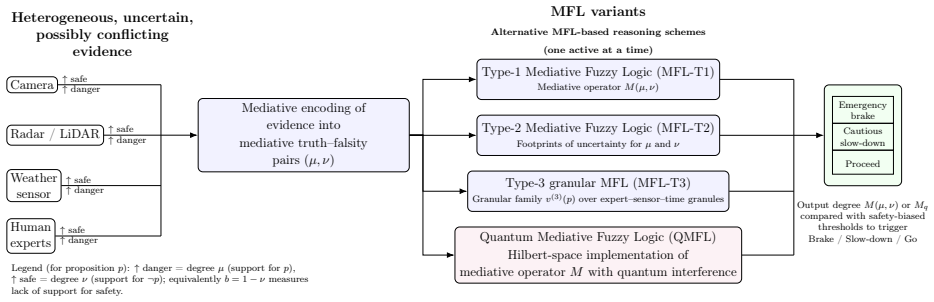
Mediative fuzzy logic extends a t-norm-based fuzzy logic by adding a mediative connective whose semantics are independent truth-falsity pairs in a continuous bilattice-like structure; the mediative operator is a convex aggregation controlled by hesitation and contradiction. The system is sound, paraconsistent, and conservative over the underlying fuzzy base for non-mediative formulas. Semantic extensions to interval type-2 truth values, granule-indexed local evaluations, and effects plus density operators on Hilbert spaces are formulated so that the higher-level versions reduce to the type-1 case under suitable assumptions, supporting consistent reasoning under conflicting evidence.
What carries the argument
The mediative operator, a convex aggregation of independent truth and falsity degrees controlled by hesitation and contradiction parameters.
If this is right
- Non-mediative formulas evaluate exactly as in the original t-norm fuzzy logic.
- The logic tolerates contradictions without deriving every statement.
- Interval type-2, granule type-3, and quantum semantics remain coherent with the type-1 foundation.
- The framework supports conservative, safety-first decisions in sensor-fusion tasks that involve heterogeneous or mildly contradictory inputs.
Where Pith is reading between the lines
- The bilattice-style pairs could be combined with other multi-valued logics used in knowledge bases to handle both vagueness and conflict.
- Granule-indexed evaluations might allow localized computation in large-scale control systems without losing global consistency guarantees.
- Quantum extensions open the possibility of testing whether density-operator representations yield measurable advantages in simulated decision problems under uncertainty.
Load-bearing premise
The mediative operator and its extensions to type-2, type-3, and quantum settings can be defined so that soundness, paraconsistency, and conservativity hold simultaneously.
What would settle it
A concrete formula using the mediative connective that produces an inconsistency under the type-1 semantics or fails to recover the base fuzzy value when mediation is removed would refute the central claims.
Figures
read the original abstract
Mediative Fuzzy Logic was conceived as a practical scheme for reconciling hesitant or conflicting assessments in fuzzy control and decision-making. However, its logical and semantic foundations remain underdeveloped, especially beyond operational type-1 settings. This article develops a unified account of the type-1 core together with interval type-2, granular type-3, and quantum extensions. We characterize the mediative operator as a convex aggregation controlled by hesitation and contradiction, model mediative truth values as independent truth-falsity pairs in a continuous bilattice-like structure, and introduce a propositional system extending a standard t-norm-based fuzzy logic with a mediative connective. We establish soundness, paraconsistency, and conservativity over the underlying fuzzy base for formulas without mediation, and formulate coherent semantic extensions to interval type-2 truth values, granule-indexed local evaluations, and effects and density operators on Hilbert spaces. An autonomous-braking sensor-fusion example illustrates how the framework supports transparent, conservative, and safety-first decisions under incomplete, heterogeneous, and mildly contradictory evidence. Under suitable assumptions, the higher-level formulations reduce to the type-1 case, clarifying coherence across levels and reliably supporting future work in intelligent decision systems.
Editorial analysis
A structured set of objections, weighed in public.
Referee Report
Summary. The paper presents Mediative Fuzzy Logic as a scheme for reconciling hesitant or conflicting assessments in fuzzy control and decision-making. It develops a unified account from type-1 foundations to interval type-2, granular type-3, and quantum extensions. The mediative operator is characterized as a convex aggregation controlled by hesitation and contradiction, with mediative truth values modeled as independent truth-falsity pairs in a continuous bilattice-like structure. A propositional system extending t-norm-based fuzzy logic with a mediative connective is introduced. The paper claims to establish soundness, paraconsistency, and conservativity over the underlying fuzzy base for formulas without mediation, and formulates semantic extensions to interval type-2 truth values, granule-indexed local evaluations, and effects and density operators on Hilbert spaces. An example in autonomous-braking sensor-fusion is provided to illustrate the framework.
Significance. If the claimed results on soundness, paraconsistency, conservativity, and coherent semantic extensions were rigorously established with proofs and definitions, this work would provide a significant advancement in fuzzy logic by offering a paraconsistent extension capable of handling contradictions while reducing to standard fuzzy logic. The multi-level extensions to type-2, type-3, and quantum settings could have implications for advanced decision systems under uncertainty.
major comments (1)
- Abstract: the claim that 'We establish soundness, paraconsistency, and conservativity over the underlying fuzzy base for formulas without mediation, and formulate coherent semantic extensions...' is asserted without any definitions of the mediative operator, semantic clauses, proof sketches, equations, or derivations. No technical content supports the central claims, making soundness, paraconsistency, and the extensions unverifiable.
Simulated Author's Rebuttal
We thank the referee for their detailed review of our manuscript on Mediative Fuzzy Logic. We address the single major comment below, providing clarification on the structure and content of the full paper.
read point-by-point responses
-
Referee: [—] Abstract: the claim that 'We establish soundness, paraconsistency, and conservativity over the underlying fuzzy base for formulas without mediation, and formulate coherent semantic extensions...' is asserted without any definitions of the mediative operator, semantic clauses, proof sketches, equations, or derivations. No technical content supports the central claims, making soundness, paraconsistency, and the extensions unverifiable.
Authors: The abstract serves as a high-level summary of the paper's main results and contributions. The full manuscript supplies the supporting technical material as follows: Section 2 defines the mediative operator as a convex aggregation parameterized by hesitation and contradiction indices; Section 3 presents the semantic clauses for the propositional system extending t-norm fuzzy logic, using independent truth-falsity pairs in a continuous bilattice; Section 4 contains the proof sketches establishing soundness, paraconsistency, and conservativity for non-mediative formulas; and Sections 5–7 formulate the interval type-2, granular type-3, and quantum extensions with explicit equations, density operators, and reduction conditions to the type-1 case. These sections provide the definitions, clauses, sketches, and derivations referenced in the abstract. If the referee overlooked these sections or if additional elaboration is desired, we are prepared to expand them. revision: no
Circularity Check
No significant circularity identified
full rationale
The abstract and available description state high-level claims of soundness, paraconsistency, and conservativity for formulas without mediation, along with semantic extensions to type-2, type-3, and quantum settings, but supply no equations, operator definitions, proof sketches, or citations. No load-bearing step is visible that reduces by construction to its inputs, fits a parameter then renames it a prediction, or relies on a self-citation chain for uniqueness or ansatz. The derivation chain therefore cannot be shown to collapse into self-definition or fitted renaming; the paper remains self-contained against external benchmarks at the level of detail provided.
Axiom & Free-Parameter Ledger
Reference graph
Works this paper leans on
-
[1]
L. A. Zadeh, Fuzzy sets, Information and Control 8 (3) (1965) 338–353. doi:10.1016/S0019-9958(65)90241-X
-
[2]
Zimmermann, Fuzzy Set Theory – and Its Applications, 4th Edition, Springer, New York, 2011
H.-J. Zimmermann, Fuzzy Set Theory – and Its Applications, 4th Edition, Springer, New York, 2011. doi:10.1007/978-94-010-0646-0
-
[3]
G. J. Klir, B. Yuan, Fuzzy Sets and Fuzzy Logic: Theory and Applications, Prentice Hall, Upper Saddle River, NJ, 1995
work page 1995
-
[4]
Hájek, Metamathematics of Fuzzy Logic, Vol
P. Hájek, Metamathematics of Fuzzy Logic, Vol. 4 of Trends in Logic, Kluwer Academic Publishers, Dordrecht, 1998. doi:10.1007/978-94-011-5300-3
-
[5]
K. T. Atanassov, Intuitionistic fuzzy sets, Fuzzy Sets and Systems 20 (1) (1986) 87–96. doi:10.1016/S0165-0114(86)80034-3
-
[6]
K. T. Atanassov, Intuitionistic Fuzzy Sets: Theory and Applications, Vol. 35 of Studies in Fuzziness and Soft Computing, Physica Heidelberg, Heidelberg, 1999. doi:10.1007/978-3-7908-1870-3
-
[7]
K. T. Atanassov, Interval-Valued Intuitionistic Fuzzy Sets, Vol. 388 of Studies in Fuzzi- ness and Soft Computing, Springer, Cham, 2020. doi:10.1007/978-3-030-32090-4
-
[8]
N. D. Belnap, A useful four-valued logic, in: J. M. Dunn, G. Epstein (Eds.), Mod- ern Uses of Multiple-Valued Logic, Springer Netherlands, Dordrecht, 1977, pp. 5–37. doi:10.1007/978-94-010-1161-7_2
-
[9]
M. L. Ginsberg, Multivalued logics: a uniform approach to reasoning in artificial intelligence, Computational Intelligence 4 (3) (1988) 265–316. doi:10.1111/j.1467- 8640.1988.tb00280.x
-
[10]
O. Arieli, A. Avron, Reasoning with logical bilattices, Journal of Logic, Language and Information 5 (1) (1996) 25–63. doi:10.1007/BF00215626
-
[11]
K. T. Atanassov, On intuitionistic fuzzy sets theory, Information Fusion 20 (2014) 1–11. doi:10.1016/j.inffus.2013.12.004
-
[12]
Xu, Intuitionistic fuzzy aggregation operators, Information Fusion 11 (3) (2010) 193–
Z. Xu, Intuitionistic fuzzy aggregation operators, Information Fusion 11 (3) (2010) 193–
work page 2010
-
[13]
doi:10.1016/j.inffus.2009.06.001
-
[14]
O. Montiel, O. Castillo, P. Melin, R. Sepulveda, Mediative fuzzy logic: a new ap- proach for contradictory knowledge management, Soft Computing 12 (2008) 251–256. doi:10.1007/s00500-007-0206-7
-
[15]
O. Montiel, O. Castillo, P. Melin, R. Sepulveda, Mediative fuzzy logic for controlling population size in evolutionary algorithms, Intelligent Information Management 1 (2) (2009) 108–119. doi:10.4236/iim.2009.12016. 27
-
[16]
I. Iancu, Heart disease diagnosis based on mediative fuzzy logic, Artificial Intelligence in Medicine 89 (2018) 51–60. doi:10.1016/j.artmed.2018.05.004
-
[17]
M. K. Sharma, N. Dhiman, Vandana, V. N. Mishra, Mediative fuzzy logic mathematical model: A contradictory management prediction in covid-19 pandemic, Applied Soft Computing 105 (2021) 107285. doi:10.1016/j.asoc.2021.107285
-
[18]
M. K. Sharma, N. Dhiman, V. N. Mishra, L. N. Mishra, A. Dhaka, D. Koundal, Post- symptomaticdetectionofcovid-2019gradebasedmediativefuzzyprojection, Computers and Electrical Engineering 101 (2022) 108028. doi:10.1016/j.compeleceng.2022.108028
-
[19]
O. Castillo, P. Melin, Proposal for mediative fuzzy control: From type-1 to type-3, Symmetry 15 (10) (2023) 1941. doi:10.3390/sym15101941
-
[20]
P. Melin, O. Castillo, Towards type-3 mediative fuzzy systems and their applications, International Journal of Fuzzy Systems 27 (2025) 2351–2365. doi:10.1007/s40815-024- 01902-0
-
[21]
Hájek, Basic fuzzy logic and BL-algebras, Soft Computing 2 (3) (1998) 124–128
P. Hájek, Basic fuzzy logic and BL-algebras, Soft Computing 2 (3) (1998) 124–128. doi:10.1007/s005000050043
-
[22]
Scalable Funding of Bitcoin Micropayment Channel Networks
P. Melin, O. Castillo, A proposal for mediative fuzzy control, in: C. Kahraman, S. Ce- vik Onar, S. Cebi, B. Oztaysi, A. C. Tolga, I. Ucal Sari (Eds.), Intelligent and Fuzzy Systems, Springer Nature Switzerland, Cham, 2024, pp. 437–443. doi:10.1007/978-3- 031-67192-0_49
-
[23]
N. N. Karnik, J. M. Mendel, Operations on type-2 fuzzy sets, Fuzzy Sets and Systems 122 (2) (2001) 327–348. doi:10.1016/S0165-0114(00)00079-8
-
[24]
O. V. Baskov, V. D. Noghin, Type-2 fuzzy sets and their application in decision-making: General concepts, Scientific and Technical Information Processing 49 (5) (2022) 283–
work page 2022
-
[25]
doi:10.3103/S014768822205001X
-
[26]
O. V. Baskov, V. D. Noghin, Type-2 fuzzy sets and their application in decision-making: Implementations, ScientificandTechnicalInformationProcessing49(5)(2022)292–300. doi:10.3103/S0147688222050021
-
[27]
N. N. Karnik, J. M. Mendel, Q. Liang, Type-2 fuzzy logic systems, IEEE Transactions on Fuzzy Systems 7 (6) (1999) 643–658. doi:10.1109/91.811231
-
[28]
J. M. Mendel, Uncertain Rule-Based Fuzzy Logic Systems: Introduction and New Di- rections, Prentice Hall, Upper Saddle River, NJ, 2001
work page 2001
-
[29]
A. Bargiela, W. Pedrycz, Granular Computing: An Introduction, Vol. 717 of The Springer International Series in Engineering and Computer Science, Springer, Boston, MA, 2002. doi:10.1007/978-1-4615-1033-8
-
[30]
W. Pedrycz, Granular Computing: Analysis and Design of Intelligent Systems, In- dustrial Electronics, CRC Press, Taylor & Francis Group, Boca Raton, FL, 2013. doi:10.1201/9781315216737. 28
-
[31]
W. Pedrycz, M. Song, A granulation of linguistic information in ahp decision-making problems, Information Fusion 17 (2014) 93–101. doi:10.1016/j.inffus.2011.09.003
-
[32]
D. J. Foulis, M. K. Bennett, Effect algebras and unsharp quantum logics, Foundations of Physics 24 (10) (1994) 1331–1352. doi:10.1007/BF02283036
-
[33]
J. Pykacz, Fuzzy set ideas in quantum logics, International Journal of Theoretical Physics 31 (9) (1992) 1767–1783. doi:10.1007/BF00671785
-
[34]
J. Pykacz, Quantum Physics, Fuzzy Sets and Logic: Steps Towards a Many-Valued Interpretation of Quantum Mechanics, SpringerBriefs in Physics, Springer, Cham, 2015. doi:10.1007/978-3-319-19384-7
-
[35]
M. L. Dalla Chiara, R. Giuntini, Quantum logics, in: D. M. Gabbay, F. Guenthner (Eds.), Handbook of Philosophical Logic, Vol. 6 of Handbook of Philosophical Logic, Springer, Dordrecht, 2002, pp. 129–228. doi:10.1007/978-94-017-0460-1_2
-
[36]
M. Aldana, M. A. Lledó, The fuzzy bit, Symmetry 15 (12) (2023) 2103. doi:10.3390/sym15122103
- [37]
-
[38]
M. Navara, P. Pták, Uncertainty and dependence in classical and quantum logic— the role of triangular norms, in: M. L. Dalla Chiara, R. Giuntini, F. Laudisa (Eds.), Language, Quantum, Music, Vol. 281 of Synthese Library, Springer, Dordrecht, 1999, pp. 249–261. doi:10.1007/978-94-017-2043-4_23
-
[39]
I. Chajda, H. Länger, Residuation in lattice effect algebras, Fuzzy Sets and Systems 397 (2020) 168–178. doi:10.1016/j.fss.2019.11.008
-
[40]
Y. Wang, J. Wu, Y. Yang, Lattice-ordered effect algebras and l-algebras, Fuzzy Sets and Systems 369 (2019) 103–113. doi:10.1016/j.fss.2018.08.013
-
[41]
I. Chajda, R. Halaš, H. Länger, The logic induced by effect algebras, Soft Computing 24 (2020) 15847–15860. doi:10.1007/s00500-020-05188-w
- [42]
-
[43]
Ripley, Paraconsistent logic, Journal of Philosophical Logic 44 (6) (2015) 771–780
D. Ripley, Paraconsistent logic, Journal of Philosophical Logic 44 (6) (2015) 771–780. doi:10.1007/s10992-015-9358-6
-
[44]
J. Qin, L. Martínez, W. Pedrycz, X. Ma, Y. Liang, An overview of granular computing in decision-making: Extensions, applications, and challenges, Information Fusion 98 (2023) 101833. doi:10.1016/j.inffus.2023.101833. 29 Table 4: Logical, semantic, and operational symbols used across MFL-T1, MFL-T2, MFL-T3, and QMFL. Symbol Meaning Illustrative example φ, ...
discussion (0)
Sign in with ORCID, Apple, or X to comment. Anyone can read and Pith papers without signing in.