REVIEW 3 major objections 5 minor 60 references
Atomistic and mean-field estimates of effective stiffness tensor of nanocrystalline materials of cubic symmetry
T0 review · 3 major / 5 minor · reviewed 2026-08-14 · deepseek-v4-flash
Pith's one-line read The paper claims that a core-shell model with shell thickness set by the interatomic cutoff radius and shell moduli from ultra-fine-grain simulations reproduces atomistic grain-size trends in eight cubic metals, with the trend direction…
desk verdict A useful Zener-factor rule built on an extensive atomistic dataset, but the core-shell validation is partly circular because the shell moduli are fitted to the two finest-grained samples per metal. read the letter →
The pith
A machine-rendered reading of the paper's core claim, the machinery that carries it, and where it could break.
The reading
What carries the argument
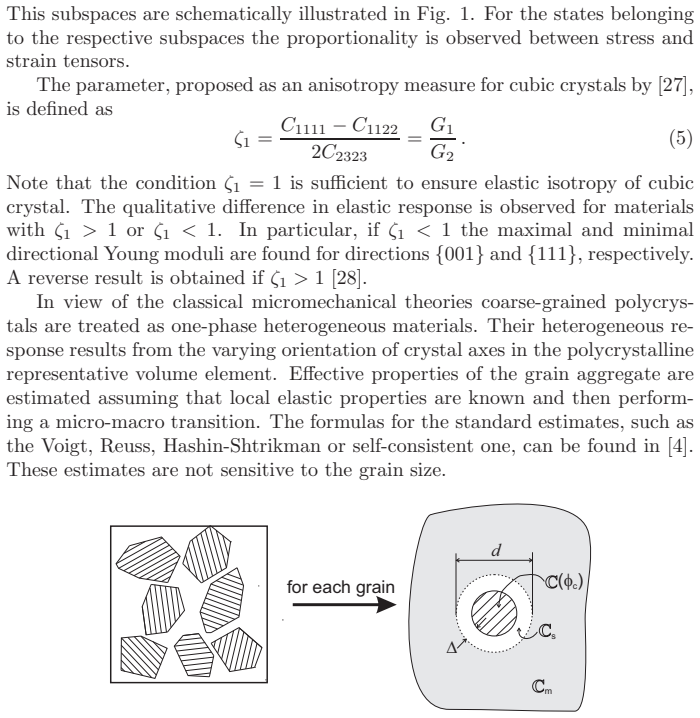
The load-bearing object is the coated-grain inclusion: a sphere with an anisotropic cubic core, whose Kelvin moduli are $3K$, $2G_1$, $2G_2$, surrounded by a uniform isotropic shell with moduli $K_s$, $G_s$. The shell's volume fraction is $f_0 = 1 - (1-2\Delta/d)^3$, where $\Delta$ is the cutoff radius of the embedded-atom potential and $d$ is the average grain diameter; this is the only size-dependent input. The effective stiffness comes from embedding the coated grain in an infinite reference medium and applying the double-inclusion scheme (Mori-Tanaka and self-consistent variants), with a spherical Hill tensor for the inclusion. The shell moduli are not free: they are pinned by atomistic simulations at $f_0 \to 1$, after which the same closed-form expressions predict all coarser grain sizes. The Zener factor $\zeta_1 = G_1/G_2$ is the classification parameter that organizes the results.
What would settle it
Measure the elastic moduli of nanocrystalline niobium or vanadium (both with Zener factor below one) across grain sizes from roughly 5 nm to 100 nm: the paper's rule predicts decreasing moduli with increasing grain size, so the opposite trend would disprove the qualitative claim. A cheaper computational test is to repeat the whole identification for one metal with a different embedded-atom potential and check whether the sign of the grain-size trend survives the change.
Extended reading notes
Core claim
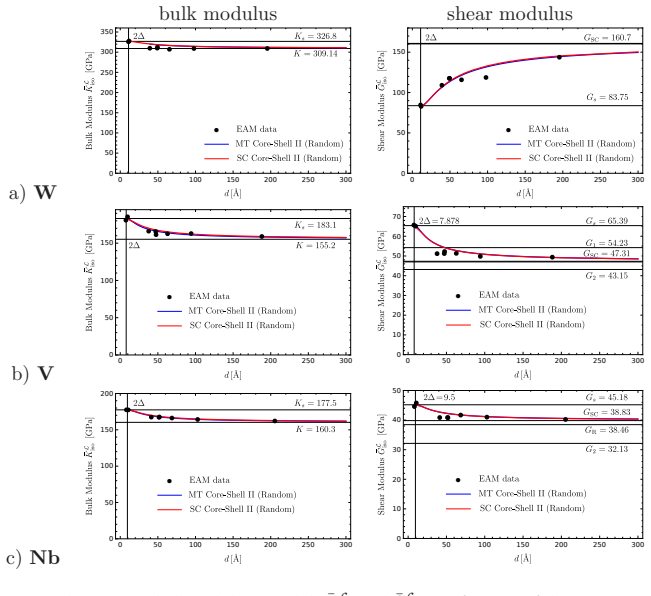
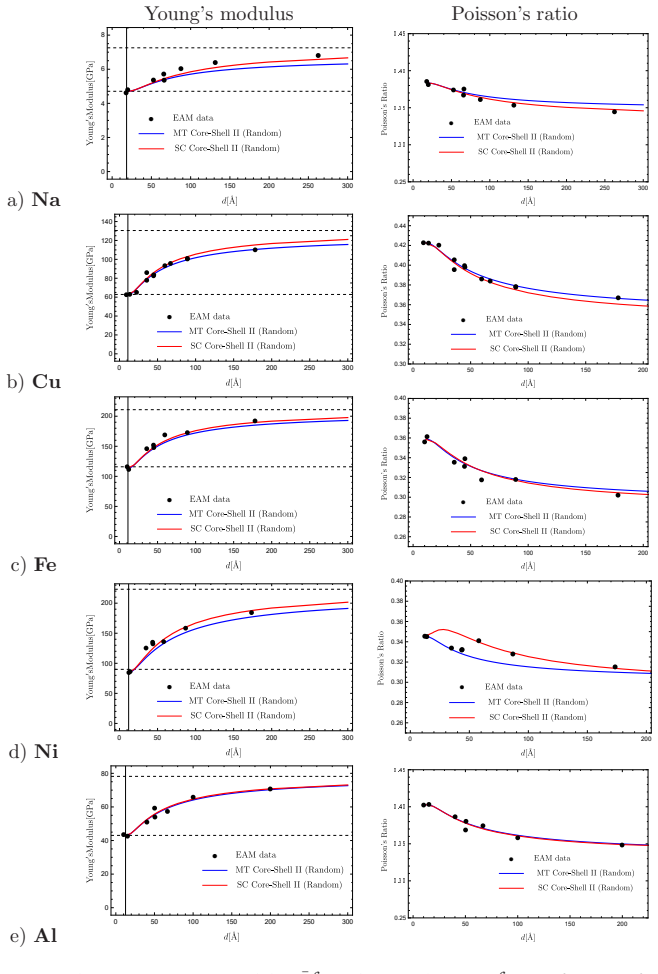
The paper reports that the grain-boundary zone in cubic nanocrystalline metals can be captured, for effective elasticity, by a uniform isotropic shell whose thickness is the potential cutoff radius and whose moduli $K_s$, $G_s$ are identified from samples with almost all atoms in the boundary zone. With this identification, the Mori-Tanaka and self-consistent variants of the core-shell model track the isotropized bulk and shear moduli from atomistic simulations across all eight metals, with the self-consistent variant in closer agreement. The accompanying qualitative rule is that the size dependence changes sign at $\zeta_1=1$: for $\zeta_1>1$ both $K$ and $G$ increase with grain size, for $\zeta_1<1$ they decrease, and FCC versus BCC lattice geometry does not change the pattern. Tungsten, with $\zeta_1\approx 1$, sits on the borderline, showing decreasing bulk modulus but increasing shear modulus with grain size.
Load-bearing premise
The load-bearing premise is that a grain-boundary zone of uniform thickness equal to the interatomic potential's cutoff radius, with elastic constants taken from the two smallest-grained simulations, faithfully represents the real boundary structure; if that identification fails, the predicted size scaling loses quantitative meaning.
Editorial extensions
If this is right
- If the core-shell identification is correct, the grain-size scaling of elastic moduli in a cubic nanocrystalline metal can be predicted from single-crystal constants, the potential cutoff radius, and one small-grain calibration — no atomistic sweep over grain sizes is required.
- The model predicts that decreasing grain size softens metals with $\zeta_1>1$ but stiffens metals with $\zeta_1<1$, so the Zener factor becomes a practical selector for whether nanocrystalline refinement should raise or lower elastic stiffness.
- The copper-specific assumption that the shell has the crystal's bulk modulus and the smaller single-crystal shear modulus is not transferable; other cubic metals need their own shell moduli identified from ultra-fine-grained samples.
- The self-consistent variant of the core-shell model should be preferred over the Mori-Tanaka variant when quantitative accuracy against atomistic data matters, since the paper finds it in better agreement.
- For very small grains the two variants converge to the shell properties, so the calibration step itself is robust to the choice of homogenization scheme at the finest grain sizes.
Reading between the lines
- Editorial extension: if the sign rule is generic, experiments on nanocrystalline niobium or vanadium — metals with $\zeta_1<1$ — should show elastic moduli that decrease as grain size increases; published experiments on such compacts are scarce, making this a direct testable prediction.
- Editorial extension: the model's quantitative predictions are tied to the chosen embedded-atom potential because both $\Delta$ and the identified shell moduli change with the potential; a systematic comparison across multiple potentials for one metal would reveal how much of the claimed agreement is potential-specific.
- Editorial extension: near $\zeta_1=1$ the clean dichotomy fails, so a practical engineering rule would need a secondary criterion — for example the full anisotropy tensor — to handle near-isotropic metals such as tungsten.
- Editorial extension: the coated-grain construction invites the same cutoff-radius calibration to be tested for inelastic properties, such as yield strength or strain-rate sensitivity, where grain-boundary zones are known to matter.
Signed reviews
Editorial analysis
A structured set of objections, weighed in public.
Referee Report
Summary. The manuscript extends a two-phase core-shell mean-field model, previously proposed for nanocrystalline copper, to eight cubic metals (FCC and BCC) with a range of Zener anisotropy factors. The authors perform molecular statics simulations with EAM potentials, isotropize the resulting stiffness tensors using the Log-Euclidean metric, and identify isotropic shell elastic moduli (Ks, Gs) as averages over the two finest-grained samples (f0 ≈ 1) of each metal. The shell thickness is set to the EAM cutoff radius, and both Mori-Tanaka and self-consistent variants of the core-shell model are compared against the atomistic data for bulk and shear moduli as functions of average grain diameter. The paper reports satisfactory qualitative and quantitative agreement, and observes that the size dependence of the moduli reverses sign depending on whether the Zener factor is above or below one.
Significance. If the central claim holds, the paper offers a potentially practical closed-form mean-field tool for estimating grain-size-dependent elasticity of nanocrystalline cubic metals, with the shell thickness given by the interatomic potential cutoff and shell properties obtained from atomistic simulations of very fine-grained samples. The dataset in the appendices (Tables A.5–A.20) is extensive and internally consistent, and the authors are transparent about the model's assumptions. However, the validation strategy is weakened by the fact that the shell properties are calibrated on the same simulation method and, in part, on the very data points used for the subsequent comparison, and by the absence of multiple realizations or error bars. The significance of the paper would be substantially higher if the predictive (out-of-calibration) content were isolated and quantified.
major comments (3)
- [Section 4.1, Table 3, and Figures 5–6] The shell moduli Ks and Gs are identified by averaging the isotropized moduli of the two samples with f0 ≈ 1 for each metal (Table 3). These same two data points are then included in the comparisons shown in Figures 5 and 6 and claimed as part of the overall agreement. Because the core-shell model reduces to Cs in the limit f0 → 1 (as stated in Section 2), the two calibration points are reproduced by construction. The genuinely predictive comparison consists of the remaining five or six grain sizes per metal. The paper should report the agreement for the held-out points separately, or preferably identify the shell properties from an independent source (e.g., bicrystal simulations or local structural metrics) and perform a leave-one-out analysis to demonstrate that the model predicts the uncalibrated data.
- [Section 3 and Appendix A] Each configuration at a given grain size is a single Voronoi realization, with no repeated samples and consequently no error bars on the atomistic moduli reported in Tables 1 and 2. Since the grain-size trends are monotonic and the model has two fitted parameters per metal (Ks and Gs), the reported 'satisfactory quantitative agreement' could be substantially absorbed by the calibration even if the underlying shell-thickness assumption were incorrect. The authors should generate at least three to five independent realizations for a subset of grain sizes per metal and report mean ± standard deviation, enabling a statistical assessment of the claimed agreement.
- [Section 4.2, Eq. (11)] The volume fraction f0 is computed from Eq. (11) under the assumption that the shell thickness Δ equals the EAM cutoff radius. This same assumption is then used to assert that the finest-grained samples consist 'approximately all atoms belonging to the grain boundary zone' and to justify the identification of Ks and Gs from those samples. The identification of the shell phase is therefore not independent of the model being tested; it is a modeling assumption rather than a measured microstructural property. The authors should either justify the Δ = cutoff identification for each potential using local structural analysis (e.g., atomic order parameters, centrosymmetry, or local elastic constants) or provide a sensitivity study varying Δ over a physically plausible range to show that the qualitative Zener-factor conclusion is robust.
minor comments (5)
- [Abstract and Section 3] The abstract and Section 3 state 'eight metals with nine grain sizes each,' but each metal appears to have eight polycrystalline samples plus a monocrystal; please clarify whether the monocrystal is counted as one of the nine grain sizes.
- [Figure captions, Figures 5 and 7] The caption of Figure 5 lists panels '(a) Na, (b) Cu (c) Fe (d) Ni (f) Al,' which appears to be a typo; the panel labels and the list of metals should be cross-checked. The same issue appears in Figure 7.
- [Table 2] Several entries in Table 2 appear with misplaced spaces or line breaks (e.g., '1 80.8', '82.85 327.7 0.84', '1 66.1', '1 65.6', '1 62.6', '1 59.0'); these are likely formatting artifacts, but they should be corrected in the final version.
- [Section 5] The phrase 'the present observations strongly relays on validity' should read 'strongly rely on the validity'.
- [References [42] and [43]] The author names in references [42] and [43] contain the stray text '/suppress', likely from document conversion; these should be cleaned up.
Circularity Check
Shell moduli are calibrated on the two smallest-grain samples, making the smallest-grain 'agreement' by construction; the other six grain sizes remain genuine predictions.
-
fitted input called prediction
[Section 3 (identification of shell moduli), Section 4.1/Table 3, Section 4.2 (Eq. 8 and Figs. 5-6)]
"For each metal the shell elastic parameters: Ks and Gs, were identified as an average value for two samples with f0 approaching unity. ... For very small grains (f0 → 1) the estimates C̄CS/MT and C̄CS/SC approach each other and coincide with Cs."
The two calibration samples per metal (smallest d, f0≈1 by Eq. 11) are averaged to define Ks and Gs (Table 3). Since Eq. (8) reduces to C̄=Cs when f0→1, the model output at those two grain sizes equals the measured shell moduli by construction. The paper then includes these two points in the claimed 'satisfactory qualitative and quantitative agreement' (Figs. 5-6), so they are not independent predictions; they are the endpoint of the fit. The remaining six grain sizes per metal are predicted with Ks and Gs held fixed, so the size-dependence claim retains genuinely independent support, but the statements 'predictions ... agreement' are partially anchored by fitted input values.
full rationale
The central model is the authors' earlier core-shell model ([4]), but the present paper is an external application to seven new metals plus Cu, with the model's equations independently evaluated against atomistic data. The shell thickness Δ is taken as the EAM cutoff radius, a parameter-free input not fitted to the target elastic moduli, and the Zener-factor trend is primarily an observation from the atomistic data itself. The only substantive circularity is the calibration of Ks and Gs from the two smallest-grain samples per metal: because the model collapses to Cs at f0→1, those two data points are forced onto the model curve by construction. However, the model's predictions for all larger grain sizes are genuinely determined after this calibration, giving the central claim meaningful independent content. No load-bearing self-citation chain or renaming of known results is present, so the circularity is partial rather than structural.
Assumptions & free parameters
free parameters (16)
- Ks (Na) =
6.723 GPa
- Gs (Na) =
1.701 GPa
- Ks (Cu) =
135.0 GPa
- Gs (Cu) =
22.06 GPa
- Ks (Fe) =
134.1 GPa
- Gs (Fe) =
41.86 GPa
- Ks (Ni) =
91.98 GPa
- Gs (Ni) =
31.74 GPa
- Ks (Al) =
73.77 GPa
- Gs (Al) =
15.35 GPa
- Ks (W) =
326.8 GPa
- Gs (W) =
83.75 GPa
- Ks (V) =
183.1 GPa
- Gs (V) =
65.39 GPa
- Ks (Nb) =
177.5 GPa
- Gs (Nb) =
45.18 GPa
assumptions (7)
- standard math The elasticity tensor of a cubic crystal admits the spectral decomposition C = 3K I_P + 2G1 (K - I_P) + 2G2 (I - K) (Eq. 2).
- domain assumption The polycrystalline RVE contains an infinite set of randomly oriented grains, so orientation averaging yields an isotropic effective tensor (Eq. 7).
- domain assumption The double-inclusion model with a spherical coated grain in an infinite matrix (Eqs. 8-11) describes the coated-grain interaction.
- ad hoc to paper The shell thickness Delta equals the cutoff radius of the corresponding EAM potential.
- ad hoc to paper Elastic constants Ks and Gs identified from the two smallest-grain samples (f0 approximately 1) are representative of the grain boundary shell at all grain sizes.
- domain assumption The EAM potentials used reproduce the elastic properties of the eight metals.
- standard math The Log-Euclidean projection (Eq. 13) is the appropriate way to isotropize the computed anisotropic stiffness tensors for comparison.
Cite this review
Pith. "Pith review of Atomistic and mean-field estimates of effective stiffness tensor of nanocrystalline materials of cubic symmetry." pith.science (2026). https://pith.science/paper/KOETCBLX
@misc{pith2026190801644,
  author       = {Pith},
  title        = {Pith review of: Atomistic and mean-field estimates of effective stiffness tensor of nanocrystalline materials of cubic symmetry},
  year         = {2026},
  howpublished = {\url{https://pith.science/paper/KOETCBLX}},
  note         = {Machine review of arXiv:1908.01644}
}
read the original abstract
Anisotropic core-shell model of a nano-grained polycrystal, proposed recently for nanocrystalline copper, is applied to estimate elastic effective properties for a set of crystals of cubic symmetry. Materials selected for analysis differ in the lattice geometry (face-centered cubic vs. body-centered cubic) as well as the value of a Zener factor: a ratio of two shear moduli defining elastic anisotropy of a cubic crystal. The predictions are verified by means of the atomistic simulations. The dependence of the overall bulk and shear moduli on the average grain diameter is analysed. In the mean-field approach the thickness of the shell is specified by the \emph{cutoff radius} of a corresponding atomistic potential, while the grain shell is isotropic and its properties are identified by molecular simulations performed for very small grains with approximately all atoms belonging to the grain boundary zone. It is shown that the core-shell model provides predictions of satisfactory qualitative and quantitative agreement with atomistic simulations. Performed study indicates that the variation of the bulk and shear moduli with the grain size changes qualitatively when the Zener anisotropy factor is smaller or greater than one.
Figures


Figures from the paper (5 more)



Reference graph
Works this paper leans on
-
[1]
H. Gleiter, Nanostructured materials: basic concepts and microstructure, Acta Materialia 48 (1) (2000) 1 – 29. doi:10.1016/S1359-6454(99)00285-2
-
[2]
G.-J. J. Gao, Y.-J. Wang, S. Ogata, Studying the elastic proper- ties of nanocrystalline copper using a model of randomly packed uni- form grains, Computational Materials Science 79 (2013) 56 – 62. doi:10.1016/j.commatsci.2013.05.053
-
[3]
P. Sanders, J. Eastman, J. Weertman, Elastic and tensile behav ior of nanocrystalline copper and palladium, Acta Materialia 45 (10) (1997) 4019 – 4025. doi:10.1016/S1359-6454(97)00092-X
-
[4]
K. Kowalczyk-Gajewska, M. Ma´ zdziarz, Atomistic and mean-fie ld es- timates of effective stiffness tensor of nanocrystalline copper, In - ternational Journal of Engineering Science 129 (2018) 47 – 62. doi:10.1016/j.ijengsci.2018.04.004
-
[5]
J. Carsley, J. Ning, W. Milligan, S. Hackney, E. Aifantis, A sim- ple, mixtures-based model for the grain size dependence of stren gth in nanophase metals, Nanostructured Materials 5 (4) (1995) 441 – 4 48. doi:10.1016/0965-9773(95)00257-F
-
[6]
H. S. Kim, M. B. Bush, The effects of grain size and porosity on the elas- tic modulus of nanocrystalline materials, Nanostructured Materials 11 (3) (1999) 361 – 367. doi:10.1016/S0965-9773(99)00052-5
-
[7]
D. J. Benson, H.-H. Fu, M. A. Meyers, On the effect of grain size on yield stress: extension into nanocrystalline domain, Ma- terials Science and Engineering: A 319321 (2001) 854 – 861. doi:10.1016/S0921-5093(00)02029-3
-
[8]
X. Qing, G. Xingming, The scale effect on the yield strength of nano crys- talline materials, International Journal of Solids and Structures 4 3 (2526) (2006) 7793 – 7799. doi:10.1016/j.ijsolstr.2006.04.015
Show all 60 references
-
[9]
J. Zhou, Y. Li, R. Zhu, Z. Zhang, The grain size and porosity de- pendent elastic moduli and yield strength of nanocrystalline ceram- ics, Materials Science and Engineering: A 445446 (2007) 717 – 724. doi:10.1016/j.msea.2006.10.005
2007 doi
-
[10]
Sharma, S
P. Sharma, S. Ganti, On the grain-size-dependent elastic modu - lus of nanocrystalline materials with and without grain-boundary sliding, Journal of Materials Research 18 (8) (2003) 18231826. doi:10.1557/JMR.2003.0253. 30
2003
-
[11]
Jiang, G
B. Jiang, G. Weng, A generalized self-consistent polycrystal m odel for the yield strength of nanocrystalline materials, Journal of the Mechanics and Physics of Solids 52 (5) (2004) 1125 – 1149. doi:10.1016/j.jmps.2003.09.002
2004 doi
-
[12]
C. Q. Chen, Y. Shi, Y. S. Zhang, J. Zhu, Y. J. Yan, Size depende nce of young’s modulus in zno nanowires, Phys. Rev. Lett. 96 (2006) 07 5505. doi:10.1103/PhysRevLett.96.075505
2006 doi
-
[13]
Capolungo, M
L. Capolungo, M. Cherkaoui, J. Qu, On the elastic-viscoplastic b ehav- ior of nanocrystalline materials, Int. J. Plasticity 23 (2007) 561–59 1. doi:10.1016/j.ijplas.2006.05.003
2007 doi
-
[14]
Mercier, A
S. Mercier, A. Molinari, Y. Estrin, Grain size dependence of stre ngth of nanocrystalline materials as exemplified by copper: an elastic-viscop lastic modelling approach, Journal of Materials Science 42 (5) (2007) 145 5–1465. doi:10.1007/s10853-006-0670-y
2007 doi
-
[15]
Ramtani, H
S. Ramtani, H. Bui, G. Dirras, A revisited generalized self-consis tent poly- crystal model following an incremental small strain formulation and in- cluding grain-size distribution effect, International Journal of En gineering Science 47 (4) (2009) 537 – 553. doi:10.1016/j.ije...
2009 doi
-
[16]
Schiøtz, T
J. Schiøtz, T. Vegge, F. D. Di Tolla, K. W. Jacobsen, Atomic-sc ale simula- tions of the mechanical deformation of nanocrystalline metals, Phy s. Rev. B 60 (1999) 11971–11983. doi:10.1103/PhysRevB.60.11971
1999 doi
-
[17]
Chang, Molecular-dynamics study of mechanical proper- ties of nanoscale copper with vacancies under static and cyclic loading, Microelectronic Engineering 65 (12) (2003) 239 – 246
W.-J. Chang, Molecular-dynamics study of mechanical proper- ties of nanoscale copper with vacancies under static and cyclic loading, Microelectronic Engineering 65 (12) (2003) 239 – 246. doi:10.1016/S0167-9317(02)00887-0
2003 doi
-
[18]
Y. Choi, Y. Park, S. Hyun, Mechanical properties of nanocrys talline cop- per under thermal load, Physics Letters A 376 (5) (2012) 758 – 76 2. doi:10.1016/j.physleta.2011.12.027
2012 doi
-
[19]
Mortazavi, G
B. Mortazavi, G. Cuniberti, Atomistic modeling of mechanical pro per- ties of polycrystalline graphene, Nanotechnology 25 (21) (2014) 2 15704. doi:10.1088/0957-4484/25/21/215704
2014 doi
-
[20]
Fang, C.-C
T.-H. Fang, C.-C. Huang, T.-C. Chiang, Effects of grain size and t emper- ature on mechanical response of nanocrystalline copper, Materia ls Science and Engineering: A 671 (2016) 1 – 6. doi:10.1016/j.msea.2016.06.042
2016 doi
-
[21]
T.-Y. Kim, J. E. Dolbow, E. Fried, Numerical study of the grain-size depen- dent Youngs modulus and Poissons ratio of bulk nanocrystalline mate rials, International Journal of Solids and Structures 49 (26) (2012) 3 942 – 3952. doi:10.1016/j.ijsolstr.2012.08.023. 31
2012 doi
-
[22]
S.-J. Zhao, K. Albe, H. Hahn, Grain size dependence of the bulk m odu- lus of nanocrystalline nickel, Scripta Materialia 55 (5) (2006) 473 – 47 6. doi:10.1016/j.scriptamat.2006.04.043
2006 doi
-
[23]
W. Xu, L. P. Dvila, Size dependence of elastic mechanical proper ties of nanocrystalline aluminum, Materials Science and Engineering: A 692 (2017) 90 – 94. doi:10.1016/j.msea.2017.03.065
2017 doi
-
[24]
L. J. Walpole, Advances in Applied Mechanics, Vol. 21, 1981, Ch. E lastic Behavior of Composite Metarials: Theoretical Foundations, pp. 16 9–236. doi:10.1016/S0065-2156(08)70332-6
1981 doi
-
[25]
Rychlewski, Unconventional approach to linear elasticity, Ar ch
J. Rychlewski, Unconventional approach to linear elasticity, Ar ch. Mech. 47 (2) (1995) 149–171
1995
-
[26]
Kowalczyk-Gajewska, Bounds and self-consistent estimat es of overall properties for random polycrystals described by lin- ear constitutive laws., Arch
K. Kowalczyk-Gajewska, Bounds and self-consistent estimat es of overall properties for random polycrystals described by lin- ear constitutive laws., Arch. Mech. 61(6) (2009) 475–503, http://am.ippt.pan.pl/am/article/view/v61p475
2009
-
[27]
Zener, Elasticity and Anelasticity of Metals, University of Chicago Press, 1948
C. Zener, Elasticity and Anelasticity of Metals, University of Chicago Press, 1948
1948
-
[28]
Ostrowska-Maciejewska, J
J. Ostrowska-Maciejewska, J. Rychlewski, Generalized prope r states for anisotropic elastic materials, Arch. Mech. 53 (4-5) (2001) 501–51 8
2001
-
[29]
Sevostianov, M
I. Sevostianov, M. Kachanov, Homogenization of a Nanopartic le with Graded Interface, International Journal of Fracture 139 (1) (2006) 121–
2006
-
[30]
Sevostianov, M
I. Sevostianov, M. Kachanov, Effect of interphase layers on t he overall elastic and conductive properties of matrix composites. Application s to nanosize inclusion, International Journal of Solids and Structure s 44 (3) (2007) 1304 – 1315. doi:10.1016/j.ijsolstr.2006.06.020
2007 doi
-
[31]
L. Shen, J. Li, Effective elastic moduli of composites reinforced by particle or fiber with an inhomogeneous interphase, Interna- tional Journal of Solids and Structures 40 (6) (2003) 1393 – 1409 . doi:10.1016/S0020-7683(02)00659-5
2003 doi
-
[32]
M. D. Kluge, D. Wolf, J. F. Lutsko, S. R. Phillpot, Formalism for th e calculation of local elastic constants at grain boundaries by means o f atomistic simulation, Journal of Applied Physics 67 (5) (1990) 2370– 2379. doi:10.1063/1.345533
1990 doi
-
[33]
Forte, M
S. Forte, M. Vianello, Symmetry classes for elasticity tensors, J. Elasticity 43 (1996) 81–108. doi:10.1007/BF00042505
1996 doi
-
[34]
Rychlewski, Elastic waves under unusual anisotropy, J
J. Rychlewski, Elastic waves under unusual anisotropy, J. Mec h. Phys. Solids 49 (2001) 2651–2666. doi:10.1016/S0022-5096(01)00083-7. 32
2001 doi
-
[35]
M. Hori, S. Nemat-Nasser, Double-inclusion model and overall m od- uli of multi-phase composites, Mech. Mater. 14 (1993) 189–206. doi:10.1016/0167-6636(93)90066-Z
1993 doi
-
[36]
Hill, Continuum micro-mechanics of elastoplastic polycrystals, J
R. Hill, Continuum micro-mechanics of elastoplastic polycrystals, J. Mech. Phys. Solids 13 (1965) 89–101. doi:10.1016/0022-5096(65)90023-2
1965 doi
-
[37]
Nadeau, M
J. Nadeau, M. Ferrari, On optimal zeroth-order bounds with a pplication to Hashin–Shtrikman bounds and anisotropy parameters, Int. J. Solids Struc- tures 38 (2001) 7945–7965. doi:10.1016/S0020-7683(00)00393-0
2001 doi
-
[38]
Walpole, The stress-strain law of a textured aggregate of c ubic crystals, Journal of the Mechanics and Physics of Solids 33 (4) (1985) 363 – 3 70
L. Walpole, The stress-strain law of a textured aggregate of c ubic crystals, Journal of the Mechanics and Physics of Solids 33 (4) (1985) 363 – 3 70. doi:10.1016/0022-5096(85)90034-1
1985 doi
-
[39]
Plimpton, Fast Parallel Algorithms for Short-Range Molecular Dy- namics, Journal of Computational Physics 117 (1) (1995) 1 – 19
S. Plimpton, Fast Parallel Algorithms for Short-Range Molecular Dy- namics, Journal of Computational Physics 117 (1) (1995) 1 – 19. doi:10.1006/jcph.1995.1039
1995
-
[40]
E. B. Tadmor, R. E. Miller, Modeling Materials: Continuum, Atomist ic and Multiscale Techniques, Cambridge University Press, 2011
2011
-
[41]
C. A. Becker, F. Tavazza, Z. T. Trautt, R. A. B. de Macedo, C onsid- erations for choosing and using force fields and interatomic potent ials in materials science and engineering - http://www.ctcms.nist.gov/pote ntials, Current Opinion in Solid State and Materials Science 17 (6...
2013 doi
-
[42]
Ma´ zdziarz, T
M. Ma´ zdziarz, T. D. Young, P. D/suppress luzewski, T. Wejrzanowski, K. J. Kurzyd/suppress lowski, Computer modelling of nanoindentation in the limits of a coupled molecular–statics and elastic scheme, Journal of Com- putational and Theoretical Nanoscience 7 (6) (2010) 1172 –...
2010
-
[43]
Ma´ zdziarz, T
M. Ma´ zdziarz, T. D. Young, G. Jurczak, A study of the af- fect of prerelaxation on the nanoindentation process of crys- talline copper, Archives of Mechanics 63 (5-6) (2011) 533, http://am.ippt.pan.pl/am/article/view/v63p533
2011
-
[44]
A. Stukowski, Visualization and analysis of atomistic simulation dat a with OVITO-the Open Visualization Tool, Modelling and Simulation in Mate- rials Science and Engineering 18 (1) (2010) 015012, https://ovito.org/. doi:10.1088/0965-0393/18/1/015012
2010 doi
-
[45]
Hirel, Atomsk: A tool for manipulating and convert- ing atomic data files, Computer Physics Communications 197 (2015) 212 – 219, http://atomsk.univ-lille1.fr/index.php
P. Hirel, Atomsk: A tool for manipulating and convert- ing atomic data files, Computer Physics Communications 197 (2015) 212 – 219, http://atomsk.univ-lille1.fr/index.php. doi:10.1016/j.cpc.2015.07.012. 33
2015 doi
-
[46]
Ma´ zdziarz, M
M. Ma´ zdziarz, M. Gajewski, Estimation of Isotropic Hyperelas ticity Con- stitutive Models to Approximate the Atomistic Simulation Data for Alu- minium and Tungsten Monocrystals, Computer Modeling in Engineering & Sciences 105 (2) (2015) 123–150. doi:10.3970/cmes.2015.105.123
2015 doi
-
[47]
Jurczak, M
G. Jurczak, M. Ma´ zdziarz, P. D/suppress lu˙ zewski, G. P. Dimitrakopulos, P. Komni- nou, T. Karakostas, On the applicability of elastic model to very thin crys- talline layers, Journal of Physics: Conference Series 1190 (2019) 012017. doi:10.1088/1742-6596/1190/1/012017
2019 doi
-
[48]
Mishin, M
Y. Mishin, M. J. Mehl, D. A. Papaconstantopoulos, A. F. Voter, J. D. Kress, Structural stability and lattice defects in copper: Ab initio , tight- binding, and embedded-atom calculations, Phys. Rev. B 63 (2001) 2 24106. doi:10.1103/PhysRevB.63.224106
2001 doi
-
[49]
Mishin, D
Y. Mishin, D. Farkas, M. J. Mehl, D. A. Papaconstantopoulos, I n- teratomic potentials for monoatomic metals from experimental dat a and ab initio calculations, Phys. Rev. B 59 (1999) 3393–3407. doi:10.1103/PhysRevB.59.3393
1999 doi
-
[50]
Mendelev, M
M. Mendelev, M. Kramer, S. Hao, K. Ho, C. Wang, Development o f in- teratomic potentials appropriate for simulation of liquid and glass pro p- erties of NiZr 2 alloy, Philosophical Magazine 92 (35) (2012) 4454–4469. doi:10.1080/14786435.2012.712220
2012
-
[51]
Marinica, L
M.-C. Marinica, L. Ventelon, M. R. Gilbert, L. Proville, S. L. Dudarev, J. Marian, G. Bencteux, F. Willaime, Interatomic po- tentials for modelling radiation defects and dislocations in tung- sten, Journal of Physics: Condensed Matter 25 (39) (2013) 395 502. doi:10.1088/0953-8...
2013 doi
-
[52]
X. W. Zhou, R. A. Johnson, H. N. G. Wadley, Misfit-energy-incr easing dislocations in vapor-deposited CoFe/NiFe multilayers, Phys. Rev. B 69 (2004) 144113. doi:10.1103/PhysRevB.69.144113
2004 doi
-
[53]
S. R. Wilson, K. G. S. H. Gunawardana, M. I. Mendelev, Solid-liquid in- terface free energies of pure bcc metals and B2 phases, The Jour nal of Chemical Physics 142 (13) (2015) 134705. doi:10.1063/1.4916741
2015 doi
-
[54]
M. R. Fellinger, H. Park, J. W. Wilkins, Force-matched embedded - atom method potential for niobium, Phys. Rev. B 81 (2010) 144119 . doi:10.1103/PhysRevB.81.144119
2010 doi
-
[55]
S. Han, L. A. Zepeda-Ruiz, G. J. Ackland, R. Car, D. J. Srolovit z, Interatomic potential for vanadium suitable for radiation damage simulations, Journal of Applied Physics 93 (6) (2003) 3328–3335. doi:10.1063/1.1555275. 34
2003 doi
-
[56]
Palosz, E
B. Palosz, E. Grzanka, S. Gierlotka, S. Stel’makh, R. Pielaszek, U. Bis- mayer, J. Neuefeind, H. Weber, T. Proffen, R. V. Dreele, W. Palosz , Anal- ysis of short and long range atomic order in nanocrystalline diamonds with application of powder diffractometry, Zeitschrift f¨ ur ...
2002 doi
-
[57]
Moakher, N
M. Moakher, N. Norris, The Closest Elastic Tensor of Arbitrary Symmetry to an Elasticity Tensor of Lower Symmetry, J. Elasticity 85 (2006) 215–263. doi:10.1007/s10659-006-9082-0
2006 doi
-
[58]
Kowalczyk-Gajewska, Micromechanical model of polycryst alline mate- rials with lamellar substructure, Arch
K. Kowalczyk-Gajewska, Micromechanical model of polycryst alline mate- rials with lamellar substructure, Arch. Metal. Mater. 56 (2011) 509 –522. doi:10.2478/v10172-011-0055-3
2011 doi
-
[59]
Haque, M
M. Haque, M. A. Saif, Mechanical behavior of 3050 nm thick alumin um films under uniaxial tension, Scripta Materialia 47 (12) (2002) 863 – 8 67. doi:10.1016/S1359-6462(02)00306-8. 35
2002 doi
-
[127]
doi:10.1007/s10704-006-8369-2
Reviewed August 14, 2026 · model on record in the stance chip above.
Discussion (0). Continue with ORCID to comment.