REVIEW 3 major objections 5 minor 52 references
A fully automatic pipeline turns simple questions into 500 deep-research tasks with rubrics grounded in web evidence.
Reviewed by Pith at T0; open to challenge. T0 means a machine referee read the full paper against a public rubric. the ladder, T0–T4 →
An automatic pipeline evolves simple QA questions into 500 deep-research tasks with DAG-structured, fact-grounded rubrics that discriminate between models.
T0 review reviewed 2026-08-04 challenge →
load-bearing objection The DAG-evolving task pipeline is a real step forward for automatic deep-research benchmarks, but the gold content derives from a single model's exploration, so the pointwise scores measure coverage of that trajectory, not absolute research quality. the 3 major comments →
From Simple QA to Deep Research: A Verifiable Benchmark Constructed through Iterative Task Evolution
The pith
A machine-rendered reading of the paper's core claim, the machinery that carries it, and where it could break.
The reading
Core claim
On the paper's own terms, the central discovery is that the task-specific knowledge needed to evaluate a deep-research answer — what evidence and reasoning a good response must include — can be revealed incrementally by an agent exploring the web, and that this same exploration can be converted into a verifiable scoring rubric. An Explorer solves a simple query and records a trajectory; a Formalizer distills the trajectory into a minimal DAG of evidential and analytical steps with independently checkable checkpoints; a Challenger uses explored-but-unused clues to pose a harder next query. Repeating this loop grows a simple question into a professional-level research task while the query, DAG
What carries the argument
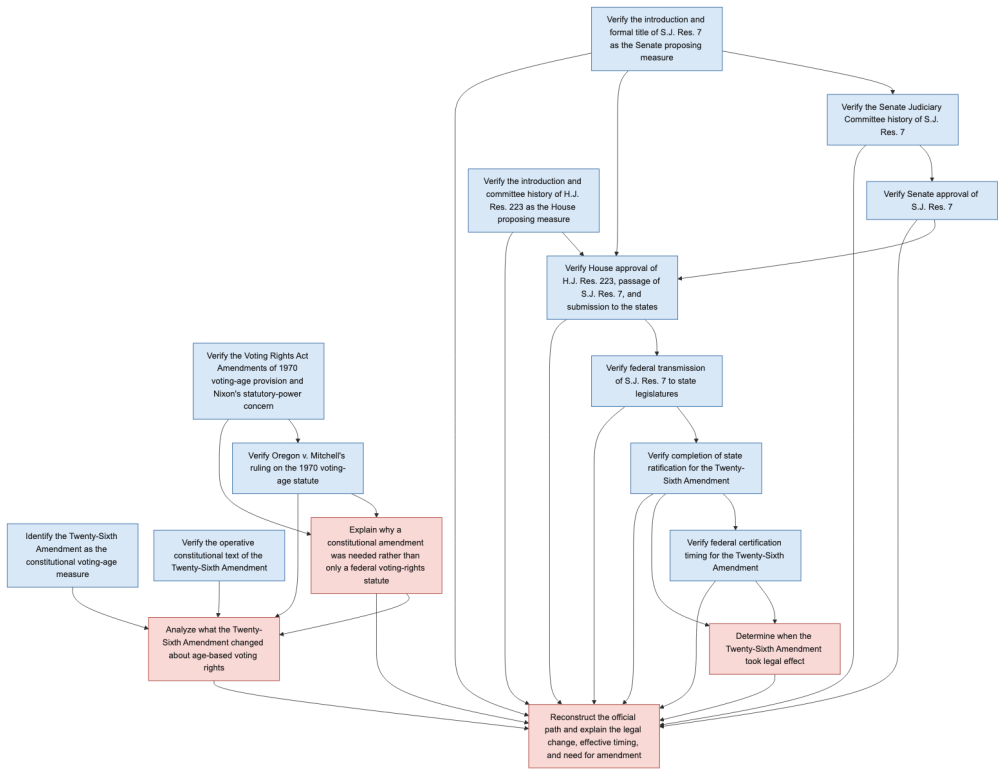
The load-bearing mechanism is the task graph: a DAG whose nodes are atomic research steps (evidential nodes retrieve traceable facts; analytical nodes reason over them), and whose checkpoints are concrete, independently verifiable claims derived from the Explorer's trajectory. The Formalizer builds and maintains this DAG, and the rubric set is exactly one rubric per node, with weights propagated from leaves to parents so that steps supporting more downstream conclusions count more. Evaluation scores a response by whether its content satisfies the checkpoints under these weights — without requiring the response to reproduce the graph's solving path. The iterative loop (Explorer → Formalizer →
Load-bearing premise
The load-bearing premise is that one language model's web exploration is a sufficient and reliable oracle for the task-specific knowledge a deep-research answer must cover, so checkpoints derived from that single trajectory are treated as gold.
What would settle it
Have independent domain experts write gold answers for a random subset of the 500 tasks, then check whether every expert-identified essential point corresponds to a checkpoint in the automatic rubric and whether the checkpoints themselves are factually accurate against authoritative sources. If sizable gaps or errors appear in that sample, the rubric-based scores do not measure deep-research quality.
If this is right
- Benchmark construction in new domains can be automated: given any seed corpus of simple questions, the pipeline yields research tasks with traceable rubrics in roughly 14 rounds and about 265 tool calls per task.
- Scores from this benchmark are absolute pointwise measures, not relative rankings; a model's score does not depend on which other models are in the comparison.
- Distinguishing query forms (with hints, without hints, assigned-topic) isolates separate deep-research abilities, so failures can be attributed to retrieval, planning, or argument formation.
- Because checkpoints are fact-grounded, the same rubric can be re-applied by different judges (LLM or human) with high agreement, enabling stable longitudinal comparisons.
- If the pipeline works, it could be extended to professional domains, turning sparse long-tail knowledge into verifiable research tasks without expert labor.
Where Pith is reading between the lines
- The paper's own limitation about construction cost (about 168 hours and $10,000) suggests a practical ceiling: scaling to thousands of tasks is expensive, although the cost is paid per benchmark, not per evaluation.
- Checkpoint-based scoring likely rewards coverage of the constructor's chosen evidence and may undervalue a response that reaches correct conclusions through novel sources the Explorer never visited; a test would be whether accepted alternative answers score well.
- The stability of scores across judges is reported for 100 tasks; checking all 500 and testing against independent expert rubrics would reveal whether the automatic rubrics generalize beyond their origin trajectory.
- Because the Challenger can only use clues already in the trajectory, the benchmark's difficulty is bounded by the Explorer's search behavior; a stronger Explorer would produce harder tasks, so the method couples benchmark quality to the constructor model's competence.
Editorial analysis
A structured set of objections, weighed in public.
Referee Report
Summary. The paper introduces a fully automatic pipeline (Explorer–Formalizer–Challenger) that evolves simple seed questions into 500 deep-research tasks, each represented as a DAG of atomic evidential/analytical steps with associated checkpoints and pointwise rubrics. The authors report three query forms (hinted, without hints, assigned topic), human review of 100 tasks, evaluations of ten models, and comparisons with existing benchmarks. The central claim is that automatically constructed, source-grounded, pointwise rubrics can substitute for expert-authored rubrics and provide absolute, human-aligned, stable evaluation of open-ended deep-research responses.
Significance. If the construction method is valid, this is a substantial contribution: it removes the expert-authoring bottleneck for deep-research benchmarks, provides traceable DAG-structured rubrics, and ships a public 500-task benchmark with code and data. The human-review evidence (Fleiss κ=0.81, no poor ratings on 100 tasks) and judge–human correlations (0.88–0.92 across judges) are meaningful external validity checks. The three-query-form design is also a useful diagnostic contribution. The main risk is that the gold content is generated from a single LLM's exploration trajectory, which may encode that model's search blind spots; the paper's claims of 'absolute' pointwise quality scores depend on resolving this concern.
major comments (3)
- [Construction Pipeline, Formalizer and Stopping Criterion (Eq. 1)] The central validity claim rests on the rubric covering what a deep-research answer must include. The paper's current evidence addresses verifiability of checkpoints, not completeness of coverage.
- [Benchmark Evaluation, Table 4 and Table 6] Load-bearing? It affects the evaluation-stability claim but the human correlations are strong. Still, the overlap between judge and tested models is a concrete, addressable confound.
- [Construction Analysis, Figure 5] This is a secondary but still load-bearing point for the paper's claim that the pipeline produces controlled difficulty escalation.
minor comments (5)
- [Table 5] The table formatting is garbled in the arXiv text (e.g., 'Pearsonr–0.73 0.6024–0.79/0.76 0.899'). Please replace with a clean table with separate rows for each benchmark and metric, and define all abbreviations in the caption.
- [Human Review (Table 3)] The text says 'all 10,695 checkpoints that encode task knowledge were manually checked as reliable,' but Table 2 reports a mean of 104.85 checkpoints per task; 100 tasks would yield about 10,485 checkpoints. Please reconcile the number or clarify whether the 10,695 figure includes additional per-task metadata.
- [Hyperparameters (Appendix)] The reviser is described as using 'at most 100,000 output tokens' per construction step. This seems excessively high for the prompts shown and likely a typo; please confirm the intended token limit.
- [Benchmark Overview] Top-500 selection by DAG node count is a design choice that biases the benchmark toward broader tasks; please state explicitly in the main text that the benchmark is not a representative sample of seed queries, but a difficulty-filtered subset.
- [Notation] In Eq. (1), the notation G_t = G_{t-1} = G_{t-2} is used; please clarify that equality is on both the node set and edge set, as stated in the prose, and note whether node IDs must match exactly across rounds.
Circularity Check
No significant circularity: the benchmark construction is an empirical data-generation pipeline with external human validation, not a self-referential derivation.
full rationale
The paper's derivation chain is a construction pipeline, not a fitted model whose outputs are relabeled as predictions. The Explorer produces web trajectories, the Formalizer converts them into DAGs and rubrics, and the Challenger evolves the query; the stopping rule in Eq. (1) is a graph-stability convergence criterion, not an identity that forces the claimed result. The rubrics are not fitted to the test-model scores they later measure, and the benchmark's validity rests partly on independent external evidence: 182 hours of human review of 100 sampled tasks (Table 3), human-machine consistency comparisons against other benchmarks (Table 5), and senior-researcher judgments of query quality, DAG correctness, rubric coverage, checkpoint verifiability, and weight reasonableness. The acknowledged limitation in the Appendix ("The current benchmark score measures coverage and correctness of task-specific evidential and analytical checkpoints. It does not separately measure citation count, citation rate, citation format...") is a scope restriction, not a circular step. The deeper epistemic concern that gold checkpoints originate from a single GPT-5.5 trajectory is a real coverage-completeness and validity risk, but it is not a circularity in the derivation: the paper does not define task quality as "whatever the constructor model found" and then derive that the constructor model finds it. No load-bearing step reduces to a self-citation, uniqueness theorem, or fitted parameter. The relative difficulty evidence in Figure 5 is an empirical measurement using the constructed rubrics, not a consequence of an equation equating the predicted quantity with its input. The paper is therefore best assessed as having no significant circularity, with its main risks lying in benchmark-validity assumptions rather than in circular reasoning.
Axiom & Free-Parameter Ledger
free parameters (3)
- Stopping criterion stability window =
2 unchanged rounds; T = min{t>=3 : G_t=G_{t-1}=G_{t-2}}
- Top-500 DAG-node retention count =
500 of 963 converged seeds
- Maximum analytical chain length =
5 consecutive analytical nodes
axioms (5)
- domain assumption Deep research solving processes can be represented as a DAG of atomic evidential/analytical steps.
- domain assumption The knowledge needed for evaluation is progressively revealed as an agent expands its exploration scope.
- ad hoc to paper GPT-5.5 trajectories are factually reliable enough to serve as gold checkpoints.
- domain assumption Challenger expansion using unused trajectory information keeps queries coherent and solvable.
- domain assumption Human review of 100 random tasks generalizes to the full 500-task benchmark.
Cite this review
Pith. "Pith review of From Simple QA to Deep Research: A Verifiable Benchmark Constructed through Iterative Task Evolution." pith.science (2026). https://pith.science/paper/KOKWEBBJ
@misc{pith2026260802163,
  author       = {Pith},
  title        = {Pith review of: From Simple QA to Deep Research: A Verifiable Benchmark Constructed through Iterative Task Evolution},
  year         = {2026},
  howpublished = {\url{https://pith.science/paper/KOKWEBBJ}},
  note         = {Machine review of arXiv:2608.02163}
}
read the original abstract
Deep research benchmarks require expert-level tasks and reliable evaluation grounded in task-specific knowledge. Existing benchmarks rely heavily on expert authoring or pre-existing human-authored materials, while fully automatic construction struggles to ensure consistent and traceable verification. To address this gap, we introduce a verifiable benchmark of 500 deep research tasks spanning 31 topics and 10 major categories, with three query forms designed to probe complementary capabilities required for deep research. The benchmark is constructed automatically using an iterative Explorer-Formalizer-Challenger pipeline that progressively transforms simple questions into deep research tasks. Each task is represented as a directed acyclic graph (DAG) of atomic steps and associated checkpoints, enabling the query, DAG, and rubrics to evolve together in a controlled manner. Experiments demonstrate that the benchmark clearly discriminates among models and query types, while its fact-grounded pointwise rubrics enable fine-grained, human-aligned, and stable evaluation. Our data, implementation, and results are publicly available.
Figures


Reference graph
Works this paper leans on
-
[1]
Alibaba Cloud Community. 2026. Qwen3.7: The Agent Frontier
2026
-
[2]
Anthropic. 2026. Introducing Claude Sonnet 5
2026
-
[3]
DeepSeek-AI. 2026. DeepSeek-V4: Towards Highly Efficient Million-Token Context Intelligence. arXiv:2606.19348
arXiv 2026
-
[4]
Du, M.; Xu, B.; Zhu, C.; Wang, X.; and Mao, Z. 2025. DeepResearch Bench: A Comprehensive Benchmark for Deep Research Agents. arXiv:2506.11763
Pith/arXiv arXiv 2025
-
[5]
Gao, Y .; Zhao, R.; Deng, Y .; and Zhang, W. 2026. DR- Arena: an Automated Evaluation Framework for Deep Research Agents. arXiv:2601.10504
Pith/arXiv arXiv 2026
-
[6]
Google DeepMind. 2026. Gemini 3.5 Flash Model Card
2026
-
[7]
Gou, B.; Huang, Z.; Ning, Y .; Gu, Y .; Lin, M.; Qi, W.; Kopanev, A.; Yu, B.; Guti ´errez, B. J.; Shu, Y .; Song, C. H.; Wu, J.; Chen, S.; Moussa, H. N.; Zhang, T.; Xie, J.; Li, Y .; Xue, T.; Liao, Z.; Zhang, K.; Zheng, B.; Cai, Z.; Rozgic, V .; Ziyadi, M.; Sun, H.; and Su, Y . 2025. Mind2Web 2: Evaluating Agentic Search with Agent- as-a-Judge. arXiv:2506.21506
Pith/arXiv arXiv 2025
-
[8]
Guo, Z.; Xu, F.; Li, Y .; Li, M.; Zou, S.; Wu, J.; Shi, H.; Bai, H.; Leung, H.-f.; and King, I. 2025. ADRA-Bank: A Modular Benchmark for Academic Deep Research Agents. arXiv:2512.00986
Pith/arXiv arXiv 2025
-
[9]
Han, J.; Kim, H.; Lee, C.; Lee, D.; Park, M. H.; Song, H.; Choi, S. J.; Lee, M.; and Lee, H. 2025. DEER: A Benchmark for Evaluating Deep Research Agents on Expert Report Generation. arXiv:2512.17776
Pith/arXiv arXiv 2025
-
[10]
Hu, C.; Du, H.; Wang, H.; Lin, L.; Chen, M.; Liu, P.; Miao, R.; Yue, T.; You, W.; Ji, W.; Yuan, W.; Deng, W.; Yuan, X.; Zhang, X.; Liu, X.; Liu, X.; Xu, Y .; Cao, Y .; Zhang, Y .; Wang, Y .; Shu, Y .; Zhang, Y .; Zhang, Y .; Gong, Z.; Chang, Z.; Li, B.; Ma, D.; Jia, F.; Wang, H.; Liu, J.; Bai, J.; Liu, J.; Liu, M.; Wang, N.; Wu, Q.; Du, Q.; Li, S.; Sun, W...
arXiv 2025
-
[11]
Huang, P.; Zhong, Z.; Wan, Z.; Zhou, D.; Alam, S.; Wang, X.; Li, Z.; Dou, Z.; Zhu, L.; Xiong, J.; Tao, C.; Xu, Y .; Dimitriadis, D.; Zhang, T.; and Zhang, M. 2026. MMDeepResearch-Bench: A Benchmark for Multimodal Deep Research Agents. arXiv:2601.12346
arXiv 2026
-
[12]
Java, A.; Khandelwal, A.; Midigeshi, S.; Halfaker, A.; Deshpande, A.; Goyal, N.; Gupta, A.; Natara- jan, N.; and Sharma, A. 2025. Characterizing Deep Research: A Benchmark and Formal Definition. arXiv:2508.04183
Pith/arXiv arXiv 2025
-
[13]
Jin, J.; Yan, Z.; Wang, S.; Jiao, W.; and Lu, Y
-
[14]
Kausik, C.; Swaminathan, A.; and Kallus, N. 2026. The Context Gathering Decision Process: A POMDP Framework for Agentic Search. arXiv:2605.07042
Pith/arXiv arXiv 2026
-
[15]
Lee, K.; Chang, M.-W.; and Toutanova, K. 2019. La- tent Retrieval for Weakly Supervised Open Domain Question Answering
2019
-
[16]
Li, K.; Zhang, Z.; Yin, H.; Zhang, L.; Ou, L.; Wu, J.; Yin, W.; Li, B.; Tao, Z.; Wang, X.; Shen, W.; Zhang, J.; Zhang, D.; Wu, X.; Jiang, Y .; Yan, M.; Xie, P.; Huang, F.; and Zhou, J. 2025. WebSailor: Navigating Super- human Reasoning for Web Agent. arXiv:2507.02592
Pith/arXiv arXiv 2025
-
[17]
Li, M.; Zeng, Y .; Cheng, Z.; Ma, C.; and Jia, K. 2025. ReportBench: Evaluating Deep Research Agents via Academic Survey Tasks. arXiv:2508.15804
Pith/arXiv arXiv 2025
-
[18]
Li, R.; Du, M.; Xu, B.; Zhu, C.; Wang, X.; and Mao, Z. 2026. DeepResearch Bench II: Diagnosing Deep Research Agents via Rubrics from Expert Re- port. arXiv:2601.08536
arXiv 2026
-
[19]
Mialon, G.; Fourrier, C.; Swift, C.; Wolf, T.; LeCun, Y .; and Scialom, T. 2023. GAIA: A Benchmark for General AI Assistants. arXiv:2311.12983
Pith/arXiv arXiv 2023
-
[20]
MindDR Team; and Li Auto Inc. 2026. Mind DeepRe- search Technical Report. arXiv:2604.14518
Pith/arXiv arXiv 2026
-
[21]
MiniMax. 2026. MiniMax M2.5: Built for Real-World Productivity
2026
-
[22]
OpenAI. 2026. Previewing GPT-5.6 Sol: a next- generation model. Announces the GPT-5.6 family in- cluding Sol, Terra, and Luna
2026
-
[23]
Qwen Team. 2025. Qwen3 Technical Report. arXiv:2505.09388
Pith/arXiv arXiv 2025
-
[24]
QwenCloud. 2026. qwen3.6-flash. Released 2026-04- 16 on the QwenCloud model changelog
2026
-
[25]
Sharma, M.; Zhang, C. B. C.; Bandi, C.; Wang, C.; Aich, A.; Nghiem, H.; Rabbani, T.; Htet, Y .; Jang, B.; Basu, S.; Balwani, A.; Peskoff, D.; Ayestaran, M.; Hendryx, S. M.; Kenstler, B.; and Liu, B
-
[26]
Sun, R.; Bai, Z.; Zhang, W.; Zhang, Y .; Zhao, L.; Sun, S.; and Qiu, Z. 2025. FinResearchBench: A Logic Tree based Agent-as-a-Judge Evaluation Framework for Fi- nancial Research Agents. arXiv:2507.16248
arXiv 2025
-
[27]
Tao, Z.; Wu, J.; Yin, W.; Zhang, J.; Li, B.; Shen, H.; Li, K.; Zhang, L.; Wang, X.; Jiang, Y .; Xie, P.; Huang, F.; and Zhou, J. 2025. WebShaper: Agentically Data Synthesizing via Information-Seeking Formalization. arXiv:2507.15061
Pith/arXiv arXiv 2025
-
[28]
Tian, S.; Zhang, Z.; Chen, L.; and Liu, Z. 2024. MMInA: Benchmarking Multihop Multimodal Inter- net Agents. arXiv:2404.09992
Pith/arXiv arXiv 2024
-
[29]
Wan, H.; Yang, C.; Yu, J.; Tu, M.; Lu, J.; Yu, D.; Cao, J.; Gao, B.; Xie, J.; Wang, A.; Zhang, W.; Torr, P.; and Zhou, D. 2025. DeepResearch Arena: The First Exam of LLMs’ Research Abilities via Seminar-Grounded Tasks. arXiv:2509.01396
arXiv 2025
-
[30]
Wang, Y .; Wang, L.; Deng, Y .; Wu, K.; Xiao, Y .; Yao, H.; Kang, L.; Ye, H.; Jing, Y .; and Bing, L. 2026. Deep- ResearchEval: An Automated Framework for Deep Research Task Construction and Agentic Evaluation. arXiv:2601.09688
arXiv 2026
-
[31]
Wei, J.; Sun, Z.; Papay, S.; McKinney, S.; Han, J.; Fulford, I.; Chung, H. W.; Passos, A. T.; Fedus, W.; and Glaese, A. 2025. BrowseComp: A Sim- ple Yet Challenging Benchmark for Browsing Agents. arXiv:2504.12516
Pith/arXiv arXiv 2025
-
[32]
Wong, R.; Wang, J.; Zhao, J.; Chen, L.; Gao, Y .; Zhang, L.; Zhou, X.; Wang, Z.; Xiang, K.; Zhang, G.; Huang, W.; Wang, Y .; and Wang, K
-
[33]
Wu, J.; Li, B.; Fang, R.; Yin, W.; Zhang, L.; Tao, Z.; Zhang, D.; Xi, Z.; Fu, G.; Jiang, Y .; Xie, P.; Huang, F.; and Zhou, J. 2025. WebDancer: Towards Autonomous Information Seeking Agency. arXiv:2505.22648
Pith/arXiv arXiv 2025
-
[34]
Wu, J.; Yin, W.; Jiang, Y .; Wang, Z.; Xi, Z.; Fang, R.; Zhang, L.; He, Y .; Zhou, D.; Xie, P.; and Huang, F. 2025. WebWalker: Benchmarking LLMs in Web Traversal. arXiv:2501.07572
Pith/arXiv arXiv 2025
-
[35]
WideSearch: Benchmarking Agentic Broad Info-Seeking. arXiv:2508.07999
-
[36]
Xie, J.; Lin, T.; Wang, Z.; Ning, Y .; Yao, Y .; Xue, T.; Zhang, Z.; Li, Z.; Zhang, K.; Wu, Y .; Chen, S.; Gou, B.; Han, M.; Wang, Y .; Lee, V .; Wei, X.; Wang, X.; Su, Y .; and Sun, H. 2026. QUEST: Training Fron- tier Deep Research Agents with Fully Synthetic Tasks. arXiv:2605.24218
Pith/arXiv arXiv 2026
-
[37]
Xu, R.; and Peng, J. 2025. A Comprehensive Survey of Deep Research: Systems, Methodologies, and Ap- plications. arXiv:2506.12594
Pith/arXiv arXiv 2025
-
[38]
Wu, T.; Wang, Y .; Ma, X.; He, X.; Wang, S.; Yin, D.; and Zhao, X. 2026. DeepResearch-9K: A Chal- lenging Benchmark Dataset of Deep-Research Agent. arXiv:2603.01152
Pith/arXiv arXiv 2026
-
[39]
Z.ai. 2026. GLM-5.2: Built for Long-Horizon Tasks
2026
-
[40]
Zhang, G.; Geng, H.; Yu, X.; Yin, Z.; Zhang, Z.; Tan, Z.; Zhou, H.; Li, Z.; Xue, X.; Li, Y .; Zhou, Y .; Chen, Y .; Zhang, C.; Fan, Y .; Wang, Z.; Huang, S.; Piedrahita- Velez, F.; Liao, Y .; Wang, H.; Yang, M.; Ji, H.; Wang, J.; Yan, S.; Torr, P.; and Bai, L. 2025. The Landscape of Agentic Reinforcement Learning for LLMs: A Survey. arXiv:2509.02547
Pith/arXiv arXiv 2025
-
[41]
Ye, J.; Du, Z.; Yao, X.; Lin, W.; Xu, Y .; Chen, Z.; Wang, Z.; Zhu, S.; Xi, Z.; Yuan, S.; Gui, T.; Zhang, Q.; Huang, X.; and Chen, J. 2025. ToolHop: A Query- Driven Benchmark for Evaluating Large Language Models in Multi-Hop Tool Use. arXiv:2501.02506
Pith/arXiv arXiv 2025
-
[44]
Zhou, S.; Xu, F. F.; Zhu, H.; Zhou, X.; Lo, R.; Srid- har, A.; Cheng, X.; Ou, T.; Bisk, Y .; Fried, D.; Alon, U.; and Neubig, G. 2023. WebArena: A Realistic Web Environment for Building Autonomous Agents. arXiv:2307.13854. Appendix Implementation Details and Experimental Settings Prompt Templates The following are the full construction and query-transform...
Pith/arXiv arXiv 2023
-
[45]
**Main object **: any confusion about the query’s main object? any dropped subquestion?
-
[46]
**Comma segments **: split on ‘,‘; count **<= 3 ** (strongly prefer **<= 2 **)? If it still lists parallel items, use umbrella phrasing
-
[47]
levels‘ / ‘including‘ / ‘considering
**Checklist smell **: still 2+ parallel facets (‘A and B‘, ‘A, B, or C‘)? ‘based on‘ / ‘in terms of‘ / ‘at ... levels‘ / ‘including‘ / ‘considering ... and ... broader ... history‘ / ‘roles behind‘? stacked style adjectives? Delete or merge all
-
[48]
**Sentences & question marks **: split on ‘.!?‘ + space; **<= 3 sentences **? **<= 2 ‘?‘**? Merge to one sentence when possible
-
[49]
**Length ratio **: ‘len(query_fuzzified) / len(query) <= 0.70‘? If not, keep deleting modifiers, lists, and method words
-
[50]
**Process leakage **: can a reader infer step order? Any First/Then/Investigate/Analyze by? Rewrite
-
[51]
first A then B
**Read-aloud test **: if it sounds like a research rubric or outline rather than a real-user question, rewrite. Assigned-Topic Query Prompt The mermaid below describes my completed deep research content and conclusions (nodes capture the research process and information; check_points are the key findings/evidence). ## My research (mermaid) {mermaid} What ...
1934
-
[1971]
0.09 E Verify completion of state ratifi- cation (1) States that the three-fourths threshold was reached on July 1, 1971
(3) Accurately describes the governors’ and federal certifying official’s roles. 0.09 E Verify completion of state ratifi- cation (1) States that the three-fourths threshold was reached on July 1, 1971. (2) States that 38 of 50 states were required and identifies North Carolina as the 38th state when discussed. (3) Distinguishes completed ratification fro...
1971
-
[2025]
ResearchRubrics: A Benchmark of Prompts and Rubrics For Evaluating Deep Research Agents. arXiv:2511.07685
-
[2026]
AgentDisCo: Towards Disentanglement and Collaboration in Open-ended Deep Research Agents. arXiv:2605.11732
This paper was first reviewed by deepseek-v4-flash on August 4, 2026.
discussion (0)
Sign in with ORCID, Apple, or X to comment. Anyone can read and Pith papers without signing in.