REVIEW 3 major objections 6 minor 78 references
Schr\"odinger equation with Pauli-Fierz Hamiltonian and double well potential as model of vibrationally enhanced tunneling for proton transfer in hydrogen bond
T0 review · 3 major / 6 minor · reviewed 2026-08-07 · deepseek-v4-flash
Pith's one-line read A resonant vibration can speed proton tunneling in the Zundel ion by up to 26 orders of magnitude, according to a first-order adiabatic solution of the Pauli-Fierz Schrödinger equation.
desk verdict A serious analytic extension with a dramatic peak, but the peak rests on an uncontrolled Hermite-drop approximation; referee-worthy if numerical validation is demanded. read the letter →
The pith
A machine-rendered reading of the paper's core claim, the machinery that carries it, and where it could break.
The reading
What carries the argument
The load-bearing object is the trigonometric double-well potential $U(x)=(m^2-1/4)\tan^2 x - p^2\sin^2 x$, whose one-dimensional Schrödinger equation is exactly solvable through normalized angular prolate spheroidal functions $\bar S^m_{q+m}(p;\sin x)$ with eigenvalues available in Mathematica. The paper factorizes the two-dimensional wavefunction as $\Phi(x,z)=\sum_q \phi_q(z)\psi_q(x)$, turns the coupled equations into shifted harmonic oscillators, and defines the frequency-dependent coefficient $c_q(\omega)=\tilde\alpha[a_{qq}+\sum_{l\neq q}h^l_q a_{ql}]$ that carries the first-order correction. Substituting the average oscillator position $\bar z_q=-c_q(\omega)/\omega^{3/2}$ into the proton equation converts $p^2$ to $p^2+\alpha c_q(\omega)/\omega$, preserving the spheroidal-function form; Weiner's theory then yields the rate as a Boltzmann sum over doublets whose splittings and WKB prefactors are evaluated with the same functions.
What would settle it
A concrete check would be to solve the same two-dimensional Schrödinger equation numerically for the Zundel-ion parameters $\{m=57,p=76\}$, $\alpha=5$, $\delta=1$ and compare the polaritonic levels and rate from (46) with the analytic results, or to compute the dropped polynomial ratio $H_{2j}((2/\delta)^{1/4}\tilde\alpha(a_{ll}-a_{qq})/\omega)/H_{2j}(0)$ at resonance to see whether it is really near unity; experimentally, one could tune a cavity frequency across the predicted $\omega_r$ and look for the sharp rate peak.
Extended reading notes
Core claim
The paper's central claim is that the two-dimensional stationary Schrödinger equation with the Pauli-Fierz Hamiltonian and the trigonometric double-well potential $U(x)=(m^2-\tfrac14)\tan^2 x - p^2\sin^2 x$ admits a tractable first-order adiabatic solution, not an exact one. The proton wavefunctions are the exact one-dimensional solutions, the prolate spheroidal functions $\bar S^m_{q+m}(p;\sin x)$, and the oscillator states are shifted harmonic oscillators. The first-order correction is encoded in a frequency-dependent coefficient $c_q(\omega)$ built from integrals of the dipole moment against these spheroidal functions. After substituting the average oscillator position, the proton sees the same double-well form with $p^2$ replaced by $p^2+\alpha c_q(\omega)/\omega$, so the polaritonic levels and the WKB ingredients of Weiner's theory remain expressible through Mathematica's spheroidal functions. The resulting rate formula (46) produces a sharp resonant-activation peak, which the paper interprets as a Rabi-like transition between the two wells.
Load-bearing premise
The entire frequency dependence, and hence the position and height of the resonance peak, rests on the shortcut that evaluates the ratio of oscillator wavefunctions at the average displacement and discards a polynomial factor in that ratio, relying on all other states being exponentially suppressed; if that shortcut fails, the predicted $10^{26}$ peak is unsupported.
Editorial extensions
If this is right
- Equation (46) gives an explicit analytic formula for the proton-transfer rate using only Mathematica-implemented spheroidal functions, avoiding a numerical solution of the two-dimensional equation.
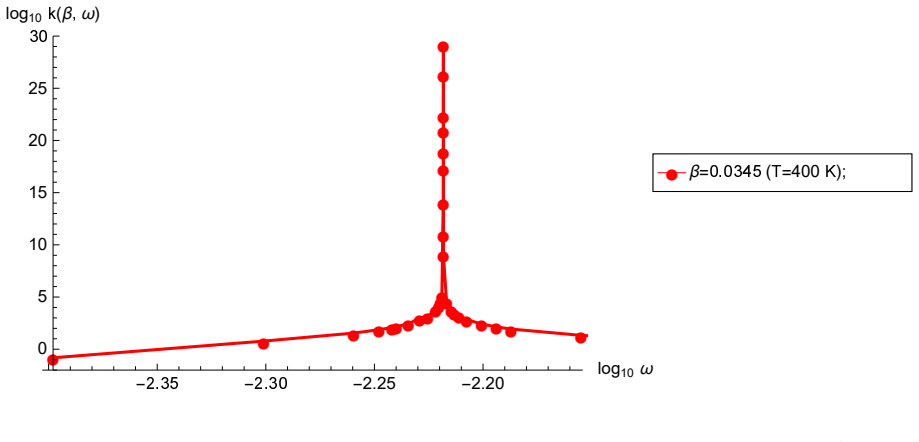
- At $R_{\mathrm{OO}}=3.0$ Å, $\alpha=5$, $T=400$ K the rate has a sharp peak at $\omega_r\approx0.01148149$ with enhancement up to $10^{26}$; at $R_{\mathrm{OO}}=2.8$ Å a similar peak appears at $\omega_r\approx0.00605$ with enhancement up to about $10^{27}$.
- The resonance frequency can be estimated from a Rabi-like condition (50), giving $\omega_r^{(2)}\approx0.0126$ for the 3.0 Å case, close to the value from the full formula.
- The peak persists when the calculation is extended from zero-order to first-order adiabatic approximation and when the coupled mode is switched from symmetric quadratic coupling to vibrational strong coupling, which the paper cites as evidence of robustness.
- Lowering the temperature from 400 K to 200 K reduces the peak height slightly while leaving the resonance frequency unchanged, matching the thermally activated picture of enzymatic hydrogen transfer.
Reading between the lines
- If the predictions survive, the sharpness of the resonance means an enzyme's rate-promoting vibration should act like a tuned gate: mutating or otherwise shifting the frequency of the coupled protein mode should abolish the enhancement, a testable consequence the paper does not state.
- The $10^{26}$ enhancement is carried by an uncontrolled approximation in which oscillator wavefunction ratios are evaluated at the average displacement and the polynomial factor is dropped; a direct numerical solution of the two-dimensional Schrödinger equation for the same parameters would show whether the peak is an artifact.
- The restriction to $\gamma=0$ excludes the linear dipole coupling that dominates real light-matter interaction, so extending the result to polariton chemistry would require solving the asymmetric double-well case or using the confluent Heun solution the paper sets aside.
- For enzymatic hydrogen transfer, the paper's contribution is a proof of principle that resonant activation can deliver the required $10^4$–$10^{12}$ accelerations; the missing piece is a physical model tying a specific protein-scaffold mode to the proton coordinate.
Editorial analysis
A structured set of objections, weighed in public.
Referee Report
Summary. The manuscript develops an approximate analytic solution of the two-dimensional Schrödinger equation with a Pauli–Fierz-type Hamiltonian and a trigonometric double-well potential, working in the first order of an adiabatic expansion. The proton coordinate is expanded in exact spheroidal-function eigenstates of the one-dimensional double well, the cavity/oscillator coordinate is treated as a shifted harmonic oscillator, and off-diagonal couplings are included perturbatively. The resulting first-order energies depend on frequency-dependent coefficients c_q(ω). The author then applies Weiner's theory to compute a proton-transfer rate constant for the Zundel ion, obtaining a sharp resonant peak with rate enhancement up to about 10^26 at ω_r ≈ 0.01148149 for ROO = 3.0 Å, α = 5, δ = 1, T = 400 K, and a similar peak for ROO = 2.8 Å. A simple Rabi-condition estimate is offered as a physical interpretation of the resonance frequency.
Significance. If the central approximation is reliable, the paper would provide a rare analytic handle on vibrationally enhanced tunneling in a double-well system coupled to an oscillator, with potential relevance to polariton chemistry and enzymatic hydrogen transfer. The algebraic derivation is explicit, the use of exact spheroidal-function solutions is technically sound, and the final formulas are implemented in terms of standard Mathematica functions, which is a practical strength. The paper also makes falsifiable predictions: a sharp resonant frequency, a temperature-dependent peak height, and robustness across two barrier shapes. However, the quantitative claim—in particular the 10^26 enhancement—rests on an uncontrolled approximation in Section 3 that has not been tested against a numerical solution. The paper is therefore promising but not yet established.
major comments (3)
- [Section 3, Eqs. (18)–(20)] The replacement h_{ql}^j ≈ h_l^q is the load-bearing step that makes c_q(ω) independent of the oscillator quantum number j, factorizes the partition function in Eq. (44), and cancels the j-sum in Eq. (46). The justification in the text is not quantitative. For the resonance parameters α = 5, δ = 1, ω_r ≈ 0.0115, the Hermite-polynomial argument in Eq. (19) is (2/δ)^{1/4} α Δ/ω ≈ 517 Δ, where Δ = a_ll − a_qq. Even for a small splitting Δ = 0.002, the argument is about 1.03 and H_{2j}(x)/H_{2j}(0) deviates from unity by order one for low j, while the accompanying exponential exp[−α²Δ²/(2√(2δ)ω²)] ≈ 0.765 is not small. Since the Boltzmann factor exp[−β(4j+1)ω√δ/2] ≈ 0.999 for low j at β = 0.0345, many thermal states contribute and the product is not negligible. Thus the claim that states with a_ll ≠ a_qq are exponentially suppressed is not valid in the regime where Eq. (20) is applied. Because c_q(ω) determines the polaritonic energy levels (30) and hence the resonance position and peak height in Eq. (46), the central quantitative result is not yet supported by this derivation.
- [Section 5, Eqs. (47)–(50)] The Rabi-condition estimate is presented as strong evidence for the validity of the calculation ('In our opinion it can not be fortuitous'), but it is not an independent derivation. Equation (50) uses c_2(ω_r), which is itself obtained from the full first-order calculation at the resonance frequency. The agreement between ω_r^(2) ≈ 0.0126 and the computed ω_r ≈ 0.0115 is therefore a consistency check, not a prediction. This does not invalidate the rate calculation, but the passage should be labeled accordingly and should not be used as independent support for the central claim.
- [General (Sections 3 and 5)] No numerical verification or convergence test is provided for the central uncontrolled approximation. The paper claims a 'reliable solution' and a 'stringent analysis', but the only tests are parametric stability for two barrier shapes and a few parameter variations. A direct numerical solution of the coupled system (10), or of the two-dimensional Schrödinger equation (4), for at least one representative case (e.g., ROO = 3.0 Å, α = 5, δ = 1) would settle whether Eqs. (18)–(20) reproduce the resonance peak position and height. Without such a test, the predicted 10^26 enhancement and the claimed reliability of the analytic solution cannot be regarded as established.
minor comments (6)
- [Eqs. (1) and (4)] The interaction term changes sign between the Hamiltonian in Eq. (1), which has +˜α√ω z d(x), and the Schrödinger equation in Eq. (4), which has −˜α√ω z d(x). The sign of z may be absorbable by a coordinate redefinition, but the inconsistency should be fixed for clarity.
- [Eq. (46)] The final closed formula for the rate constant is extremely long and difficult to audit. Consider moving it to an appendix or a supplementary Mathematica notebook and stating only its key structure—factorization and cancellation of the j-sum—in the main text.
- [Figs. 2 and 5] Because the dimensional conversion constant C in Eq. (57) is not fixed, the absolute vertical scale of log10 k is arbitrary. The captions should state explicitly that only relative values of log10 k are shown.
- [Section 4, before Eq. (34)] The restriction to C1 = 0 (γ = 0) means the dipole is purely quadratic, so the model does not correspond to the standard electric-dipole vibrational strong coupling used in polariton chemistry. The authors acknowledge this at the end of Section 5, but the abstract and title should be rephrased to avoid giving the opposite impression.
- [Eqs. (19)–(21)] The notation h_{ql}^j and h_l^q is easy to confuse. After Eq. (20) the j index is suppressed; it would be clearer to write h_{ql}^{(j)} and h_{ql}, or to state the suppression explicitly.
- [Section 5, second paragraph] The phrase 'resonance absorbtion' is a typo for 'resonance absorption'.
Circularity Check
Central rate formula is self-contained; the only circular element is the Sec. 5 Rabi-frequency 'derivation', which feeds the full calculation's c_2(omega_r) back into the formula it claims to derive.
-
self definitional
[Sec. 5, Eqs. (47)-(50), paragraph beginning 'A descriptive physical origin...']
"However we know these coefficients at the resonance frequency from our stringent analysis. We find it expedient to present a simple qualitative way for ”deriving” the resonance frequency. ... omega_r^(2) = alpha |<psi_R| sin^2 x |psi_L>| c_2(omega_r)/(epsilon_3 - epsilon_2)"
Equation (50) is presented as deriving the resonance frequency, but its right-hand side contains c_2(omega_r), the coefficient evaluated by the full first-order calculation exactly at the peak frequency omega_r of Fig. 2. The paper states this explicitly: 'we know these coefficients at the resonance frequency from our stringent analysis.' Thus the formula is a fixed-point consistency check rather than an independent prediction: inserting the output of the complete calculation reproduces approximately the same frequency (0.0126 vs 0.0115), so the agreement cannot independently validate the model. This aside is not what generates the peak itself, since the peak in Fig. 2 comes from scanning Eq.
full rationale
The central derivation chain—exact 1D TDWP solution via spheroidal functions, the exact coupled system (10), the first-order adiabatic reduction, the definition of c_q(omega), the factorized partition function (44), and the closed rate formula (46)—is self-contained in the sense that the predicted peak frequency and height are computed from the model equations with parameters {m,p,alpha,delta} taken from literature/model choices, not fitted to the peak. The approximation in Eqs. (18)-(20), where the Hermite-polynomial ratio is dropped to make h_ql^j j-independent, is an uncontrolled and non-rigorous step, and it directly controls the omega-dependence of c_q(omega) and hence the peak; however, that is a correctness/robustness concern, not a circularity in the derivation logic. The author's prior papers [52,54,55,68] are used for background, exact special-function solutions, and comparison of robustness; these are not load-bearing in the sense of defining the new result, and the special-function solutions are independently checkable in Mathematica. The only genuine circularity found is the Rabi-frequency consistency check in Eqs. (47)-(50), which uses c_2(omega_r) from the full calculation to 'derive' omega_r. Because that step is a heuristic aside rather than the source of the main predicted peak, the overall circularity score is moderate rather than high.
Assumptions & free parameters
free parameters (5)
- TDWP parameters p and m =
p=76, m=57 (ROO=3.0 Å); p=70.5, m=57 (ROO=2.8 Å)
- Coupling constant alpha = C2 * tilde_alpha =
5 (hand-chosen model value)
- Mass ratio delta =
1 (hand-chosen model value)
- Dipole expansion coefficient C1 (gamma) =
0 (symmetric coupling restriction)
- Dimensional conversion constant C =
Fixed via eq. (58) from a reference nonenzymatic rate, e.g. 10^-3 s^-1 at 300 K
assumptions (6)
- standard math The one-dimensional SE with the trigonometric double-well potential has exact solutions in prolate spheroidal functions, eqs. (5)-(7)
- domain assumption Adiabatic factorization of the wavefunction and the assumption that the oscillator frequency is much higher than the inverse proton-motion time
- ad hoc to paper Off-diagonal couplings between oscillator states can be treated as a small perturbation, with the ratio approximation in eqs. (18)-(20)
- domain assumption Weiner's quasi-classical rate theory for symmetric double wells, Appendix 2
- domain assumption Boltzmann statistics for the population of energy levels
- ad hoc to paper Dipole moment form d(x) = C1 sin x + C2 sin^2 x with C1 = 0
Cite this review
Pith. "Pith review of Schr\"odinger equation with Pauli-Fierz Hamiltonian and double well potential as model of vibrationally enhanced tunneling for proton transfer in hydrogen bond." pith.science (2026). https://pith.science/paper/KPUA5NMA
@misc{pith2026250607733,
  author       = {Pith},
  title        = {Pith review of: Schr\"odinger equation with Pauli-Fierz Hamiltonian and double well potential as model of vibrationally enhanced tunneling for proton transfer in hydrogen bond},
  year         = {2026},
  howpublished = {\url{https://pith.science/paper/KPUA5NMA}},
  note         = {Machine review of arXiv:2506.07733}
}
abstract
A solution of the two-dimensional Schr\"odinger equation with Pauli-Fierz Hamiltonian and trigonometric double-well potential is obtained within the framework of the first-order of adiabatic approximation. The case of vibrational strong coupling is considered which is pertinent for polariton chemistry and (presumably) for enzymatic hydrogen transfer. We exemplify the application of the solution by calculating the proton transfer rate constant in the hydrogen bond of the Zundel ion ${\rm{H_5O_2^{+}}}$ (oxonium hydrate) within the framework of the Weiner's theory. An analytic formula is derived which provides the calculation of the proton transfer rate with the help of elements implemented in {\sl {Mathematica}}. The parameters of the model for the Zundel ion are extracted from the literature data on IR spectroscopy and quantum chemical calculations. The approach yields a vivid manifestation of the phenomenon of vibrationally enhanced tunneling, i.e., a sharp bell-shaped peak of the rate enhancement by the external vibration at its symmetric coupling to the proton coordinate. The results obtained testify that the effect of resonant activation in our model is robust and stable to variations in the types of the quadratically coupled mode (vibrational strong coupling or symmetric one).
Figures


Figures from the paper (3 more)


Reference graph
Works this paper leans on
-
[1]
Y . G. Ahmed, G. Gomes, D.J. Tantillo, J.Am.Chem.Soc. 147 (2025) 5971–5983
work page 2025
- [2]
- [3]
- [4]
-
[5]
X. Li, A. Mandal, P . Huo, Nature Communications 12 (2021) 1315
work page 2021
- [6]
- [7]
- [8]
Show all 78 references
-
[9]
Nagarajan, A
K. Nagarajan, A. Thomas, T.W . Ebbesen, J.Am.Chem.Soc. 1 43 (2021) 16877-16889
2021
-
[10]
Simpkins, A.D
B.S. Simpkins, A.D. Dunkelberger, J.C. Owrutsky, J.Ph ys.Chem. C 125 (2021) 19081-19087
2021
-
[11]
T.E. Li, A. Nitzan, J.E. Subotnik, J.Chem.Phys. 156 (20 22) 134106
-
[12]
T.E. Li, B. Cui, J.E. Subotnik, A. Nitzan, Annu.Rev.Phy s.Chem. 73 (2022) 43-71
2022
-
[13]
Y ang, B
Z. Y ang, B. Xiang, W . Xiong, ACS Photonics 7 (2020) 919-9 24
2020
-
[14]
Herrera, New J.Phys
J.F Triana, F. Herrera, New J.Phys. 24 (2022) 023008
2022
-
[15]
Hirai, J.A
K. Hirai, J.A. Hutchison, H. Uji-i, ChemPlusChem 85 (20 20) 1981-1988
1981
-
[16]
Hirai, H
K. Hirai, H. Uji-i, Chem.Lett. 50 (2021) 727-732
2021
-
[17]
Bonini, J
J. Bonini, J. Flick, J.Chem.Theory Comput. 18 (2022) 27 64-2773
2022
-
[18]
V ergauwe, A
R.M.A. V ergauwe, A. Thomas, K. Nagarajan, et al, Angew. Chem.Int.Ed. 58 (2019) 15324-15328
2019
-
[19]
Lather, J
J. Lather, J. George, J.Phys.Chem.Lett. 12 (2021) 379- 384
2021
-
[20]
V . May, O. K¨ uhn, Charge and energy transfer dynamics inmolecular systems, 3-d ed., Wiley, 2011
2011
-
[21]
Schowen, Ch.13 in: Quantum Tunnelling in Enzyme-C atalysed Reactions, eds
R.L. Schowen, Ch.13 in: Quantum Tunnelling in Enzyme-C atalysed Reactions, eds. R.K. Allemann, N.S. Scrutton, RSC Publishing, 2009
2009
-
[22]
Warshel, Proc.Natl.Acad.Sci.USA 75 (1978) 5250-52 54
A. Warshel, Proc.Natl.Acad.Sci.USA 75 (1978) 5250-52 54
1978
-
[23]
Welsh, ed., The fluctuating enzyme, Wiley, 1986
C.R. Welsh, ed., The fluctuating enzyme, Wiley, 1986
1986
-
[24]
Bruno, W , Bialek, Biophys.J
W .J. Bruno, W , Bialek, Biophys.J. 63 (1992) 689-699
1992
-
[25]
Tully, J.Phys.Chem
S.Hammes-Schi ffer, J.C. Tully, J.Phys.Chem. 99 (1995) 5793-5797
1995
-
[26]
Sitnitsky, Chem.Phys.Lett
A.E. Sitnitsky, Chem.Phys.Lett. 240 (1995) 47-52
1995
-
[27]
Basran, M.J
J. Basran, M.J. Sutcli ffe, N.S. Scrutton, Biochemistry 38 (1999) 3218-3222
1999
-
[28]
Kohen, J.P
A. Kohen, J.P . Klinman, Chem.Biol. 6 (1999) R191-R198
1999
-
[29]
Antoniou, S.D
D. Antoniou, S.D. Schwartz, J.Phys.Chem. B 105 (2001) 5 553-5558
2001
-
[30]
Alper, M
K.O. Alper, M. Singla, J.L. Stone, C.K. Bagdassarian, P rot.Sci. 10 (2001) 1319-1330
2001
-
[31]
Agarwal, J.Am.Chem.Soc
P .K. Agarwal, J.Am.Chem.Soc. 127 (2005) 15248-15256
2005
-
[32]
Sitnitsky, Physica A 371 (2006) 481-491
A.E. Sitnitsky, Physica A 371 (2006) 481-491
2006
-
[33]
Sitnitsky, Physica A 387 (2008) 5483-5497
A.E. Sitnitsky, Physica A 387 (2008) 5483-5497
2008
-
[34]
Sitnitsky, Chem.Phys
A.E. Sitnitsky, Chem.Phys. 369 (2010) 37-42. 19
2010
-
[35]
Kohen, Acc.Chem.Res
A. Kohen, Acc.Chem.Res. 48 (2015) 466-473
2015
-
[36]
Jevtic, J
S. Jevtic, J. Anders, J.Chem.Phys. 147 (2017) 114108
2017
-
[37]
Sokolov, M.V
N.D. Sokolov, M.V . V ener, Chem.Phys. 168 (1992) 29-40
1992
-
[38]
Weiner, J.Chem.Phys
J.H. Weiner, J.Chem.Phys. 68 (1978) 2492-2506
1978
-
[39]
Weiner, J.Chem.Phys
J.H. Weiner, J.Chem.Phys. 69 (1978) 4743-4749
1978
-
[40]
Janoschek, E.G
R. Janoschek, E.G. Weidemann, G. Zundel, J.Chem.Soc., Faraday Transactions 2: Mol.Chem.Phys. 69 (1973) 505-520
1973
-
[41]
V ener, J
M.V . V ener, J. Sauer, Chem.Phys.Lett. 312 (1999) 591-597
1999
-
[42]
V ener, O
M.V . V ener, O. K¨ uhn, J. Sauer, J.Chem.Phys. 114 (2001)240-249
2001
-
[43]
Q. Shi, L. Zhu, L. Chen, J.Chem.Phys. 135 (2011) 044505
2011
-
[44]
Y u, J.M
Q. Y u, J.M. Bowman, J.Phys.Chem.Lett. 7 (2016) 5259-52 65
2016
-
[45]
Nanni, Chem.Phys
L. Nanni, Chem.Phys. 597 (2025) 112771
2025
-
[46]
Ferro-Costas, A
D. Ferro-Costas, A. Fern´ andez-Ramos, Ch.9 in: Tunnel ling in molecules: nuclear quantum e ffects from bio to physical chemistry, eds. J. K¨ astner, S. Kozuch, RSC Publishing, 2021
2021
-
[47]
Gamper, F
J. Gamper, F. Kluibenschedl, A.K. H. Weiss, T.S. Hofer, Phys.Chem.Chem.Phys. 24 (2022) 25191
2022
-
[48]
Jelic, F
V . Jelic, F. Marsiglio, Eur.J.Phys. 33 (2012) 1651-166 6
2012
-
[49]
Turbiner, Phys.Rep
A.V . Turbiner, Phys.Rep. 642 (2016) 1-71
2016
-
[50]
Ibrahim, F
A. Ibrahim, F. Marsiglio, Am.J.Phys. 86 (2018) 180-185
2018
-
[51]
N. Wine, J. Achtymichuk, F. Marsiglio, AIP Advances 15 ( 2025) 035330
2025
-
[52]
Sitnitsky, Comput.Theor.Chem
A.E. Sitnitsky, Comput.Theor.Chem. 1138 (2018) 15-22
2018
-
[53]
Schulze-Halberg, Eur.Phys.J.Plus 131 (2016) 202
A. Schulze-Halberg, Eur.Phys.J.Plus 131 (2016) 202
2016
-
[54]
Sitnitsky, Chem.Phys.Lett
A.E. Sitnitsky, Chem.Phys.Lett. 676C (2017) 169-173
2017
-
[55]
Sitnitsky, Vibr.Spectrosc
A.E. Sitnitsky, Vibr.Spectrosc. 93 (2017) 36-41
2017
-
[56]
Dong, F.A
Q. Dong, F.A. Serrano, G.-H. Sun, J. Jing, S.-H. Dong, Ad v.High Energy Phys. (2018) 9105825
2018
-
[57]
S. Dong, Q. Dong, G.-H. Sun, S. Femmam, S.-H. Dong, Adv.H igh Energy Phys. (2018) 5824271
2018
-
[58]
Dong, G.-H
Q. Dong, G.-H. Sun, J. Jing, S.-H. Dong, Phys.Lett. A383 (2019) 270-275
2019
-
[59]
Dong, S.-S
Q. Dong, S.-S. Dong, E. Hern´ andez-M´ arquez, R. Silva-Ortigoza, G.-H. Sun, S.-H. Dong, Commun.Theor.Phys. 71 (2019) 231-236
2019
-
[60]
Dong, A.J
Q. Dong, A.J. Torres-Arenas, G.-H. Sun, Camacho-Nieto , S. Femmam, S.-H. Dong, J.Math.Chem. 57 (2019) 1924-1931
2019
-
[61]
Dong, G.-H
Q. Dong, G.-H. Sun, M. Avila Aoki, C.-Y . Chen, S.-H. Dong , Mod.Phys.Lett. A 34 (2019) 1950208
2019
-
[62]
G.-H. Sun, Q. Dong, V .B. Bezerra, S.-H. Dong, J.Math.Ch em. 60 (2022) 605-612
2022
-
[63]
Sitnitsky, Comput.Theor.Chem
A.E. Sitnitsky, Comput.Theor.Chem. 1160 (2019) 19-23
2019
-
[64]
Porto, N.H
C.M. Porto, N.H. Morgon, Comput.Theor.Chem. 1187 (202 0) 112917
-
[65]
Sitnitsky, J.Mol.Spectr
A.E. Sitnitsky, J.Mol.Spectr. 372 (2020) 111347
2020
-
[66]
Sitnitsky, Comput.Theor.Chem
A.E. Sitnitsky, Comput.Theor.Chem. 1200 (2021) 11322 0
2021
-
[67]
Porto, G.A
C.M. Porto, G.A. Barros, L.C. Santana, A.C. Moralles, N .H. Morgon, J.Mol.Model. 28 (2022) 293-301
2022
-
[68]
Sitnitsky, Chem.Phys.Lett
A.E. Sitnitsky, Chem.Phys.Lett. 813 (2023) 140294
2023
-
[69]
Komarov, L.I
I.V . Komarov, L.I. Ponomarev, S.Y u. Slavaynov, Sphero idal and Coloumb spheroidal functions, Moscow, Science, 1976
1976
-
[70]
G. X. Chan, X. Wang, Phys. Rev. B106 (2022) 075417. 20
2022
-
[71]
Xu, PhD thesis, Basel, 2018
Z.-H. Xu, PhD thesis, Basel, 2018
2018
-
[72]
Davydov, Theory of molecular excitons, Springer, 1971
A.S. Davydov, Theory of molecular excitons, Springer, 1971
1971
-
[73]
Prudnikov, Y u.A
A.P . Prudnikov, Y u.A. Brychkov, O.I. Marichev, Integr als and series. Special functions., 2-d ed., FIZ- MA TLIT, Moscow, 2003
2003
-
[74]
Atkins, J
P . Atkins, J. de Paula, R. Friedman, Quanta, Matter, and Change. A molecular approach to physical chem- istry, Freeman, 2009
2009
-
[75]
Falloon, MS thesis, Australia, 2001
P .E. Falloon, MS thesis, Australia, 2001
2001
-
[76]
Weiner, J.Chem.Phys
J.H. Weiner, J.Chem.Phys. 74 (1981) 2419-2426
1981
-
[77]
L. D. Landau, E. M. Lifshitz, Quantum Mechanics, Pergam on, New Y ork, 1977, 3-rd ed
1977
-
[78]
Kaledin, A.L
M. Kaledin, A.L. Kaledin, J.M. Bowman, J. Ding, K.D. Jor dan, J.Phys.Chem. A 113 (2009) 7671-7677. 21
2009
Reviewed August 7, 2026 · model on record in the stance chip above.
Discussion (0). Continue with ORCID to comment.