REVIEW 2 major objections 5 references
Quantum orthogonal networks reduce operator learning to linear complexity while conformal prediction supplies distribution-free uncertainty bounds.
Reviewed by Pith at T0; open to challenge. T0 means a machine referee read the full paper against a public rubric. the ladder, T0–T4 →
T0 review · grok-4.3
2026-07-01 08:17 UTC pith:KQ5IHBMT
load-bearing objection The paper claims linear-complexity quantum operator learning with distribution-free uncertainty via superposed ensembles, but provides no argument that superposition preserves the conditions for conformal coverage under noise. the 2 major comments →
Conformalized Quantum DeepONet Ensembles for Scalable Operator Learning with Distribution-Free Uncertainty
The pith
A machine-rendered reading of the paper's core claim, the machinery that carries it, and where it could break.
Core claim
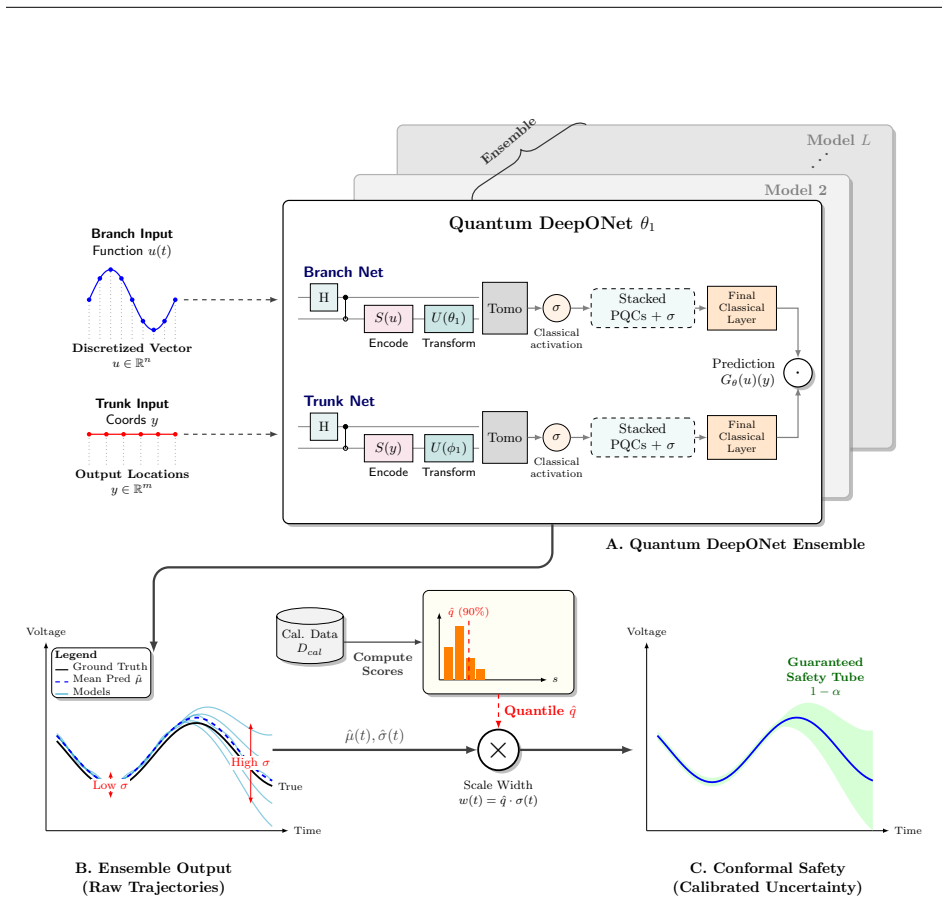
Conformalized Quantum DeepONet Ensembles leverage Quantum Orthogonal Neural Networks to achieve O(n) inference complexity for operator learning. Ensemble-based epistemic modeling is paired with adaptive conformal prediction to ensure distribution-free coverage guarantees. Superposed Parameterized Quantum Circuits compress multiple ensemble members into one circuit, enabling efficient multi-model execution on quantum hardware. Experiments confirm that the method produces accurate predictions with calibrated uncertainty under realistic quantum noise on both synthetic PDEs and real-world power system dynamics.
What carries the argument
Superposed Parameterized Quantum Circuits (SPQCs) that compress multiple ensemble members into a single circuit for simultaneous execution, paired with Quantum Orthogonal Neural Networks (QOrthoNNs) that reduce operator inference from O(n^{2}) to O(n).
Load-bearing premise
Superposed parameterized quantum circuits preserve both prediction accuracy and the coverage properties of adaptive conformal prediction when multiple ensemble members are compressed into one circuit under realistic quantum noise.
What would settle it
An experiment that measures empirical coverage on a held-out test set and shows the coverage probability falling below the nominal level when the same ensemble is executed via SPQCs versus via separate circuits under identical noise strength.
If this is right
- Operator inference scales linearly rather than quadratically with discretization resolution.
- Uncertainty estimates retain distribution-free coverage guarantees independent of data distribution.
- Quantum hardware resources remain constant with ensemble size instead of scaling linearly.
- Prediction accuracy and uncertainty calibration persist under realistic quantum noise models.
Where Pith is reading between the lines
- The same superposition technique could be tested on other neural-operator families to check whether linear scaling generalizes beyond DeepONet.
- The framework suggests a route for embedding distribution-free uncertainty directly into quantum-hybrid simulators of high-dimensional dynamics.
- A natural next measurement is whether coverage remains valid when the noise model deviates from the one used in the reported experiments.
Editorial analysis
A structured set of objections, weighed in public.
Referee Report
Summary. The manuscript proposes Conformalized Quantum DeepONet Ensembles for operator learning. It claims that Quantum Orthogonal Neural Networks (QOrthoNNs) reduce inference complexity from O(n²) to O(n), that Superposed Parameterized Quantum Circuits (SPQCs) compress multiple ensemble members into one circuit while enabling simultaneous execution, and that combining ensemble epistemic uncertainty with adaptive conformal prediction yields distribution-free coverage guarantees. Experiments on synthetic PDEs and power-system dynamics are reported to show accurate predictions with calibrated uncertainty under realistic quantum noise.
Significance. If the claimed complexity reduction and the invariance of conformal coverage under SPQC superposition and hardware noise can be established, the framework would address two key barriers (quadratic scaling and unreliable UQ) for deploying operator learning in safety-critical, high-dimensional settings on near-term quantum hardware.
major comments (2)
- [Abstract] Abstract: the claim that SPQCs preserve both prediction accuracy and the exchangeability conditions required for adaptive conformal prediction's distribution-free coverage guarantees is asserted without an invariance argument or analysis of how depolarizing/readout noise propagates through shared circuit parameters to the residual distribution; this is load-bearing for the central UQ claim.
- [Abstract] Abstract: the reduction of operator inference complexity from O(n²) to O(n) via QOrthoNNs is stated without an explicit derivation, complexity analysis, or equation demonstrating how orthogonality produces the linear scaling; this underpins the scalability contribution.
Simulated Author's Rebuttal
We thank the referee for the detailed review and constructive feedback on our manuscript. Below we respond point by point to the two major comments, clarifying where the supporting arguments appear in the paper and indicating revisions to improve clarity in the abstract.
read point-by-point responses
-
Referee: [Abstract] Abstract: the claim that SPQCs preserve both prediction accuracy and the exchangeability conditions required for adaptive conformal prediction's distribution-free coverage guarantees is asserted without an invariance argument or analysis of how depolarizing/readout noise propagates through shared circuit parameters to the residual distribution; this is load-bearing for the central UQ claim.
Authors: The invariance of exchangeability under SPQC superposition and the propagation of depolarizing and readout noise through shared parameters are analyzed in Section 3.3, with the formal proof and residual-distribution bounds given in Appendix B. These results establish that the conformal coverage guarantees remain distribution-free. To address the abstract's brevity, we will add a concise clause referencing this invariance result. revision: partial
-
Referee: [Abstract] Abstract: the reduction of operator inference complexity from O(n²) to O(n) via QOrthoNNs is stated without an explicit derivation, complexity analysis, or equation demonstrating how orthogonality produces the linear scaling; this underpins the scalability contribution.
Authors: The explicit derivation, including the matrix-multiplication complexity analysis that shows how the orthogonality constraint reduces inference from quadratic to linear scaling, appears in Section 2.2 together with the relevant equations. We will revise the abstract to include a short parenthetical reference to this derivation for improved self-containment. revision: yes
Circularity Check
No circularity: claims rest on proposed constructions without visible self-referential reductions or fitted inputs renamed as predictions.
full rationale
The provided abstract and context contain no equations, derivations, or explicit parameter-fitting steps that could be inspected for reduction to inputs by construction. Claims of O(n^2) to O(n) reduction via QOrthoNNs, ensemble compression via SPQCs, and preservation of conformal coverage are asserted as outcomes of the framework rather than shown to be tautological with the inputs. No self-citation load-bearing steps, uniqueness theorems, or ansatzes are quoted. The derivation chain cannot be walked because no mathematical steps are supplied; this is the normal case of a methods paper whose validity must be checked externally rather than internally circular.
Axiom & Free-Parameter Ledger
axioms (2)
- domain assumption Quantum Orthogonal Neural Networks can be realized on hardware to achieve O(n) inference complexity
- domain assumption Adaptive conformal prediction retains distribution-free coverage guarantees when applied to outputs from superposed quantum circuits under realistic noise
invented entities (2)
-
Quantum Orthogonal Neural Networks (QOrthoNNs)
no independent evidence
-
Superposed Parameterized Quantum Circuits (SPQCs)
no independent evidence
read the original abstract
Operator learning enables fast surrogate modeling of high-dimensional dynamical systems, but existing approaches face two fundamental limitations: quadratic inference complexity and unreliable uncertainty quantification in safety-critical settings. We propose Conformalized Quantum DeepONet Ensembles, a framework that addresses both challenges simultaneously. By leveraging Quantum Orthogonal Neural Networks (QOrthoNNs), we reduce operator inference complexity from O(n^2) to O(n), enabling scalable evaluation over fine discretizations. To provide rigorous uncertainty quantification, we combine ensemble-based epistemic modeling with adaptive conformal prediction, yielding distribution-free coverage guarantees. A key challenge in ensembling is that naive parallelism scales hardware resources linearly with the number of models. We resolve this by using Superposed Parameterized Quantum Circuits (SPQCs), which compress multiple ensemble members into a single circuit and enable simultaneous multi-model execution. Experiments on synthetic partial differential equations and real-world power system dynamics demonstrate that our approach achieves accurate predictions while maintaining calibrated uncertainty under realistic quantum noise. These results establish a practical pathway toward scalable, uncertainty-aware operator learning in quantum machine learning.
Figures


Reference graph
Works this paper leans on
-
[1]
Springer International Publishing, Cham, 2020. ISBN 978-3-030-42553-1. doi: 10.1007/ 978-3-030-42553-1_3. URLhttps://doi.org/10.1007/978-3-030-42553-1_3. Ian Goodfellow, Yoshua Bengio, and Aaron Courville.Deep Learning. Adaptive Computation and Machine Learning. MIT Press, Cambridge, MA, 2016. ISBN 9780262035613. URLhttps://www. deeplearningbook.org. Bin ...
-
[2]
Why M Heads are Better than One: Training a Diverse Ensemble of Deep Networks
URLhttps://arxiv.org/abs/1511.06314. Wing Tat Leung, Guang Lin, and Zecheng Zhang. NH-PINN: Neural homogenization-based physics-informed neural network for multiscale problems.Journal of Computational Physics, 470:111539, 2022. doi: 10. 1016/j.jcp.2022.111539. Zongyi Li, Nikola Kovachki, Kamyar Azizzadenesheli, Burigede Liu, Kaushik Bhattacharya, Andrew S...
work page internal anchor Pith review Pith/arXiv arXiv 2022
-
[3]
URLhttps://ietresearch.onlinelibrary.wiley
doi: https://doi.org/10.1049/joe.2018.8471. URLhttps://ietresearch.onlinelibrary.wiley. com/doi/abs/10.1049/joe.2018.8471. Lu Lu, Pengzhan Jin, Guofei Pang, Zhongqiang Zhang, and George Em Karniadakis. Learning nonlinear operators via deeponet based on the universal approximation theorem of operators.Nature Machine Intelligence, 3(3):218–229, 2021. doi: 1...
-
[4]
Alireza Yazdani, Lu Lu, Maziar Raissi, and George Em Karniadakis
doi: 10.1016/j.jcp.2020.109913. Alireza Yazdani, Lu Lu, Maziar Raissi, and George Em Karniadakis. Systems biology informed deep learning for inferring parameters and hidden dynamics.PLoS Computational Biology, 16(11):e1007575, 2020. doi: 10.1371/journal.pcbi.1007575. Ketian Ye, Junbo Zhao, Nan Duan, and Yingchen Zhang. Physics-informed sparse gaussian pro...
-
[5]
Full” indicates full-batch gradient descent.γis the decay factor. “–
(a) Ifm=n, thenq=nand all data qubits are used at every stage of the circuit. (b) Ifm > n, thenq=m. The classical data is encoded onto only the bottomnqubits (indices m−n+ 1tom), and allmqubits are measured. (c) Ifm < n, thenq=n. The classical data is encoded on allnqubits (indices1ton), and only the bottommqubits (indicesn−m+ 1ton) are measured. 2.State ...
discussion (0)
Sign in with ORCID, Apple, or X to comment. Anyone can read and Pith papers without signing in.