Extraction of the nucleon axial form factor from Lattice QCD using NNLO chiral perturbation theory
Pith reviewed 2026-07-01 01:23 UTC · model grok-4.3
The pith
NNLO relativistic chiral perturbation theory with the Delta resonance fits lattice QCD data to extract the nucleon axial form factor, giving g_A = 1.257 at the physical point.
A machine-rendered reading of the paper's core claim, the machinery that carries it, and where it could break.
Core claim
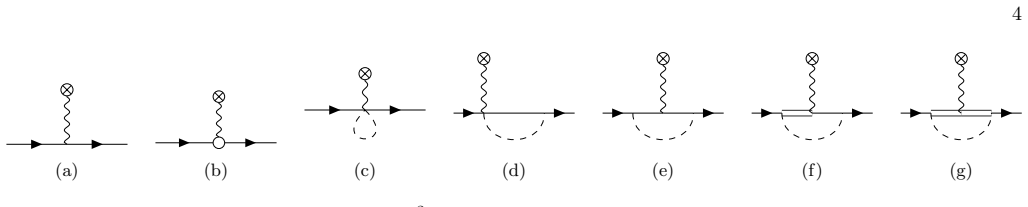
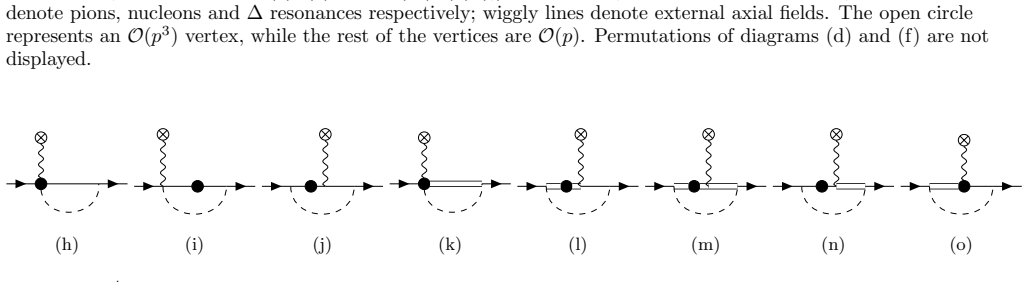
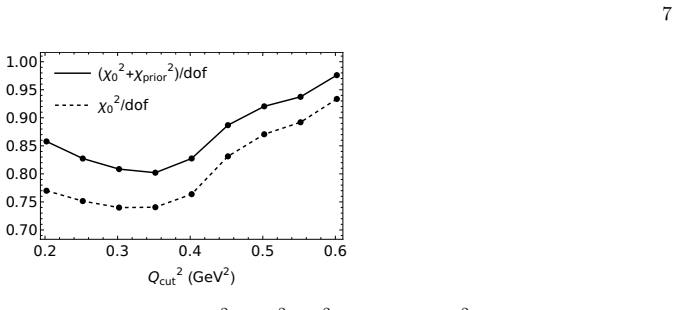
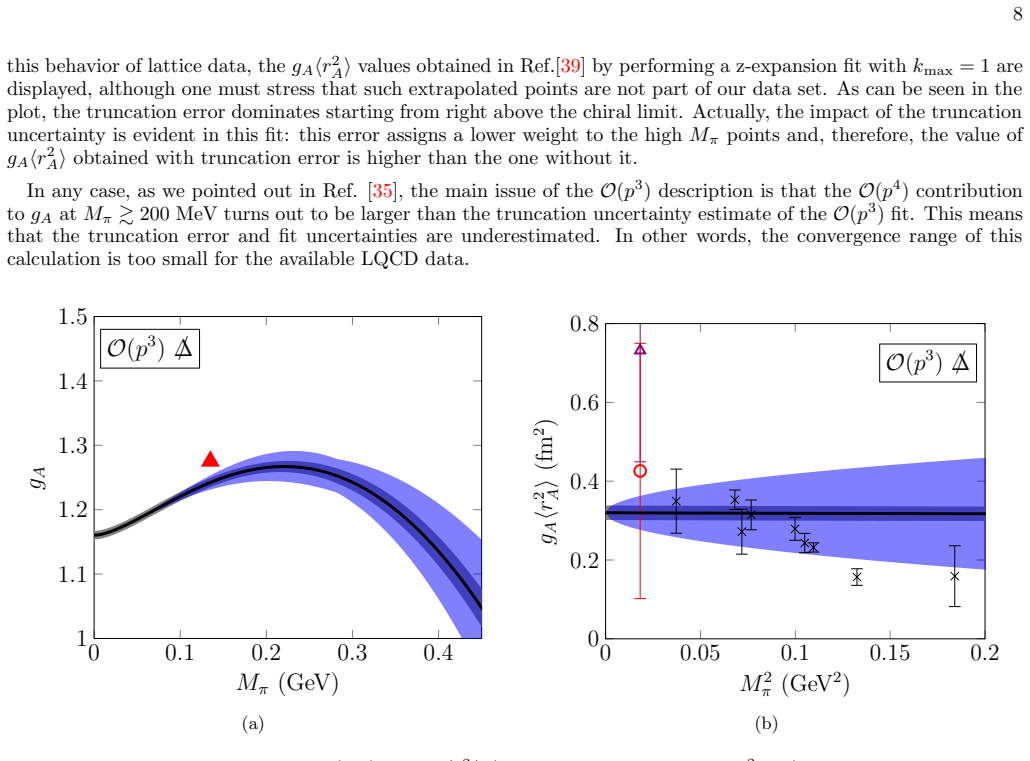
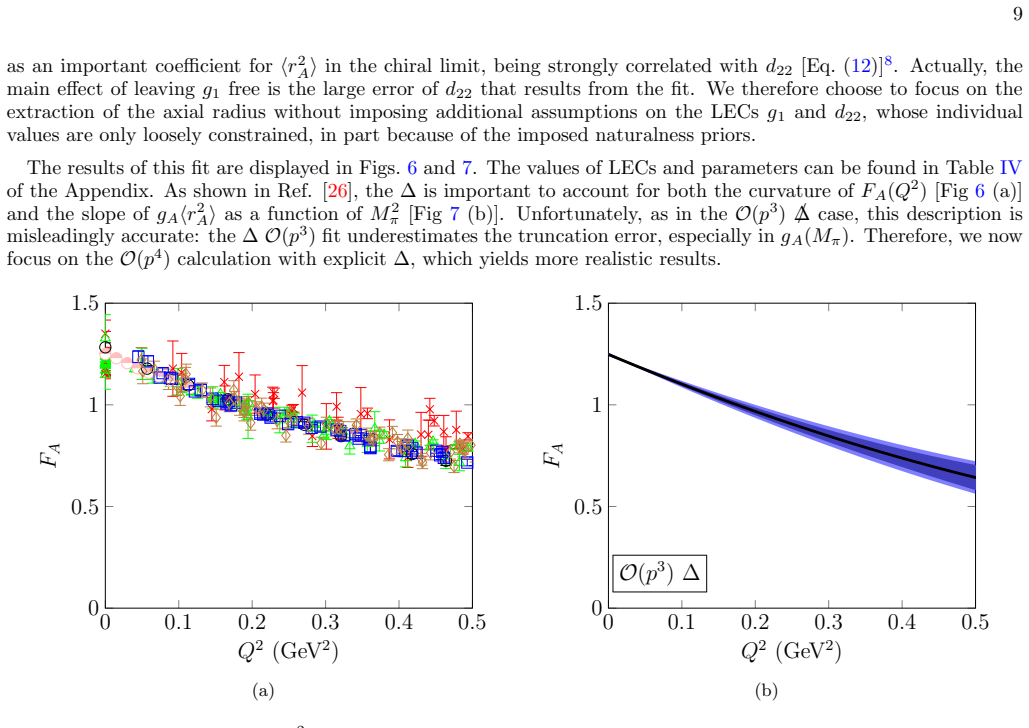
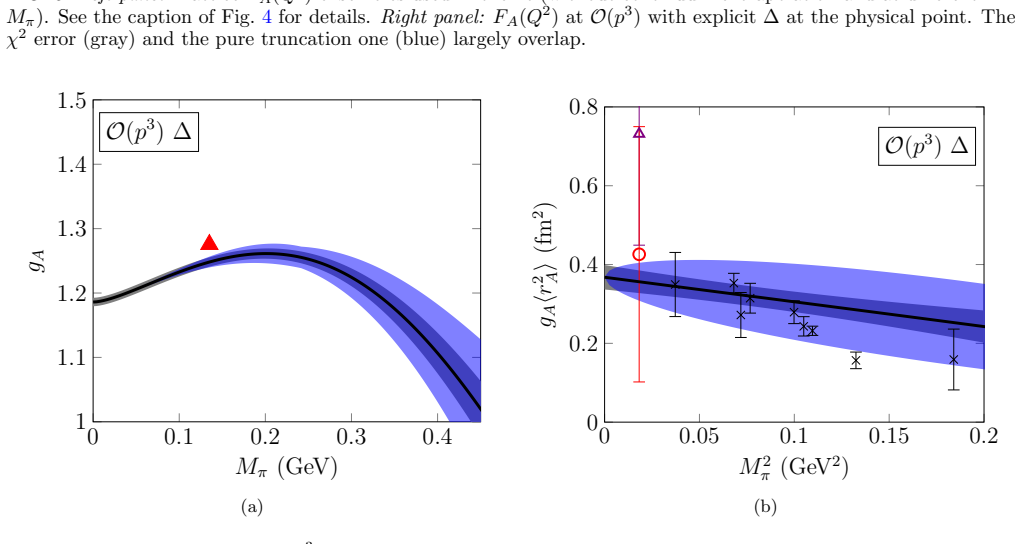
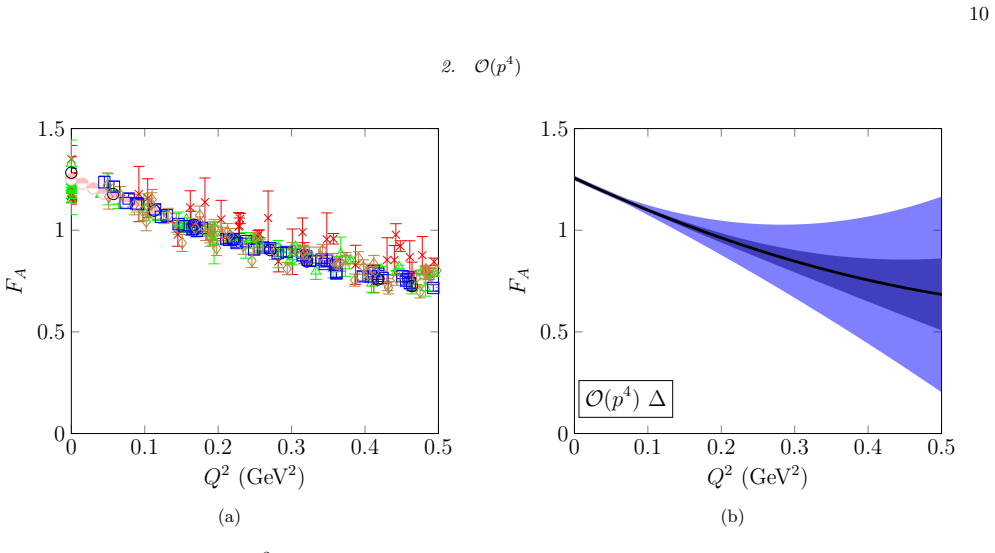
The nucleon axial form factor is calculated in relativistic chiral perturbation theory with Δ(1232) up to NNLO. Relevant low-energy constants are determined by fitting to recent lattice-QCD results at several pion masses, while accounting for the uncertainty associated with the truncation of the chiral expansion. We obtain a good description of the lattice data for momentum transfers up to √Q² ≃ 0.6 GeV and pion masses up to M_π ≃ 400 MeV. We find that the explicit inclusion of the Delta resonance is required to reproduce the lattice-QCD pion-mass dependence of the axial charge and axial radius, as well as the momentum dependence of the form factor. At the physical point we obtain g_A = 1.25
What carries the argument
relativistic chiral perturbation theory with explicit Δ(1232) resonance up to next-to-next-to-leading order (NNLO), with low-energy constants fitted to lattice QCD data while estimating truncation uncertainty
If this is right
- The axial form factor is accurately described for momentum transfers up to √Q² ≃ 0.6 GeV and pion masses up to M_π ≃ 400 MeV.
- Explicit inclusion of the Delta resonance is required to reproduce the pion-mass dependence of the axial charge and axial radius.
- The parametrization enables systematic extrapolation of lattice-QCD results to the physical point.
- It supplies a framework for improving predictions of low-energy weak interactions involving nucleons.
Where Pith is reading between the lines
- The extrapolated form factor could be inserted into calculations of neutrino-nucleon scattering rates at low energies.
- Future lattice simulations performed near the physical pion mass could directly test whether the NNLO extrapolation holds within the quoted errors.
- The same fitting procedure could be applied to other nucleon form factors, such as the electromagnetic ones, using analogous lattice data sets.
Load-bearing premise
The NNLO truncation of the chiral expansion with its estimated uncertainty is sufficient to describe the lattice data across the simulated pion-mass range and permits reliable extrapolation to the physical point when the Delta resonance is included explicitly.
What would settle it
A lattice QCD calculation performed directly at the physical pion mass that finds the axial form factor differing from the extrapolated Q² dependence by more than the stated uncertainties would falsify the NNLO fit and extrapolation.
Figures
read the original abstract
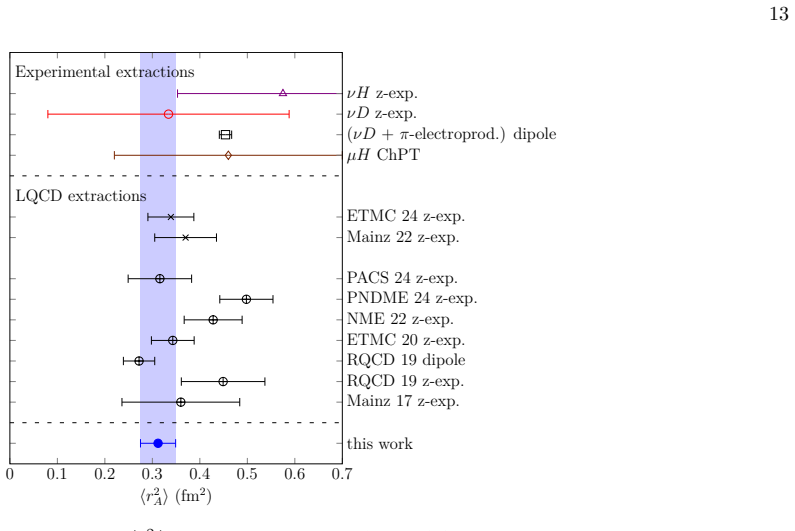
We calculate the nucleon axial form factor in relativistic chiral perturbation theory with $\Delta(1232)$ up to next-to-next-to-leading order (NNLO). Relevant low-energy constants are determined by fitting to recent lattice-QCD results at several pion masses, while accounting for the uncertainty associated with the truncation of the chiral expansion. We obtain a good description of the lattice data for momentum transfers up to $\sqrt{Q^2}\simeq0.6$ GeV and pion masses up to $M_\pi\simeq400$ MeV. We find that the explicit inclusion of the $\Delta$ resonance is required to reproduce the lattice-QCD pion-mass dependence of the axial charge and axial radius, as well as the momentum dependence of the form factor. At the physical point we obtain $g_A=1.257\pm 0.011$ and $\langle r_A^2\rangle=0.312\pm0.037~\mathrm{fm}^2$. Our analysis provides a model-independent and systematically improvable parametrization of the pion-mass and momentum dependence of the axial form factor, offering a framework for extrapolating lattice-QCD results to the physical point and for improving predictions of low-energy weak interactions involving nucleons.
Editorial analysis
A structured set of objections, weighed in public.
Referee Report
Summary. The manuscript calculates the nucleon axial form factor in relativistic baryon chiral perturbation theory including explicit Δ(1232) degrees of freedom up to NNLO. Low-energy constants are fitted to lattice QCD data at pion masses up to ≈400 MeV and momentum transfers up to √Q²≈0.6 GeV, incorporating an estimate of chiral truncation uncertainty. The analysis concludes that explicit inclusion of the Δ is required to reproduce the pion-mass dependence of g_A and the axial radius as well as the Q² dependence. At the physical point the results are g_A=1.257±0.011 and ⟨r_A²⟩=0.312±0.037 fm². The work claims to deliver a model-independent and systematically improvable parametrization of the pion-mass and momentum dependence of the axial form factor.
Significance. If the NNLO truncation with its estimated uncertainty is controlled across the simulated range and the extrapolation step, the framework supplies a systematically improvable route from unphysical-mass lattice data to physical predictions for the axial form factor, which is relevant for neutrino-nucleus scattering and low-energy weak processes. The explicit Δ treatment and the attempt to quantify truncation error are strengths relative to lower-order or resonance-less approaches. The reported physical-point values would then serve as useful benchmarks provided convergence is demonstrated.
major comments (2)
- [results and truncation-error estimation (around the discussion of physical-point values)] The central claim that the NNLO ChPT+Δ expansion plus truncation-error estimate permits reliable extrapolation to the physical point rests on the assumption that the expansion remains controlled up to M_π≈400 MeV. The manuscript does not show the size of the NNLO corrections relative to NLO for g_A(M_π) or the form factor (e.g., in the results section or associated figures), nor does it provide an N³LO estimate or convergence plot that would confirm the quoted ±0.011 and ±0.037 uncertainties encompass possible higher-order shifts. This directly affects the support for the headline physical-point numbers.
- [discussion of Δ necessity (near the pion-mass dependence analysis)] The statement that “the explicit inclusion of the Δ resonance is required” is demonstrated only within the NNLO framework by comparing fits with and without Δ. A comparison with a Δ-less calculation pushed to N³LO (or an assessment of whether the Δ effects can be absorbed into LECs at higher order) is absent; without it the necessity claim remains internal to the chosen truncation and is load-bearing for the interpretation of the pion-mass dependence.
minor comments (2)
- [methods] The notation for the axial form factor and the precise definition of the truncation-error prescription should be stated explicitly in the methods section rather than referenced only to prior work.
- [figures] Figure captions should include the range of Q² and M_π shown and indicate which data points are included in the fit versus validation.
Simulated Author's Rebuttal
We thank the referee for the careful reading and constructive comments. We address each major point below and indicate where revisions will be made to improve the manuscript.
read point-by-point responses
-
Referee: [results and truncation-error estimation (around the discussion of physical-point values)] The central claim that the NNLO ChPT+Δ expansion plus truncation-error estimate permits reliable extrapolation to the physical point rests on the assumption that the expansion remains controlled up to M_π≈400 MeV. The manuscript does not show the size of the NNLO corrections relative to NLO for g_A(M_π) or the form factor (e.g., in the results section or associated figures), nor does it provide an N³LO estimate or convergence plot that would confirm the quoted ±0.011 and ±0.037 uncertainties encompass possible higher-order shifts. This directly affects the support for the headline physical-point numbers.
Authors: We agree that explicit visualization of the chiral convergence would strengthen the support for the physical-point results. In the revised manuscript we will add a new figure (or extended discussion in Sec. IV) that displays the separate NLO and NNLO contributions to g_A(M_π) and ⟨r_A²⟩(M_π) at the simulated pion masses, together with the corresponding breakdown for the Q² dependence at representative points. We will also clarify in the text how the existing Bayesian truncation-error estimate already incorporates an assessment of possible higher-order shifts, and we will relate this estimate directly to the quoted uncertainties on the extrapolated values. revision: yes
-
Referee: [discussion of Δ necessity (near the pion-mass dependence analysis)] The statement that “the explicit inclusion of the Δ resonance is required” is demonstrated only within the NNLO framework by comparing fits with and without Δ. A comparison with a Δ-less calculation pushed to N³LO (or an assessment of whether the Δ effects can be absorbed into LECs at higher order) is absent; without it the necessity claim remains internal to the chosen truncation and is load-bearing for the interpretation of the pion-mass dependence.
Authors: The necessity of the explicit Δ is established by direct comparison of NNLO fits performed with and without the resonance, which is the order at which the present analysis is carried out. While a complete Δ-less N³LO calculation would provide an independent test, such a computation constitutes a separate, resource-intensive project that lies outside the scope of this work. We will add a brief clarifying sentence in the discussion section noting that the necessity statement is made within the NNLO truncation and that higher-order studies could further examine whether Δ effects can be absorbed into LECs. revision: partial
- A direct comparison with a Δ-less calculation performed at N³LO cannot be provided within the present manuscript, as it would require an independent and extensive new computation.
Circularity Check
No circularity: standard ChPT fit to external lattice data followed by extrapolation
full rationale
The paper determines LECs by fitting the NNLO relativistic ChPT+Δ expressions to lattice QCD results at unphysical M_π and Q², then evaluates the same expressions at the physical point. This is a conventional extrapolation procedure using independent external data as input; the physical-point values (g_A and ⟨r_A²⟩) are not part of the fitted dataset and do not reduce to the inputs by construction. No self-citation load-bearing steps, no self-definitional relations, and no renaming of known results are present. The analysis is self-contained against the cited lattice benchmarks.
Axiom & Free-Parameter Ledger
free parameters (1)
- low-energy constants
axioms (2)
- domain assumption Standard relativistic baryon ChPT power counting truncated at NNLO with estimated truncation uncertainty
- domain assumption Lattice QCD results at unphysical pion masses accurately represent the underlying theory in the simulated regime
Reference graph
Works this paper leans on
-
[1]
This collection of data points is plotted in Fig
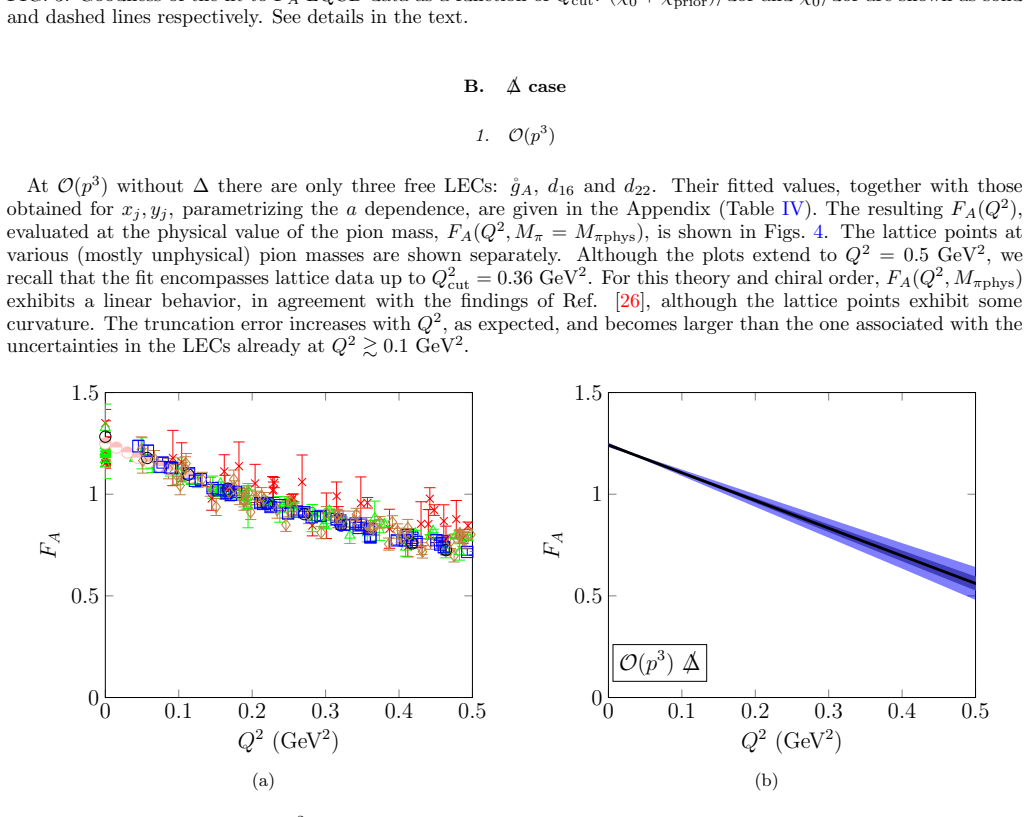
6, PNDME [40], PACS [41] and ETMC [42] (PACS and ETMC provide results only at the physical point). This collection of data points is plotted in Fig. 4(a) as a function ofQ 2. The choice of range inQ 2 andM π is addressed below. The data we fit have not been extrapolated inQ 2,M π or to the continuum. Furthermore, we restrict ourselves to large ensembles, ...
-
[2]
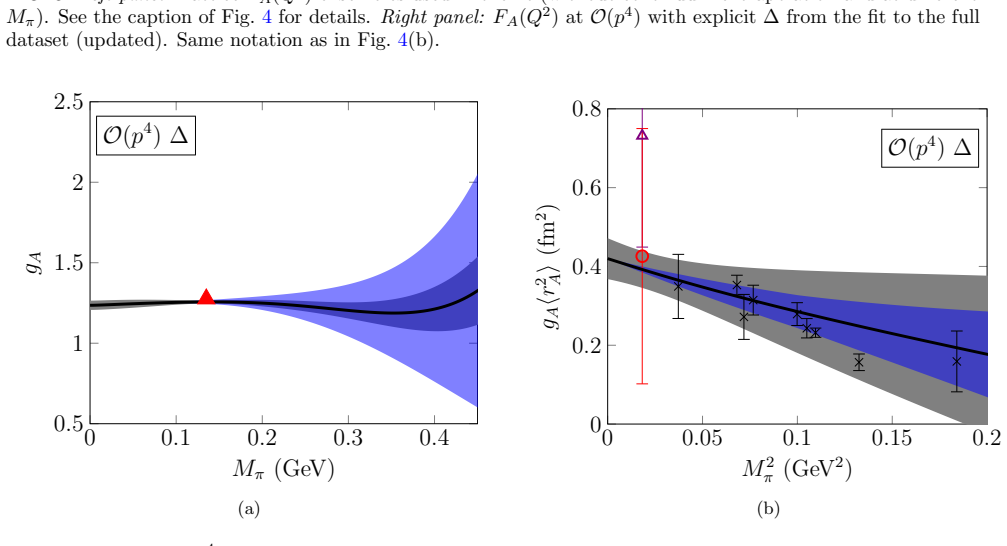
9(a)], theO(p 4) contribution significantly impacts the axial charge
As can be seen from theM π dependence ofg A [Fig. 9(a)], theO(p 4) contribution significantly impacts the axial charge. Hence,O(p 5), including two-loop contributions, would be required to achieve a full convergence [52], particularly if one is interested in describingg A at relatively largeM π. This is relevant for the extraction ofd 16 LEC (see the disc...
-
[3]
8 (b)] displays an increase of the truncation error withQ 2, indicating that the next order can be important to describe the form factor at p Q2 ≳600 MeV
The plot ofF A(Q2, Mπphys) [Fig. 8 (b)] displays an increase of the truncation error withQ 2, indicating that the next order can be important to describe the form factor at p Q2 ≳600 MeV. Nevertheless, the relative uncertainty introduced by the truncation is significantly smaller for theQ 2 dependence of the FF atM phys π compared to theM π dependence ofF...
2019
-
[4]
L. Alvarez-Rusoet al.(NuSTEC), NuSTEC White Paper: Status and challenges of neutrino–nucleus scattering, Prog. Part. Nucl. Phys.100, 1 (2018), arXiv:1706.03621 [hep-ph]
Pith/arXiv arXiv 2018
-
[5]
Nambu and E
Y. Nambu and E. Shrauner, Soft pion emission induced by electromagnetic and weak interactions, Phys. Rev.128, 862 (1962)
1962
-
[6]
V. Bernard, L. Elouadrhiri, and U.-G. Meissner, Axial structure of the nucleon: Topical Review, J. Phys. G28, R1 (2002), arXiv:hep-ph/0107088
Pith/arXiv arXiv 2002
-
[7]
Bernard, N
V. Bernard, N. Kaiser, and U. G. Meissner, Measuring the axial radius of the nucleon in pion electroproduction, Phys. Rev. Lett.69, 1877 (1992)
1992
-
[8]
A. Bodek, S. Avvakumov, R. Bradford, and H. S. Budd, Vector and Axial Nucleon Form Factors:A Duality Constrained Parameterization, Eur. Phys. J. C53, 349 (2008), arXiv:0708.1946 [hep-ex]
Pith/arXiv arXiv 2008
-
[9]
A. S. Meyer, M. Betancourt, R. Gran, and R. J. Hill, Deuterium target data for precision neutrino-nucleus cross sections, Phys. Rev. D93, 113015 (2016), arXiv:1603.03048 [hep-ph]
Pith/arXiv arXiv 2016
-
[10]
Caiet al.(MINERvA), Measurement of the axial vector form factor from antineutrino–proton scattering, Nature614, 48 (2023)
T. Caiet al.(MINERvA), Measurement of the axial vector form factor from antineutrino–proton scattering, Nature614, 48 (2023)
2023
-
[11]
R. J. Hill, P. Kammel, W. J. Marciano, and A. Sirlin, Nucleon Axial Radius and Muonic Hydrogen — A New Analysis and Review, Rept. Prog. Phys.81, 096301 (2018), arXiv:1708.08462 [hep-ph]. 16
Pith/arXiv arXiv 2018
-
[12]
A. S. Meyeret al.(MINERvA), The Nucleon Axial Form Factor from Elementary Target Data (2025), arXiv:2512.14097 [hep-ex]
arXiv 2025
-
[13]
L. Alvarez-Ruso, K. M. Graczyk, and E. Saul-Sala, Nucleon axial form factor from a Bayesian neural-network analysis of neutrino-scattering data, Phys. Rev. C99, 025204 (2019), arXiv:1805.00905 [hep-ph]
Pith/arXiv arXiv 2019
-
[14]
Y. Aokiet al.(Flavour Lattice Averaging Group (FLAG)), FLAG Review 2024 (2024), arXiv:2411.04268 [hep-lat]
Pith/arXiv arXiv 2024
-
[15]
Gasser and H
J. Gasser and H. Leutwyler, Chiral Perturbation Theory to One Loop, Annals Phys.158, 142 (1984)
1984
-
[16]
Gasser, M
J. Gasser, M. E. Sainio, and A. Svarc, Nucleons with chiral loops, Nucl. Phys. B307, 779 (1988)
1988
-
[17]
S. R. Beane and M. J. Savage, Nucleon properties at finite lattice spacing in chiral perturbation theory, Phys. Rev. D68, 114502 (2003), arXiv:hep-lat/0306036
Pith/arXiv arXiv 2003
-
[18]
S. R. Beane and M. J. Savage, Baryon axial charge in a finite volume, Phys. Rev. D70, 074029 (2004), arXiv:hep- ph/0404131
arXiv 2004
-
[19]
Z. B. Hallet al., Signs of nonmonotonic finite-volume corrections to gA, Phys. Rev. C113, 055206 (2026), arXiv:2503.09891 [hep-lat]
arXiv 2026
-
[20]
F. Hermsen, T. Isken, M. F. M. Lutz, and R. G. E. Timmermans, The axial-vector form factor of the nucleon in a finite box (2025), arXiv:2504.11902 [hep-lat]
arXiv 2025
-
[21]
F. Hermsen, M. F. M. Lutz, and R. G. E. Timmermans, Decomposition of the axial-vector current in a finite box (2026), arXiv:2606.02243 [hep-lat]
Pith/arXiv arXiv 2026
-
[22]
B. C. Tiburzi, Time Dependence of Nucleon Correlation Functions in Chiral Perturbation Theory, Phys. Rev. D80, 014002 (2009), arXiv:0901.0657 [hep-lat]
Pith/arXiv arXiv 2009
-
[23]
Bar, Chiral perturbation theory and nucleon–pion-state contaminations in lattice QCD, Int
O. Bar, Chiral perturbation theory and nucleon–pion-state contaminations in lattice QCD, Int. J. Mod. Phys. A32, 1730011 (2017), arXiv:1705.02806 [hep-lat]
Pith/arXiv arXiv 2017
-
[24]
G. S. Bali, L. Barca, S. Collins, M. Gruber, M. L¨ offler, A. Sch¨ afer, W. S¨ oldner, P. Wein, S. Weish¨ aupl, and T. Wurm (RQCD), Nucleon axial structure from lattice QCD, JHEP05, 126, arXiv:1911.13150 [hep-lat]
arXiv 1911
-
[25]
J.-M. Chen, Z.-R. Liang, and D.-L. Yao, Low-energy elastic (anti)neutrino–nucleon scattering in covariant baryon chiral perturbation theory, Front. Phys. (Beijing)19, 64202 (2024), arXiv:2403.17743 [hep-ph]
arXiv 2024
-
[26]
T. Fuchs, J. Gegelia, G. Japaridze, and S. Scherer, Renormalization of relativistic baryon chiral perturbation theory and power counting, Phys. Rev. D68, 056005 (2003), arXiv:hep-ph/0302117
Pith/arXiv arXiv 2003
-
[27]
T. R. Hemmert, B. R. Holstein, and J. Kambor, Systematic 1/M expansion for spin 3/2 particles in baryon chiral pertur- bation theory, Phys. Lett. B395, 89 (1997), arXiv:hep-ph/9606456
Pith/arXiv arXiv 1997
-
[28]
T. R. Hemmert, B. R. Holstein, and J. Kambor, Chiral Lagrangians and delta(1232) interactions: Formalism, J. Phys. G 24, 1831 (1998), arXiv:hep-ph/9712496
Pith/arXiv arXiv 1998
-
[29]
D.-L. Yao, L. Alvarez-Ruso, and M. J. Vicente-Vacas, Extraction of nucleon axial charge and radius from lattice QCD results using baryon chiral perturbation theory, Phys. Rev. D96, 116022 (2017), arXiv:1708.08776 [hep-ph]
Pith/arXiv arXiv 2017
-
[30]
N. Fettes, U.-G. Meissner, M. Mojzis, and S. Steininger, The Chiral effective pion nucleon Lagrangian of order p**4, Annals Phys.283, 273 (2000), [Erratum: Annals Phys. 288, 249–250 (2001)], arXiv:hep-ph/0001308
Pith/arXiv arXiv 2000
-
[31]
S.-Z. Jiang, Y.-R. Liu, and H.-Q. Wang, Chiral Lagrangians with ∆(1232) to one loop, Phys. Rev. D97, 014002 (2018), arXiv:1707.09690 [hep-ph]
Pith/arXiv arXiv 2018
-
[32]
M. Holmberg and S. Leupold, The relativistic chiral Lagrangian for decuplet and octet baryons at next-to-leading order, Eur. Phys. J. A54, 103 (2018), arXiv:1802.05168 [hep-ph]
Pith/arXiv arXiv 2018
- [33]
-
[34]
C. Hacker, N. Wies, J. Gegelia, and S. Scherer, Including the Delta(1232) resonance in baryon chiral perturbation theory, Phys. Rev. C72, 055203 (2005), arXiv:hep-ph/0505043
Pith/arXiv arXiv 2005
-
[35]
D. Siemens, Elastic pion-nucleon scattering in chiral perturbation theory: Explicit ∆(1232) degrees of freedom, (2020), arXiv:2001.03906 [nucl-th]
arXiv 2020
-
[36]
S.-i. Ando and H. W. Fearing, Ordinary muon capture on a proton in manifestly Lorentz invariant baryon chiral perturbation theory, Phys. Rev. D75, 014025 (2007), arXiv:hep-ph/0608195
Pith/arXiv arXiv 2007
-
[37]
M. F. M. Lutz, U. Sauerwein, and R. G. E. Timmermans, On the axial-vector form factor of the nucleon and chiral symmetry, Eur. Phys. J. C80, 844 (2020), arXiv:2003.10158 [hep-lat]
arXiv 2020
-
[38]
F. Alvarado and L. Alvarez-Ruso, Light-quark mass dependence of the nucleon axial charge and pion-nucleon scattering phenomenology, Phys. Rev. D105, 074001 (2022), arXiv:2112.14076 [hep-ph]
arXiv 2022
-
[39]
D.-L. Yao, D. Siemens, V. Bernard, E. Epelbaum, A. M. Gasparyan, J. Gegelia, H. Krebs, and U.-G. Meißner, Pion-nucleon scattering in covariant baryon chiral perturbation theory with explicit Delta resonances, JHEP05, 038, arXiv:1603.03638 [hep-ph]
-
[40]
X.-L. Ren, L. Alvarez-Ruso, L.-S. Geng, T. Ledwig, J. Meng, and M. J. Vicente Vacas, Consistency between SU(3) and SU(2) covariant baryon chiral perturbation theory for the nucleon mass, Phys. Lett. B766, 325 (2017), arXiv:1606.03820 [nucl-th]
Pith/arXiv arXiv 2017
-
[41]
S. Park, R. Gupta, B. Yoon, S. Mondal, T. Bhattacharya, Y.-C. Jang, B. Jo´ o, and F. Winter (Nucleon Matrix Elements (NME)), Precision nucleon charges and form factors using (2+1)-flavor lattice QCD, Phys. Rev. D105, 054505 (2022), arXiv:2103.05599 [hep-lat]
arXiv 2022
-
[42]
S. Capitani, M. Della Morte, D. Djukanovic, G. M. von Hippel, J. Hua, B. J¨ ager, P. M. Junnarkar, H. B. Meyer, T. D. Rae, and H. Wittig, Isovector axial form factors of the nucleon in two-flavor lattice QCD, Int. J. Mod. Phys. A34, 1950009 (2019), arXiv:1705.06186 [hep-lat]. 17
Pith/arXiv arXiv 2019
-
[43]
Y.-C. Jang, R. Gupta, T. Bhattacharya, B. Yoon, and H.-W. Lin (Precision Neutron Decay Matrix Elements (PNDME)), Nucleon isovector axial form factors, Phys. Rev. D109, 014503 (2024), arXiv:2305.11330 [hep-lat]
arXiv 2024
-
[44]
R. Tsuji, Y. Aoki, K.-I. Ishikawa, Y. Kuramashi, S. Sasaki, K. Sato, E. Shintani, H. Watanabe, and T. Yamazaki (PACS), Nucleon form factors in Nf=2+1 lattice QCD at the physical point: Finite lattice spacing effect on the root-mean-square radii, Phys. Rev. D109, 094505 (2024), arXiv:2311.10345 [hep-lat]
arXiv 2024
-
[45]
C. Alexandrouet al., Nucleon axial and pseudoscalar form factors from lattice QCD at the physical point, Phys. Rev. D 103, 034509 (2021), arXiv:2011.13342 [hep-lat]
arXiv 2021
-
[46]
S. Wesolowski, N. Klco, R. J. Furnstahl, D. R. Phillips, and A. Thapaliya, Bayesian parameter estimation for effective field theories, J. Phys. G43, 074001 (2016), arXiv:1511.03618 [nucl-th]
Pith/arXiv arXiv 2016
-
[47]
Manohar and H
A. Manohar and H. Georgi, Chiral Quarks and the Nonrelativistic Quark Model, Nucl. Phys. B234, 189 (1984)
1984
-
[48]
Scherer and M
S. Scherer and M. R. Schindler,A Primer for Chiral Perturbation Theory, Vol. 830 (2012)
2012
-
[49]
E. Epelbaum, H. Krebs, and U. G. Meißner, Improved chiral nucleon-nucleon potential up to next-to-next-to-next-to-leading order, Eur. Phys. J. A51, 53 (2015), arXiv:1412.0142 [nucl-th]
Pith/arXiv arXiv 2015
-
[50]
D. Siemens, V. Bernard, E. Epelbaum, A. Gasparyan, H. Krebs, and U.-G. Meißner, Elastic pion-nucleon scattering in chiral perturbation theory: A fresh look, Phys. Rev. C94, 014620 (2016), arXiv:1602.02640 [nucl-th]
Pith/arXiv arXiv 2016
-
[51]
M. Gorchtein and C.-Y. Seng, Dispersion relation analysis of the radiative corrections tog A in the neutronβ-decay, JHEP 10, 053, arXiv:2106.09185 [hep-ph]
-
[52]
D. Siemens, V. Bernard, E. Epelbaum, A. M. Gasparyan, H. Krebs, and U.-G. Meißner, Elastic and inelastic pion-nucleon scattering to fourth order in chiral perturbation theory, Phys. Rev. C96, 055205 (2017), arXiv:1704.08988 [nucl-th]
arXiv 2017
-
[53]
V. Pascalutsa and M. Vanderhaeghen, The Nucleon and delta-resonance masses in relativistic chiral effective-field theory, Phys. Lett. B636, 31 (2006), arXiv:hep-ph/0511261
Pith/arXiv arXiv 2006
-
[54]
L. Alvarez-Ruso, T. Ledwig, J. Martin Camalich, and M. J. Vicente-Vacas, Nucleon mass and pion-nucleon sigma term from a chiral analysis of lattice QCD data, Phys. Rev. D88, 054507 (2013), arXiv:1304.0483 [hep-ph]
Pith/arXiv arXiv 2013
-
[55]
V. Bernard, J. Gegelia, S. Ghosh, and U.-G. Meißner, Calculation of the axial-vector coupling constant gA to two loops in covariant chiral perturbation theory, Phys. Lett. B868, 139637 (2025), arXiv:2505.05941 [hep-ph]
arXiv 2025
-
[56]
G. H. Guerrero Navarro and M. J. Vicente Vacas, Threshold pion electro- and photoproduction off nucleons in covariant chiral perturbation theory, Phys. Rev. D102, 113016 (2020), arXiv:2008.04244 [hep-ph]
arXiv 2020
-
[57]
V. Cirigliano, J. de Vries, L. Hayen, E. Mereghetti, and A. Walker-Loud, Pion-Induced Radiative Corrections to Neutron βDecay, Phys. Rev. Lett.129, 121801 (2022), arXiv:2202.10439 [nucl-th]
arXiv 2022
-
[58]
M. Goharipour, F. Irani, M. H. Amiri, H. Fatehi, B. Falahi, A. Moradi, and K. Azizi (MMGPDs), Can we determine the exact size of the nucleon?: A comprehensive study of different radii, Nucl. Phys. B1017, 116962 (2025), arXiv:2503.08847 [hep-ph]
arXiv 2025
-
[59]
C. Alexandrou, S. Bacchio, M. Constantinou, J. Finkenrath, R. Frezzotti, B. Kostrzewa, G. Koutsou, G. Spanoudes, and C. Urbach (Extended Twisted Mass), Nucleon axial and pseudoscalar form factors using twisted-mass fermion ensembles at the physical point, Phys. Rev. D109, 034503 (2024), arXiv:2309.05774 [hep-lat]
arXiv 2024
-
[60]
D. Djukanovic, G. von Hippel, J. Koponen, H. B. Meyer, K. Ottnad, T. Schulz, and H. Wittig, Isovector axial form factor of the nucleon from lattice QCD, Phys. Rev. D106, 074503 (2022), arXiv:2207.03440 [hep-lat]
arXiv 2022
-
[61]
A. S. Meyer, The Nucleon Axial Form Factor from Averaging Lattice QCD Results (2026), arXiv:2601.02676 [hep-lat]
arXiv 2026
discussion (0)
Sign in with ORCID, Apple, or X to comment. Anyone can read and Pith papers without signing in.