E_infty^(1,2)-type Lieb-Schultz-Mattis anomalies, deconfined quantum critical points, and non-invertible symmetry breaking
Pith reviewed 2026-06-27 23:24 UTC · model grok-4.3
The pith
Gauging an E∞^{1,2}-type LSM anomaly necessarily produces a non-invertible dual symmetry.
A machine-rendered reading of the paper's core claim, the machinery that carries it, and where it could break.
Core claim
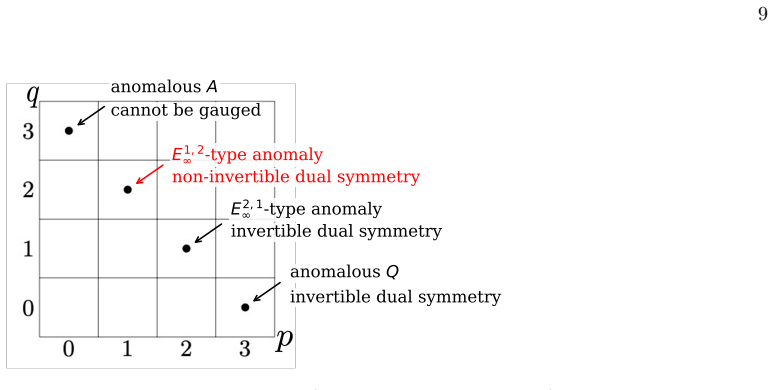
Gauging the internal symmetry in the presence of an E∞^{1,2}-type anomaly necessarily produces a non-invertible dual symmetry. This supplies the general mechanism for type-II DQCP: in contrast to type-I examples with E∞^{2,1}-type anomalies which are dual to ordinary group-like symmetry breaking, type-II transitions are dual to spontaneous breaking of a non-invertible symmetry.
What carries the argument
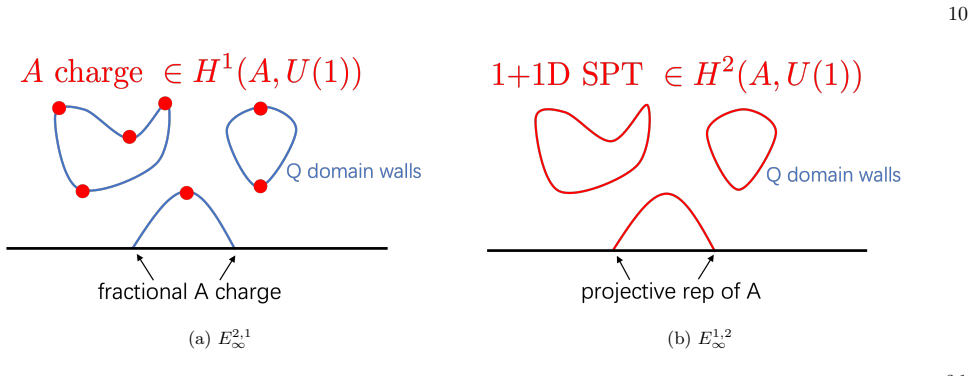
The E∞^{1,2} term of the spectral sequence, equal to H^1(Z_trans, H^2(G_int, U(1))) inside H^3(G_int ⋊_ρ Z_trans, U(1)), which decorates a translation defect with a projective representation of the internal symmetry; the gauging map that converts this anomaly into a non-invertible dual symmetry.
If this is right
- Type-II DQCPs correspond to spontaneous breaking of non-invertible symmetries rather than ordinary symmetries.
- In the D8 example the dual symmetry after gauging is the representation category Rep(H8).
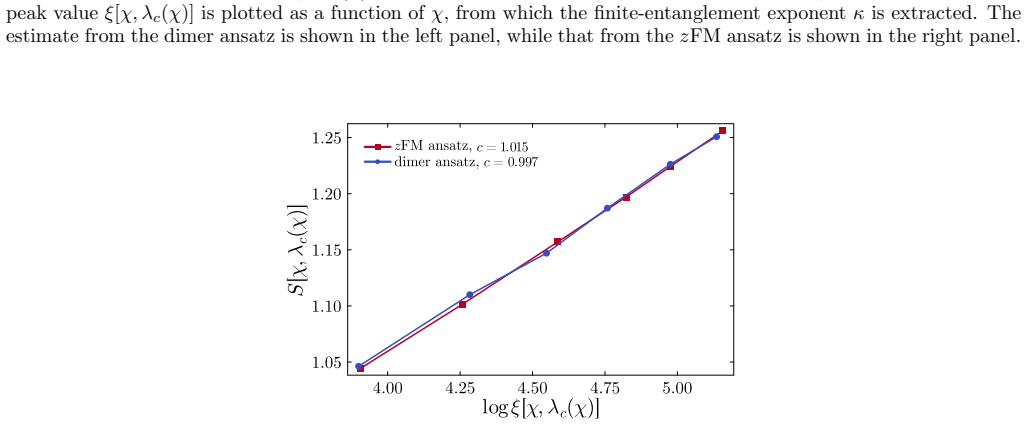
- The critical theory at the dimer-to-ferromagnet point has central charge approximately 1.
- Numerical evidence on the lattice model supports the existence of this critical point.
Where Pith is reading between the lines
- The same spectral-sequence placement may classify non-invertible dualities in models with mixed translation and internal symmetries beyond one dimension.
- Explicit lattice constructions of the non-invertible symmetry could be used to test duality relations in other candidate DQCP models.
- Category-theoretic descriptions of the dual symmetry may connect to classification schemes for topological phases protected by non-invertible symmetries.
Load-bearing premise
That an anomaly placed in the E∞^{1,2} position of the spectral sequence must produce a non-invertible symmetry when the internal symmetry is gauged.
What would settle it
An explicit lattice model or category-theoretic calculation in which an E∞^{1,2}-type LSM anomaly is gauged yet only an invertible (group-like) dual symmetry appears.
Figures
read the original abstract
We study deconfined quantum critical points (DQCP) associated with Lieb-Schultz-Mattis (LSM) anomalies in one-dimensional spin chains. Our starting point is a structural characterization of the LSM anomaly in the Lyndon-Hochschild-Serre spectral sequence: $\omega_{\mathrm{LSM}}\in E_\infty^{1,2}= H^1(\mathbb Z_{\mathrm{trans}},H^2(G_{\mathrm{int}},\mathrm{U}(1)))\subseteq H^3(G_{\mathrm{int}}\rtimes_{\rho}\mathbb Z_{\mathrm{trans}},\mathrm{U}(1))$. Physically, this class decorates a translation defect with a projective representation of the internal symmetry $G_\mathrm{int}$. We show that gauging the internal symmetry in the presence of an $E_\infty^{1,2}$-type anomaly necessarily produces a non-invertible dual symmetry. This gives a general mechanism for type-II DQCP: in contrast to type-I examples with $E_\infty^{2,1}$-type anomalies which are dual to ordinary group-like symmetry breaking, type-II transitions are dual to spontaneous breaking of a non-invertible symmetry. We illustrate the mechanism using a spin-$1/2$ chain with an anomalous $D_8$ LSM symmetry. We construct a dimer-to-ferromagnet DQCP candidate, provide numerical evidence for a critical theory with central charge $c\approx 1$, and show, using both category theory and explicit lattice constructions, that gauging the internal symmetry yields the non-invertible $\mathrm{Rep}(H_8)$ dual symmetry.
Editorial analysis
A structured set of objections, weighed in public.
Referee Report
Summary. The manuscript claims that LSM anomalies classified in the E_∞^{1,2} term of the Lyndon-Hochschild-Serre spectral sequence (ω_LSM ∈ H^1(Z_trans, H^2(G_int, U(1))) ⊆ H^3(G_int ⋊_ρ Z_trans, U(1))) decorate translation defects with projective G_int representations; gauging the internal symmetry in the presence of such an anomaly necessarily produces a non-invertible dual symmetry. This supplies a general mechanism for type-II DQCPs, distinct from type-I cases with E_∞^{2,1} anomalies that are dual to ordinary group-like symmetry breaking. The claim is illustrated by an explicit spin-1/2 chain with anomalous D_8 LSM symmetry, including lattice constructions of a dimer-to-ferromagnet transition, category-theoretic identification of the dual Rep(H_8) symmetry, and numerical evidence for a critical theory with c ≈ 1.
Significance. If the central claims hold, the work supplies a cohomological organizing principle that distinguishes type-I and type-II DQCPs via the anomaly class and directly ties the latter to spontaneous breaking of non-invertible symmetries. Credit is due for the explicit D_8 lattice model, the category-theoretic and lattice constructions of the dual symmetry, and the accompanying numerical data; these elements make the proposed mechanism falsifiable and provide a concrete benchmark for future studies of non-invertible symmetries in one dimension.
major comments (2)
- [§3] §3 (general gauging argument): the assertion that an E_∞^{1,2}-type anomaly 'necessarily' produces a non-invertible dual symmetry upon gauging rests on the defect-decoration interpretation of the class; the manuscript does not supply an explicit general computation of the dual fusion category (or a proof that it cannot be group-like) that is independent of the specific extension class ρ or the choice of G_int, which is load-bearing for the type-II DQCP mechanism.
- [§5.2] §5.2 (D_8 numerical evidence): the reported central charge c ≈ 1 is consistent with a critical theory, but the finite-size scaling analysis of the dimerization order parameter and the correlation-length exponent across the putative transition is not presented in sufficient detail to rule out a conventional (non-deconfined) critical point, weakening support for the DQCP interpretation.
minor comments (2)
- The notation E_∞^{1,2} and the embedding into H^3(G_int ⋊_ρ Z_trans, U(1)) would benefit from a short self-contained reminder of the filtration and convergence properties of the spectral sequence in the introduction.
- Figure captions for the numerical data should explicitly state the system sizes used and the fitting procedure for the central charge extraction.
Simulated Author's Rebuttal
We thank the referee for their thorough review and constructive comments, which help clarify the presentation of our results. We address each major comment below.
read point-by-point responses
-
Referee: [§3] §3 (general gauging argument): the assertion that an E_∞^{1,2}-type anomaly 'necessarily' produces a non-invertible dual symmetry upon gauging rests on the defect-decoration interpretation of the class; the manuscript does not supply an explicit general computation of the dual fusion category (or a proof that it cannot be group-like) that is independent of the specific extension class ρ or the choice of G_int, which is load-bearing for the type-II DQCP mechanism.
Authors: The defect-decoration interpretation follows directly from the definition of the E_∞^{1,2} class in the Lyndon-Hochschild-Serre spectral sequence and is the physical content of the anomaly. This decoration of translation defects by projective G_int representations implies that, after gauging G_int, the dual symmetry must fuse in a manner incompatible with a group-like structure for any choice of ρ and G_int; this is the cohomological distinction from E_∞^{2,1} anomalies. The D_8 example provides an explicit realization, but the argument itself is independent of the specific group because it relies only on the existence of the projective decoration. We will add a clarifying paragraph in §3 making this cohomological obstruction explicit without reference to a particular model. revision: partial
-
Referee: [§5.2] §5.2 (D_8 numerical evidence): the reported central charge c ≈ 1 is consistent with a critical theory, but the finite-size scaling analysis of the dimerization order parameter and the correlation-length exponent across the putative transition is not presented in sufficient detail to rule out a conventional (non-deconfined) critical point, weakening support for the DQCP interpretation.
Authors: We agree that additional finite-size scaling details would strengthen the case for deconfined criticality. In the revised manuscript we will include data-collapse plots for the dimerization order parameter and estimates of the correlation-length exponent obtained from multiple system sizes, allowing a clearer comparison with conventional critical points. revision: yes
Circularity Check
No significant circularity; central claims rest on standard spectral sequence and external category/lattice constructions.
full rationale
The paper takes the E_∞^{1,2} characterization of the LSM anomaly as its starting point via the Lyndon-Hochschild-Serre spectral sequence (a standard tool in group cohomology) and then derives the non-invertible dual symmetry upon gauging. This is illustrated concretely for the D8 case with explicit category-theoretic arguments, lattice constructions, and numerics (c≈1), without any step reducing by definition or self-citation to the target result itself. No fitted inputs renamed as predictions, no self-definitional loops, and no load-bearing uniqueness theorems imported from the authors' own prior work appear in the derivation chain. The result is therefore self-contained against external benchmarks.
Axiom & Free-Parameter Ledger
Reference graph
Works this paper leans on
-
[1]
This gauging is qualitatively different from gaugingZ XY 2
GaugingZ a2 2 : self-dual invertible symmetry We next gauge the central subgroupZ a2 2 ⊂G int, which is generated byU XY UY X = Q i Zi. This gauging is qualitatively different from gaugingZ XY 2 . The subgroup is central and diagonal in the internal symmetry, so the operation is closer to an ordinary Kramers-Wannier relabeling of order and disorder variab...
-
[2]
It can be implemented sequentially by first gauging the diagonal subgroupZ a2 2 and then gauging the remainingZ XY 2 subgroup
Gauging the full internal symmetryZ XY 2 ×Z Y X 2 Gauging the full internal symmetry means gauging the normal Abelian subgroupG int =⟨U XY , UY X ⟩=⟨ax, a 2⟩. It can be implemented sequentially by first gauging the diagonal subgroupZ a2 2 and then gauging the remainingZ XY 2 subgroup. The resulting dual symmetry is Rep(H 8). This sequential implementation...
-
[3]
We now consider the dual Hamilto- nian of Eq
Dual model of the dimer-to-ferromagnet DQCP In the preceding discussion, we derived the lattice gauging procedure in detail. We now consider the dual Hamilto- nian of Eq. 71 after gauging anomaly-free subgroups ofD 8. The dual Hamiltonian is obtained by tracking the gauge image of each local symmetric operator. The advantage of the bond-algebra constructi...
-
[4]
condensable algebras
Fusion-category symmetries and gapped phases LetCbe a fusion category overC. Physically, in a 1+1D systemTwith fusion-category symmetryC, objects of Care topological defect lines, the tensor productX⊗Yis the fusion of two defect lines, and the associator is the F-symbol that tells us how three lines reassociate [57, 60, 61, 63, 64]. A simple object is an ...
-
[5]
To gauge, one chooses a condensable algebraA∈ C, or equivalently the corresponding interface module categoryC A
Gauging algebras and dual symmetries Generalized gauging is a different use of condensable algebras. To gauge, one chooses a condensable algebraA∈ C, or equivalently the corresponding interface module categoryC A. This is operational data, not merely a name for a gapped phase: the network to be summed over is built from the multiplication and unit ofA. Ph...
-
[6]
Its simple objects are labeled by elementsg∈G, and they fuse by group multiplication,g⊗h=gh
Algebras inVec ω G The basic pointed example is Vec ω G. Its simple objects are labeled by elementsg∈G, and they fuse by group multiplication,g⊗h=gh. The associator is multiplication by a normalized 3-cocycleω(g, h, k). Thus Vec G describes an ordinary non-anomalousGsymmetry, while Vec ω G describes aGsymmetry with ’t Hooft anomaly [ω]∈H 3(G,U(1)), as for...
-
[7]
For a chosen condensable algebraA∈ C, after gaugingA, the new system, denoted by T/A, has fusion-category symmetry ACA
Gapped phases under gauging LetCbe a fusion category. For a chosen condensable algebraA∈ C, after gaugingA, the new system, denoted by T/A, has fusion-category symmetry ACA. Categorically, the Morita context defined by the interfaceC A gives a corre- spondence between indecomposable module categories ofCand those of ACA. Physically, this is the correspond...
-
[8]
Similar discussions can be found in [81]
Composing gaugings We use the Brauer-Picard groupoid to mathematically describe the composition of generalized gaugings. Similar discussions can be found in [81]. Here, we discuss the autoequivalences more precisely. For a 1+1D systemTwith a fusion category symmetryC, gauging a condensable algebraA∈ Cyields a new systemT/Awith fusion category symmetry ACA...
-
[9]
Computing group-theoretical categories The simple objects in a group-theoretical fusion category can be represented in the following way: Proposition A.4.[66] LetA= (H 1, γ1), B= (H 2, γ2)∈Vec ω G be two algebras. The simple objects ofA-Bbimodule A(Vecω G)B are classified by the pairs(Z, π), whereZis aH 1-H2 double coset inG, andπis an irreducible project...
-
[10]
The associated 2+1D SPT phases, and hence their 1+1D boundary anomalies, are classified byH 3(Za 2 ×Z b 2 ×Z c 2,U(1)) =Z 7
-
[11]
Among the seven generators, three type-I cocycles are associated with the individualZ 2 factors, three type-II cocycles are associated with pairs ofZ 2 factors, and the remaining generator is the type-III cocycle involving all threeZ 2 factors. We choose the representative ωIII 3 (g, h, k) = (−1)gahbkc ,∀g, h, k∈Z a 2 ×Z b 2 ×Z c 2.(B1) The important poin...
-
[12]
On the 1+1D boundary, this decoration implies that exchanging aZ b 2 domain wall with aZ c 2 domain wall creates aZ a 2 charge
FromE 2,1 ∞ decomposition to type-I DQCP We first choose the rank-one normal subgroupA=Z a 2 and quotientQ=G/A=Z b 2 ×Z c 2, giving the short exact sequence 1→Z a 2 →Z a 2 ×Z b 2 ×Z c 2 →Z b 2 ×Z c 2 →1.(B2) In the corresponding LHS spectral sequence Ep,q 2 =H p(Zb 2 ×Z c 2, Hq(Za 2,U(1)))⇒H p+q(Za 2 ×Z b 2 ×Z c 2,U(1)),(B3) the type-III cocycle contribut...
-
[13]
FromE 1,2 ∞ decomposition to type-II DQCP We now choose the rank-two normal subgroupA=Z a 2 ×Z b 2 and quotientQ=G/A=Z c 2, giving the short exact sequence 1→Z a 2 ×Z b 2 →Z a 2 ×Z b 2 ×Z c 2 →Z c 2 →1.(B5) This choice is the one most directly adapted to the lattice construction below. In the corresponding LHS spectral sequence Ep,q 2 =H p(Zc 2, Hq(Za 2 ×...
-
[14]
A candidate type-II DQCP We start from the boundary-action formula withω 3 =ω III 3 . In the group-variable basis|{g i}⟩, the anomalous actions of the generatorsa,b, andcofZ a 2 ×Z b 2 ×Z c 2 are Ua|{gi}⟩= Y ⟨ij⟩ ωsij 3 (g−1 i gj, g−1 j , a)|{gi +a}⟩=|{g i +a}⟩,(B8) Ub|{gi}⟩= Y ⟨ij⟩ ωsij 3 (g−1 i gj, g−1 j , b)|{gi +b}⟩=|{g i +b}⟩,(B9) Uc|{gi}⟩= Y ⟨ij⟩ ωs...
-
[15]
Gauging theZ a 2 symmetry maps thisZ a 2 ×Z b 2 →Z c 2 ⊆Z 3 2 DQCP to aZ x 2 →Z ax 2 ×Z a3x 2 ⊆D 8 critical point
As a result, the proliferation ofZ c 2 domain walls also proliferatesZ a 2 ×Z b 2 projective representations, which necessarily breakZ a 2 ×Z b 2 symmetry and can drive a DQCP. Gauging theZ a 2 symmetry maps thisZ a 2 ×Z b 2 →Z c 2 ⊆Z 3 2 DQCP to aZ x 2 →Z ax 2 ×Z a3x 2 ⊆D 8 critical point. Gauging the dualD 8 symmetry then maps the transition further to ...
-
[16]
(B24) realizes a continuous transition rather than a first-order level crossing
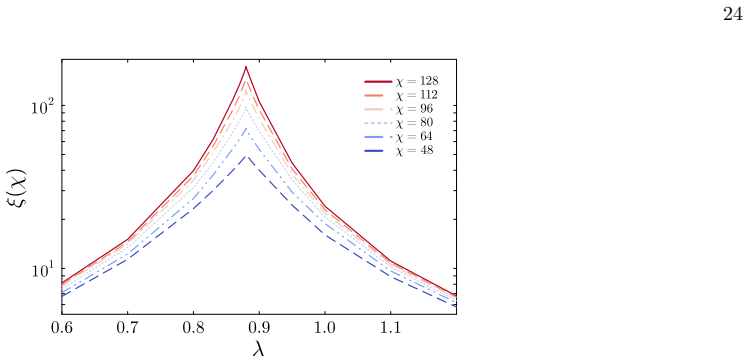
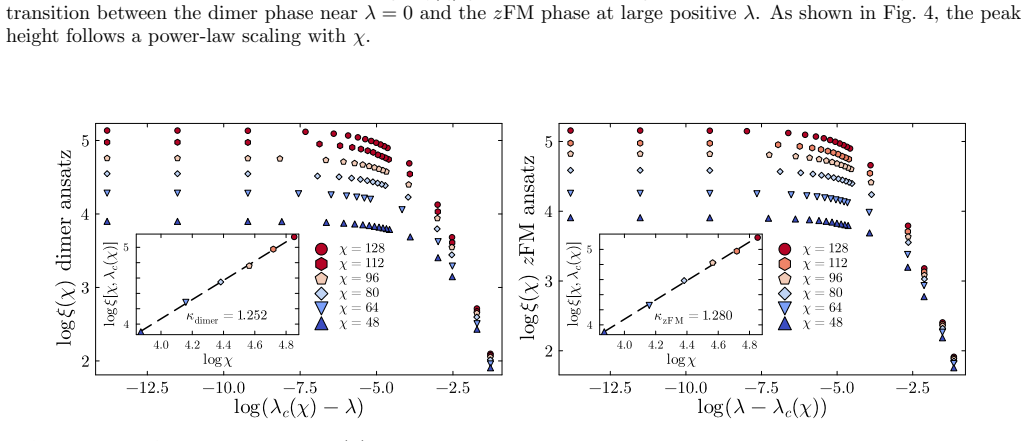
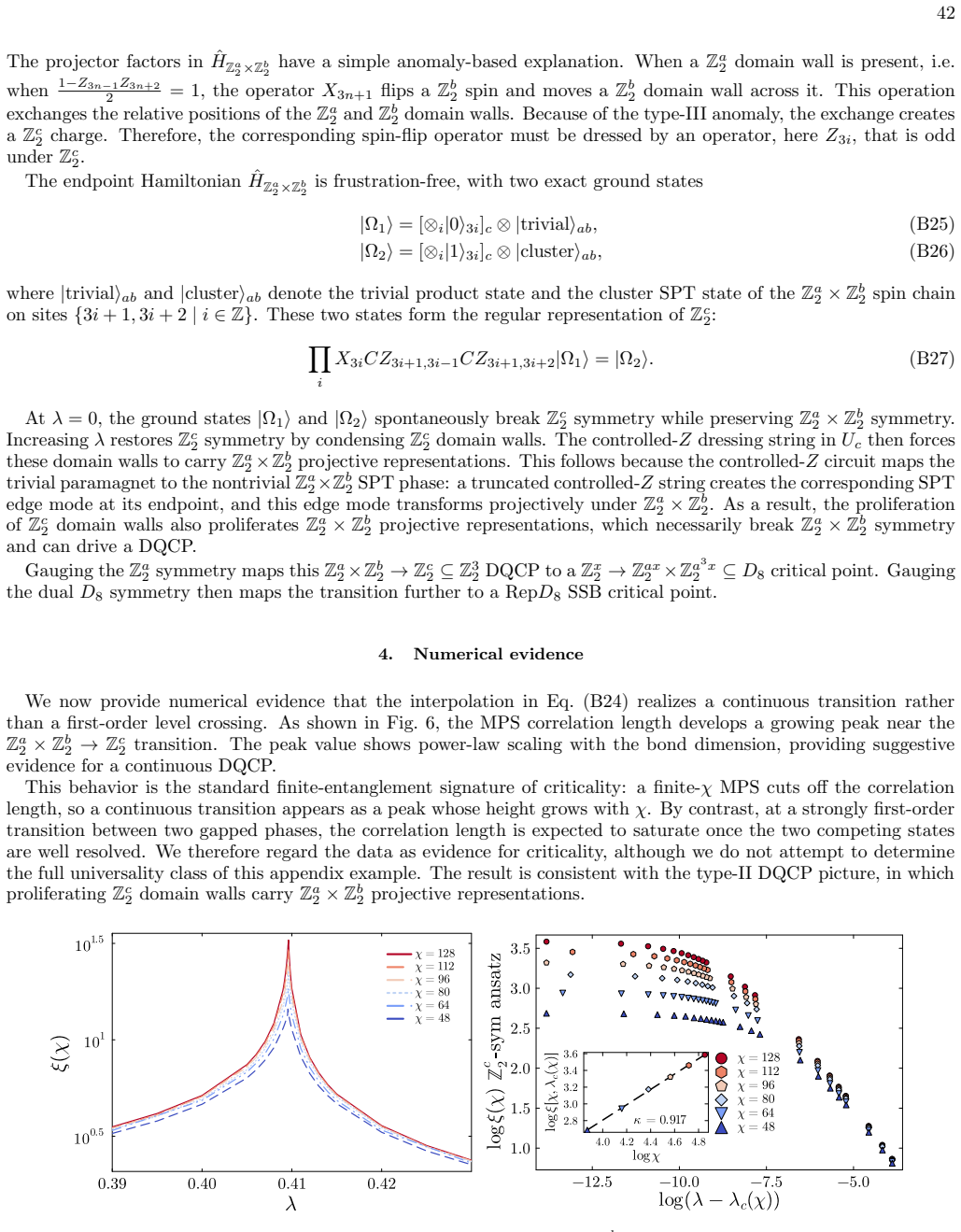
Numerical evidence We now provide numerical evidence that the interpolation in Eq. (B24) realizes a continuous transition rather than a first-order level crossing. As shown in Fig. 6, the MPS correlation length develops a growing peak near the Za 2 ×Z b 2 →Z c 2 transition. The peak value shows power-law scaling with the bond dimension, providing suggesti...
-
[17]
For each gaugeable algebraA, the gauged symmetry is theA-bimodule category ACA, which is group-theoretical and Morita equivalent to Vecω Z3 2
Subgroup gauging inVec ω Z3 2 for allω∈H 3(Z3 2,U(1)) This subsection summarizes subgroup gaugings of Vec ω Z3 2 for all 3-cocyclesω∈H 3(Z3 2,U(1)). For each gaugeable algebraA, the gauged symmetry is theA-bimodule category ACA, which is group-theoretical and Morita equivalent to Vecω Z3 2 . The tables below list one representative from each tensor-equiva...
-
[18]
= 1 4 δr,1.(D5) We now expressζas a cochain on the standard bar resolution. To do this, we construct a comparison maph:F→C from the standard bar resolutionFto the resolutionC: F:· · · →F 2 − →F 1 − →F 0 − →Z ↓h 2 ↓h 1 ↓h 0 ↓id C:· · · →C 2 − →C 1 − →C 0 − →Z (D6) We use theZ-linear contracting homotopyTofC. Starting withh −1 = id, we definehinductively by...
-
[19]
This gives h∗ 3ζ([a i1 xj1 |ai2 xj2 |ai3 xj3]) =ζ(h 3([ai1 xj1 |ai2 xj2 |ai3 xj3])) = 1 4(−1)j1 δi1̸=0δi3̸=0(4−i 1)(δj2=0δ[−i3]4+[−i2]4≥4 −δ j2=1δ[i3]4+[−i2]4<4) = 1 4(−1)j1[−i1]4 δj2=0 [−i2]4 + [−i3]4 4 −δ j2=1δi3̸=0 1− [−i2]4 + [i3]4 4 (D16) As a consistency check, consider the subgroupZ a 4 i ,→D 8 generated by the rotationa. The restriction ofζtoZ a 4...
-
[20]
Senthil, A
T. Senthil, A. Vishwanath, L. Balents, S. Sachdev, and M. P. A. Fisher, Deconfined quantum critical points, Science303, 1490 (2004)
2004
-
[21]
Senthil, L
T. Senthil, L. Balents, S. Sachdev, A. Vishwanath, and M. P. A. Fisher, Quantum criticality beyond the landau-ginzburg- wilson paradigm, Phys. Rev. B70, 144407 (2004)
2004
-
[22]
O. I. Motrunich and A. Vishwanath, Emergent photons and new transitions in the O(3) sigma model with hedgehog suppression, Physical Review B70, 075104 (2004), arXiv:cond-mat/0311222 [cond-mat.str-el]
Pith/arXiv arXiv 2004
-
[23]
C. Wang, A. Nahum, M. A. Metlitski, C. Xu, and T. Senthil, Deconfined quantum critical points: Symmetries and dualities, Phys. Rev. X7, 031051 (2017)
2017
-
[24]
A. W. Sandvik, Evidence for deconfined quantum criticality in a two-dimensional Heisenberg model with four-spin inter- actions, Physical Review Letters98, 227202 (2007)
2007
-
[25]
J. Lou, A. W. Sandvik, and L. Balents, Emergence of U(1) symmetry in the 3d XY model withZ q anisotropy, Physical Review Letters99, 207203 (2007)
2007
-
[26]
R. G. Melko and R. K. Kaul, Scaling in the fan of an unconventional quantum critical point, Physical Review Letters 100, 017203 (2008)
2008
-
[27]
A. Nahum, J. T. Chalker, P. Serna, M. Ortu˜ no, and A. M. Somoza, Deconfined quantum criticality, scaling violations, and classical loop models, Physical Review X5, 041048 (2015), arXiv:1506.06798 [cond-mat.stat-mech]
Pith/arXiv arXiv 2015
-
[28]
S. Jiang and O. I. Motrunich, Ising ferromagnet to valence bond solid transition in a one-dimensional spin chain: Analogies to deconfined quantum critical points, Physical Review B99, 075103 (2019), arXiv:1810.00888 [cond-mat.str-el]
Pith/arXiv arXiv 2019
-
[29]
Roberts, S
B. Roberts, S. Jiang, and O. I. Motrunich, Deconfined quantum critical point in one dimension, Phys. Rev. B99, 165143 (2019)
2019
-
[30]
C. Zhang and M. Levin, Exactly solvable model for a deconfined quantum critical point in 1d, Phys. Rev. Lett.130, 026801 (2023), arXiv:2206.01222 [cond-mat.str-el]
arXiv 2023
-
[31]
A. Chatterjee and X.-G. Wen, Holographic theory for continuous phase transitions: Emergence and symmetry protection of gaplessness, Physical Review B108, 10.1103/physrevb.108.075105 (2023)
-
[32]
E. Lieb, T. Schultz, and D. Mattis, Two soluble models of an antiferromagnetic chain, Annals of Physics16, 407 (1961)
1961
-
[33]
Affleck and E
I. Affleck and E. H. Lieb, A proof of part of haldane’s conjecture on spin chains, Letters in Mathematical Physics12, 57 (1986)
1986
-
[34]
Oshikawa, Commensurability, excitation gap, and topology in quantum many-particle systems on a periodic lattice, Physical Review Letters84, 1535 (2000)
M. Oshikawa, Commensurability, excitation gap, and topology in quantum many-particle systems on a periodic lattice, Physical Review Letters84, 1535 (2000)
2000
-
[35]
M. B. Hastings, Lieb-schultz-mattis in higher dimensions, Physical Review B69, 104431 (2004)
2004
- [36]
-
[37]
Yao and M
Y. Yao and M. Oshikawa, Twisted boundary condition and lieb-schultz-mattis ingappability for discrete symmetries, Physical Review Letters126, 217201 (2021)
2021
-
[38]
G. Y. Cho, C.-T. Hsieh, and S. Ryu, Anomaly manifestation of lieb-schultz-mattis theorem and topological phases, Physical Review B96, 195105 (2017)
2017
-
[39]
S. C. Furuya and M. Oshikawa, Symmetry protection of critical phases and a global anomaly in 1+1 dimensions, Physical Review Letters118, 021601 (2017), arXiv:1503.07292 [cond-mat.stat-mech]
Pith/arXiv arXiv 2017
- [40]
-
[41]
D. V. Else and R. Thorngren, Topological theory of lieb-schultz-mattis theorems in quantum spin systems, Physical Review B101, 224437 (2020)
2020
-
[42]
M. Cheng and N. Seiberg, Lieb-schultz-mattis, luttinger, and ’t hooft – anomaly matching in lattice systems, SciPost Physics15, 051 (2023), arXiv:2211.12543 [cond-mat.str-el]
arXiv 2023
-
[43]
¨O. M. Aksoy, C. Mudry, A. Furusaki, and A. Tiwari, Lieb–schultz–mattis anomalies and web of dualities induced by gauging in quantum spin chains, SciPost Physics16, 022 (2024), arXiv:2308.00743 [cond-mat.str-el]
arXiv 2024
-
[44]
X. Chen, Z.-C. Gu, and X.-G. Wen, Local unitary transformation, long-range quantum entanglement, wave function renormalization, and topological order, Physical Review B82, 155138 (2010), arXiv:1004.3835 [cond-mat.str-el]
Pith/arXiv arXiv 2010
-
[45]
X. Chen, Z.-C. Gu, and X.-G. Wen, Classification of gapped symmetric phases in one-dimensional spin systems, Physical Review B83, 035107 (2011), arXiv:1008.3745 [cond-mat.str-el]
Pith/arXiv arXiv 2011
-
[46]
X. Chen, Z.-C. Gu, and X.-G. Wen, Complete classification of one-dimensional gapped quantum phases in interacting spin systems, Physical Review B84, 235128 (2011), arXiv:1103.3323 [cond-mat.str-el]
Pith/arXiv arXiv 2011
-
[47]
N. Schuch, D. P´ erez-Garc´ ıa, and I. Cirac, Classifying quantum phases using matrix product states and projected entangled pair states, Physical Review B84, 165139 (2011), arXiv:1010.3732 [cond-mat.str-el]
Pith/arXiv arXiv 2011
-
[48]
F. Pollmann, E. Berg, A. M. Turner, and M. Oshikawa, Symmetry protection of topological phases in one-dimensional quantum spin systems, Physical Review B85, 075125 (2012), arXiv:0909.4059 [cond-mat.str-el]
Pith/arXiv arXiv 2012
-
[49]
Levin and Z.-C
M. Levin and Z.-C. Gu, Braiding statistics approach to symmetry-protected topological phases, Physical Review B86, 115109 (2012)
2012
-
[50]
Chen, Z.-C
X. Chen, Z.-C. Gu, Z.-X. Liu, and X.-G. Wen, Symmetry protected topological orders and the group cohomology of their symmetry group, Physical Review B87, 155114 (2013)
2013
-
[51]
T. Lan, L. Kong, and X.-G. Wen, Classification of (2+1)-dimensional topological orders and symmetry-protected topological orders for bosonic and fermionic systems with on-site symmetries, Physical Review B95, 235140 (2017), arXiv:1602.05946 [cond-mat.str-el]
Pith/arXiv arXiv 2017
-
[52]
X. Chen, Y.-M. Lu, and A. Vishwanath, Symmetry-protected topological phases from decorated domain walls, Nature Communications5, 3507 (2014), arXiv:1303.4301 [cond-mat.str-el]
Pith/arXiv arXiv 2014
-
[53]
Huang, H
S.-J. Huang, H. Song, Y.-P. Huang, and M. Hermele, Building crystalline topological phases from lower-dimensional states, Physical Review B96, 205106 (2017)
2017
-
[54]
Thorngren and D
R. Thorngren and D. V. Else, Gauging spatial symmetries and the classification of topological crystalline phases, Physical Review X8, 011040 (2018)
2018
-
[55]
D. V. Else and R. Thorngren, Crystalline topological phases as defect networks, Physical Review B99, 115116 (2019)
2019
-
[56]
R. C. Lyndon, The cohomology theory of group extensions, Duke Mathematical Journal15, 271 (1948)
1948
-
[57]
Hochschild and J.-P
G. Hochschild and J.-P. Serre, Cohomology of group extensions, Transactions of the American Mathematical Society74, 110 (1953)
1953
-
[58]
K. S. Brown,Cohomology of Groups, Graduate Texts in Mathematics, Vol. 87 (Springer, New York, 1982)
1982
-
[59]
Q.-R. Wang, S.-Q. Ning, and M. Cheng, Domain wall decorations, anomalies and spectral sequences in bosonic topological phases, arXiv preprint arXiv:2104.13233 10.48550/arXiv.2104.13233 (2021), arXiv:2104.13233 [cond-mat.str-el]
-
[60]
Dijkgraaf and E
R. Dijkgraaf and E. Witten, Topological gauge theories and group cohomology, Communications in Mathematical Physics 129, 393 (1990)
1990
-
[61]
A. Kapustin and R. Thorngren, Anomalies of discrete symmetries in various dimensions and group cohomology, arXiv preprint arXiv:1404.3230 (2014)
Pith/arXiv arXiv 2014
-
[62]
Kapustin and R
A. Kapustin and R. Thorngren, Anomalous discrete symmetries in three dimensions and group cohomology, Physical review letters112, 231602 (2014)
2014
-
[63]
H. A. Kramers and G. H. Wannier, Statistics of the two-dimensional ferromagnet. part i, Physical Review60, 252 (1941)
1941
-
[64]
Fradkin and L
E. Fradkin and L. Susskind, Order and disorder in gauge systems and magnets, Physical Review D17, 2637 (1978)
1978
-
[65]
M. Levin, Constraints on order and disorder parameters in quantum spin chains, Communications in Mathematical Physics378, 1081 (2020), arXiv:1903.09028 [cond-mat.str-el]
arXiv 2020
-
[66]
Bhardwaj and Y
L. Bhardwaj and Y. Tachikawa, On finite symmetries and their gauging in two dimensions, Journal of High Energy Physics2018, 1 (2018)
2018
-
[67]
M. A. Levin and X.-G. Wen, String-net condensation: A physical mechanism for topological phases, Physical Review B 71, 045110 (2005), arXiv:cond-mat/0404617
Pith/arXiv arXiv 2005
-
[68]
D. Gaiotto, A. Kapustin, N. Seiberg, and B. Willett, Generalized global symmetries, Journal of High Energy Physics 2015, 172 (2015), arXiv:1412.5148 [hep-th]
Pith/arXiv arXiv 2015
-
[69]
L. Kong and X.-G. Wen, Braided fusion categories, gravitational anomalies, and the mathematical framework for topo- logical orders in any dimensions, arXiv preprint arXiv:1405.5858 (2014), arXiv:1405.5858 [cond-mat.str-el]
Pith/arXiv arXiv 2014
-
[70]
C. Cordova, T. T. Dumitrescu, K. Intriligator, and S.-H. Shao, Snowmass white paper: Generalized symmetries in quantum field theory and beyond, arXiv preprint arXiv:2205.09545 (2022), arXiv:2205.09545 [hep-th]
Pith/arXiv arXiv 2022
-
[71]
L. Bhardwaj, L. E. Bottini, L. Fraser-Taliente, L. Gladden, D. S. W. Gould, A. Platschorre, and H. Tillim, Lectures on generalized symmetries, Physics Reports1051, 1 (2024), arXiv:2307.07547 [hep-th]
Pith/arXiv arXiv 2024
-
[72]
J. McGreevy, Generalized symmetries in condensed matter, Annual Review of Condensed Matter Physics14, 57 (2023), arXiv:2204.03045 [cond-mat.str-el]
arXiv 2023
-
[73]
T. D. Brennan and S. Hong, Introduction to generalized global symmetries in QFT and particle physics, arXiv preprint arXiv:2306.00912 (2023), arXiv:2306.00912 [hep-ph]
arXiv 2023
-
[74]
S. Sch¨ afer-Nameki, ICTP lectures on (non-)invertible generalized symmetries, Physics Reports1063, 1 (2024), 53 arXiv:2305.18296 [hep-th]
Pith/arXiv arXiv 2024
-
[75]
S.-H. Shao, What’s done cannot be undone: TASI lectures on non-invertible symmetries, arXiv preprint arXiv:2308.00747 (2023), arXiv:2308.00747 [hep-th]
Pith/arXiv arXiv 2023
-
[76]
R. Thorngren and Y. Wang, Fusion category symmetry i: Anomaly in-flow and gapped phases, arXiv preprint arXiv:1912.02817 (2019), arXiv:1912.02817 [hep-th]
Pith/arXiv arXiv 1912
- [77]
-
[78]
Luo, Q.-R
R. Luo, Q.-R. Wang, and Y.-N. Wang, Lecture notes on generalized symmetries and applications, Physics Reports1065, 1 (2024)
2024
-
[79]
J. Fr¨ ohlich, J. Fuchs, I. Runkel, and C. Schweigert, Kramers-wannier duality from conformal defects, Physical Review Letters93, 070601 (2004), arXiv:cond-mat/0404051
Pith/arXiv arXiv 2004
-
[80]
J. Fuchs, I. Runkel, and C. Schweigert, Defect lines, dualities, and generalised orbifolds, arXiv preprint arXiv:0909.5013 (2009), arXiv:0909.5013 [hep-th]
Pith/arXiv arXiv 2009
discussion (0)
Sign in with ORCID, Apple, or X to comment. Anyone can read and Pith papers without signing in.