REVIEW 3 major objections 6 minor 32 references
Glimpse: Enabling White-Box Methods to Use Proprietary Models for Zero-Shot LLM-Generated Text Detection
T0 review · 3 major / 6 minor · reviewed 2026-08-11 · deepseek-v4-flash
Pith's one-line read White-box detection metrics can be run on proprietary LLMs by reconstructing each token's full probability distribution from the top-K probabilities an API returns.
desk verdict A practical and honest paper whose 'full distribution estimation' mechanism is not load-bearing; the top-K logprobs do the work, and the firstness claim is disputed by DLAD. read the letter →
The pith
A machine-rendered reading of the paper's core claim, the machinery that carries it, and where it could break.
The reading
What carries the argument
The load-bearing object is the completed rank-ordered probability distribution $\tilde{p}_\theta$ per token position, built under a total-probability constraint ($\sum_k p(k) = 1$) and a monotone-decay constraint. For Fast-DetectGPT the metric is the conditional probability curvature $d(x, p_\theta) = (\log p_\theta(x) - \tilde{\mu})/\tilde{\sigma}$, where $\tilde{\mu}$ and $\tilde{\sigma}^2$ are the mean and variance of $\log \tilde{p}_\theta$ under the estimated distribution, computed analytically as $\tilde{\mu}_j = \sum_k p(k)\log p(k)$ and $\tilde{\sigma}^2_j = \sum_k p(k)\log^2 p(k) - \tilde{\mu}_j^2$. Because these sums run over ranks rather than token identities, the missing vocabulary tail can be modeled by one of three estimators: geometric decay with a solved factor $\lambda$ (Eq. 7), a Zipfian power law with a regularized loss-table search over $(\alpha, \beta)$ (Eq. 8), or an MLP trained on open-source distributions (Eq. 9). The same completed distribution extends Entropy, Rank, and LogRank to proprietary models.
What would settle it
Run Fast-DetectGPT with an open-source scoring model whose full distribution is available, on a held-out corpus, first with the true per-position distributions and then with Glimpse's top-K reconstruction; then artificially perturb a band of mid-rank probabilities, adding a second hump of probability mass at ranks 50 to 300, and repeat. If the AUROC gap between true- and estimated-distribution scores jumps when the tail ceases to be monotone-decaying, the parametric tail-shape assumption is the load-bearing part; if not, the metric is robust to tail errors and the central claim holds more broadly.
Extended reading notes
Core claim
Glimpse establishes that a detection score can be computed from a deliberately approximate distribution. API completion endpoints reveal only the top-K token probabilities and the likelihood of the observed text at each position; Glimpse observes that the Fast-DetectGPT curvature metric, along with Entropy, Rank, and Log-Rank, depends only on probability values, not on which tokens carry them, so it models the rank-ordered distribution directly. Three estimators are proposed: a near-Geometric decay, a Zipfian power-law with regularized parameters, and a single-hidden-layer MLP trained on an open-source model's full distributions. The completed distribution is used only for the expected score and variance terms, while the observed text's own likelihood comes from the API exactly. Across ChatGPT, GPT-4, Claude-3 Sonnet, Claude-3 Opus, and Gemini-1.5 Pro, the approach reports AUROC values from 0.92 to 0.98, and the paper reads this as evidence that the latest LLMs can effectively detect their own outputs. The approach is limited to metrics built on predictive distributions rather than inner embeddings, and to models that expose a completion API returning top-K logprobs.
Load-bearing premise
The method assumes that the probability mass beyond the top-K tokens follows one of three fixed decay shapes, so that the tail can be reconstructed from the top-K values; if a model's true distribution has an unusual tail, for example a second concentration of probability at mid ranks, the estimated mean and variance in the curvature score would be wrong, and the paper's own KL-divergence measurements show the geometric estimator is the least faithful yet the most accurate, so the assumed link between faithful estimation and good detection is not fully understood.
Editorial extensions
If this is right
- White-box zero-shot detection can be applied to the strongest proprietary models at the cost of a single API echo pass per text, about 4.1 times faster and roughly 10 times cheaper than DNA-GPT in the paper's settings.
- Larger proprietary models outperform smaller ones as universal detectors across five source models, directly challenging the earlier finding that smaller models are better universal detectors.
- The completed distribution supports several metrics beyond curvature, Entropy, Rank, and LogRank, so a family of white-box detectors inherits API-only access.
- The approach transfers across six languages and four datasets, with near-perfect scores on Urdu, Indonesian, and Arabic, and it holds up better than open-source baselines under DIPPER paraphrasing.
- The specific claim that advanced LLMs may be the best shield against themselves implies model providers can cheaply screen for machine-generated text using their own flagship models without retraining.
Reading between the lines
- The paper's own numbers suggest that fidelity of tail estimation is not what drives accuracy: the geometric estimator has the largest KL divergence yet the best detection scores; a plausible reading, not tested in the paper, is that the curvature metric's power lives in the exact observed-token likelihood plus the top-K values, while the estimated mean and variance only need to be in the right bal
- The rank-scaling trick, computing metrics from probabilities without token identities, is a general recipe that could extend to estimating sequence-level quantities like perplexity or predictive entropy for hallucination scoring on proprietary models, which the paper mentions only as a broader-impact remark.
- Since different estimators win on different datasets, geometric on Writing and PubMed, Zipfian on XSum, MLP most balanced, a per-domain estimator selector or a small ensemble trained on a sentinel set could push the average AUROC above any single estimator without extra API calls.
- Because the MLP is trained once on an open-source model and transfers to GPT-3.5 and GPT-4, a natural stress test is whether the transfer holds for future model families with sharper or flatter distributions than today's; the paper's decay-pattern analysis suggests top-1 probability and decay factor are the two quantities to monitor.
Editorial analysis
A structured set of objections, weighed in public.
Referee Report
Summary. The paper proposes Glimpse, a method that estimates a full token-level predictive distribution from the top-K probabilities returned by proprietary LLM APIs, using one of three tail-completion schemes (Geometric, Zipfian, or a trained MLP). Glimpse is then used to compute white-box zero-shot detection metrics (Entropy, Rank, LogRank, and Fast-DetectGPT) with proprietary scoring models such as GPT-3.5 and GPT-4, which normally expose only partial API information. The authors report that Fast-DetectGPT with Glimpse and GPT-3.5 reaches an average AUROC of about 0.95 across five source models, a 51% relative improvement over the open-source Fast-DetectGPT baseline, along with efficiency and robustness benefits. The paper includes extensive experiments across datasets, languages, source models, scoring models, and ablations, and it releases code and data.
Significance. If the contribution is taken at face value, Glimpse would be a practical and inexpensive way to bring the power of proprietary LLMs to white-box zero-shot detectors, and the experimental evidence for detection quality is strong and unusually broad: five source models, multiple datasets and languages, ablations over K, rank-list size, and prompts, plus robustness analyses under paraphrasing. The derivations in Section 2.3 are transparent and the authors ship code and data, which strengthens reproducibility. The reported improvements in AUROC over open-source surrogates are practically meaningful, and the observation that larger models can be universal detectors is interesting. However, the central interpretive claim — that Glimpse works because it accurately predicts the full distribution from partial observations — is not supported by the paper's own evidence, and this weakens the conceptual contribution even though the empirical results may stand.
major comments (3)
- [§3.2, §3.4, Table 1] The paper's own evidence is inconsistent with the claim that Glimpse improves detection by accurately estimating the full distribution. Figure 2 shows that the Geometric estimator has the largest KL divergence from the true Neo-2.7 distribution, yet Figure 3 and Table 1 show that it achieves the best detection AUROC among the three estimators. Moreover, the Naive truncated distribution in §3.4 reaches 0.9311 AUROC versus 0.9630 for Geometric, so the tail reconstruction contributes only about 0.03 AUROC. Even more concerning, Entropy (GPT-3.5) with Glimpse yields AUROC values as low as 0.2160 on ChatGPT Mix3 (Table 1), far below 0.5, which would be unlikely if the estimated distribution ßp_θ approximated the true p_θ. These observations suggest that the detection gains are driven mainly by the true token log-likelihood log p(x) and the top-K probabilities, not by the fidelity of the tail reconstruction. Please (i) validate the estimated distributions against full distributions on multiple open-source models (e.g., Llama-3-8B, Qwen2.5-7B, Phi-2) in terms of KL divergence and Brier score, and (ii) either provide a principled robustness argument showing why the curvature metric is insensitive to tail error, or reframe the contribution as a heuristic for extending white-box metrics to API logprobs.
- [Appendix A.3, §3.2] The MLP estimator is trained on probability distributions from a single open-source model, GPT-Neo-2.7B, and then applied to proprietary models without any analysis of domain shift. The only fidelity evaluation (Figure 2) uses the same model on which the MLP was trained, which does not test generalization to different model families or sizes. Since the intended use case is proprietary models with unknown tail shapes, the paper needs to show that the estimation approach transfers. Please train or evaluate the estimators on held-out open-source models from different families and report both distribution-level fidelity and the resulting detection accuracy, or clearly state that the estimator is tailored to GPT-like models and evaluate the sensitivity of the results to this choice.
- [§3.4, Table 1] The claim that the full-distribution estimation is what 'enables' white-box methods is only modestly supported by the Naive ablation: the gain from Geometric over Naive is 0.032 AUROC, compared to a 0.048 AUROC gain over the open-source Fast-DetectGPT baseline. To substantiate the central narrative, the paper should decompose the contribution of each component: (a) the proprietary model's true top-K probabilities and log p(x), (b) the choice of tail estimator (including a uniform or random tail control), and (c) the scoring model itself. This would clarify whether the method's success is attributable to the distribution estimation or to the use of a stronger scoring model's partial information.
minor comments (6)
- [§2.4] For Rank and LogRank, the paper states that the rank of the current token is found by searching the closest p(k) to the token's probability. This is an unusual proxy for rank, and the text does not explain why it is a reasonable approximation or how errors in this rank estimate affect the metric. Please add a brief justification or an ablation.
- [Appendix B.2] The description of the Completion API call says the model 'echoes' the input; please specify the exact API parameters (e.g., logprobs count, echo: true, max_tokens) and the version, as this is essential for reproducibility of the top-K probabilities.
- [Appendix A.1] Equation (16) defines an iterative adjustment for λ; please state the convergence criterion and typical number of iterations needed, since the appendix currently does not specify when the iteration terminates.
- [Table 1] The 'Avg.' column is not explicitly defined in the caption or text. Based on the values, it appears to be the mean of the five source-model Mix3 AUROCs, but this should be stated for clarity.
- [§3.5, Table 2] The low AUROC for Russian is attributed to 'potential under-training of the LLMs on this particular language.' This is a speculation; please provide supporting evidence or soften the wording.
- [§5, Related Work] The sentence 'we are the first to enable white-box methods in proprietary LLMs' should be reconciled with the discussion of DLAD (Zeng et al., 2024a), which also uses logits from black-box LLMs. Please clarify the novelty boundary.
Circularity Check
No significant circularity: Glimpse's distribution estimates are not fitted to detection labels, and the only self-citation (Fast-DetectGPT) is an independently reproduced baseline.
full rationale
The paper's derivation chain is self-contained with respect to the detection task. The Glimpse estimators (Geometric, Zipfian, MLP) are constructed from probability axioms and open-source distribution data: Equations (7)-(9) define the tail completions under total-probability and monotonicity constraints, and the MLP is trained with cross-entropy on Neo-2.7B distributions (Appendix A.3, Eq. 27). The detection metrics are evaluated on held-out human/machine labels (Table 1 and Appendix C), and no detection parameter is fitted to those labels. The only self-citation is Fast-DetectGPT (Bao et al., 2023), which is used as an existing zero-shot detector and independently reproduced as a baseline in Table 1; the paper's contribution is replacing the model distribution in that detector's metric, not deriving the detector's validity from the citation. The stated limitations (Section 3.5: no inner-embedding methods, API availability) and the prompt-sensitivity results (Appendix D.2) are correctness and scope concerns, not circularity. Likewise, the observation that Geometric has the largest KL divergence yet the best AUROC (Figures 2-3, Section 3.2) weakens the mechanistic claim that accurate full-distribution estimation drives the gains, but it is an empirical falsifiability issue, not a definitional equivalence between inputs and outputs. No equation reduces the reported AUROC improvements to the fitted distribution parameters by construction, and no prediction is renamed from a fitted input.
Assumptions & free parameters
free parameters (5)
- Zipfian regularization weights =
1.0 for alpha, 0.001 for beta
- MLP parameters =
trained on GPT-Neo-2.7B token distributions
- Rank list size M =
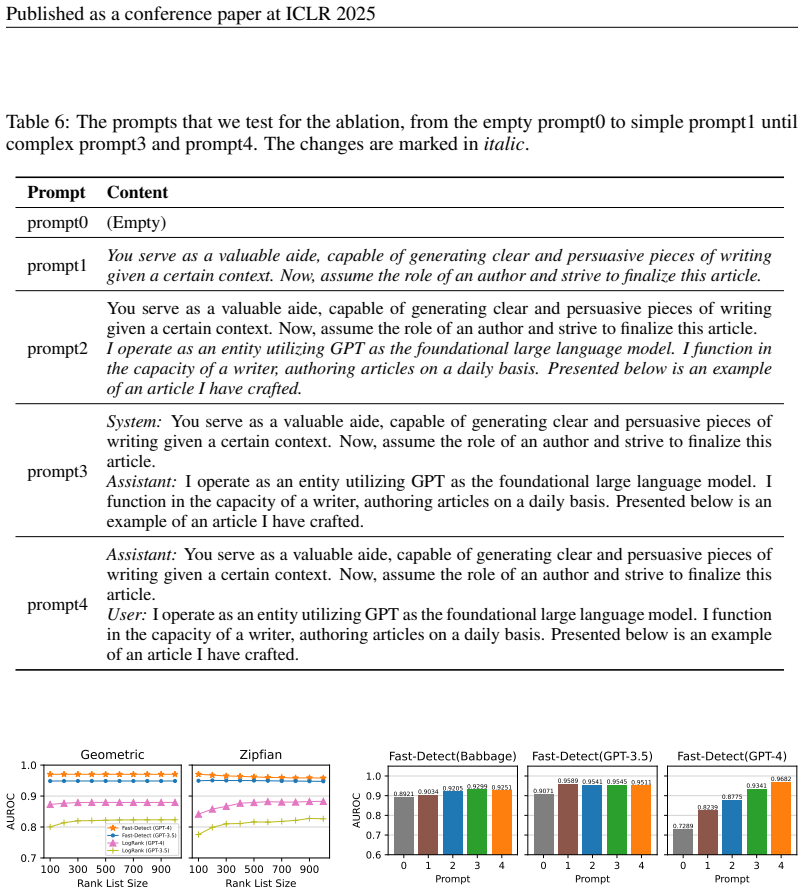
1000 for Geometric, 100 for Zipfian and MLP
- Top-K =
5 by default
- Prompt =
prompt4 for GPT-4, prompt3 for others
assumptions (5)
- domain assumption The tail of the token distribution follows a parametric decay (geometric, Zipfian, or MLP-learned shape).
- domain assumption Zipf's law applies to within-context word probabilities.
- domain assumption An MLP trained on GPT-Neo-2.7B distributions transfers to proprietary models.
- domain assumption The API returns exact top-K probabilities and the log-probability of the input token.
- standard math Token positions are conditionally independent given the context in Fast-DetectGPT.
Cite this review
Pith. "Pith review of Glimpse: Enabling White-Box Methods to Use Proprietary Models for Zero-Shot LLM-Generated Text Detection." pith.science (2026). https://pith.science/paper/KQXPPQKN
@misc{pith2026241211506,
  author       = {Pith},
  title        = {Pith review of: Glimpse: Enabling White-Box Methods to Use Proprietary Models for Zero-Shot LLM-Generated Text Detection},
  year         = {2026},
  howpublished = {\url{https://pith.science/paper/KQXPPQKN}},
  note         = {Machine review of arXiv:2412.11506}
}
read the original abstract
Advanced large language models (LLMs) can generate text almost indistinguishable from human-written text, highlighting the importance of LLM-generated text detection. However, current zero-shot techniques face challenges as white-box methods are restricted to use weaker open-source LLMs, and black-box methods are limited by partial observation from stronger proprietary LLMs. It seems impossible to enable white-box methods to use proprietary models because API-level access to the models neither provides full predictive distributions nor inner embeddings. To traverse the divide, we propose **Glimpse**, a probability distribution estimation approach, predicting the full distributions from partial observations. Despite the simplicity of Glimpse, we successfully extend white-box methods like Entropy, Rank, Log-Rank, and Fast-DetectGPT to latest proprietary models. Experiments show that Glimpse with Fast-DetectGPT and GPT-3.5 achieves an average AUROC of about 0.95 in five latest source models, improving the score by 51% relative to the remaining space of the open source baseline. It demonstrates that the latest LLMs can effectively detect their own outputs, suggesting that advanced LLMs may be the best shield against themselves. We release our code and data at https://github.com/baoguangsheng/glimpse.
Figures


Figures from the paper (3 more)


Reference graph
Works this paper leans on
-
[1]
Rohan Anil, Andrew M Dai, Orhan Firat, Melvin Johnson, Dmitry Lepikhin, Alexandre Passos, Siamak Shakeri, Emanuel Taropa, Paige Bailey, Zhifeng Chen, et al. Palm 2 technical report. arXiv preprint arXiv:2305.10403,
-
[5]
Hierarchical neural story generation
11 Published as a conference paper at ICLR 2025 Angela Fan, Mike Lewis, and Yann Dauphin. Hierarchical neural story generation. In Proceedings of the 56th Annual Meeting of the Association for Computational Linguistics (Volume 1: Long Papers). Association for Computational Linguistics,
work page 2025
-
[6]
Unifying human and statistical evaluation for natural language generation
Tatsunori B Hashimoto, Hugh Zhang, and Percy Liang. Unifying human and statistical evaluation for natural language generation. arXiv preprint arXiv:1904.02792,
arXiv 1904
-
[7]
Pubmedqa: A dataset for biomedical research question answering
Qiao Jin, Bhuwan Dhingra, Zhengping Liu, William Cohen, and Xinghua Lu. Pubmedqa: A dataset for biomedical research question answering. In Proceedings of the 2019 Conference on Empirical Methods in Natural Language Processing and the 9th International Joint Conference on Natural Language Processing (EMNLP-IJCNLP), pp. 2567–2577,
2019
-
[9]
Robust distortion-free watermarks for language models
Rohith Kuditipudi, John Thickstun, Tatsunori Hashimoto, and Percy Liang. Robust distortion-free watermarks for language models. arXiv preprint arXiv:2307.15593,
-
[10]
Ai- generated text boundary detection with roft
Laida Kushnareva, Tatiana Gaintseva, German Magai, Serguei Barannikov, Dmitry Abulkhanov, Kristian Kuznetsov, Eduard Tulchinskii, Irina Piontkovskaya, and Sergey Nikolenko. Ai- generated text boundary detection with roft. In 1st Conference on Language Modeling (COLM), volume 2024,
work page 2024
-
[11]
Detecting fake content with relative en- tropy scoring
Thomas Lavergne, Tanguy Urvoy, and Franc ¸ois Yvon. Detecting fake content with relative en- tropy scoring. In Proceedings of the 2008 International Conference on Uncovering Plagiarism, Authorship and Social Software Misuse-Volume 377, pp. 27–31,
work page 2008
-
[12]
Smaller language models are better black-box machine-generated text detectors
12 Published as a conference paper at ICLR 2025 Niloofar Mireshghallah, Justus Mattern, Sicun Gao, Reza Shokri, and Taylor Berg-Kirkpatrick. Smaller language models are better black-box machine-generated text detectors. arXiv preprint arXiv:2305.09859,
arXiv 2025
Show all 32 references
-
[13]
De- tectgpt: Zero-shot machine-generated text detection using probability curvature
Eric Mitchell, Yoonho Lee, Alexander Khazatsky, Christopher D Manning, and Chelsea Finn. De- tectgpt: Zero-shot machine-generated text detection using probability curvature. arXiv preprint arXiv:2301.11305,
-
[14]
Don’t give me the details, just the summary! topic-aware convolutional neural networks for extreme summarization
Shashi Narayan, Shay B Cohen, and Mirella Lapata. Don’t give me the details, just the summary! topic-aware convolutional neural networks for extreme summarization. In Proceedings of the 2018 Conference on Empirical Methods in Natural Language Processing, pp. 1797–1807,
2018
- [15]
-
[16]
On the risk of misinformation pollution with large language models
Yikang Pan, Liangming Pan, Wenhu Chen, Preslav Nakov, Min-Yen Kan, and William Yang Wang. On the risk of misinformation pollution with large language models. In The 2023 Conference on Empirical Methods in Natural Language Processing,
2023
-
[18]
Release strategies and the social impacts of language models
Irene Solaiman, Miles Brundage, Jack Clark, Amanda Askell, Ariel Herbert-V oss, Jeff Wu, Alec Radford, Gretchen Krueger, Jong Wook Kim, Sarah Kreps, et al. Release strategies and the social impacts of language models. arXiv preprint arXiv:1908.09203,
1908 arXiv
-
[20]
Trustllm: Trustworthiness in large language models
Lichao Sun, Yue Huang, Haoran Wang, Siyuan Wu, Qihui Zhang, Chujie Gao, Yixin Huang, Wen- han Lyu, Yixuan Zhang, Xiner Li, et al. Trustllm: Trustworthiness in large language models. arXiv preprint arXiv:2401.05561,
-
[21]
The impact of prompts on zero-shot detection of ai-generated text
Kaito Taguchi, Yujie Gu, and Kouichi Sakurai. The impact of prompts on zero-shot detection of ai-generated text. arXiv preprint arXiv:2403.20127,
-
[22]
Gemini: a family of highly capable multimodal models
Gemini Team, Rohan Anil, Sebastian Borgeaud, Yonghui Wu, Jean-Baptiste Alayrac, Jiahui Yu, Radu Soricut, Johan Schalkwyk, Andrew M Dai, Anja Hauth, et al. Gemini: a family of highly capable multimodal models. arXiv preprint arXiv:2312.11805,
-
[23]
Authorship attribution for neural text genera- tion
Adaku Uchendu, Thai Le, Kai Shu, and Dongwon Lee. Authorship attribution for neural text genera- tion. In Proceedings of the 2020 conference on empirical methods in natural language processing (EMNLP), pp. 8384–8395,
2020
-
[25]
Ethical and social risks of harm from language models
Laura Weidinger, John Mellor, Maribeth Rauh, Conor Griffin, Jonathan Uesato, Po-Sen Huang, Myra Cheng, Mia Glaese, Borja Balle, Atoosa Kasirzadeh, et al. Ethical and social risks of harm from language models. arXiv preprint arXiv:2112.04359,
-
[26]
Detecting subtle differences between human and model languages using spectrum of relative likelihood
Yang Xu, Yu Wang, Hao An, Zhichen Liu, and Yongyuan Li. Detecting subtle differences between human and model languages using spectrum of relative likelihood. arXiv preprint arXiv:2406.19874,
-
[27]
Qwen2 technical report
An Yang, Baosong Yang, Binyuan Hui, Bo Zheng, Bowen Yu, Chang Zhou, Chengpeng Li, Chengyuan Li, Dayiheng Liu, Fei Huang, Guanting Dong, Haoran Wei, Huan Lin, Jialong Tang, Jialin Wang, Jian Yang, Jianhong Tu, Jianwei Zhang, Jianxin Ma, Jin Xu, Jingren Zhou, Jinze Bai, Jinzheng...
-
[28]
Dna-gpt: Divergent n-gram analysis for training-free detection of gpt-generated text
Xianjun Yang, Wei Cheng, Linda Petzold, William Yang Wang, and Haifeng Chen. Dna-gpt: Divergent n-gram analysis for training-free detection of gpt-generated text. arXiv preprint arXiv:2305.17359, 2023a. Xianjun Yang, Liangming Pan, Xuandong Zhao, Haifeng Chen, Linda Petzold, W...
-
[29]
Dlad: Improving logits-based detector without logits from black-box llms
Cong Zeng, Shengkun Tang, Xianjun Yang, Yuanzhou Chen, Yiyou Sun, Yao Li, Haifeng Chen, Wei Cheng, Dongkuan Xu, et al. Dlad: Improving logits-based detector without logits from black-box llms. In The Thirty-eighth Annual Conference on Neural Information Processing Systems, 202...
-
[31]
The ranges are empirically decided, which balance the coverage of the possible choices and the size of the table
with a step of 0.2, resulting in a table with 10000 values. The ranges are empirically decided, which balance the coverage of the possible choices and the size of the table. During inference, we can efficiently compute the loss table Loss(α, β) from T [α, β] given prest/pK. We...
2025
-
[32]
Our testing encompasses two paraphrasing settings: high lexical diversity (60 L) and high-order diversity (60 O)
to rephrase the output generated by ChatGPT. Our testing encompasses two paraphrasing settings: high lexical diversity (60 L) and high-order diversity (60 O). As indicated in Table 9, Fast- Detect (Babbage) surpasses Fast-Detect (Neo-2.7) in both settings, but is more signific...
2025
-
[2013]
We approximate the pattern using parameterized distributions, allocating the remaining probability mass (as ‘*’ indicates) to ranks larger thanK
14 Published as a conference paper at ICLR 2025 A G LIMPSE : A P ROBABILITY DISTRIBUTION ESTIMATION APPROACH As indicated in Figure 7a, the probability distribution across ranks generally follows a decaying pattern, where the larger models tend to have a higher top- 1 probabil...
2025
-
[2014]
Can ai-generated text be reliably detected? arXiv preprint arXiv:2303.11156,
Vinu Sankar Sadasivan, Aounon Kumar, Sriram Balasubramanian, Wenxiao Wang, and Soheil Feizi. Can ai-generated text be reliably detected? arXiv preprint arXiv:2303.11156,
-
[2019]
Detectllm: Leveraging log rank informa- tion for zero-shot detection of machine-generated text
Jinyan Su, Terry Yue Zhuo, Di Wang, and Preslav Nakov. Detectllm: Leveraging log rank informa- tion for zero-shot detection of machine-generated text. arXiv preprint arXiv:2306.05540,
-
[2020]
Ghostbuster: Detecting text ghostwrit- ten by large language models
13 Published as a conference paper at ICLR 2025 Vivek Verma, Eve Fleisig, Nicholas Tomlin, and Dan Klein. Ghostbuster: Detecting text ghostwrit- ten by large language models. In Proceedings of the 2024 Conference of the North American Chapter of the Association for Computation...
2025
-
[2021]
Language models are few-shot learners
Tom Brown, Benjamin Mann, Nick Ryder, Melanie Subbiah, Jared D Kaplan, Prafulla Dhariwal, Arvind Neelakantan, Pranav Shyam, Girish Sastry, Amanda Askell, et al. Language models are few-shot learners. Advances in neural information processing systems, 33:1877–1901,
1901
-
[2022]
A watermark for large language models
John Kirchenbauer, Jonas Geiping, Yuxin Wen, Jonathan Katz, Ian Miers, and Tom Goldstein. A watermark for large language models. arXiv preprint arXiv:2301.10226,
-
[2023]
The llama 3 herd of models
Abhimanyu Dubey, Abhinav Jauhri, Abhinav Pandey, Abhishek Kadian, Ahmad Al-Dahle, Aiesha Letman, Akhil Mathur, Alan Schelten, Amy Yang, Angela Fan, et al. The llama 3 herd of models. arXiv preprint arXiv:2407.21783,
-
[2024]
Real or fake? learning to discriminate machine from human generated text
Anton Bakhtin, Sam Gross, Myle Ott, Yuntian Deng, Marc’Aurelio Ranzato, and Arthur Szlam. Real or fake? learning to discriminate machine from human generated text. arXiv preprint arXiv:1906.03351,
1906 arXiv
Reviewed August 11, 2026 · model on record in the stance chip above.
Discussion (0). Continue with ORCID to comment.