Hidden valley dynamics behind vanishing circular polarization in moir\'e excitons
Pith reviewed 2026-06-29 02:54 UTC · model grok-4.3
The pith
Nearly zero steady-state valley polarization in moiré excitons arises from temporal compensation between opposite-helicity channels rather than fast relaxation.
A machine-rendered reading of the paper's core claim, the machinery that carries it, and where it could break.
Core claim
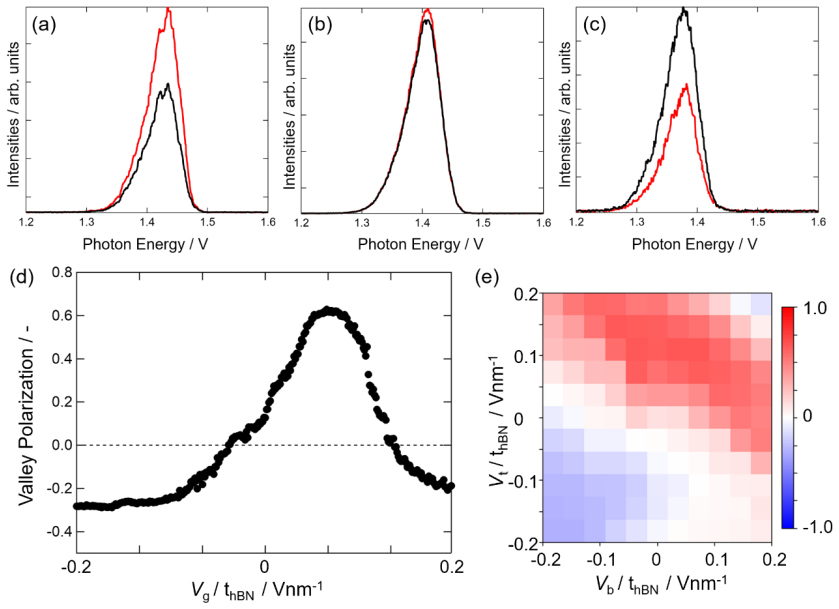
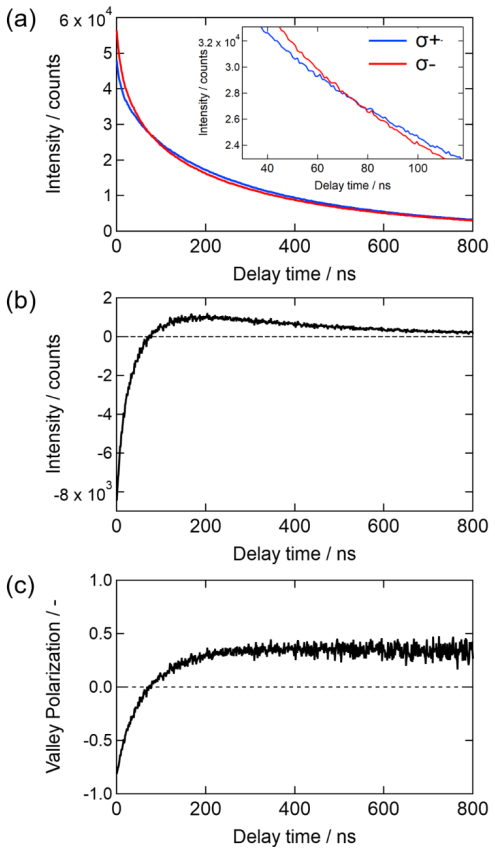
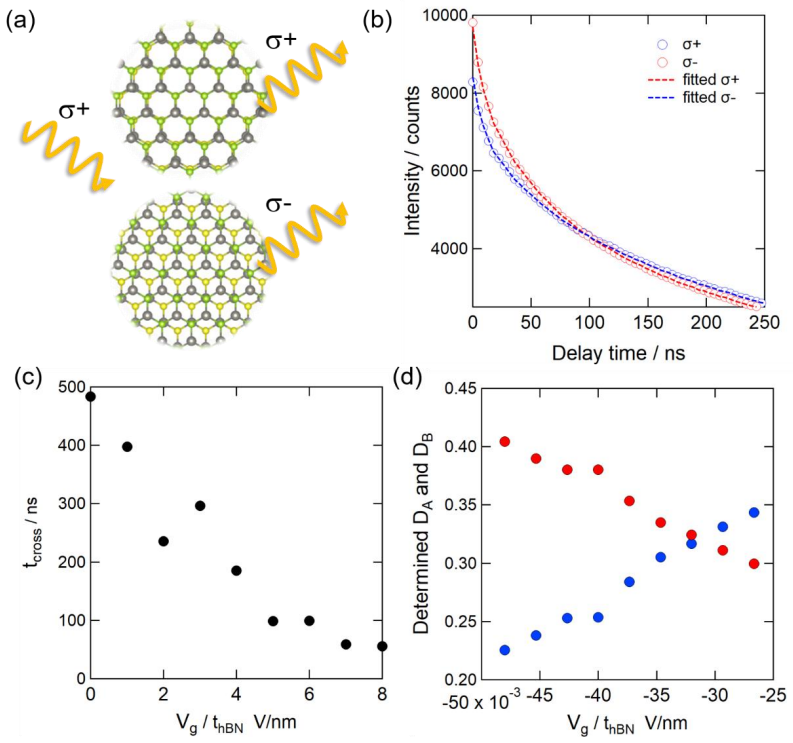
A nearly zero steady-state valley polarization in electrically tunable moiré excitons does not necessarily indicate fast valley relaxation. Helicity-resolved time-resolved photoluminescence reveals a temporal crossing between co- and cross-circularly polarized emission, indicating that helicity-opposite dynamical components coexist and compensate after time integration. A minimal two-channel model, representing A-like and B-like moiré emission channels with opposite optical selection rules and distinct effective decay/depolarization rates, reproduces the observed helicity crossing without invoking a single rapid valley relaxation process. Two-dimensional gate-field maps show that the crossin
What carries the argument
The minimal two-channel model of A-like and B-like moiré emission channels possessing opposite optical selection rules and distinct effective decay/depolarization rates tunable by gate field.
If this is right
- Time-integrated circular polarization measurements can produce false-negative indications of valley polarization in multichannel emitters.
- The crossing time between co- and cross-polarized emission shifts systematically with applied gate field.
- Hidden valley dynamics remain electrically controllable even when steady-state polarization appears absent.
- Multichannel moiré systems can maintain slow valley relaxation in individual channels while exhibiting compensated time-integrated signals.
Where Pith is reading between the lines
- Valleytronic readout schemes relying solely on steady-state circular polarization may underestimate retention times unless time-resolved data are included.
- The same compensation mechanism could appear in other multilayer heterostructures that host multiple optically active sites with differing selection rules.
- Mapping the crossing time versus gate voltage provides a direct experimental handle on the relative decay rates of the two channels.
Load-bearing premise
A-like and B-like moiré emission channels possess opposite optical selection rules and distinct decay or depolarization rates that can be tuned independently by gate field.
What would settle it
Observation of time-resolved photoluminescence traces that lack a temporal crossing between co- and cross-circular components while still showing near-zero time-integrated polarization would falsify the compensation mechanism.
Figures
read the original abstract
Optically addressable valley degrees of freedom in transition-metal dichalcogenide heterostructures provide a powerful platform for valleytronic and quantum-optical functionalities. In moir\'e superlattices, interlayer excitons inherit valley-contrasting optical selection rules while acquiring long lifetimes, electric dipoles, and site-dependent optical responses. However, because conventional measurements typically probe time-integrated valley polarization, the dynamical origin of vanishing polarization has remained elusive. Here, we show that a nearly zero steady-state valley polarization in electrically tunable moir\'e excitons does not necessarily indicate fast valley relaxation. Helicity-resolved time-resolved photoluminescence reveals a temporal crossing between co- and cross-circularly polarized emission, indicating that helicity-opposite dynamical components coexist and compensate after time integration. A minimal two-channel model, representing A-like and B-like moir\'e emission channels with opposite optical selection rules and distinct effective decay/depolarization rates, reproduces the observed helicity crossing without invoking a single rapid valley relaxation process. Furthermore, two-dimensional gate-field maps show that the crossing time evolves systematically with electrostatic tuning, demonstrating that the hidden valley dynamics are electrically controllable. These results show that time-integrated circular polarization can give a false-negative indication of valley polarization in multichannel valley emitters.
Editorial analysis
A structured set of objections, weighed in public.
Referee Report
Summary. The manuscript claims that a nearly zero steady-state valley polarization in electrically tunable moiré excitons does not imply fast valley relaxation. Instead, helicity-resolved time-resolved photoluminescence shows a temporal crossing between co- and cross-circularly polarized emission, which a minimal two-channel model (A-like and B-like moiré channels with opposite optical selection rules and distinct decay/depolarization rates) reproduces; the crossing time is shown to be gate-tunable via 2D maps.
Significance. If the result holds, the work demonstrates that time-integrated circular polarization can produce false negatives for valley polarization in multichannel emitters, with implications for valleytronic device interpretation. The time-resolved approach and electrical tunability are strengths; the absence of quantitative fit details or error analysis in the provided abstract leaves the reproduction claim plausible but unverified.
major comments (2)
- [Abstract (final paragraph)] Abstract (final paragraph): The minimal two-channel model assumes A-like and B-like moiré emission channels possess opposite optical selection rules so that their contributions can cancel after integration. No microscopic derivation, early-time polarization sign check, or reference to prior work establishing sign reversal for these specific interlayer states under gate tuning is supplied. This assumption is load-bearing for the cancellation mechanism that replaces fast valley relaxation.
- [Abstract] Abstract: The statement that the two-channel model 'reproduces the observed helicity crossing' is given without quantitative fit details, error analysis, exclusion criteria for alternative models, or comparison to data. This leaves the central claim that the model accounts for the crossing (rather than merely being consistent with it) unverified.
Simulated Author's Rebuttal
We thank the referee for their careful reading of the manuscript and for highlighting points that can improve clarity. We respond to each major comment below.
read point-by-point responses
-
Referee: [Abstract (final paragraph)] The minimal two-channel model assumes A-like and B-like moiré emission channels possess opposite optical selection rules so that their contributions can cancel after integration. No microscopic derivation, early-time polarization sign check, or reference to prior work establishing sign reversal for these specific interlayer states under gate tuning is supplied. This assumption is load-bearing for the cancellation mechanism that replaces fast valley relaxation.
Authors: The two-channel model is presented as a minimal phenomenological description whose purpose is to demonstrate that opposite selection rules plus distinct rates are sufficient to produce the observed crossing and vanishing time-integrated polarization. The opposite selection rules follow from the established site-dependent optical activity of A-like and B-like moiré interlayer excitons; we will insert explicit citations to prior experimental and theoretical works that map these selection rules under gate tuning. The manuscript already contains the early-time polarization data that fix the initial sign; we will add a short paragraph in the main text that explicitly compares this sign to the model prediction and to the cited literature. revision: yes
-
Referee: [Abstract] The statement that the two-channel model 'reproduces the observed helicity crossing' is given without quantitative fit details, error analysis, exclusion criteria for alternative models, or comparison to data. This leaves the central claim that the model accounts for the crossing (rather than merely being consistent with it) unverified.
Authors: The abstract is intentionally concise. The full manuscript and its supplementary information contain the quantitative least-squares fits to the time-resolved traces, the extracted rate parameters with uncertainties, the 2D gate maps of crossing time, and a discussion of why single-channel or equal-rate alternatives fail to reproduce the crossing. We will revise the abstract to include one sentence directing readers to these quantitative comparisons and will ensure the main text states the goodness-of-fit metrics and the criteria used to rule out simpler models. revision: yes
Circularity Check
Minimal two-channel rate model fitted to observed crossing; no derivation reduces to self-referential inputs
full rationale
The paper's central result is an experimental observation of helicity crossing in time-resolved PL, reproduced by fitting a minimal two-channel model whose parameters (distinct decay/depolarization rates) are adjusted to match the data. The assumption of opposite selection rules for A-like/B-like channels is stated as part of the model construction but is not derived from the same dataset in a self-definitional loop, nor is any 'prediction' shown to equal its fitted inputs by construction. No self-citation chain or uniqueness theorem is invoked to force the result. This matches the default case of an experimental observation plus a fitted phenomenological model, warranting only a minor score.
Axiom & Free-Parameter Ledger
free parameters (1)
- channel-specific decay and depolarization rates
axioms (1)
- domain assumption A-like and B-like moiré channels possess opposite optical selection rules
Reference graph
Works this paper leans on
-
[1]
Xiao, G.-B
D. Xiao, G.-B. Liu, W. Feng, X. Xu, and W. Yao, Coupled spin and valley physics in monolayers of MoS₂ and other group-VI dichalcogenides, Phys. Rev. Lett. 108, 196802 (2012)
2012
-
[2]
K. F. Mak, K. He, J. Shan, and T. F. Heinz, Control of valley polarization in monolayer MoS₂ by optical helicity, Nat. Nanotechnol. 7, 494–498 (2012)
2012
-
[3]
H. Zeng, J. Dai, W. Yao, D. Xiao, and X. Cui, Valley polarization in MoS₂ monolayers by optical pumping, Nat. Nanotechnol. 7, 490–493 (2012)
2012
-
[4]
X. Xu, W. Yao, D. Xiao, and T. F. Heinz, Spin and pseudospins in layered transition metal dichalcogenides, Nat. Phys. 10, 343–350 (2014)
2014
-
[5]
Rivera, J
P. Rivera, J. R. Schaibley, A. M. Jones, J. S. Ross, S. Wu, G. Aivazian, P. Klement, K. Seyler, G. Clark, N. J. Ghimire, J. Yan, D. G. Mandrus, W. Yao, and X. Xu, Observation of long-lived interlayer excitons in monolayer MoSe₂-WSe₂ heterostructures, Nat. Commun. 6, 6242 (2015)
2015
-
[6]
Rivera, K
P. Rivera, K. L. Seyler, H. Yu, J. R. Schaibley, J. Yan, D. G. Mandrus, W. Yao, and X. Xu, Valley-polarized exciton dynamics in a 2D semiconductor heterostructure, Science 351, 688–691 (2016)
2016
-
[7]
Rivera, H
P. Rivera, H. Yu, K. L. Seyler, N. P. Wilson, W. Yao, and X. Xu, Interlayer valley excitons in heterobilayers of transition metal dichalcogenides, Nat. Nanotechnol. 13, 1004–1015 (2018)
2018
-
[8]
Ciarrocchi, D
A. Ciarrocchi, D. Unuchek, A. Avsar, K. Watanabe, T. Taniguchi, and A. Kis, Polarization switching and electrical control of interlayer excitons in two-dimensional van der Waals heterostructures, Nat. Photonics 13, 131–136 (2019)
2019
-
[9]
Yu, G.-B
H. Yu, G.-B. Liu, J. Tang, X. Xu, and W. Yao, Moiré excitons: From programmable quantum emitter arrays to spin-orbit-coupled artificial lattices, Sci. Adv. 3, e1701696 (2017)
2017
-
[10]
F. Wu, T. Lovorn, and A. H. MacDonald, Theory of optical absorption by interlayer excitons in transition metal dichalcogenide heterobilayers, Phys. Rev. B 97, 035306 (2018)
2018
-
[11]
K. L. Seyler et al., Signatures of moiré-trapped valley excitons in MoSe₂/WSe₂ heterobilayers, Nature 567, 66–70 (2019)
2019
-
[12]
Tran et al., Evidence for moiré excitons in van der Waals heterostructures, Nature 567, 71–75 (2019)
K. Tran et al., Evidence for moiré excitons in van der Waals heterostructures, Nature 567, 71–75 (2019)
2019
-
[13]
Jin et al., Observation of moiré excitons in WSe₂/WS₂ heterostructure superlattices, Nature 567, 76–80 (2019)
C. Jin et al., Observation of moiré excitons in WSe₂/WS₂ heterostructure superlattices, Nature 567, 76–80 (2019)
2019
-
[14]
E. M. Alexeev et al., Resonantly hybridized excitons in moiré superlattices in van der Waals heterostructures, Nature 567, 81–86 (2019)
2019
-
[15]
Jin et al., Identification of spin, valley and moiré quasi-angular momentum of interlayer excitons, Nat
C. Jin et al., Identification of spin, valley and moiré quasi-angular momentum of interlayer excitons, Nat. Phys. 15, 1140–1144 (2019)
2019
-
[16]
F. Wu, T. Lovorn, E. Tutuc, and A. H. MacDonald, Hubbard model physics in transition metal dichalcogenide moiré bands, Phys. Rev. Lett. 121, 026402 (2018)
2018
-
[17]
Tang et al., Simulation of Hubbard model physics in WSe₂/WS₂ moiré superlattices, Nature 579, 353–358 (2020)
Y . Tang et al., Simulation of Hubbard model physics in WSe₂/WS₂ moiré superlattices, Nature 579, 353–358 (2020)
2020
-
[18]
E. C. Regan et al., Mott and generalized Wigner crystal states in WSe₂/WS₂ moiré superlattices, Nature 579, 359–363 (2020)
2020
-
[19]
Miao et al., Strong interaction between interlayer excitons and correlated electrons in WSe₂/WS₂ moiré superlattice, Nat
S. Miao et al., Strong interaction between interlayer excitons and correlated electrons in WSe₂/WS₂ moiré superlattice, Nat. Commun. 12, 3608 (2021)
2021
-
[20]
Scuri et al., Electrically tunable valley dynamics in twisted WSe₂/WSe₂ bilayers, Phys
G. Scuri et al., Electrically tunable valley dynamics in twisted WSe₂/WSe₂ bilayers, Phys. Rev. Lett. 124, 217403 (2020)
2020
-
[21]
Holler et al., Interlayer exciton valley polarization dynamics in large magnetic fields, Phys
J. Holler et al., Interlayer exciton valley polarization dynamics in large magnetic fields, Phys. Rev. B 105, 085303 (2022)
2022
-
[22]
Kim et al., Correlation-driven nonequilibrium exciton site transition in a WSe₂/WS₂ moiré supercell, Nat
J. Kim et al., Correlation-driven nonequilibrium exciton site transition in a WSe₂/WS₂ moiré supercell, Nat. Commun. 15, 3312 (2024)
2024
-
[23]
X. Hong, J. Kim, S.-F. Shi, Y . Zhang, C. Jin, Y . Sun, S. Tongay, J. Wu, Y . Zhang, and F. Wang, Ultrafast charge transfer in atomically thin MoS₂/WS₂ heterostructures, Nat. Nanotechnol. 9, 682–686 (2014)
2014
discussion (0)
Sign in with ORCID, Apple, or X to comment. Anyone can read and Pith papers without signing in.