REVIEW 4 major objections 4 minor 27 references
Implementation of Morse-Witten theory for a polydisperse wet 2D foam simulation
T0 review · 4 major / 4 minor · reviewed 2026-08-14 · deepseek-v4-flash
Pith's one-line read This paper extends Morse-Witten bubble-contact theory to polydisperse foams and turns it into a working 2D simulation for the wet limit.
desk verdict First real polydisperse Morse-Witten foam simulator, with solid pair-level checks but a multi-contact superposition that is tested only in two-bubble geometry; worth refereeing after some extra validation. read the letter →
The pith
A machine-rendered reading of the paper's core claim, the machinery that carries it, and where it could break.
The reading
What carries the argument
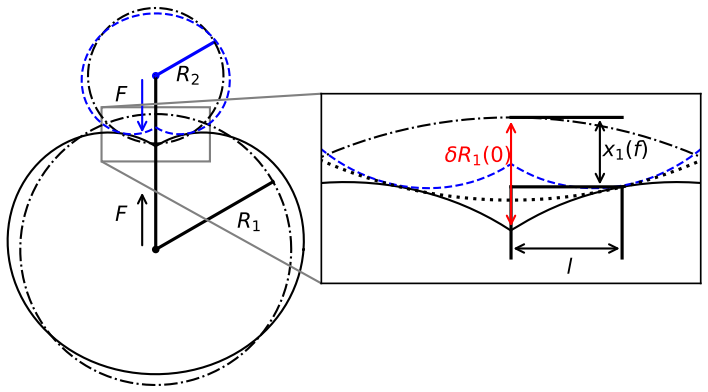
The load-bearing object is the generalized force-deformation relation (Equation 10), which superposes linearized single-contact Morse-Witten deformation profiles from all contacts of a bubble and adds a quadratic correction that encodes polydispersity. The single-contact profile comes from solving the linearized Young-Laplace equation for a 2D bubble pressed by a point force while keeping the centroid fixed, giving the deformation function $g(\theta)=(\pi-\theta)\sin\theta - \cos\theta/2 - 1$. This relation turns a foam into a central-force network on centroid coordinates, and the paper surrounds it with an iteration that updates deformations, forces, and positions while monitoring overlaps and removing spurious negative-force contacts.
What would settle it
A direct numerical solution of the Young-Laplace equation for two unequal bubbles pressed together across the reported force range $0<f<0.5$ would test Equation (9): if the center-to-center separation deviates by more than the claimed $\sim2\%$, or if the deviation grows with the number of contacts in a larger foam, the superposition assumption is not safe.
Extended reading notes
Core claim
The paper claims that the Morse-Witten description of bubble contacts can be made genuinely polydisperse: when two bubbles of radii $R_1$ and $R_2$ meet, the inward displacement of each contact point is not the linear Morse-Witten result but includes a term of order $f^2$ involving $2 + R_1/R_2 + R_2/R_1$, and this corrected law (Equation 10) can be applied to every contact of every bubble. The resulting system, in which bubbles are represented by centroid positions, contact forces, and contact deformations, satisfies force-deformation consistency, deformation-displacement consistency, action-reaction, and force equilibrium through an iterative scheme that adds and removes contacts as the foam evolves. The authors find that their equilibrated structures reproduce contact changes seen in direct calculations, match the exact result for ordered monodisperse wet foams, and give a critical liquid fraction of $\varphi_c \simeq 0.843$, consistent with published values. Near jamming they report an excess energy scaling $\varepsilon \propto \Delta\varphi^{2.2}$ and an excess coordination number scaling $\Delta Z \propto \Delta\varphi^{0.52}$.
Load-bearing premise
The construction rests on adding up the small deformations each contact would cause if isolated, trusting that the errors left by this linearization remain small even when many unequal bubbles press on each other near jamming.
Editorial extensions
If this is right
- Foam simulations can now be run reliably in the wet limit, at liquid fractions above about 0.12, where the standard geometric simulation approach most often fails to converge.
- For ordered monodisperse foams the model reproduces the exact excess-energy result, so the scheme can serve as a validated baseline for wet foam mechanics.
- Near jamming the simulation gives specific scalings, excess energy $\varepsilon \propto \Delta\varphi^{2.2}$ and excess coordination number $\Delta Z \propto \Delta\varphi^{0.52}$, plus a critical liquid fraction consistent with published values.
- The same machinery carries over to three dimensions; the paper writes down the 3D force-deformation relation, including its logarithmic term, as the foundation of a future implementation.
Reading between the lines
- One testable extension is to seed a two-bubble calculation with unequal radii and measure whether the predicted force-separation law, Equation (7), holds for polydispersities up to $\Delta R/R_0 = 0.45$; the paper reports deviations under 2% only in its two-bubble test.
- The discrepancy between the $\Delta Z \propto \Delta\varphi^{0.52}$ scaling found here and the linear scaling reported from the geometric simulator suggests the linear law may be an artefact of contact detection; comparing both methods on identical initial packings would resolve it.
- The force networks generated by this method could be used to study the tail of the contact-force distribution in polydisperse foams, a question this paper only begins with its preliminary distribution.
Signed reviews
Editorial analysis
A structured set of objections, weighed in public.
Referee Report
Summary. The paper presents an implementation of Morse-Witten theory for polydisperse two-dimensional foams. It derives a two-bubble force-deformation relation (Eq. 7) with an O(f^2) correction, extends it to multi-contact bubbles via Eq. (10), and introduces an iterative fixed-point scheme that updates forces, deformations, and centre positions while monitoring the contact network. Validation includes a two-bubble separation test (relative error <2% for f <= 0.5), a monodisperse hexagonal case that reproduces Princen's exact excess energy, and a 10-bubble comparison with the Plat simulator in which the sequence of contact changes is nearly reproduced after a liquid-fraction shift. For disordered 100-bubble systems the paper reports epsilon ~ Delta-phi^2.2 and Delta-Z ~ Delta-phi^0.52, and it outlines a 3D extension.
Significance. If the multi-contact approximation is accepted, the paper fills a genuine gap: existing 2D foam simulators such as Plat struggle near the wet limit, while the proposed method is reported to converge for liquid fractions down to about 0.12. The two-bubble test and the exact Princen comparison are useful quantitative anchors, and the algorithm is described in enough detail to be reimplemented. The reported scaling laws are relevant to the debate on foam jamming, and the explicit acknowledgement of the theory's O(f^2) limitations is a strength. However, the significance is limited by the thin multi-contact validation and the absence of uncertainty estimates on the scaling exponents, which is why the manuscript needs further work.
major comments (4)
- [Section 2.2, Eq. (10), Fig. 3] The load-bearing step from the validated two-bubble law to a foam is the superposition in Eq. (10), whose only O(f^2) term is proportional to F_ij^2 and contains no cross-contact quadratic terms. The numerical check in Fig. 3 validates Eq. (9) for an isolated pair over 0 < f < 0.5, but no controlled test exercises a bubble with three or more contacts at comparable forces. The 10-bubble Plat comparison in Section 5 is a single disordered configuration and is reported only as a sequence of contact changes with a systematic shift Delta-phi ~ 0.01, so it cannot quantify the omitted cross-contact O(f^2) errors. The authors' own statement in Section 2.2 that 'the linearised theory contains errors of order f^2 from the outset' is a relevant limitation, but the magnitude of the multi-contact error remains unquantified, and this is the key link between the pair-level theory and the paper's central claim. A direct comparison for a small cluster, such as a three-bubble triangle, against Surface Evolver or Plat would provide a concrete bound on this error.
- [Section 5, Figs. 6(b) and 7] The reported scaling laws epsilon ~ Delta-phi^2.2 and Delta-Z ~ Delta-phi^0.52 are presented without uncertainties or a statement of the fitting procedure. The phi_c values used to define Delta-phi are obtained by fitting the lowest eight points above an arbitrary threshold of 10^-4, with no sensitivity analysis; different choices of the fitting window and threshold could change the exponents, which are the main quantitative results of the disordered-foam simulations. The authors should report error bars, for example from a bootstrap over the 1000 systems, and show the stability of the exponents with respect to the fitting window.
- [Section 5, phi_c determination] The text says the simulations were run for liquid fractions from 0.18 to 0.12 and that the expected critical liquid fraction is phi_c ~ 0.16, but then reports the fitted average as 0.843 +/- 0.003. This is internally inconsistent: 0.843 is a packing fraction, not a liquid fraction, and if it were used in Delta-phi = phi_c - phi the plotted range in Fig. 6(b) would not be accessible. The manuscript must clarify which convention is used and correct this value, because the scaling analysis depends on the definition of Delta-phi.
- [Section 5, Fig. 5] The validation against Plat is limited to a single 10-bubble system and to the sequence of contact changes, compared only after a shift in liquid fraction of roughly Delta-phi ~ 0.01. There is no quantitative comparison of bubble positions, coordination numbers, or energies. A few small-system comparisons with a defined error metric would substantially strengthen the claim that the Morse-Witten implementation reproduces direct calculations for polydisperse foams.
minor comments (4)
- [Fig. 3 caption] The caption refers to 'Eqn (??)'; this should be Equation (9).
- [Section 2.2, after Eq. (9)] The phrase 'termsoforder f 2 orhigherneedtobeconsidered' is missing spaces and should be typeset as 'terms of order f^2 or higher need to be considered'.
- [Eq. (14)] The update F^(n+1) = a F^(n+1) + (1-a) F^(n) uses the same superscript for the new force and the mixed force; introducing an intermediate symbol for the undamped update would remove the ambiguity.
- [Eq. (10) and Section 3.1] The symbol N is used both for the number of bubbles and for the number of contacts in the sum over k; a different index or letter would avoid confusion.
Circularity Check
No significant circularity: central claims are benchmarked against external calculations (Princen, Plat) and acknowledged O(f^2) limitations are not circular steps.
full rationale
The paper's central input, the single-contact deformation profile g(theta), is taken from prior work by Weaire et al. [5], but that function is derived from the linearized Young-Laplace equation and is externally checkable; the paper even corrects an error in [5]'s appendix, showing it is not a blind import. The two-bubble test in Figure 3 is an internal consistency check: Eq. (9) is compared against numerical integration of the same Morse-Witten profiles, so it validates the algebra of the O(f^2) expansion rather than the physical accuracy of the linearized theory, and the authors explicitly acknowledge residual O(f^2) errors in Section 2.2. The headline foam-scale results are validated against external references: Princen's exact solution for monodisperse ordered foams and the Plat software for polydisperse disordered foams. The fitted critical liquid fraction phi_c = 0.843 +/- 0.003 is consistent with a range of previously published independent values, and the Delta Z scaling exponent is compared with the external soft-disk model of O'Hern et al. [22]. No fitted parameter is renamed as a prediction: phi_c is estimated from the energy data using a standard procedure and then used to examine scaling exponents, which emerge from the simulation output rather than being imposed by the fit. No uniqueness theorem is imported from the authors' own prior work. The acknowledged limitation that the linearized theory contains errors of order f^2 is a correctness caveat, not a circularity. Thus the derivation is self-contained against external benchmarks and no circular step is present.
Assumptions & free parameters
free parameters (4)
- critical liquid fraction phi_c =
0.843 +/- 0.003 (average over 1000 systems; fit per system)
- damping parameter a =
0.9
- displacement step b =
0.1 R0/gamma
- convergence threshold =
gamma x 10^-4 on net force
assumptions (5)
- domain assumption Linearized Young-Laplace solution for the 2D bubble profile, Eqs. (1)-(2), from Weaire et al. [5], is the correct response to a point contact force.
- domain assumption The deformation of a bubble under multiple contacts is a linear superposition of single-contact profiles, with body forces cancelling (after [2]).
- domain assumption Bubble pressure is p_i = gamma/R_i at lowest order (Eq. 4), neglecting higher-order Laplace corrections.
- domain assumption Affine compression relation deltaR/R0 = Delta phi/(2(1-phi)) relates bubble deformation to liquid fraction.
- domain assumption Statistical ensemble: 1000 foams of 100 bubbles with polydispersity 0.21 +/- 0.02 are representative of disordered 2D foams.
Cite this review
Pith. "Pith review of Implementation of Morse-Witten theory for a polydisperse wet 2D foam simulation." pith.science (2026). https://pith.science/paper/KRKS4CM2
@misc{pith2026190803768,
  author       = {Pith},
  title        = {Pith review of: Implementation of Morse-Witten theory for a polydisperse wet 2D foam simulation},
  year         = {2026},
  howpublished = {\url{https://pith.science/paper/KRKS4CM2}},
  note         = {Machine review of arXiv:1908.03768}
}
read the original abstract
The Morse-Witten theory (D. Morse and T. Witten, EPL 22 (1993) 549-555) provides a formulation for the inter-bubble forces and corresponding deformations in a liquid foam, accurate in the limit of high liquid fraction. Here we show how the theory may be applied in practice, including allowing for polydispersity in the bubble sizes. The resulting equilibrated 2D structures are consistent with direct calculations, within the limitations of the theory. The path to developing a 3D model is outlined for future work.
Figures


Figures from the paper (5 more)


Reference graph
Works this paper leans on
- [5]
-
[1]
D. Morse and T. Witten,Droplet elasticity in weakly compressed emulsions, EPL (Europhysics Letters) 22 (1993), pp. 549–555
work page 1993
-
[2]
R. Höhler and D. Weaire,Can liquid foams and emulsions be modeled as packings of soft elastic particles?, Submitted to Advances in Colloid and Interface Science (2018)
work page 2018
-
[3]
D. Buzza and M. Cates,Uniaxial elastic modulus of concentrated emulsions, Lang- muir 10 (1994), pp. 4503–4508
work page 1994
-
[4]
R. Höhler and S. Cohen-Addad,Many-body interactions in soft jammed materials, Soft Matter 13 (2017), pp. 1371–1383
work page 2017
- [6]
-
[7]
F. Bolton and D. Weaire,The effects of Plateau borders in the two-dimensional soap froth. I. Decoration lemma and diffusion theorem., Phil. Mag. B 63 (1991), pp. 795–809
work page 1991
-
[8]
F. Bolton and D. Weaire,The effects of Plateau borders in the two-dimensional soap froth. II. General simulation and analysis of rigidity loss transition., Phil. Mag. B 65 (1992), pp. 473–487
work page 1992
Show all 27 references
-
[9]
Bolton and D
F. Bolton and D. Weaire,Rigidity loss transition in a disordered 2D froth, Physical Review Letters 65 (1990), p. 3449
1990
-
[10]
Bolton,Software PLAT: A computer code for simulating two-dimensional liquid foams, https://github.com/fbolton/plat (1996)
F. Bolton,Software PLAT: A computer code for simulating two-dimensional liquid foams, https://github.com/fbolton/plat (1996)
1996
-
[11]
Dunne, F
F.F. Dunne, F. Bolton, D. Weaire, and S. Hutzler, Statistics and topological changes in 2d foam from the dry to the wet limit, Philosophical Magazine 97 (2017), pp. 1768–1781
2017
-
[12]
Hutzler, D
S. Hutzler, D. Weaire, and F. Bolton,The effects of Plateau borders in the two- dimensional soap froth, III. Further results, Phil. Mag. B 71 (1995), p. 277
1995
-
[13]
Hutzler, J
S. Hutzler, J. Ryan-Purcell, F. Dunne, and D. Weaire,A simple formula for the es- timation of surface tension from two length measurements for a sessile or pendant drop, Philosophical Magazine Letters 98 (2018), pp. 9–16. 20
2018
-
[14]
Durian,Foam mechanics at the bubble scale, Phys
D.J. Durian,Foam mechanics at the bubble scale, Phys. Rev. Lett. 75 (1995), pp. 4780–4783
1995
-
[15]
Brakke,The Surface Evolver, Experimental Mathematics 1 (1992), pp
K.A. Brakke,The Surface Evolver, Experimental Mathematics 1 (1992), pp. 141– 165
1992
-
[16]
Winkelmann, F
J. Winkelmann, F. Dunne, V. Langlois, M. Möbius, D. Weaire, and S. Hutzler,2d foams above the jamming transition: Deformation matters, Colloids and Surfaces A: Physicochemical and Engineering Aspects 534 (2017), pp. 52 – 57
2017
-
[17]
Princen,Highly concentrated emulsions
H. Princen,Highly concentrated emulsions. I. Cylindrical systems, Journal of Col- loid and Interface Science 71 (1979), pp. 55–66
1979
-
[18]
Cox, A.M
S.J. Cox, A.M. Kraynik, D. Weaire, and S. Hutzler,Ideal wet two-dimensional foams and emulsions with finite contact angle, Soft Matter 14 (2018), pp. 5922– 5929
2018
-
[19]
Bideau and J
D. Bideau and J. Troadec,Compacity and mean coordination number of dense packings of hard discs, Journal of Physics C: Solid State Physics 17 (1984), p. L731
1984
-
[20]
Majmudar, M
T.S. Majmudar, M. Sperl, S. Luding, and R.P. Behringer,Jamming transition in granular systems, Phys. Rev. Lett. 98 (2007), p. 058001,
2007
-
[21]
Sun and S
Q. Sun and S. Hutzler,Lattice gas simulations of two-dimensional liquid foams, Rheologica Acta 43 (2004), pp. 567–574
2004
-
[22]
O’Hern, L.E
C.S. O’Hern, L.E. Silbert, A.J. Liu, and S.R. Nagel,Jamming at zero temperature and zero applied stress: The epitome of disorder, Physical Review E 68 (2003), p. 011306
2003
-
[23]
Jaeger, S.R
H.M. Jaeger, S.R. Nagel, and R.P. Behringer,Granular solids, liquids, and gases, Rev. Mod. Phys. 68 (1996), pp. 1259–1273
1996
-
[24]
Snoeijer, T.J.H
J.H. Snoeijer, T.J.H. Vlugt, M. van Hecke, and W. van Saarloos,Force network ensemble: A new approach to static granular matter, Phys. Rev. Lett. 92 (2004), p. 054302
2004
-
[25]
van Eerd, W.G
A.R.T. van Eerd, W.G. Ellenbroek, M. van Hecke, J.H. Snoeijer, and T.J.H. Vlugt, Tail of the contact force distribution in static granular materials, Phys. Rev. E 75 (2007), p. 060302
2007
-
[26]
Radjai, M
F. Radjai, M. Jean, J.J. Moreau, and S. Roux,Force distributions in dense two- dimensional granular systems, Phys. Rev. Lett. 77 (1996), pp. 274–277
1996
-
[27]
Liu, S.R
C.h. Liu, S.R. Nagel, D.A. Schecter, S.N. Coppersmith, S. Majumdar, O. Narayan, 21 and T.A. Witten,Force fluctuations in bead packs, Science 269 (1995), pp. 513– 515. 22
1995
Reviewed August 14, 2026 · model on record in the stance chip above.
Discussion (0). Continue with ORCID to comment.