HAMNO: A Hierarchical Adaptive Multi-scale Neural Operator with Physics-Informed Learning for Dynamical Systems
Pith reviewed 2026-06-27 10:09 UTC · model grok-4.3
The pith
HAMNO uses data-dependent gating to adaptively balance local and global features in neural operators for multi-scale dynamical systems.
A machine-rendered reading of the paper's core claim, the machinery that carries it, and where it could break.
Core claim
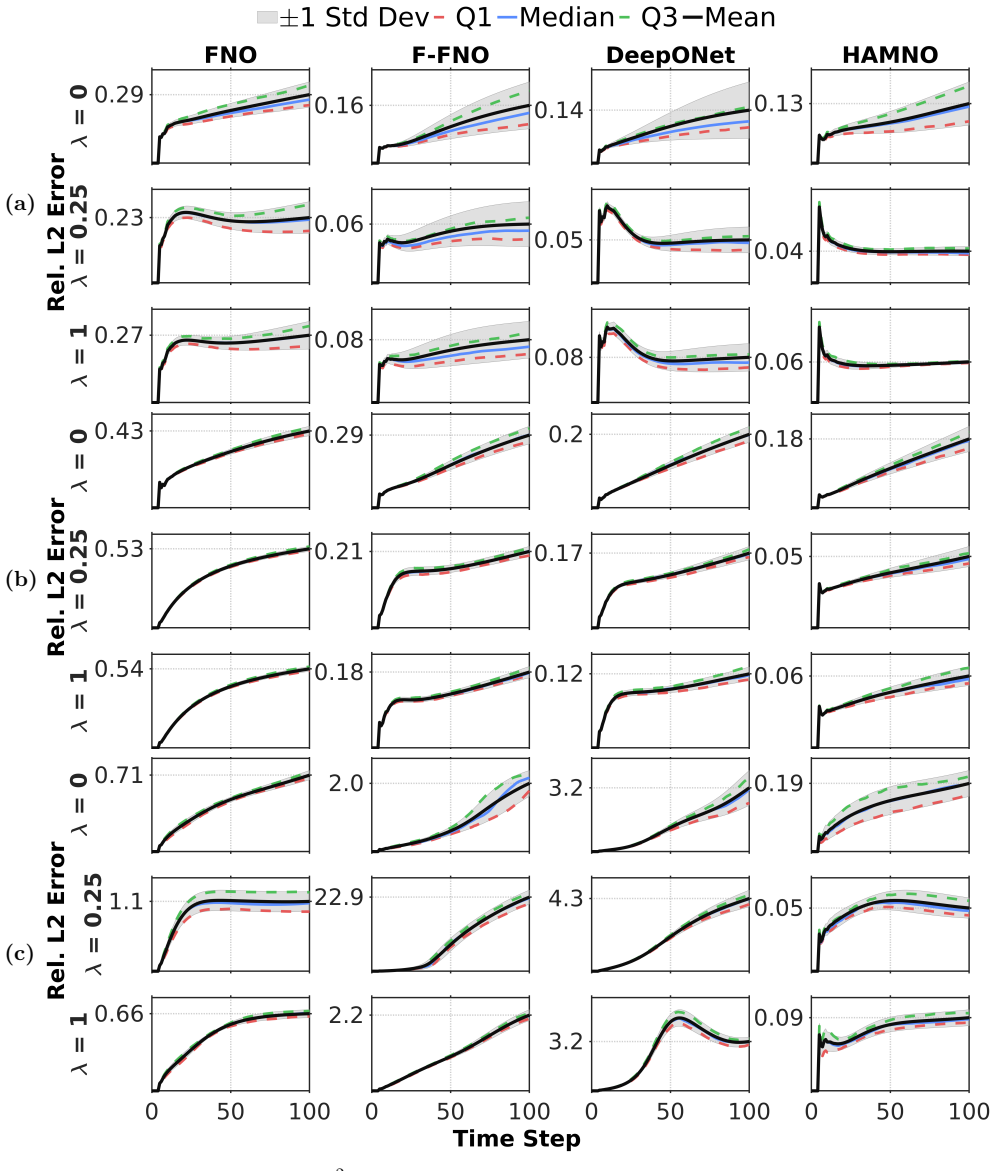
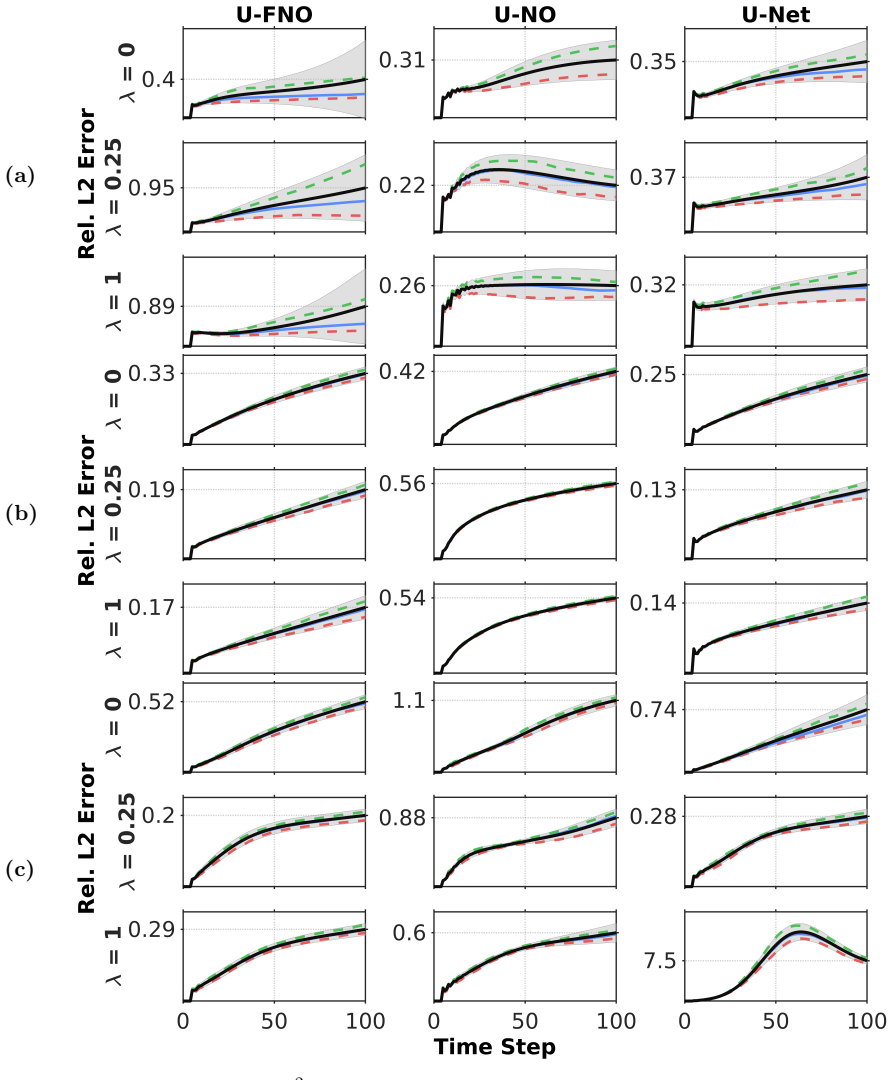
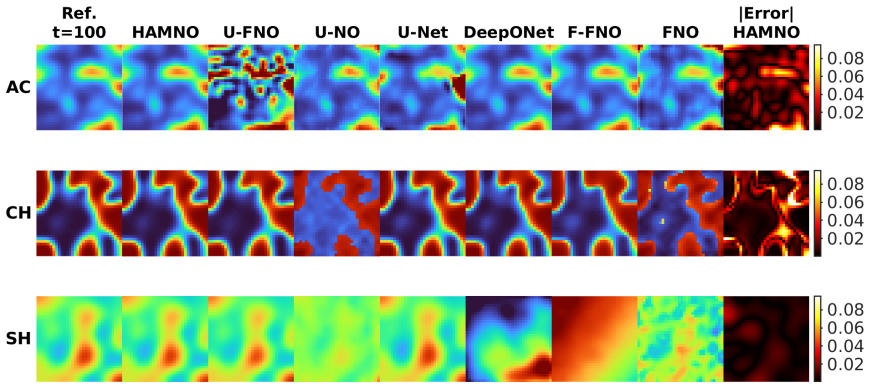
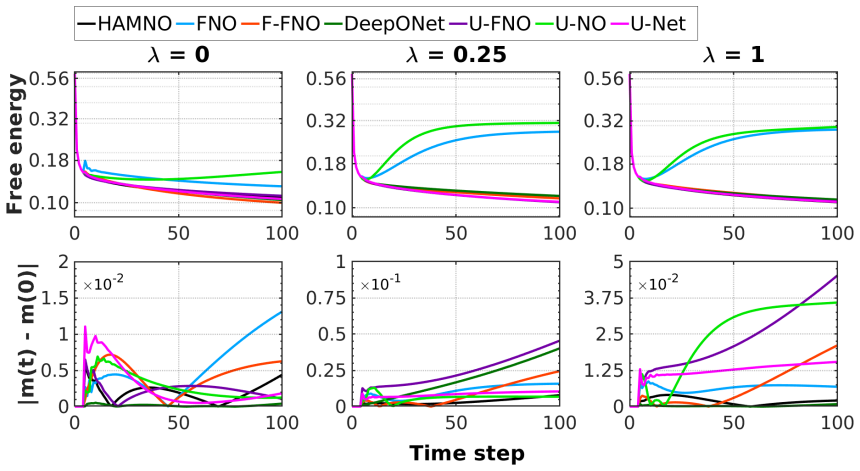
HAMNO achieves improved predictive accuracy over standard neural-operator baselines across long-horizon rollout, data-limited training, out-of-distribution initial-condition shifts, and random-seed variations on the Allen-Cahn, Cahn-Hilliard, and Swift-Hohenberg equations; the PI-HAMNO extension, which augments the loss with domain-integrated strong-form residuals and weak-form integrals obtained via centroid quadrature, further increases stability, physical consistency, and data efficiency.
What carries the argument
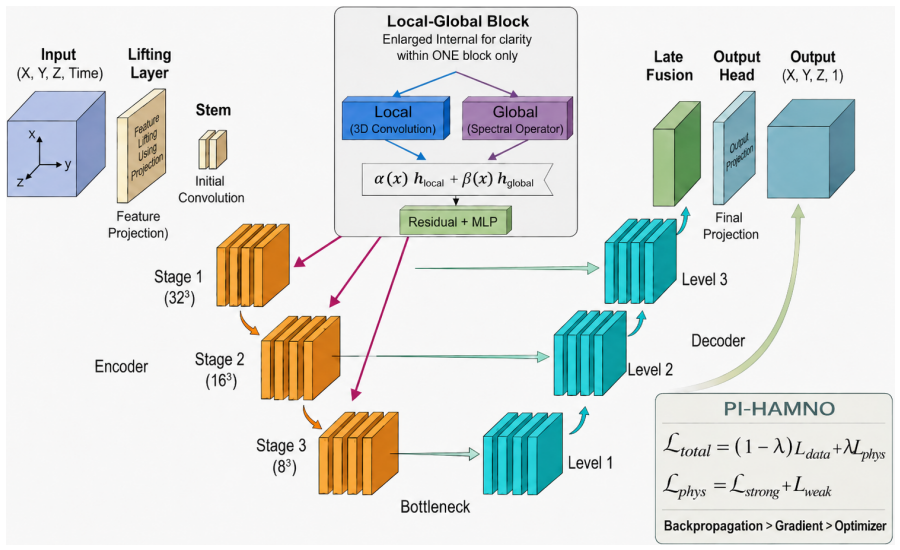
The data-dependent gating mechanism that adaptively balances local convolutional representations and global spectral operators at each spatial location inside a hierarchical encoder-decoder structure.
If this is right
- Long-horizon predictions of the tested phase-field models become more accurate than with prior neural operators.
- Training succeeds with smaller datasets while retaining physical fidelity.
- Models remain accurate when initial conditions lie outside the training distribution.
- Incorporating strong- and weak-form residuals yields more stable and consistent long-time behavior.
Where Pith is reading between the lines
- The gating idea may transfer to other multi-scale PDE families such as fluid or wave equations without major redesign.
- Spatially varying resolution learned by the gates could be inspected to reveal which regions require fine versus coarse treatment.
- Hybrid use with traditional solvers might allow selective replacement of expensive subdomains by the learned operator.
Load-bearing premise
The data-dependent gating mechanism successfully adapts to balance local convolutional and global spectral information at each spatial location to resolve fine-scale features while preserving long-range dependencies.
What would settle it
If HAMNO fails to produce lower rollout error than standard neural-operator baselines on the Allen-Cahn equation under data-limited training and long time horizons, the accuracy claim would not hold.
Figures
read the original abstract
Neural operators provide a powerful framework for learning solution mappings of partial differential equations directly in function space. However, many existing architectures still struggle to represent nonlinear time-dependent systems that involve multi-scale structures, long-range interactions, and stable long-time evolution. In this work, we introduce the Hierarchical Adaptive Multi-scale Neural Operator (HAMNO), a neural-operator architecture that combines local convolutional representations, global spectral operators, and hierarchical encoder-decoder processing. The central component of HAMNO is a data-dependent gating mechanism that adaptively balances local and global information at each spatial location, allowing the model to resolve fine-scale features while preserving long-range dependencies. We further develop a physics-informed extension, PI-HAMNO, based on a multi-objective loss strategy that combines data fitting with strong- and weak-form physics constraints. The strong-form term penalizes the domain-integrated squared PDE residual in physical coordinates, while the weak-form term is constructed by multiplying the governing residual by finite-element test functions and evaluating the resulting element integrals using centroid-based tetrahedral quadrature. The framework is evaluated on non-periodic Allen-Cahn (AC), Cahn-Hilliard (CH), and Swift-Hohenberg (SH) equations defined on cubic domains. Across long-horizon rollout, data-limited training, out-of-distribution initial-condition shifts, and random-seed variations, HAMNO improves predictive accuracy over standard neural-operator baselines, while PI-HAMNO further enhances stability, physical consistency, and data efficiency. The implementation is publicly available at https://github.com/MBamdad/HAMNO .
Editorial analysis
A structured set of objections, weighed in public.
Referee Report
Summary. The manuscript introduces HAMNO, a hierarchical neural operator architecture that integrates local convolutional representations, global spectral operators, and a data-dependent gating mechanism within an encoder-decoder structure to learn solution operators for nonlinear time-dependent PDEs. It further proposes PI-HAMNO, which augments training with a multi-objective loss combining data fidelity, strong-form PDE residuals integrated over the domain, and weak-form residuals discretized via finite-element test functions and centroid-based tetrahedral quadrature. Evaluations on non-periodic Allen-Cahn, Cahn-Hilliard, and Swift-Hohenberg equations on cubic domains report improved predictive accuracy over standard neural-operator baselines in long-horizon rollouts, data-limited regimes, out-of-distribution initial conditions, and across random seeds; PI-HAMNO additionally improves stability and physical consistency.
Significance. If the reported gains in accuracy, stability, and data efficiency hold under the described conditions, the adaptive gating and combined strong/weak-form physics constraints would represent a practical advance for neural operators applied to multi-scale dynamical systems. The public code release strengthens reproducibility.
minor comments (3)
- Abstract: the claim of improvement 'across long-horizon rollout, data-limited training, out-of-distribution initial-condition shifts, and random-seed variations' would be strengthened by explicit quantitative metrics (e.g., relative L2 errors or rollout horizons) rather than qualitative statements; these appear in later sections but should be previewed with numbers.
- The description of the weak-form term (centroid-based tetrahedral quadrature on cubic domains) is clear in principle but would benefit from a brief statement on how the test functions are chosen and whether the quadrature order is fixed or adaptive.
- Ensure that all baseline neural-operator architectures (FNO, DeepONet, etc.) are cited with exact references and that the same training protocol (optimizer, epochs, data splits) is used for fair comparison.
Simulated Author's Rebuttal
We thank the referee for the positive summary of our work and the recommendation of minor revision. No specific major comments were provided in the report, so we have no points requiring rebuttal or clarification at this stage. We will address any minor suggestions in the revised manuscript.
Circularity Check
No significant circularity in derivation chain
full rationale
The paper introduces HAMNO as a hierarchical neural operator architecture combining convolutional, spectral, and encoder-decoder components with a data-dependent gating mechanism, plus PI-HAMNO using a multi-objective loss with strong- and weak-form residuals. All central claims concern empirical improvements in rollout accuracy, data efficiency, and stability on standard phase-field PDEs (Allen-Cahn, Cahn-Hilliard, Swift-Hohenberg). No load-bearing mathematical derivation exists that reduces by construction to fitted parameters, self-definitions, or self-citation chains. The architecture is specified independently of the target metrics, and validation relies on external benchmarks and public code rather than internal tautologies.
Axiom & Free-Parameter Ledger
axioms (1)
- domain assumption The centroid-based tetrahedral quadrature accurately evaluates the weak-form integrals for the physics constraints.
Reference graph
Works this paper leans on
-
[1]
Learning nonlinear operators via DeepONet based on the universal approximation theorem of operators
Lu Lu, Pengzhan Jin, Guofei Pang, Zhongqiang Zhang, and George Em Karni- adakis. Learning nonlinear operators via deeponet based on the universal ap- proximation theorem of operators.Nature Machine Intelligence, 3:218–229, 2021. https://doi.org/10.1038/s42256-021-00302-5
-
[2]
Lu Lu, Xuhui Meng, Shengze Cai, Zhiping Mao, Somdatta Goswami, Zhongqiang Zhang, and George Em Karniadakis. A comprehensive and fair comparison of two neural oper- ators (with practical extensions) based on fair data.Computer Methods in Applied Me- chanics and Engineering, 393:114778, 2022. https://doi.org/10.1016/j.cma.2022.114778
-
[3]
The parametric complexity of operator learning.SIAM Journal on Mathematics of Data Science, 5(4):1072–1101,
Nikola Kovachki, Samuel Lanthaler, and Siddhartha Mishra. The parametric complexity of operator learning.SIAM Journal on Mathematics of Data Science, 5(4):1072–1101,
-
[4]
https://doi.org/10.1137/23M156382X
-
[5]
Ziad Aldirany, R´ emi Cottereau, Mathieu Laforest, and Serge Prudhomme. Operator approximation of the wave equation based on deep learning of green’s function.arXiv preprint arXiv:2307.13902, 2023. https://arxiv.org/abs/2307.13902
arXiv 2023
-
[6]
Dhairya Patel, Deep Ray, Mohamed R. Abdelmalik, Thomas J. R. Hughes, and Assad A. Oberai. Variationally mimetic operator networks.Computer Methods in Applied Mechan- ics and Engineering, 419:116536, 2024. https://doi.org/10.1016/j.cma.2023.116536
-
[7]
Factorized fourier neural operators.International Conference on Learning Representations, 2023
Alasdair Tran, Alexander Mathews, Lexing Xie, and Cheng Soon Ong. Factorized fourier neural operators.International Conference on Learning Representations, 2023. https://arxiv.org/abs/2111.13802
arXiv 2023
-
[8]
Gaurav Gupta, Xiongye Xiao, and Paul Bogdan. Multiwavelet-based operator learning for differential equations.Advances in Neural Information Processing Systems, 34:24048– 24062, 2021. https://arxiv.org/abs/2109.13459
arXiv 2021
-
[9]
Tapas Tripura and Souvik Chakraborty. Wavelet neural operator for solv- ing parametric partial differential equations in computational mechanics prob- lems.Computer Methods in Applied Mechanics and Engineering, 404:115783, 2023. https://doi.org/10.1016/j.cma.2022.115783
-
[10]
Qianying Cao, Somdatta Goswami, and George Em Karniadakis. Laplace neural op- erator for solving differential equations.Nature Machine Intelligence, 6:631–640, 2024. https://doi.org/10.1038/s42256-024-00844-4
-
[11]
Zongyi Li, Weiyang Huang, Burigede Liu, and Anima Anandkumar. Geometry-aware fourier neural operator for partial differential equations on complex geometries.arXiv preprint arXiv:2207.05209, 2022. https://arxiv.org/abs/2207.05209
arXiv 2022
-
[12]
Shuhao Cao. Choose a transformer: Fourier or galerkin.Advances in Neural Information Processing Systems, 34:24924–24940, 2021. https://arxiv.org/abs/2105.14995
arXiv 2021
-
[13]
Zijie Li, Kazem Meidani, and Amir Barati Farimani. Transformer for partial differen- tial equations’ operator learning.Transactions on Machine Learning Research, 2023. https://arxiv.org/abs/2205.13671
arXiv 2023
-
[14]
Shields, and George Em Kar- niadakis
Katiana Kontolati, Somdatta Goswami, Michael D. Shields, and George Em Kar- niadakis. Learning nonlinear operators in latent spaces for real-time predictions 32 of complex dynamics in physical systems.Nature Communications, 15:5101, 2024. https://doi.org/10.1038/s41467-024-49411-w
-
[15]
Marimuthu Kalimuthu, David Holzm¨ uller, and Mathias Niepert. Loglo-fno: Efficient learning of local and global features in fourier neural operators.Transactions on Machine Learning Research, 2025. https://doi.org/10.48550/arXiv.2504.04260
-
[16]
Gege Wen, Zongyi Li, Kamyar Azizzadenesheli, Anima Anandkumar, and Sally M. Benson. U-fno: An enhanced fourier neural operator-based deep-learning model for multiphase flow.Advances in Water Resources, 163:104180, 2022. https://doi.org/10.1016/j.advwatres.2022.104180
-
[17]
Md Ashiqur Rahman and Zachary E. Ross. U-no: U-shaped neural operators.Transac- tions on Machine Learning Research, 2022. https://arxiv.org/abs/2204.11127
arXiv 2022
-
[18]
Olaf Ronneberger, Philipp Fischer, and Thomas Brox. U-net: Convolutional networks for biomedical image segmentation.Medical Image Computing and Computer-Assisted Intervention, pages 234–241, 2015. https://arxiv.org/abs/1505.04597
Pith/arXiv arXiv 2015
-
[19]
Mohammad Sadegh Eshaghi, Navid Valizadeh, Cosmin Anitescu, Yizheng Wang, Xi- aoying Zhuang, and Timon Rabczuk. Multi-head neural operator for modelling in- terfacial dynamics.International Journal of Mechanical Sciences, 285:111363, 2026. https://doi.org/10.1016/j.ijmecsci.2026.111363
-
[20]
Katarzyna Micha lowska, Somdatta Goswami, George Em Karniadakis, and Signe Riemer- Sørensen. Neural operator learning for long-time integration in dynamical systems with recurrent neural networks.International Joint Conference on Neural Networks, pages 1–8, 2024. https://doi.org/10.1109/IJCNN60899.2024.10650331
-
[21]
Mohammad Sadegh Eshaghi, Cosmin Anitescu, Navid Valizadeh, Yizheng Wang, Xiaoy- ing Zhuang, and Timon Rabczuk. Nows: Neural operator warm starts for accelerating iter- ative solvers.arXiv preprint arXiv:2511.02481, 2025. https://arxiv.org/abs/2511.02481
Pith/arXiv arXiv 2025
-
[22]
Mohammad Sadegh Eshaghi, Cosmin Anitescu, Manish Thombre, Yizheng Wang, Xiaoy- ing Zhuang, and Timon Rabczuk. Variational physics-informed neural operator (VINO) for solving partial differential equations.Computer Methods in Applied Mechanics and Engineering, 437:117785, 2025. https://doi.org/10.1016/j.cma.2025.117785
-
[23]
Navaneeth and Souvik Chakraborty
N. Navaneeth and Souvik Chakraborty. Physics-informed wavelet neural op- erator for learning solution operators of parametric partial differential equa- tions.Computer Methods in Applied Mechanics and Engineering, 418:116546, 2024. https://doi.org/10.1016/j.cma.2023.116546
-
[24]
Sharmila Karumuri, Lori Graham-Brady, and Somdatta Goswami. Physics-informed latent neural operator for real-time simulations of parametric pdes.arXiv preprint arXiv:2501.08428, 2025. https://arxiv.org/abs/2501.08428
arXiv 2025
-
[25]
Penco: A physics–energy–numerics–consistent operator for 3d phase field modeling.Computer Methods in Applied Mechanics and Engineering, 454:118862,
Mostafa Bamdad, Mohammad Sadegh Eshaghi, Cosmin Anitescu, Navid Valizadeh, and Timon Rabczuk. Penco: A physics–energy–numerics–consistent operator for 3d phase field modeling.Computer Methods in Applied Mechanics and Engineering, 454:118862,
-
[26]
https://doi.org/10.1016/j.cma.2026.118862. 33
-
[27]
The phase field method for geometric moving inter- faces and their numerical approximations
Qiang Du and Xiaobing Feng. The phase field method for geometric moving inter- faces and their numerical approximations. InGeometric Partial Differential Equations – Part I, volume 21 ofHandbook of Numerical Analysis, pages 425–508. Elsevier, 2020. https://doi.org/10.1016/bs.hna.2019.05.001
-
[28]
Damien Tourret, Hong Liu, and Javier Llorca. Phase-field modeling of microstructure evolution: Recent applications, perspectives and challenges.Progress in Materials Sci- ence, 123:100810, 2022. https://doi.org/10.1016/j.pmatsci.2021.100810
-
[29]
Xiaoying Zhuang, Shuwei Zhou, G. D. Huynh, P. Areias, and Timon Rabczuk. Phase field modeling and computer implementation: A review.Engineering Fracture Mechanics, 262:108234, 2022. https://doi.org/10.1016/j.engfracmech.2022.108234
-
[30]
David Montes de Oca Zapiain, James A. Stewart, and R´ emi Dingreville. Ac- celerating phase-field-based microstructure evolution predictions via surrogate mod- els trained by machine learning methods.npj Computational Materials, 7:3, 2021. https://doi.org/10.1038/s41524-020-00471-8
-
[31]
Andreas Krischok, Basavesh Yaraguntappa, and Marc-Andr´ e Keip. Fast implicit up- date schemes for cahn–hilliard-type gradient flow in the context of fourier-spectral meth- ods.Computer Methods in Applied Mechanics and Engineering, 431:117220, 2024. https://doi.org/10.1016/j.cma.2024.117220
-
[32]
Mohammad Sadegh Eshaghi, Mostafa Bamdad, Cosmin Anitescu, Yizheng Wang, Xi- aoying Zhuang, and Timon Rabczuk. Applications of scientific machine learning for the analysis of functionally graded porous beams.Neurocomputing, 619:129119, 2025. https://doi.org/10.1016/j.neucom.2024.129119
-
[33]
Fourier-spectral method for the phase-field equations.Mathemat- ics, 8(8):1385, 2020
Sungha Yoon, Darae Jeong, Chaeyoung Lee, Hyundong Kim, Sangkwon Kim, Hyun Geun Lee, and Junseok Kim. Fourier-spectral method for the phase-field equations.Mathemat- ics, 8(8):1385, 2020. https://doi.org/10.3390/math8081385. 34
discussion (0)
Sign in with ORCID, Apple, or X to comment. Anyone can read and Pith papers without signing in.