REVIEW 3 major objections 5 minor 11 references
Given only published CMS and ATLAS dijet mass spectra, a symbolic-regression search rediscovers the standard background functions used in those analyses, suggesting that the manual trial-and-error search for functional forms can be automate
Reviewed by Pith at T0; open to challenge. T0 means a machine referee read the full paper against a public rubric. the ladder, T0–T4 →
T0 review · deepseek-v4-flash
2026-08-01 11:46 UTC pith:KS4DKHLA
load-bearing objection Useful demonstration of symbolic regression for HEP background fitting, but the 111/560 rediscovery number is inflated because most dijet hits drop the p3 ln x term and the template configs are built to exclude it. the 3 major comments →
Machine Can Automatically Discover Parametric Functions to Model HEP Data
The pith
A machine-rendered reading of the paper's core claim, the machinery that carries it, and where it could break.
Core claim
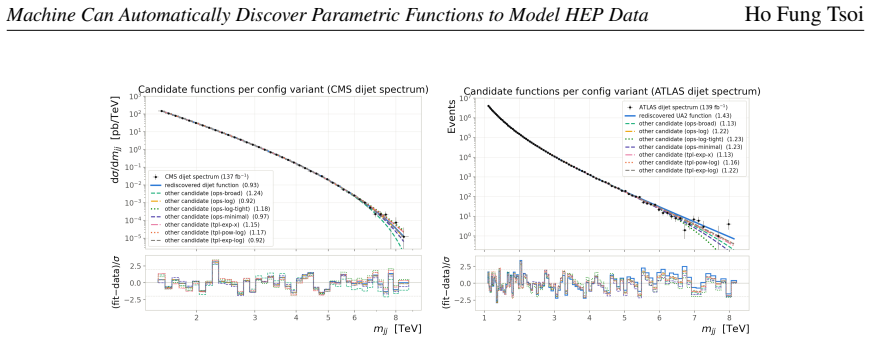
The paper's central claim is that, given only the observed dijet spectra, a machine can rediscover the very empirical functions that human analysts had previously invented to model those spectra. The rediscovery is not rare: 111 of 560 seeded runs over seven search configurations returned at least one candidate algebraically equivalent to a member of the dijet or UA2 families. Beyond rediscovery, the search produced a wide diversity of alternative functions that fit the spectra equally well, indicating that the published functions are not uniquely determined by the data alone.
What carries the argument
The central mechanism is the SymbolFit pipeline: it feeds the binned spectrum to a symbolic-regression search engine that proposes candidate functional forms, then re-fits the numerical constants with standard nonlinear least-squares optimization and estimates parameter uncertainties via the covariance matrix. The search is guided by a per-bin chi-squared loss, and the paper defines seven search configurations—four free-form operator sets and three template-constrained forms—that restrict the space of possible function expressions.
Load-bearing premise
The load-bearing premise is that a candidate counts as a rediscovery when it is 'algebraically equivalent to a member' of the dijet or UA2 family, but the paper does not specify the exact equivalence-checking procedure, and since most rediscovered dijet forms omit the p3 ln x term, a stricter match to the full published formula would reduce the reported rediscovery rate.
What would settle it
Run the same 560-seed experiment but define rediscovery as matching the full published two-term forms with the p3 ln x term present and significantly nonzero. If the rediscovery rate drops to near zero, the paper's claim that the search rediscovers the published functions is much weaker. Alternatively, apply SymbolFit to a synthetic spectrum generated from a known analytic function and check whether the search returns that function with high probability.
If this is right
- If the result holds, the manual, intuition-driven selection of parametric background functions can be automated, speeding up a common step in HEP analyses.
- The search finds many distinct functional forms with comparable fit quality, implying that the published dijet and UA2 functions are not unique and that background modeling could benefit from considering a wider family of candidates.
- Rediscovery rates improve sharply when the search is guided by templates inspired by the target function, suggesting that human priors still matter even in an automated search.
- Uncertainty estimation is built into every candidate, which is necessary for using such functions in statistical inference and resonance searches.
- The approach can in principle be applied to any binned distribution in HEP where an empirical smooth model is needed, not just dijet spectra.
Where Pith is reading between the lines
- The paper's rediscovery count uses a broad definition of 'algebraically equivalent to a member of the family', and most rediscovered dijet forms drop the p3 ln x term; a stricter match to the full published two-term form would likely yield a lower rediscovery rate.
- Because the search returns many equally good functions, downstream resonance searches would need criteria beyond chi2/NDF to select a background model that is unbiased in the signal region.
- The most assumption-free configuration (ops-minimal) still rediscovers the target functions at a modest rate, while the templated configurations do far better—this suggests the machine's 'discovery' is partly enabled by the human-supplied structure of the function space.
- A natural extension, not tested in the paper, is to apply SymbolFit to a synthetic spectrum generated from a known true function, which would provide a controlled check of how often the search recovers the ground truth under different operator sets and noise levels.
Editorial analysis
A structured set of objections, weighed in public.
Referee Report
Summary. The paper presents SymbolFit, a pipeline combining symbolic regression (PySR) with LMFIT-based re-optimization and uncertainty estimation, and tests whether it can rediscover the published CMS dijet background function and the UA2 function from the Run 2 dijet mass spectra. Across 560 seeded runs with seven configurations (four free-form, three template), 111 runs return a candidate declared algebraically equivalent to a member of the dijet or UA2 families with chi2/NDF<2, and over 1000 candidate functions achieve chi2/NDF≈1. The authors argue this demonstrates that the manual empirical functional-form search can be automated.
Significance. If the central claim is established, this would be a useful demonstration that symbolic regression can automate a task that is currently manual in HEP, with potential applications to background modeling and scale-factor derivation. Strengths: public HEPData inputs, open-source package, a clearly described pipeline, and a benchmark against published functions rather than self-generated targets. The paper also shows a wide variety of alternative functions fit equally well, which is informative. However, the central rediscovery claim currently rests on an unspecified equivalence criterion and a family definition that admits the p3=0 special case; these need to be tightened before the headline number can be taken at face value.
major comments (3)
- [§3, rediscovery criterion] The rediscovery definition — 'algebraically equivalent to a member of the dijet or UA2 function families in Eq. 1' with chi2/NDF<2 — is not operationalized. The manuscript never states how equivalence is determined (e.g., which symbolic simplifications are allowed, whether constants can be absorbed, how p3=0 cases are classified). Without this, the central number 111/560 cannot be reproduced or independently verified. Please specify the exact procedure and, ideally, provide the list of candidates judged equivalent and their equivalence mapping.
- [§4 and Table 2] The manuscript concedes that 'the majority of the rediscovered dijet forms have the p3 ln x term absent (p3=0)' and the CMS rediscovery in Table 2 is 0.00672(1-x)^8.15 / x^5.23, with no ln term. This is a special case of Eq. (1) (f_dijet with p3=0), not the full published two-term form. Consequently the abstract/summary claim that SymbolFit 'rediscovered the very dijet and UA2 functions used in published searches' is overstated. Please report rediscovery rates separately for the full published form and for the p3=0 special case, and discuss the implications for the headline rate. The direct-fit result that p3 is consistent with zero for this dataset does not change the fact that the benchmark is the published function.
- [§3, Table 1; §4] The template configurations are structurally aligned with the target functions: tpl-exp-log searches functions of the form exp(h(ln x, ln(1-x))) with h built from {+,-,*}, which for p3=0 contains the dijet form exactly; tpl-exp-x contains the UA2 form. The text calls these 'simple search configurations' and notes the template 'narrow[s] down the building blocks toward those of the dijet function,' but the abstract and §4's 'rediscovered the very dijet and UA2 functions' do not fully convey how much of the discovery is due to these guided templates. Please clearly distinguish unguided (ops-*) and guided (tpl-*) rediscovery rates in the abstract and summary, and avoid 'nearly assumption-free' characterizations of the template results.
minor comments (5)
- [Fig. 1] Rediscovery rates are quoted as raw counts out of 40 runs; include binomial confidence intervals or state explicitly that uncertainties are not shown.
- [§4, Fig. 1 caption] The sentence 'No run finds both, so in total 111 of the 560 runs rediscover one of the two' is unclear: the 'so' suggests a logical connection that is not stated. Give the breakdown (e.g., number of dijet vs UA2 rediscoveries).
- [Fig. 2 caption] 'those with the same vertical position belong to the same run' is hard to verify because the y-axis is not categorical; clarify the plotting method.
- [Throughout] There are several typos and rendering artifacts in the PDF (e.g., 'symbolicregression', missing spaces in inline math). Please ensure the final compiled version is clean.
- [§4] The phrase 'with the p3 ln x term absent (p3=0)' is imprecise: a functional form that never contains ln x does not have a parameter p3. Please rephrase (e.g., 'candidates without a logarithmic term in the denominator').
Circularity Check
No significant circularity: rediscovery is measured against external published dijet functions and spectra, not against inputs derived from the model.
full rationale
The paper's central claim is an empirical benchmark: SymbolFit is given only the CMS and ATLAS published dijet mass spectra and asked whether the search can return functions algebraically equivalent to the published dijet/UA2 families (Eq. 1). The target functions come from external CMS/ATLAS papers, and no constants of those functions are fitted as inputs; the experiment is self-contained against external data. The templated configurations (tpl-exp-log etc.) are admittedly designed to guide the search toward the dijet building blocks (Section 4: "When a template is imposed to guide the search by narrowing down the building blocks toward those of the dijet function"), but this is an openly disclosed search-space choice, not a hidden re-import of the result; free-form ops-minimal also finds the functions (3/40 and 2/40). The self-citations [4] and [5] are tool citations whose functionality is demonstrated in this paper, so they are not load-bearing. The main non-circularity caveat is validity, not circularity: Section 4 concedes "the majority of the rediscovered dijet forms have the p3 ln x term absent (p3 = 0)", and the CMS rediscovery in Table 2 is the p3=0 form 0.00672(1-x)^8.15/x^5.23, so the 'rediscovery' definition is broad and the headline rate is inflated relative to the full published two-term dijet function. This concerns the rigor of the equivalence metric, not a derivation that reduces to its own inputs.
Axiom & Free-Parameter Ledger
free parameters (3)
- Function-space configuration choices
- PySR hyperparameters
- Rediscovery definition thresholds
axioms (3)
- domain assumption The published CMS and ATLAS dijet spectra and their uncertainties, taken from HEPData, are correct and usable as-is.
- domain assumption chi2 loss with per-bin uncertainties is an adequate objective for finding useful background functions.
- domain assumption PySR's evolutionary search adequately samples the function space defined by each config.
read the original abstract
In HEP data analyses, finding an adequate function to model binned data has largely relied on a manual process: guess a functional form by intuition, fit, examine, then repeat until successful. We show that this iterative process can be automated by a machine using symbolic regression, which performs a data-driven search over function space without requiring prior knowledge of what an adequate function should look like. We present the SymbolFit package, which pairs symbolic regression with uncertainty modeling to target HEP analysis use cases, and demonstrate it on the CMS and ATLAS Run 2 dijet spectra: 560 independent seeded runs across seven simple fit configurations generated over 1000 functions fitting the spectra with $\chi^2/\text{NDF}\approx 1$, and 111 of the runs rediscovered the very dijet and UA2 functions used in published dijet searches.
Figures



Reference graph
Works this paper leans on
-
[2]
Cranmer, Miles , month = may, year =. Interpretable. doi:10.48550/arXiv.2305.01582 , urldate =
-
[6]
Search for high mass dijet resonances with a new background prediction method in proton-proton collisions at s = 13 TeV
CMS Collaboration. Search for high mass dijet resonances with a new background prediction method in proton-proton collisions at s = 13 TeV
-
[7]
Search for new resonances in mass distributions of jet pairs using 139 fb ^ -1 of pp collisions at s =13 TeV with the ATLAS detector
ATLAS Collaboration. Search for new resonances in mass distributions of jet pairs using 139 fb ^ -1 of pp collisions at s =13 TeV with the ATLAS detector
-
[9]
author Sirunyan, A. M. et al. title Search for high mass dijet resonances with a new background prediction method in proton-proton collisions at s = 13 TeV . journal JHEP volume 05 , pages 033 ( year 2020 ). 1911.03947
Pith/arXiv arXiv 2020
-
[10]
author Aad, G. et al. title Search for new resonances in mass distributions of jet pairs using 139 fb ^ -1 of pp collisions at s =13 TeV with the ATLAS detector . journal JHEP volume 03 , pages 145 ( year 2020 ). 1910.08447
Pith/arXiv arXiv 2020
-
[11]
author Aaboud, M. et al. title Search for low-mass dijet resonances using trigger-level jets with the ATLAS detector in pp collisions at s =13 TeV . journal Phys. Rev. Lett. volume 121 , pages 081801 ( year 2018 ). 1804.03496
Pith/arXiv arXiv 2018
-
[12]
author Tsoi, H. F. et al. title SymbolFit: Automatic Parametric Modeling with Symbolic Regression . journal Comput. Softw. Big Sci. volume 9 , pages 12 ( year 2025 ). 2411.09851
Pith/arXiv arXiv 2025
-
[13]
title Interpretable Machine Learning for Science with PySR and SymbolicRegression .jl ( year 2023 )
author Cranmer, M. title Interpretable Machine Learning for Science with PySR and SymbolicRegression .jl ( year 2023 ). ://arxiv.org/abs/2305.01582. note ArXiv:2305.01582 [astro-ph, physics:physics]
Pith/arXiv arXiv 2023
-
[14]
author Newville, M. et al. title LMFIT : Non-linear least-squares minimization and curve-fitting for Python ( year 2025 ). ://doi.org/10.5281/zenodo.16175987
-
[15]
author CMS Collaboration . title Search for high mass dijet resonances with a new background prediction method in proton-proton collisions at s = 13 TeV . howpublished HEPData (collection) ( year 2019 ). note https://doi.org/10.17182/hepdata.91059
-
[16]
author ATLAS Collaboration . title Search for new resonances in mass distributions of jet pairs using 139 fb ^ -1 of pp collisions at s =13 TeV with the ATLAS detector . howpublished HEPData (collection) ( year 2020 ). note https://doi.org/10.17182/hepdata.91126
discussion (0)
Sign in with ORCID, Apple, or X to comment. Anyone can read and Pith papers without signing in.