REVIEW 2 major objections 4 minor 39 references
Observing the Sun with the Atacama Large Aperture Submillimeter Telescope (AtLAST): Forecasting Full-disk Observations
T0 review · 2 major / 4 minor · reviewed 2026-08-15 · deepseek-v4-flash
Pith's one-line read The paper argues that AtLAST can scan the full solar disk in under a minute with instruments of a few thousand to 50,000 detectors, and in seconds with ~100,000-detector large-field-of-view arrays.
desk verdict Useful feasibility study with a real internal inconsistency: the scan-time scaling relation does not reproduce the paper's own simulated cases; the qualitative sub-minute conclusion is plausible, but the quantitative forecasts need fixing. read the letter →
The pith
A machine-rendered reading of the paper's core claim, the machinery that carries it, and where it could break.
The reading
What carries the argument
The engine of the argument is the combination of three design choices: the instantaneous field of view of the focal-plane array (set by pixel count, pixel spacing in units of the wavelength-scaled beam, and observing frequency), the scan pattern (double-circle vs. simple circle), and the sampling length $l$ — the gap between adjacent scan paths, normalized to the field of view. For the double-circle pattern the paper derives power-law fits $N_{\mathrm{circles}}\propto \mathrm{FOV}^{-0.95}$ and $t_{\mathrm{scan}}\propto \mathrm{FOV}^{-0.9}$ for $l=0.5$ and $1.0\,\mathrm{FOV}$, which convert instrumental parameters into predicted full-disk cadence. The maria code supplies the realistic time-ordered data that let the authors test whether the resulting maps actually recover the input Sun.
What would settle it
Run the actual mount through the small-field double-circle pattern and the large-field circular pattern and compare the wall-clock times to the fitted $t\propto \mathrm{FOV}^{-0.9}$ relation; a clear mismatch would overturn the cadence claims. A simpler check is to re-run the intermediate simulation with the same sampling-length criterion used for the fits and see whether the full disk stays covered without gaps.
Extended reading notes
Core claim
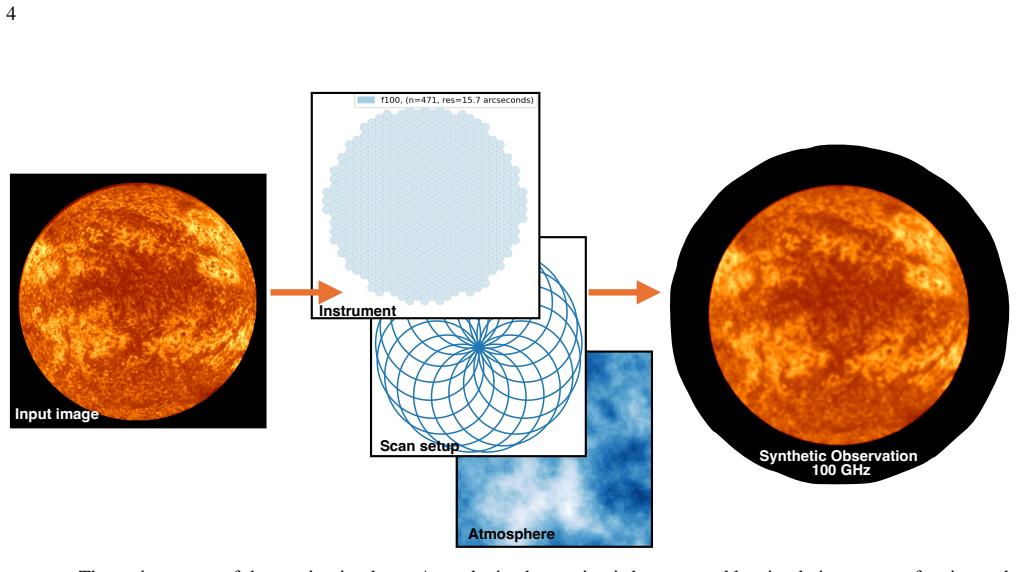
The paper's central claim is that full-disk millimetre imaging of the Sun is within reach of the planned AtLAST telescope at cadences no current solar millimetre facility provides. Using the maria simulator with realistic all-disk input maps built from SDO ultraviolet and ALMA total-power data, it simulates three instrument archetypes: a small-field-of-view array (1,000 detectors, $2f\lambda$ spacing, 0.03051° field of view) completes a dense 36-circle double-circle scan in 89 seconds; an intermediate array (50,000 detectors, $1f\lambda$ spacing, 0.146679° field of view) covers the disk in about 11.4 seconds with a 4-circle double-circle scan; and a large-field-of-view array (100,000 detectors, $2f\lambda$ spacing, 0.30573° field of view) uses a simple circular scan of radius $0.6\,R_\odot$ and finishes in about 2.7 seconds. Power-law fits to these simulations give the number of secondary circles and the scan time as functions of instrument field of view, so any detector count, spacing, and frequency can be translated into a full-disk cadence. The conclusion is that a realistic first-generation multi-chroic camera reaches sub-minute cadence across the 100–950 GHz range, with the double-circle pattern used at ALMA remaining acceptable for small and intermediate fields of view while a plain circle wins at large fields of view.
Load-bearing premise
Everything rests on the assumption that AtLAST's mount can actually sustain 3 degrees per second and 1 degree per second squared while a detector array densely fills its nominal field of view; if the real telescope slews slower or the array has gaps, the quoted scan times are too short.
Editorial extensions
If this is right
- With a first-generation array of 50,000 detectors per band, full-disk maps at all considered bands can be made in under a minute, roughly ten times faster than ALMA's total-power scans and at about four times the angular resolution.
- Pushing to ~100,000 detectors with a field of view of at least about one solar radius brings full-disk cadence to a few seconds, enough to resolve the ~5-minute peak of a small flare with dozens to over a hundred time steps.
- The double-circle scan pattern currently used at ALMA is adequate for AtLAST at small to intermediate fields of view; at larger fields of view a simple circular scan is more efficient, so the optimal scan strategy depends on the instrument built.
- Atmospheric transmission limits high-frequency (670 and 950 GHz) work more than low-frequency work, and a large-field-of-view fast scan preserves smaller spatial scales than a small-field-of-view slow scan at the same frequency.
- A high-cadence full-disk millimetre capability would complement ALMA by catching transient events such as flares and by mapping large-scale structures like prominences that exceed ALMA's field of view.
Reading between the lines
- A natural extension is to run the same simulations with a time-dependent input map, since the paper uses a static Sun; a flaring brightening that evolves during the ~3-second Case C circle would tell how much transient information is blurred.
- The cadence-vs-FOV scaling (roughly $t\propto \mathrm{FOV}^{-0.9}$) should transfer to other extended millimetre targets of similar angular size, so the results could inform scanning strategies for observations beyond the Sun.
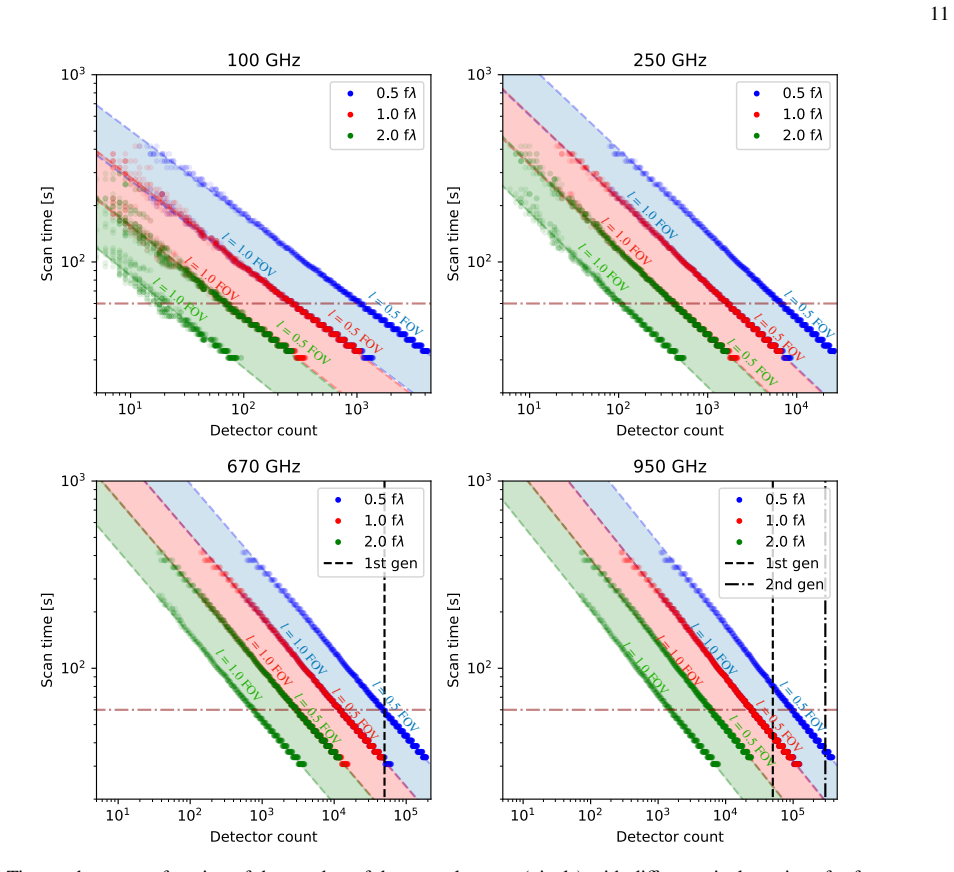
- The paper's pixel-count tables (for example, ~97,000 pixels at $0.5f\lambda$ spacing for a 1-minute cadence at 950 GHz) give instrument designers a concrete trade-off between Nyquist sampling, detector count, and cadence; optimizing that trade-off is the immediate engineering follow-up.
Signed reviews
Editorial analysis
A structured set of objections, weighed in public.
Referee Report
Summary. The paper uses the maria single-dish telescope simulator to forecast full-disk solar observations with the proposed AtLAST 50-m telescope. It constructs realistic millimeter input maps by combining SDO/AIA ultraviolet images with ALMA total-power maps, simulates three representative instrument configurations (a 1,000-pixel small-FOV array, a 50,000-pixel intermediate-FOV array, and a 100,000-pixel large-FOV array), and compares double-circle and circular scan patterns. From these simulations the paper derives power-law scaling relations between instrument field of view, pixel count, and full-disk scan time, and concludes that sub-minute cadence is achievable across AtLAST's 100-950 GHz range, with cadences of a few seconds for large-FOV instruments.
Significance. If the results hold, this is a valuable and timely design-study contribution: it gives concrete, quantitative guidance for a possible solar instrument at AtLAST, uses a publicly available simulator, and makes falsifiable predictions about scan times and required pixel counts that can be tested once the telescope and instrument parameters are finalized. The comparison with ALMA total-power full-disk maps (about 10-minute cadence) indicates a potential order-of-magnitude improvement in cadence and a substantial gain in angular resolution. However, the quantitative relations that anchor Figure 6 and Table 2 are not self-consistent with the explicitly simulated scan times, so the headline cadence numbers are not yet presented in a fully coherent way.
major comments (2)
- [§4.3, Eqs. (3)–(4)] The fitted scan-time relations do not reproduce the simulated scan times reported for Cases A and B. For Case B (FOV = 0.146679 deg and l = 1.0 FOV), Eq. (4) gives approximately 17.9 s, whereas the simulation in §4.2.2 reports about 11.4 s. For Case A (FOV = 0.03051 deg), Eq. (4) gives about 73 s and Eq. (3) gives about 135 s, bracketing but not matching the reported 89 s. The reason appears to be that Eqs. (1)–(4) are derived from a geometric 'no gaps' criterion with sampling length l = 1.0 FOV or l = 0.5 FOV, while the simulations declare a scan sufficient when the input map structures are recovered after smoothing. Because Figure 6 and Table 2 are generated from Eqs. (3)–(4), the central cadence numbers are not firmly anchored to the simulated trajectories. Please either refit the relations using the same sufficiency criterion as the simulations, or report the scan times from the simulated Cases A–C directly, and quantify the difference between the two criteria.
- [§4.2.2 and Eq. (2)] For Case B, Eq. (2) with l = 1.0 FOV predicts about 6.2 secondary circles for a region of 2400 arcsec diameter, whereas the simulation uses only four secondary circles and finds this sufficient. This is not a minor rounding difference; it corresponds to a factor of roughly 1.5 in coverage and about a factor of 1.6 in scan time. The definition of 'sufficient sampling' therefore needs to be made explicit and applied uniformly. As written, the reader cannot tell whether the quoted 11.4 s scan time corresponds to the same quality criterion as the power-law fits, and the status of Figure 6 and Table 2 as predictions is unclear.
minor comments (4)
- [§4.2.1 and Fig. 3a] The text states that 36 minor circles were sufficient for Case A, while the label in Fig. 3a reads ncirc = 35; please reconcile these numbers.
- [§5.1 and Fig. 6] The text says the trends in Fig. 6 were made with a sampling length of l = 0.5 FOV, but Fig. 6 and the surrounding discussion show both l = 0.5 FOV and l = 1.0 FOV; please clarify which sampling length was used for the entries in Table 2.
- [§4.3] The power-law fits in Eqs. (1)–(4) are quoted with parameter uncertainties, but no goodness-of-fit statistic or number of fitted FOV values is reported; please add the fit range, number of points, and scatter.
- [Abstract and Table 2] The abstract states that instruments with 1,000–50,000 detectors achieve sub-minute cadence across AtLAST's frequency range, but Table 2 shows that 950 GHz with 0.5 fλ spacing requires about 97,768 pixels for a one-minute cadence; the claim should be qualified with the relevant pixel spacings.
Circularity Check
No significant circularity: the cadence forecasts are outputs of the published maria simulator and independent geometric scaling relations, not restatements of their inputs.
full rationale
The paper's derivation chain is self-contained in the relevant sense. Scan times for the three instrument cases are obtained directly from maria simulations with specified instrument parameters, scan patterns, and AtLAST mount limits (Sects. 4.2.1-4.2.3). The analytic cadence relations in Eqs. 1-4 are derived from an explicitly stated geometric sampling criterion (minor-circle gaps equal to the instrument FOV) combined with the assumed velocity and acceleration limits, and are then used to forecast cadence as a function of pixel count (Sect. 4.3, Fig. 6, Table 2). None of these steps defines the target result, sub-minute full-disk cadence, in terms of itself. The input maps constructed from SDO/AIA and scaled to ALMA total-power temperatures affect the image-fidelity tests and power-spectrum comparisons, not the scan-time computation, so they do not make the cadence claim circular. The maria simulator is cited from prior work by overlapping authors, but it is a published, externally usable code with stated assumptions and is not invoked as an unverified assertion of the target result; the self-citation is therefore not load-bearing in a circular way. The geometric 'sufficient sampling' criterion used for Eqs. 1-4 is not identical to the visual-recovery criterion used in the Case A/B/C simulations, and Eq. 4 does not perfectly reproduce the simulated Case B time; however, this is an internal consistency and extrapolation concern, not a reduction of the prediction to its own inputs. No fitted parameter is renamed as an independent prediction, and no uniqueness theorem or ansatz is smuggled in via self-citation. The central forecasting claim rests on a published simulator and on transparently stated engineering assumptions, so the paper warrants a score of 0 for circularity.
Assumptions & free parameters
free parameters (6)
- N_circles scaling exponent =
-0.951 ± 0.003 (l=0.5), -0.943 ± 0.006 (l=1.0)
- N_circles normalization =
10^(0.285 ± 0.004) (l=0.5), 10^(0.008 ± 0.008) (l=1.0)
- t_scan scaling exponent =
-0.893 ± 0.004 (l=0.5), -0.897 ± 0.006 (l=1.0)
- t_scan normalization =
10^(0.778 ± 0.004) (l=0.5), 10^(0.504 ± 0.009) (l=1.0)
- Input map brightness temperature scaling =
not specified numerically
- AIA 304/1600 Å mask threshold =
not specified; 'adjusted slightly at different epochs'
assumptions (5)
- domain assumption AtLAST will meet a velocity limit of 3 deg/s and an acceleration limit of 1 deg/s^2
- domain assumption The Sun can be approximated as a circular 2400 arcsec region with a 200 arcsec off-limb margin
- ad hoc to paper Sampling length l = 0.5 or 1.0 FOV is sufficient for full-disk sampling with a double-circle pattern
- domain assumption SDO AIA 304/1600 Å maps, scaled in brightness temperature, adequately represent the millimeter Sun for resolution forecasts
- domain assumption The maria simulator correctly models single-dish beams, scan kinematics, and the atmosphere
Cite this review
Pith. "Pith review of Observing the Sun with the Atacama Large Aperture Submillimeter Telescope (AtLAST): Forecasting Full-disk Observations." pith.science (2026). https://pith.science/paper/KV4FBO63
@misc{pith2026250513145,
  author       = {Pith},
  title        = {Pith review of: Observing the Sun with the Atacama Large Aperture Submillimeter Telescope (AtLAST): Forecasting Full-disk Observations},
  year         = {2026},
  howpublished = {\url{https://pith.science/paper/KV4FBO63}},
  note         = {Machine review of arXiv:2505.13145}
}
abstract
The Atacama Large Millimeter Array (ALMA) has revolutionised the field of solar millimetre astronomy with its high angular resolution and cadence. However, with a limited field of view (FOV), targeted observations of highly dynamic phenomena such of flares are challenging. A large aperture single-dish telescope with a large FOV, such as the future Atacama Large Aperture Submillimeter Telescope (AtLAST), would prove useful in observing such phenomena, as one could scan the full solar disk on shorter timescales. We aimed to explore what FOVs, detector counts, and scan strategies are suitable for AtLAST to push the required full-disk scan times below 1 minute, enabling regular observations of dynamic solar phenomena. Utilising the maria code, we were able to simulate solar observations with AtLAST, and thoroughly explored how instrumental properties and scanning strategies affect the full-disk observations in the planned frequency bands. We find the double-circle scan pattern, currently employed at ALMA for full-disk mapping to also be an acceptable way of scanning the Sun with AtLAST. Using small to intermediately sized instruments (1000 - 50,000 detector elements), the estimated observational cadence would be less than 1 minute across AtLAST's frequency range with a reasonable pixel spacing. Using instruments with larger FOVs ($\gtrapprox 0.25^\circ$, equivalent to $\gtrapprox$ 1 R$_\odot$), we find a simple circular scan to be more efficient, achieving cadences on second time scales, but requiring more detector elements ($\gtrapprox$ 100,000). We find that a large FOV single-dish telescope such as AtLAST could provide the solar millimetre community with hitherto unachievable observations, namely full-disk observations at high cadence and adequate resolution. With cadences potentially down to seconds, such an instrument would be ideal in the study of quickly evolving solar phenomena.
Figures


Figures from the paper (8 more)




Reference graph
Works this paper leans on
-
[1]
Solar science with the Atacama Large Millimeter/submillimeter Array - A new view of our Sun
author author S. Wedemeyer , author T. Bastian , author R. Braj s a , author H. Hudson , author G. Fleishman , author M. Loukitcheva , author B. Fleck , author E. P. \ Kontar , author B. De Pontieu , author P. Yagoubov , author S. K. \ Tiwari , author R. Soler , author J. H. \ Black , author P. Antolin , author E. Scullion , author S. Gun \'a r , author N...
-
[2]
author author L. H. M. \ Rouppe van der Voort , author B. De Pontieu , author M. Carlsson , author J. de la Cruz Rodr \' guez , author S. Bose , author G. Chintzoglou , author A. Drews , author C. Froment , author M. Go s i \'c , author D. R. \ Graham , author V. H. \ Hansteen , author V. M. J. \ Henriques , author S. Jafarzadeh , author J. Joshi , author...
-
[3]
High-resolution observational analysis of flare ribbon fine structures
author author J. Thoen Faber , author R. Joshi , author L. R. \ van der Voort , author S. Wedemeyer , author L. Fletcher , author G. Aulanier , \ and\ author D. N \'o brega-Siverio ,\ 10.1051/0004-6361/202452370 journal journal \ volume 693 ,\ eid A8 ( year 2025 ) ,\ http://arxiv.org/abs/2411.18233 arXiv:2411.18233 [astro-ph.SR] NoStop
-
[4]
Non-LTE inversions of the Mg II h&k and UV triplet lines
author author J. de la Cruz Rodr \' guez , author J. Leenaarts , \ and\ author A. Asensio Ramos ,\ 10.3847/2041-8205/830/2/L30 journal journal \ volume 830 ,\ eid L30 ( year 2016 ) ,\ http://arxiv.org/abs/1609.09527 arXiv:1609.09527 [astro-ph.SR] NoStop
work page Pith review arXiv 2016
-
[5]
author author T. S. \ Bastian , author M. B \'a rta , author R. Braj s a , author B. Chen , author B. D. \ Pontieu , author D. E. \ Gary , author G. D. \ Fleishman , author A. S. \ Hales , author K. Iwai , author H. Hudson , author S. Kim , author A. Kobelski , author M. Loukitcheva , author M. Shimojo , author I. Skoki \'c , author S. Wedemeyer , author ...
work page 2018
-
[6]
author author T. S. \ Bastian ,\ 10.1002/1521-3994(200208)323:3/4<271::AID-ASNA271>3.0.CO;2-1 journal journal Astronomische Nachrichten \ volume 323 ,\ pages 271 ( year 2002 ) NoStop
-
[7]
Atacama Large Aperture Submillimeter Telescope (AtLAST) Science: Solar and stellar observations
author author S. Wedemeyer , author M. Barta , author R. Braj s a , author Y. Chai , author J. Costa , author D. Gary , author G. Gimenez de Castro , author S. Gunar , author G. Fleishman , author A. Hales , author H. Hudson , author M. Kirkaune , author A. Mohan , author G. Motorina , author A. Pellizzoni , author M. Saberi , author C. L. \ Selhorst , au...
-
[8]
author author A. Wootten \ and\ author A. R. \ Thompson ,\ 10.1109/JPROC.2009.2020572 journal journal IEEE Proceedings \ volume 97 ,\ pages 1463 ( year 2009 ) ,\ http://arxiv.org/abs/0904.3739 arXiv:0904.3739 [astro-ph.IM] NoStop
arXiv 2009
Show all 39 references
-
[9]
author author T. S. \ Bastian , author M. Shimojo , author M. B \'a rta , author S. M. \ White , \ and\ author K. Iwai ,\ 10.3389/fspas.2022.977368 journal journal Frontiers in Astronomy and Space Sciences \ volume 9 ,\ eid 977368 ( year 2022 ) ,\ http://arxiv.org/abs/2209.016...
2022
-
[10]
Shimizu , author M
author author T. Shimizu , author M. Shimojo , \ and\ author M. Abe ,\ 10.3847/1538-4357/ac27a4 journal journal \ volume 922 ,\ eid 113 ( year 2021 ) ,\ http://arxiv.org/abs/2109.11215 arXiv:2109.11215 [astro-ph.SR] NoStop
2021 arXiv
-
[11]
Skoki \'c , author A
author author I. Skoki \'c , author A. O. \ Benz , author R. Braj s a , author D. Sudar , author F. Matkovi \'c , \ and\ author M. B \'a rta ,\ 10.1051/0004-6361/202244532 journal journal \ volume 669 ,\ eid A156 ( year 2023 ) ,\ http://arxiv.org/abs/2211.16935 arXiv:2211.1693...
2023 arXiv
-
[12]
author author S. M. \ White , author K. Iwai , author N. M. \ Phillips , author R. E. \ Hills , author A. Hirota , author P. Yagoubov , author G. Siringo , author M. Shimojo , author T. S. \ Bastian , author A. S. \ Hales , author T. Sawada , author S. Asayama , author M. Sugi...
-
[13]
Mroczkowski , author P
author author T. Mroczkowski , author P. A. \ Gallardo , author M. Timpe , author A. Kiselev , author M. Groh , author H. Kaercher , author M. Reichert , author C. Cicone , author R. Puddu , author P. Dubois-dit-Bonclaude , author D. Bok , author E. Dahl , author M. Macintosh ...
-
[14]
van Marrewijk , author T
author author J. van Marrewijk , author T. W. \ Morris , author T. Mroczkowski , author C. Cicone , author S. Dicker , author L. Di Mascolo , author S. K. \ Haridas , author J. Orlowski-Scherer , author E. Rasia , author C. Romero , \ and\ author J. W \"u rzinger ,\ 10.33232/0...
-
[15]
De Moortel \ and\ author P
author author I. De Moortel \ and\ author P. Browning ,\ 10.1098/rsta.2014.0269 journal journal Philosophical Transactions of the Royal Society of London Series A \ volume 373 ,\ pages 20140269 ( year 2015 ) ,\ http://arxiv.org/abs/1510.00977 arXiv:1510.00977 [astro-ph.SR] NoStop
2014
-
[16]
author author A. O. \ Benz ,\ 10.1007/s41116-016-0004-3 journal journal Living Reviews in Solar Physics \ volume 14 ,\ eid 2 ( year 2017 ) NoStop
2017 doi
-
[17]
Krucker , author A
author author S. Krucker , author A. O. \ Benz , author T. S. \ Bastian , \ and\ author L. W. \ Acton ,\ 10.1086/304686 journal journal \ volume 488 ,\ pages 499 ( year 1997 ) NoStop
1997 doi
-
[18]
author author A. O. \ Benz \ and\ author S. Krucker ,\ 10.1023/A:1005046620684 journal journal \ volume 182 ,\ pages 349 ( year 1998 ) NoStop
1998 doi
-
[19]
Berghmans , author F
author author D. Berghmans , author F. Clette , \ and\ author D. Moses ,\ @noop journal journal \ volume 336 ,\ pages 1039 ( year 1998 ) NoStop
1998
-
[20]
R \'e gnier \ and\ author R
author author S. R \'e gnier \ and\ author R. C. \ Canfield ,\ 10.1051/0004-6361:20054171 journal journal \ volume 451 ,\ pages 319 ( year 2006 ) NoStop
2006 doi
-
[21]
\ Vial \ and\ editor O
editor J.-C. \ Vial \ and\ editor O. Engvold ,\ eds.,\ 10.1007/978-3-319-10416-4 title Solar Prominences ,\ series Astrophysics and Space Science Library , Vol.\ volume 415 \ ( year 2015 ) NoStop
2015 doi
-
[22]
author author D. H. \ Mackay , author J. T. \ Karpen , author J. L. \ Ballester , author B. Schmieder , \ and\ author G. Aulanier ,\ 10.1007/s11214-010-9628-0 journal journal \ volume 151 ,\ pages 333 ( year 2010 ) ,\ http://arxiv.org/abs/1001.1635 arXiv:1001.1635 [astro-ph.SR] NoStop
2010 arXiv
-
[23]
author author T. W. \ Morris , author R. Bustos , author E. Calabrese , author S. K. \ Choi , author A. J. \ Duivenvoorden , author J. Dunkley , author R. D \"u nner , author P. A. \ Gallardo , author M. Hasselfield , author A. D. \ Hincks , author T. Mroczkowski , author S. N...
-
[24]
Wedemeyer , author M
author author S. Wedemeyer , author M. Szydlarski , author S. Jafarzadeh , author H. Eklund , author J. C. \ Guevara Gomez , author T. Bastian , author B. Fleck , author J. de la Cruz Rodriguez , author A. Rodger , \ and\ author M. Carlsson ,\ 10.1051/0004-6361/201937122 journ...
-
[25]
author author J. R. \ Lemen , author A. M. \ Title , author D. J. \ Akin , author P. F. \ Boerner , author C. Chou , author J. F. \ Drake , author D. W. \ Duncan , author C. G. \ Edwards , author F. M. \ Friedlaender , author G. F. \ Heyman , author N. E. \ Hurlburt , author N...
-
[26]
author author W. D. \ Pesnell , author B. J. \ Thompson , \ and\ author P. C. \ Chamberlin ,\ 10.1007/s11207-011-9841-3 journal journal \ volume 275 ,\ pages 3 ( year 2012 ) NoStop
2012 doi
-
[27]
Remijan , author A
author author A. Remijan , author A. Biggs , author P. A. \ Cortes , author B. Dent , author J. Di Franceso , author E. Fomalont , author A. Hales , author S. Kameno , author B. Mason , author N. Philips , author K. Saini , author B. Vila Vilaro , \ and\ author E. Villard ,\ 1...
-
[28]
Loukitcheva , author S
author author M. Loukitcheva , author S. K. \ Solanki , author M. Carlsson , \ and\ author R. F. \ Stein ,\ 10.1051/0004-6361:20034159 journal journal \ volume 419 ,\ pages 747 ( year 2004 ) NoStop
2004 doi
-
[29]
author author E. van Kampen ,\ @noop journal journal AtLAST Memo Series \ volume 4 ( year 2024 ) ,\ note https://atlast-telescope.org/memo-series/memo-public/instrumentationwgmemo4_29feb2024.pdf NoStop
2024
-
[30]
author author P. A. \ Gallardo , author R. Puddu , author T. Mroczkowski , author M. Timpe , author P. Dubois-dit-Bonclaude , author M. Groh , author M. Reichert , author C. Cicone , \ and\ author H. J. \ Kaercher ,\ in\ 10.1117/12.3020272 booktitle Ground-based and Airborne T...
-
[31]
Puddu , author P
author author R. Puddu , author P. A. \ Gallardo , author T. Mroczkowski , author P. Dubois-dit-Bonclaude , author M. Groh , author A. Kiselev , author M. Reichert , author M. Timpe , author C. Cicone , author H. J. \ Kaercher , \ and\ author R. D \"u nner ,\ in\ 10.1117/12.30...
-
[32]
author author S. R. \ Dicker , author P. A. R. \ Ade , author J. Aguirre , author J. A. \ Brevik , author H. M. \ Cho , author R. Datta , author M. J. \ Devlin , author B. Dober , author D. Egan , author J. Ford , author P. Ford , author G. Hilton , author K. D. \ Irwin , auth...
-
[33]
author author M. J. \ Griffin , author J. J. \ Bock , \ and\ author W. K. \ Gear ,\ 10.1364/AO.41.006543 journal journal \ volume 41 ,\ pages 6543 ( year 2002 ) ,\ http://arxiv.org/abs/astro-ph/0205264 arXiv:astro-ph/0205264 [astro-ph] NoStop
2002 arXiv
-
[34]
Mason ,\ https://www.gb.nrao.edu/ptcs/ptcspn/ptcspn33/ptcspn33.pdf journal journal Precision Telescope Control System PTCS Project Note 33.1 \ ( year 2003 ) NoStop
author author B. Mason ,\ https://www.gb.nrao.edu/ptcs/ptcspn/ptcspn33/ptcspn33.pdf journal journal Precision Telescope Control System PTCS Project Note 33.1 \ ( year 2003 ) NoStop
2003
-
[35]
author author P. M. \ Korngut , author S. R. \ Dicker , author E. D. \ Reese , author B. S. \ Mason , author M. J. \ Devlin , author T. Mroczkowski , author C. L. \ Sarazin , author M. Sun , \ and\ author J. Sievers ,\ 10.1088/0004-637X/734/1/10 journal journal \ volume 734 ,\...
-
[36]
Gun \'a r , author P
author author S. Gun \'a r , author P. Heinzel , author D. H. \ Mackay , \ and\ author U. Anzer ,\ 10.3847/1538-4357/833/2/141 journal journal \ volume 833 ,\ eid 141 ( year 2016 ) NoStop
2016 doi
-
[37]
Gun \'a r , author P
author author S. Gun \'a r , author P. Heinzel , author U. Anzer , \ and\ author D. H. \ Mackay ,\ 10.3847/1538-4357/aaa001 journal journal \ volume 853 ,\ eid 21 ( year 2018 ) NoStop
2018 doi
-
[38]
author author G. K. \ Parks \ and\ author J. R. \ Winckler ,\ 10.1086/180315 journal journal \ volume 155 ,\ pages L117 ( year 1969 ) NoStop
1969 doi
-
[39]
Phillips , author R
author author N. Phillips , author R. Hills , author T. Bastian , author H. Hudson , author R. Marson , \ and\ author S. Wedemeyer ,\ in\ 10.48550/arXiv.1502.06122 booktitle Revolution in Astronomy with ALMA: The Third Year ,\ series Astronomical Society of the Pacific Confere...
Reviewed August 15, 2026 · model on record in the stance chip above.
Discussion (0). Continue with ORCID to comment.