REVIEW 4 major objections 5 minor 30 references
A drone swarm can track a moving target through dense obstacles by compressing all obstacles into one safe ellipse per drone, keeping per-drone computation independent of obstacle count.
Reviewed by Pith at T0; open to challenge. T0 means a machine referee read the full paper against a public rubric. the ladder, T0–T4 →
T0 review · deepseek-v4-flash
2026-08-03 11:42 UTC pith:KX4IU2O2
load-bearing objection A credible systems paper with a neat ellipse-compression idea that decouples MPC cost from obstacle density; the real-time scaling is real, but the collective-safety claim is thinner than advertised. the 4 major comments →
MROPE: A Multi-Robot Safe Cooperative Strategy via combined Predictive Safety Filters and Ellipse-based Constraint Compression
The pith
A machine-rendered reading of the paper's core claim, the machinery that carries it, and where it could break.
Core claim
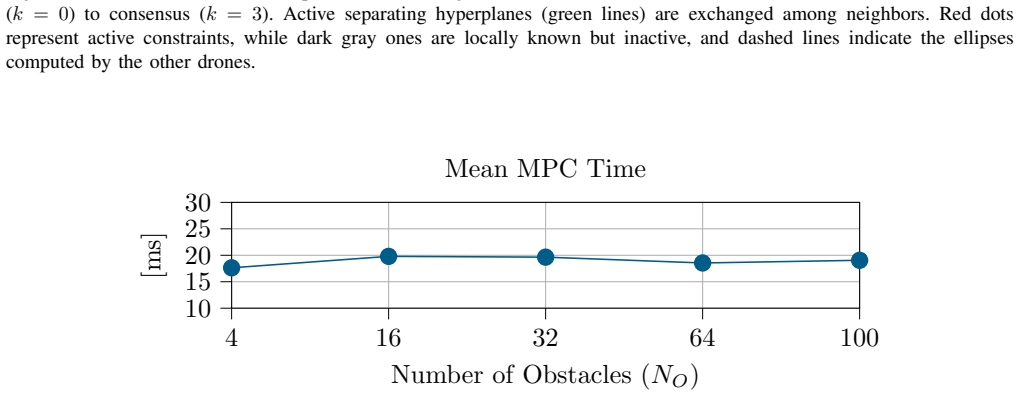
MROPE's core claim is that collective safety for a monitoring swarm reduces to a local constraint-compression identity: every static obstacle seen by any drone can be turned into a separating hyperplane, and the set of active hyperplanes can be exchanged among neighbors until a maximum-volume inscribed ellipse is agreed under consensus. That ellipse, shrunk by the drone's radius and propagated along the predicted target path, becomes a single quadratic constraint (12d) in the local predictive safety filter's MPC. Because the MPC sees one ellipse instead of hundreds of obstacle constraints, its solve time stays almost constant as the obstacle count grows — the paper reports roughly 6 ms avera
What carries the argument
The load-bearing object is the safe bounding ellipse E_t^i, defined by shape matrix M_t^i = Sigma_t^i (circle) M_t_nom^i (equation 11), where M_t_nom^i comes from solving the maximum-volume inscribed ellipsoid problem (9) over active separating hyperplanes (8) obtained from local obstacle observations. Algorithm 2 spreads the active constraints through a distance-based communication graph until consensus; Algorithm 3 re-solves the ellipse problem for each future horizon step using the predicted target trajectory, so the local MPC receives a time-indexed sequence of single quadratic safety constraints (12d). This compression is what bounds the downstream MPC dimension and keeps its complexity
Load-bearing premise
The safety guarantee rests on the assumption that each propagated ellipse remains a true subset of the collision-free region for the drone's full radius across the whole prediction horizon and that the local MPC always remains feasible inside it — a property the paper explicitly says is not yet formally proven.
What would settle it
Run the algorithm with an adversarial target that swings sharply inside a narrow gap so that the predicted target path used to propagate the ellipse diverges from the actual target motion; then check whether any drone's constraint (12d) is violated or the solver returns infeasible while the drone is still commanded forward. A single recorded collision or infeasibility event with the claimed safety guarantee would refute the collective-safety claim.
If this is right
- Per-drone safety-filter solve time stays roughly flat as the number of obstacles grows from 4 to 100, making dense environments computationally cheap instead of prohibitive.
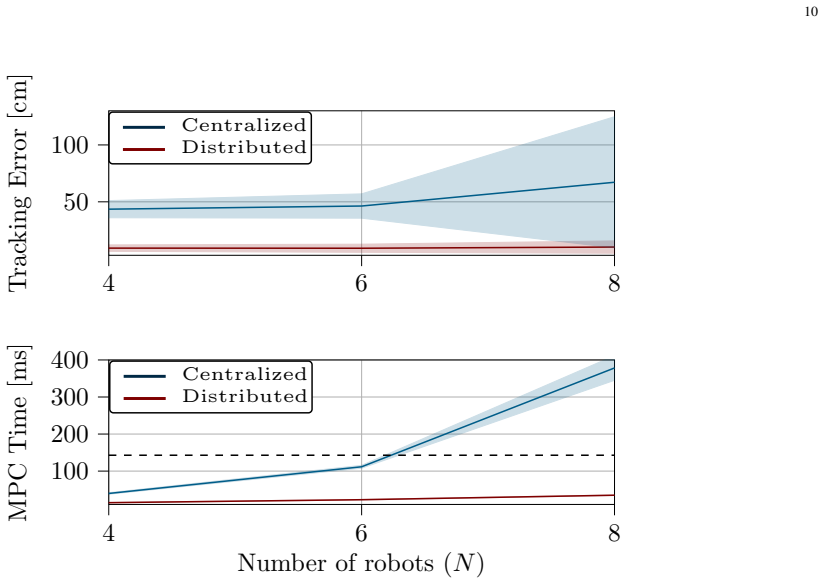
- An 8-drone swarm can run decentralized predictive safety filtering at about 7 Hz while a centralized filter misses the deadline by roughly a factor of three, so the approach shifts the scaling bottleneck from obstacle count to something else (like communication).
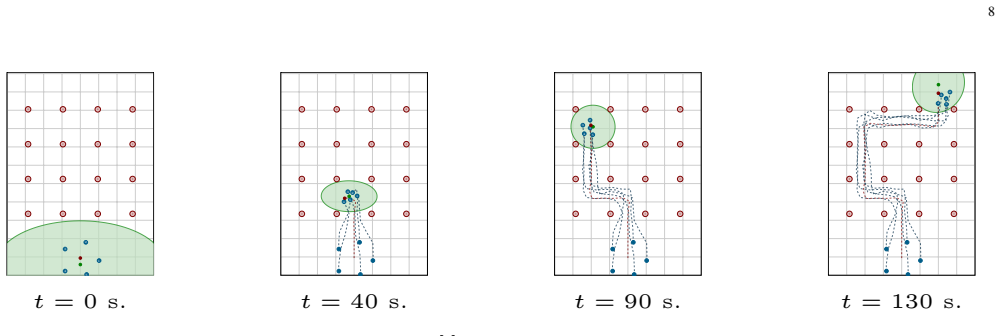
- The swarm's shape emerges from the geometry of free space rather than from a rigid formation rule, so drones automatically string out into single-file through narrow gaps.
- The architecture separates mission-level target tracking from low-level safety, so the same safety filter could be reused with different high-level planners or tasks.
- Because each drone solves a fixed-size local problem, the method is suitable for resource-constrained platforms such as nano-quadrotors, where onboard computation is limited.
Where Pith is reading between the lines
- If the ellipse-compression idea transfers to dynamic obstacles, the same bounding-region trick could make real-time safety filtering feasible in environments with moving clutter, as long as the obstacle velocities are known or estimated.
- The paper leaves recursive feasibility of the MPC as open work; a natural extension would be to add a feasibility-recovery mode (e.g., a fallback single-step safety controller) for the cases where the propagated ellipse fails to contain a feasible trajectory.
- The same constraint-compression pattern — replace many linear constraints with one convex body agreed by consensus — could be applied to other multi-robot tasks like coverage, exploration, or formation control, not just target monitoring.
- One testable prediction of the paper's logic: if the ellipse is replaced by a sphere of the same volume, the safety filter's solve time will still be constant but the feasible region shrinks, so tracking error in tight spaces should rise; that would isolate how much the eccentricity adaptation contributes.
Editorial analysis
A structured set of objections, weighed in public.
Referee Report
Summary. The paper proposes MROPE, a hierarchical control architecture for a drone swarm monitoring a moving target in cluttered environments. A distributed aggregative planner generates reference motions, a decentralized ellipse-consensus mechanism compresses obstacle constraints into one safe ellipsoid per drone, and a local predictive safety filter based on MPC enforces obstacle and inter-agent avoidance with minimal deviation from the reference. The claims are that the compression makes per-drone MPC complexity independent of obstacle density and that the overall scheme ensures collective safety (Definition 2.1). The paper reports Webots simulations with 5 drones and up to 100 obstacles, Monte Carlo campaigns for different fleet sizes and target speeds, and a real Crazyflie/TurtleBot experiment, with computation times around 6-11 ms per safety-filter call.
Significance. If the claims were fully supported, this would be a useful engineering contribution: decoupling mission planning from safety, and replacing dense polyhedral obstacle sets by a single evolving ellipse are practically attractive ideas for real-time multi-robot MPC. The empirical scope is a strength: the paper provides reproducible parameter settings, a real-hardware validation, and Monte Carlo success rates over a range of target velocities. The computational scalability result is visually convincing. However, the central safety guarantee is weaker than stated: the paper explicitly defers recursive-feasibility analysis, and the horizon propagation of the ellipse relies on an active-constraint set that is not recomputed for future time steps. The paper is therefore best viewed as an empirical architecture study rather than a certified safety filter.
major comments (4)
- [Sec. III-B, Alg. 3, Eq. (12d)] The horizon ellipse E_t^i for tau>t is computed from S_i^t obtained by Algorithm 2 at time t, updated only by re-evaluating the same hyperplanes (8) at c^tau. Obstacles that are inactive at t are not in S_i^t. When the predicted target moves toward such an obstacle, the max-volume ellipse can extend into it because the separating hyperplane is missing; (12d) can then be satisfied while the planned state is unsafe. The closed-loop simulations may still avoid collisions because Algorithm 2 reruns at each t, but the planned-horizon safety required by Definition 2.1 is not enforced. The authors should either include all relevant obstacle halfspaces in the horizon propagation, recompute the active set per tau, or prove that the active set at t remains sufficient.
- [Sec. III-C, Eqs. (12e)-(12g)] Inter-agent collision avoidance is hard only for tau=t and tau=t+1; for all later tau the radius r_dr is relaxed by a slack epsilon_tau_ij up to epsilon_max. With both drones of a pair on opposite sides, the minimum admissible center distance becomes 2(r_dr - epsilon), with no margin delta_a, and no value for epsilon_max is reported. Thus a feasible solution of (12) does not guarantee condition (3) of Definition 2.1 at every predicted time. Since the safety filter output is only u_t, future violations are expected to be corrected by replanning; this is an empirical property, not a certificate.
- [Sec. IV-B and Sec. V] The Monte Carlo and real-world experiments use 'a parallel architecture with a single obstacle compression node', not Algorithm 2. Therefore the scalability and safety results (Figs. 8-11) validate the local PSF with centralized obstacle compression, not the distributed consensus scheme that is a claimed novelty. The distributed ellipse consensus is demonstrated only in the single deterministic scenario of Fig. 7. The paper should make this limitation explicit and ideally evaluate Algorithm 2 in the Monte Carlo and hardware settings.
- [Sec. VI and terminal set after Eq. (12i)] Recursive feasibility is explicitly declared future work, and the terminal set X_T_i is introduced without a proof that it is invariant or reachable under (12d). If (12) becomes infeasible at some step, Algorithm 1 has no fallback and 'collective safety' (Definition 2.1) cannot be guaranteed. The manuscript can still be valuable as an empirical architecture, but the abstract and Problem 2.2 should not state that MROPE 'ensures' collective safety; the claims need to be qualified or supported by a feasibility proof.
minor comments (5)
- [Eq. (13)] The term |N_s,t_i|-1 is undefined when the neighborhood is empty; the index set of slack variables should be defined explicitly.
- [Sec. IV-A] The values of epsilon_max, delta_a, and delta_o are not reported. Without these safety margins, the quantitative safety claims are not fully reproducible.
- [Sec. IV-B] The 'success rate' metric counts only whether collisions occurred in closed loop. It does not test whether the planned horizon trajectories satisfy Definition 2.1, which is exactly the property that the theoretical concern in the major comments affects.
- [Algorithms 2 and 3] Algorithm 2's final assignment uses ilde B_k^i and ilde c_k^i without specifying k=K; Algorithm 3 has no explicit return statement. These pseudocode details should be cleaned up.
- [Throughout] Several parameter-sensitivity claims are made without a sensitivity analysis. Given the large number of tuned weights (gamma, rho, beta, K_p, K_v, K_i), a brief sensitivity study or a discussion of robustness would improve reproducibility.
Circularity Check
No derivation-equals-input circularity: safety and performance claims rest on constructive algorithms and empirical validation; the main gap (propagated ellipse inner-approximation, recursive feasibility) is a proof gap, not a circular step. Minor self-citations are not load-bearing.
full rationale
I walked the claimed derivation chain and found no step in which an output is, by the paper's own equations, equal to its input, or in which a fitted parameter is renamed as a prediction. The ellipse-compression mechanism (Alg. 2-3, constraint (12d)) is a constructive approximation: the ellipse is computed from local separating hyperplanes and then used inside the local MPC. The paper asserts that this enforces the static-obstacle condition of Definition 2.1, but it does not prove that the propagated ellipse remains an inner approximation of the true free space over the horizon; recursive feasibility is explicitly deferred in Sec. VI ('Future work includes the development of a comprehensive theoretical analysis to formally guarantee the recursive feasibility of MROPE'). This is a verification gap, not circularity: (12d) is not defined in terms of Definition 2.1, and an unproven implication is not an equation-level reduction. The computational claims (bounded MPC time as N_O grows) are properties of the fixed-size QP (12) plus measurements against a centralized baseline, not predictions fitted to those measurements. The paper reuses hand-tuned weights in simulation and reality, but no fitting-to-output procedure is described, so this is a tuning/demonstration limitation rather than a fitted-input-called-prediction step. The self-citations ([7], [27], [28], [29]) supply standard distributed-optimization algorithms and toolboxes; they are not invoked as a uniqueness theorem, they do not forbid alternatives, and their cited convergence guarantees are independent of the paper's safety claim. Thus the central novelty has independent empirical content, and no circular step meets the required 'Eq. X = Eq. Y by construction' standard.
Axiom & Free-Parameter Ledger
free parameters (9)
- planner weights γ1, γ2, γ3 =
1.0/40.0/10.0 (sim); 10.0/1.0/0.1 (real)
- safety filter weights ρ1, ρ2, ρ3 =
20/0.01/600 (sim); 64/1e-3/75 (real)
- ellipse weights β1, β2 =
1.0/1.0
- desired formation distance d_b =
0.4 m (sim), 0.5 m (real)
- stepsize α =
1e-3
- prediction horizon T =
35 (sim), 30 (real)
- sensing range r_sens =
1.0 m (sim), 0.8 m (real)
- slack bound ε_max =
not specified
- low-level gains Kp, Kv, Ki =
0.4/1.5/0.01 I₂ (sim); 3.75/4.0/0.3 I₂ (real)
axioms (7)
- domain assumption Linear double-integrator dynamics (1) adequately model the quadrotor over the 7 Hz filter period
- domain assumption Separating hyperplanes (8) tangent to obstacles inflated by r_j,obs define a safe polytope, and the inscribed ellipse eroded by the drone radius remains safe
- ad hoc to paper The predicted target trajectory c^{t:t+T} is available, and ellipses propagated by Algorithm 3 along it remain valid safe regions for the drones' actual future positions
- standard math Convergence of the aggregative tracking dynamics (5)
- domain assumption Each drone tracks a single local obstacle; extension to multiple obstacles is asserted as straightforward
- domain assumption High-level graph is connected with doubly stochastic adjacency; safety-layer graph is defined by r_sens range
- domain assumption Obstacle perception is solved elsewhere; the obstacle map and positions are inputs
read the original abstract
Deploying drone swarms to track a dynamic target in cluttered environments presents severe computational and safety challenges. We propose MROPE, a hierarchical strategy that decouples the cooperative monitoring mission from strict local safety requirements. To overcome the computational bottlenecks typical of dense spaces, our approach dynamically aggregates complex obstacle geometries into a single safe bounding ellipse for each drone. Methodologically, this architecture is realized by combining distributed aggregative optimization for high-level swarm coordination, a decentralized consensus scheme for the safe area computation, and local Predictive Safety Filters (PSF) for real-time collision avoidance. Virtual and real-world experiments validate the framework, demonstrating superior real-time efficiency and scalability compared to centralized approaches.
Figures






Reference graph
Works this paper leans on
-
[1]
Swarm of micro flying robots in the wild,
X. Zhou, X. Wen, Z. Wang, Y . Gao, H. Li, Q. Wang, T. Yang, H. Lu, Y . Cao, C. Xu, and F. Gao, “Swarm of micro flying robots in the wild,”Science Robotics, vol. 7, no. 66, p. eabm5954, 2022
2022
-
[2]
Swarm distribution and deployment for cooperative surveillance by micro-aerial vehicles,
M. Saska, V . V on ´asek, J. Chudoba, J. Thomas, G. Loianno, and V . Kumar, “Swarm distribution and deployment for cooperative surveillance by micro-aerial vehicles,”Journal of Intelligent & Robotic Systems, vol. 84, pp. 469–492, 2016
2016
-
[3]
Distributed relative localization algorithms for multi-robot networks: A survey,
S. Wang, Y . Wang, D. Li, and Q. Zhao, “Distributed relative localization algorithms for multi-robot networks: A survey,”Sensors, vol. 23, no. 5, p. 2399, 2023
2023
-
[4]
Distributed optimization methods for multi-robot systems: Part 2—a survey,
O. Shorinwa, T. Halsted, J. Yu, and M. Schwager, “Distributed optimization methods for multi-robot systems: Part 2—a survey,”IEEE Robotics & Automation Magazine, 2024
2024
-
[5]
A tutorial on distributed optimization for cooperative robotics: from setups and algorithms to toolboxes and research directions,
A. Testa, G. Carnevale, and G. Notarstefano, “A tutorial on distributed optimization for cooperative robotics: from setups and algorithms to toolboxes and research directions,”Proceedings of the IEEE, 2025
2025
-
[6]
Distributed online convex optimization with an aggregative variable,
X. Li, X. Yi, and L. Xie, “Distributed online convex optimization with an aggregative variable,”IEEE Trans. on Control of Network Systems, vol. 9, no. 1, pp. 438–449, 2021
2021
-
[7]
Distributed online aggregative optimization for dynamic multirobot coordination,
G. Carnevale, A. Camisa, and G. Notarstefano, “Distributed online aggregative optimization for dynamic multirobot coordination,”IEEE Trans. on Automatic Control, vol. 68, no. 6, pp. 3736–3743, 2022
2022
-
[8]
Multi-robot target monitoring and encirclement via triggered distributed feedback optimization,
L. Pichierri, G. Carnevale, L. Sforni, and G. Notarstefano, “Multi-robot target monitoring and encirclement via triggered distributed feedback optimization,”IEEE Trans. on Robotics, 2026
2026
-
[9]
Distributed aggregative optimization algorithm for solving multi-robot formation problem,
J. Huang, C. Yang, S. Wu, and Q. Liu, “Distributed aggregative optimization algorithm for solving multi-robot formation problem,”IEEE Trans. on Control of Network Systems, 2025
2025
-
[10]
Fast, on-line collision avoidance for dynamic vehicles using buffered voronoi cells,
D. Zhou, Z. Wang, S. Bandyopadhyay, and M. Schwager, “Fast, on-line collision avoidance for dynamic vehicles using buffered voronoi cells,”IEEE Robotics and Automation Letters, vol. 2, no. 2, pp. 1047–1054, 2017
2017
-
[11]
Decentralized, safe, multiagent motion planning for drones under uncertainty via filtered reinforcement learning,
A. P. Vinod, S. Safaoui, T. H. Summers, N. Yoshikawa, and S. Di Cairano, “Decentralized, safe, multiagent motion planning for drones under uncertainty via filtered reinforcement learning,”IEEE Trans. on Control Systems Technology, 2024
2024
-
[12]
Online trajectory generation with distributed model predictive control for multi-robot motion planning,
C. E. Luis, M. Vukosavljev, and A. P. Schoellig, “Online trajectory generation with distributed model predictive control for multi-robot motion planning,”IEEE Robotics and Automation Letters, vol. 5, no. 2, pp. 604–611, 2020. 0.14 0.17 0.21 0.28 0.31 0.34 0.40 0 50 100 14.0% 21.9% 76.0% 84.0% 98.0%100.0%100.0% Mean Target Velocity [m/s] Success Rate [%] F...
2020
-
[13]
Distributed predictive drone swarms in cluttered environments,
E. Soria, F. Schiano, and D. Floreano, “Distributed predictive drone swarms in cluttered environments,”IEEE Robotics and Automation Letters, vol. 7, no. 1, pp. 73–80, 2021
2021
-
[14]
Decentralized multi-agent planning using model predictive control and time-aware safe corridors,
C. Toumieh and A. Lambert, “Decentralized multi-agent planning using model predictive control and time-aware safe corridors,”IEEE Robotics and Automation Letters, vol. 7, no. 4, pp. 11 110–11 117, 2022
2022
-
[15]
Multirobot adversarial resilience using control barrier functions,
M. Cavorsi, L. Sabattini, and S. Gil, “Multirobot adversarial resilience using control barrier functions,”IEEE Transactions on Robotics, vol. 40, pp. 797–815, 2023
2023
-
[16]
Decentralized robust collision-avoidance for cooperative multirobot systems: A gaussian process-based control barrier function approach,
Y . Hu, J. Fu, and G. Wen, “Decentralized robust collision-avoidance for cooperative multirobot systems: A gaussian process-based control barrier function approach,”IEEE Transactions on Control of Network Systems, vol. 10, no. 2, pp. 706–717, 2022
2022
-
[17]
Safe multi-agent interaction through robust control barrier functions with learned uncertainties,
R. Cheng, M. J. Khojasteh, A. D. Ames, and J. W. Burdick, “Safe multi-agent interaction through robust control barrier functions with learned uncertainties,” in2020 59th IEEE Conference on Decision and Control (CDC). IEEE, 2020, pp. 777–783
2020
-
[18]
Deadlock analysis and resolution for multi-robot systems,
J. S. Grover, C. Liu, and K. Sycara, “Deadlock analysis and resolution for multi-robot systems,” inInternational Workshop on the Algorithmic Foundations of Robotics. Springer, 2020, pp. 294–312
2020
-
[19]
Linear model predictive safety certification for learning-based control,
K. P. Wabersich and M. N. Zeilinger, “Linear model predictive safety certification for learning-based control,” in2018 IEEE Conference on Decision and Control (CDC). IEEE, 2018, pp. 7130–7135
2018
-
[20]
A predictive safety filter for learning-based racing control,
B. Tearle, K. P. Wabersich, A. Carron, and M. N. Zeilinger, “A predictive safety filter for learning-based racing control,”IEEE Robotics and Automation Letters, vol. 6, no. 4, pp. 7635–7642, 2021
2021
-
[21]
Multi-step model predictive safety filters: Reducing chattering by increasing the prediction horizon,
F. P. Bejarano, L. Brunke, and A. P. Schoellig, “Multi-step model predictive safety filters: Reducing chattering by increasing the prediction horizon,” 13 in2023 62nd IEEE Conference on Decision and Control (CDC). IEEE, 2023, pp. 4723–4730
2023
-
[22]
Modular control architecture for safe marine navigation: Reinforcement learning with predictive safety filters,
A. Vaaler, S. J. Husa, D. Menges, T. N. Larsen, and A. Rasheed, “Modular control architecture for safe marine navigation: Reinforcement learning with predictive safety filters,”Artificial Intelligence, vol. 336, p. 104201, 2024
2024
-
[23]
Safe multi-agent motion planning under uncertainty for drones using filtered reinforcement learning,
S. Safaoui, A. P. Vinod, A. Chakrabarty, R. Quirynen, N. Yoshikawa, and S. Di Cairano, “Safe multi-agent motion planning under uncertainty for drones using filtered reinforcement learning,”IEEE Trans. on Robotics, 2024
2024
-
[24]
Vision-based drone flocking in outdoor environments,
F. Schilling, F. Schiano, and D. Floreano, “Vision-based drone flocking in outdoor environments,”IEEE Robotics and Automation Letters, vol. 6, no. 2, pp. 2954–2961, 2021
2021
-
[25]
Present and future of slam in extreme environments: The darpa subt challenge,
K. Ebadi, L. Bernreiter, H. Biggie, G. Catt, Y . Chang, A. Chatterjee, C. E. Denniston, S.-P. Desch ˆenes, K. Harlow, S. Khattaket al., “Present and future of slam in extreme environments: The darpa subt challenge,”IEEE Trans. on Robotics, vol. 40, pp. 936–959, 2023
2023
-
[26]
Minimum snap trajectory generation and control for quadrotors,
D. Mellinger and V . Kumar, “Minimum snap trajectory generation and control for quadrotors,” in2011 IEEE international conference on robotics and automation. IEEE, 2011, pp. 2520–2525
2011
-
[27]
Distributed abstract optimization via constraints consensus: Theory and applications,
G. Notarstefano and F. Bullo, “Distributed abstract optimization via constraints consensus: Theory and applications,”IEEE Transactions on Automatic Control, vol. 56, no. 10, pp. 2247–2261, 2011
2011
-
[28]
Crazychoir: Flying swarms of crazyflie quadrotors in ros 2,
L. Pichierri, A. Testa, and G. Notarstefano, “Crazychoir: Flying swarms of crazyflie quadrotors in ros 2,”IEEE Robotics and Automation Letters, vol. 8, no. 8, pp. 4713–4720, 2023
2023
-
[29]
ChoiRbot: A ROS 2 toolbox for cooperative robotics,
A. Testa, A. Camisa, and G. Notarstefano, “ChoiRbot: A ROS 2 toolbox for cooperative robotics,”IEEE Robotics and Automation Letters, vol. 6, no. 2, pp. 2714–2720, 2021
2021
-
[30]
Clarabel: An interior-point solver for conic programs with quadratic objectives,
P. J. Goulart and Y . Chen, “Clarabel: An interior-point solver for conic programs with quadratic objectives,”Mathematical Programming Computation, pp. 1–83, 2026
2026
discussion (0)
Sign in with ORCID, Apple, or X to comment. Anyone can read and Pith papers without signing in.