Holistic Data Scheduler for LLM Pre-training via Multi-Objective Reinforcement Learning
Pith reviewed 2026-06-26 00:44 UTC · model grok-4.3
The pith
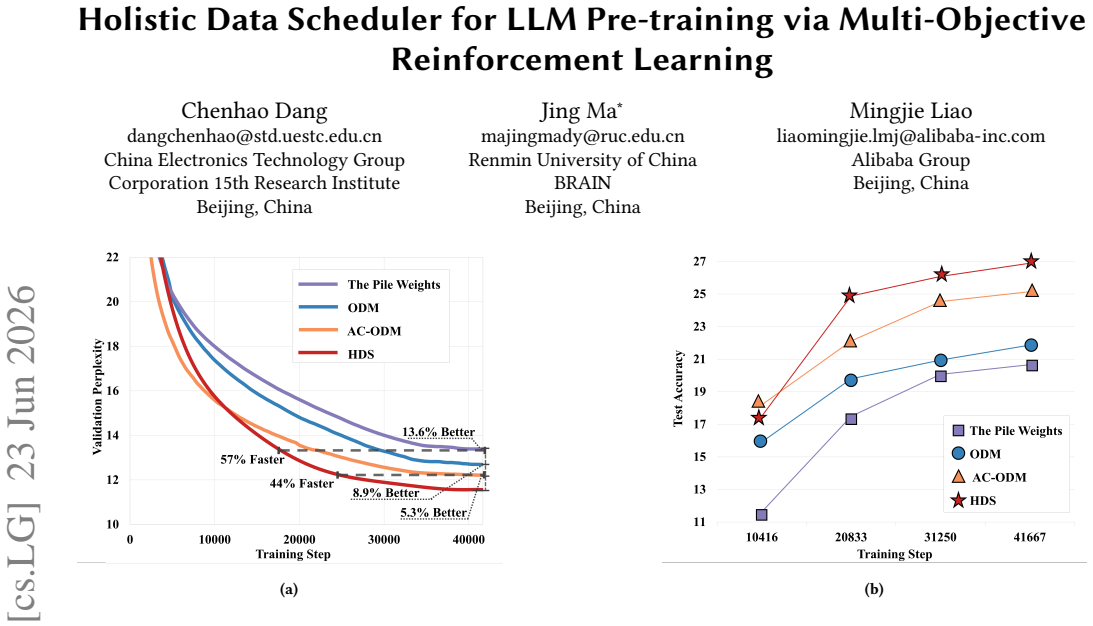
Holistic Data Scheduler reaches target perplexity on The Pile with 44% fewer training iterations using multi-objective RL.
A machine-rendered reading of the paper's core claim, the machinery that carries it, and where it could break.
Core claim
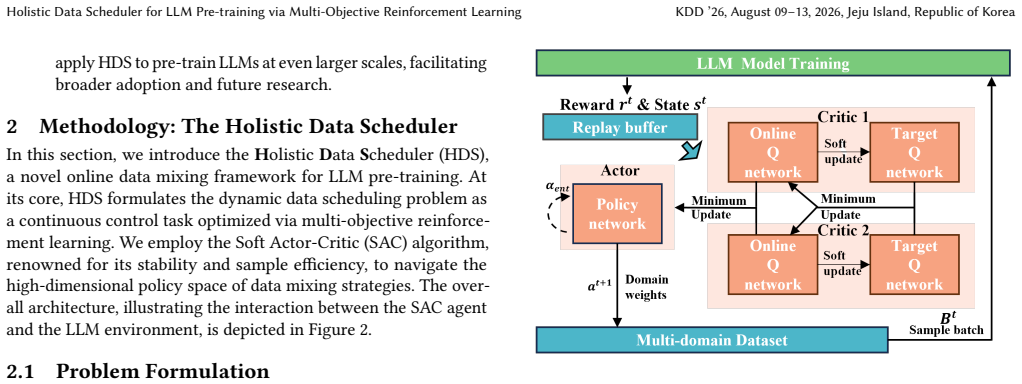
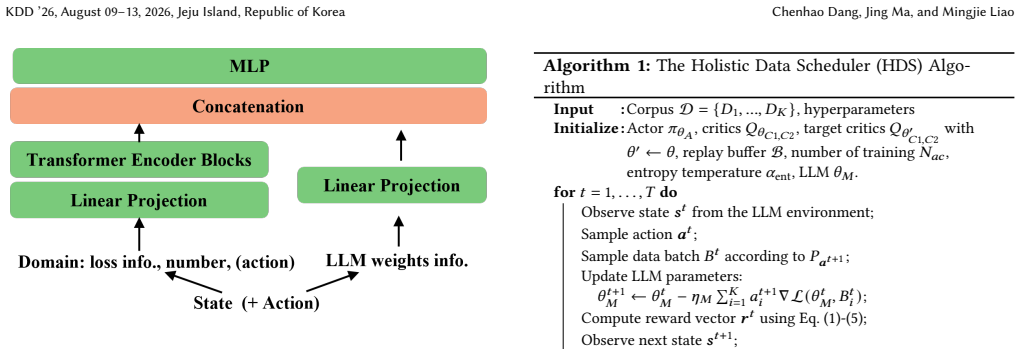
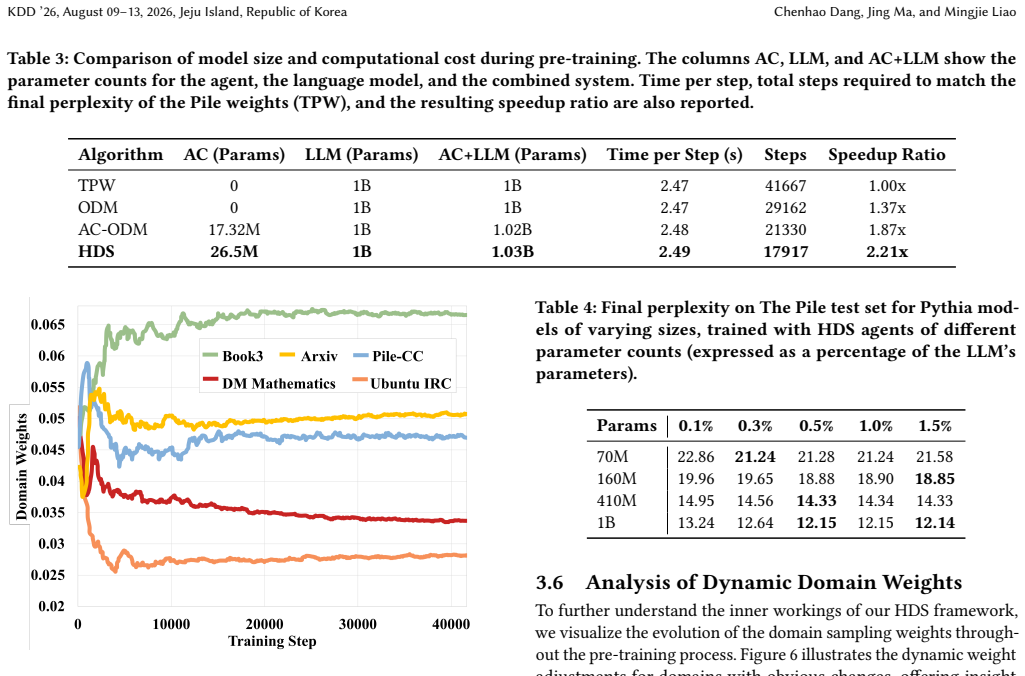
HDS formulates the data scheduling challenge as a reinforcement learning problem in a continuous control space and leverages the Soft Actor-Critic (SAC) algorithm. At the core of HDS lies a novel multi-objective, holistic reward function that integrates three critical perspectives: a data-driven reward for quality, a loss-driven reward capturing inter-domain influence, and a model-driven reward based on weight norms. On The Pile benchmark, HDS reaches the final validation perplexity of the next best method with 44% fewer training iterations and achieves a 7.2% improvement on the MMLU 0-shot task.
What carries the argument
The multi-objective holistic reward function that combines data-driven quality, loss-driven inter-domain influence, and model-driven weight norms to guide the SAC policy in adjusting data mixtures.
If this is right
- Reaches the same final validation perplexity with 44% fewer training iterations on The Pile.
- Achieves a 7.2% improvement on the MMLU 0-shot task.
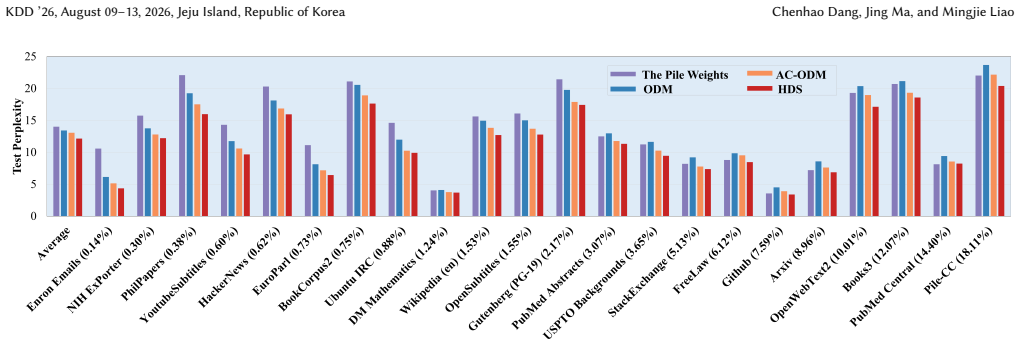
- Shows consistent gains on other benchmarks.
- Enhances both training efficiency and final model capability across various model sizes.
- Provides a stable training signal without extensive per-benchmark retuning.
Where Pith is reading between the lines
- Applying similar multi-objective rewards could improve data efficiency in other machine learning domains such as computer vision training.
- The method might allow for even larger efficiency gains if the reward components are dynamically weighted during training.
- Testing HDS on models beyond the sizes experimented with could reveal scaling behaviors of the scheduling benefits.
- Integrating this scheduler with other optimization techniques like curriculum learning could yield additive improvements.
Load-bearing premise
The three-component reward function supplies a sufficiently stable and non-overfitting training signal for the SAC policy across different model sizes and data distributions without extensive per-benchmark retuning.
What would settle it
Running HDS on a new large model or different data distribution where it fails to match the 44% iteration reduction or requires heavy reward weight retuning would falsify the central claim.
Figures
read the original abstract
The composition of training data, governed by the diversity of sources and their mixing strategy, is a cornerstone of Large Language Model (LLM) pre-training. Online Data Mixing (ODM), the technique of adaptively adjusting data mixtures during training, has emerged as a promising direction to improve efficiency. However, existing methods are constrained by their reliance on a singular optimization perspective, which fundamentally overlooks the need for complex LLM pre-training to consider the dynamic data composition from multiple dimensions. To overcome this limitation, we introduce the Holistic Data Scheduler (HDS), a novel online data mixing framework. HDS formulates the data scheduling challenge as a reinforcement learning problem in a continuous control space and leverages the Soft Actor-Critic (SAC) algorithm for its stability and sample efficiency in exploring the high-dimensional policy space. At the core of HDS lies a novel multi-objective, holistic reward function that integrates three critical perspectives: a data-driven reward for quality, a loss-driven reward capturing inter-domain influence, and a model-driven reward based on weight norms. To validate our design and determine its optimal configuration, we conducted systematic experiments on LLMs of various sizes. On The Pile benchmark, HDS reaches the final validation perplexity of the next best method with 44% fewer training iterations. Furthermore, it achieves a 7.2% improvement on the MMLU 0-shot task along with consistent gains on other benchmarks, showcasing its ability to enhance both training efficiency and final model capability.
Editorial analysis
A structured set of objections, weighed in public.
Referee Report
Summary. The paper introduces Holistic Data Scheduler (HDS), an online data mixing framework for LLM pre-training that casts data scheduling as a continuous-control RL problem solved via Soft Actor-Critic (SAC). Its central contribution is a three-component multi-objective reward (data-driven quality, loss-driven inter-domain influence, model-driven weight norms) intended to capture multiple perspectives simultaneously. Systematic experiments on LLMs of varying sizes are reported to yield a 44% reduction in training iterations to reach the next-best final validation perplexity on The Pile, together with a 7.2% absolute gain on MMLU 0-shot and consistent improvements on other benchmarks.
Significance. If the reported efficiency and capability gains prove robust, the work would offer a practical route to more sample-efficient pre-training by replacing single-objective heuristics with a learned, multi-perspective scheduler. The use of SAC in a high-dimensional continuous mixing space and the explicit attempt to integrate data, loss, and model signals are technically interesting directions for the data-mixing literature.
major comments (3)
- [Abstract] Abstract and experimental sections: the headline claims (44% fewer iterations on The Pile, 7.2% MMLU gain) are presented without any description of the baselines, number of runs, statistical tests, or implementation equations for the three reward components. Without these details it is impossible to determine whether the performance differences are load-bearing or sensitive to post-hoc choices.
- [Reward function] Reward-function description (presumably §3 or §4): the manuscript states that systematic experiments were run on LLMs of various sizes, yet supplies no evidence that the relative weighting of the three reward terms was held fixed across model scales and data distributions. If per-size or per-benchmark re-balancing is required to prevent instability or collapse of the SAC policy, the reported gains would not transfer and the “holistic” framing would be undercut.
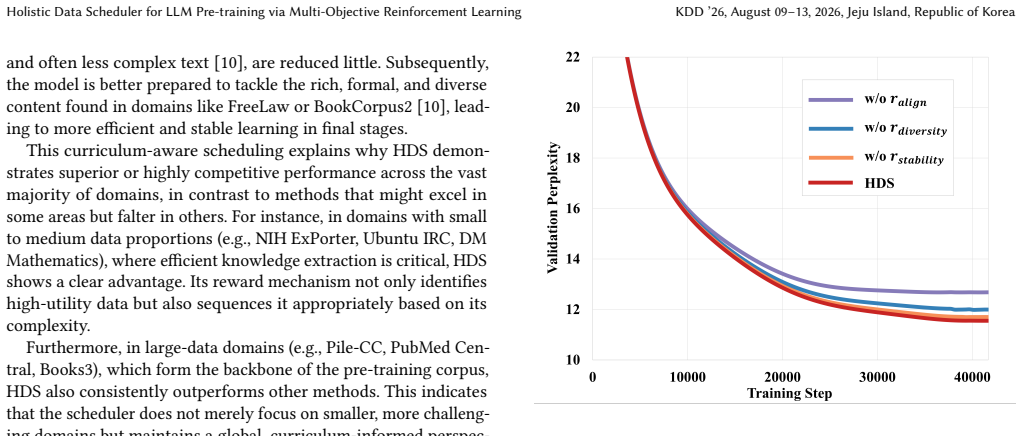
- [Experiments] Experimental protocol: the abstract asserts “systematic experiments” but the provided text contains no tables, figures, or appendices showing learning curves, ablation of individual reward components, or sensitivity to the SAC hyperparameters. These omissions make the central efficiency claim unverifiable from the manuscript as presented.
minor comments (2)
- Notation for the three reward terms is introduced without explicit equations or normalization details, making it difficult to reproduce the exact reward signal.
- [Abstract] The abstract refers to “the next best method” without naming the comparator or citing its source; this should be clarified in the main text.
Simulated Author's Rebuttal
We thank the referee for the constructive feedback highlighting the need for greater clarity and verifiability in our claims. We address each major comment below and will revise the manuscript to incorporate the requested details, equations, and experimental evidence.
read point-by-point responses
-
Referee: [Abstract] Abstract and experimental sections: the headline claims (44% fewer iterations on The Pile, 7.2% MMLU gain) are presented without any description of the baselines, number of runs, statistical tests, or implementation equations for the three reward components. Without these details it is impossible to determine whether the performance differences are load-bearing or sensitive to post-hoc choices.
Authors: We agree that the abstract and experimental sections require additional context for full verifiability. In the revised manuscript we will expand the abstract to name the primary baselines (uniform mixing, DoReMi, and other ODM methods), state that all results are averaged over three independent runs with standard deviations, and reference the statistical tests performed. The explicit equations for the three reward components (data quality, inter-domain loss influence, and weight-norm regularization) will be moved to the main text in Section 3.2 with a pointer from the abstract. revision: yes
-
Referee: [Reward function] Reward-function description (presumably §3 or §4): the manuscript states that systematic experiments were run on LLMs of various sizes, yet supplies no evidence that the relative weighting of the three reward terms was held fixed across model scales and data distributions. If per-size or per-benchmark re-balancing is required to prevent instability or collapse of the SAC policy, the reported gains would not transfer and the “holistic” framing would be undercut.
Authors: The relative weights of the three reward terms were held fixed across all model scales and data distributions in our experiments; this is stated in the hyperparameter appendix of the original submission. To make this explicit and address the concern, the revision will add a dedicated paragraph in Section 4 together with a sensitivity table confirming that the same fixed weights were used without per-scale re-balancing and that policy collapse was not observed. revision: yes
-
Referee: [Experiments] Experimental protocol: the abstract asserts “systematic experiments” but the provided text contains no tables, figures, or appendices showing learning curves, ablation of individual reward components, or sensitivity to the SAC hyperparameters. These omissions make the central efficiency claim unverifiable from the manuscript as presented.
Authors: We acknowledge that the current manuscript version omitted several supporting visualizations due to space limits. The revised submission will include new figures and an expanded appendix containing (i) training curves for all methods, (ii) ablations isolating each reward component, and (iii) sensitivity plots for key SAC hyperparameters (learning rate, entropy coefficient, replay buffer size). These additions will render the experimental protocol fully verifiable. revision: yes
Circularity Check
No significant circularity; derivation self-contained
full rationale
The abstract formulates data scheduling as an RL problem solved by SAC and defines a three-component reward (data-driven quality, loss-driven inter-domain influence, model-driven weight norms) as independent perspectives. No equations, fitting procedures, or self-citations are shown that would reduce any claimed prediction or result to its own inputs by construction. Experimental claims rest on validation runs rather than analytic reductions, satisfying the criteria for a self-contained derivation with no load-bearing circular steps.
Axiom & Free-Parameter Ledger
Reference graph
Works this paper leans on
-
[1]
Alon Albalak, Yanai Elazar, Sang Michael Xie, Shayne Longpre, Nathan Lambert, Xinyi Wang, Niklas Muennighoff, Bairu Hou, Liangming Pan, Haewon Jeong, et al. 2024. A survey on data selection for language models. arXiv preprint arXiv:2402.16827
arXiv 2024
-
[2]
Alon Albalak, Liangming Pan, Colin Raffel, and William Yang Wang. 2023. Ef- ficient online data mixing for language model pre-training. arXiv preprint arXiv:2312.02406
arXiv 2023
-
[3]
Peter Auer, Nicolo Cesa-Bianchi, Yoav Freund, and Robert E Schapire. 2002. The nonstochastic multiarmed bandit problem.SIAM journal on computing32, 1 (2002), 48–77
2002
-
[4]
Stella Biderman, Hailey Schoelkopf, Quentin Gregory Anthony, Herbie Bradley, Kyle O’Brien, Eric Hallahan, Mohammad Aflah Khan, Shivanshu Purohit, USVSN Sai Prashanth, Edward Raff, et al . 2023. Pythia: A suite for analyzing large language models across training and scaling. InInternational Conference on Machine Learning. PMLR, Honolulu, Hawaii, USA, 2397–2430
2023
-
[5]
Sid Black, Stella Biderman, Eric Hallahan, Quentin Anthony, Leo Gao, Laurence Golding, Horace He, Connor Leahy, Kyle McDonell, Jason Phang, et al . 2022. Gpt-neox-20b: An open-source autoregressive language model. arXiv preprint arXiv:2204.06745
Pith/arXiv arXiv 2022
-
[6]
Mayee F Chen, Michael Y Hu, Nicholas Lourie, Kyunghyun Cho, and Christopher Re. 2025. Aioli: A Unified Optimization Framework for Language Model Data Mixing. The Thirteenth International Conference on Learning Representations
2025
-
[7]
Tri Dao, Dan Fu, Stefano Ermon, Atri Rudra, and Christopher Ré. 2022. Flashat- tention: Fast and memory-efficient exact attention with io-awareness.Advances in neural information processing systems35 (2022), 16344–16359
2022
-
[8]
Nan Du, Yanping Huang, Andrew M Dai, Simon Tong, Dmitry Lepikhin, Yuanzhong Xu, Maxim Krikun, Yanqi Zhou, Adams Wei Yu, Orhan Firat, et al
-
[9]
In International conference on machine learning
Glam: Efficient scaling of language models with mixture-of-experts. In International conference on machine learning. PMLR, Baltimore, Maryland, USA, 5547–5569
-
[10]
Simin Fan, Matteo Pagliardini, and Martin Jaggi. 2024. DOGE: domain reweighting with generalization estimation. InProceedings of the 41st International Conference on Machine Learning. PMLR, Vienna, Austria, 12895–12915
2024
-
[11]
Leo Gao, Stella Biderman, Sid Black, Laurence Golding, Travis Hoppe, Charles Foster, Jason Phang, Horace He, Anish Thite, Noa Nabeshima, et al. 2020. The pile: An 800gb dataset of diverse text for language modeling. arXiv preprint arXiv:2101.00027
Pith/arXiv arXiv 2020
-
[12]
Tuomas Haarnoja, Aurick Zhou, Pieter Abbeel, and Sergey Levine. 2018. Soft actor-critic: Off-policy maximum entropy deep reinforcement learning with a sto- chastic actor. InInternational conference on machine learning. PMLR, Stockholm, Sweden, 1861–1870
2018
-
[13]
Dan Hendrycks, Collin Burns, Steven Basart, Andy Zou, Mantas Mazeika, Dawn Song, and Jacob Steinhardt. 2020. Measuring massive multitask language under- standing. arXiv preprint arXiv:2009.03300
Pith/arXiv arXiv 2020
-
[14]
Feiyang Kang, Yifan Sun, Bingbing Wen, Si Chen, Dawn Song, Rafid Mahmood, and Ruoxi Jia. 2024. Autoscale: Scale-aware data mixing for pre-training llms. arXiv preprint arXiv:2407.20177
arXiv 2024
-
[15]
Diederik P. Kingma and Jimmy Ba. 2014. Adam: A Method for Stochastic Opti- mization. arXiv preprint arXiv:1412.6980
Pith/arXiv arXiv 2014
-
[16]
Qian Liu, Xiaosen Zheng, Niklas Muennighoff, Guangtao Zeng, Longxu Dou, Tianyu Pang, Jing Jiang, and Min Lin. 2024. Regmix: Data mixture as regression for language model pre-training. arXiv preprint arXiv:2407.01492
arXiv 2024
-
[17]
Jing Ma, Chenhao Dang, and Mingjie Liao. 2025. Actor-Critic based Online Data Mixing For Language Model Pre-Training. arXiv preprint arXiv:2505.23878
arXiv 2025
-
[18]
Andrea Matarazzo and Riccardo Torlone. 2025. A survey on large language models with some insights on their capabilities and limitations. arXiv preprint arXiv:2501.04040
arXiv 2025
-
[19]
Philip M McCarthy and Scott Jarvis. 2010. MTLD, vocd-D, and HD-D: A validation study of sophisticated approaches to lexical diversity assessment.Behavior research methods42, 2 (2010), 381–392
2010
-
[20]
Jiahui Peng, Xinlin Zhuang, Qiu Jiantao, Ren Ma, Jing Yu, Tianyi Bai, and Conghui He. 2025. Unsupervised topic models are data mixers for pre-training language models. arXiv preprint arXiv:2502.16802
arXiv 2025
-
[21]
Jianlin Su, Murtadha Ahmed, Yu Lu, Shengfeng Pan, Wen Bo, and Yunfeng Liu. 2024. Roformer: Enhanced transformer with rotary position embedding. Neurocomputing568 (2024), 127063
2024
-
[22]
Sang Michael Xie, Hieu Pham, Xuanyi Dong, Nan Du, Hanxiao Liu, Yifeng Lu, Percy S Liang, Quoc V Le, Tengyu Ma, and Adams Wei Yu. 2023. Doremi: Optimizing data mixtures speeds up language model pretraining.Advances in Neural Information Processing Systems36 (2023), 69798–69818
2023
-
[23]
Jiasheng Ye, Peiju Liu, Tianxiang Sun, Jun Zhan, Yunhua Zhou, and Xipeng Qiu. 2024. Data mixing laws: Optimizing data mixtures by predicting language modeling performance. arXiv preprint arXiv:2403.16952
arXiv 2024
-
[24]
Wayne Xin Zhao, Kun Zhou, Junyi Li, Tianyi Tang, Xiaolei Wang, Yupeng Hou, Yingqian Min, Beichen Zhang, Junjie Zhang, Zican Dong, et al. 2023. A Survey of Large Language Models. arXiv preprint arXiv:2303.18223. A LLM Model Configuration Our language model is built upon a 16-layer Transformer architec- ture. It features a hidden dimension of 2048 and utili...
Pith/arXiv arXiv 2023
discussion (0)
Sign in with ORCID, Apple, or X to comment. Anyone can read and Pith papers without signing in.