Stability of the Hydrogen Molecule and Related Issues
Pith reviewed 2026-07-01 03:00 UTC · model grok-4.3
The pith
A collaboration produced the first rigorous proof that the hydrogen molecule is stable in quantum mechanics.
A machine-rendered reading of the paper's core claim, the machinery that carries it, and where it could break.
Core claim
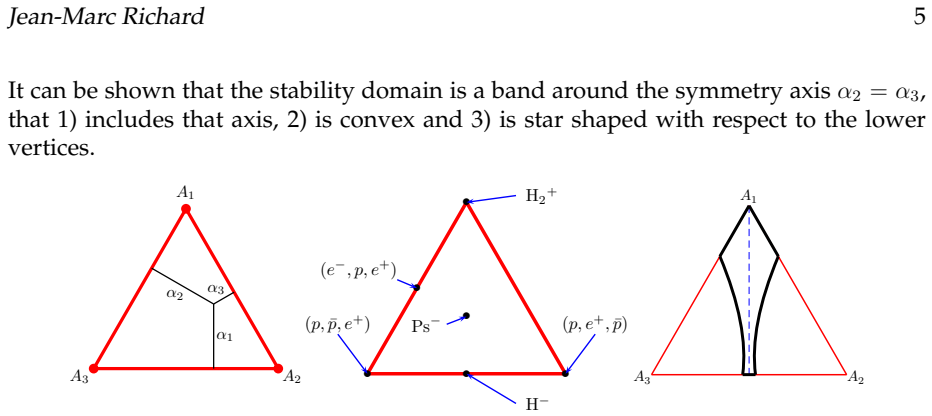
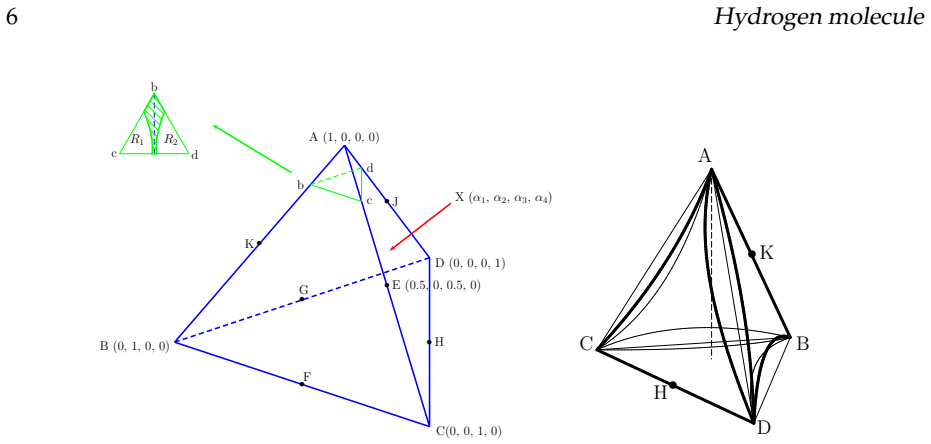
The collaboration delivered the first rigorous proof of the stability of the hydrogen molecule within quantum mechanics. The paper discusses the role of symmetry breaking, the stability domains of Coulombic few-body systems, and some applications to exotic hadrons in the quark model.
What carries the argument
Symmetry breaking as the mechanism that determines stability domains for Coulombic few-body systems
Load-bearing premise
The referenced collaboration provided the chronologically first rigorous proof, which depends on the completeness of the cited prior literature on few-body stability.
What would settle it
An earlier publication that supplies a rigorous proof of hydrogen-molecule stability, or a calculation showing the molecule is unbound under the same quantum-mechanical assumptions.
Figures
read the original abstract
We review the collaboration that led to the first rigorous proof of the stability of the hydrogen molecule within quantum mechanics and discuss several related issues concerning few-charge systems. Particular emphasis is placed on the role of symmetry breaking, the stability domains of Coulombic few-body systems, and some applications to exotic hadrons in the quark model.
Editorial analysis
A structured set of objections, weighed in public.
Referee Report
Summary. The manuscript is a review article recounting the collaboration that produced the first rigorous proof of the stability of the hydrogen molecule in non-relativistic quantum mechanics. It surveys related topics in few-charge Coulomb systems, with emphasis on symmetry-breaking arguments, the domains of stability for such systems, and applications to exotic hadrons within the quark model.
Significance. If the cited historical record and literature survey are accurate, the review offers a coherent synthesis of conceptual advances in rigorous few-body stability results, particularly the utility of symmetry considerations, which may assist researchers working on mathematical aspects of quantum chemistry and hadronic physics.
Simulated Author's Rebuttal
We thank the referee for their careful reading and positive evaluation of the manuscript. We are pleased that the review is viewed as offering a coherent synthesis of the conceptual advances in rigorous few-body stability results, and we appreciate the recommendation for acceptance.
Circularity Check
No significant circularity
full rationale
This is a review article whose central narrative surveys an existing collaboration's proof of H2 stability and related few-body results. The claim rests on accurate citation of prior external literature rather than any internal derivation, ansatz, or fitted parameter that reduces to the paper's own inputs. No load-bearing self-citation chain, self-definitional step, or renamed empirical pattern appears. The paper is self-contained against external benchmarks as a survey.
Axiom & Free-Parameter Ledger
Reference graph
Works this paper leans on
-
[1]
Study of the doubly charmed tetraquarkT cc +˝
R. Aaij et al. “Study of the doubly charmed tetraquarkT cc +˝”. In:Nature Commun. 13.1 (2022), p. 3351.DOI:10.1038/s41467-022-30206-w. arXiv:2109.01056 [hep-ex]
-
[2]
Adamowski, S
J. Adamowski, S. Bednarek, and M. Suffczynski. ”Binding energy of the biexci- tons”. In:Solid State Communications9.23 (Dec. 1971), pp. 2037–2038.DOI:10. 1016/0038-1098(71)90355-3
1971
-
[3]
J. P . Ader, J. M. Richard, and P . Taxil. ”Do narrow heavy multiquark states exist?” In:Phys. Rev. D25 (1982), p. 2370.DOI:10.1103/PhysRevD.25.2370
-
[4]
E. A. G. Armour, J.-M. Richard, and K. Varga. ”Stability of few-charge systems in quantum mechanics”. In:Phys. Rep.413.1 (July 2005), pp. 1–90.DOI:10.1016/j. physrep.2005.02.003. arXiv:physics/0411204 [physics.atom-ph]
work page internal anchor Pith review Pith/arXiv arXiv doi:10.1016/j 2005
-
[5]
Bednarek and J
S. Bednarek and J. Adamowski. ”Binding energy of four-particle complexes in semiconductors”. In:Physics Letters A41.4 (Oct. 1972), pp. 347–348.DOI:10.1016/ 0375-9601(72)90922-X
1972
-
[6]
H. A. Bethe and E. E. Salpeter.–Quantum Mechanics of One- and Two-Electron Atoms. 1957
1957
-
[7]
M. Born and R. Oppenheimer. ”Zur Quantentheorie der Molekeln”. In:Annalen der Physik389.20 (Jan. 1927), pp. 457–484.DOI:10.1002/andp.19273892002
-
[8]
Bransden and C
B. Bransden and C. Joachain.Physics of Atoms and Molecules. Pearson Education. Prentice Hall, 2003.ISBN: 9780582356924.URL:https://books.google.fr/ books?id=i5IPWXDQlcIC
2003
-
[9]
Bressanini, M
D. Bressanini, M. Mella, and G. Morosi. ”Stability of four-body systems in three and two dimensions: A theoretical and quantum Monte Carlo study of biexci- ton molecules”. In:Phys. Rev. A57.6 (June 1998), pp. 4956–4959.DOI:10.1103/ PhysRevA.57.4956. 10Hydrogen molecule
1998
-
[10]
D. B. Cassidy and A. P . Mills. ”The production of molecular positronium”. In:Na- ture449.7159 (Sept. 2007), pp. 195–197.DOI:10.1038/nature06094
-
[11]
A. Czarnecki. ”Positronium and Polyelectrons”. In:Nucl. Phys. A827.1-4 (Aug. 2009), pp. 541–543.DOI:10.1016/j.nuclphysa.2009.05.118
-
[12]
Grosse and A
H. Grosse and A. Martin.Particle physics and the Schr¨ odinger equation. Vol. 6. Cam- bridge University Press, Mar. 2011.ISBN: 978-0-511-87788-9, 978-0-521-01778-7
2011
-
[13]
Y. K. Ho. ”Binding energy of positronium molecules”. In:Phys. Rev. A33.5 (May 1986), pp. 3584–3587.DOI:10.1103/PhysRevA.33.3584
-
[14]
E. A. Hylleraas, J. Midtdal, K. Thalberg, and H. Wergeland.Selected scientific papers of Egil A. Hylleraas: 1und Trondheim: NTH-Press, 1968
1968
-
[15]
E. A. Hylleraas, J. Midtdal, K. Thalberg, and H. Wergeland.Selected scientific papers of Egil A. Hylleraas: 2und Trondheim: NTH-Press, 1968
1968
-
[16]
E. A. Hylleraas and A. Ore. ”Binding Energy of the Positronium Molecule”. In: Physical Review71.8 (Apr. 1947), pp. 493–496.DOI:10.1103/PhysRev.71.493
-
[17]
D. Janc and M. Rosina. ”TheT cc =DD ∗ molecular state”. In:Few Body Syst. 35 (2004), pp. 175–196.DOI:10.1007/s00601-004-0068-9. arXiv:hep-ph/ 0405208
-
[18]
R. K. Merton. ”The Matthew Effect in Science”. In:Science159.3810 (Jan. 1968), pp. 56–63.DOI:10.1126/science.159.3810.56
-
[19]
A. Ore. ”Binding Energy of Polyelectrons”. In:Physical Review70.1-2 (July 1946), pp. 90–90.DOI:10.1103/PhysRev.70.90
-
[20]
How History Is Made
A. Ore. “How History Is Made”. In:Science143.3612 (1964), pp. 1276–1276
1964
-
[21]
C. Quigg and J. L. Rosner. ”Quantum Mechanics with Applications to Quarko- nium”. In:Phys. Rept.56 (1979), pp. 167–235.DOI:10.1016/0370-1573(79) 90095-4
-
[22]
J.-M. Richard. ”Critically bound four-body molecules”. In:Phys. Rev. A67.3, 034702 (Mar. 2003), p. 034702.DOI:10.1103/PhysRevA.67.034702. arXiv:physics/ 0302004 [physics.atom-ph]
-
[23]
Proof of stability of the hydrogen molecule
J.-M. Richard, J. Fr ¨ohlich, G.-M. Graf, and M. Seifert. ”Proof of stability of the hydrogen molecule”. In:Phys. Rev. Lett.71.9 (Aug. 1993), pp. 1332–1334.DOI: 10.1103/PhysRevLett.71.1332. arXiv:nucl-th/9305013 [nucl-th]
work page internal anchor Pith review Pith/arXiv arXiv doi:10.1103/physrevlett.71.1332 1993
-
[24]
R. R. Sharma. ”Binding Energy of the Positronium Molecule”. In:Physical Review 171.1 (July 1968), pp. 36–42.DOI:10.1103/PhysRev.171.36. Jean-Marc Richard11
-
[25]
Varga, S
K. Varga, S. Fleck, and J. M. Richard. ”On the stability domain of systems of four unit charges”. In:EPL (Europhysics Letters)37.3 (Jan. 1997), pp. 183–188.DOI:10. 1209/epl/i1997-00131-8
1997
-
[26]
K. Varga, J. Usukura, and Y. Suzuki. ”Second Bound State of the Positro- nium Molecule and Biexcitons”. In:Phys. Rev. Lett.80.9 (Mar. 1998), pp. 1876–1879.DOI:10.1103/PhysRevLett.80.1876. arXiv:cond-mat/ 9802261 [cond-mat.mes-hall]
-
[27]
J. A. Wheeler. ”On the Mathematical Description of Light Nuclei by the Method of Resonating Group Structure”. In:Physical Review52.11 (Dec. 1937), pp. 1107–1122. DOI:10.1103/PhysRev.52.1107
-
[28]
J. A. Wheeler. ”Polyelectrons”. In:Annals of the New York Academy of Sciences48 (Dec. 1946), p. 219.DOI:10.1111/j.1749-6632.1946.tb31764.x
discussion (0)
Sign in with ORCID, Apple, or X to comment. Anyone can read and Pith papers without signing in.