REVIEW 3 major objections 1 minor 35 references
MSFNet-CPD: Multi-Scale Cross-Modal Fusion Network for Crop Pest Detection
T0 review · 3 major / 1 minor · reviewed 2026-08-16 · deepseek-v4-flash
Pith's one-line read A pest detector that fuses super-resolved images with species text descriptions claims to beat state-of-the-art unimodal detectors on IP102-derived benchmarks.
desk verdict The multimodal pest-detection results are likely inflated by label leakage through the per-species text input; the datasets and architecture are new but the main empirical claim isn't supported by the reported protocol. read the letter →
The pith
A machine-rendered reading of the paper's core claim, the machinery that carries it, and where it could break.
The reading
What carries the argument
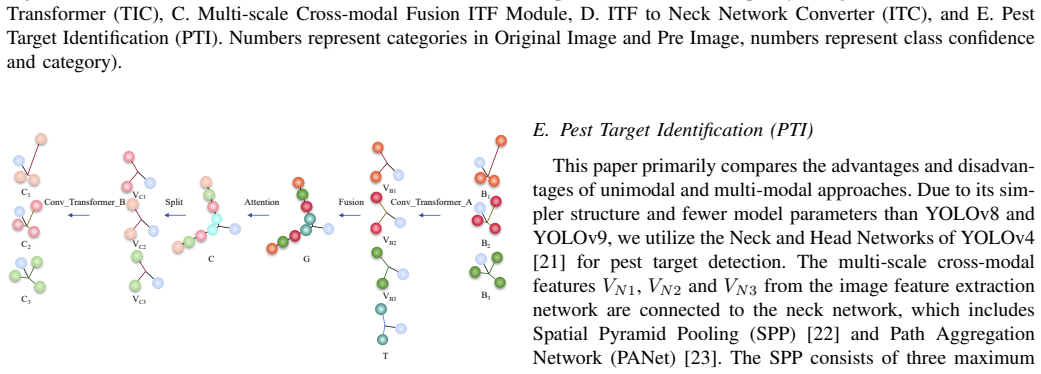
The load-bearing mechanism is the ITF module: a Transformer encoder (scaled dot-product attention, multi-head self-attention plus feed-forward sub-layers) that receives a concatenated sequence G built from n text tokens and 25 visual tokens at each of three scales, for both the original and super-resolved image, so the same attention operation mixes semantic class cues with fine-grained visual cues. The TIC and ITC converters map visual feature maps into and out of this token space; the LSRGAN super-resolution path supplies a second, sharper view of the same scene; and the YOLOv4 neck/head (SPP + PANet) turns the fused multi-scale features into bounding-box predictions.
What would settle it
Run MSFNet-CPD on CTIP102 with the text channel removed, or with text descriptions swapped randomly between species; the paper's own ablation predicts mAP falls from 46.06% to about 35.6%, which would erase most of the claimed advantage over YOLOv9 (42.32%) on the same data.
Extended reading notes
Core claim
The central discovery the authors report is that cross-modal fusion of visual and textual features beats unimodal detection on pest benchmarks, provided the text describes the species present. The network architecture interleaves three components: LSRGAN super-resolution to repair low-quality field images; a Text-Image Converter (TIC) that condenses multi-scale visual features into 25 tokens per scale; and an Image-Text Fusion (ITF) Transformer in which text tokens and visual tokens attend to one another, with an Image-Text Converter (ITC) decoding the fused representation back to feature maps for the detection neck. The paper also contributes three datasets—STIP102 (simple text), CTIP102 (complex text), and MTIP102 (multi-target composites made by the ACIE augmentation algorithm)—and reports that more complex text yields higher precision and mAP50 than simple text.
Load-bearing premise
The evaluation assumes it is a valid protocol to hand the model a text description built from the species label at inference time; if that text is removed or does not match the image's species, the reported gains largely disappear.
Editorial extensions
If this is right
- If text descriptions of the target species are available at inference time, pest detectors can be expected to beat image-only detectors by a wide margin on IP102-style data.
- The roughly 10-point mAP drop without text indicates that almost all of the multimodal advantage depends on the semantic channel, not on the visual architecture alone.
- The super-resolution path contributes about as much as the text channel, suggesting low-quality field images are a first-order bottleneck for pest detection.
- The ACIE augmentation can generate labeled multi-target training images with random backgrounds and placements, which the paper reports improves robustness in complex scenes even if raw scores on MTIP102 are lower.
Reading between the lines
- Because the text descriptions in STIP102 and CTIP102 are constructed from the species identities, the reported mAP measures how much class-label information the model can exploit through the text channel; a deployment protocol with genuinely independent text (e.g., a field-guide entry not tailored to the image) would likely show smaller gains.
- The same TIC-ITF-ITC design could transfer to any fine-grained detection task—plant diseases, medical images, insect taxonomy—where a short verbal description of the target class exists, offering a cheap way to inject semantic priors.
- A fairer comparison against unimodal baselines would either give those baselines equivalent class information or evaluate MSFNet-CPD under text-only, no-text, and mismatched-text conditions; the paper reports only the no-text ablation.
- The roughly 10-point gap without text suggests the visual backbone alone may underperform YOLOv9, so the headline comparison effectively contrasts a text-augmented model with an image-only model.
Signed reviews
Editorial analysis
A structured set of objections, weighed in public.
Referee Report
Summary. The paper proposes MSFNet-CPD, a multi-scale cross-modal fusion network for crop pest detection. The method combines super-resolved and original images with per-species text descriptions, and the authors introduce four datasets (HIP102, STIP102, CTIP102, MTIP102) derived from IP102, plus an ACIE data-enhancement algorithm for multi-target images. The central claim is that MSFNet-CPD consistently outperforms state-of-the-art unimodal detectors on these benchmarks, with the best result reported on the CTIP102 dataset (mAP 46.06, mAP50 92.18, mAP75 40.18).
Significance. If the evaluation protocol were sound, the paper would make a useful contribution by introducing multimodal pest-detection benchmarks and demonstrating a cross-modal benefit. The datasets, particularly STIP102 and CTIP102, could be of interest to the community, and the ACIE algorithm addresses a practical multi-target scenario. However, the central claim of cross-modal superiority rests on an evaluation setup in which the test-time text input is generated from the ground-truth species label. This confound, together with uncontrolled comparisons against published baselines, means the reported gains are not evidence for the paper's central conclusion. The strength of the contribution therefore depends entirely on whether the protocol can be fixed, which the current manuscript does not demonstrate.
major comments (3)
- [§II-F, Figure 3; §III-C; Table VI] The comparison in Table IV versus Table V is not controlled. Table IV reports YOLOv9 on unimodal IP102 at 42.32 mAP, while Table V reports MSFNet-CPD on CTIP102 at 46.06 mAP. These differ in the dataset (IP102 vs CTIP102), in the training data (the multimodal model also sees text, which leaks the label), and possibly in the train/validation/test split: Section III-A states only that datasets are divided 'according to 8:1:1' with no random seed or confirmation that the split matches that used for the published IP102 baselines in Table IV. No experiment runs MSFNet-CPD on unmodified IP102 under the same training conditions as the baselines, and no error bars or repeated runs are reported. The 0.32-point mAP75 difference (Table V 40.18 vs Table IV 39.86) is well within run-to-run noise for object detectors, so the claim of 'significantly outperforms this state-of-the-art model across all metrics' is not supported by the presented evidence.
- [Table V vs Table VI] There is an internal inconsistency in the reported mAP75 values for the full model on CTIP102. Table V lists the CTIP102 row as P=82.15, F1=78.21, mAP=46.06, mAP50=92.18, mAP75=40.18, while Table VI lists 'Our model' with mAP=46.06, mAP50=92.18, mAP75=39.86. The same setup should produce the same number; if the difference is due to a different dataset split or random seed, that should be stated. As written, this discrepancy undermines the reliability of the numerical comparisons, especially since the mAP75 value in Table VI coincides exactly with the YOLOv9 mAP75 in Table IV.
- [§III-A and Table II] The ACIE-generated MTIP102 results are not compared against any baseline detector on the same data. Table V reports only MSFNet-CPD on MTIP102 (mAP 22.33), and Section III-E attributes the drop to task complexity. Without a unimodal baseline trained on MTIP102, the reader cannot tell whether the low score is due to the difficulty of the multi-target task or to a deficiency of the proposed method on that data.
minor comments (1)
- [§III-C] Section II-G states parameter values for ACIE (B=580, T=820, R=4, num=10000) without any justification or sensitivity analysis; the choice of these values may materially affect the MTIP102 results.
Circularity Check
Text input is built from ground-truth species labels; the reported cross-modal gain is a label side-channel by construction.
-
self definitional
[Section II-F (Data Set Construction), Figure 3; Section III-C; Table VI]
"we constructed two text descriptions, simple and complex, for each pest. These text descriptions are intended to provide information about the pest characteristics ... The results indicate that the CTIP02 and STIP102 datasets outperform the unimodal dataset in detection performance. This suggests that incorporating textual descriptive features corresponding to the images helps overcome the limitations of using single-image features. ... Simple Description: The adult body of the rice leaf roller is approximately 12-15 millimeters long and appears grayish brown."
The text descriptions are authored per pest species (Figure 3), and at test time each image is paired with the description of its true species. Thus the text modality carries the ground-truth class identity; the network can read the answer class from the text. The claimed cross-modal advantage over unimodal IP102 baselines (e.g., CTIP102 46.06 mAP vs YOLOv9 42.32) is not an independent test: the baselines never receive the text side channel. The paper's own ablation confirms the channel's role: removing text lowers mAP by 10.42 points, roughly the reported margin. The conclusion that cross-modal fusion is more effective than unimodal features therefore reduces by construction to feeding class-conditioned text into the classifier.
full rationale
The central empirical claim is that MSFNet-CPD consistently outperforms state-of-the-art unimodal detectors on pest detection benchmarks, and that this superiority demonstrates the benefit of cross-modal fusion. The evaluation protocol, however, supplies test images with text descriptions that are constructed from the species label of each image: Figure 3 gives per-species descriptions, and Table II pairs every image with simple or complex text. At inference the model therefore receives the target class through the text modality, while the unimodal baselines in Table IV do not. The ablation in Table VI shows that removing text drops mAP by 10.42 points, which is comparable to the gap between CTIP102 and YOLOv9, indicating that most of the claimed cross-modal gain is attributable to the class-identifying text input rather than to learned visual-text fusion. This is not a controlled test of multimodal fusion, and the abstract's 'consistently outperforms' claim is not supported as a statement about multimodal capability. The paper also contains no external benchmark validation in which text is withheld or class-agnostic; all comparisons are on datasets where the text is derived from the labels. For this reason the central claim is substantially circular by construction, though the super-resolution and data-augmentation components are evaluated separately and are not themselves circular. The score reflects that the headline cross-modal result is forced by the input protocol, not that the entire architecture is vacuous.
Assumptions & free parameters
free parameters (5)
- wordmaxlen =
41
- sentmaxlen =
35
- numattentionheads =
16
- ACIE targets per image (R) =
4
- ACIE num generated images =
10000
assumptions (4)
- domain assumption IP102 annotations are correct and the image-label correspondence is noise-free.
- domain assumption The per-species text descriptions collected from books and websites are accurate and aligned with the IP102 class labels.
- domain assumption Pretrained Real-ESRGAN and BERT produce features that help pest detection in this dataset.
- domain assumption The 8:1:1 random split is equivalent to the IP102 split used for published baselines.
invented entities (4)
-
STIP102
-
CTIP102
-
HIP102
-
MTIP102
Cite this review
Pith. "Pith review of MSFNet-CPD: Multi-Scale Cross-Modal Fusion Network for Crop Pest Detection." pith.science (2026). https://pith.science/paper/KZB36Y4W
@misc{pith2026250502441,
  author       = {Pith},
  title        = {Pith review of: MSFNet-CPD: Multi-Scale Cross-Modal Fusion Network for Crop Pest Detection},
  year         = {2026},
  howpublished = {\url{https://pith.science/paper/KZB36Y4W}},
  note         = {Machine review of arXiv:2505.02441}
}
read the original abstract
Accurate identification of agricultural pests is essential for crop protection but remains challenging due to the large intra-class variance and fine-grained differences among pest species. While deep learning has advanced pest detection, most existing approaches rely solely on low-level visual features and lack effective multi-modal integration, leading to limited accuracy and poor interpretability. Moreover, the scarcity of high-quality multi-modal agricultural datasets further restricts progress in this field. To address these issues, we construct two novel multi-modal benchmarks-CTIP102 and STIP102-based on the widely-used IP102 dataset, and introduce a Multi-scale Cross-Modal Fusion Network (MSFNet-CPD) for robust pest detection. Our approach enhances visual quality via a super-resolution reconstruction module, and feeds both the original and reconstructed images into the network to improve clarity and detection performance. To better exploit semantic cues, we propose an Image-Text Fusion (ITF) module for joint modeling of visual and textual features, and an Image-Text Converter (ITC) that reconstructs fine-grained details across multiple scales to handle challenging backgrounds. Furthermore, we introduce an Arbitrary Combination Image Enhancement (ACIE) strategy to generate a more complex and diverse pest detection dataset, MTIP102, improving the model's generalization to real-world scenarios. Extensive experiments demonstrate that MSFNet-CPD consistently outperforms state-of-the-art methods on multiple pest detection benchmarks. All code and datasets will be made publicly available at: https://github.com/Healer-ML/MSFNet-CPD.
Figures


Figures from the paper (3 more)


Reference graph
Works this paper leans on
-
[29]
Cam-can: Class activation map-based categorical adversarial network,
G. Batchuluun, J. Choi, and K. R. Park, “Cam-can: Class activation map-based categorical adversarial network,” Expert Systems with Appli- cations, vol. 222, p. 119809, 2023
work page 2023
-
[1]
G. Dai, J. Fan, Z. Tian, and C. Wang, “Pplc-net: Neural network- based plant disease identification model supported by weather data augmentation and multi-level attention mechanism,” Journal of King Saud University-Computer and Information Sciences , vol. 35, no. 5, p. 101555, 2023
work page 2023
-
[2]
Offline mobile diagnosis system for citrus pests and diseases using deep compression neural network,
J. You and J. Lee, “Offline mobile diagnosis system for citrus pests and diseases using deep compression neural network,” IET Computer Vision, vol. 14, no. 6, pp. 370–377, 2020
work page 2020
-
[3]
Identification of crop diseases using improved convolutional neural networks,
L. Wang, J. Sun, X. Wu, J. Shen, B. Lu, and W. Tan, “Identification of crop diseases using improved convolutional neural networks,” IET Computer Vision, vol. 14, no. 7, pp. 538–545, 2020
work page 2020
-
[4]
An efficient insect pest clas- sification using multiple convolutional neural network based models,
H. T. Ung, H. Q. Ung, and B. T. Nguyen, “An efficient insect pest clas- sification using multiple convolutional neural network based models,” arXiv preprint arXiv:2107.12189 , 2021
arXiv 2021
-
[5]
Q. Guo, C. Wang, D. Xiao, and Q. Huang, “A novel multi-label pest image classifier using the modified swin transformer and soft binary cross entropy loss,” Engineering Applications of Artificial Intelligence , vol. 126, p. 107060, 2023
work page 2023
-
[6]
A two- stream network with complementary feature fusion for pest image classification,
C. Wang, J. Zhang, J. He, W. Luo, X. Yuan, and L. Gu, “A two- stream network with complementary feature fusion for pest image classification,” Engineering Applications of Artificial Intelligence , vol. 124, p. 106563, 2023
work page 2023
-
[7]
An improved densenet model to classify the damage caused by cotton aphid,
W. Bao, T. Cheng, X.-G. Zhou, W. Guo, Y . Wang, X. Zhang, H. Qiao, and D. Zhang, “An improved densenet model to classify the damage caused by cotton aphid,” Computers and Electronics in Agriculture, vol. 203, p. 107485, 2022
work page 2022
Show all 35 references
-
[8]
Deep transfer learning model for disease identification in wheat crop,
S. Nigam, R. Jain, S. Marwaha, A. Arora, M. A. Haque, A. Dheeraj, and V . K. Singh, “Deep transfer learning model for disease identification in wheat crop,” Ecological Informatics, vol. 75, p. 102068, 2023
2023
-
[9]
Inception convolutional vision trans- formers for plant disease identification,
S. Yu, L. Xie, and Q. Huang, “Inception convolutional vision trans- formers for plant disease identification,” Internet of Things , vol. 21, p. 100650, 2023
2023
-
[10]
Ai based rice leaf disease identification enhanced by dynamic mode decomposition,
S. KM, S. V , S. P. Kurian, and O. K. Sikha, “Ai based rice leaf disease identification enhanced by dynamic mode decomposition,” 2023
2023
-
[11]
Trends in vision- based machine learning techniques for plant disease identification: A systematic review,
P. S. Thakur, P. Khanna, T. Sheorey, and A. Ojha, “Trends in vision- based machine learning techniques for plant disease identification: A systematic review,” Expert Systems with Applications , p. 118117, 2022
2022
-
[12]
A survey on smart agriculture: Development modes, tech- nologies, and security and privacy challenges,
X. Yang, L. Shu, J. Chen, M. A. Ferrag, J. Wu, E. Nurellari, and K. Huang, “A survey on smart agriculture: Development modes, tech- nologies, and security and privacy challenges,” IEEE/CAA Journal of Automatica Sinica, vol. 8, no. 2, pp. 273–302, 2021
2021
-
[13]
Rice-fusion: A multimodality data fusion framework for rice disease diagnosis,
R. R. Patil and S. Kumar, “Rice-fusion: A multimodality data fusion framework for rice disease diagnosis,” IEEE Access, vol. 10, pp. 5207– 5222, 2022
2022
-
[14]
Multimodal fine-grained transformer model for pest recognition,
Y . Zhang, L. Chen, and Y . Yuan, “Multimodal fine-grained transformer model for pest recognition,” Electronics, vol. 12, no. 12, p. 2620, 2023
2023
-
[15]
Crop disease identification and interpretation method based on multimodal deep learning,
J. Zhou, J. Li, C. Wang, H. Wu, C. Zhao, and G. Teng, “Crop disease identification and interpretation method based on multimodal deep learning,” Computers and Electronics in Agriculture , vol. 189, p. 106408, 2021
2021
-
[16]
Tomato disease classification and identification method based on multimodal fusion deep learning,
N. Zhang, H. Wu, H. Zhu, Y . Deng, and X. Han, “Tomato disease classification and identification method based on multimodal fusion deep learning,” Agriculture, vol. 12, no. 12, p. 2014, 2022
2014
-
[17]
Real-esrgan: Training real- world blind super-resolution with pure synthetic data,
X. Wang, L. Xie, C. Dong, and Y . Shan, “Real-esrgan: Training real- world blind super-resolution with pure synthetic data,” in Proceedings of the IEEE/CVF International Conference on Computer Vision , 2021, pp. 1905–1914
2021
-
[18]
Super-resolution via deep learning,
K. Hayat, “Super-resolution via deep learning,” arXiv preprint arXiv:1706.09077, 2017
2017 arXiv
-
[19]
Attention is all you need,
A. Vaswani, N. Shazeer, N. Parmar, J. Uszkoreit, L. Jones, A. N. Gomez, Ł. Kaiser, and I. Polosukhin, “Attention is all you need,” Advances in Neural Information Processing Systems , vol. 30, 2017
2017
-
[20]
A guide to convolution arithmetic for deep learning,
V . Dumoulin and F. Visin, “A guide to convolution arithmetic for deep learning,” arXiv preprint arXiv:1603.07285 , 2016
2016 arXiv
-
[21]
Yolov4: Op- timal speed and accuracy of object detection,
A. Bochkovskiy, C.-Y . Wang, and H.-Y . M. Liao, “Yolov4: Op- timal speed and accuracy of object detection,” arXiv preprint arXiv:2004.10934, 2020
2004 arXiv
-
[22]
Spatial pyramid pooling in deep convolutional networks for visual recognition,
K. He, X. Zhang, S. Ren, and J. Sun, “Spatial pyramid pooling in deep convolutional networks for visual recognition,” IEEE Transactions on Pattern Analysis and Machine Intelligence , vol. 37, no. 9, pp. 1904– 1916, 2015
1904
-
[23]
Path aggregation network for instance segmentation,
S. Liu, L. Qi, H. Qin, J. Shi, and J. Jia, “Path aggregation network for instance segmentation,” in Proceedings of the IEEE Conference on Computer Vision and Pattern Recognition , 2018, pp. 8759–8768
2018
-
[24]
Yolov3: An incremental improvement,
J. Redmon and A. Farhadi, “Yolov3: An incremental improvement,” arXiv preprint arXiv:1804.02767 , 2018
2018 arXiv
-
[25]
Ip102: A large- scale benchmark dataset for insect pest recognition,
X. Wu, C. Zhan, Y .-K. Lai, M.-M. Cheng, and J. Yang, “Ip102: A large- scale benchmark dataset for insect pest recognition,” in Proceedings of the IEEE/CVF Conference on Computer Vision and Pattern Recognition, 2019, pp. 8787–8796
2019
-
[26]
Faster r-cnn: Towards real-time object detection with region proposal networks,
S. Ren, K. He, R. Girshick, and J. Sun, “Faster r-cnn: Towards real-time object detection with region proposal networks,” Advances in Neural Information Processing Systems , vol. 28, 2015
2015
-
[27]
Feature pyramid networks for object detection,
T.-Y . Lin, P. Doll´ar, R. Girshick, K. He, B. Hariharan, and S. Belongie, “Feature pyramid networks for object detection,” in Proceedings of the IEEE Conference on Computer Vision and Pattern Recognition , 2017, pp. 2117–2125
2017
-
[28]
Ssd: Single shot multibox detector,
W. Liu, D. Anguelov, D. Erhan, C. Szegedy, S. Reed, C.-Y . Fu, and A. C. Berg, “Ssd: Single shot multibox detector,” in Computer Vision– ECCV 2016: 14th European Conference, Amsterdam, The Netherlands, October 11–14, 2016, Proceedings, Part I 14 . Springer, 2016, pp. 21–37
2016
-
[30]
Real-time flying object detection with yolov8,
D. Reis, J. Kupec, J. Hong, and A. Daoudi, “Real-time flying object detection with yolov8,” 2024. [Online]. Available: https: //arxiv.org/abs/2305.09972
2024 arXiv
-
[31]
Yolov9: Learning what you want to learn using programmable gradient information,
C.-Y . Wang, I.-H. Yeh, and H.-Y . M. Liao, “Yolov9: Learning what you want to learn using programmable gradient information,” 2024. [Online]. Available: https://arxiv.org/abs/2402.13616
2024 arXiv
-
[32]
Efficient estimation of word representations in vector space,
T. Mikolov, K. Chen, G. Corrado, and J. Dean, “Efficient estimation of word representations in vector space,” 2013. [Online]. Available: https://arxiv.org/abs/1301.3781
2013 arXiv
-
[33]
Enhanced litehrnet based sheep weight estimation using rgb-d images,
C. He, Y . Qiao, R. Mao, M. Li, and M. Wang, “Enhanced litehrnet based sheep weight estimation using rgb-d images,”Computers and Electronics in Agriculture, vol. 206, p. 107667, 2023
2023
-
[34]
Ex- plainable deep convolutional neural networks for insect pest recogni- tion,
S. Coulibaly, B. Kamsu-Foguem, D. Kamissoko, and D. Traore, “Ex- plainable deep convolutional neural networks for insect pest recogni- tion,” Journal of Cleaner Production , vol. 371, p. 133638, 2022
2022
-
[35]
Application of transfer learning and image augmentation technology for tomato pest identifi- cation,
M.-L. Huang, T.-C. Chuang, and Y .-C. Liao, “Application of transfer learning and image augmentation technology for tomato pest identifi- cation,” Sustainable Computing: Informatics and Systems , vol. 33, p. 100646, 2022
2022
Reviewed August 16, 2026 · model on record in the stance chip above.
Discussion (0). Continue with ORCID to comment.