REVIEW 4 major objections 4 minor 19 references
Relativistic Locality from Electromagnetism to Quantum Field Theory
T0 review · 4 major / 4 minor · reviewed 2026-08-11 · deepseek-v4-flash
Pith's one-line read The paper argues that collapse-free (many-worlds) quantum field theory meets the same relativistic-locality standard as classical electromagnetism, provided regions are assigned states by tracing field wave functionals, and that…
desk verdict The classical proofs and the Fock-space comparison are solid and worth having, but the QFT locality proof in Section 4.2 rests on an inference that is not just unproven but false in general, so the headline claim about Everettian QFT locality is not established. read the letter →
The pith
A machine-rendered reading of the paper's core claim, the machinery that carries it, and where it could break.
The reading
What carries the argument
The central object is the 'difference matrix' between two solutions of the von Neumann equation that agree inside a region R initially. The machinery works as follows: if the difference matrix at time zero is supported in the complement of R, then after unitary evolution it should be supported in the complement of the contracting-light-cone slice at later times, and this is enforced by the fact that Heisenberg-picture field operators commute at spacelike separation. Tracing over the complement of that slice then annihilates the difference matrix, so the two reduced states agree on the slice. The same frustum-and-divergence-theorem energy argument used for electromagnetism, the Klein-Gordon equation, and the Dirac equation supplies the classical yardstick that the quantum-field-theory argument is held against.
What would settle it
A concrete check would be to compute, in a lattice regularization, the evolved reduced density matrix difference for an initial difference localized just outside a sphere: if any signal appears inside the contracting light-cone at a later time, the field-approach locality claim fails. Equally decisive would be to construct a well-defined reduced density matrix for a region using the standard Fock-space creation operators, which the paper says cannot be done.
Extended reading notes
Core claim
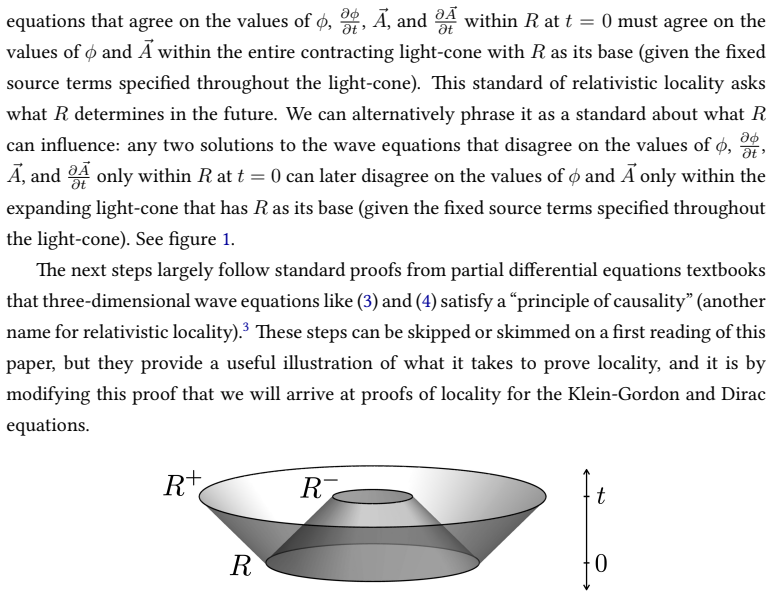
The central claim is that Everettian quantum field theory is relativistically local at the fundamental level. The paper's standard says a deterministic theory is local when specifying what is happening in a sphere R at time zero uniquely fixes what happens in the contracting light-cone with R as its base. For quantum field theory, that requires a concrete way to say what is happening in a region. The preferred method uses the field wave functional and defines the reduced density matrix of a region R by tracing over field configurations outside R. The difference between two initially identical-in-R solutions then evolves into an operator supported in the complement of the future slice, so tracing over the complement gives zero there; the argument rests on the spacelike commutativity of Heisenberg-picture field operators. The same standard applied to Fock-space states fails: with standard creation operators no reduced density matrix for a region can be written down, and with Newton-Wigner operators the time-evolved creation operators do not commute at spacelike separation, allowing initially outside differences to reach inside the contracting light-cone. The paper concludes that whether quantum field theory looks local depends on whether fields or particles are fundamental, and that a field ontology shows the many-worlds interpretation to be local.
Load-bearing premise
The argument assumes that the state of a region can be extracted by averaging over the field configurations outside it, and that an initial difference outside a sphere can never leak into the future contracting light-cone of the sphere; the authors themselves flag both steps as unproven and call the proof 'not watertight'.
Editorial extensions
If this is right
- If the field-based argument is right, the many-worlds interpretation is fundamentally local, so the usual Bell-type nonlocality arguments do not apply to it in the same way.
- The field wave functional ontology is favored over a particle ontology, because only the field approach satisfies the paper's locality standard for quantum field theory.
- A non-local, global picture of branching into worlds is compatible with the fundamental locality of the underlying dynamics, just as Newtonian gravity and electrostatics are non-local approximations to local deeper theories.
- The debate between local and global branching does not affect the fundamental locality of the many-worlds interpretation, because region-level reduced states remain unchanged by distant measurements.
- The Born-rule derivation from self-locating uncertainty can be defended against the objection that global branching is non-local, since Bob's reduced state is unaffected by Alice's distant measurement even when a global branching picture is adopted.
Reading between the lines
- The authors do not pursue this, but the same region-state test could be applied to collapse theories: because collapse is a non-unitary, non-local update, such theories would likely fail the contracting-light-cone standard, sharpening the contrast with the many-worlds reading.
- A testable extension would be to compare, in a lattice regularization, the growth of mutual information between a region and its complement for field-based versus Newton-Wigner particle-based reduced states; the field representation should show strictly light-cone-bounded growth while the particle representation should show a small superluminal tail.
- The paper's asymmetry between field and particle approaches suggests a broader moral: any fundamental ontology that treats particle number as primitive will face analogous difficulties with localizing states to regions, extending the known no-go results for relativistic localizable particles.
- If the 'should be' steps in the quantum-field-theory proof were replaced by rigorous algebraic arguments, the same contraction-of-state idea might generalize to interacting theories and curved spacetimes, where the Hilbert-space factorization issue is even more delicate.
Editorial analysis
A structured set of objections, weighed in public.
Referee Report
Summary. The paper proposes a single standard for relativistic locality—contracting light-cone determinism—and proves that classical electromagnetism, the Klein-Gordon equation, and the Dirac equation satisfy it. It then attempts to extend this standard to unitary (Everettian) quantum field theory by assigning reduced density matrix states to spatial regions. The authors argue that a field-wave-functional approach to QFT meets the locality standard, while Fock-space particle approaches either fail to assign states to regions (standard creation operators) or violate locality (Newton-Wigner operators). They conclude that the many-worlds interpretation is fundamentally local and that global branching is compatible with this locality. The central load-bearing element is the locality proof in Section 4.2.
Significance. The classical proofs (EM and Klein-Gordon) are presented carefully and are checkable; the Dirac proof in Section 3.3 is a useful addition to the literature, since it follows the same energy-integral strategy as the other cases. The discussion of Fock-space alternative localizations in Sections 4.4.1 and 4.4.2 is illuminating, particularly the contrast between the failure of standard creation operators to yield regional states and the superluminal propagation of Newton-Wigner states. The paper is also honest in flagging that the QFT proof is not watertight (intro to Section 4, footnote 13). However, the significance of the paper hinges on Section 4.2: if that proof fails, the thesis that Everettian QFT is local is unsupported. The authors' explicit acknowledgement of gaps does not mitigate the fact that the proof contains an inference that is not merely insufficiently rigorous but generally false.
major comments (4)
- [§4.2, Eqs. (47)-(48)] The inference from tr_Rbar ρ_d(0)=0 to ρ_d(0) being a local operator restricted to Rbar is invalid. The vanishing partial trace over Rbar does not imply that ρ_d(0) has no component acting on R; it only requires that the partial trace of each term vanish. Operators of the form A_R ⊗ B_Rbar with tr B_Rbar = 0 have zero partial trace but act nontrivially on R. Such terms represent R-Rbar correlations, and two density matrices with identical reduced states on R can differ by such correlations. Consequently, the representation (48) in terms of |φ_Rbar⟩⟨φ'_Rbar| is unjustified, the microcausality step (49) cannot be applied, and the final conclusion (50) does not follow. This is a load-bearing error: the proof of locality for the field approach, and hence the paper's central claim that the many-worlds interpretation is fundamentally local, rests on it.
- [§4.2, after (49)] The step from ρ_d(t) commuting with all operators in R- to ρ_d(t) being a local operator restricted to Rbar- is asserted with 'should be sufficient' and is not established. In algebraic QFT, this commutant claim requires a duality condition such as A(Rbar-) = A(R-)', which is not automatically satisfied in all representations and fails for fermionic fields. The paper neither proves nor cites a basis for this step, and it is essential for reaching (50).
- [§4.1, Eq. (38) and footnote 13] The partial trace construction presumes a factorization H = H_R ⊗ H_Rbar. As the authors acknowledge (citing Swanson 2020), this factorization is not generally valid in algebraic QFT. The paper sets this concern aside, but the issue is load-bearing: if the partial trace is not well-defined, then the reduced density matrix states ρ_R are not well-defined, and the locality statement is empty. A fully convincing treatment would need to show that the field-wave-functional partial trace yields a state on the local algebra that satisfies the appropriate time-slice property.
- [§4.2, last paragraph] The claim that the proof extends immediately to interacting theories is too strong, since the commutation property (43) holds at the level of the abstract net of local algebras, whereas the wave-functional representation and the partial-trace construction for interacting fields are not established. The fermionic extension is explicitly conditional on the unproven assertion that the difference matrix can be written as a sum of pairs of anticommuting local operators. These are substantive gaps in the paper's central argument.
minor comments (4)
- [§3.3, Eqs. (25)-(29)] The sum-of-squares decomposition of the edge integral is difficult to follow; a short derivation or a reference to the relevant gamma-matrix identities would make the proof more accessible.
- [§4.4.2, Eq. (69)] The combinatorial factor l! in the partial trace over the outside particles is introduced without explanation; a brief comment on the symmetry of the wave function and the distinct ways of pairing the outside particles would clarify the expression.
- [§4.2] The notation 'Rbar-' is used in Eqs. (48)-(50) but is not defined at first use; the paper should introduce it explicitly as the complement of the contracting light-cone slice R-.
- [§5] The discussion of global versus local branching is engaging, but it is only loosely connected to the technical proof; stating at the start of Section 5 which conclusions depend on Section 4.2 and which are independent would help the reader.
Circularity Check
No significant circularity: the classical locality proofs are self-contained PDE arguments, and the QFT argument uses microcausality as an explicit premise while flagging its own gaps, rather than deriving its conclusion from a renamed version of itself.
full rationale
The paper's derivation chain is not circular. Sections 2–3 prove relativistic locality for electromagnetism, the Klein-Gordon equation, and the Dirac equation by direct energy-identity and continuity-equation arguments over a light-cone frustum; these proofs do not presuppose the target conclusion. Section 4.2 for QFT is conditional: it takes microcausality, Eq. (43), as an imported premise and attempts to derive the paper's region-state locality standard. That is a substantive inference, not a definitional equivalence. The authors explicitly flag the two delicate inferences in Eqs. (47)–(50) with 'should be' and concede that the proof 'is not watertight and certainly not up to the standards of mathematical rigor found in algebraic approaches to quantum field theory.' The first flagged step, from tr_Rbar rho_d(0)=0 to the claim that rho_d(0) is supported in Rbar, is indeed invalid as written, and the partial-trace manipulation in Eq. (50) is compressed. But this is a soundness gap, not circularity: the conclusion does not follow by construction from the premises, and the gap is acknowledged rather than concealed. The Fock-space discussion is derived from explicit commutator facts about standard and Newton-Wigner creation operators, and the Section 5 defense of global branching uses Sebens and Carroll only to address compatibility of an already-argued fundamental locality with a non-fundamental branching picture. Self-citations to Sebens (2022) and Sebens and Carroll (2018) support background preferences and interpretive commitments, but the locality proofs themselves are carried out in this paper and are not dependent on those citations for their content. No fitted parameters, no self-defined quantities, and no uniqueness claims imported from the authors' prior work are load-bearing. The flagged mathematical gaps should be assessed as correctness risks, not as circularity.
Assumptions & free parameters
assumptions (5)
- domain assumption Heisenberg picture local operators commute at spacelike separation, [O1(x), O2(y)] = 0.
- ad hoc to paper The global Hilbert space factorizes as H_R tensor H_Rbar for a spatial region R.
- domain assumption The universal state is a wave functional Psi[phi] evolving by a Schrodinger equation with Hamiltonian (42).
- ad hoc to paper An operator that commutes with all local operators in R- is localized in Rbar-.
- ad hoc to paper UV divergences can be handled somehow.
Cite this review
Pith. "Pith review of Relativistic Locality from Electromagnetism to Quantum Field Theory." pith.science (2026). https://pith.science/paper/KZEMZHO6
@misc{pith2026241211532,
  author       = {Pith},
  title        = {Pith review of: Relativistic Locality from Electromagnetism to Quantum Field Theory},
  year         = {2026},
  howpublished = {\url{https://pith.science/paper/KZEMZHO6}},
  note         = {Machine review of arXiv:2412.11532}
}
read the original abstract
Electromagnetism is the paradigm case of a theory that satisfies relativistic locality. This can be proven by demonstrating that, once the theory's laws are imposed, what is happening within a region fixes what will happen in the contracting light-cone with that region as its base. The Klein-Gordon and Dirac equations meet the same standard. We show that this standard can also be applied to quantum field theory (without collapse), examining two different ways of assigning reduced density matrix states to regions of space. Our preferred method begins from field wave functionals and judges quantum field theory to be local. Another method begins from particle wave functions (states in Fock space) and leads to either non-locality or an inability to assign states to regions, depending on the choice of creation operators. We take this analysis of quantum field theory (without collapse) to show that the many-worlds interpretation of quantum physics is local at the fundamental level. We argue that this fundamental locality is compatible with either local or global accounts of the non-fundamental branching of worlds, countering an objection that has been raised to the Sebens-Carroll derivation of the Born Rule from self-locating uncertainty.
Figures


Figures from the paper (1 more)

Reference graph
Works this paper leans on
-
[1]
Should Everettians Aspire to Locality?
Adlam, Emily. “Should Everettians Aspire to Locality?” In:Everett and Locality (ed. Alyssa Ney). Forthcoming. Oxford University Press. Baker, David John. “Against Field Interpretations of Quantum Field Theory”. In: The British Journal for the Philosophy of Science 60.3 (2009), pp. 585–609. Bohm, David and Basil J. Hiley.The Undivided Universe: An ontologi...
work page 2009
-
[11]
Schr¨odinger Picture Analysis of Boson and Fermion Quantum Field Theories
Jackiw, Roman. “Schr¨odinger Picture Analysis of Boson and Fermion Quantum Field Theories.” In: Mathematical Quantum Field Theory. Canadian Mathematical Society, 1987, pp. 1–27. Kent, Adrian. “Does it Make Sense to Speak of Self-Locating Uncertainty in the Universal Wave Function? Remarks on Sebens and Carroll”. In: Foundations of Physics 45.2 (2015), pp....
work page 2015
-
[16]
Pilot-Wave Theory and Quantum Fields
43 Struyve, Ward. “Pilot-Wave Theory and Quantum Fields”. In: Reports on Progress in Physics 73.10 (2010), p. 106001. Susskind, Leonard and James Lindesay. An Introduction to Black Holes, Information and the String Theory Revolution: The holographic universe. Hackensack, NJ: World Scientific,
work page 2010
-
[19]
Colloquium: Bell’s theorem and locally mediated reformulations of quantum mechanics
Wharton, Ken B. and Nathan Argaman. “Colloquium: Bell’s theorem and locally mediated reformulations of quantum mechanics”. In: Reviews of Modern Physics 92.2 (May 2020), p. 021002. Williams, Porter, John Dougherty, and Michael E. Miller. “Cluster Decomposition and Two Senses of Isolability”. In: Philosophy of Physics 2.1 (July 2024), p
work page 2020
-
[1961]
Sebens, Charles T. “The Fundamentality of Fields”. In: Synthese 200.5 (2022), pp. 1–28. Sebens, Charles T. and S. M. Carroll. “Self-locating Uncertainty and the Origin of Probability in Everettian Quantum Mechanics”. In:The British Journal for the Philosophy of Science69.1 (2018). Publisher: The University of Chicago Press, pp. 25–74. Strauss, Walter A. P...
work page 2022
-
[1962]
Geometric and renormalized entropy in conformal field theory
Holzhey, Christoph, Finn Larsen, and Frank Wilczek. “Geometric and renormalized entropy in conformal field theory”. In: Nuclear Physics B 424.3 (1994), pp. 443–467. Huang, Kerson. Quantum Field Theory: From Operators to Path Integrals. Wiley,
work page 1994
-
[1992]
Healey, Richard A. “Holism and Nonseparability”. In: The Journal of Philosophy 88.8 (1991). Publisher: Journal of Philosophy, Inc., pp. 393–421. Henley, Ernest M. and Walter Thirring. Elementary Quantum Field Theory. McGraw Hill Book Company Inc.,
work page 1991
-
[1993]
Decoherence, Branching, and the Born Rule in a Mixed-State Everettian Multiverse
Calder´on, Francisco. “The Causal Axioms of Algebraic Quantum Field Theory: A diagnostic”. In: Studies in History and Philosophy of Science 104 (2024), pp. 98–108. Carroll, S. M. “Reality as a Vector in Hilbert Space”. In:Quantum Mechanics and Fundamentality. Springer, 2022, pp. 211–224. Carroll, S. M. and Charles T. Sebens. “Many Worlds, the Born Rule, a...
work page Pith review arXiv 2024
Show all 19 references
-
[1995]
Particles in Quantum Field Theory
Fraser, Doreen. “Particles in Quantum Field Theory”. In:The Routledge Companion to Philosophy of Physics. Ed. by Eleanor Knox and Alastair Wilson. Routledge, 2022, pp. 323–336. — “The Fate of ‘Particles’ in Quantum Field Theories with Interactions”. In: Studies in History and ...
2008
-
[1996]
Reeh-Schlieder Defeats Newton-Wigner: On Alternative Localization Schemes in Relativistic Quantum Field Theory
Halvorson, Hans. “Reeh-Schlieder Defeats Newton-Wigner: On Alternative Localization Schemes in Relativistic Quantum Field Theory”. In: Philosophy of Science 68.1 (2001). Publisher: University of Chicago Press, pp. 111–133. Hatfield, Brian. Quantum Field Theory of Point Particl...
2001
-
[1998]
Non-Separability, Locality and Criteria of Reality: A Reply to Waegell and Mcqueen
Faglia, Paolo. “Non-Separability, Locality and Criteria of Reality: A Reply to Waegell and Mcqueen”. In: Studies in History and Philosophy of Science 106.C (2024), pp. 43–53. 41 Falcone, Riccardo and Claudio Conti. “Localization in quantum field theory”. In: Reviews in Physics...
2024
-
[2002]
In Defense of Dogma: Why There Cannot Be a Relativistic Quantum Mechanical Theory of (Localizable) Particles
42 Malament, David. “In Defense of Dogma: Why There Cannot Be a Relativistic Quantum Mechanical Theory of (Localizable) Particles”. In: Perspectives on Quantum Reality. Ed. by R. Clifton. Kluwer Academic Publishers, 1996, pp. 1–10. Maudlin, Tim. “What Bell did”. In: Journal of...
2014
-
[2005]
How to Be a Relativistic Spacetime State Realist
Swanson, Noel. “How to Be a Relativistic Spacetime State Realist”. In: The British Journal for the Philosophy of Science 71.3 (2020), pp. 933–957. Thaller, Bernd. The Dirac Equation. Berlin, Heidelberg: Springer,
2020
-
[2008]
The Vacuum in Relativistic Quantum Field Theory
Redhead, Michael. “The Vacuum in Relativistic Quantum Field Theory”. In: PSA: Proceedings of the Biennial Meeting of the Philosophy of Science Association 1994 (1994). Publisher: University of Chicago Press, pp. 77–87. Schwartz, Matthew Dean.Quantum Field Theory and the Standa...
1994
-
[2012]
On the Role of Density Matrices in Bohmian Mechanics
D¨urr, Detlef, Sheldon Goldstein, et al. “On the Role of Density Matrices in Bohmian Mechanics”. In: Foundations of Physics 35.3 (2005), pp. 449–467. — “Trajectories and particle creation and annihilation in quantum field theory”. In: Journal of Physics A: Mathematical and Gen...
2005
-
[2017]
Particle Creation and Annihilation: Two Bohmian Approaches
Oldofredi, Andrea. “Particle Creation and Annihilation: Two Bohmian Approaches”. In: Lato Sensu: Revue de la Soci ´et´e de Philosophie des Sciences 5.1 (2018). Publisher: Soci ´et´e de Philosophie des Sciences, pp. 77–85. Pavˇsiˇc, Matej. “Localized States in Quantum Field The...
2018
-
[2020]
Relativistic Causality in Algebraic Quantum Field Theory
Earman, John and Giovanni Valente. “Relativistic Causality in Algebraic Quantum Field Theory”. In: International Studies in the Philosophy of Science 28.1 (2014). Publisher: Taylor & Francis, pp. 1–48. Evans, Lawrence C. Partial Differential Equations. American Mathematical Society,
2014
-
[2022]
Quantum Mechanics on Spacetime I: Spacetime State Realism
Wallace, David and Christopher Gordon Timpson. “Quantum Mechanics on Spacetime I: Spacetime State Realism”. In: British Journal for the Philosophy of Science 61.4 (2010). Publisher: Oxford University Press, pp. 697–727. Weinberg, Steven. The Quantum Theory of Fields. 1: Founda...
2010
-
[2023]
Superentangled states
Clifton, Rob et al. “Superentangled states”. In: Physical Review A 58.1 (July 1998). Publisher: American Physical Society, pp. 135–145. Deckert, Dirk-Andr´e, Michael Esfeld, and Andrea Oldofredi. “A Persistent Particle Ontology for Quantum Field Theory in Terms of the Dirac Se...
1998
Reviewed August 11, 2026 · model on record in the stance chip above.
Discussion (0). Continue with ORCID to comment.