Soft-Dimuon Signature from Two-Component Scalar Dark Matter at the LHC
Pith reviewed 2026-07-02 18:12 UTC · model grok-4.3
The pith
LHC can search for two-component scalar dark matter via soft opposite-sign dimuons plus missing energy and a hard jet.
A machine-rendered reading of the paper's core claim, the machinery that carries it, and where it could break.
Core claim
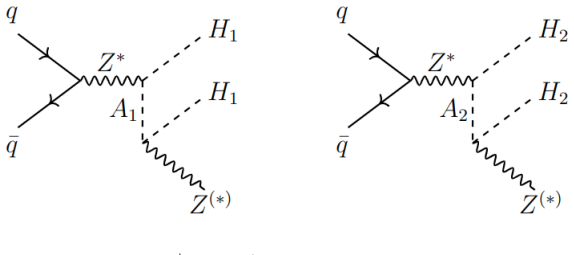
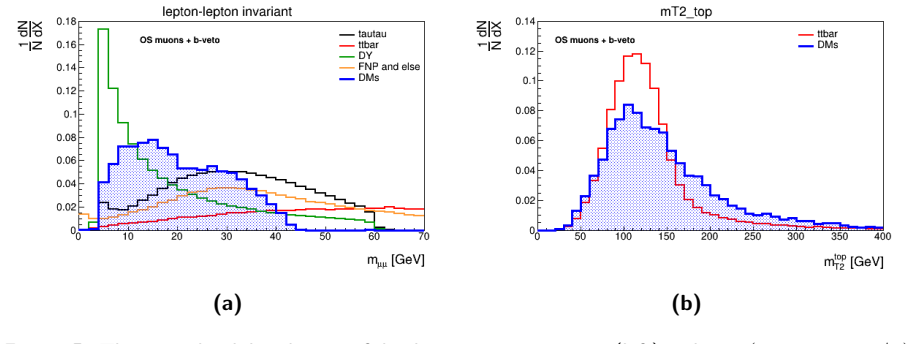
In the I(2+1)HDM with Z2 times Z2 prime symmetry the two inert doublets each stabilize their lightest neutral scalar as a dark matter candidate. The next-to-lightest scalars in each sector decay to the dark matter plus an off-shell Z that produces a soft opposite-sign muon pair. A dedicated cut-based analysis on the dimuon plus missing transverse energy plus jet channel yields S over B approximately 9.8 percent and S over square root of B equal to 1.35 at 300 fb inverse for a representative benchmark, increasing to 4.93 at 4 ab inverse under statistical-only extrapolation. The double-bump structure visible in the dimuon invariant-mass distribution before the final cuts is not statistically r
What carries the argument
Two inert scalar doublets, each stabilized by an independent Z2 symmetry, with small mass splittings to their next-to-lightest states that enable off-shell Z decays to soft muon pairs.
If this is right
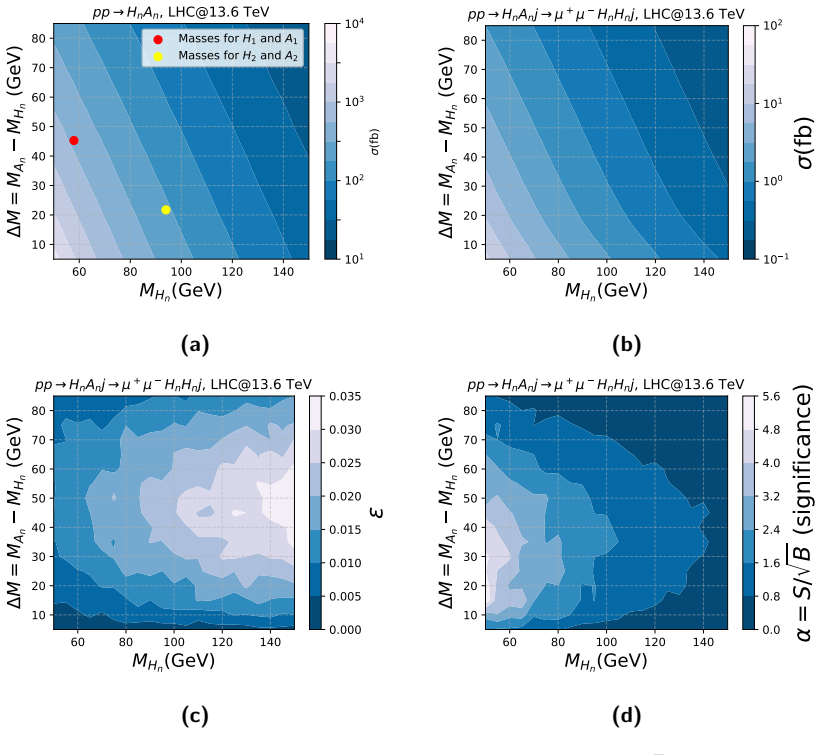
- The parameter space is explored in terms of the two dark matter masses and the two independent mass splittings to the next-to-lightest states.
- Before the final selection the two dark sectors produce a double-bump feature in the dimuon invariant-mass spectrum.
- The benchmark point is underabundant and can be interpreted as subdominant dark matter while the collider analysis stays independent of cosmological abundance.
- The same signal topology and cuts apply to any weakly interacting sector that features electroweak associated production followed by cascade decays through an off-shell Z.
Where Pith is reading between the lines
- Observation of the soft dimuon signal would point to the existence of multiple independent stabilizing symmetries rather than a single dark sector.
- Combining the dimuon channel with direct detection or relic-density constraints could test whether both components contribute measurably to the total dark matter density.
- The same off-shell Z mechanism could be searched for in models with additional inert doublets or singlets provided the mass splittings remain below m_Z.
- Higher-luminosity runs or improved muon resolution could make the double-bump feature statistically significant and thereby distinguish two-component from single-component scenarios.
Load-bearing premise
The mass splittings between each dark matter candidate and its next-to-lightest partner must be smaller than the Z boson mass so that the partner decays through an off-shell Z.
What would settle it
A search at the LHC collecting 300 fb inverse that observes no excess above background in the soft opposite-sign dimuon plus missing transverse energy plus hard jet channel with the predicted kinematics would exclude the benchmark at the quoted significance.
Figures
read the original abstract
We explore the potential of the Large Hadron Collider to probe a two-component scalar dark matter scenario in the opposite-sign dimuon plus missing transverse energy final state, accompanied by a hard jet. The signal features a soft dimuon system with an invariant mass well below $m_Z$. We consider a 3-Higgs Doublet Model with one active and two inert scalar doublets, where a $Z_2 \times Z_2'$ symmetry stabilises the lightest neutral scalar in each inert sector, yielding two scalar DM candidates. The relevant parameter space is mapped in terms of the two DM masses and the mass splittings between each DM candidate and its corresponding next-to-lightest scalar state. We perform a detector-level Monte Carlo analysis and design a dedicated cut-based selection, including a transverse-mass requirement adapted to the signal topology. For a representative benchmark, we obtain $S/B\simeq 9.8%$ and a statistical-only significance of $S/\sqrt{B}=1.35$ at Run 3 with ${\cal L}=300~{\rm fb}^{-1}$, increasing to $S/\sqrt{B}=4.93$ under a statistical-only extrapolation to ${\cal L}=4~{\rm ab}^{-1}$. Before the full selection, the two dark sectors generate a double-bump structure in the dimuon invariant-mass distribution. After the cuts optimised for inclusive sensitivity, however, this feature is not statistically robust enough to establish the two-component origin of the signal. The benchmark is underabundant and is interpreted as a subdominant two-component DM scenario, while the collider analysis remains independent of its cosmological abundance. Although the numerical study is carried out in the I(2+1)HDM, the results are applicable to weakly interacting sectors with similar electroweak associated production and cascade decays, where a heavier state separated from the DM candidate by less than $m_Z$ produces a soft muon pair via an off-shell $Z$ boson.
Editorial analysis
A structured set of objections, weighed in public.
Referee Report
Summary. The manuscript explores the LHC sensitivity to a two-component scalar dark matter scenario in the I(2+1)HDM via the soft opposite-sign dimuon + MET + hard jet final state. The signal arises from cascade decays of next-to-lightest scalars through off-shell Z bosons when mass splittings are below m_Z. Parameter space is mapped in the two DM masses and splittings; a cut-based detector-level MC analysis is performed, yielding for one benchmark S/B ≃ 9.8 % and statistical-only significances S/√B = 1.35 (300 fb^{-1}) and 4.93 (4 ab^{-1}). The double-bump feature in m_μμ is noted to lose statistical robustness after cuts, and the benchmark is interpreted as subdominant DM.
Significance. If the analysis holds after inclusion of systematics and background validation, the work supplies a concrete, topology-adapted search strategy for two-component scalar DM with soft dimuon signatures that can be ported to other weakly coupled electroweak sectors. The modest S/B and purely statistical significances limit the immediate phenomenological impact.
major comments (2)
- [Abstract] Abstract: the reported significances are explicitly statistical-only (S/√B = 1.35 at 300 fb^{-1} and 4.93 at 4 ab^{-1}); the absence of any systematic uncertainties, background estimation/validation procedure, or full cut-optimization details is load-bearing for the central claim that the LHC can probe this scenario.
- [Abstract] Abstract: the double-bump structure generated by the two dark sectors before cuts is stated to be 'not statistically robust enough' after the inclusive selection; this directly weakens any claim that the signature can establish the two-component nature of the signal.
Simulated Author's Rebuttal
We thank the referee for the careful reading of our manuscript and the constructive comments. We address each major comment below and indicate the revisions we will make.
read point-by-point responses
-
Referee: [Abstract] Abstract: the reported significances are explicitly statistical-only (S/√B = 1.35 at 300 fb^{-1} and 4.93 at 4 ab^{-1}); the absence of any systematic uncertainties, background estimation/validation procedure, or full cut-optimization details is load-bearing for the central claim that the LHC can probe this scenario.
Authors: We agree that the statistical-only nature of our significances and the lack of systematic uncertainties are important caveats for the phenomenological claim. Although the abstract already notes that the significances are statistical-only, we will revise it to more explicitly state that no systematic uncertainties have been included and that a complete experimental analysis would require background validation and systematic error estimation. The cut-optimization details are provided in the main text of the manuscript. We will update the abstract in the revised version. revision: yes
-
Referee: [Abstract] Abstract: the double-bump structure generated by the two dark sectors before cuts is stated to be 'not statistically robust enough' after the inclusive selection; this directly weakens any claim that the signature can establish the two-component nature of the signal.
Authors: The manuscript already acknowledges this limitation in the abstract by stating that the double-bump feature is not statistically robust enough after the cuts to establish the two-component origin of the signal. Our central claim concerns the LHC sensitivity to the soft dimuon signature from the two-component scalar DM scenario, not the ability to confirm the two-component nature via the invariant mass distribution. We believe the text does not overstate the latter point, so no revision is required. revision: no
Circularity Check
No significant circularity detected
full rationale
The paper's central results (S/B ≃ 9.8% and statistical significances) are obtained from a standard detector-level Monte Carlo simulation of a benchmark point in the I(2+1)HDM, with explicit input parameters for the two DM masses and mass splittings. The cut-based analysis and transverse-mass requirement are applied to simulated events; the signal topology is defined by the stated mass-splitting regime (< m_Z) rather than derived from the outputs. No equations reduce predictions to fitted inputs by construction, no self-citation chains support the core claim, and the collider study is explicitly independent of cosmological abundance. This is a conventional model-prediction exercise with no load-bearing circular steps.
Axiom & Free-Parameter Ledger
free parameters (2)
- two DM masses
- mass splittings
axioms (1)
- domain assumption Z_2 × Z_2' symmetry stabilizes the lightest neutral scalars in each inert doublet
invented entities (1)
-
Two inert scalar doublets
no independent evidence
Reference graph
Works this paper leans on
-
[1]
King, Stefano Moretti, and Dorota Sokolowska
Venus Keus, Stephen F. King, Stefano Moretti, and Dorota Sokolowska. Dark Matter with Two Inert Doublets plus One Higgs Doublet.JHEP, 11:016, 2014. doi: 10.1007/JHEP11(2014)016
-
[2]
Venus Keus, Stephen F. King, and Stefano Moretti. Phenomenology of the inert ( 2+1 ) and ( 4+2 ) Higgs doublet models.Phys. Rev. D, 90(7):075015, 2014. doi: 10.1103/PhysRevD.90.075015
-
[3]
King, Stefano Moretti, and Dorota Sokolowska
Venus Keus, Stephen F. King, Stefano Moretti, and Dorota Sokolowska. Observable Heavy Higgs Dark Matter.JHEP, 11:003, 2015. doi: 10.1007/JHEP11(2015)003
-
[4]
A. Cordero-Cid, J. Hernández-Sánchez, V. Keus, S. F. King, S. Moretti, D. Rojas, and D. Sokołowska. CP violating scalar Dark Matter.JHEP, 12:014, 2016. doi: 10.1007/JHEP12(2016)014
-
[5]
A. Cordero, J. Hernandez-Sanchez, V. Keus, S. F. King, S. Moretti, D. Rojas, and D. Sokolowska. Dark Matter Signals at the LHC from a 3HDM.JHEP, 05:030, 2018. doi: 10.1007/JHEP05(2018)030
-
[6]
A. Cordero-Cid, J. Hernández-Sánchez, V. Keus, S. Moretti, D. Rojas, and D. Sokołowska. Lepton collider indirect signatures of dark CP-violation.Eur. Phys. J. C, 80(2):135, 2020. doi: 10.1140/epjc/s10052-020-7689-0
-
[7]
Dark CP-violation through theZ-portal.Phys
Venus Keus. Dark CP-violation through theZ-portal.Phys. Rev. D, 101(7):073007, 2020. doi: 10.1103/PhysRevD.101.073007
-
[8]
Cordero-Cid, J
A. Cordero-Cid, J. Hernández-Sánchez, V. Keus, S. Moretti, D. Rojas-Ciofalo, and D. Sokołowska. Collider signatures of darkCP-violation.Phys. Rev. D, 101(9):095023,
-
[9]
doi: 10.1103/PhysRevD.101.095023
-
[10]
Hernandez-Sanchez, V
J. Hernandez-Sanchez, V. Keus, S. Moretti, D. Rojas-Ciofalo, and D. Sokolowska. Complementary Probes of Two-component Dark Matter. 12 2020. – 17 –
2020
-
[11]
Complementary collider and astrophysical probes of multi-component Dark Matter
Jaime Hernandez-Sanchez, Venus Keus, Stefano Moretti, and Dorota Sokolowska. Complementary collider and astrophysical probes of multi-component Dark Matter. JHEP, 03:045, 2023. doi: 10.1007/JHEP03(2023)045
-
[12]
On the CP properties of spin-0 dark matter.JHEP, 06:206, 2025
Atri Dey, Jaime Hernández-Sánchez, Venus Keus, Stefano Moretti, and Tetsuo Shindou. On the CP properties of spin-0 dark matter.JHEP, 06:206, 2025. doi: 10.1007/JHEP06(2025)206
-
[13]
Nilendra G. Deshpande and Ernest Ma. Pattern of Symmetry Breaking with Two Higgs Doublets. Phys. Rev. D, 18:2574, 1978. doi: 10.1103/PhysRevD.18.2574
-
[14]
Multilepton signatures from dark matter at the LHC.JHEP, 09:173, 2022
Alexander Belyaev, Ulla Blumenschein, Arran Freegard, Stefano Moretti, and Dipan Sengupta. Multilepton signatures from dark matter at the LHC.JHEP, 09:173, 2022. doi: 10.1007/JHEP09(2022)173
-
[15]
Ivanov, Venus Keus, and Evgeny Vdovin
Igor P. Ivanov, Venus Keus, and Evgeny Vdovin. Abelian symmetries in multi-Higgs-doublet models. J. Phys. A, 45:215201, 2012. doi: 10.1088/1751-8113/45/21/215201
-
[16]
Venus Keus, Stephen F. King, and Stefano Moretti. Three-Higgs-doublet models: symmetries, potentials and Higgs boson masses.JHEP, 01:052, 2014. doi: 10.1007/JHEP01(2014)052
-
[17]
A. Aranda, D. Hernández-Otero, J. Hernández-Sanchez, V. Keus, S. Moretti, D. Rojas-Ciofalo, and T. Shindou. Z3 symmetric inert ( 2+1 )-Higgs-doublet model.Phys. Rev. D, 103(1):015023, 2021. doi: 10.1103/PhysRevD.103.015023
-
[18]
M. A. Arroyo-Ureña, J. Hernández-Sánchez, C. G. Honorato, S. Moretti, and T. Shindou. TheZ 3 soft breaking in the I(2+1)HDM and its cosmological probes. 4 2026
2026
-
[19]
B. Grzadkowski, O. M. Ogreid, and P. Osland. Natural Multi-Higgs Model with Dark Matter and CP Violation.Phys. Rev. D, 80:055013, 2009. doi: 10.1103/PhysRevD.80.055013
-
[20]
Francisco S. Faro and Igor P. Ivanov. Boundedness from below in theU(1)×U(1) three-Higgs-doublet model. Phys. Rev. D, 100(3):035038, 2019. doi: 10.1103/PhysRevD.100.035038
-
[21]
M. Baak, J. Cúth, J. Haller, A. Hoecker, R. Kogler, K. Mönig, M. Schott, and J. Stelzer. The global electroweak fit at NNLO and prospects for the LHC and ILC.Eur. Phys. J. C, 74:3046, 2014. doi: 10.1140/epjc/s10052-014-3046-5
-
[22]
The Inert Doublet Model and LEP II Limits.Phys
Erik Lundstrom, Michael Gustafsson, and Joakim Edsjo. The Inert Doublet Model and LEP II Limits.Phys. Rev. D, 79:035013, 2009. doi: 10.1103/PhysRevD.79.035013
-
[23]
Aaron Pierce and Jesse Thaler. Natural Dark Matter from an Unnatural Higgs Boson and New Colored Particles at the TeV Scale.JHEP, 08:026, 2007. doi: 10.1088/1126-6708/2007/08/026
-
[24]
Constraining new physics with searches for long-lived particles: Implementation into SModelS.Phys
Jan Heisig, Sabine Kraml, and Andre Lessa. Constraining new physics with searches for long-lived particles: Implementation into SModelS.Phys. Lett. B, 788:87–95, 2019. doi: 10.1016/j.physletb.2018.10.049. – 18 –
-
[25]
Combined Measurement of the Higgs Boson Mass inppCollisions at√s= 7and 8 TeV with the ATLAS and CMS Experiments.Phys
Georges Aad et al. Combined Measurement of the Higgs Boson Mass inppCollisions at√s= 7and 8 TeV with the ATLAS and CMS Experiments.Phys. Rev. Lett., 114:191803,
-
[26]
doi: 10.1103/PhysRevLett.114.191803
-
[27]
Albert M Sirunyan et al. Measurements of the Higgs boson width and anomalousHVV couplings from on-shell and off-shell production in the four-lepton final state.Phys. Rev. D, 99(11):112003, 2019. doi: 10.1103/PhysRevD.99.112003
-
[28]
Georges Aad et al. Measurements of the Higgs boson production and decay rates and constraints on its couplings from a combined ATLAS and CMS analysis of the LHC pp collision data at√s= 7and 8 TeV. JHEP, 08:045, 2016. doi: 10.1007/JHEP08(2016)045
-
[29]
Georges Aad et al. Combination of searches for invisible decays of the Higgs boson using 139 fb−1 of proton-proton collision data at s=13 TeV collected with the ATLAS experiment. Phys. Lett. B, 842:137963, 2023. doi: 10.1016/j.physletb.2023.137963
-
[30]
Armen Tumasyan et al. A search for decays of the Higgs boson to invisible particles in events with a top-antitop quark pair or a vector boson in proton-proton collisions at√s= 13TeV. Eur. Phys. J. C, 83(10):933, 2023. doi: 10.1140/epjc/s10052-023-11952-7
-
[31]
N. Aghanim et al. Planck 2018 results. VI. Cosmological parameters.Astron. Astrophys., 641:A6, 2020. doi: 10.1051/0004-6361/201833910. [Erratum: Astron.Astrophys. 652, C4 (2021)]
-
[32]
J. Aalbers et al. Dark Matter Search Results from 4.2 Tonne-Years of Exposure of the LUX-ZEPLIN (LZ) Experiment.Phys. Rev. Lett., 135(1):011802, 2025. doi: 10.1103/4dyc-z8zf
-
[33]
E. Aprile et al. WIMP Dark Matter Search Using a 3.1 Tonne-Year Exposure of the XENONnT Experiment. Phys. Rev. Lett., 135(22):221003, 2025. doi: 10.1103/msw4-t342
-
[34]
Dark Matter Search Results from 1.54 Tonne-Year Exposure of PandaX-4T
Zihao Bo et al. Dark Matter Search Results from 1.54 Tonne-Year Exposure of PandaX-4T. Phys. Rev. Lett., 134(1):011805, 2025. doi: 10.1103/PhysRevLett.134.011805
-
[35]
M. Ackermann et al. Searching for Dark Matter Annihilation from Milky Way Dwarf Spheroidal Galaxies with Six Years of Fermi Large Area Telescope Data.Phys. Rev. Lett., 115(23):231301, 2015. doi: 10.1103/PhysRevLett.115.231301
-
[36]
Antiprotons from Dark Matter: Current constraints and future sensitivities
Marco Cirelli and Gaelle Giesen. Antiprotons from Dark Matter: Current constraints and future sensitivities. JCAP, 04:015, 2013. doi: 10.1088/1475-7516/2013/04/015
-
[37]
Christensen, Céline Degrande, Claude Duhr, and Benjamin Fuks
Adam Alloul, Neil D. Christensen, Céline Degrande, Claude Duhr, and Benjamin Fuks. FeynRules 2.0 - A complete toolbox for tree-level phenomenology.Comput. Phys. Commun., 185:2250–2300, 2014. doi: 10.1016/j.cpc.2014.04.012
-
[38]
G. Alguero, G. Belanger, F. Boudjema, S. Chakraborti, A. Goudelis, S. Kraml, A. Mjallal, and A. Pukhov. micrOMEGAs 6.0: N-component dark matter.Comput. Phys. Commun., 299:109133, 2024. doi: 10.1016/j.cpc.2024.109133
-
[39]
Christensen, and Alexander Pukhov
Alexander Belyaev, Neil D. Christensen, and Alexander Pukhov. CalcHEP 3.4 for collider physics within and beyond the Standard Model.Comput. Phys. Commun., 184:1729–1769,
-
[40]
doi: 10.1016/j.cpc.2013.01.014. – 19 –
-
[41]
J. Alwall, R. Frederix, S. Frixione, V. Hirschi, F. Maltoni, O. Mattelaer, H. S. Shao, T. Stelzer, P. Torrielli, and M. Zaro. The automated computation of tree-level and next-to-leading order differential cross sections, and their matching to parton shower simulations. JHEP, 07:079, 2014. doi: 10.1007/JHEP07(2014)079
-
[42]
A comprehensive guide to the physics and usage of PYTHIA 8.3
Christian Bierlich et al. A comprehensive guide to the physics and usage of PYTHIA 8.3. SciPost Phys. Codeb., 2022:8, 2022. doi: 10.21468/SciPostPhysCodeb.8
-
[43]
J. de Favereau, C. Delaere, P. Demin, A. Giammanco, V. Lemaître, A. Mertens, and M. Selvaggi. DELPHES 3, A modular framework for fast simulation of a generic collider experiment. JHEP, 02:057, 2014. doi: 10.1007/JHEP02(2014)057
work page internal anchor Pith review doi:10.1007/jhep02(2014)057 2014
-
[44]
CheckMATE: Confronting your Favourite New Physics Model with LHC Data.Comput
Manuel Drees, Herbi Dreiner, Daniel Schmeier, Jamie Tattersall, and Jong Soo Kim. CheckMATE: Confronting your Favourite New Physics Model with LHC Data.Comput. Phys. Commun., 187:227–265, 2015. doi: 10.1016/j.cpc.2014.10.018
-
[45]
A framework to create customised LHC analyses within CheckMATE.Comput
Jong Soo Kim, Daniel Schmeier, Jamie Tattersall, and Krzysztof Rolbiecki. A framework to create customised LHC analyses within CheckMATE.Comput. Phys. Commun., 196: 535–562, 2015. doi: 10.1016/j.cpc.2015.06.002
-
[46]
CheckMATE 2: From the model to the limit.Comput
Daniel Dercks, Nishita Desai, Jong Soo Kim, Krzysztof Rolbiecki, Jamie Tattersall, and Torsten Weber. CheckMATE 2: From the model to the limit.Comput. Phys. Commun., 221:383–418, 2017. doi: 10.1016/j.cpc.2017.08.021
-
[47]
Peskin and Daniel V
Michael E. Peskin and Daniel V. Schroeder.An Introduction to Quantum Field Theory. Addison-Wesley, Reading, USA, 1995. ISBN 978-0201503975
1995
-
[48]
Morad Aaboud et al. Search for electroweak production of supersymmetric states in scenarios with compressed mass spectra at√s= 13TeV with the ATLAS detector.Phys. Rev. D, 97(5):052010, 2018. doi: 10.1103/PhysRevD.97.052010
-
[49]
Georges Aad et al. Searches for electroweak production of supersymmetric particles with compressed mass spectra in√s=13 TeVppcollisions with the ATLAS detector. Phys. Rev. D, 101(5):052005, 2020. doi: 10.1103/PhysRevD.101.052005
-
[50]
Georges Aad et al. Tools for estimating fake/non-prompt lepton backgrounds with the ATLAS detector at the LHC.JINST, 18(11):T11004, 2023. doi: 10.1088/1748-0221/18/11/T11004
-
[51]
Muon reconstruction performance of the ATLAS detector in proton–proton collision data at√s=13 TeV
Georges Aad et al. Muon reconstruction performance of the ATLAS detector in proton–proton collision data at√s=13 TeV. Eur. Phys. J. C, 76(5):292, 2016. doi: 10.1140/epjc/s10052-016-4120-y
-
[52]
Matteo Cacciari, Gavin P. Salam, and Gregory Soyez. The anti-kt jet clustering algorithm. JHEP, 04:063, 2008. doi: 10.1088/1126-6708/2008/04/063
-
[53]
Matteo Cacciari, Gavin P. Salam, and Gregory Soyez. FastJet User Manual.Eur. Phys. J. C, 72:1896, 2012. doi: 10.1140/epjc/s10052-012-1896-2
-
[54]
HEPMC format 13 TeV proton-proton Open Data from the ATLAS experiment
ATLAS collaboration. HEPMC format 13 TeV proton-proton Open Data from the ATLAS experiment. CERN Open Data Portal. – 20 –
-
[55]
Kribs, Adam Martin, and Arjun Menon
Zhenyu Han, Graham D. Kribs, Adam Martin, and Arjun Menon. Hunting quasidegenerate Higgsinos. Phys. Rev. D, 89(7):075007, 2014. doi: 10.1103/PhysRevD.89.075007
-
[56]
Monojet plus soft dilepton signal from light higgsino pair production at LHC14.Phys
Howard Baer, Azar Mustafayev, and Xerxes Tata. Monojet plus soft dilepton signal from light higgsino pair production at LHC14.Phys. Rev. D, 90(11):115007, 2014. doi: 10.1103/PhysRevD.90.115007
-
[57]
A boost for the EW SUSY hunt: monojet-like search for compressed sleptons at LHC14 with 100 fb−1
Alan Barr and James Scoville. A boost for the EW SUSY hunt: monojet-like search for compressed sleptons at LHC14 with 100 fb−1. JHEP, 04:147, 2015. doi: 10.1007/JHEP04(2015)147
-
[58]
C. G. Lester and D. J. Summers. Measuring masses of semiinvisibly decaying particles pair produced at hadron colliders.Phys. Lett. B, 463:99–103, 1999. doi: 10.1016/S0370-2693(99)00945-4
-
[59]
Alan J. Barr, Christopher G. Lester, and Phil Stephens.mT2 : The Truth behind the glamour. J. Phys. G, 29:2343–2363, 2003. doi: 10.1088/0954-3899/29/10/304
-
[60]
Minimal Kinematic Constraints and m(T2).JHEP, 12:063, 2008
Hsin-Chia Cheng and Zhenyu Han. Minimal Kinematic Constraints and m(T2).JHEP, 12:063, 2008. doi: 10.1088/1126-6708/2008/12/063
-
[61]
Armen Tumasyan et al. Search for supersymmetry in final states with two or three soft leptons and missing transverse momentum in proton-proton collisions at√s= 13 TeV. JHEP, 04:091, 2022. doi: 10.1007/JHEP04(2022)091
-
[62]
Rajasekaran
Qing-Hong Cao, Ernest Ma, and G. Rajasekaran. Observing the Dark Scalar Doublet and its Impact on the Standard-Model Higgs Boson at Colliders.Phys. Rev. D, 76:095011,
-
[63]
doi: 10.1103/PhysRevD.76.095011
-
[64]
GES1point5 Travels Simulator
Labos1.5. GES1point5 Travels Simulator. https://apps.labos1point5.org/travels-simulator
-
[65]
Open LHC Monte Carlo Event Generation
Enrico Bothmann et al. Open LHC Monte Carlo Event Generation. 5 2026
2026
-
[66]
Lifecycle carbon intensity of electricity generation – Ember
Ember (2026) – with major processing by Our World in Data. “Lifecycle carbon intensity of electricity generation – Ember” [dataset]. Ember, “Yearly Electricity Data Europe”; Ember, “Yearly Electricity Data” [original data]. Retrieved June 25, 2026 from https://archive.ourworldindata.org/20260601-105254/grapher/ carbon-intensity-electricity.html(archived o...
discussion (0)
Sign in with ORCID, Apple, or X to comment. Anyone can read and Pith papers without signing in.