REVIEW 4 major objections 5 minor 40 references
FedSaaS: Class-Consistency Federated Semantic Segmentation via Global Prototype Supervision and Local Adversarial Harmonization
T0 review · 4 major / 5 minor · reviewed 2026-08-15 · deepseek-v4-flash
Pith's one-line read Federated semantic segmentation can stay accurate under severe domain shift by aligning class representations, reaching 82.26% pixel accuracy with an improvement of 6.68 percentage points over the prior best method.
desk verdict A promising-looking federated segmentation method whose core mechanism is mis-specified: class exemplars are uploaded once from the initial model, so the reported gains cannot be attributed to the described algorithm. read the letter →
The pith
A machine-rendered reading of the paper's core claim, the machinery that carries it, and where it could break.
The reading
What carries the argument
The load-bearing object is the class exemplar $m_c^i = \mathrm{FCN}(x)\odot M_c^i$, a per-class masked feature map produced by multiplying a fully convolutional network's output with the class mask. Clients upload these instead of raw images. The server uses them in three ways: weighted ensemble distillation aggregates client global-branch logits into $L_{\text{distill}}$; an inter-client contrastive loss $L_{\text{inter}}$ pulls same-class exemplars together; and a prototype head builds class prototypes $g_c = v_c + \frac{1}{|C|}\sum_{c'} R_{c,c'}\,v_{c'}$ from class distribution vectors and co-occurrence correlations, then broadcasts these prototypes to clients to supervise the global branch. Locally, a discriminator maximizes $L_d$ while both branches try to fool it, harmonizing their outputs, and an intra-class contrastive loss $L_{\text{intra}}$ constrains local embeddings. The machinery's job is to let the server become a teacher that never sees raw pixels.
What would settle it
Run the server-side prototype construction on class exemplars whose labels are randomly permuted while everything else is kept the same; if severe-heterogeneity accuracy stays near 82%, prototype supervision is not the active ingredient. Alternatively, measure how well the generated prototypes separate classes on held-out exemplars with a nearest-centroid classifier: near-chance separation would falsify the claim that exemplars carry enough semantic information to drive class-consistent alignment.
Extended reading notes
Core claim
The central discovery is that aligning local and global class representations, rather than only averaging model weights or transferring styles, is what makes federated segmentation robust to domain shift. The paper supports this with an ablation in which adding prototype supervision, then multilevel contrastive losses, then the adversarial harmonizer raises severe-heterogeneity accuracy in stages from 68.14% to 82.26%, with mIoU climbing from 37.55% to 48.67%. FedSaaS thus claims that class consistency is a distinct and effective axis of improvement beyond the baselines it compares against.
Load-bearing premise
The whole method stands on the premise that a class exemplar, computed as a masked feature map, preserves enough class-specific semantic information for the server to build useful prototypes; the paper's own privacy analysis describes exemplars as 'highly sparse, lacking effective and informative features,' and if that description is accurate, the global supervision signal would be too weak to explain the reported gains.
Editorial extensions
If this is right
- Under severe heterogeneity, FedSaaS reports per-client gains across almost all evaluated classes, including rare ones such as bicycle and traffic sign, not just higher averages.
- Because the ablation shows monotonic gains from each module, the paper implies that prototype supervision, contrastive alignment, and adversarial harmonization are complementary.
- Uploading roughly half of the class exemplars preserves most of the accuracy (75.50% accuracy and 43.28% mIoU under severe heterogeneity at the 50% upload ratio), so communication cost can be traded against performance.
- The method transfers beyond driving scenes: the paper reports improved mIoU on a remote-sensing benchmark and a multi-organ medical benchmark compared with the baselines used there.
- Holding out one dataset as an unseen domain, FedSaaS still outperforms the other methods, indicating the global branch learned a class-consistent representation rather than memorizing client domains.
Reading between the lines
- The same server-as-teacher template could apply wherever clients can emit compact, class-conditioned descriptors, for example federated instance segmentation or open-vocabulary segmentation, with class exemplars playing the role of prompts.
- A testable consequence is that the value of prototype supervision should degrade gracefully as the exemplar upload ratio shrinks; measuring the slope of that degradation could isolate which component carries the class-consistency signal.
- The paper's privacy argument treats exemplar sparsity as protection, but that same sparsity could weaken prototypes under class imbalance; a stress test comparing the inverse-frequency weighting $\beta^c$ against no weighting on tail classes would show whether the weighting actually rescues rare categories.
Signed reviews
Editorial analysis
A structured set of objections, weighed in public.
Referee Report
Summary. The paper proposes FedSaaS, a federated semantic segmentation framework intended to maintain class-consistency across clients under domain shift. The method introduces class exemplars obtained by masking FCN outputs, uploads these exemplars to the server, and uses them for weighted ensemble distillation, inter-client contrastive learning, prototype construction, and client-side adversarial harmonization between local and global branches. Experiments on driving-scene datasets with slight and severe heterogeneity report state-of-the-art results, including 82.26% pixel accuracy and 48.67% mIoU under severe heterogeneity, with ablations attributing the gains to prototype supervision, multilevel contrastive loss, and adversarial harmonization. The paper also includes generalization experiments on remote sensing and medical segmentation data.
Significance. If the method works as intended, FedSaaS would be a meaningful step for federated semantic segmentation under domain shift, where class-level alignment between local and global representations is an important and underexplored problem. The main comparisons in Table 1 show non-overlapping mean errors between FedSaaS and the strongest baseline in the key settings, which supports the headline empirical claim. However, the significance is currently limited by serious specification issues in the core mechanism: the one-time exemplar upload contradicts the per-round prototype supervision, the formulas for the inverse-frequency weights and co-occurrence features are ambiguous or incorrect as written, and the privacy analysis explicitly states that the uploaded exemplars are information-poor, undercutting the method's central premise. No code is released and only three test runs are reported, so independent verification is not currently possible.
major comments (4)
- [§3.1, Algorithm 1, Appendix C] The one-time generation and upload of class exemplars in Algorithm 1 (step 2) is inconsistent with the claimed per-round role of prototypes. Appendix C explicitly states that class exemplars are uploaded only once (8.79 GB), yet Sections 3.2 and 3.3 use these same exemplars throughout all 50 rounds for weighted ensemble distillation, inter-client contrastive learning, and prototype construction. Since the FCN used to compute m_c^i = FCN(x) followed by the Hadamard product with M_c^i is initialized before training (step 1), the exemplars are frozen or, if the network is randomly initialized, are masked noise; in either case they cannot track the representations that evolve in the client branches. The mechanism therefore cannot implement the 'supervision of local class alignment through global class prototypes' claimed in Section 4.2, and the reported gains cannot be attributed to the described class-consistency method without resolving this contradiction. Please either refresh exemplars each round, with the communication cost in Table 4 updated accordingly, or provide a precise argument for why fixed exemplars remain representative.
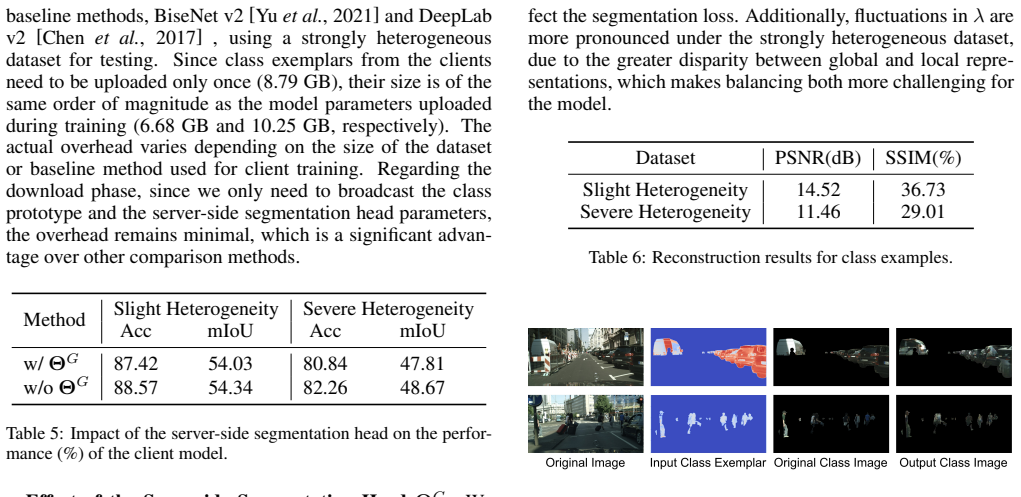
- [Appendix C] The privacy analysis asserts that class exemplars are 'highly sparse, lacking effective and informative features,' which is used to argue that reconstruction attacks fail. This assertion directly undercuts the central premise of the method, which requires the same exemplars to carry enough class-discriminative information to train the server-side global branch via distillation and to construct class prototypes that supervise the client branches. The paper cannot have it both ways: either the exemplars contain useful class information, in which case the privacy argument needs to be made more carefully, or they do not, in which case the proposed alignment mechanism cannot work. Please quantify or demonstrate the information content of exemplars and reconcile the two claims.
- [§3.3, Eqs. (2)-(5)] The inverse-frequency weighting formula for beta_c is not well defined. As written, beta_c = 1 - K_c^{-1} / (max(K_c'^{-1}) - min(K_c'^{-1})) assigns larger weights to classes with larger K_c, which is the opposite of the stated goal of up-weighting underrepresented classes. The co-occurrence term phi_{c,c'} and correlation R_{c,c'} also contain undefined quantities: the sets Omega_c, Omega(c,c'), the global Omega in the denominator, and the Gaussian kernel K_d are never specified, making Eqs. (3)-(5) non-reproducible. Please correct the formulas and define all sets, indices, and kernels.
- [§3.2] The weighting scheme in the weighted ensemble distillation is internally inconsistent. The weight alpha_i is defined using sim(z_k, z) and a denominator over i not equal to k, but the aggregation is written as a weighted sum of the z_i with no explanation of how the excluded index k relates to the summation indices. Furthermore, sim(.) is said to be implementable using KL divergence or cosine similarity, yet the distillation loss L_distill = E[sim(z, z_hat)] is only a valid minimization objective for one of these choices. Please specify the similarity measure and give a consistent, unambiguous definition of the weighting and aggregation steps.
minor comments (5)
- [Table 1, ablation row] The final ablation row '+Proto.+L multi - con +L_d' reports an unseen-domain mIoU of 46.06, while the identical FedSaaS row above it reports 45.96; please correct this numeric inconsistency.
- [§4.3 and table cross-references] The text refers to 'Table 4' for upload-ratio results and for the reconstruction-attack results, but these should be Table 2 and Table 6, respectively; several other figure references also appear to be shifted (e.g., 'Figure 8(a)' and 'Figure 9(a)' in the introduction and Section 3.1).
- [Algorithm 1] The placement of lines 13-15 relative to the communication-round loop is ambiguous; it should be made explicit whether the server update and prototype generation occur inside or outside the per-round loop.
- [Appendix B] The description of GTA5 incorrectly states that it was 'Created by Mapillary'; GTA5 is from the Playing for Data project, and the dataset descriptions should be corrected.
- [§4.1] Only three independent tests are reported and no code is released; please provide the number of random seeds, the seed values, and ideally a public implementation to make the results reproducible.
Circularity Check
No load-bearing circularity: the FedSaaS training objectives are self-contained, and the FedSiam-DA self-citation appears only as background in Related Work.
full rationale
FedSaaS is an empirical training method rather than a derivation from first principles. The claimed components—class exemplars m_c^i = FCN(x) ⊙ M_c^i, weighted ensemble distillation via L_distill = E[sim(z, z_hat)] with z_hat = sum_i alpha_i z_i, the inter- and intra-client contrastive losses, prototype construction g_c = v_c + (1/|C|) sum R_{c,c'} v_{c'}, and the local adversarial harmonization—are training objectives defined from client data and model outputs. None of these equations reduces to the reported Table 1 accuracy or mIoU by construction; the reported numbers come from external benchmark evaluation on Cityscapes, Mapillary, BDD100K, GTA5, and Synthia. Using a server-side prototype derived from uploaded exemplars to supervise local training is a standard federated-learning mechanism and does not make the evaluation score a restatement of the input. The self-citation to the authors' prior FedSiam-DA [Wang et al., 2025] appears only as background in Section 2 ('In general FL methods, such as [Wang et al., 2025; Xu et al., 2024; Collins et al., 2021]...') and is not used to justify the FedSaaS mechanism or to forbid alternatives. No uniqueness theorem is imported from the authors' prior work. Two internal consistency concerns—Algorithm 1 generates exemplars once before training whereas the surrounding text describes per-round prototype supervision, and Appendix C states that class exemplars are 'highly sparse, lacking effective and informative features'—undermine the plausibility of the method as written, but they are specification and reproducibility risks, not circularity, because they do not exhibit an output that is equivalent to an input by definition. The hyperparameters tau = 0.05 and lambda = 0.1 are manually chosen, and lambda sensitivity is shown in Figure 10, which is ordinary empirical practice rather than a fitted-input-called-prediction pattern. Under the required standard of quoting a specific reduction (Eq. X = Eq. Y by construction), no such step is present in the paper.
Assumptions & free parameters
free parameters (8)
- temperature tau =
0.05
- adversarial loss weight lambda =
0.1
- batch size =
16
- local iterations =
10
- communication rounds =
50
- initial learning rate =
0.05
- weight decay =
5e-4
- number of clients / data partition =
not specified
assumptions (4)
- domain assumption The semantic label spaces of the five driving datasets can be mapped to a common class set without loss of meaning.
- ad hoc to paper Class exemplars, computed from ground-truth masks, are representative and informative enough for server-side training and prototype construction.
- ad hoc to paper The Gaussian kernel and co-occurrence formulas in Eqs. (3)-(4) capture meaningful spatial relationships between classes.
- domain assumption The adversarial harmonization converges to a useful balance between global and local branches.
Cite this review
Pith. "Pith review of FedSaaS: Class-Consistency Federated Semantic Segmentation via Global Prototype Supervision and Local Adversarial Harmonization." pith.science (2026). https://pith.science/paper/L4GJKF4W
@misc{pith2026250509385,
  author       = {Pith},
  title        = {Pith review of: FedSaaS: Class-Consistency Federated Semantic Segmentation via Global Prototype Supervision and Local Adversarial Harmonization},
  year         = {2026},
  howpublished = {\url{https://pith.science/paper/L4GJKF4W}},
  note         = {Machine review of arXiv:2505.09385}
}
read the original abstract
Federated semantic segmentation enables pixel-level classification in images through collaborative learning while maintaining data privacy. However, existing research commonly overlooks the fine-grained class relationships within the semantic space when addressing heterogeneous problems, particularly domain shift. This oversight results in ambiguities between class representation. To overcome this challenge, we propose a novel federated segmentation framework that strikes class consistency, termed FedSaaS. Specifically, we introduce class exemplars as a criterion for both local- and global-level class representations. On the server side, the uploaded class exemplars are leveraged to model class prototypes, which supervise global branch of clients, ensuring alignment with global-level representation. On the client side, we incorporate an adversarial mechanism to harmonize contributions of global and local branches, leading to consistent output. Moreover, multilevel contrastive losses are employed on both sides to enforce consistency between two-level representations in the same semantic space. Extensive experiments on several driving scene segmentation datasets demonstrate that our framework outperforms state-of-the-art methods, significantly improving average segmentation accuracy and effectively addressing the class-consistency representation problem.
Figures


Figures from the paper (9 more)




Reference graph
Works this paper leans on
-
[1]
Segdiff: Image segmenta- tion with diffusion probabilistic models.arXiv preprint arXiv:2112.00390,
[Amitet al., 2021 ] Tomer Amit, Tal Shaharbany, Eliya Nachmani, and Lior Wolf. Segdiff: Image segmenta- tion with diffusion probabilistic models.arXiv preprint arXiv:2112.00390,
arXiv 2021
-
[4]
The cityscapes dataset for semantic urban scene under- standing
[Cordtset al., 2016 ] Marius Cordts, Mohamed Omran, Se- bastian Ramos, Timo Rehfeld, Markus Enzweiler, Rodrigo Benenson, Uwe Franke, Stefan Roth, and Bernt Schiele. The cityscapes dataset for semantic urban scene under- standing. InProceedings of the IEEE/CVF Conference on Computer Vision and Pattern Recognition, pages 3213– 3223,
work page 2016
-
[8]
Preserving privacy in federated learning with ensemble cross-domain knowledge distilla- tion
[Gonget al., 2022 ] Xuan Gong, Abhishek Sharma, Srikr- ishna Karanam, Ziyan Wu, Terrence Chen, David Doer- mann, and Arun Innanje. Preserving privacy in federated learning with ensemble cross-domain knowledge distilla- tion. InProceedings of the AAAI Conference on Artificial Intelligence, volume 36, pages 11891–11899,
work page 2022
-
[9]
Rethinking federated learning with domain shift: A prototype view
[Huanget al., 2023 ] Wenke Huang, Mang Ye, Zekun Shi, He Li, and Bo Du. Rethinking federated learning with domain shift: A prototype view. InProceedings of the IEEE/CVF Conference on Computer Vision and Pattern Recognition, pages 16312–16322. IEEE,
work page 2023
-
[11]
[Kouet al., 2024 ] Wei-Bin Kou, Qingfeng Lin, Ming Tang, Sheng Xu, Rongguang Ye, Yang Leng, Shuai Wang, Guofa Li, Zhenyu Chen, Guangxu Zhu, et al. pfedlvm: A large vision model (lvm)-driven and latent feature-based person- alized federated learning framework in autonomous driv- ing.arXiv preprint arXiv:2405.04146,
arXiv 2024
-
[13]
Swin transformer: Hierarchical vision transformer using shifted windows
[Liuet al., 2021 ] Ze Liu, Yutong Lin, Yue Cao, Han Hu, Yixuan Wei, Zheng Zhang, Stephen Lin, and Baining Guo. Swin transformer: Hierarchical vision transformer using shifted windows. InProceedings of the IEEE/CVF Inter- national Conference on Computer Vision, pages 10012– 10022,
work page 2021
-
[14]
Fully convolutional networks for semantic segmentation
[Longet al., 2015 ] Jonathan Long, Evan Shelhamer, and Trevor Darrell. Fully convolutional networks for semantic segmentation. InProceedings of the IEEE/CVF CConfer- ence on Computer Vision and Pattern Recognition, pages 3431–3440,
work page 2015
-
[16]
Communication-efficient learning of deep networks from decentralized data
[McMahanet al., 2017 ] Brendan McMahan, Eider Moore, Daniel Ramage, Seth Hampson, and Blaise Aguera y Ar- cas. Communication-efficient learning of deep networks from decentralized data. InArtificial intelligence and statistics, pages 1273–1282. PMLR,
2017
Show all 40 references
-
[17]
Fedseg: Class-heterogeneous federated learning for semantic segmentation
[Miaoet al., 2023 ] Jiaxu Miao, Zongxin Yang, Leilei Fan, and Yi Yang. Fedseg: Class-heterogeneous federated learning for semantic segmentation. InProceedings of the IEEE/CVF Conference on Computer Vision and Pattern Recognition, pages 8042–8052,
2023
-
[18]
Prototype guided federated learning of visual feature representations.arXiv preprint arXiv:2105.08982,
[Michieli and Ozay, 2021] Umberto Michieli and Mete Ozay. Prototype guided federated learning of visual feature representations.arXiv preprint arXiv:2105.08982,
2021 arXiv
-
[19]
The mapillary vistas dataset for semantic understanding of street scenes
[Neuholdet al., 2017 ] Gerhard Neuhold, Tobias Ollmann, Samuel Rota Bulo, and Peter Kontschieder. The mapillary vistas dataset for semantic understanding of street scenes. InProceedings of the IEEE/CVF International Conference on Computer Vision, pages 4990–4999,
2017
-
[20]
Pytorch: An imperative style, high- performance deep learning library.Advances in neural in- formation processing systems, 32,
[Paszkeet al., 2019 ] Adam Paszke, Sam Gross, Francisco Massa, Adam Lerer, James Bradbury, Gregory Chanan, Trevor Killeen, Zeming Lin, Natalia Gimelshein, Luca Antiga, et al. Pytorch: An imperative style, high- performance deep learning library.Advances in neural in- formation...
2019
-
[22]
Playing for data: Ground truth from computer games
[Richteret al., 2016 ] Stephan R Richter, Vibhav Vineet, Ste- fan Roth, and Vladlen Koltun. Playing for data: Ground truth from computer games. InEuropean Conference on Computer Vision, pages 102–118. Springer,
2016
-
[23]
U-net: Convolutional networks for biomedical image segmentation
[Ronnebergeret al., 2015 ] Olaf Ronneberger, Philipp Fis- cher, and Thomas Brox. U-net: Convolutional networks for biomedical image segmentation. InInternational Conference on Medical Image Computing and Computer- Assisted Intervention, pages 234–241. Springer,
2015
-
[24]
The synthia dataset: A large collection of synthetic images for semantic segmentation of urban scenes
[Roset al., 2016 ] German Ros, Laura Sellart, Joanna Materzynska, David Vazquez, and Antonio M Lopez. The synthia dataset: A large collection of synthetic images for semantic segmentation of urban scenes. InProceedings of the IEEE/CVF Conference on Computer Vision and Pat- ter...
2016
-
[25]
Grad-cam: Visual explanations from deep networks via gradient-based localization
[Selvarajuet al., 2017 ] Ramprasaath R Selvaraju, Michael Cogswell, Abhishek Das, Ramakrishna Vedantam, Devi Parikh, and Dhruv Batra. Grad-cam: Visual explanations from deep networks via gradient-based localization. In Proceedings of the IEEE/CVF International Conference on Co...
2017
-
[26]
Amp: Adaptive masked prox- ies for few-shot segmentation
[Siamet al., 2019 ] Mennatullah Siam, Boris N Oreshkin, and Martin Jagersand. Amp: Adaptive masked prox- ies for few-shot segmentation. InProceedings of the IEEE/CVF International Conference on Computer Vision, pages 5249–5258,
2019
-
[27]
Federated adaptive prompt tuning for multi-domain collaborative learning
[Suet al., 2024 ] Shangchao Su, Mingzhao Yang, Bin Li, and Xiangyang Xue. Federated adaptive prompt tuning for multi-domain collaborative learning. InProceedings of the AAAI Conference on Artificial Intelligence, volume 38, pages 15117–15125,
2024
-
[28]
Towards personalized federated learn- ing.IEEE transactions on neural networks and learning systems, 34(12):9587–9603,
[Tanet al., 2022 ] Alysa Ziying Tan, Han Yu, Lizhen Cui, and Qiang Yang. Towards personalized federated learn- ing.IEEE transactions on neural networks and learning systems, 34(12):9587–9603,
2022
-
[29]
Bridging data islands: Geographic heterogeneity-aware federated learning for collaborative remote sensing seman- tic segmentation.arXiv preprint arXiv:2404.09292,
[Tanet al., 2024 ] Jieyi Tan, Yansheng Li, Sergey A Bartalev, Bo Dang, Wei Chen, Yongjun Zhang, and Liangqi Yuan. Bridging data islands: Geographic heterogeneity-aware federated learning for collaborative remote sensing seman- tic segmentation.arXiv preprint arXiv:2404.09292,
2024 arXiv
-
[30]
Diffuse attend and segment: Unsupervised zero-shot segmentation using stable diffusion
[Tianet al., 2024 ] Junjiao Tian, Lavisha Aggarwal, Andrea Colaco, Zsolt Kira, and Mar Gonzalez-Franco. Diffuse attend and segment: Unsupervised zero-shot segmentation using stable diffusion. InProceedings of the IEEE/CVF Conference on Computer Vision and Pattern Recognition, ...
2024
-
[31]
Visualizing data using t-sne.Journal of Machine Learning Research, 9(11),
[Van der Maaten and Hinton, 2008] Laurens Van der Maaten and Geoffrey Hinton. Visualizing data using t-sne.Journal of Machine Learning Research, 9(11),
2008
-
[33]
FedSiam-DA: Dual-aggregated federated learning via siamese network for non-IID data.IEEE Transactions on Mobile Comput- ing, 24(2):985–998,
[Wanget al., 2025 ] Xin Wang, Yanhan Wang, Ming Yang, Feng Li, Xiaoming Wu, Lisheng Fan, et al. FedSiam-DA: Dual-aggregated federated learning via siamese network for non-IID data.IEEE Transactions on Mobile Comput- ing, 24(2):985–998,
2025
-
[35]
Segmamba: Long-range sequen- tial modeling mamba for 3d medical image segmentation
[Xinget al., 2024 ] Zhaohu Xing, Tian Ye, Yijun Yang, Guang Liu, and Lei Zhu. Segmamba: Long-range sequen- tial modeling mamba for 3d medical image segmentation. InInternational Conference on Medical Image Comput- ing and Computer-Assisted Intervention, pages 578–588. Springer,
2024
-
[36]
Fblg: A local graph based approach for han- dling dual skewed non-iid data in federated learning
[Xuet al., 2024 ] Yi Xu, Ying Li, Haoyu Luo, Xiaoliang Fan, and Xiao Liu. Fblg: A local graph based approach for han- dling dual skewed non-iid data in federated learning. In Proceedings of the Thirty-Third International Joint Con- ference on Artificial Intelligence, IJCAI-24,...
2024
-
[37]
Bdd100k: A diverse driv- ing dataset for heterogeneous multitask learning
[Yuet al., 2020 ] Fisher Yu, Haofeng Chen, Xin Wang, Wenqi Xian, Yingying Chen, Fangchen Liu, Vashisht Madhavan, and Trevor Darrell. Bdd100k: A diverse driv- ing dataset for heterogeneous multitask learning. InPro- ceedings of the IEEE/CVF Conference on Computer Vision and Pat...
2020
-
[38]
Bisenet v2: Bilateral network with guided aggregation for real- time semantic segmentation.International Journal of Computer Vision, 129:3051–3068,
[Yuet al., 2021 ] Changqian Yu, Changxin Gao, Jingbo Wang, Gang Yu, Chunhua Shen, and Nong Sang. Bisenet v2: Bilateral network with guided aggregation for real- time semantic segmentation.International Journal of Computer Vision, 129:3051–3068,
2021
-
[39]
A review of deep learning methods for semantic seg- mentation of remote sensing imagery.Expert Systems with Applications, 169:114417,
[Yuanet al., 2021 ] Xiaohui Yuan, Jianfang Shi, and Lichuan Gu. A review of deep learning methods for semantic seg- mentation of remote sensing imagery.Expert Systems with Applications, 169:114417,
2021
-
[40]
Pyramid scene parsing network
[Zhaoet al., 2017 ] Hengshuang Zhao, Jianping Shi, Xiao- juan Qi, Xiaogang Wang, and Jiaya Jia. Pyramid scene parsing network. InProceedings of the IEEE/CVF Confer- ence on Computer Vision and Pattern Recognition, pages 2881–2890, 2017
2017
-
[2008]
LoveDA: A remote sens- ing land-cover dataset for domain adaptive semantic seg- mentation, October
[Wanget al., 2021 ] Junjue Wang, Zhuo Zheng, Ailong Ma, Xiaoyan Lu, and Yanfei Zhong. LoveDA: A remote sens- ing land-cover dataset for domain adaptive semantic seg- mentation, October
2021
-
[2015]
Fedst: Federated style transfer learning for non-iid image segmentation
[Maet al., 2024 ] Boyuan Ma, Xiang Yin, Jing Tan, Yongfeng Chen, Haiyou Huang, Hao Wang, Weihua Xue, and Xiaojuan Ban. Fedst: Federated style transfer learning for non-iid image segmentation. InProceedings of the AAAI Conference on Artificial Intelligence, volume 38, pages 4053–4061,
2024
-
[2016]
An image is worth 16x16 words: Transformers for image recognition at scale
[Dosovitskiyet al., 2020 ] Alexey Dosovitskiy, Lucas Beyer, Alexander Kolesnikov, Dirk Weissenborn, Xiaohua Zhai, Thomas Unterthiner, Mostafa Dehghani, Matthias Min- derer, Georg Heigold, Sylvain Gelly, et al. An image is worth 16x16 words: Transformers for image recognition a...
2020
-
[2017]
Exploiting shared rep- resentations for personalized federated learning
[Collinset al., 2021 ] Liam Collins, Hamed Hassani, Aryan Mokhtari, and Sanjay Shakkottai. Exploiting shared rep- resentations for personalized federated learning. InInter- national Conference on Machine Learning, pages 2089–
2021
-
[2019]
Med- ical image segmentation using deep semantic-based meth- ods: A review of techniques, applications and emerging trends.Information Fusion, 90:316–352,
[Qureshiet al., 2023 ] Imran Qureshi, Junhua Yan, Qaisar Abbas, Kashif Shaheed, Awais Bin Riaz, Abdul Wahid, Muhammad Waseem Jan Khan, and Piotr Szczuko. Med- ical image segmentation using deep semantic-based meth- ods: A review of techniques, applications and emerging trends....
2023
-
[2020]
Feddrive: Generalizing fed- erated learning to semantic segmentation in autonomous driving
[Fantauzzoet al., 2022 ] Lidia Fantauzzo, Eros Fan`ı, Debora Caldarola, Antonio Tavera, Fabio Cermelli, Marco Cic- cone, and Barbara Caputo. Feddrive: Generalizing fed- erated learning to semantic segmentation in autonomous driving. In2022 IEEE/RSJ International Conference on ...
2022
-
[2021]
Deeplab: Semantic image segmentation with deep convo- lutional nets, atrous convolution, and fully connected crfs
[Chenet al., 2017 ] Liang-Chieh Chen, George Papandreou, Iasonas Kokkinos, Kevin Murphy, and Alan L Yuille. Deeplab: Semantic image segmentation with deep convo- lutional nets, atrous convolution, and fully connected crfs. IEEE Transactions on Pattern Analysis and Machine In- ...
2017
-
[2022]
[Fenget al., 2020 ] Di Feng, Christian Haase-Sch ¨utz, Lars Rosenbaum, Heinz Hertlein, Claudius Glaeser, Fabian Timm, Werner Wiesbeck, and Klaus Dietmayer. Deep multi-modal object detection and semantic segmentation for autonomous driving: Datasets, methods, and chal- lenges.I...
2020
-
[2023]
Image-to-image translation with conditional adversarial networks
[Isolaet al., 2017 ] Phillip Isola, Jun-Yan Zhu, Tinghui Zhou, and Alexei A Efros. Image-to-image translation with conditional adversarial networks. InProceedings of the IEEE/CVF Conference on Computer Vision and Pattern Recognition, pages 1125–1134,
2017
-
[2024]
Federated optimization in heterogeneous networks.Pro- ceedings of Machine Learning and Systems, 2:429–450,
[Liet al., 2020 ] Tian Li, Anit Kumar Sahu, Manzil Zaheer, Maziar Sanjabi, Ameet Talwalkar, and Virginia Smith. Federated optimization in heterogeneous networks.Pro- ceedings of Machine Learning and Systems, 2:429–450,
2020
-
[2025]
pflfe: Cross-silo per- sonalized federated learning via feature enhancement on medical image segmentation
[Xieet al., 2024 ] Luyuan Xie, Manqing Lin, Siyuan Liu, ChenMing Xu, Tianyu Luan, Cong Li, Yuejian Fang, Qingni Shen, and Zhonghai Wu. pflfe: Cross-silo per- sonalized federated learning via feature enhancement on medical image segmentation. InInternational Conference on Medic...
2024
Reviewed August 15, 2026 · model on record in the stance chip above.
Discussion (0). Continue with ORCID to comment.