REVIEW 4 major objections 4 minor 28 references
LightRot claims a rotation scheme and 28nm accelerator deliver 4-bit LLaMA inference near full precision at 27.4 TOPS/W.
Reviewed by Pith at T0; open to challenge. T0 means a machine referee read the full paper against a public rubric. the ladder, T0–T4 →
T0 review · deepseek-v4-flash
2026-08-01 02:57 UTC pith:L4LNKUE5
load-bearing objection The paper's GLR + ODA algorithmic additions are plausible and the hierarchical FHT hardware is a genuine contribution, but the WikiText-2 evaluation may be circular and the TOPS/W comparison looks wrong (ref [18] is 27.5), so the headline accuracy and efficiency claims are not fully supported as written. the 4 major comments →
LightRot: A Light-Weighted Rotation Scheme and Architecture for Accurate Low-Bit Large Language Model Inference
The pith
A machine-rendered reading of the paper's core claim, the machinery that carries it, and where it could break.
Core claim
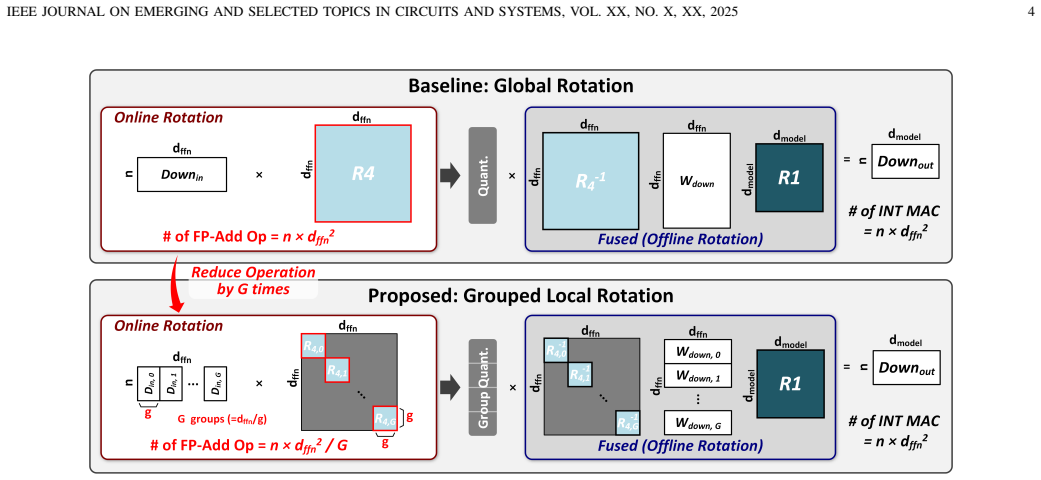
On the paper's own terms, the discovery is that the two practical barriers to rotation-based low-bit LLM inference — the high compute cost of rotations when dimensions are not powers of two, and the bimodal distributions caused by extreme outliers that survive rotation — can both be removed. Grouped Local Rotation restricts rotations to power-of-two-size groups (128 channels in the experiments), enabling a small hierarchical Fast Hadamard Transform to replace large or matrix-multiplication-based rotation units. Outlier Direction Aligning permutes the largest outlier in each group to the row of the Hadamard matrix that is all +1, so that outstanding outliers are not split into two modes; a gr
What carries the argument
Grouped Local Rotation (GLR) and Outlier Direction Aligning (ODA). GLR partitions the activation vector into groups of g channels and applies a g×g Hadamard rotation inside each group, so a Fast Hadamard Transform unit works even when the model dimension is not a power of two; the hardware uses a two-step hierarchical FHT (16-way then 8-way) around a transposable register file to keep area and energy low. ODA uses the Sylvester construction of Hadamard matrices, whose first row is all +1, and permutes the largest outlier in each group to that row before rotation; this concentrates the outlier in one direction, prevents a bimodal post-rotation distribution, and enables a group-shared asymmetr
Load-bearing premise
The load-bearing premise is that outlier channel indices and their relative magnitudes stay consistent enough across tokens and batches that a permutation learned on one calibration set (WikiText-2) remains correct for the full inference run; if those indices drift on unseen data, the aligned outlier is no longer placed on the all-ones row, and the range-reduction benefit of ODA collapses.
What would settle it
Run a LLaMA2-7B model quantized with LightRot's full recipe on a corpus whose outlier channels are substantially re-ordered after calibration, and check whether the perplexity gap to FP16 grows beyond the 0.26 reported on WikiText-2; a sharp degradation would indicate that the ODA permutation is not transferable across distributions.
If this is right
- If LightRot's claims hold, 4-bit quantized LLaMA2-13B and LLaMA3-8B can reach WikiText-2 perplexity within 0.26 and 0.84 of FP16, respectively, while all IA, W, and KV are INT4; this makes low-bit inference viable for production-quality chat models.
- Rotation energy overhead, previously over 35.7% of layer energy in LLaMA2-7B with naive rotation, drops to a negligible level after GLR+ODA and the hierarchical FHT unit, enabling 3.9x per-block energy reduction versus an 8-bit no-rotation baseline for LLaMA3-8B.
- The accelerator's 27.4 TOPS/W exceeds the 1.91–22.9 TOPS/W range of prior processors, according to the paper's comparison, without relying on mixed precision or arbitrary quantization.
- Because ODA improves quantizability independently of GLR, the two techniques can in principle be applied together or separately to other models and other low-bit formats.
- The MT-Bench win-rate results suggest the accuracy benefit transfers to long-form conversational outputs, not just perplexity on short text slices.
Where Pith is reading between the lines
- The paper's quality numbers depend on the stability of outlier channel indices across tokens and batches, since ODA's permutation is fitted on a calibration set (WikiText-2) and then applied at inference; a natural extension is to test whether the permutation generalizes to held-out domains such as code or medical text, and whether re-calibrating on a small sample of the target domain recovers acc
- The hierarchical FHT design with a transposable register file is a general hardware pattern for any rotation-based scheme in non-power-of-two dimensions, so it could benefit other quantization methods that use Hadamard rotations, not only LightRot.
- ODA introduces an asymmetric quantization bias; the paper argues the 128-sized group keeps the overhead low. A testable extension is to combine the same alignment idea with smaller-group formats such as microscaling (MX) to see whether the accuracy gain survives when group size is reduced.
- Since the 27.4 TOPS/W is demonstrated on a 28nm process at 250 MHz with a relatively small 4.86 mm² die, porting the same architecture to a more advanced node would likely raise efficiency further, though the paper does not claim this.
Editorial analysis
A structured set of objections, weighed in public.
Referee Report
Summary. LightRot proposes a low-bit LLM inference scheme combining Grouped Local Rotation (GLR) and Outlier Direction Aligning (ODA) with a hierarchical Fast Hadamard Transform (FHT) unit. The algorithm is evaluated on WikiText-2 perplexity and MT-Bench, reporting 4-bit results close to FP16 for LLaMA2-7B/13B and LLaMA3-8B. A 28nm accelerator implementation is described, claiming 27.4 TOPS/W peak energy efficiency for 4-bit inference and positioning this as surpassing prior state-of-the-art.
Significance. If the accuracy results hold under a clean calibration/evaluation protocol, the algorithmic contribution would be a useful step toward making rotation-based quantization hardware-efficient for LLMs. The GLR idea is straightforward and the hardware implementation with hierarchical FHT appears non-trivial. The paper also goes beyond GPT-2 evaluations by testing on LLaMA-class models and MT-Bench, which is commendable. However, the two main claims — near-FP16 perplexity and superiority over prior accelerators — are not currently supported by the evidence as presented.
major comments (4)
- [§III-B and §IV-A] The ODA permutation order is stated to be 'pre-determined using a calibration set, such as WikiText-2 perplexity benchmarks' (§III-B), yet Table 1 reports final perplexity on WikiText-2 without disclosing any calibration/evaluation split. If the same token subset is used to select outlier channel indices and to compute PPL, the results are leaked and not an independent measure. The authors must specify the calibration data (e.g., a separate split or a distinct corpus) and report evaluation on a disjoint test set. This is load-bearing because the near-FP16 PPL numbers in Table 1 are the principal algorithmic claim.
- [§III-B] The stability assumption that 'outlier indices remain consistent across batches' is asserted but never tested. No comparison between calibration-set outlier ranks and evaluation-set outlier ranks is reported, nor any cross-corpus experiment. If the assumption fails on unseen data, the ODA permutation order may misalign and the range-reduction benefit shown in Fig. 8 would not transfer, invalidating the generalization of the Table 1 PPL improvements. Please add a robustness experiment, e.g., calibrating on one corpus and evaluating on another, or a quantitative outlier-rank correlation analysis.
- [§VI / Table II / Abstract] The paper claims 27.4 TOPS/W 'surpassing prior state-of-the-art designs.' However, the cited prior work [18] (ISSCC 2022) reports 27.5 TOPS/W in the same 28nm process. The comparison table lists prior efficiencies ranging from 1.91–22.9 TOPS/W, excluding [18] and thereby making the 'surpassing' claim internally inconsistent. Please either include [18] in the comparison and qualify the claim (e.g., 'comparable' or 'better under a different metric'), or provide a fairer normalized comparison accounting for precision, model, and measurement conditions.
- [§IV-B / Fig. 9] The MT-Bench win/loss rates are reported without confidence intervals, number of prompts, or any significance test. Since Fig. 9(c) shows the proposed method is 'relatively competitive' against FP16 but the win rates are all below 50%, the statistical basis for the 'robust applicability' conclusion is unclear. Please report the number of MT-Bench prompts and include confidence intervals or a significance test, especially because the win-rate differences between configurations appear small (e.g., between +GQ and +GQ+GLR in Fig. 9(a) by visual inspection).
minor comments (4)
- [Captions and text] Several figure references are inconsistent. §V-C refers to 'Fig. 13' for the Gathering Unit, but the Gathering Unit appears in Fig. 12, while Fig. 13 is the chip summary. Also, §III-C is mentioned in the text but ODA is in §III-B.
- [Fig. 8 caption] The caption says 'Evaluated on the top 5% Outlier Group' — should probably be 'top 5% outlier groups' to match the description in the text.
- [Reference [22]] The reference for EdgeDiff lists the venue as ISSCC 2024 but the date as Feb. 2025; the year and page information should be corrected.
- [Typos] Fig. 14 caption has 'LLaMMA2-7B' (extra M). Fig. 9 caption has 'opeartion' typo. The name 'QuaRot' is spelled inconsistently as both 'Quarot' and 'QuaRot'.
Circularity Check
ODA's permutation order is calibrated on WikiText-2 and PPL is reported on WikiText-2 with no disclosed split; Table 1 may be leaked.
specific steps
-
fitted input called prediction
[Section III-B (ODA) and Section IV-A, Table I]
"outlier indices remain consistent across batches, allowing the permutation order to be pre-determined using a calibration set, such as WikiText-2 perplexity benchmarks [16]. ... Table 1 presents the perplexity (PPL) results on the WikiText-2 dataset [16] for various configurations, demonstrating the effectiveness of the proposed features (+GLR and +ODA) in improving quantization quality while maintaining low-bit inference efficiency."
The ODA permutation order is a fitted parameter: it is selected on a calibration set and then carried into inference. The headline accuracy is WikiText-2 perplexity, and the calibration set is named as 'WikiText-2 perplexity benchmarks' while the evaluation is also on the WikiText-2 dataset. As written, no disjoint calibration/test split is disclosed, so the near-FP16 PPL values in Table 1 can measure the quantizer's fit to the evaluation text itself rather than an independent prediction. No stability check of outlier ranks on held-out data is reported.
full rationale
The only load-bearing circularity is the ODA calibration/evaluation coupling. Section III-B states outlier indices are stable and the permutation order can be pre-determined using a calibration set 'such as WikiText-2 perplexity benchmarks'; Section IV-A then reports the final perplexity on the WikiText-2 dataset without stating that calibration and evaluation token sets are disjoint. On this text, the permutation order is fitted to the same named benchmark that is scored, so the near-FP16 results in Table 1 are not independently established. The rest of LightRot builds on QuaRot's external rotation framework, and the hardware-efficiency claim (28nm, 27.4 TOPS/W) is self-contained from the chip implementation and energy analysis. Self-citations to [21] and [22] are minor and not load-bearing. Score 6 rather than higher because the GLR/FHT hardware contributions and the accelerator energy claims remain independent; only the core accuracy evaluation is partly reduced to its calibration input.
Axiom & Free-Parameter Ledger
free parameters (4)
- GLR group size g =
128
- Group-wise quantization scale IAscale and bias IAbias =
per-group values from calibration data
- ODA outstanding-outlier threshold =
not stated
- ODA permutation order (outlier channel indices) =
per-model, from WikiText-2 calibration
axioms (6)
- standard math Hadamard rotation preserves the network output when the inverse rotation is folded into weights
- domain assumption Outlier channels of LLM input activations are stable across tokens and batches
- standard math Sylvester construction yields Hadamard matrices whose first row is all +1
- standard math The 128-point Hadamard transform can be factored into a two-stage 16-way then 8-way FHT via a transpose
- domain assumption Group quantization with the same group size as GLR compensates the scale misalignment introduced by local rotation
- domain assumption The calibration set is representative of the inference distribution
read the original abstract
As large language models (LLMs) continue to demonstrate exceptional capabilities across various domains, the challenge of achieving energy-efficient and accurate inference becomes increasingly critical. This work presents LightRot, a lightweight rotation scheme and dedicated hardware accelerator designed for low-bit LLM inference. The proposed architecture integrates Grouped Local Rotation (GLR) and Outlier Direction Aligning (ODA) algorithms with a hierarchical Fast Hadamard Transform (FHT)-based rotation unit to address key challenges in low-bit quantization, including the energy overhead of rotation operations. The proposed accelerator, implemented in a 28nm CMOS process, achieves a peak energy efficiency of 27.4 TOPS/W for 4-bit inference, surpassing prior state-of-the-art designs. Unlike conventional approaches that rely on higher-precision inference or evaluate on basic language modeling tasks like GPT-2, LightRot is optimized for advanced models such as LLaMA2-13B and LLaMA3-8B. Its performance is further validated on MT-Bench, demonstrating robust applicability to real-world conversational scenarios and redefining benchmarks for chat-based AI systems. By synergizing algorithmic innovations and hardware efficiency, this work sets a new paradigm for scalable, low-bit LLM inference, paving the way for sustainable AI advancements.
Figures




Reference graph
Works this paper leans on
-
[1]
T. B. Brown, B. Mann, N. Ryder, M. Subbiah, J. Kaplan, P. Dhariwal, A. Neelakantan, P. Shyam, G. Sastry, A. Askell, et al., ”Language Models are Few-Shot Learners,” inAdvances in Neural Information Processing Systems (NeurIPS), vol. 33, pp. 1877–1901, 2020
1901
-
[2]
H. Touvron, L. Martin, K. Stone, et al., ”LLaMA 2: Open Foundation and Fine-Tuned Chat Models,” inarXiv preprint, arXiv:2307.09288, 2023. [Online]. Available: https://arxiv.org/abs/2307.09288
Pith/arXiv arXiv 2023
-
[3]
A. Dubey, A. Jauhri, A. Pandey, et al., ”The Llama 3 Herd of Mod- els,” inarXiv preprint, arXiv:2407.21783, 2024. [Online]. Available: https://arxiv.org/abs/2407.21783
Pith/arXiv arXiv 2024
-
[4]
A. Q. Jianget al., ”Mixtral of Experts,”arXiv preprint arXiv:2401.04088, Jan. 2024. [Online]. Available: https://arxiv.org/abs/2401.04088
Pith/arXiv arXiv 2024
-
[5]
J. Lin, J. Tang, H. Tang, S. Yang, W.-M. Chen, W.-C. Wang, G. Xiao, X. Dang, C. Gan, and S. Han, ”AWQ: Activation-aware Weight Quantization for On-Device LLM Compression and Acceleration,” inProceedings of Machine Learning and Systems (MLSys), vol. 6, 2024
2024
-
[6]
S. Kim, C. R. C. Hooper, A. Gholami, Z. Dong, X. Li, S. Shen, M. W. Mahoney, and K. Keutzer, ”SqueezeLLM: Dense-and-Sparse Quan- tization,” presented atICML 2024 Poster Session, May 2024. [Online]. Available: https://arxiv.org/abs/2309.05662
Pith/arXiv arXiv 2024
-
[7]
C. Lee, J. Jin, T. Kim, H. Kim, and E. Park, ”OWQ: Outlier-Aware Weight Quantization for Efficient Fine-Tuning and Inference of Large Language Models,” inProceedings of the AAAI Conference on Artificial Intelligence, vol. 38, no. 12, pp. 13355–13364, 2024. [Online]. Available: https://doi.org/10.1609/aaai.v38i12.29237
-
[8]
G. Xiao, J. Lin, M. Seznec, H. Wu, J. Demouth, and S. Han, ”SmoothQuant: Accurate and Efficient Post-Training Quantization for Large Language Models,” inProceedings of the 40th International Con- ference on Machine Learning (ICML), PMLR, vol. 202, pp. 38087–38099, 2023
2023
-
[9]
Zhao, C.-Y
Y . Zhao, C.-Y . Lin, K. Zhu, Z. Ye, L. Chen, S. Zheng, L. Ceze, A. Krishnamurthy, T. Chen, and B. Kasikci, ”Atom: Low-Bit Quantization for Efficient and Accurate LLM Serving,” inProceedings of Machine Learning and Systems (MLSys), vol. 6, 2024
2024
-
[10]
Y . Lin, H. Tang, S. Yang, Z. Zhang, G. Xiao, C. Gan, and S. Han, ”QServe: W4A8KV4 Quantization and System Co-design for Efficient LLM Serving,” inarXiv preprint, arXiv:2405.04532, May 2024. [Online]. Available: https://doi.org/10.48550/arXiv.2405.04532
-
[11]
S. Ashkboos, A. Mohtashami, M. L. Croci, B. Li, P. Cameron, M. Jaggi, D. Alistarh, T. Hoefler, and J. Hensman, ”QuaRot: Outlier-Free 4-Bit Inference in Rotated LLMs,” inarXiv preprint, arXiv:2404.00456, Apr
-
[12]
Z. Liu, C. Zhao, I. Fedorov, B. Soran, D. Choudhary, R. Krishnamoorthi, V . Chandra, Y . Tian, and T. Blankevoort, ”SpinQuant: LLM Quantization with Learned Rotations,” inarXiv preprint, arXiv:2405.16406, May 2024. [Online]. Available: https://doi.org/10.48550/arXiv.2405.16406
-
[13]
Y . Sun, R. Liu, H. Bai, H. Bao, K. Zhao, Y . Li, J. Hu, X. Yu, L. Hou, C. Yuan, X. Jiang, W. Liu, and J. Yao, ”FlatQuant: Flatness Matters for LLM Quantization,” inarXiv preprint, arXiv:2410.09426, Oct. 2024. [Online]. Available: https://doi.org/10.48550/arXiv.2410.09426
-
[14]
A. Tseng, J. Chee, Q. Sun, V . Kuleshov, and C. De Sa, ”QuIP: Even Better LLM Quantization with Hadamard Incoherence and Lattice Codebooks,” presented atICML 2024 Poster Session, May 2024. [Online]. Available: https://arxiv.org/abs/2405.04532
Pith/arXiv arXiv 2024
-
[15]
Shazeer, ”GLU Variants Improve Transformer,” inarXiv preprint, arXiv:2002.05202, Feb
N. Shazeer, ”GLU Variants Improve Transformer,” inarXiv preprint, arXiv:2002.05202, Feb. 2020. [Online]. Available: https://arxiv.org/abs/2002.05202
Pith/arXiv arXiv 2002
-
[16]
S. Merity, C. Xiong, J. Bradbury, and R. Socher, ”Pointer Sentinel Mixture Models,” inProceedings of the 5th International Conference on Learning Representations (ICLR), Toulon, France, 2017. [Online]. Available: https://arxiv.org/abs/1609.07843 IEEE JOURNAL ON EMERGING AND SELECTED TOPICS IN CIRCUITS AND SYSTEMS, VOL. XX, NO. X, XX, 2025 13
Pith/arXiv arXiv 2017
-
[17]
Zheng, W.-L
L. Zheng, W.-L. Chiang, Y . Sheng, S. Zhuang, Z. Wu, Y . Zhuang, Z. Lin, Z. Li, D. Li, E. Xing, H. Zhang, J. E. Gonzalez, and I. Stoica, ”Judging LLM-as-a-Judge with MT-Bench and Chatbot Arena,” in Advances in Neural Information Processing Systems (NeurIPS) Datasets and Benchmarks Track, vol. 36, 2023
2023
-
[18]
Y . Wang, Y . Qin, D. Deng, J. Wei, Y . Zhou, Y . Fan, T. Chen, H. Sun, L. Liu, S. Wei, and S. Yin, ”A 28nm 27.5 TOPS/W approximate computing- based transformer processor with asymptotic sparsity speculating and out-of-order computing,” inProceedings of the 2022 IEEE International Solid-State Circuits Conference (ISSCC), IEEE, pp. 1-3, 2022
2022
-
[19]
T. Tambeet al., ”22.9 A 12nm 18.1TFLOPs/W Sparse Transformer Processor with Entropy-Based Early Exit, Mixed-Precision Predication and Fine-Grained Power Management,” inProceedings of the 2023 IEEE International Solid-State Circuits Conference (ISSCC), San Francisco, CA, USA, pp. 342-344, 2023
2023
-
[20]
Qinet al., ”Ayaka: A Versatile Transformer Accelerator With Low- Rank Estimation and Heterogeneous Dataflow,”IEEE Journal of Solid- State Circuits, pp
Y . Qinet al., ”Ayaka: A Versatile Transformer Accelerator With Low- Rank Estimation and Heterogeneous Dataflow,”IEEE Journal of Solid- State Circuits, pp. 1–15, 2024
2024
-
[21]
S. Kim, S. Kim, W. Jo, S. Kim, S. Hong, and H.-J. Yoo, ”C-Transformer: A 2.6-18.1µJ/Token Homogeneous DNN-Transformer/Spiking- Transformer Processor with Big-Little Network and Implicit Weight Generation for Large Language Models,” inProceedings of the 2024 IEEE International Solid-State Circuits Conference (ISSCC), San Francisco, CA, USA, Feb. 2024, doi:...
arXiv 2024
-
[22]
S. Kim, J. Oh, J. So, Y . Choi, S. Kim, D. Im, G. Park, and H.-J. Yoo, ”EdgeDiff: 418.4mJ/inference Multi-modal Few-step Diffusion Model Accelerator with Mixed-Precision and Reordered Group-Quantization,” inProceedings of the 2024 IEEE International Solid-State Circuits Conference (ISSCC), San Francisco, CA, USA, Feb. 2025
2024
-
[23]
B. D. Rouhaniet al., ”Microscaling data formats for deep learning.” in arXiv preprint arXiv:2310.10537, 2023b
-
[24]
J. Leeet al., ”AMXFP4: Taming Activation Outliers with Asymmetric Microscaling Floating-Point for 4-bit LLM Inference” inarXiv preprint arXiv:2411.09909, 2024
Pith/arXiv arXiv 2024
-
[25]
B. Kelleret al., ”A 95.6-TOPS/W Deep Learning Inference Accelerator With Per-Vector Scaled 4-bit Quantization in 5 nm,” inIEEE Journal of Solid-State Circuits, vol. 58, no. 4, pp. 1129-1141, April 2023, doi: 10.1109/JSSC.2023.3234893
arXiv 2023
-
[26]
S. Moon, H. -G. Mun, H. Son and J. -Y . Sim, ”Multipurpose Deep- Learning Accelerator for Arbitrary Quantization With Reduction of Stor- age, Logic, and Latency Waste,” inIEEE Journal of Solid-State Circuits, vol. 59, no. 1, pp. 143-156, Jan. 2024, doi: 10.1109/JSSC.2023.3312615. Sangjin Kim(Member, IEEE) received his B.S., M.S., and Ph.D. degrees in Elec...
arXiv 2024
-
[28]
degree in Graduate School of AI Semiconductor, Ko- rea Advanced Institute of Science and Technology (KAIST), Daejeon, South Korea
He is currently pursuing an M.S. degree in Graduate School of AI Semiconductor, Ko- rea Advanced Institute of Science and Technology (KAIST), Daejeon, South Korea. His current re- search interests include hardware-aware optimiza- tion algorithms and energy-efficient deep learning processors. Byeongcheol Kim(Graduate Student Member, IEEE) received the B.S....
2018
-
[2024]
Available: https://doi.org/10.48550/arXiv.2404.00456
[Online]. Available: https://doi.org/10.48550/arXiv.2404.00456
discussion (0)
Sign in with ORCID, Apple, or X to comment. Anyone can read and Pith papers without signing in.