REVIEW 3 major objections 4 minor 11 references
Information Field Theory based Event Reconstruction for Cosmic Ray Radio Detectors
T0 review · 3 major / 4 minor · reviewed 2026-08-06 · deepseek-v4-flash
Pith's one-line read One Bayesian forward model can reconstruct a cosmic-ray air shower's electric field, geometry, electromagnetic energy, and depth of maximum from radio-detector traces in a single inference pass, with the electric field recovered well and…
desk verdict Honest early-stage methods paper that reconstructs fluence well but the headline observables are biased and the uncertainty estimates are undercut by a signal-inclusive noise model. read the letter →
The pith
A machine-rendered reading of the paper's core claim, the machinery that carries it, and where it could break.
The reading
What carries the argument
The engine is a semiparametric forward model, i.e. a function that turns a finite set of shower parameters plus Gaussian-process fields into the expected voltage traces of every antenna. Its parametric core is the GS lateral distribution function (a Gaussian plus a sigmoid) for geomagnetic emission, the charge-excess fraction parametrised through $d_{\mathrm{max}}$ and the density at shower maximum, and an analytic absolute spectrum normalised to the fluence via the Plancherel theorem. Deviations from these parametrisations, shower-to-shower fluctuations, and narrowband RFI are modelled as Gaussian processes added at the electric-field level. The instrument response, including the complex antenna gain pattern, is applied to the field, and the comparison to data uses a Gaussian likelihood whose width is the RMS of the measured trace. Inference is performed with metric Gaussian variational inference, which makes the high-dimensional continuum-limit problem tractable.
What would settle it
Re-run the same 2859 simulated events without the signal-to-noise and reduced-$\chi^2$ cuts, replacing the Gaussian likelihood with one that models integer ADC counts; if the pull distributions for $E_{\mathrm{em}}$ and $d_{\mathrm{max}}$ remain offset or non-unit, the Gaussian-likelihood approximation is not the dominant source of the miscalibration, and the bias must instead come from the physical parametrisations.
Extended reading notes
Core claim
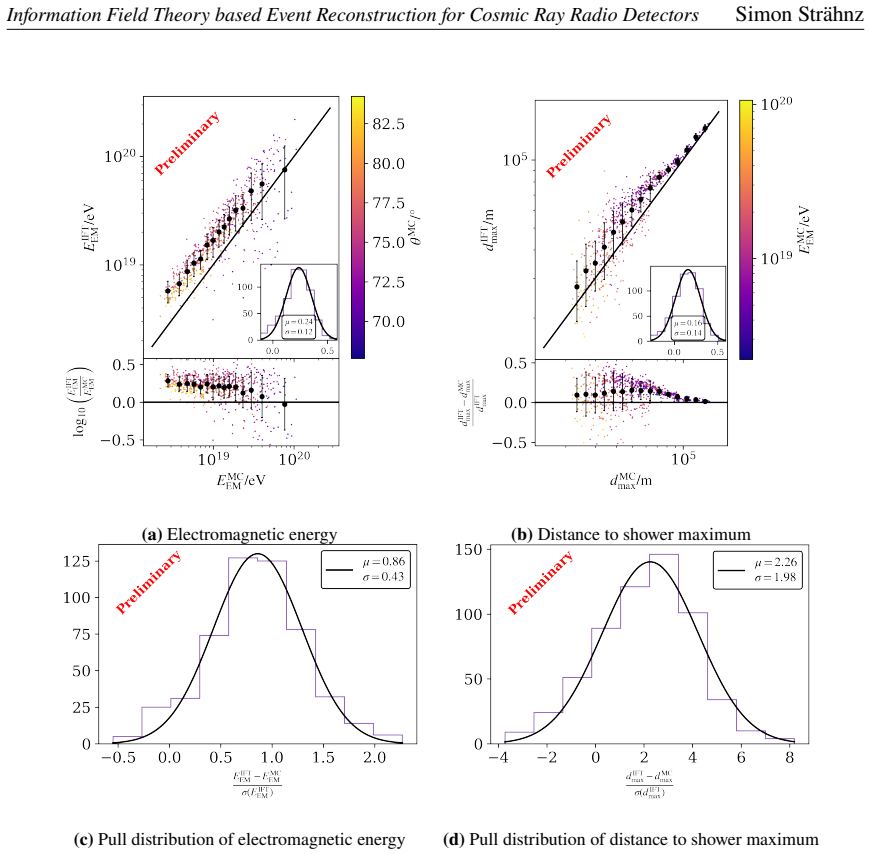
On its own terms, the paper establishes that a semiparametric information-field forward model can map shower parameters and fluctuating field components all the way to measured ADC-count voltage traces, and that inverting that map with variational inference yields a posterior over the electric field together with the arrival direction, $f_0$ normalisation, electromagnetic energy $E_{\mathrm{em}}$, and geometric distance to shower maximum $d_{\mathrm{max}}$. The electric-field part of the posterior is validated: fluence residuals are narrow and the pull distribution has $\sigma=0.73$, indicating overestimated uncertainties. The same plot shows a small systematic underestimation of fluence. For the two shower observables the reconstruction is acknowledged to be weaker: $E_{\mathrm{em}}$ is biased high at low energies, $d_{\mathrm{max}}$ is overestimated and hardly constrained for deep showers, and the pull distributions show overestimated energy uncertainties and underestimated $d_{\mathrm{max}}$ uncertainties. The paper's claim, stated fairly, is that this holistic reconstruction is possible in principle, with these biases and miscalibrations as the current, understood limitations.
Load-bearing premise
The forward model assumes the measured voltage traces are Gaussian-distributed with a width equal to their own RMS; the paper admits this is wrong for low-signal stations because the digitised ADC counts are integers, and it removes those stations by cuts instead of modelling the discreteness.
Editorial extensions
If this is right
- One inference run yields a joint posterior over the electric field, shower geometry, electromagnetic energy, and distance to shower maximum, so the correlations between these quantities become available in radio reconstruction.
- Every reconstructed quantity carries a natural uncertainty estimate, which is exactly the piece traditional single-observable methods struggle to provide.
- Narrowband RFI and shower-to-shower fluctuations are handled inside the forward model by Gaussian processes, so no separate RFI subtraction or fluctuation-averaging step is needed.
- Because the model is modular, timing distributions or particle-detector data can be added as extra data channels in a later version, which the authors say is needed to constrain $d_{\mathrm{max}}$.
- The energy bias is attributed to a definitional mismatch: the LDF parametrisation was fit to noise-subtraction fluences, while this work integrates over all time, implying the method most likely underestimates the highest energies rather than systematically overestimating all energies.
Reading between the lines
- If the fluence-definition mismatch is corrected by subtracting a noise-window integral before comparing to the LDF, the electromagnetic-energy bias should largely disappear; this is directly testable by re-running the same forward model with the alternative fluence definition.
- The strong dependence of $d_{\mathrm{max}}$ constraining power on shower depth suggests that replacing the indirect spectral-slope constraint with explicit per-station arrival-time information would sharpen the posterior more than any other single model change.
- The SNR>10 and reduced-$\chi^2<1.05$ cuts are a direct consequence of the Gaussian likelihood's inability to describe integer ADC counts; a discrete-count likelihood would recover the excluded low-signal events and reveal whether the reported pulls are artefacts of the cut rather than of the physics.
- A natural stress test is to apply the same forward model, unchanged, to vertical or near-vertical showers, where the rotationally-symmetric LDF assumption is better justified; agreement there would separate geometry effects from model-form errors.
Editorial analysis
A structured set of objections, weighed in public.
Referee Report
Summary. The paper presents a forward model for Bayesian reconstruction of inclined cosmic-ray air showers from radio detector data, built on Information Field Theory. The model combines parametric descriptions of the lateral signal distribution, charge-excess emission, and spectral shape with Gaussian-process models for shower-to-shower fluctuations and narrowband RFI, followed by a detailed detector response and a Gaussian likelihood. The model is applied to 2859 CoREAS simulations folded through a Pierre Auger radio-detector simulation with measured ADC noise. The reconstructed energy fluence agrees well with simulations (pull sigma 0.73), while the reconstructed electromagnetic energy and distance to shower maximum show clear biases and miscalibrated uncertainties. The authors present the work as a first attempt and label the results preliminary.
Significance. If the central claim were fully supported, this would be a valuable step toward holistic, uncertainty-aware reconstruction of air-shower radio signals. The fluence normalisation in Eqs. (5)-(6) is a clean, parameter-free derivation from the Poynting theorem, and using IFT/MGVI to handle continuous fields is well motivated. The evaluation on a large set of CoREAS simulations with realistic noise injection is a strength, and reporting pull distributions is the right way to test uncertainty calibration. However, the paper's own results show that the model currently delivers calibrated, unbiased reconstruction only for the electric-field-related quantity (fluence), not for the two headline shower observables E_EM and dmax. The likelihood misspecification described below is load-bearing for the claimed ability to 'naturally provide uncertainties', so the central claim is not yet fully supported.
major comments (3)
- [Section 2.4] The likelihood is defined as a normal distribution whose width equals the RMS of the measured voltage trace, but that RMS includes the air-shower signal itself. For the stations retained by the SNR>10 cut, the signal dominates the trace, so the nominal noise variance scales with the signal amplitude rather than representing an independent noise estimate. This makes the likelihood an incorrect generative model for the data, so the posterior mode and covariance are not the correct Bayesian update. It also directly affects the reported uncertainty calibration: the inflated variance naturally produces overestimated uncertainties, consistent with the fluence pull sigma of 0.73 reported in Section 3. The same flawed noise model is used to compute the reduced chi2 that enters the event-selection cut, so the selection itself is contaminated by the misspecification. The paper should either use an independent noise estimate for the likelihood width or explicitly model the noise level as a free parameter; without this, the claim that the method 'naturally provides uncertainties' is not supported.
- [Section 3, Figures 2 and 3] The results for the two headline shower observables contradict the abstract's unconditional claim that the model 'can infer ... the electromagnetic energy and position of shower maximum'. For all events, E_EM is biased toward overestimation at low energies with a wide spread, dmax is always overestimated and 'hardly constrained for deep showers', and the pull distributions show the E_EM uncertainty is severely overestimated while the dmax uncertainty is underestimated. Even after restricting to events with at least five stations, the biases remain. The abstract and introduction should be revised to state that the current model reconstructs the electric field/fluence reliably while E_EM and dmax are only preliminary and biased, or the model must be improved so that the headline claim matches the demonstrated performance.
- [Section 3, selection criteria] The selection criteria SNR>10 and reduced chi2<1.05 are both applied before evaluating reconstruction quality, but the reduced chi2 is computed with the same Gaussian likelihood whose width is the data RMS. This creates a circularity: events are accepted partly based on how well they fit the misspecified likelihood, and the reported performance is then conditioned on that acceptance. The number of events passing each cut should be reported, and the main results should be shown with and without the reduced-chi2 cut to demonstrate that the reported biases and pulls are not an artifact of the selection. If the cut is necessary to remove ADC-discretisation failures, a likelihood that accounts for the integer-count noise should be used instead of excluding a potentially large fraction of events.
minor comments (4)
- [Throughout] There are several typos and spacing errors, including 'noticably', 'claculated', 'colou', 'mathematial', and 'one-dimensionallateraldistributionfunction'; these should be corrected.
- [Section 2.4] The assumption that the phase spectrum is linear with a slope set by the trace peak time is introduced without justification or validation; given that timing information is later identified as important for constraining dmax, this assumption deserves an explicit statement of its role and limitations.
- [Section 2.2 / 2.4] The Gaussian-process priors for shower-to-shower fluctuations and RFI are described only qualitatively; the kernel choice and hyperparameter values should be listed to make the inference reproducible.
- [Section 3] The statement that dmax is 'hardly constrained for deep showers' is not quantified; adding a typical uncertainty or credible-interval width for dmax as a function of depth would make the claim precise.
Circularity Check
No significant circularity: the target observables are not inserted into the model, the derivation chain rests on external parameterizations and prior work with independent validation, and the reported biases are explicitly diagnosed as model limitations rather than hidden fits.
full rationale
The paper's derivation chain is self-contained against its stated inputs. The electric-field spectrum is normalized to the energy fluence through Eqs. (5)-(6), and the fluence is computed from the GS-LDF and charge-excess parameterizations taken from refs. [5] and [9]; E_EM and dmax are outputs of the fitted parameters, not inputs to the forward model. The electric-field machinery, fluctuations, RFI, and likelihood are inherited from ref. [8], which is cited as prior work with its own validation; the paper's remark that good fluence agreement 'is to be expected' because the same electric-field model was used acknowledges inherited performance rather than using the citation to prove the new E_EM/dmax claim. No fitted parameter is renamed as a prediction: the only data-driven width is the likelihood RMS, which is a stated modeling assumption, and the resulting pull miscalibration (e.g., fluence pull sigma 0.73, biased E_EM and dmax) is openly reported in Sections 3 and 4. The bias caused by using the LDF with a different fluence definition than in the parameterizing dataset is explicitly diagnosed as a source of systematic error, not hidden. Remaining concerns — Gaussian likelihood misspecification at low SNR and validation on CoREAS simulations from the same family as the parameterizations — are correctness and robustness risks, not circularity, because the inferred quantities are not defined in terms of the fitted values and no predictive claim reduces to a fit by construction.
Assumptions & free parameters
free parameters (3)
- LDF shape deviation prior widths (r0, sigma, p, a_rel, s, r02) =
Not given in text; taken from scatter in [5]
- Gaussian process kernel hyperparameters =
Not specified
- Selection thresholds SNR and reduced chi2 =
SNR > 10; reduced chi2 < 1.05
assumptions (8)
- standard math Information Field Theory allows treating discretised fields in the continuum limit without changing mathematical implications.
- domain assumption Posterior is approximately Gaussian so MGVI/geoVI variational inference is valid.
- domain assumption GS lateral distribution function from [5] describes inclined shower radio fluence after early-late correction.
- domain assumption Charge-excess fraction parameterisation from [5] as function of dmax and rho_max is valid.
- domain assumption Spectral shape parameterisation from [9] describes the absolute radio spectrum.
- ad hoc to paper Phase spectrum is linear with slope set by the trace peak time.
- ad hoc to paper Measured voltage traces are Gaussian distributed with width equal to the data RMS.
- standard math Energy fluence relates to time-integrated Poynting vector for transverse waves.
Cite this review
Pith. "Pith review of Information Field Theory based Event Reconstruction for Cosmic Ray Radio Detectors." pith.science (2026). https://pith.science/paper/L4PT4P4A
@misc{pith2026250710738,
  author       = {Pith},
  title        = {Pith review of: Information Field Theory based Event Reconstruction for Cosmic Ray Radio Detectors},
  year         = {2026},
  howpublished = {\url{https://pith.science/paper/L4PT4P4A}},
  note         = {Machine review of arXiv:2507.10738}
}
read the original abstract
Detection of extensive air showers with radio antennas is an appealing technique in cosmic ray physics. However, because of the high level of measurement noise, current reconstruction methods still leave room for improvement. Furthermore, reconstruction efforts typically focus only on a single aspect of the signal, such as the energy fluence or arrival time. Bayesian inference is then a natural choice for a holistic approach to reconstruction, yet, this problem would be ill-posed, since the electric field is a continuous quantity. Information Field Theory provides the solution for this by providing a statistical framework to deal with discretised fields in the continuum limit. We are currently developing models for this novel approach to reconstructing extensive air showers. The model described here is based on the best current understanding of the emission mechanisms: It uses parametrisations of the lateral signal strength distribution, charge-excess contribution and spectral shape. Shower-to-shower fluctuations and narrowband RFI are modelled using Gaussian processes. Combined with a detailed detector description, this model can infer not only the electric field, but also the shower geometry, electromagnetic energy and position of shower maximum. Another big achievement of this approach is its ability to naturally provide uncertainties for the reconstruction, which has been shown to be difficult in more traditional methods. With such an open framework and robust computational methods based in Information Field Theory, it will also be easy to incorporate new insights and additional data, such as timing distributions or particle detector data, in the future. This approach has a high potential to exploit the full information content of a complex detector with rigorous statistical methods, in a way that directly includes domain knowledge.
Figures


Reference graph
Works this paper leans on
-
[8]
P. Frank, R. Leike and T.A. Enßlin, https://doi.org/10.3390/e23070853 Entropy 23 (2021)
- [5]
-
[1]
" write "" before.all 'output.state := FUNCTION blank.sep after.quote 'output.state := FUNCTION fin.entry output.state after.quoted.block = 'skip 'add.period if write FUNCTION new.block output.state before.all = 'skip output.state after.quote = after.quoted.block 'output.state := after.block 'output.state := if if FUNCTION new.sentence output.state after....
-
[2]
Pont for the Pierre Auger collaboration PoS ICRC2025 294
B. Pont for the Pierre Auger collaboration PoS ICRC2025 294
-
[3]
Strähnz for the Pierre Auger collaboration PoS ICRC2025 401
S. Strähnz for the Pierre Auger collaboration PoS ICRC2025 401
-
[4]
Enßlin, https://doi.org/10.1063/1.4819999 AIP Conference Proceedings 1553.1 (2013) 184
T. Enßlin, https://doi.org/10.1063/1.4819999 AIP Conference Proceedings 1553.1 (2013) 184
-
[6]
F. Schlüter and T. Huege, https://doi.org/10.1088/1475-7516/2023/01/008 JCAP 2023 (2023) 008
-
[7]
J. Knollmüller and T.A. Enßlin, https://arxiv.org/abs/1901.11033 1901.11033
arXiv 1901
Show all 11 references
-
[9]
Strähnz, T
S. Strähnz, T. Huege, P. Frank and T. Enßlin, https://doi.org/10.22323/1.470.0056 PoS ARENA2024 (2024) 056
2024 doi
-
[10]
Martinelli, F
S. Martinelli, F. Schlüter and T. Huege, https://doi.org/10.22323/1.424.0036 PoS ARENA2022 (2023) 036
2023 doi
-
[11]
Giaccari for the Pierre Auger collaboration https://doi.org/10.22323/1.424.0042 PoS ARENA2022 (2023) 042
U.G. Giaccari for the Pierre Auger collaboration https://doi.org/10.22323/1.424.0042 PoS ARENA2022 (2023) 042
2023 doi
Reviewed August 6, 2026 · model on record in the stance chip above.
Discussion (0). Continue with ORCID to comment.