REVIEW 3 major objections 4 minor 33 references
Don't Regenerate, Debug: A Domain-Specific Agent for Repairing Near-Miss Hardware Operators
T0 review · 3 major / 4 minor · reviewed 2026-08-07 · deepseek-v4-flash
Pith's one-line read This paper argues that LLM-generated hardware kernels that compile and run but fail numerical validation should be repaired, not discarded and regenerated from scratch.
desk verdict A careful empirical case for debug-over-regenerate in AscendC kernel repair, with a knowledge-base provenance gap and narrower token savings than the headline suggests. read the letter →
The pith
A machine-rendered reading of the paper's core claim, the machinery that carries it, and where it could break.
The reading
What carries the argument
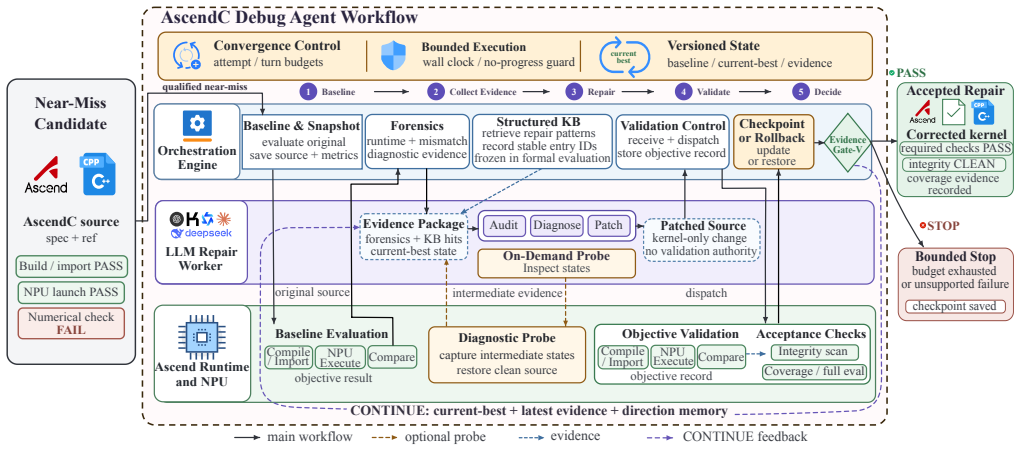
The load-bearing mechanism is an engine-orchestrated debug loop in which a deterministic orchestration engine owns forensics, validation, and integrity checking, while an LLM repair worker only proposes kernel-only patches and never decides acceptance. Three layers implement five mechanisms: the Guidance Layer retrieves patterns from a quality-gated, auto-ingested structured knowledge base and can request diagnostic tensor-statistic instrumentation; the Integrity Layer applies anti-cheat detection (wrapper validation and kernel-source scanning) and full-coverage evaluation on an extended shape/dtype test set; the Control Layer enforces hard turn/attempt/wall-clock bounds, snapshots the best checkpoint, and restores it after two consecutive non-improving attempts. The engine's ownership of validation and integrity is what separates reported Pass@1 from raw pass rate.
What would settle it
Inspect the auto-ingested knowledge base's provenance: check file timestamps, version history, and content overlap against the 27 test operators' source code and failure traces. If any KB pattern's exemplar code or diagnostic description matches code from a test operator and was recorded before that operator was frozen, the central claim of knowledge-driven recovery is falsified. A cleaner test is to rebuild the KB using only the 11 operators that regeneration fails to produce and then evaluate on the remaining 16; if Pass@1 does not drop substantially, leakage is unlikely.
Extended reading notes
Core claim
The central discovery is that state-continuous repair of near-miss operators is both more capable and cheaper than repeated fresh regeneration: Debug Pass@1 of 66.7% (18/27) beats Regenerate Pass@3's 40.7% (11/27) and Regenerate Avg Pass@1's 25.9%, with 11 Debug-only successes versus 4 Regenerate-only. The advantage holds against CANNBot's own precision-debug mode under a matched protocol (+22.2 percentage points on Qwen, +18.5 on Kimi). Ablations attribute recovery primarily to the retrieved knowledge base (removing it drops Pass@1 from 18/27 to 13/27 and raises all-tokens-per-success by 58%), while the anti-cheat and full-coverage gates reject 12.5% and 33.3% of workflow-accepted successes respectively, showing that integrity enforcement is what makes the pass rate trustworthy. The adaptive scheduling bundle showed no measurable benefit on this cohort.
Load-bearing premise
The knowledge base used to guide repairs is said to be frozen, but the paper never documents that its entries were collected before and independently of the 27 test operators; if any retrieved patterns were derived from the same operators, the repair success rate and the knowledge-base ablation would be inflated by test-set leakage.
Editorial extensions
If this is right
- If the result holds, kernel-generation pipelines should route near-miss candidates to repair agents instead of discarding them, converting sunk compilation and execution cost into recovered operators.
- A single debug run replacing three regeneration trials cuts token cost per successful operator by more than 90%, making systematic repair economically viable in production.
- Integrity gates are not optional auditing: without anti-cheat and full-coverage evaluation, reported success rates would be 12.5–33.3% higher but would include wrapper-assisted bypasses and incomplete coverage.
- Knowledge bases distilled from prior failures become first-class assets: removing the KB costs five operators and raises all-tokens-per-success by 58%.
- Evaluation coverage, rather than nominal task difficulty, determines debugging difficulty, so future benchmarks should report case-count expansion separately.
Reading between the lines
- If knowledge-base entries were collected independently of the test operators, the 66.7% Pass@1 is a genuine measure of transferable repair knowledge; if any entries encode the same operators' failure modes, the advantage could shrink substantially. Documenting KB provenance is the fastest way to test this.
- The debug-over-regenerate principle should transfer to other low-resource accelerator DSLs (for example Intel SYCL or Moore Threads MUSA) where near-miss candidates are common and pretraining data are scarce, since the paper's mechanisms are expressed generically in terms of engine-owned validation.
- The null result for adaptive scheduling suggests that a simpler hard-bounded loop with checkpoint rollback may be sufficient, and that the engineering effort spent on semantic early-stopping rules could be redirected to knowledge ingestion.
- A natural next experiment is to collect repair patterns on one operator cohort and evaluate on a disjoint second cohort; that would directly measure the knowledge base's generalization rather than its fit to the current 27 operators.
Editorial analysis
A structured set of objections, weighed in public.
Referee Report
Summary. The paper proposes a domain-specific debug agent for AscendC kernels that compile and run but fail numerical validation ('near-miss operators'). The agent is engine-orchestrated, with a structured knowledge base, diagnostic instrumentation, anti-cheat detection, full-coverage evaluation, and convergence guards. On 27 frozen NPUKernelBench operators, the authors report Debug Pass@1 of 66.7% versus Regenerate Avg Pass@1 of 25.9% and Regenerate Pass@3 of 40.7%, with 92.8% fewer all-tokens per success than three-trial regeneration. Component ablations attribute recovery primarily to the knowledge base and show that the integrity gates reject 12.5-33.3% of workflow-accepted successes. A matched comparison with CANNBot's precision-debug mode gives a +22.2pp margin under Qwen and +18.5pp under Kimi, though neither is statistically significant. The appendix (S1-S9) reports detailed per-operator matrices, token decompositions, paired tests, and a candid limitations section.
Significance. If the central claim holds, the paper makes a useful contribution: it demonstrates a practical repair paradigm for a low-resource hardware-kernel setting, with a reusable knowledge base and explicit integrity mechanisms that prevent reward hacking. The paper is unusually transparent: it defines Pass@1 precisely, reports non-significant contrasts as directional, discloses the matched-shadow nature of the -Full-eval ablation, and enumerates claim boundaries in S8. The balanced 2x2 factorial design for the precision-debug comparison is a strength, as are the exact McNemar tests and the inclusion of token-flow details. However, two load-bearing gaps currently limit the claims as stated: the provenance of the auto-ingested knowledge base is not documented, and the headline token-efficiency figure excludes the cost of producing the initial near-miss candidate. Both are fixable, but until they are addressed the central empirical claims are not fully supported.
major comments (3)
- [System Design (Guidance Layer), Figure 2, Table 5a] The knowledge base is labeled 'frozen in formal evaluation' in Figure 2, but the paper never states when KB entries were collected or whether any source operator overlapped the 27-operator test cohort. Because ingestion is auto-gated from repair history (match >= 0.95, clean integrity history), and the ablation in Table 5a attributes recovery to the KB (8 Full-only vs 3 ablation-only successes), a KB derived from the same 27 operators would inflate the headline 18/27 Debug Pass@1 and the -KB contrast. Please document the ingestion timeline, a source-operator manifest, any overlap exclusion rule, and report the -KB and headline results with a KB built without access to the test cohort, or demonstrate non-overlap explicitly. The Related Works mention of 'contamination from spurious successes' addresses quality but not temporal leakage.
- [Experiments, RQ2, Table 3, S2.4] The 92.8% token-reduction claim is not end-to-end: Debug-Agent reuses the near-miss implementation produced by CANNBot's generation pipeline, and the tokens consumed by that generation are excluded from Debug's cost numerator. A user choosing between 'regenerate from spec' and 'debug a near-miss' must pay for obtaining the near-miss. Please report the combined generation-plus-debug token cost per success, or explicitly frame the comparison as conditional on a freely available near-miss candidate. Without this, the headline token savings overstate the economic advantage of the proposed workflow.
- [Experiments, RQ1, Table 2, S3.3] The headline contrast of Debug Pass@1 (18/27) against Regenerate Pass@3 (11/27) is not statistically significant (exact McNemar p = 0.1185); the significant Bonferroni-corrected results are against each individual regeneration trial, which are three correlated views of the same Debug outcome vector. The main text states 'These results demonstrate that targeted repair shifts the economic boundary' and the abstract juxtaposes 66.7% against 40.7% without the p-value. Please present the Pass@3 comparison with its p-value in the main text and describe it as directional, or restrict the significance claim to the individual-trial contrasts.
minor comments (4)
- [Abstract] The abstract's '92.8% fewer tokens per success' lacks the caveat that the near-miss candidate generation cost is excluded; consider adding a qualifier such as 'for repair, given a near-miss candidate.'
- [Conclusion and Control Layer] The conclusion refers to the adaptive-scheduling bundle as 'pre-registered,' but no preregistration artifact or location is provided; please add a reference or drop the term.
- [S7. Reproducibility Checklist] The reproducibility checklist describes scripts and manifests but provides no URL or data release; for a systems paper, an artifact link is needed for the claims to be auditable.
- [Table 5 and Table 24] The -Full-eval arm is a matched shadow, not an independent run; Table 5(b) labels this, but the p=0.0312 in Table 24 is easily misread as a standard ablation result; suggest noting 'descriptive' in the table caption as well.
Circularity Check
No significant circularity: headline results are externally measured against NPUKernelBench and the CANN reference; the undocumented KB provenance is an auditability concern, not a by-construction circularity.
full rationale
This is an empirical systems comparison rather than a derivation chain. Debug Pass@1, Regenerate Pass@1/Pass@3, and the token-efficiency ratios are measured outcomes on a frozen 27-operator cohort from NPUKernelBench, judged against the CANN reference and a fixed full-evaluation/integrity protocol; no equation defines a predicted quantity in terms of a fitted input. The component ablations are matched empirical comparisons, and their claims, such as the drop from 18/27 to 13/27 when the knowledge base is removed, are reported with paired uncertainty and treated as observed effects rather than as derivations. The one audit-sensitive point is the provenance of the auto-ingested structured knowledge base: Figure 1 labels it "frozen in formal evaluation" and S2.1 states that the cohort was frozen before compared outcomes were produced, but the paper does not document a collection cutoff or a source-operator manifest for KB entries. If KB patterns had been derived from the same 27 operators, the -KB ablation would be inflated by test-set leakage. That is a data-contamination and external-validity concern, not a circularity by construction, because no result is defined in terms of itself and no fitted parameter is renamed as a prediction. The only overlapping-author citation of note, AscendCraft (Wen et al. 2026), which includes co-author Shudi Shao, supports a motivational premise with externally measurable benchmark results and is not load-bearing for the central Debug-vs-Regenerate claim. Score 0.
Assumptions & free parameters
free parameters (4)
- Knowledge admission match threshold =
0.95
- Adaptive scheduling soft budget =
480 turns per task
- Hard execution bounds =
240 turns/session, 600 turns/task, 5 repair attempts, 12h timeout
- Full-coverage progress threshold =
90% of cases
assumptions (5)
- domain assumption The CANN reference implementation is the correct ground truth for numerical validation.
- domain assumption NPUKernelBench's compact and full case sets adequately cover each operator's specification.
- domain assumption The 27 near-miss operators from CANNBot's pipeline are representative of low-resource kernel failures.
- domain assumption The auto-ingested knowledge base is frozen before formal evaluation and is not contaminated by the 27 test operators.
- domain assumption Provider-reported token volumes are reliable proxies for cost.
Cite this review
Pith. "Pith review of Don't Regenerate, Debug: A Domain-Specific Agent for Repairing Near-Miss Hardware Operators." pith.science (2026). https://pith.science/paper/L4R7PBKP
@misc{pith2026260802712,
  author       = {Pith},
  title        = {Pith review of: Don't Regenerate, Debug: A Domain-Specific Agent for Repairing Near-Miss Hardware Operators},
  year         = {2026},
  howpublished = {\url{https://pith.science/paper/L4R7PBKP}},
  note         = {Machine review of arXiv:2608.02712}
}
read the original abstract
Kernel generation for hardware accelerators such as GPUs and NPUs has become a proving ground for large language models (LLMs), and state-of-the-art systems raise correctness through pipelines that couple LLMs with agentic reinforcement learning and evolutionary search. Such pipelines generate, compile, and execute large numbers of candidate kernels, discarding most of them and forgoing the opportunity to distill failures into reusable knowledge. Many discarded candidates are near-miss operators that compile and run but fail numerical validation; each embodies genuine domain knowledge and a nontrivial investment in LLM inference, cross-compilation, and hardware execution. We argue for a paradigm shift: rather than regenerate, debug. Debugging is far more constrained than generating from scratch: the search space is small and feedback is dense. We present a domain-specific debug agent that addresses three core challenges in autonomous repair: mitigating knowledge scarcity through retrieved patterns and diagnostic instrumentation, ensuring integrity through anti-cheat detection and full-coverage evaluation, and controlling cost via convergence guards and bounded iteration. Debugging serves two complementary roles: it extends the capability frontier by recovering operators that repeated regeneration fails to produce, and it lowers cost per deliverable operator. Debug Pass@1 achieves 66.7% versus Regenerate Avg Pass@1's 25.9% and Regenerate Pass@3's 40.7%, while consuming 92.8% fewer tokens per success than three-trial regeneration. Component ablations show that the knowledge base drives recovery, while integrity gates reject 12.5-33.3% of the successes the workflow itself accepted.
Figures

Reference graph
Works this paper leans on
-
[1]
a materialized and executable candidate exists
-
[2]
an external full-coverage evaluation completes
-
[3]
MultiKernelBench: A Multi-Platform Benchmark for Kernel Generation. arXiv:2507.17773. Wiedemann, N.; Leboutet, Q.; Paulitsch, M.; Wofk, D.; and Ummenhofer, B. 2026. KernelFoundry: Hardware- awareevolutionaryGPUkerneloptimization.arXiv preprint arXiv:2603.12440. Xia, C. S.; Deng, Y.; Dunn, S.; and Zhang, L. 2024. Agentless: Demystifying LLM-based Software ...
arXiv 2026
-
[4]
SkillEvolver: Skill Learning as a Meta-Skill
SkillEvolver: Skill Learning as a Meta-Skill. arXiv:2605.10500. Zhang, Z.; Wang, R.; Li, S.; Luo, Y.; Hong, M.; and Ding, C. 2025. CudaForge: An Agent Framework with Hardware Feedback for CUDA Kernel Optimization. arXiv:2511.01884. Zhou,C.;Chai,H.;Chen,W.;Guo,Z.;Shan,R.;Song,Y.;Xu, T.;Yang,Y.;Yu,A.;Zhang,W.;etal.2026.Externalizationin LLMAgents:AUnifiedRe...
work page Pith review arXiv 2025
-
[5]
noframework/referenceimplementationperformsthetar- get computation, and no golden-output cache, monkey patch, dynamic Python execution, or case-manifest spe- cialization substitutes for the kernel. Compact success or automatic anti-cheatCLEANalone is insufficient.Attempt0omitsprobesunlessNaN/Infforensics triggers localization. S2.3 Final integrity criteri...
-
[6]
paired-outcome, bootstrap, Wilson-interval, and exact- McNemar scripts
-
[7]
every required numerical case passes the benchmark tol- erance
-
[8]
the final integrity check confirms a real path from ModelNew.forwardthrough the extension binding, tiling, and custom AscendC kernel launch
Show all 33 references
-
[9]
Within-model ratios are comparable; cross-provider to- kentotalsandpricingproxiesarenottreatedasauditable monetary cost
Token fields are provider-reported execution volumes. Within-model ratios are comparable; cross-provider to- kentotalsandpricingproxiesarenottreatedasauditable monetary cost
-
[10]
trace the executable path from the Python model to the custom kernel
-
[11]
distinguish metadata/allocation calls from target compu- tation
-
[12]
rejecthost-sideorframework-sideimplementationsofthe target semantics
-
[13]
Static checks first flag suspicious candidates
record a final integrity verdict for every candidate. Static checks first flag suspicious candidates. The cur- rent scanner assumes a fixed Python-wrapper, binding, and launch layout and does not fully cover direct kernel invoca- tion, launches in.ascfiles, split registration ...
-
[14]
a frozen 27-operator manifest with difficulty level, com- pact/full case counts, coverage-equivalence status, and compact/full case-set hashes
-
[15]
redacted model, context, effort, turn, attempt, timeout, and evaluator configuration
-
[16]
a run manifest mapping each candidate ID to its result row and task/trial identity
-
[17]
post-hoc full-eval summaries, automatic compatibility- awareanti-cheatverdicts,finalintegrityverdictsforevery candidate,andavailablesource-levelresolutionmetadata
-
[18]
per-candidate token aggregates and aggrega- tion/deduplication code
-
[20]
the derived no-full-eval shadow script, including the first compact-pass selection rule
-
[21]
All 27 Full tasks have terminal status, post-hoc numerical evidence, token aggregates, and final integrity verdicts
a script reproducing the reported headline counts and statistics from these structured inputs. All 27 Full tasks have terminal status, post-hoc numerical evidence, token aggregates, and final integrity verdicts. Arm vs. Full Common Pass@1 Mean turns Mean all tokens Mean cost p...
-
[22]
Transfer to other hardware and languages remains untested
Thecohortcontains27near-missoperatorsfromoneNPU programming ecosystem. Transfer to other hardware and languages remains untested
-
[23]
Debugattemptssharestateandcannotbereinterpretedas independent samples
Debug-Agent has one end-to-end task per operator, whereasRegeneratehasthreeindependenttrials.Internal Check Debug-Agent Qwen Regenerate Qwen Frozen operators 27/27 27/27 Terminal tasks/runs 27/27 81/81 Materialized candidates 27/27 81/81 Independent post-hoc full-eval 27/27 81...
-
[24]
Their paired advantages are directional observations on this cohort
Debug-Agent versus Regenerate Pass@3 and Debug- AgentversusCBDdonotreachp <0.05underoperator- level exact McNemar tests. Their paired advantages are directional observations on this cohort
-
[25]
L5–L7containonlyfouroperators.Their100%observed success is descriptive and does not establish a general advantage on advanced tasks
-
[26]
RQ3isabalanced,operator-blockedmethod×modelfac- torial experiment with a fixed environment and one run per operator-cell. The 27 operators provide the matched blocks, but there is no additional technical replication within an operator-cell; the interaction estimate is there- f...
-
[27]
Thesamefinalintegritycriterionisappliedsymmetrically toeverycandidate;automaticanti-cheatandfinalverdicts are retained as separate evidence layers, together with available source-level resolution metadata
-
[29]
Earlier runs terminatedbyinfrastructureorproviderinterruptionsare retainedforstabilitydiagnosisbutexcludedfromthepri- mary operator cost
The primary ablation cost uses the end-to-end task run thatproduceseachoperator’sreportedterminaloutcome, following the predeclared task-level metric. Earlier runs terminatedbyinfrastructureorproviderinterruptionsare retainedforstabilitydiagnosisbutexcludedfromthepri- mary ope...
-
[30]
A single state-continuous Debug-Agent task recovers 18/27 operators, compared with an average single-trial regenerationsuccessof21/81andanoperator-levelthree- trialPass@3of11/27.Itsolves11operatorsthatallregen- eration trials miss, while Regenerate has four exclusive successes
-
[31]
In the method×model factorial, its all-token efficiency advan- tage over CANNBot precision-debug repeats within both Qwen and Kimi
Debug-Agent reduces all tokens per Pass@1 by 92.8% relative to the full three-trial regeneration budget. In the method×model factorial, its all-token efficiency advan- tage over CANNBot precision-debug repeats within both Qwen and Kimi. CBD-Q has lower uncached-token vol- umep...
-
[32]
Debug-Agent obtains 18/27 versus 12/27 Pass@1 outcomes under Qwen and 21/27 versus 16/27 under Kimi
The balanced2×2factorial yields a +20.4 pp ob- served method main effect for Debug-Agent, a +13.0 pp model main effect for Kimi, and a -3.7 pp method- by-model interaction. Debug-Agent obtains 18/27 versus 12/27 Pass@1 outcomes under Qwen and 21/27 versus 16/27 under Kimi. The...
-
[33]
The ablation evidence shows distinct outcome patterns when different capabilities are removed: removing re- trievedknowledgeisassociatedwiththeclearestdecrease inrecoveryandtokenefficiency;removingdiagnosticev- idence corresponds to a weaker degradation; removing anti-cheat or...
-
[2025]
Kevin:Multi-turnrlforgeneratingcudakernels.arXiv preprint arXiv:2507.11948. Cao, X.; Zhai, J.; Li, P.; Hu, Z.; Yan, C.; Mu, B.; Fang, G.; She, B.; Li, J.; Su, Y.; Tao, D.; Huang, X.; Xu, F.; Yang, F.; Lu, Y.; Wang, C.-D.; Lu, Y.; Xue, W.; Zhou, B.; and Tian, Y. 2026. AscendKer...
2026 arXiv
-
[2026]
arXiv:2601.22760
AscendCraft:AutomaticAscendNPUKernelGenera- tion via DSL-Guided Transcompilation. arXiv:2601.22760. Wen, Z.; Zhang, Y.; Li, Z.; Liu, Z.; Xie, L.; and Zhang, T
Reviewed August 7, 2026 · model on record in the stance chip above.
Discussion (0). Continue with ORCID to comment.