REVIEW 4 major objections 5 minor 1 cited by
RefineX: Learning to Refine Pre-training Data at Scale from Expert-Guided Programs
T0 review · 4 major / 5 minor · reviewed 2026-08-06 · deepseek-v4-flash
Pith's one-line read A small deletion-only refiner trained on expert rewrites improves LLM pretraining corpora more than filtering alone.
desk verdict RefineX is a genuine incremental extension of ProX with a clean two-stage distillation, but a missing length-matched control leaves its headline gains confounded with document count. read the letter →
The pith
A machine-rendered reading of the paper's core claim, the machinery that carries it, and where it could break.
The reading
What carries the argument
The load-bearing object is the two-stage distillation pipeline. In stage one, expert end-to-end refinement produces a target text; in stage two, minimum edit distance (Levenshtein distance) decomposes the difference between original and target into insertions, replacements, and deletions, and only deletion spans survive. Those spans are mapped to a minimal function set, namely remove_lines(start_line, end_line), remove_str(line, del_str), and keep_all(), which the paper designs to stay token-cheap so the small refiner can predict them reliably. The mechanism turns an expensive free-form rewrite into a sparse, executable program and, by construction, guarantees that the output is always a subsequence of the input, which is what enforces authenticity and prevents hallucinated new content.
What would settle it
A reader could settle the central claim by pretraining two equal-budget models on corpora produced by RefineX's distilled delete-only programs versus corpora produced by faithfully applying the full minimal-edit operation set (insertions and replacements included); if the full-edit variant wins, the deletion-only restriction is not the source of the reported gains.
Extended reading notes
Core claim
The central claim is that expert-guided data refinement can be distilled into deletion-only edit programs without losing most of its value. The authors have an expert model rewrite web documents end to end, align the original and rewritten text with minimum edit distance, discard all insertions and replacements, convert the remaining deletion spans into three compact program functions, and train a 0.6-billion-parameter model to emit those programs. The trained refiner runs at corpus scale, leaving untouched text it judges clean and removing only junk spans. The paper reports that this pipeline consistently outperforms prior program-based refinement and all tested filtering baselines when used to pretrain 350M- and 750M-parameter models for 20B tokens, and that 10B tokens of its refined data match or exceed 20B tokens of one filtered baseline, so the contribution is the distillation recipe rather than the program executor.
Load-bearing premise
The load-bearing premise is that the value of an expert rewrite is mostly carried by the text it would delete, so a deletion-only program extracted from the rewrite can stand in for the rewrite itself.
Editorial extensions
If this is right
- On a 750M model, RefineX-refined corpora raise average LightEval scores by 2.6 to 7.2 percent over the previous program-based refiner and over filtering baselines at the same 20B-token budget.
- A model trained on 10B tokens of RefineX-refined data matches or exceeds a model trained on 20B tokens of a rule-filtered corpus, implying better data efficiency under fixed compute.
- RefineX improves text quality within documents across every quality-score group it is applied to, and it introduces zero words absent from the original text, so raw-text diversity is preserved.
- RefineX stacks on top of both rule-based and LLM-based document filters, making it a complement to existing filtering rather than a replacement.
- Because the refiner only deletes, minor spelling and grammar imperfections remain in the data, and the paper reports downstream gains anyway, suggesting that removing junk matters more than polishing surface errors at this scale.
Reading between the lines
- Beyond the paper: the pipeline's ceiling is tied to the expert model, because if a stronger expert mostly rephrases rather than deletes, the deletion-only extraction may throw away the useful part of the supervision signal.
- Beyond the paper: a testable extension would compare RefineX against a variant that also keeps short insertions and replacements with execution-safety checks, to see whether the authenticity guarantee is worth the lost edit types.
- Beyond the paper: because the refined corpus is a strict token subset of the raw corpus, per-document token counts shrink predictably, which could make deduplication and token-budget planning for large pretraining runs easier.
- Beyond the paper: if these gains replicate at billion-parameter scale, the method points toward programmatic data cleaning, in which data quality is controlled by executable, inspectable edits rather than by model judgment.
Editorial analysis
A structured set of objections, weighed in public.
Referee Report
Summary. The paper introduces RefineX, a pipeline that refines pretraining corpora by training a 0.6B model to emit deletion-only programmatic edits. Distillation data is created by prompting Qwen2.5-72B to rewrite documents, computing minimal edit-distance operations between original and rewritten text, discarding insertions and replacements, and converting the surviving deletions into a small set of Python functions (remove_lines, remove_str, keep_all). RefineX is applied at scale to RedPajama subsets and compared against raw, rule-filtered, Prox-D, and Prox-C corpora under a fixed 20B-token budget, with 350M and 750M LLMs evaluated on 10 LightEval tasks. The paper reports consistent average improvements, with 750M gains of 2.6%–7.2% over baselines, and additional instance-level quality analysis using DataMan.
Significance. The core idea is timely and the execution is substantial: the paper provides full checkpoint-level results at two model scales, transparent algorithm descriptions, extensive appendix tables, and an external LightEval evaluation that is independent of the refinement pipeline. If the causal attribution is established, RefineX would be a practical contribution showing that distillation from end-to-end edits into deletion-only programs can improve pretraining data at low inference cost. However, the fixed-token-budget comparison does not isolate learned deletion quality from the increased document count caused by token removal, the instance-level quality metric is not independent of the training signal, and all pretraining runs are single-seed with no variance estimates. These issues are fixable with additional controls, so the contribution is promising but not yet fully established.
major comments (4)
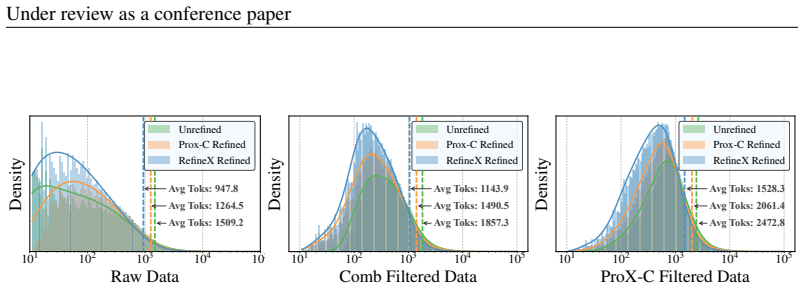
- [§4.2, Table 2, Fig. 4, Appendix B] The fixed-token-budget comparison is confounded by document count. RefineX's deletion-only programs shorten documents dramatically (Fig. 4: raw 1509→948 tokens, Comb 1857→1144, Prox-D 2473→1528), so assembling a 20B-token corpus with RefineX requires drawing from substantially more source documents than the baseline corpora. The paper even describes this as "access to a more diverse set of documents" (Section 4.2). Without a length-matched control (e.g., truncating each document to the RefineX output length, or deleting the same number of characters with a random or simple rule-based heuristic) or a matched-document-count comparison, the average gains in Table 2 cannot be attributed to learned deletion quality rather than to the larger document count under the same token budget. This gap is load-bearing for the central claim of 2.6%–7.2% gains.
- [§4.3, Table 3, Appendix A.1] The text-quality evaluation is not independent of the training signal. Appendix A.1 uses DataMan scores to sample the seed data for distillation, and Section 4.3 uses DataMan to measure the quality improvement of refined text. Moreover, DataMan's author list (Peng et al., 2025) includes two co-authors of this paper (Junyang Lin and Dayiheng Liu). The claim that RefineX "effectively improves text quality" (Table 3) is therefore assessed with the same model that shaped the distillation data, and the potential author-related bias is not disclosed. An external quality metric or a held-out quality test set not used in pipeline construction would be needed.
- [§4.2, Tables 2 and 8] All pretraining comparisons are single-run and no variance estimates are reported. Many differences between methods are small (for example, 42.9 vs. 42.4 on Raw, and 43.2 vs. 42.6 on Gopher in Table 2), so it is not possible to assess whether the reported gains are statistically meaningful. At minimum, the authors should report standard deviations across evaluation subsets or multiple seeds, or provide a bootstrap interval for the average difference.
- [§3.2, Eq. (2), Appendix A.1, Table 14] The key design assumption, that deletion-only operations extracted from minimal edit distance preserve enough of the expert rewrite's benefit, is not directly validated. Insertions and replacements are discarded by construction, and the resulting deletion-only text is never checked against the expert output. The hand-set filtering thresholds in Appendix A.1 (insertion/replacement spans under 20 characters, deletions under 10 characters) are not a validation of this assumption. A control experiment that applies random deletions matched in number and length, or that compares against the full end-to-end rewrite on the same document budget, would clarify whether the downstream gains come from the deletion supervision or simply from token removal.
minor comments (5)
- [Global] The method name is inconsistently typeset as "REFINE X" and "REFINEX"; one consistent form should be used throughout, including tables and figure captions.
- [Figure 3] The legend label "Prox-D + C" is ambiguous and should be "Prox-D + Prox-C" for consistency with Table 2.
- [Appendix C] The text says "The final reported average is computed over all nine benchmarks" but Table 2 reports ten tasks; please clarify whether the average is over the nine early-signal benchmarks plus SciQ or over the ten listed tasks.
- [Eq. (1)] The notation (c'_i)|t|_i=1 is awkward; it would be clearer to define c'_i for i = 1 to |t| in a separate display.
- [Table 6 and Table 9] The Empty column is high for low-score documents (68.17% for Score=1 with the 0.6B model); the authors should discuss the implications of converting many low-quality documents into empty strings, since this effectively combines in-document refinement with document-level filtering.
Circularity Check
The central LightEval pretraining claim is externally grounded, but the text-quality evidence is partially self-referential: DataMan (co-authored) is used both to sample the distillation seed and to measure quality, the 'zero new words' result is definitional, and the comparison against E2Edel is favorably structured by the filtering of the supervision data.
-
self definitional
[Section 3.1, Eq. (1); Section 4.3, Table 4]
"E(Odel, t) = (c′i)|t| i=1, where c′i = ‘’ if ci in (dj)|Odel| j=1 else ci ... REFINE X applies a moderate level of edits that enhance text quality, while ensuring reliability by relying solely on deletion operations. As shown in Table 4, it introduces no additional content (i.e., zero new words), thereby avoiding risks of hallucination or over-modification."
Eq. (1) defines the refined text as the original character sequence with selected spans removed. Therefore 'zero new words' is entailed by the definition of the executor, not an empirically discovered property. The paper presents Table 4 as reliability evidence, but the result is true by construction for any deletion-only operator and does not distinguish RefineX from any other deletion-only method.
-
self citation load bearing
[Appendix A.1; Section 4.3; Appendix C]
"To construct the seed dataset, we begin by scoring the raw collected corpus using DataMan (Peng et al., 2025), a state-of-the-art quality scoring model. To ensure that the seed data reflect the true distribution of the full corpus, we sample approximately 5 million documents in accordance with the score distribution. ... we begin by pre-classifying raw text data collected from RedPajama-V2 using DataMan (Peng et al., 2025)"
DataMan is cited from Peng et al. (2025), whose author list includes RefineX co-authors Dayiheng Liu and Junyang Lin. The same DataMan scorer is used both to construct the distillation seed set (Appendix A.1) and to evaluate the quality improvement claims (Section 4.3, Tables 3 and 9). The 'quality improvement' evidence is therefore not fully independent of the authors' own prior tool, although the central downstream LightEval results do not depend on DataMan and remain externally grounded.
1 more flagged steps
-
fitted input called prediction
[Appendix A.1; Section 4.3, Table 3]
"We discard any document containing insertion or replacement spans of 20 characters or more, and further filter out examples with fewer than 10 characters affected by deletions. ... A particularly encouraging result is that REFINEX significantly outperforms its own distillation source E2Edel, used as supervision during training. This suggests that the refine model not only learned the deletion-based programs effectively but also generalized beyond the examples it was distilled from."
The supervision used to train RefineX is not unfiltered E2Edel but a hand-filtered subset of deletion programs, with short deletions and long insertions/replacements removed (Appendix A.1). Comparing the resulting model against full E2Edel is therefore favorable by construction: the training data was deliberately curated to exclude the operations the authors deem low-confidence. The claim that RefineX 'generalized beyond' its distillation source is not supported by this comparison, since the observed superiority over E2Edel is at least partly an artifact of the filtering choices rather than evidence of emergent behavior.
full rationale
The paper's main empirical claim, that RefineX yields 2.6%-7.2% average gains over baselines on LightEval tasks for a 750M model, is anchored in external, independently run downstream benchmarks (LightEval tasks: ARC-C, ARC-E, CSQA, HellaSwag, MMLU, OBQA, PIQA, SIQA, WinoG, SciQ). These results are not fitted to RefineX's own outputs and do not reduce to the method's definitions, so the central pretraining claim is not circular. However, the supporting text-quality narrative contains genuine self-referential elements. First, DataMan, a quality scorer co-authored by two RefineX authors, is used both to sample the distillation seed distribution and to measure the quality improvements in Section 4.3; this makes the quality-improvement evidence partially dependent on the authors' own prior tool, even though DataMan is an external published model and is not re-fit in this paper. Second, the 'zero new words' reliability result is a direct logical consequence of the deletion-only executor in Eq. (1), so presenting it as an evaluation finding is definitional rather than empirical. Third, the claim that RefineX outperforms its own distillation source E2Edel is confounded by the fact that the distillation data is a filtered subset of E2Edel with short deletions and long insertions/replacements removed; the comparison is therefore stacked in RefineX's favor. These issues are confined to the text-quality analysis and do not invalidate the independent LightEval comparison, so the overall circularity score is moderate rather than severe.
Assumptions & free parameters
free parameters (3)
- distillation filtering thresholds =
insertion/replacement >= 20 chars discarded; deletions < 10 chars discarded
- chunk size for refinement inference =
approximately 12,000 characters (described as 12k tokens in Section 3.2)
- expert decoding parameters =
top-p=0.8, top-k=20
assumptions (5)
- domain assumption Deletion-only refinement improves pretraining data while preserving diversity and naturalness (Section 3.1).
- domain assumption The minimal edit distance between raw and expert-refined text identifies the 'right' deletions (Section 3.2, Eq. 2).
- domain assumption DataMan scores are a valid measure of pretraining utility (Appendix A.1, Section 4.3).
- domain assumption Downstream LightEval tasks (zero-shot accuracy on 10 benchmarks) reflect pretraining data quality (Section 4.1, Appendix C).
- domain assumption The expert model Qwen2.5-72B-Instruct produces higher-quality text under the provided prompts (Section 3.2, Appendix A.2).
Cite this review
Pith. "Pith review of RefineX: Learning to Refine Pre-training Data at Scale from Expert-Guided Programs." pith.science (2026). https://pith.science/paper/L4U62CEJ
@misc{pith2026250703253,
  author       = {Pith},
  title        = {Pith review of: RefineX: Learning to Refine Pre-training Data at Scale from Expert-Guided Programs},
  year         = {2026},
  howpublished = {\url{https://pith.science/paper/L4U62CEJ}},
  note         = {Machine review of arXiv:2507.03253}
}
abstract
The foundational capabilities of large language models (LLMs) are deeply influenced by the quality of their pre-training corpora. However, enhancing data quality at scale remains a significant challenge, primarily due to the trade-off between refinement effectiveness and processing efficiency. While rule-based filtering remains the dominant paradigm, it typically operates at the document level and lacks the granularity needed to refine specific content within documents. Inspired by emerging work such as ProX, we propose $\textbf{RefineX}$, a novel framework for large-scale, surgical refinement of pre-training data through programmatic editing tasks. RefineX enables efficient and fine-grained data refinement while reliably preserving the diversity and naturalness of raw text. The core strength of RefineX lies in distilling high-quality, expert-guided end-to-end refinement results into minimal edit-based deletion programs. This high-precision distillation pipeline is used to train an efficient and reliable refine model that can systematically improve every instance in the corpus at scale. We evaluate RefineX across from-scratch pre-training at multiple model scales and find that it consistently outperforms models trained on raw, filtered, or alternatively refined data across diverse downstream tasks. On the 750M model, RefineX yields 2.6%-7.2% average gains on lighteval tasks, and achieves comparable performance using significantly fewer training tokens. Further analysis shows that RefineX reliably enhances text quality with both high efficiency and precision, outperforming prior approaches such as end-to-end generation and Prox-C. These results position RefineX as a scalable, effective, and reliable solution for optimizing pre-training data in modern LLM pipelines.
Figures


Figures from the paper (2 more)

Forward citations
Cited by 1 Pith paper
-
DataOrchestra: Learning to Orchestrate Per-Example Curation of Pretraining Data
A learned orchestrator builds per-example drop/untouch/clean pipelines over noise pruning and instruction-conditioned rewriting, improving from-scratch and math continued pretraining over fixed curation methods.
Reference graph
Works this paper leans on
-
[1]
Josh Achiam, Steven Adler, Sandhini Agarwal, Lama Ahmad, Ilge Akkaya, Florencia Leoni Aleman, Diogo Almeida, Janko Altenschmidt, Sam Altman, Shyamal Anadkat, et al. Gpt-4 technical report. arXiv preprint arXiv:2303.08774, 2023
arXiv 2023
-
[2]
Lightning AI. Litgpt. https://github.com/Lightning-AI/litgpt, 2023
work page 2023
-
[3]
The claude 3 model family: Opus, sonnet, haiku
AI Anthropic. The claude 3 model family: Opus, sonnet, haiku. Claude-3 Model Card, 2024. URL https://www-cdn.anthropic.com/de8ba9b01c9ab7cbabf5c33b80b7bbc618857627/Model_Card_Claude_3.pdf
work page 2024
-
[4]
Program synthesis with large language models
Jacob Austin, Augustus Odena, Max Nye, et al. Program synthesis with large language models. arXiv preprint arXiv:2108.07732, 2021
arXiv 2021
-
[5]
A critical analysis of the largest source for generative ai training data: Common crawl
Stefan Baack. A critical analysis of the largest source for generative ai training data: Common crawl. In Proceedings of the 2024 ACM Conference on Fairness, Accountability, and Transparency, pp.\ 2199--2208, 2024
work page 2024
-
[6]
Baolong Bi, Shenghua Liu, Yiwei Wang, Yilong Xu, Junfeng Fang, Lingrui Mei, and Xueqi Cheng. Parameters vs. context: Fine-grained control of knowledge reliance in language models. arXiv preprint arXiv:2503.15888, 2025
arXiv 2025
-
[7]
Piqa: Reasoning about physical commonsense in natural language
Yonatan Bisk, Rowan Zellers, Jianfeng Gao, Yejin Choi, et al. Piqa: Reasoning about physical commonsense in natural language. In Proceedings of the AAAI conference on artificial intelligence, volume 34, pp.\ 7432--7439, 2020
2020
-
[8]
On the resemblance and containment of documents
Andrei Z Broder. On the resemblance and containment of documents. In Proceedings. Compression and Complexity of SEQUENCES 1997 (Cat. No. 97TB100171), pp.\ 21--29. IEEE, 1997
work page 1997
Show all 68 references
-
[9]
Evaluating large language models trained on code
Mark Chen, Jerry Tworek, Heewoo Jun, et al. Evaluating large language models trained on code. arXiv preprint arXiv:2107.03374, 2021
2021 arXiv
-
[10]
Think you have solved question answering? try arc, the ai2 reasoning challenge
Peter Clark, Isaac Cowhey, Oren Etzioni, Tushar Khot, Ashish Sabharwal, Carissa Schoenick, and Oyvind Tafjord. Think you have solved question answering? try arc, the ai2 reasoning challenge. arXiv preprint arXiv:1803.05457, 2018
2018 arXiv
-
[11]
Flash A ttention-2: Faster attention with better parallelism and work partitioning
Tri Dao. Flash A ttention-2: Faster attention with better parallelism and work partitioning. In International Conference on Learning Representations (ICLR), 2024
2024
- [12]
-
[13]
The llama 3 herd of models
Abhimanyu Dubey, Abhinav Jauhri, Abhinav Pandey, Abhishek Kadian, Ahmad Al-Dahle, Aiesha Letman, Akhil Mathur, Alan Schelten, Amy Yang, Angela Fan, et al. The llama 3 herd of models. arXiv preprint arXiv:2407.21783, 2024
2024 arXiv
-
[14]
Minedojo: Building open-ended embodied agents with internet-scale knowledge
Linxi Fan, Guanzhi Wang, Yunfan Jiang, Ajay Mandlekar, Yuncong Yang, Haoyi Zhu, Andrew Tang, De-An Huang, Yuke Zhu, and Anima Anandkumar. Minedojo: Building open-ended embodied agents with internet-scale knowledge. Advances in Neural Information Processing Systems, 35: 0 18343...
2022
-
[15]
Lighteval: A lightweight framework for llm evaluation, 2023
Clémentine Fourrier, Nathan Habib, Thomas Wolf, and Lewis Tunstall. Lighteval: A lightweight framework for llm evaluation, 2023. URL https://github.com/huggingface/lighteval
2023
-
[16]
Incoder: A generative model for code infilling and synthesis
Daniel Fried, Sewon Chen, Eric Wallace, et al. Incoder: A generative model for code infilling and synthesis. In arXiv preprint arXiv:2204.05999, 2022
2022 arXiv
-
[17]
Measuring mathematical problem solving with the math dataset
Dan Hendrycks, Collin Burns, Saurav Kadavath, Akul Arora, Steven Basart, Eric Tang, Dawn Song, and Jacob Steinhardt. Measuring mathematical problem solving with the math dataset. In Thirty-fifth Conference on Neural Information Processing Systems Datasets and Benchmarks Track ...
2021
-
[18]
A survey on hallucination in large language models: Principles, taxonomy, challenges, and open questions, 2023
Lei Huang, Weijiang Yu, Weitao Ma, Weihong Zhong, Zhangyin Feng, Haotian Wang, Qianglong Chen, Weihua Peng, Xiaocheng Feng, Bing Qin, and Ting Liu. A survey on hallucination in large language models: Principles, taxonomy, challenges, and open questions, 2023
2023
-
[19]
Gonzalez, Hao Zhang, and Ion Stoica
Woosuk Kwon, Zhuohan Li, Siyuan Zhuang, Ying Sheng, Lianmin Zheng, Cody Hao Yu, Joseph E. Gonzalez, Hao Zhang, and Ion Stoica. Efficient memory management for large language model serving with pagedattention. In Proceedings of the ACM SIGOPS 29th Symposium on Operating Systems...
2023
-
[20]
Rho-1: Not all tokens are what you need
Zhenghao Lin, Zhibin Gou, Yeyun Gong, Xiao Liu, Yelong Shen, Ruochen Xu, Chen Lin, Yujiu Yang, Jian Jiao, Nan Duan, et al. Rho-1: Not all tokens are what you need. arXiv preprint arXiv:2404.07965, 2024
2024 arXiv
-
[21]
Efficient inference for large reasoning models: A survey
Yue Liu, Jiaying Wu, Yufei He, Hongcheng Gao, Hongyu Chen, Baolong Bi, Jiaheng Zhang, Zhiqi Huang, and Bryan Hooi. Efficient inference for large reasoning models: A survey. arXiv preprint arXiv:2503.23077, 2025
2025 arXiv
-
[22]
Openelm: An efficient language model family with open-source training and inference framework
Sachin Mehta, Mohammad Hossein Sekhavat, Qingqing Cao, Maxwell Horton, Yanzi Jin, Chenfan Sun, Iman Mirzadeh, Mahyar Najibi, Dmitry Belenko, Peter Zatloukal, et al. Openelm: An efficient language model family with open-source training and inference framework. arXiv preprint ar...
2024 arXiv
-
[23]
Slang: New concept comprehension of large language models
Lingrui Mei, Shenghua Liu, Yiwei Wang, Baolong Bi, and Xueqi Cheng. Slang: New concept comprehension of large language models. arXiv preprint arXiv:2401.12585, 2024
2024 arXiv
-
[24]
Introducing meta llama 3: The most capable openly available llm to date, 2024
Meta. Introducing meta llama 3: The most capable openly available llm to date, 2024. URL https://ai.meta.com/blog/meta-llama-3
2024
-
[25]
Can a suit of armor conduct electricity? a new dataset for open book question answering
Todor Mihaylov, Peter Clark, Tushar Khot, and Ashish Sabharwal. Can a suit of armor conduct electricity? a new dataset for open book question answering. In Ellen Riloff, David Chiang, Julia Hockenmaier, and Jun ' ichi Tsujii (eds.), Proceedings of the 2018 Conference on Empiri...
2018 doi
-
[26]
Towards fully exploiting llm internal states to enhance knowledge boundary perception
Shiyu Ni, Keping Bi, Jiafeng Guo, Lulu Yu, Baolong Bi, and Xueqi Cheng. Towards fully exploiting llm internal states to enhance knowledge boundary perception. arXiv preprint arXiv:2502.11677, 2025
2025 arXiv
-
[27]
Generative agents: Interactive simulacra of human behavior
Joon Sung Park, Joseph O'Brien, Carrie Jun Cai, Meredith Ringel Morris, Percy Liang, and Michael S Bernstein. Generative agents: Interactive simulacra of human behavior. In Proceedings of the 36th Annual ACM Symposium on User Interface Software and Technology, pp.\ 1--22, 2023
2023
-
[28]
The fineweb datasets: Decanting the web for the finest text data at scale
Guilherme Penedo, Hynek Kydl \' c ek, Anton Lozhkov, Margaret Mitchell, Colin Raffel, Leandro Von Werra, Thomas Wolf, et al. The fineweb datasets: Decanting the web for the finest text data at scale. arXiv preprint arXiv:2406.17557, 2024 a
2024 arXiv
-
[29]
Datatrove: large scale data processing, 2024 b
Guilherme Penedo, Hynek Kydlíček, Alessandro Cappelli, Mario Sasko, and Thomas Wolf. Datatrove: large scale data processing, 2024 b . URL https://github.com/huggingface/datatrove
2024
-
[30]
The refinedweb dataset for falcon llm: Outperforming curated corpora with web data only
Guilherme Penedo, Quentin Malartic, Daniel Hesslow, Ruxandra Cojocaru, Hamza Alobeidli, Alessandro Cappelli, Baptiste Pannier, Ebtesam Almazrouei, and Julien Launay. The refinedweb dataset for falcon llm: Outperforming curated corpora with web data only. Advances in Neural Inf...
2024
-
[31]
Dataman: Data manager for pre-training large language models
Ru Peng, Kexin Yang, Yawen Zeng, Junyang Lin, Dayiheng Liu, and Junbo Zhao. Dataman: Data manager for pre-training large language models. arXiv preprint arXiv:2502.19363, 2025
2025 arXiv
-
[32]
Scaling language models: Methods, analysis & insights from training gopher
Jack W Rae, Sebastian Borgeaud, Trevor Cai, Katie Millican, Jordan Hoffmann, Francis Song, John Aslanides, Sarah Henderson, Roman Ring, Susannah Young, et al. Scaling language models: Methods, analysis & insights from training gopher. arXiv preprint arXiv:2112.11446, 2021
2021 arXiv
-
[33]
Exploring the limits of transfer learning with a unified text-to-text transformer
Colin Raffel, Noam Shazeer, Adam Roberts, Katherine Lee, Sharan Narang, Michael Matena, Yanqi Zhou, Wei Li, and Peter J Liu. Exploring the limits of transfer learning with a unified text-to-text transformer. Journal of machine learning research, 21 0 (140): 0 1--67, 2020
2020
-
[34]
Web data mining with organized contents using naive bayes algorithm
Bathini Ravinder, Senthil Kumar Seeni, VS Prabhu, P Asha, SP Maniraj, and C Srinivasan. Web data mining with organized contents using naive bayes algorithm. In 2024 2nd International Conference on Computer, Communication and Control (IC4), pp.\ 1--6. IEEE, 2024
2024
-
[35]
Winogrande: An adversarial winograd schema challenge at scale
Keisuke Sakaguchi, Ronan Le Bras, Chandra Bhagavatula, and Yejin Choi. Winogrande: An adversarial winograd schema challenge at scale. Communications of the ACM, 64 0 (9): 0 99--106, 2021
2021
-
[36]
Socialiqa: Commonsense reasoning about social interactions
Maarten Sap, Hannah Rashkin, Derek Chen, Ronan LeBras, and Yejin Choi. Socialiqa: Commonsense reasoning about social interactions. arXiv preprint arXiv:1904.09728, 2019
1904 arXiv
-
[37]
Toolformer: Language models can teach themselves to use tools
Timo Schick, Ananya Dwivedi-Yu, Yeganeh Kordi Hou, et al. Toolformer: Language models can teach themselves to use tools. In International Conference on Learning Representations (ICLR), 2024
2024
-
[38]
Using deepspeed and megatron to train megatron-turing nlg 530b, a large-scale generative language model
Shaden Smith, Mostofa Patwary, Brandon Norick, Patrick LeGresley, Samyam Rajbhandari, Jared Casper, Zhun Liu, Shrimai Prabhumoye, George Zerveas, Vijay Korthikanti, et al. Using deepspeed and megatron to train megatron-turing nlg 530b, a large-scale generative language model. ...
2022 arXiv
-
[39]
SlimPajama: A 627B token cleaned and deduplicated version of RedPajama , June 2023
Daria Soboleva, Faisal Al-Khateeb, Robert Myers, Jacob R Steeves, Joel Hestness, and Nolan Dey. SlimPajama: A 627B token cleaned and deduplicated version of RedPajama , June 2023. URL https://huggingface.co/datasets/cerebras/SlimPajama-627B
2023
-
[40]
Dolma: an open corpus of three trillion tokens for language model pretraining research
Luca Soldaini, Rodney Kinney, Akshita Bhagia, Dustin Schwenk, David Atkinson, Russell Authur, Ben Bogin, Khyathi Chandu, Jennifer Dumas, Yanai Elazar, Valentin Hofmann, Ananya Jha, Sachin Kumar, Li Lucy, Xinxi Lyu, Nathan Lambert, Ian Magnusson, Jacob Morrison, Niklas Muennigh...
2024
-
[41]
Nemotron-cc: Transforming common crawl into a refined long-horizon pretraining dataset
Dan Su, Kezhi Kong, Ying Lin, Joseph Jennings, Brandon Norick, Markus Kliegl, Mostofa Patwary, Mohammad Shoeybi, and Bryan Catanzaro. Nemotron-cc: Transforming common crawl into a refined long-horizon pretraining dataset. arXiv preprint arXiv:2412.02595, 2024
2024 arXiv
-
[42]
C ommonsense QA : A question answering challenge targeting commonsense knowledge
Alon Talmor, Jonathan Herzig, Nicholas Lourie, and Jonathan Berant. C ommonsense QA : A question answering challenge targeting commonsense knowledge. In Jill Burstein, Christy Doran, and Thamar Solorio (eds.), Proceedings of the 2019 Conference of the North A merican Chapter o...
2019 doi
-
[43]
Redpajama: an open dataset for training large language models, October 2023
Together. Redpajama: an open dataset for training large language models, October 2023. URL https://github.com/togethercomputer/RedPajama-Data
2023
-
[44]
M Towhidul Islam Tonmoy, S M Mehedi Zaman, Vinija Jain, Anku Rani, Vipula Rawte, Aman Chadha, and Amitava Das
S. M Towhidul Islam Tonmoy, S M Mehedi Zaman, Vinija Jain, Anku Rani, Vipula Rawte, Aman Chadha, and Amitava Das. A comprehensive survey of hallucination mitigation techniques in large language models, 2024
2024
-
[45]
Llama: Open and efficient foundation language models
Hugo Touvron, Thibaut Lavril, Gautier Izacard, Xavier Martinet, Marie-Anne Lachaux, Timoth \'e e Lacroix, Baptiste Rozi \`e re, Naman Goyal, Eric Hambro, Faisal Azhar, et al. Llama: Open and efficient foundation language models. arXiv preprint arXiv:2302.13971, 2023 a
2023 arXiv
-
[46]
Llama 2: Open foundation and fine-tuned chat models
Hugo Touvron, Louis Martin, Kevin Stone, Peter Albert, Amjad Almahairi, Yasmine Babaei, Nikolay Bashlykov, Soumya Batra, Prajjwal Bhargava, Shruti Bhosale, et al. Llama 2: Open foundation and fine-tuned chat models. arXiv preprint arXiv:2307.09288, 2023 b
2023 arXiv
-
[47]
Code llama: Open foundation models for code
Albert Wang, Baptiste Roziere, Gautier Izacard, et al. Code llama: Open foundation models for code. arXiv preprint arXiv:2308.12950, 2023
2023 arXiv
-
[48]
Chain-of-thought prompting elicits reasoning in large language models
Jason Wei, Xuezhi Wang, Dale Schuurmans, Maarten Bosma, Fei Xia, Ed Chi, Quoc V Le, Denny Zhou, et al. Chain-of-thought prompting elicits reasoning in large language models. Advances in neural information processing systems, 35: 0 24824--24837, 2022
2022
-
[49]
Crowdsourcing multiple choice science questions
Johannes Welbl, Nelson F Liu, and Matt Gardner. Crowdsourcing multiple choice science questions. arXiv preprint arXiv:1707.06209, 2017
2017 arXiv
-
[50]
QuRating : Selecting high-quality data for training language models
Alexander Wettig, Aatmik Gupta, Saumya Malik, and Danqi Chen. QuRating : Selecting high-quality data for training language models. In International Conference on Machine Learning (ICML), 2024
2024
-
[51]
Data selection for language models via importance resampling
Sang Michael Xie, Shibani Santurkar, Tengyu Ma, and Percy S Liang. Data selection for language models via importance resampling. Advances in Neural Information Processing Systems, 36: 0 34201--34227, 2023
2023
-
[52]
Qwen3 technical report
An Yang, Anfeng Li, Baosong Yang, Beichen Zhang, Binyuan Hui, Bo Zheng, Bowen Yu, Chang Gao, Chengen Huang, Chenxu Lv, et al. Qwen3 technical report. arXiv preprint arXiv:2505.09388, 2025
2025 arXiv
-
[53]
React: Synergizing reasoning and acting in language models
Shinn Yao, Jiong Zhao, Dian Yu, and et al. React: Synergizing reasoning and acting in language models. In NeurIPS, 2023
2023
-
[54]
Craw4llm: Efficient web crawling for llm pretraining
Shi Yu, Zhiyuan Liu, and Chenyan Xiong. Craw4llm: Efficient web crawling for llm pretraining. arXiv preprint arXiv:2502.13347, 2025
2025 arXiv
-
[55]
Mates: Model-aware data selection for efficient pretraining with data influence models
Zichun Yu, Spandan Das, and Chenyan Xiong. Mates: Model-aware data selection for efficient pretraining with data influence models. arXiv preprint arXiv:2406.06046, 2024
2024 arXiv
-
[56]
A normalized levenshtein distance metric
Li Yujian and Liu Bo. A normalized levenshtein distance metric. IEEE transactions on pattern analysis and machine intelligence, 29 0 (6): 0 1091--1095, 2007
2007
-
[57]
Hellaswag: Can a machine really finish your sentence? arXiv preprint arXiv:1905.07830, 2019
Rowan Zellers, Ari Holtzman, Yonatan Bisk, Ali Farhadi, and Yejin Choi. Hellaswag: Can a machine really finish your sentence? arXiv preprint arXiv:1905.07830, 2019
1905 arXiv
-
[58]
Map-neo: Highly capable and transparent bilingual large language model series
Ge Zhang, Scott Qu, Jiaheng Liu, Chenchen Zhang, Chenghua Lin, Chou Leuang Yu, Danny Pan, Esther Cheng, Jie Liu, Qunshu Lin, et al. Map-neo: Highly capable and transparent bilingual large language model series. arXiv preprint arXiv:2405.19327, 2024 a
2024 arXiv
-
[59]
Tinyllama: An open-source small language model
Peiyuan Zhang, Guangtao Zeng, Tianduo Wang, and Wei Lu. Tinyllama: An open-source small language model. arXiv preprint arXiv:2401.02385, 2024 b
2024 arXiv
-
[60]
Editavalanche: A multi-granularity benchmark for edit-based language model evaluation
Yuxian Zhang, Canwen Xu, Zhiyuan Liu, and Maosong Sun. Editavalanche: A multi-granularity benchmark for edit-based language model evaluation. arXiv preprint arXiv:2310.11603, 2023
2023 arXiv
-
[61]
Pytorch fsdp: Experiences on scaling fully sharded data parallel
Yanli Zhao, Andrew Gu, Rohan Varma, Liang Luo, Chien-Chin Huang, Min Xu, Less Wright, Hamid Shojanazeri, Myle Ott, Sam Shleifer, Alban Desmaison, Can Balioglu, Pritam Damania, Bernard Nguyen, Geeta Chauhan, Yuchen Hao, Ajit Mathews, and Shen Li. Pytorch fsdp: Experiences on sc...
2023
-
[62]
Programming every example: Lifting pre-training data quality like experts at scale
Fan Zhou, Zengzhi Wang, Qian Liu, Junlong Li, and Pengfei Liu. Programming every example: Lifting pre-training data quality like experts at scale. arXiv preprint arXiv:2409.17115, 2024
2024 arXiv
-
[63]
Toolqa: A dataset for llm question answering with external tools
Yuchen Zhuang, Yue Yu, Kuan Wang, Haotian Sun, and Chao Zhang. Toolqa: A dataset for llm question answering with external tools. Advances in Neural Information Processing Systems, 36: 0 50117--50143, 2023
2023
-
[64]
Bigcodebench: Benchmarking code generation with diverse function calls and complex instructions
Terry Yue Zhuo, Minh Chien Vu, Jenny Chim, Han Hu, Wenhao Yu, Ratnadira Widyasari, Imam Nur Bani Yusuf, Haolan Zhan, Junda He, Indraneil Paul, et al. Bigcodebench: Benchmarking code generation with diverse function calls and complex instructions. arXiv preprint arXiv:2406.15877, 2024
2024 arXiv
-
[65]
write newline
" write newline "" before.all 'output.state := FUNCTION n.dashify 't := "" t empty not t #1 #1 substring "-" = t #1 #2 substring "--" = not "--" * t #2 global.max substring 't := t #1 #1 substring "-" = "-" * t #2 global.max substring 't := while if t #1 #1 substring * t #2 gl...
-
[66]
@esa (Ref
\@ifxundefined[1] #1\@undefined \@firstoftwo \@secondoftwo \@ifnum[1] #1 \@firstoftwo \@secondoftwo \@ifx[1] #1 \@firstoftwo \@secondoftwo [2] @ #1 \@temptokena #2 #1 @ \@temptokena \@ifclassloaded agu2001 natbib The agu2001 class already includes natbib coding, so you should ...
-
[67]
\@lbibitem[] @bibitem@first@sw\@secondoftwo \@lbibitem[#1]#2 \@extra@b@citeb \@ifundefined br@#2\@extra@b@citeb \@namedef br@#2 \@nameuse br@#2\@extra@b@citeb \@ifundefined b@#2\@extra@b@citeb @num @parse #2 @tmp #1 NAT@b@open@#2 NAT@b@shut@#2 \@ifnum @merge>\@ne @bibitem@firs...
-
[68]
@open @close @open @close and [1] URL: #1 \@ifundefined chapter * \@mkboth \@ifxundefined @sectionbib * \@mkboth * \@mkboth\@gobbletwo \@ifclassloaded amsart * \@ifclassloaded amsbook * \@ifxundefined @heading @heading NAT@ctr thebibliography [1] @ \@biblabel @NAT@ctr \@bibset...
Reviewed August 6, 2026 · model on record in the stance chip above.
Discussion (0). Sign in to comment.