REVIEW 5 major objections 6 minor 45 references
Enhancing Classification with Semi-Supervised Deep Learning Using Distance-Based Sample Weights
T0 review · 5 major / 6 minor · reviewed 2026-08-07 · deepseek-v4-flash
Pith's one-line read A distance-based weighting scheme that upweights training samples closest to the test set consistently beats a plain neural network across twelve datasets.
desk verdict Claimed gains rest on an unfair transductive advantage; the weighting itself is never actually isolated. read the letter →
The pith
A machine-rendered reading of the paper's core claim, the machinery that carries it, and where it could break.
The reading
What carries the argument
The load-bearing object is the distance-based sample weight $w_i = \frac{1}{M}\sum_{j=1}^M \exp(-\lambda\, d(x_i, x'_j))$, where $d$ is a per-dataset distance metric (Euclidean, Hamming, Cosine, or Jaccard) and $\lambda$ is a tuned decay constant. This weight is the multiplier in the weighted loss $L_{\mathrm{weighted}} = \frac{1}{N}\sum_i w_i\, L(y_i, f(x_i;\theta))$, so it directly changes which training errors the optimizer corrects: high error on a sample far from the test set is penalized more heavily, while close samples contribute favorably. The choice of $d$ and $\lambda$ per dataset (Table I) is part of the mechanism, along with the exponential form chosen for numerical stability over inverse-distance weighting.
What would settle it
Train the identical weighted-loss model but compute each training sample's weight against a set of test-like feature vectors drawn from a different label distribution (or randomly permuted test features). If accuracy against the true test set stays as high as with the real test features, the effect is not caused by proximity to the actual target distribution; if accuracy drops to baseline level, the proximity signal is what carries the claim.
Extended reading notes
Core claim
On the paper's own terms, the core discovery is that reweighting each training sample by its exponential-decay similarity to the test set, then feeding those weights into the loss function, makes a deep neural network generalize better than the same network trained unweighted. The authors report that the weighted model 'consistently outperforms the traditional neural network model across multiple datasets' (Section IV-B), with notable gains on Haberman's Survival, Sonar, and Statlog (Heart), and that it also beats inverse-distance weighting. The improvement is attributed to the weighting's ability to de-emphasize noisy or class-imbalanced samples while amplifying samples that resemble the target distribution, thereby reducing error propagation relative to hard pseudo-labeling.
Load-bearing premise
The paper assumes the accuracy gains come from the distance-weighting formula itself; the weighted model also sees the test set's feature vectors when computing weights and gets per-dataset tuning of the decay constant and distance metric, so if those extras—not the weighting—drive the improvements, the central claim does not hold.
Editorial extensions
If this is right
- When the test split is 90% of the data, the weighted model keeps accuracy high while the baseline declines, indicating the method is most useful precisely when labeled examples are few.
- The weighted model raises recall and F1 on imbalanced sets such as Haberman and Sonar, suggesting the weighting counteracts minority-class neglect without explicit resampling.
- IDW sits between baseline and weighted on most reported metrics, so the exponential-decay form itself matters, not just the act of weighting.
- Because the weighting adds only a distance computation over the test set, the approach is cheap to bolt onto an existing network and its optimizer unchanged.
- Gains are smaller on near-saturated datasets like Banknote and Mammographic Mass, so the method's edge is concentrated in harder, less separable problems.
Reading between the lines
- The method is transductive rather than broadly semi-supervised: it uses the test set's feature vectors at training time. A fairer framing would be that it exploits the target distribution's unlabeled features, and its practical use requires test features to be available during training, which is true in some batch settings but not in true online deployment.
- The per-dataset tuning of $\lambda$ and the distance metric, reported in Table I, is a degree of freedom the plain baseline does not receive; part of the reported gap could reflect hyperparameter search rather than the weighting rule itself. Giving the baseline the same tuning budget would isolate the contribution.
- A natural stress test is to compute weights against randomly shuffled test features: if accuracy gains persist, the benefit would come from variance reduction or regularization, not from semantic proximity to the target distribution; if they vanish, the proximity signal is doing the work.
- The evidence is entirely tabular. Extending the same weighting to image datasets (where the distance metric would need to be learned, say from a feature embedding) would clarify whether the claim 'consistently outperforming existing methods' survives outside standard tabular benchmarks.
Editorial analysis
A structured set of objections, weighed in public.
Referee Report
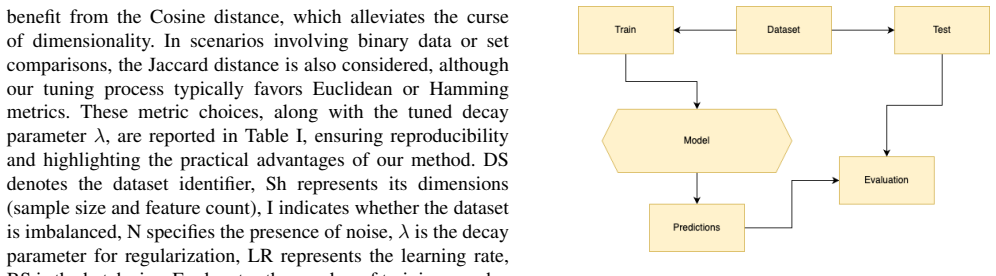
Summary. The manuscript proposes a distance-based weighting scheme for deep classifiers: each training sample is weighted by its average exponential distance to all test-set feature vectors (Eq. 2), and these weights multiply the per-sample loss (Eq. 3). The authors compare the weighted model against an unweighted baseline and an inverse-distance weighting (IDW) variant on twelve datasets at test sizes of 10%, 50%, and 90%, reporting precision, recall, F1, AUC, and accuracy. The paper claims that the weighted model consistently outperforms the baseline and, in the abstract, that it outperforms existing methods. The method is essentially a transductive, test-aware reweighting scheme, and the central claim is not supported by the evidence as presented.
Significance. The idea of reweighting training samples by proximity to test inputs is simple and could be practically valuable if the reported gains were real. The paper has identifiable strengths: it gives explicit equations, reports per-dataset hyperparameters in Table I, evaluates on twelve datasets, and includes a second comparator (IDW). However, the significance is currently undercut by three central problems: (i) the weighted model is granted access to test-set feature vectors during training while the baseline is not, so the comparison does not isolate the weighting; (ii) no existing semi-supervised learning method is evaluated, despite the abstract's claim of outperforming existing methods; and (iii) the quantitative tables contain internally inconsistent precision/recall/F1 values. These issues prevent the paper from establishing its main empirical claim.
major comments (5)
- [§III-A, Eq. (2); §IV] The weighted model's training weights are computed from the test-set feature vectors in Eq. (2), whereas the baseline in Section IV is a standard network trained without access to test features. At test sizes up to 90%, the additional information available to the weighted model is substantial, and the reported gains are therefore not attributable to the weighting scheme per se. No ablation or control gives the baseline equivalent access to the test distribution (e.g., a transductive baseline, test-distance features as auxiliary inputs, or a uniform-weight variant with the same computation graph), so the claim that the weighting itself is responsible for the improvements is untested. This is load-bearing for the paper's main conclusion.
- [§IV-B; Abstract] The abstract and Section IV-B claim that the method 'consistently outperforms existing methods,' but the experiments compare only the proposed weighted model, the unweighted baseline, and the IDW variant. No existing semi-supervised learning method (pseudo-labeling, consistency regularization, graph-based SSL, or any published SSL baseline) is evaluated. Moreover, the method is not a standard SSL method: no unlabeled data are used apart from the test set, which is exploited transductively in Eq. (2). The stated claim of outperforming existing methods is therefore unsupported by the experimental design.
- [Tables II and III] Many rows of Tables II and III report precision, recall, and F1 values that are mutually inconsistent under the standard binary F1 definition. For example, Adult at test size 0.9, Base row reports P=0.6520, R=0.9429, F1=0.5525, but the harmonic mean of P and R is approximately 0.771; similar inconsistencies appear in the ILPD, Heart, and Statlog rows. The tables do not state whether metrics are macro-averaged, micro-averaged, or computed for a particular class, so these entries cannot be used to verify the claimed improvements.
- [§III-B, Eq. (3)] The prose in Section III-B describes the weighting as penalizing less similar samples with high error more heavily and giving closer samples a lower penalty, but Eq. (3) combined with Eq. (2) does the opposite: closer samples receive larger weights w_i and therefore contribute more to the loss for a given error. This internal inconsistency makes it unclear whether the intended mechanism is to upweight or downweight test-proximal samples, and it needs to be resolved before the method can be evaluated.
- [Table I; §IV] The manuscript reports per-dataset choices of the decay parameter λ and the distance metric in Table I, but no validation procedure is described. If these choices were made using test-set performance, the comparison is further biased in favor of the weighted model; if a validation split was used, that procedure should be explained and the selected hyperparameters should be held out. As written, the experimental protocol does not rule out selection on the test set.
minor comments (6)
- [§IV-A] The text refers to 'test sizes (e.g., 70% or higher)' although the experiments use only 10%, 50%, and 90%; this sentence should be aligned with the actual test sizes.
- [§IV] The paper states that each configuration was run five times, but Tables II and III report only point estimates; reporting standard deviations or confidence intervals would allow the consistency claim to be assessed.
- [Table I] The column labels in Table I are confusing: the column named 'I' takes values 'I' and 'B', and the column named 'N' takes values 'N' and 'Y', which makes the legend ('I indicates whether the dataset is imbalanced, N specifies presence of noise') hard to parse; please use unambiguous labels such as 'Balanced?' and 'Noisy?' with Yes/No values.
- [§IV] The paper does not provide the neural network architecture, activation functions, preprocessing steps, or data splitting procedure; these details are needed for reproducibility.
- [Figures 3-6] Figures 3-6 aggregate results across test sizes and datasets but do not include error bars or numeric values, which makes the visual comparisons difficult to interpret.
- [§III-A, Eq. (2)] The paper claims computational efficiency but does not analyze the O(N·M·d) cost of computing all pairwise distances in Eq. (2), which may be substantial at large test sizes.
Circularity Check
No significant circularity; the weighting formula is stated explicitly and the empirical claim is not forced by construction.
full rationale
The paper's central claim is empirical: the distance-weighted model outperforms the baseline and IDW across datasets. The weighting is defined in Eq. (2) as the average exponential distance from each training sample to all test feature vectors, and Eq. (3) incorporates these weights into the loss. Reported accuracies are not algebraically determined by these equations, so the result is not a tautology. The method is attributed to the authors' own Semi-Cart paper [1] in Section III-A, which is a self-citation, but the formula is restated in the paper itself, so the citation is provenance rather than the load-bearing justification. The per-dataset choices of lambda and distance metric in Table I and the stated train/validation/test split in Section IV raise reproducibility concerns, but without evidence that test labels or test-set results were used to choose them, this is not circularity. Any potential advantage from seeing test feature vectors during training is an experimental-confound issue, not an input-output identity. Under the required standard of exhibiting Eq. X = Eq. Y by construction or a fitted parameter renamed as a prediction, no circular step can be demonstrated.
Assumptions & free parameters
free parameters (3)
- Decay parameter lambda =
0.5 to 1.0 per dataset (Table I)
- Distance metric =
Euclidean, Hamming, or Cosine per dataset (Table I)
- Learning rate, batch size, epochs =
0.001, 32, 100
assumptions (3)
- domain assumption Test set feature vectors are available when computing training weights
- ad hoc to paper Proximity to test data is a valid measure of sample informativeness
- ad hoc to paper Exponential decay mapping is preferable to IDW and other mappings
Cite this review
Pith. "Pith review of Enhancing Classification with Semi-Supervised Deep Learning Using Distance-Based Sample Weights." pith.science (2026). https://pith.science/paper/L4YGMD6Z
@misc{pith2026250514345,
  author       = {Pith},
  title        = {Pith review of: Enhancing Classification with Semi-Supervised Deep Learning Using Distance-Based Sample Weights},
  year         = {2026},
  howpublished = {\url{https://pith.science/paper/L4YGMD6Z}},
  note         = {Machine review of arXiv:2505.14345}
}
read the original abstract
Recent advancements in semi-supervised deep learning have introduced effective strategies for leveraging both labeled and unlabeled data to improve classification performance. This work proposes a semi-supervised framework that utilizes a distance-based weighting mechanism to prioritize critical training samples based on their proximity to test data. By focusing on the most informative examples, the method enhances model generalization and robustness, particularly in challenging scenarios with noisy or imbalanced datasets. Building on techniques such as uncertainty consistency and graph-based representations, the approach addresses key challenges of limited labeled data while maintaining scalability. Experiments on twelve benchmark datasets demonstrate significant improvements across key metrics, including accuracy, precision, and recall, consistently outperforming existing methods. This framework provides a robust and practical solution for semi-supervised learning, with potential applications in domains such as healthcare and security where data limitations pose significant challenges.
Figures


Figures from the paper (3 more)


Reference graph
Works this paper leans on
-
[1]
Building semi-supervised decision trees with semi-cart algorithm
Aydin Abedinia and Vahid Seydi. Building semi-supervised decision trees with semi-cart algorithm. International Journal of Machine Learning and Cybernetics , pages 1–18, 2024
work page 2024
-
[2]
Deep learning for biological image classification
Carlos Affonso, Andr ´e Luis Debiaso Rossi, F ´abio Henrique Antunes Vieira, Andr ´e Carlos Ponce de Leon Ferreira, et al. Deep learning for biological image classification. Expert systems with applications , 85:114–122, 2017
work page 2017
-
[3]
Review of deep learning: concepts, cnn architectures, challenges, applications, future directions
Laith Alzubaidi, Jinglan Zhang, Amjad J Humaidi, Ayad Al-Dujaili, Ye Duan, Omran Al-Shamma, Jos ´e Santamar´ıa, Mohammed A Fadhel, Muthana Al-Amidie, and Laith Farhan. Review of deep learning: concepts, cnn architectures, challenges, applications, future directions. Journal of big Data , 8:1–74, 2021
work page 2021
-
[4]
Deep learning models for digital image processing: a review
R Archana and PS Eliahim Jeevaraj. Deep learning models for digital image processing: a review. Artificial Intelligence Review , 57(1):11, 2024
work page 2024
-
[5]
A comparison of graph construction methods for semi-supervised learning
Lilian Berton, Alneu de Andrade Lopes, and Didier A Vega-Oliveros. A comparison of graph construction methods for semi-supervised learning. In 2018 International Joint Conference on Neural Networks (IJCNN) , pages 1–8. IEEE, 2018
work page 2018
-
[6]
Correcting data imbalance for semi- supervised covid-19 detection using x-ray chest images
Saul Calderon-Ramirez, Shengxiang Yang, Armaghan Moemeni, David Elizondo, Simon Colreavy-Donnelly, Luis Fernando Chavarria-Estrada, and Miguel A Molina-Cabello. Correcting data imbalance for semi- supervised covid-19 detection using x-ray chest images. Applied Soft Computing, 111:107692, 2021
work page 2021
-
[7]
Improving uncertainty estimations for mammogram classification using semi-supervised learning
Saul Calderon-Ramirez, Diego Murillo-Hernandez, Kevin Rojas-Salazar, Luis-Alexander Calvo-Valverd, Shengxiang Yang, Armaghan Moemeni, David Elizondo, Ezequiel L ´opez-Rubio, and Miguel A Molina-Cabello. Improving uncertainty estimations for mammogram classification using semi-supervised learning. In 2021 International Joint Conference on Neural Networks (...
work page 2021
-
[8]
Semi- supervised learning (chapelle, o
Olivier Chapelle, Bernhard Scholkopf, and Alexander Zien. Semi- supervised learning (chapelle, o. et al., eds.; 2006)[book reviews]. IEEE Transactions on Neural Networks , 20(3):542–542, 2009
work page 2006
Show all 45 references
-
[9]
Attention-based label con- sistency for semi-supervised deep learning based image classification
Jiaming Chen, Meng Yang, and Jie Ling. Attention-based label con- sistency for semi-supervised deep learning based image classification. Neurocomputing, 453:731–741, 2021
2021
-
[10]
Cnn image retrieval learns from bow: Unsupervised fine-tuning with hard examples
Filip Radenovi ´c Giorgos Tolias Ond ˇrej Chum. Cnn image retrieval learns from bow: Unsupervised fine-tuning with hard examples. IEEE Transaction on Image Processing , 2017
2017
-
[11]
A survey of deep learning and its applications: a new paradigm to machine learning
Shaveta Dargan, Munish Kumar, Maruthi Rohit Ayyagari, and Gulshan Kumar. A survey of deep learning and its applications: a new paradigm to machine learning. Archives of Computational Methods in Engineer- ing, 27:1071–1092, 2020
2020
-
[12]
A survey on deep learning and its applications
Shi Dong, Ping Wang, and Khushnood Abbas. A survey on deep learning and its applications. Computer Science Review , 40:100379, 2021
2021
-
[13]
Logistic regression and artificial neural network classification models: a methodology review
Stephan Dreiseitl and Lucila Ohno-Machado. Logistic regression and artificial neural network classification models: a methodology review. Journal of biomedical informatics , 35(5-6):352–359, 2002
2002
-
[14]
Recent advances in deep learning techniques for face recognition
Md Tahmid Hasan Fuad, Awal Ahmed Fime, Delowar Sikder, Md Akil Raihan Iftee, Jakaria Rabbi, Mabrook S Al-Rakhami, Abdu Gumaei, Ovishake Sen, Mohtasim Fuad, and Md Nazrul Islam. Recent advances in deep learning techniques for face recognition. IEEE Access, 9:99112–99142, 2021
2021
-
[15]
A survey on semi-supervised learning for delayed partially labelled data streams
Heitor Murilo Gomes, Maciej Grzenda, Rodrigo Mello, Jesse Read, Minh Huong Le Nguyen, and Albert Bifet. A survey on semi-supervised learning for delayed partially labelled data streams. ACM Computing Surveys, 55(4):1–42, 2022
2022
-
[16]
A survey on deep learning based face recognition
Guodong Guo and Na Zhang. A survey on deep learning based face recognition. Computer vision and image understanding , 189:102805, 2019
2019
-
[17]
Self-training from labeled features for sentiment analysis
Yulan He and Deyu Zhou. Self-training from labeled features for sentiment analysis. Information Processing & Management , 47(4):606– 616, 2011
2011
-
[18]
When face recognition meets with deep learning: an evaluation of convolutional neural networks for face recognition
Guosheng Hu, Yongxin Yang, Dong Yi, Josef Kittler, William Christmas, Stan Z Li, and Timothy Hospedales. When face recognition meets with deep learning: an evaluation of convolutional neural networks for face recognition. In Proceedings of the IEEE international conference on ...
2015
-
[19]
Model complexity of deep learning: A survey
Xia Hu, Lingyang Chu, Jian Pei, Weiqing Liu, and Jiang Bian. Model complexity of deep learning: A survey. Knowledge and Information Systems, 63:2585–2619, 2021
2021
-
[20]
Survey on deep learning with class imbalance
Justin M Johnson and Taghi M Khoshgoftaar. Survey on deep learning with class imbalance. Journal of big data , 6(1):1–54, 2019
2019
-
[21]
Stds: self- training data streams for mining limited labeled data in non-stationary environment
Shirin Khezri, Jafar Tanha, Ali Ahmadi, and Arash Sharifi. Stds: self- training data streams for mining limited labeled data in non-stationary environment. Applied Intelligence, 50:1448–1467, 2020
2020
-
[22]
Transfer learning for medical image classification: a literature review
Hee E Kim, Alejandro Cosa-Linan, Nandhini Santhanam, Mahboubeh Jannesari, Mate E Maros, and Thomas Ganslandt. Transfer learning for medical image classification: a literature review. BMC medical imaging, 22(1):69, 2022
2022
-
[23]
Semi-supervised learning with deep generative models
Durk P Kingma, Shakir Mohamed, Danilo Jimenez Rezende, and Max Welling. Semi-supervised learning with deep generative models. Advances in neural information processing systems , 27, 2014
2014
-
[24]
Imagenet classification with deep convolutional neural networks
Alex Krizhevsky, Ilya Sutskever, and Geoffrey E Hinton. Imagenet classification with deep convolutional neural networks. Advances in neural information processing systems , 25, 2012
2012
-
[25]
Unlabeled data selection for active learning in image classification
Xiongquan Li, Xukang Wang, Xuhesheng Chen, Yao Lu, Hongpeng Fu, and Ying Cheng Wu. Unlabeled data selection for active learning in image classification. Scientific Reports, 14(1):424, 2024
2024
-
[26]
Deep learning models based on image classification: a review
Kavi B Obaid, Subhi Zeebaree, Omar M Ahmed, et al. Deep learning models based on image classification: a review. International Journal of Science and Business , 4(11):75–81, 2020
2020
-
[27]
Daso: Distribution- aware semantics-oriented pseudo-label for imbalanced semi-supervised learning
Youngtaek Oh, Dong-Jin Kim, and In So Kweon. Daso: Distribution- aware semantics-oriented pseudo-label for imbalanced semi-supervised learning. In Proceedings of the IEEE/CVF conference on computer vision and pattern recognition , pages 9786–9796, 2022
2022
-
[28]
Realistic evaluation of deep semi-supervised learning algorithms
Avital Oliver, Augustus Odena, Colin A Raffel, Ekin Dogus Cubuk, and Ian Goodfellow. Realistic evaluation of deep semi-supervised learning algorithms. Advances in neural information processing systems , 31, 2018
2018
-
[29]
Search datasets
OpenML. Search datasets. https://www.openml.org/search?type=data& sort=runs&status=active. Accessed: 2024-08-13
2024
-
[30]
Deep co-training for semi-supervised image segmentation
Jizong Peng, Guillermo Estrada, Marco Pedersoli, and Christian Desrosiers. Deep co-training for semi-supervised image segmentation. Pattern Recognition, 107:107269, 2020
2020
-
[31]
Cnn image retrieval learns from bow: Unsupervised fine-tuning with hard examples
Filip Radenovi ´c, Giorgos Tolias, and Ondˇrej Chum. Cnn image retrieval learns from bow: Unsupervised fine-tuning with hard examples. In Computer Vision–ECCV 2016: 14th European Conference, Amsterdam, The Netherlands, October 11–14, 2016, Proceedings, Part I 14 , pages 3–20. ...
2016
-
[32]
The perceptron: a probabilistic model for information storage and organization in the brain
Frank Rosenblatt. The perceptron: a probabilistic model for information storage and organization in the brain. Psychological review, 65(6):386, 1958
1958
-
[33]
Hybrid deep learning based semi-supervised model for medical imag- ing
Hemlata Sahu, Ramgopal Kashyap, and Bhupesh Kumar Dewangan. Hybrid deep learning based semi-supervised model for medical imag- ing. In 2022 OPJU International Technology Conference on Emerging Technologies for Sustainable Development (OTCON), pages 1–6. IEEE, 2023
2022
-
[34]
A review on graph- based semi-supervised learning methods for hyperspectral image classi- fication
Shrutika S Sawant and Manoharan Prabukumar. A review on graph- based semi-supervised learning methods for hyperspectral image classi- fication. The Egyptian Journal of Remote Sensing and Space Science , 23(2):243–248, 2020
2020
-
[35]
A survey on semi-, self-and unsupervised learning for image classification
Lars Schmarje, Monty Santarossa, Simon-Martin Schr ¨oder, and Reinhard Koch. A survey on semi-, self-and unsupervised learning for image classification. IEEE Access, 9:82146–82168, 2021
2021
-
[36]
Graph-based semi- supervised learning
Amarnag Subramanya and Partha Pratim Talukdar. Graph-based semi- supervised learning. Springer Nature, 2022
2022
-
[37]
Deep learning: Systematic review, models, challenges, and research directions
Tala Talaei Khoei, Hadjar Ould Slimane, and Naima Kaabouch. Deep learning: Systematic review, models, challenges, and research directions. Neural Computing and Applications , 35(31):23103–23124, 2023
2023
-
[38]
Natural language processing advancements by deep learning: A survey
Amirsina Torfi, Rouzbeh A Shirvani, Yaser Keneshloo, Nader Tavaf, and Edward A Fox. Natural language processing advancements by deep learning: A survey. arXiv preprint arXiv:2003.01200 , 2020
2003 arXiv
-
[39]
Self-labeled techniques for semi-supervised learning: taxonomy, software and em- pirical study
Isaac Triguero, Salvador Garc ´ıa, and Francisco Herrera. Self-labeled techniques for semi-supervised learning: taxonomy, software and em- pirical study. Knowledge and Information systems , 42:245–284, 2015
2015
-
[40]
A survey on semi-supervised learning
Jesper E Van Engelen and Holger H Hoos. A survey on semi-supervised learning. Machine learning, 109(2):373–440, 2020
2020
-
[41]
Comparative analysis of image classification algorithms based on traditional machine learning and deep learning
Pin Wang, En Fan, and Peng Wang. Comparative analysis of image classification algorithms based on traditional machine learning and deep learning. Pattern recognition letters, 141:61–67, 2021
2021
-
[42]
Deep semi-supervised multiple instance learning with self- correction for dme classification from oct images
Xi Wang, Fangyao Tang, Hao Chen, Carol Y Cheung, and Pheng- Ann Heng. Deep semi-supervised multiple instance learning with self- correction for dme classification from oct images. Medical Image Analysis, 83:102673, 2023
2023
-
[43]
A survey on deep semi-supervised learning
Xiangli Yang, Zixing Song, Irwin King, and Zenglin Xu. A survey on deep semi-supervised learning. IEEE Transactions on Knowledge and Data Engineering, 35(9):8934–8954, 2022
2022
-
[44]
Recent trends in deep learning based natural language processing
Tom Young, Devamanyu Hazarika, Soujanya Poria, and Erik Cambria. Recent trends in deep learning based natural language processing. ieee Computational intelligenCe magazine , 13(3):55–75, 2018
2018
-
[45]
Introduction to semi-supervised learning
Xiaojin Zhu and Andrew B Goldberg. Introduction to semi-supervised learning. Springer Nature, 2022
2022
Reviewed August 7, 2026 · model on record in the stance chip above.
Discussion (0). Continue with ORCID to comment.