Finite Coherence in Gravitational Waves from Tidally Excited Axion Clouds
Pith reviewed 2026-06-29 03:16 UTC · model grok-4.3
The pith
In axion clouds around black holes in binaries, gravitational wave radiation from tidal Bohr crossings is determined by the outgoing two-level coherence rather than the transition probability.
A machine-rendered reading of the paper's core claim, the machinery that carries it, and where it could break.
Core claim
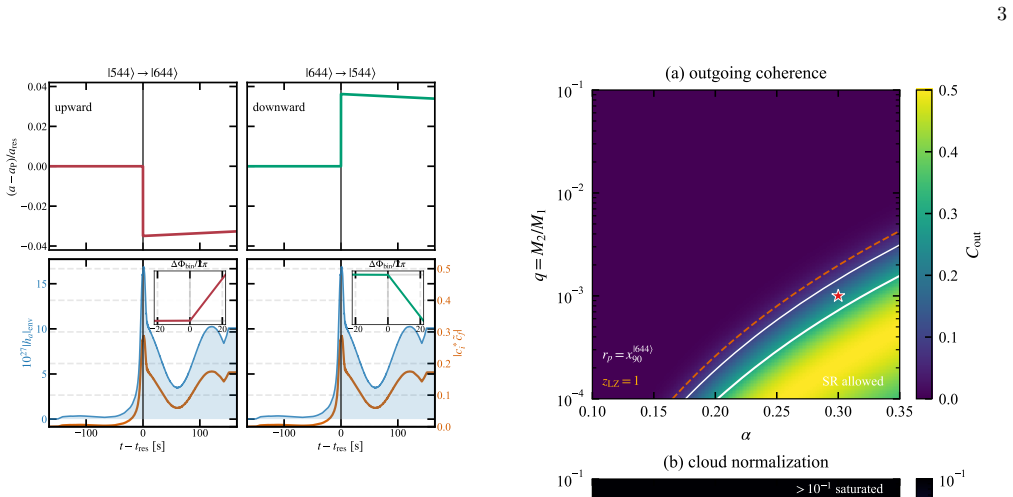
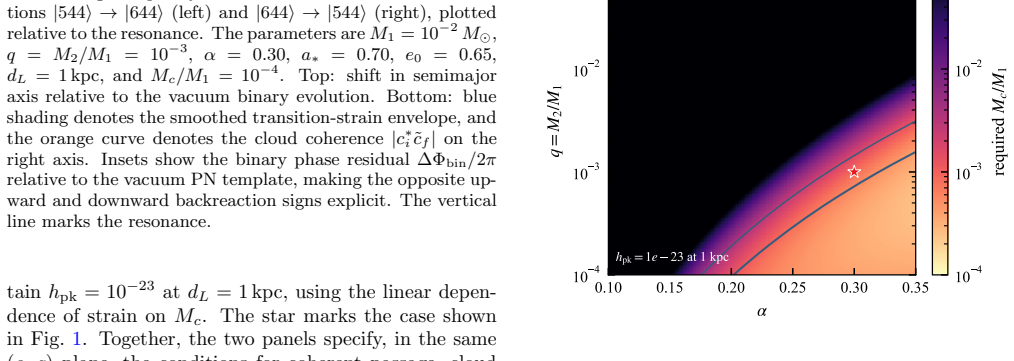
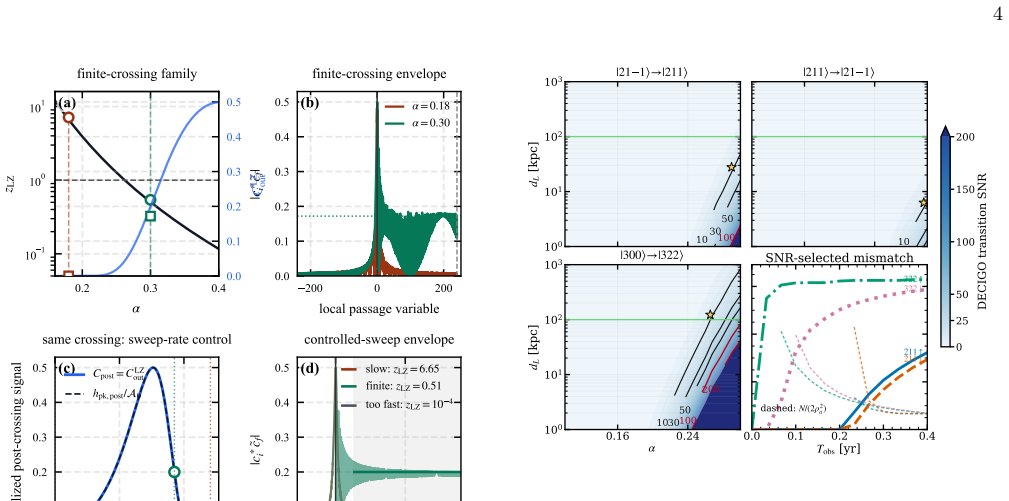
For strongly coupled Bohr crossings, transition radiation is governed by the outgoing two-level coherence, not by the transition probability alone. This coherence is suppressed both on the adiabatic branch and in the weak passage limit, but survives for intermediate sweep rates, producing a finite transition waveform and a localized orbital response. In more massive systems, fine and hyperfine transitions produce narrowband gravitational radiation and cumulative departures from vacuum binary waveforms. Coherent tidal crossings offer a gravitational-wave probe of axion-cloud dynamics.
What carries the argument
Outgoing two-level coherence after tidally driven Bohr crossings in axion gravitational atoms.
If this is right
- Finite transition waveforms appear for intermediate sweep rates through resonance.
- A localized orbital response follows directly from surviving coherence.
- Narrowband gravitational radiation is produced by fine and hyperfine transitions in more massive systems.
- Cumulative departures from vacuum binary waveforms accumulate over repeated crossings.
Where Pith is reading between the lines
- Detection of these signals could allow gravitational-wave data to constrain the mass and coupling of axion fields around black holes.
- The coherence mechanism may provide a template for distinguishing scalar-cloud effects from other environmental perturbations in binary inspirals.
- Similar coherence analysis could be applied to other light bosonic fields forming clouds around compact objects.
Load-bearing premise
Axion clouds remain stable and form well-defined gravitational-atom states around rotating black holes in binaries with well-characterized tidal sweep rates through resonance.
What would settle it
A search for narrowband gravitational-wave signals or cumulative waveform deviations at frequencies set by axion fine or hyperfine transitions in known black hole binaries would confirm or rule out the predicted finite coherence waveforms.
Figures
read the original abstract
Axion clouds around rotating black holes form gravitational atoms whose tidal transitions can radiate gravitational waves in binaries. For strongly coupled Bohr crossings, transition radiation is governed by the outgoing two-level coherence, not by the transition probability alone. This coherence is suppressed both on the adiabatic branch and in the weak passage limit, but survives for intermediate sweep rates, producing a finite transition waveform and a localized orbital response. In more massive systems, fine and hyperfine transitions produce narrowband gravitational radiation and cumulative departures from vacuum binary waveforms. Coherent tidal crossings offer a gravitational-wave probe of axion-cloud dynamics.
Editorial analysis
A structured set of objections, weighed in public.
Referee Report
Summary. The paper claims that axion clouds around rotating black holes form gravitational atoms whose tidal transitions in binaries produce gravitational waves. For strongly coupled Bohr crossings, the radiation is governed by outgoing two-level coherence rather than transition probability alone; this coherence is suppressed on the adiabatic branch and in the weak-passage limit but survives at intermediate sweep rates, yielding a finite transition waveform and localized orbital response. In more massive systems, fine and hyperfine transitions generate narrowband GW signals and cumulative departures from vacuum binary waveforms, offering a GW probe of axion-cloud dynamics.
Significance. If the central result holds, the work identifies a distinctive coherence-driven GW signature from tidally driven axion clouds that is absent in standard binary evolution, potentially enabling observational constraints on axion parameters through waveform morphology and orbital perturbations. The focus on intermediate sweep rates as the regime where coherence survives is a clear, falsifiable prediction within the two-level framework.
major comments (1)
- The central claim presupposes that axion clouds remain stable gravitational-atom states whose level structure and population are not appreciably altered by the binary orbit or by the transition itself. No estimate of back-reaction timescale, no condition on cloud mass or binary separation, and no demonstration that the instantaneous frequency sweep remains unperturbed are supplied. This assumption is load-bearing for the predicted finite waveform and localized orbital response; if the cloud is disrupted or the sweep rate is modified, the two-level coherence argument does not apply.
Simulated Author's Rebuttal
We thank the referee for the detailed report and for highlighting the importance of the stability assumption underlying the two-level coherence analysis. We address the single major comment below and commit to revisions that strengthen the manuscript without altering its central claims.
read point-by-point responses
-
Referee: The central claim presupposes that axion clouds remain stable gravitational-atom states whose level structure and population are not appreciably altered by the binary orbit or by the transition itself. No estimate of back-reaction timescale, no condition on cloud mass or binary separation, and no demonstration that the instantaneous frequency sweep remains unperturbed are supplied. This assumption is load-bearing for the predicted finite waveform and localized orbital response; if the cloud is disrupted or the sweep rate is modified, the two-level coherence argument does not apply.
Authors: We agree that the stability of the gravitational-atom states is a foundational assumption. The manuscript restricts attention to the regime in which the axion cloud mass is a small fraction of the central black-hole mass and the binary separation greatly exceeds the cloud radius, so that the orbital motion and instantaneous frequency sweep are set by the vacuum binary dynamics. Within this regime the two-level coherence calculation is self-consistent. We will add an explicit section providing order-of-magnitude estimates of the back-reaction timescale (cloud self-gravity and level-population depletion) relative to both the orbital period and the Bohr-crossing sweep time, together with the corresponding inequalities on cloud mass and separation. These additions will delineate the parameter domain in which the reported finite waveforms and localized orbital responses remain valid. revision: yes
Circularity Check
No significant circularity detected
full rationale
The derivation applies standard two-level quantum coherence to tidally driven Bohr crossings in axion clouds, with the outgoing coherence governing radiation derived from sweep-rate dependence rather than defined circularly. No equations reduce a prediction to a fitted input by construction, no load-bearing self-citation chains appear, and the central claims about finite waveforms at intermediate rates follow from the stated dynamics without renaming known results or smuggling ansatze. The analysis remains self-contained against its explicit assumptions on cloud stability.
Axiom & Free-Parameter Ledger
axioms (2)
- domain assumption Axion clouds around rotating black holes form stable gravitational-atom states with well-defined Bohr levels.
- domain assumption Tidal interactions in binaries produce controllable sweep rates through resonances without destroying the cloud.
invented entities (1)
-
gravitational atoms
no independent evidence
Reference graph
Works this paper leans on
-
[1]
R. D. Peccei and H. R. Quinn, CP Conservation in the Presence of Pseudoparticles, Phys. Rev. Lett.38, 1440 (1977)
1977
-
[2]
R. D. Peccei and H. R. Quinn, Constraints imposed by CP conservation in the presence of pseudoparticles, Phys. Rev. D16, 1791 (1977)
1977
-
[3]
A. Arvanitaki, S. Dimopoulos, S. Dubovsky, N. Kaloper, and J. March-Russell, String Axiverse, Phys. Rev. D81, 123530 (2010), arXiv:0905.4720 [hep-th]
Pith/arXiv arXiv 2010
-
[4]
D. J. E. Marsh, Axion Cosmology, Phys. Rept.643, 1 (2016), arXiv:1510.07633 [astro-ph.CO]
Pith/arXiv arXiv 2016
-
[5]
S. L. Detweiler, Klein-Gordon Equation and Rotating Black Holes, Phys. Rev. D22, 2323 (1980)
1980
-
[6]
A. Arvanitaki and S. Dubovsky, Exploring the String Ax- iverse with Precision Black Hole Physics, Phys. Rev. D 83, 044026 (2011), arXiv:1004.3558 [hep-th]
Pith/arXiv arXiv 2011
-
[7]
R. Brito, V. Cardoso, and P. Pani, Superradiance: New Frontiers in Black Hole Physics, Lect. Notes Phys.906, pp.1 (2015), arXiv:1501.06570 [gr-qc]
Pith/arXiv arXiv 2015
-
[8]
R. Brito, S. Ghosh, E. Barausse, E. Berti, V. Cardoso, I. Dvorkin, A. Klein, and P. Pani, Gravitational wave searches for ultralight bosons with LIGO and LISA, Phys. Rev. D96, 064050 (2017), arXiv:1706.06311 [gr- qc]
Pith/arXiv arXiv 2017
-
[9]
A. Kyriazis and F. Yang, Gravitational waves from reso- nant transitions of tidally perturbed gravitational atoms, JHEP11, 062, arXiv:2503.18121 [hep-ph]
-
[10]
G. M. Tomaselli, T. F. M. Spieksma, and G. Bertone, Resonant history of gravitational atoms in black hole binaries, Phys. Rev. D110, 064048 (2024), arXiv:2403.03147 [gr-qc]
arXiv 2024
-
[11]
G. M. Tomaselli, T. F. M. Spieksma, and G. Bertone, Legacy of Boson Clouds on Black Hole Binaries, Phys. Rev. Lett.133, 121402 (2024), arXiv:2407.12908 [gr-qc]
arXiv 2024
-
[12]
R. Della Monica and R. Brito, Detectability of grav- itational atoms in black hole binaries with the Ein- stein Telescope, Phys. Rev. D112, 024074 (2025), arXiv:2503.23419 [gr-qc]
arXiv 2025
-
[13]
D. Baumann, H. S. Chia, and R. A. Porto, Probing Ul- tralight Bosons with Binary Black Holes, Phys. Rev. D 99, 044001 (2019), arXiv:1804.03208 [gr-qc]
Pith/arXiv arXiv 2019
-
[14]
D. Baumann, H. S. Chia, J. Stout, and L. ter Haar, The Spectra of Gravitational Atoms, JCAP12, 006, arXiv:1908.10370 [gr-qc]
arXiv 1908
-
[15]
D. Baumann, G. Bertone, J. Stout, and G. M. Tomaselli, Ionization of gravitational atoms, Phys. Rev. D105, 115036 (2022), arXiv:2112.14777 [gr-qc]
arXiv 2022
-
[16]
M. Boˇ skovi´ c, M. Koschnitzke, and R. A. Porto, Signa- tures of Ultralight Bosons in the Orbital Eccentricity of Binary Black Holes, Phys. Rev. Lett.133, 121401 (2024), arXiv:2403.02415 [gr-qc]
arXiv 2024
-
[17]
M. Boˇ skovi´ c, R. A. Porto, and M. Koschnitzke, Trails of clouds in binary black holes, arXiv e-prints (2025), arXiv:2512.17887 [gr-qc]
arXiv 2025
-
[18]
K. Yagi and N. Seto, Detector configuration of DE- CIGO/BBO and identification of cosmological neutron- star binaries, Phys. Rev. D83, 044011 (2011), [Erratum: Phys.Rev.D 95, 109901 (2017)], arXiv:1101.3940 [astro- ph.CO]
Pith/arXiv arXiv 2011
- [19]
-
[20]
R. Vicente, T. K. Karydas, and G. Bertone, Fully Rel- ativistic Treatment of Extreme Mass-Ratio Inspirals in Collisionless Environments, Phys. Rev. Lett.135, 211401 (2025), arXiv:2505.09715 [gr-qc]
arXiv 2025
- [21]
-
[22]
P. C. Peters, Gravitational Radiation and the Motion of Two Point Masses, Phys. Rev.136, B1224 (1964)
1964
-
[23]
L. D. Landau, A theory of energy transfer. 2., Phys. Z. Sowjetunion2, 46 (1932)
1932
-
[24]
L. D. Landau, A theory of energy transfer on collisions, Phys. Z. Sowjetunion1, 88 (1932)
1932
-
[25]
T. Takahashi, H. Omiya, and T. Tanaka, Axion cloud evaporation during inspiral of black hole binaries: The ef- fects of backreaction and radiation, PTEP2022, 043E01 (2022), arXiv:2112.05774 [gr-qc]
arXiv 2022
-
[26]
N. Dai, Y. Gong, Y. Zhao, and T. Jiang, Extreme mass ratio inspirals in galaxies with dark matter halos, Phys. Rev. D110, 084080 (2024), arXiv:2301.05088 [gr-qc]
arXiv 2024
-
[27]
Y. Zhao, N. Dai, and Y. Gong, Distinguishing dark mat- ter haloes with extreme mass ratio inspirals, Mon. Not. Roy. Astron. Soc.543, 2326 (2025), arXiv:2410.06882 [gr-qc]
arXiv 2025
-
[28]
T. Robson, N. J. Cornish, and C. Liu, The construction and use of LISA sensitivity curves, Class. Quant. Grav. 36, 105011 (2019), arXiv:1803.01944 [astro-ph.HE]
Pith/arXiv arXiv 2019
-
[29]
S. Babak, H. Fang, J. R. Gair, K. Glampedakis, and S. A. Hughes, ’Kludge’ gravitational waveforms for a test-body orbiting a Kerr black hole, Phys. Rev. D75, 024005 (2007), [Erratum: Phys. Rev. D 77, 049901 (2008)], arXiv:gr-qc/0607007. 6
Pith/arXiv arXiv 2007
-
[30]
L. Lindblom, B. J. Owen, and D. A. Brown, Model Waveform Accuracy Standards for Gravitational Wave Data Analysis, Phys. Rev. D78, 124020 (2008), arXiv:0809.3844 [gr-qc]
Pith/arXiv arXiv 2008
-
[31]
E. S. Phinney, A Practical Theorem on Gravitational Wave Backgrounds, arXiv e-prints (2001), arXiv:astro- ph/0108028
arXiv 2001
-
[32]
Regimbau, The astrophysical gravitational wave stochastic background, Res
T. Regimbau, The astrophysical gravitational wave stochastic background, Res. Astron. Astrophys.11, 369 (2011), arXiv:1101.2762 [astro-ph.CO]
Pith/arXiv arXiv 2011
-
[33]
P. A. Rosado, Gravitational wave background from binary systems, Phys. Rev. D84, 084004 (2011), arXiv:1106.5795 [gr-qc]
Pith/arXiv arXiv 2011
-
[34]
K. Eda, Y. Itoh, S. Kuroyanagi, and J. Silk, Gravitational waves as a probe of dark matter mini-spikes, Phys. Rev. D91, 044045 (2015), arXiv:1408.3534 [gr-qc]
Pith/arXiv arXiv 2015
-
[35]
C. L. Rodriguez, S. Chatterjee, and F. A. Rasio, Binary Black Hole Mergers from Globular Clusters: Masses, Merger Rates, and the Impact of Stellar Evolution, Phys. Rev. D93, 084029 (2016), arXiv:1602.02444 [astro- ph.HE]
Pith/arXiv arXiv 2016
-
[36]
F. Antonini and F. A. Rasio, Merging black hole binaries in galactic nuclei: implications for advanced-LIGO detec- tions, Astrophys. J.831, 187 (2016), arXiv:1606.04889 [astro-ph.HE]
Pith/arXiv arXiv 2016
-
[37]
N. C. Stone, B. D. Metzger, and Z. Haiman, Assisted inspirals of stellar mass black holes embedded in AGN discs: solving the final au problem, Mon. Not. Roy. Astron. Soc.464, 946 (2017), arXiv:1602.04226 [astro- ph.GA]
Pith/arXiv arXiv 2017
-
[38]
Y. Yang, I. Bartos, V. Gayathri, S. Ford, Z. Haiman, S. Klimenko, B. Kocsis, S. Marka, Z. Marka, B. McK- ernan, and R. O’Shaughnessy, Hierarchical Black Hole Mergers in Active Galactic Nuclei, Phys. Rev. Lett.123, 181101 (2019), arXiv:1906.09281 [astro-ph.HE]
arXiv 2019
-
[39]
T. Harada, C.-M. Yoo, K. Kohri, and K.-i. Nakao, Spins of primordial black holes formed in the matter-dominated phase of the Universe, Phys. Rev. D96, 083517 (2017), arXiv:1707.03595 [gr-qc]
Pith/arXiv arXiv 2017
-
[40]
E. de Jong, J. C. Aurrekoetxea, E. A. Lim, and T. Fran¸ ca, Spinning primordial black holes formed during a matter- dominated era, JCAP10, 067, arXiv:2306.11810 [astro- ph.CO]
discussion (0)
Sign in with ORCID, Apple, or X to comment. Anyone can read and Pith papers without signing in.