REVIEW 3 major objections 6 minor 12 references
EssayBench: Evaluating Large Language Models in Multi-Genre Chinese Essay Writing
T0 review · 3 major / 6 minor · reviewed 2026-08-07 · deepseek-v4-flash
Pith's one-line read This paper claims that a genre-aware, fine-grained, dependency-weighted evaluation protocol can rank LLM-written Chinese essays in close agreement with human judges, reaching Spearman rho 0.816, and exposes genre-specific weaknesses…
desk verdict Useful benchmark and dataset, but the sensitivity claim in Section 4.3 is contradicted by the paper's own Table 3 and needs fixing before publication. read the letter →
The pith
A machine-rendered reading of the paper's core claim, the machinery that carries it, and where it could break.
The reading
What carries the argument
The load-bearing mechanism is the dependency-aware hierarchical trait rubric. It defines six genre-specific traits, assigns each a depth $d$ (0 for foundational traits up to 3 for advanced ones), scores each trait via targeted sub-questions judged under chain-of-thought prompting, and aggregates the result as a weighted sum $W_t = \alpha^d$ with $\alpha=3$. This weighting is what converts fine-grained rubric scores into an overall ranking, and the paper attributes its alignment and sensitivity results to it.
What would settle it
Run the same 80-prompt, 5,040-pair human annotation set through the protocol with $\alpha$ swept over values such as 1, 2, 3, 4, and 5 and with several re-shufflings of the trait-depth assignments; if agreement with human rankings does not peak near $\alpha=3$ and stay significantly above the $\alpha=1$ unweighted baseline, the paper's dependency-weighting claim is not supported.
Extended reading notes
Core claim
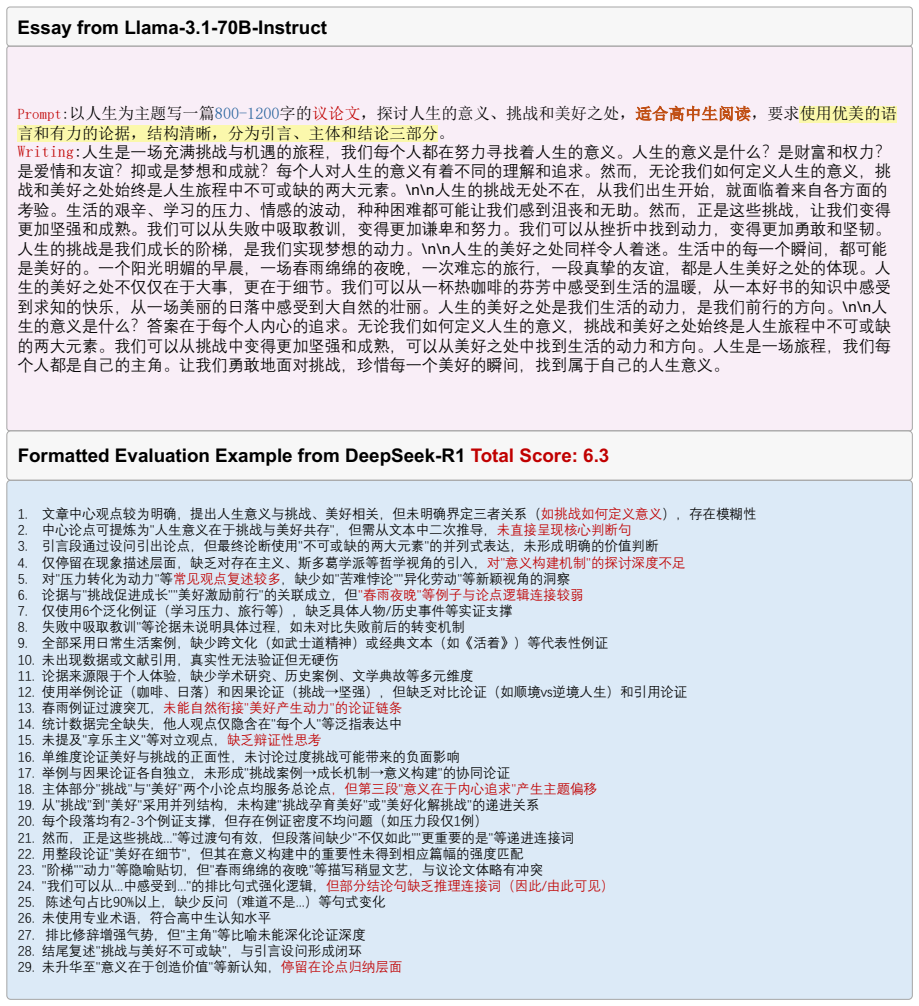
The paper's central claim is that essay quality is better captured by a genre-oriented hierarchy of traits than by a single coarse score. For each of the four genres, six traits are arranged in levels with depths $d=0,1,2,3$, and each trait is assessed through several sub-questions under chain-of-thought prompting. The trait scores are aggregated with dependency weights $W_t = \alpha^d$ (with $\alpha=3$), so advanced traits contribute more than basic ones. The authors assert that this weighted, fine-grained protocol aligns closely with human rankings, with DeepSeek-R1 reaching $\rho=0.816$ and $\tau=0.704$, and that it distinguishes quality tiers better than the AlignScore reference-free baseline. They further claim that the benchmark of 15 LLMs reveals consistent genre patterns, with narrative and descriptive writing being the weak spots.
Load-bearing premise
The scoring stands or falls on the assumption that the hand-assigned importance levels for each essay trait, with a fixed threefold weight per level and no sensitivity check, match how human readers actually weigh those traits; weighting improves agreement by only about 2 percent over no weighting.
Editorial extensions
If this is right
- Fine-grained, genre-aware rubrics can replace coarse text-quality metrics when judging Chinese essays, giving evaluators a score with a written rationale per trait.
- Stronger reasoning models make better judges of Chinese essays: agreement with human raters rises from DeepSeek-V3 through GPT-4o to DeepSeek-R1.
- Dependency weighting adds about 2 percent agreement over unweighted trait averaging and improves separation of high-, medium-, and low-quality essays.
- LLMs are comparatively weaker at narrative and descriptive Chinese essays, so those genres are the next targets for generation improvements.
- Constrained prompts produce better essays than open-ended prompts across models, suggesting models benefit from explicit structural guidance.
Reading between the lines
- Editorial inference: because the weights are fixed at $\alpha=3$ without a reported sweep, a per-genre calibration of $\alpha$ and of the trait-depth assignments could push agreement beyond 0.816 or reveal that the weighting itself is not the main driver.
- Editorial inference: the protocol measures essay quality through the judge model, so part of the reported agreement may reflect judge reasoning ability rather than essay properties; ensembling several judges or adding a difficulty-normalized score could disentangle these.
- Editorial inference: the trait hierarchy for Chinese essays could be translated to other languages by replacing genre-specific literary conventions, an extension the paper flags as future work.
- Editorial inference: pairing the evaluation protocol with instruction-following checks, which the paper lists as a limitation, would make automated essay scoring directly usable for formative feedback, since a high-quality essay that ignores prompt constraints would currently score well.
Editorial analysis
A structured set of objections, weighed in public.
Referee Report
Summary. The paper introduces ESSAYBENCH, a Chinese essay-writing benchmark containing 728 prompts across four genres (Argumentative, Narrative, Descriptive, Expository), each split into Open-Ended and Constrained subsets. The authors propose a fine-grained, genre-specific LLM-as-a-judge evaluation protocol with multiple sub-questions per trait and a dependency-weighted aggregation W_t = α^d. They validate the protocol with a human pairwise-comparison study and report high ranking agreement (e.g., DeepSeek-R1: Spearman ρ = 0.816, Kendall τ = 0.704) as well as a sensitivity analysis intended to show that the metric can distinguish high-, medium-, and low-quality essays better than an AlignScore-based baseline. The paper also benchmarks 15 large LLMs, reporting comparative strengths across genres and instruction types.
Significance. If the claims are sustained, ESSAYBENCH would be a useful resource for Chinese essay evaluation, and the human-agreement study is a substantive contribution: it provides 5,040 pairwise human labels, the evaluation weights are not fitted to those labels, and the reported correlations are not circular by construction. The fine-grained genre-specific rubrics are also more detailed than previous coarse Chinese writing benchmarks, and the benchmarking results provide a useful snapshot of model behavior in this domain. However, the central sensitivity claim is not uniformly supported by the paper's own Table 3, and the dependency-weighting scheme is under-validated; these issues need to be addressed before the benchmark can be recommended as a reliable evaluation protocol.
major comments (3)
- [§4.3, Table 3] The text states that the proposed method 'greatly improves the ability to distinguish essays of varying quality' compared with AlignScore and that 'these trends hold consistently across all judge models.' Table 3 does not support this claim. For DeepSeek-V3, Ours yields a lower Mann-Whitney U than Align-Score in medium&low (0.78 vs. 0.90) and in high&low (0.82 vs. 0.92), while the high&medium gain is only 0.57 vs. 0.56. The paper should either report paired significance tests and confidence intervals for each comparison or substantially qualify the claim to reflect the judges and contrasts for which improvement actually holds; as printed, the central sensitivity claim is internally inconsistent.
- [Eq. (1), Appendix B, Table 2] The dependency-aware weighting W_t = α^d fixes α = 3 and the trait-depth assignments d by author choice (Appendix B), but no sensitivity analysis is reported over α or over alternative depth assignments. This is load-bearing because the 'dependency-aware' contribution rests on the claim that weighting improves alignment, yet the observed overall gains in Table 2 are small (roughly 2–3 points) and not uniform: for DeepSeek-V3 in the Argumentative genre, Ours (0.670) is worse than Ours w/o WT. (0.701). The paper should report α sensitivity (e.g., α = 1, 2, 3, 5, 10) and ideally compare against alternative depth mappings or a learned weighting, so that the proposed weighting scheme is not an arbitrary modeling choice.
- [§4.1, Table 4] The human-agreement study is the primary validation of the protocol, but the human labels have only moderate inter-annotator agreement (Fleiss κ = 0.469), and the study uses 80 prompts with 14 annotators. The paper does not report how annotator disagreement affects the ranking correlation or the sensitivity statistics, nor does it provide adjudication or a per-pair disagreement breakdown. Additionally, the judge set includes DeepSeek-V3 and GPT-4o, which are also among the generator models in the same study, so a possible same-family self-preference bias is not addressed; at minimum, the paper should discuss these limitations and their expected effect on the reported agreement numbers.
minor comments (6)
- [Table 5] The model name 'Claud-3.5-sonnet' is a typo and should be 'Claude-3.5-sonnet'; also, model names such as 'Deepseek-v3' and 'DeepSeek-V3' are used inconsistently across the paper.
- [Figure 6] The CoT prompt shown in Figure 6 contains a duplicated Chinese prompt placeholder ('以下是作文题目' appears twice), and the English translation has missing spaces in 'Thefollowingistheevaluationrubrics'.
- [Table 3] The table header 'Up ↑ M Dstd ↑' is difficult to parse; the paper should clearly define U, M D, std, and the p-value notation, and should report confidence intervals for the U statistics and mean differences.
- [Table 2] The column header row for genre-specific results is malformed (e.g., 'τ τ ρ τ'), making it hard to tell which coefficients correspond to Spearman's ρ and Kendall's τ for each genre; this should be reformatted.
- [§4.1] The conversion of pairwise human annotations into model rankings using a 'voting-based scoring approach' is mentioned but never described; the paper should specify how ties, annotator disagreements, and unequal numbers of comparisons are handled.
- [§2.2] The ROUGE-L similarity threshold of 0.7 for prompt deduplication is presented without any sensitivity analysis or justification; a brief ablation or a citation for the threshold choice would be helpful.
Circularity Check
No significant circularity: the central evaluation-alignment claim is validated against independent human pairwise judgments, and the weighting scheme is a fixed modeling choice, not a fitted input.
full rationale
The paper's central claim—that the genre-oriented, dependency-aware evaluation protocol aligns with human judgments—is supported by an external human agreement study (5,040 pairwise labels from 14 professional annotators, with Fleiss' kappa reported), not by a parameter fitted to that same data. The dependency weights W_t = alpha^d with alpha fixed to 3 are stated as fixed in Section 4.1 and are not tuned to the human rankings, so the reported Spearman rho and Kendall tau values are not enforced by construction. The sensitivity analysis in Table 3 is also anchored to human-annotated quality tiers. The use of GPT-4o and DeepSeek-V3 as both generators and judges is a potential bias, but it does not reduce the main validation to a self-derivation. The arbitrary alpha and the apparent internal inconsistency in Table 3 (e.g., DeepSeek-V3 medium&low and high&low U values being lower than Align-Score) are correctness and robustness concerns, not circularity. No load-bearing self-citation or imported uniqueness theorem appears; self-citations such as Gao et al. 2024 and Jiang et al. 2024 are background or preprocessing references and do not carry the argument. The derivation chain is therefore self-contained against external human evidence, and I find no step that reduces to its own inputs.
Assumptions & free parameters
free parameters (3)
- alpha =
3
- trait depth assignments d =
0 to 3 per trait
- ROUGE-L similarity threshold =
0.7
assumptions (5)
- domain assumption LLM-as-a-judge with chain-of-thought can reliably score fine-grained essay traits.
- domain assumption The four-genre taxonomy (argumentative, narrative, descriptive, expository) covers the relevant space of Chinese educational essay writing.
- standard math Saaty AHP and LBWA hierarchical weighting are appropriate for aggregating essay trait scores.
- domain assumption Human pairwise annotations with Fleiss kappa 0.469 are a reliable ground truth for ranking quality.
- domain assumption English AES rubrics from Blanchard et al. (2013) and Hamner et al. (2012) transfer to Chinese essay evaluation.
Cite this review
Pith. "Pith review of EssayBench: Evaluating Large Language Models in Multi-Genre Chinese Essay Writing." pith.science (2026). https://pith.science/paper/L6CO5WXM
@misc{pith2026250602596,
  author       = {Pith},
  title        = {Pith review of: EssayBench: Evaluating Large Language Models in Multi-Genre Chinese Essay Writing},
  year         = {2026},
  howpublished = {\url{https://pith.science/paper/L6CO5WXM}},
  note         = {Machine review of arXiv:2506.02596}
}
read the original abstract
Chinese essay writing and its evaluation are critical in educational contexts, yet the capabilities of Large Language Models (LLMs) in this domain remain largely underexplored. Existing benchmarks often rely on coarse-grained text quality metrics, largely overlooking the structural and rhetorical complexities of Chinese essays, particularly across diverse genres. To address this gap, we propose \benchName, a multi-genre benchmark specifically designed for Chinese essay writing across four major genres: Argumentative, Narrative, Descriptive, and Expository. We curate and refine a total of 728 real-world prompts to ensure authenticity and meticulously categorize them into the \textit{Open-Ended} and \textit{Constrained} sets to capture diverse writing scenarios. To reliably evaluate generated essays, we develop a fine-grained, genre-specific scoring framework that hierarchically aggregates scores. We further validate our evaluation protocol through a comprehensive human agreement study. Finally, we benchmark 15 large-sized LLMs, analyzing their strengths and limitations across genres and instruction types. With \benchName, we aim to advance LLM-based Chinese essay evaluation and inspire future research on improving essay generation in educational settings.
Figures


Figures from the paper (11 more)




Reference graph
Works this paper leans on
-
[1]
Do the sub-arguments form a clear, progressive logical chain?3
Are the sub-arguments in each paragraph coherent with the central thesis?2. Do the sub-arguments form a clear, progressive logical chain?3. Does each paragraph’s sub-argument have appropriate supporting evidence?4. Are there smooth transitions and logical connections between paragraphs? 1.⽂章的⼩论点是否与中⼼论点保持连贯?2.⼩论点之间是否构成合理的层层递进的逻辑链条? 3.每个段落⼩论点是否有对应的论据⽀撑?4.段落...
-
[4]
Is the language logically coherent?3
Is the word choice appropriate and precise?2. Is the language logically coherent?3. Are sentence structures and tones varied and engaging?1.⽂章⽤词是否贴切、精确?2.⽂章语⾔是否具有逻辑性?3.⽂章句式、语⽓是否丰富多样? Expression 语⾔表达 1.Does the conclusion echo the issues or claims raised in the introduction to form a cohesive whole?2.Does it summarize the essay’s main theme rather than mer...
-
[5]
语⾔是否通俗易懂⽽⼜不失⽂采,体现⽂学性句⼦之间、段落之间是否衔接⾃然流畅,避免⽣硬的跳跃或内容堆砌?3
是否通过恰当的修辞⼿法(⽐喻、拟⼈、排⽐等)增加可读性2. 语⾔是否通俗易懂⽽⼜不失⽂采,体现⽂学性句⼦之间、段落之间是否衔接⾃然流畅,避免⽣硬的跳跃或内容堆砌?3. 是否能够运⽤过渡词或关联词,让⾏⽂舒展、章法清晰? Language & Style语⾔表达 1.Are the selected events or scenes typical and representative?2.Can a single small incident illuminate deeper life, social, or emotional themes?3.Is the angle or material fresh and inventive, avoiding clichés?5.Can familiar s...
-
[6]
所选事件或场景是否具有代表性、典型性;2 能否通过⼀件⼩事折射出深层次的⼈⽣、社会或情感问题?3.写作材料或⻆度是否独具匠⼼,避免千篇⼀律?4.常⻅题材能否有独特的视⻆或写法,呈现新的亮点?选材与主题能否紧密结合,避免选材有意思但与主题脱节?5. 是否⽤⽣活中真实且富有意义的素材,⽀撑⽂章的⽴意与情感? Choice of Material选材的典型性与创新性 1.Are techniques like chronological order, flashback, or interwoven narratives used effectively?2.Does clever sequencing help readers immerse themselves or build suspense?3.Is...
-
[7]
Is the central theme or key image prominently highlighted?2. Is the essay’s main purpose or emotional tone clearly conveyed?1.中⼼主题或中⼼意象是否突出?2.⽂章写作的主旨或情感基调是否清晰? Clarity of Subject and Central Theme描写对象的鲜明性与中⼼主题
-
[8]
Does the writing employ multiple senses—visual, auditory, tactile, gustatory, etc.—to portray the subject’s details?2. Does it create an immersive, “you-are-there” experience rather than remaining at a superficial or generic level?3. Are word choices precise and evocative, capturing the subject’s characteristics with vivid language? 1.是否通过视觉、听觉、触觉、味觉等多种感官...
-
[9]
Does it evoke a distinct mood or ambiance—such as tranquility, liveliness, mystery, or solemnity?3
Does the essay seamlessly integrate the author’s emotions (e.g., affection, longing, nostalgia, wonder) into the descriptive details?2. Does it evoke a distinct mood or ambiance—such as tranquility, liveliness, mystery, or solemnity?3. Do the environmental descriptions resonate with the author’s feelings, offering readers a unified internal-external aesth...
-
[10]
Does it avoid clichéd phrasing or formulaic techniques?3
Does the writer uncover new insights in familiar subjects, using a fresh angle or dimension of thought?2. Does it avoid clichéd phrasing or formulaic techniques?3. Does it draw on personal experience or reflection to add warmth and emotional impact?4. Does the chosen subject carry real-world relevance or cultural resonance that fosters reader empathy?
Show all 12 references
-
[11]
是否⽤⽣活中真实且富有意义的素材,⽀撑⽂章的⽴意与情感? Content and Unique Perspective选材典型性与独特视⻆
所选事件或场景是否具有代表性、典型性;2 能否通过⼀件⼩事折射出深层次的⼈⽣、社会或情感问题?3.写作材料或⻆度是否独具匠⼼,避免千篇⼀律?4.常⻅题材能否有独特的视⻆或写法,呈现新的亮点?选材与主题能否紧密结合,避免选材有意思但与主题脱节?5. 是否⽤⽣活中真实且富有意义的素材,⽀撑⽂章的⽴意与情感? Content and Unique Perspective选材典型性与独特视⻆
-
[12]
⼈⽣意义在于挑战与美好共存
Does the author vary sentence length to reflect the subject’s characteristics or emotional pacing?2. Are short, simple sentences and longer parallel constructions used judiciously to create rhythm and flow?3. Are rhetorical devices—such as metaphor, personification, parallelis...
-
[2011]
evidence-inference
A new dataset and method for automatically grading esol texts. In Proceedings of the 49th annual meeting of the association for computational linguis- tics: human language technologies, pages 180–189. Jiebin Zhang, J Yu Eugene, Qinyu Chen, Chenhao Xiong, Dawei Zhu, Han Qian, M...
2025
-
[2024]
arXiv preprint arXiv:2409.16191
Hellobench: Evaluating long text generation capabilities of large language models. arXiv preprint arXiv:2409.16191. Qwen. 2025. Qwen2.5-max:exploring the intelligence of large-scale moe model. Accessed: 2025-05-19. Qwen. 2025. Qwen2.5 technical report. Thomas L. Saaty. 1980. T...
2025 arXiv
Reviewed August 7, 2026 · model on record in the stance chip above.
Discussion (0). Sign in to comment.