REVIEW 3 major objections 4 minor 5 cited by
A hybrid simulation-plus-EFT model reproduces the Lyman-alpha forest power spectrum to 5% down to k = 1 h/Mpc, with residual noise that is nearly scale- and angle-independent.
Reviewed by Pith at T0; open to challenge. T0 means a machine referee read the full paper against a public rubric. the ladder, T0–T4 →
T0 review · deepseek-v4-flash
2026-08-03 16:21 UTC pith:L6ZMD55S
load-bearing objection First HEFT treatment of the Lyman-alpha forest; the whitened noise floor is a real but in-sample finding, and the k~1 h/Mpc claim needs an out-of-sample test and an internal consistency fix. the 3 major comments →
Bridging Simulations and EFT: A Hybrid Model of the Lyman-Alpha Forest Field
The pith
A machine-rendered reading of the paper's core claim, the machinery that carries it, and where it could break.
Core claim
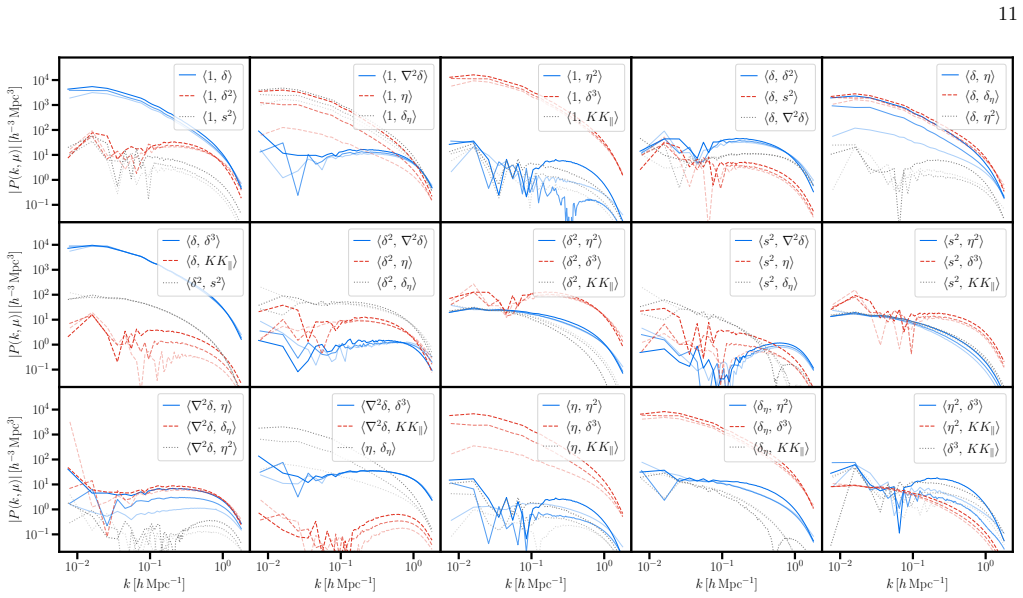
The central claim is that replacing Zel'dovich displacements with the full nonlinear displacements from an N-body simulation, while keeping the same Lagrangian bias expansion (with the Lyman-alpha-specific line-of-sight operators η and KK∥), removes most of the scale and orientation dependence of the residual stochastic noise. For the mock with a low redshift-space-distortion bias, the cubic HEFT error power spectrum is approximately flat and orientation-independent down to k ~ 1 h/Mpc; for a high-RSD mock, a residual tilt remains but is still vastly reduced relative to EFT. The paper shows the recovered power spectrum agrees with the simulation within 5% up to k_max ~ 1 h/Mpc (1% to ~0.3 h/
What carries the argument
The key machinery is the HEFT field-level model: each dark-matter particle is weighted by a cubic Lagrangian bias expansion F(q) built from the initial density field (δ_L, δ_L², tidal s², line-of-sight operators η and KK∥, etc.), then advected to redshift space using the N-body nonlinear displacement, with the line-of-sight velocity displacement taken from the Zel'dovich prediction. The bias transfer functions β_i(k, μ) are fit by minimizing the low-pass filtered residual field against the simulation, which exploits cosmic-variance cancellation since the HEFT model and simulation share initial conditions. This combination turns the residual noise into an approximately white stochastic term,
Load-bearing premise
The whole validation rests on the synthetic Lyman-alpha forests painted onto the N-body simulation being a faithful stand-in for the real forest; if the real redshift-space distortions or astrophysical feedback produce residual noise that is not white below k ~ 1 h/Mpc, the 5% reach and the emulator plan would not transfer.
What would settle it
Run the exact HEFT field-level fit against a full hydrodynamical simulation of the intergalactic medium at z ≈ 2.5 and compare the residual error power spectrum P_err(k, μ) to the flat white-noise fit: if a strong k- or μ-dependence appears at k below 1 h/Mpc, the white-noise conclusion and the 5% validity range fail for realistic baryonic physics.
If this is right
- If correct, pure-EFT analyses can be pushed from k_max ≈ 0.8 to ≈ 1.0 h/Mpc, equivalent to doubling the effective volume for the 3D Lyman-alpha forest power spectrum and reducing cosmological parameter error bars by up to ~40%.
- The nearly white residual noise means the small-scale stochastic term can be approximated by a single constant 'shot-noise-like' parameter in cosmological fits, removing the need to model its scale and angle dependence.
- The transfer functions are smooth and can be compressed into low-order polynomial fits, making it feasible to build a fast power-spectrum emulator calibrated on a suite of simulations with fixed phases, exploiting cosmic-variance cancellation.
- The framework can be extended to cross-correlations with quasars or galaxies by weighting the same advected operators, potentially yielding combined high-redshift large-scale structure constraints.
- A field-generation pipeline with this hybrid model can produce a 2 h⁻¹ Gpc volume with DESI-like resolution in under an hour, suitable for validating cosmological inference pipelines.
Where Pith is reading between the lines
- Editorial inference: If the white-noise property holds for real quasar spectra, survey analyses could marginalize a single amplitude for the 3D stochastic term, dramatically reducing the nuisance-parameter dimensionality compared to current heuristic fitting functions.
- Testable extension: applying the same HEFT procedure to full hydrodynamical simulations rather than the approximate painted mocks would reveal whether the near-white residual persists once thermal pressure and velocity feedback are resolved; a strong scale dependence there would signal that the white-noise conclusion is an artifact of mock simplicity.
- Neighbouring problem: the same relaxed-symmetry bias operators and advection machinery apply to other line-of-sight observables such as 21-cm intensity mapping, where field-level stochastic noise is a comparable obstacle; the success here suggests a transferable recipe.
- Editorial inference: the claimed factor-of-two effective volume gain assumes the residual noise is truly white and that a constant shot-noise marginalization captures the remaining systematic; if the tilt seen in the high-RSD mock persists in real data, the gain would be smaller.
Editorial analysis
A structured set of objections, weighed in public.
Referee Report
Summary. The paper presents a hybrid effective field theory (HEFT) forward model for the 3D Lyman-alpha forest field, combining AbacusSummit nonlinear particle displacements with an LPT-based bias expansion of ten operators (Eq. 1). The bias transfer functions are fitted per (k, mu) bin to FGPA Lyman-alpha mocks painted on AbacusSummit (Secs. 2.3 and 3.1). The authors report that the model reproduces the simulated field power spectrum at the 5% level to k ~ 1 h/Mpc, with a nearly scale- and orientation-independent error power spectrum on quasi-linear scales, extending the reach of a purely perturbative EFT forward model by about 0.2 h/Mpc (Sec. 4.1, Figs. 1-3). They also present polynomial fits to the transfer functions and noise power spectrum (Sec. 4.2, Eq. 12, Tab. III) and outline an emulator strategy for cosmological analyses (Sec. 5).
Significance. If the claims were fully validated, this would be a useful step for DESI-era Lyman-alpha cosmology: extending the quasi-linear regime reduces the need for expensive hydrodynamical mocks and simplifies stochastic modeling. The methodology is clearly described, the fitting procedure is standard, and the paper is careful in several places (e.g., comparing velocity prescriptions, noting NGP and reduced-precision IC noise, and tabulating transfer-function coefficients). The public availability of the AbacusSummit mocks strengthens reproducibility. However, the headline quantitative claims are currently in-sample: the transfer functions are fitted to the same field used as 'truth', and the residual noise properties are therefore properties of that fit. The internal inconsistency between the abstract/Sec. 5 and the Fig. 2 caption on the 5% reach, and the much larger residual scale dependence for model III (the mock closest to DESI-like bias parameters), mean that the significance is conditional on additional out-of-sample validation.
major comments (3)
- [Abstract / Sec. 4.1 / Fig. 2 caption] There is a direct inconsistency in the key number. The abstract and Sec. 5 state 5% agreement to k <= 1 h/Mpc, and Sec. 4.1 repeats 'k <~ 1 h/Mpc'. However, the Fig. 2 caption explicitly says 'the power spectrum of the forward model agrees at the 5% level up to k_max ~ 0.8 h/Mpc for HEFT, increasing the reach ... by delta_k ~ 0.15 h/Mpc'. The derived factor-of-two volume gain and ~40% parameter-error reduction are computed from an increase 0.8 -> 1.0 h/Mpc. If the true 5% reach is 0.8 h/Mpc, the abstract and Sec. 5 claims must be revised; if 1.0 h/Mpc is correct, Fig. 2's caption and the quoted delta_k are wrong. This must be reconciled.
- [Sec. 2.3, Eqs. (7)-(10); Figs. 1-3] The validation is in-sample. The bias transfer functions beta_i are solved per (k,mu) bin by minimizing the residual against the same AbacusSummit FGPA mock that is subsequently treated as 'truth' in Figs. 1-3. Thus P_err and r_cc measure the residual of the fit, not out-of-sample predictive accuracy. The per-bin fits have far more freedom than the 80 polynomial coefficients of Eq. (12) quoted in Sec. 4.2, so the reported whitening of P_err can partly reflect absorption of deterministic scale- and orientation-dependent bias. The emulator proposed in Sec. 5 uses the polynomial Ansatz and template spectra, but its predictions are not tested against the per-bin fits. I would like to see a held-out test (e.g., fit on one AbacusSummit realization or mock model and evaluate on an independent realization/model, or at least cross-validate the polynomial emulator against the full per-bin fit) bef
- [Sec. 4.2, Fig. 4, Tab. II] The 'nearly white' noise claim is not uniform across the mocks used. The paper's own model III, which is closest to DESI/hydro bias parameters (Tab. I and Sec. 3.1), retains a residual scale dependence; Sec. 4.2 describes it as 'approximately an order of magnitude larger' than model I, and Fig. 4 (bottom panel) shows a clear k-dependent residual even after the polynomial fit. The abstract's unconditional statement that the residual noise is 'nearly white' on quasi-linear scales is therefore only demonstrated for the low-b_eta model I. Please qualify the claim to the model(s) for which it holds, and either validate whitening for model III or state explicitly that the emulator must marginalize over a residual scale-dependent component, as hinted in Sec. 4.1.
minor comments (4)
- [Eq. (4)] The integral over q uses a 'Kronecker delta' notation, but the context requires the 3D Dirac delta distribution. Please use \delta_D^{(3)} or state the intended normalization explicitly.
- [Sec. 4.2, Eq. (11)] The sentence 'we include terms linear in k to account for higher-order loop corrections' appears to be a typo: Eq. (11) contains a cubic term a_3 k^3, not a linear term. Please correct the wording to 'odd powers of k' or similar, if that was the intent.
- [Sec. 2.1, Eq. (1)] The notation in the equation mixes F(q) for the field and 'beta_cb' for the constant operator's transfer function. This is understandable, but it would help to define the mean-subtracted operators explicitly; currently 'langle ... rangle' appears in several terms without specifying whether it is an ensemble average or a simulation-box average.
- [Sec. 5] The emulator discussion in Sec. 5 is schematic; Eqs. (13)-(14) are correct in spirit, but the paper does not state how the beta coefficients entering the emulator would be obtained from the polynomial fits of Eq. (12) or whether the template cross-spectra are to be computed from the same advected fields. Adding one or two sentences on the emulator calibration pipeline would improve clarity.
Circularity Check
No circular derivation: the reported agreement is an in-sample fit residual, but the paper labels it as such and the white-noise property is not imposed by the fit.
full rationale
All quantitative claims (5% power-spectrum agreement at k≲1 h/Mpc; nearly white P_err) are measured on the same AbacusSummit FGPA mock used to fit the bias transfer functions β_i(k,µ) in Eqs. (8)–(10). This is an in-sample goodness-of-fit, not an out-of-sample prediction. However, that is not circular: the paper explicitly states it 'fit[s] a bias expansion at the field level' and compares 'to the input simulations' (Sec. 4), and the near-whiteness of P_err is not imposed by the fitting procedure — the polynomial fit of Eq. (11) returns small but non-zero scale/orientation coefficients, and model III retains a residual tilt that the paper reports (Sec. 4.2, Fig. 4). The whitening is thus a nontrivial property of the residual after projection onto the operator basis. Self-citations to Refs. [56,63,92] provide the mock and operator basis, but they are published external results with independent validation, and no uniqueness theorem or ansatz is smuggled through them. The abstract's k≤1 h/Mpc vs Fig. 2 caption's 0.8 h/Mpc and the model-I vs model-III residual difference are robustness/correctness caveats, not circular steps.
Axiom & Free-Parameter Ledger
free parameters (3)
- Bias transfer functions beta_i(k, mu) (10 operators x 8 polynomial coefficients) =
Tab. III (Models I and III)
- P_err noise polynomial coefficients (a0, a2, a3, a4, a22, a44) =
Tab. II
- Zel'dovich LOS velocity prescription
axioms (5)
- domain assumption The bias expansion Eq. (1), truncated at second order in the initial conditions (with delta^3 and KK_parallel), is a complete basis for the Lyman-alpha field on quasi-linear scales.
- domain assumption The FGPA-based mocks (Sec. 3.1) faithfully represent the Lyman-alpha forest signal, including redshift-space distortions, with bias parameters close to observed data.
- domain assumption The stochastic residual epsilon(k) is uncorrelated with the deterministic operators and initial conditions (loss function Eq. 7).
- ad hoc to paper The transfer functions beta_i(k, mu) are smooth and well-approximated by the polynomial Ansatz Eq. (12).
- domain assumption AbacusSummit stores initial positions at reduced precision, from which Lagrangian coordinates q can be inferred without significant bias.
read the original abstract
The Lyman-alpha (Lya) forest is a unique probe of cosmology and the intergalactic medium at high redshift and small scales. The statistical power of the ongoing Dark Energy Spectroscopic Instrument (DESI) demands precise theoretical tools to model the Lya forest. We present a hybrid effective field theory (HEFT) forward model in redshift space that leverages the accuracy of non-linear particle displacements computed using the N-body simulation suite AbacusSummit with the predictive power of an analytical, perturbative bias forward model in the framework of the effective field theory (EFT). The residual noise between the model and the simulated Lya field has a nearly white (scale-and orientation-independent) power spectrum on quasi-linear scales, substantially simplifying its modeling compared to a purely perturbative description. As a consequence of the improved control over the 3D Lya forest stochasticity, we find agreement between the modeled and the true power spectra at the 5 per cent level down to scales of k <= 1 h/Mpc. This procedure offers a promising path toward constructing efficient and accurate emulators to predict large-scale clustering summary statistics for full-shape cosmological analyses of Lya forest data from both DESI and its successor, DESI-II.
Figures


Forward citations
Cited by 5 Pith papers
-
Analytic compression of the effective field theory of the Lyman-alpha forest
Analytic compression of EFT parameters for Lyα forest P1D via Fisher matrix and linearization allows efficient marginalization, saturating constraints with linear bias plus five effective terms and forecasting 10% and...
-
Lyman-Alpha Forest and its Cross-Correlation with High-Redshift Galaxies in Effective Field Theory at the Field Level
An EFT-based field-level forward model for the Lyman-alpha forest matches simulations at the percent level on quasi-linear scales and generates mocks for DESI and DESI-II analyses.
-
Biased tracers, Hybrid Effective Field Theory and Modified Gravity
Extends HEFT to f(R) gravity for loop-corrected biased power spectra and outlines emulator extensions from LambdaCDM codes.
-
GGI Lectures on Large-Scale Structure Perturbation Theory (Effective Field Theory)
Pedagogical notes derive large-scale-structure EFT from symmetries, covering SPT failures, BAO IR resummation, counterterms, galaxy bias, redshift-space distortions, and Lagrangian PT.
-
Machine Learning Techniques for Astrophysics and Cosmology: Lyman-$\alpha$ forest
Review of machine learning applications for analyzing Lyman-alpha forest observations to probe cosmology, reionization, and dark matter.
Reference graph
Works this paper leans on
-
[1]
INTRODUCTION Light emitted by high-redshift quasars (2 < ∼ z < ∼ 5) is absorbed in the low-density, highly ionized intergalactic medium (IGM). This creates a series of absorption fea- tures in their observed spectrum – the Lyman-α(Ly-α) forest [1]. Correlations along the line-of-sight have pro- vided strong constraints on small-scale physics using the one...
Pith/arXiv arXiv 2025
-
[2]
In the following, we will briefly summa- rize HEFT and refer the reader to Refs
HYBRID EFT FOR W ARD MODEL The hybrid effective field theory (HEFT; [68]) com- bines a perturbative bias expansion using Lagrangian perturbation theory (LPT) withN-body techniques to solve the full non-linear dynamics to compute particle displacements. In the following, we will briefly summa- rize HEFT and refer the reader to Refs. [75, 76] for a review o...
-
[3]
shifted operator basis
SIMULA TIONS We validate our perturbative forward model using the AbacusSummitsimulations and compute the displace- ments using the same simulations. In brief,Abacus- Summitis a suite of cosmologicalN-body simulations 2 Note that here we solve the inverse problem given in Eq. (8) and in Ref. [63] we use the “shifted operator basis” and apply the Gram-Schm...
-
[4]
shot-noise
RESUL TS In this section we forward model the Ly-αforest trans- mitted flux fraction,δ F , by evolving a set of initial condi- tions using a hybrid EFT (HEFT) model, introduced in Sec. 2, and fit a set of bias transfer functions to theAba- cusSummitsimulations, introduced in Sec. 3. We assess the performance of our forward model in Sec. 4.1 and quantify t...
-
[5]
SUMMAR Y AND CONCLUSION The Ly-αforest – as measured by the currently observ- ing Dark Energy Spectroscopic Instrument (DESI) – is a pristine tracer of large-scale structure at Mpc scales and below at high redshift (2≤z≤4). The Ly-αforest has four main advantages compared to traditional galaxy sur- veys: First, it probes a significantly larger cosmologica...
-
[6]
C. Ravoux, M. L. Abdul Karim, E. Armengaud, M. Walther, N. G. Kara¸ caylı, P. Martini et al.,The Dark Energy Spectroscopic Instrument: one-dimensional power spectrum from first Lyαforest samples with Fast Fourier Transform, MNRAS526 (2023) 5118 [2306.06311]
Pith/arXiv arXiv 2023
-
[7]
N. G. Kara¸ caylı, P. Martini, J. Guy, C. Ravoux, M. L. A. Karim, E. Armengaud et al.,Optimal 1D LyαForest Power Spectrum Estimation - III. DESI early data, MNRAS (2024) [2306.06316]
Pith/arXiv arXiv 2024
-
[9]
M. Viel, J. Lesgourgues, M. G. Haehnelt, S. Matarrese and A. Riotto,Constraining warm dark matter candidates including sterile neutrinos and light gravitinos with WMAP and the Lyman-αforest, Phys. Rev. D71(2005) 063534 [astro-ph/0501562]
Pith/arXiv arXiv 2005
-
[10]
P. McDonald, U. Seljak, S. Burles, D. J. Schlegel, D. H. Weinberg, R. Cen et al.,The LyαForest Power Spectrum from the Sloan Digital Sky Survey, ApJS163 (2006) 80 [astro-ph/0405013]
Pith/arXiv arXiv 2006
-
[11]
S. Chabanier, N. Palanque-Delabrouille, C. Y` eche, J.-M. Le Goff, E. Armengaud, J. Bautista et al.,The one-dimensional power spectrum from the SDSS DR14 Lyαforests, J. Cosmology Astropart. Phys.2019 (2019) 017 [1812.03554]
Pith/arXiv arXiv 2019
-
[12]
C. Pedersen, A. Font-Ribera, K. K. Rogers, P. McDonald, H. V. Peiris, A. Pontzen et al.,An emulator for the Lyman-αforest in beyond-ΛCDM cosmologies,JCAP05(2021) 033 [2011.15127]. 12
Pith/arXiv arXiv 2021
-
[13]
R. Murgia, G. Scelfo, M. Viel and A. Raccanelli, Lyman-αForest Constraints on Primordial Black Holes as Dark Matter,Phys. Rev. Lett.123(2019) 071102 [1903.10509]
Pith/arXiv arXiv 2019
-
[14]
M. M. Ivanov and S. Trifinopoulos,Effective Field Theory Constraints on Primordial Black Holes from the High-Redshift Lyman-αForest,2508.04767
-
[15]
U. Seljak, A. Makarov, P. McDonald, S. F. Anderson, N. A. Bahcall, J. Brinkmann et al.,Cosmological parameter analysis including SDSS Lyαforest and galaxy bias: Constraints on the primordial spectrum of fluctuations, neutrino mass, and dark energy, Phys. Rev. D71(2005) 103515 [astro-ph/0407372]
Pith/arXiv arXiv 2005
-
[16]
M. Viel, M. G. Haehnelt and V. Springel,The effect of neutrinos on the matter distribution as probed by the intergalactic medium, J. Cosmology Astropart. Phys. 2010(2010) 015 [1003.2422]
Pith/arXiv arXiv 2010
-
[17]
N. Palanque-Delabrouille, C. Y` eche, A. Borde, J.-M. Le Goff, G. Rossi, M. Viel et al.,The one-dimensional Lyαforest power spectrum from BOSS, A&A559 (2013) A85 [1306.5896]
Pith/arXiv arXiv 2013
-
[18]
N. Palanque-Delabrouille, C. Y` eche, N. Sch¨ oneberg, J. Lesgourgues, M. Walther, S. Chabanier et al.,Hints, neutrino bounds, and WDM constraints from SDSS DR14 Lyman-αand Planck full-survey data, J. Cosmology Astropart. Phys.2020(2020) 038 [1911.09073]
Pith/arXiv arXiv 2020
-
[19]
N. Afshordi, P. McDonald and D. N. Spergel, Primordial Black Holes as Dark Matter: The Power Spectrum and Evaporation of Early Structures, ApJ 594(2003) L71 [astro-ph/0302035]
Pith/arXiv arXiv 2003
-
[20]
R. Murgia, V. Irˇ siˇ c and M. Viel,Novel constraints on noncold, nonthermal dark matter from Lyman-αforest data, Phys. Rev. D98(2018) 083540 [1806.08371]
Pith/arXiv arXiv 2018
-
[21]
A. Garzilli, A. Magalich, T. Theuns, C. S. Frenk, C. Weniger, O. Ruchayskiy et al.,The Lyman-αforest as a diagnostic of the nature of the dark matter, MNRAS489(2019) 3456 [1809.06585]
Pith/arXiv arXiv 2019
-
[22]
M. Viel, G. D. Becker, J. S. Bolton and M. G. Haehnelt,Warm dark matter as a solution to the small scale crisis: New constraints from high redshift Lyman-αforest data, Phys. Rev. D88(2013) 043502 [1306.2314]
Pith/arXiv arXiv 2013
-
[23]
J. Baur, N. Palanque-Delabrouille, C. Y` eche, C. Magneville and M. Viel,Lyman-alpha forests cool warm dark matter, J. Cosmology Astropart. Phys. 2016(2016) 012 [1512.01981]
Pith/arXiv arXiv 2016
-
[24]
V. Irˇ siˇ c, M. Viel, M. G. Haehnelt, J. S. Bolton, S. Cristiani, G. D. Becker et al.,New Constraints on the free-streaming of warm dark matter from intermediate and small scale Lyman-αforest data, ArXiv e-prints(2017) [1702.01764]
Pith/arXiv arXiv 2017
-
[25]
T. Kobayashi, R. Murgia, A. De Simone, V. Irˇ siˇ c and M. Viel,Lyman-αconstraints on ultralight scalar dark matter: Implications for the early and late universe, Phys. Rev. D96(2017) 123514 [1708.00015]
Pith/arXiv arXiv 2017
-
[26]
E. Armengaud, N. Palanque-Delabrouille, C. Y` eche, D. J. E. Marsh and J. Baur,Constraining the mass of light bosonic dark matter using SDSS Lyman-αforest, MNRAS471(2017) 4606 [1703.09126]
Pith/arXiv arXiv 2017
-
[27]
M. Zaldarriaga,Searching for Fluctuations in the Intergalactic Medium Temperature Using the Lyα Forest, ApJ564(2002) 153 [astro-ph/0102205]
Pith/arXiv arXiv 2002
-
[28]
A. A. Meiksin,The physics of the intergalactic medium,Reviews of Modern Physics81(2009) 1405 [0711.3358]
Pith/arXiv arXiv 2009
-
[29]
V. Irˇ siˇ c, H. Xiao and M. McQuinn,Early structure formation constraints on the ultralight axion in the postinflation scenario, Phys. Rev. D101(2020) 123518 [1911.11150]
Pith/arXiv arXiv 2020
-
[30]
K. K. Rogers, C. Dvorkin and H. V. Peiris,Limits on the Light Dark Matter-Proton Cross Section from Cosmic Large-Scale Structure, Phys. Rev. Lett.128 (2022) 171301 [2111.10386]
Pith/arXiv arXiv 2022
-
[31]
B. Villasenor, B. Robertson, P. Madau and E. Schneider,New constraints on warm dark matter from the Lyman-αforest power spectrum, Phys. Rev. D108(2023) 023502 [2209.14220]
Pith/arXiv arXiv 2023
-
[32]
V. Irˇ siˇ c, M. Viel, M. G. Haehnelt, J. S. Bolton, M. Molaro, E. Puchwein et al.,Unveiling Dark Matter free-streaming at the smallest scales with high redshift Lyman-alpha forest,arXiv e-prints(2023) arXiv:2309.04533 [2309.04533]
Pith/arXiv arXiv 2023
-
[33]
S. Goldstein, J. C. Hill, V. Irˇ siˇ c and B. D. Sherwin, Canonical Hubble-Tension-Resolving Early Dark Energy Cosmologies Are Inconsistent with the Lyman-αForest, Phys. Rev. Lett.131(2023) 201001 [2303.00746]
Pith/arXiv arXiv 2023
-
[34]
P. Gaikwad, R. Srianand, V. Khaire and T. R. Choudhury,Effect of non-equilibrium ionization on derived physical conditions of the high-z intergalactic medium, MNRAS490(2019) 1588 [1812.01016]
Pith/arXiv arXiv 2019
-
[35]
E. Boera, G. D. Becker, J. S. Bolton and F. Nasir, Revealing Reionization with the Thermal History of the Intergalactic Medium: New Constraints from the Lyα Flux Power Spectrum, ApJ872(2019) 101 [1809.06980]. 13
Pith/arXiv arXiv 2019
-
[36]
McQuinn,The Evolution of the Intergalactic Medium, ARA&A54(2016) 313 [1512.00086]
M. McQuinn,The Evolution of the Intergalactic Medium, ARA&A54(2016) 313 [1512.00086]
Pith/arXiv arXiv 2016
-
[37]
M. Viel, J. Lesgourgues, M. G. Haehnelt, S. Matarrese and A. Riotto,Can Sterile Neutrinos Be Ruled Out as Warm Dark Matter Candidates?, Phys. Rev. Lett.97 (2006) 071301 [astro-ph/0605706]
Pith/arXiv arXiv 2006
-
[38]
M. Walther, J. O˜ norbe, J. F. Hennawi and Z. Luki´ c, New Constraints on IGM Thermal Evolution from the LyαForest Power Spectrum, ApJ872(2019) 13 [1808.04367]
Pith/arXiv arXiv 2019
-
[39]
J. S. Bolton, M. Viel, T. S. Kim, M. G. Haehnelt and R. F. Carswell,Possible evidence for an inverted temperature-density relation in the intergalactic medium from the flux distribution of the Lyαforest, MNRAS386(2008) 1131 [0711.2064]
Pith/arXiv arXiv 2008
-
[40]
A. Garzilli, J. S. Bolton, T. S. Kim, S. Leach and M. Viel,The intergalactic medium thermal history at redshift z = 1.7-3.2 from the Lyαforest: a comparison of measurements using wavelets and the flux distribution, MNRAS424(2012) 1723 [1202.3577]
Pith/arXiv arXiv 2012
-
[41]
N. G. Busca, T. Delubac, J. Rich, S. Bailey, A. Font-Ribera, D. Kirkby et al.,Baryon acoustic oscillations in the Lyαforest of BOSS quasars, A&A 552(2013) A96 [1211.2616]
Pith/arXiv arXiv 2013
-
[42]
H. du Mas des Bourboux, J. Rich, A. Font-Ribera, V. de Sainte Agathe, J. Farr, T. Etourneau et al.,The Completed SDSS-IV Extended Baryon Oscillation Spectroscopic Survey: Baryon Acoustic Oscillations with LyαForests, ApJ901(2020) 153 [2007.08995]
Pith/arXiv arXiv 2020
-
[43]
P. Gaikwad, R. Srianand, M. G. Haehnelt and T. R. Choudhury,A consistent and robust measurement of the thermal state of the IGM at 2≤z≤4 from a large sample of Lyαforest spectra: evidence for late and rapid He II reionization, MNRAS506(2021) 4389 [2009.00016]
Pith/arXiv arXiv 2021
-
[44]
B. Wilson, V. Irˇ siˇ c and M. McQuinn,A measurement of the Lyβforest power spectrum and its cross with the Lyαforest in X-Shooter XQ-100, MNRAS509 (2022) 2423 [2106.04837]
Pith/arXiv arXiv 2022
-
[45]
B. Villasenor, B. Robertson, P. Madau and E. Schneider,Inferring the Thermal History of the Intergalactic Medium from the Properties of the Hydrogen and Helium LyαForest, ApJ933(2022) 59 [2111.00019]
Pith/arXiv arXiv 2022
-
[46]
P. McDonald and D. J. Eisenstein,Dark energy and curvature from a future baryonic acoustic oscillation survey using the Lyman-αforest, Phys. Rev. D76 (2007) 063009 [astro-ph/0607122]
Pith/arXiv arXiv 2007
-
[47]
A. Slosar, V. Irˇ siˇ c, D. Kirkby, S. Bailey, N. G. Busca, T. Delubac et al.,Measurement of baryon acoustic oscillations in the Lyman-αforest fluctuations in BOSS data release 9, J. Cosmology Astropart. Phys. 2013(2013) 026 [1301.3459]
Pith/arXiv arXiv 2013
-
[48]
Cuceu et al.,DESI DR1 Lyαforest: 3D full-shape analysis and cosmological constraints,2509.15308
A. Cuceu et al.,DESI DR1 Lyαforest: 3D full-shape analysis and cosmological constraints,2509.15308
-
[49]
J. S. Bolton, E. Puchwein, D. Sijacki, M. G. Haehnelt, T.-S. Kim, A. Meiksin et al.,The Sherwood simulation suite: overview and data comparisons with the Lyman αforest at redshifts 2≤z≤5,Mon. Not. Roy. Astron. Soc.464(2017) 897 [1605.03462]
Pith/arXiv arXiv 2017
-
[50]
DESI Collaboration, A. G. Adame, J. Aguilar, S. Ahlen, S. Alam, D. M. Alexander et al.,DESI 2024 IV: Baryon Acoustic Oscillations from the Lyman Alpha Forest,arXiv e-prints(2024) arXiv:2404.03001 [2404.03001]
Pith/arXiv arXiv 2024
-
[51]
tion bias parameter (b η) respectively
and DESI data [43] and quote them here for complete- ness. tion bias parameter (b η) respectively. Note that model three is closest to observed Ly-αdata for linear bias pa- rametersb 1 andb η. Although the FGPA-based models described in [92] are simplified, they provide an efficient and transpar- ent link between the dark matter and neutral hydro- gen dis...
-
[52]
DESI Collaboration, A. G. Adame, J. Aguilar, S. Ahlen, S. Alam, D. M. Alexander et al.,DESI 2024 VI: Cosmological Constraints from the Measurements of Baryon Acoustic Oscillations,arXiv e-prints(2024) arXiv:2404.03002 [2404.03002]
Pith/arXiv arXiv 2024
-
[53]
A. Cuceu, A. Font-Ribera, B. Joachimi and S. Nadathur,Cosmology beyond BAO from the 3D distribution of the Lyman-αforest, MNRAS506 (2021) 5439 [2103.14075]
Pith/arXiv arXiv 2021
-
[54]
A. Cuceu, A. Font-Ribera, S. Nadathur, B. Joachimi and P. Martini,Constraints on the Cosmic Expansion Rate at Redshift 2.3 from the Lyman-αForest, Phys. Rev. Lett.130(2023) 191003 [2209.13942]
Pith/arXiv arXiv 2023
-
[55]
C. Gordon, A. Cuceu, J. Chaves-Montero, A. Font-Ribera, A. Xochitl Gonz´ alez-Morales, J. Aguilar et al.,3D Correlations in the Lyman-α Forest from Early DESI Data,arXiv e-prints(2023) arXiv:2308.10950 [2308.10950]
Pith/arXiv arXiv 2023
-
[56]
B. Hadzhiyska, R. de Belsunce, A. Cuceu, J. Guy, M. M. Ivanov, H. Coquinot et al.,Measuring and unbiasing the BAO shift in the Lyαforest with ABACUSSUMMIT, MNRAS540(2025) 1960 [2503.13442]. [57]DESIcollaboration,The DESI Experiment Part I: Science,Targeting, and Survey Design,1611.00036
Pith/arXiv arXiv 2025
-
[57]
Z. Luki´ c, C. W. Stark, P. Nugent, M. White, A. A. Meiksin and A. Almgren,The Lymanαforest in optically thin hydrodynamical simulations, MNRAS 446(2015) 3697 [1406.6361]
Pith/arXiv arXiv 2015
-
[58]
S. Chabanier, C. Ravoux, L. Latrille, J. Sexton, E. Armengaud, J. Bautista et al.,The ACCEL 2 project: simulating Lyman-αforest in large-volume hydrodynamical simulations,2407.04473
-
[59]
P. McDonald,Toward a measurement of the cosmological geometry at Z 2: predicting lyman-alpha forest correlation in three dimensions, and the potential of future data sets,Astrophys. J.585(2003) 34 [astro-ph/0108064]
Pith/arXiv arXiv 2003
-
[60]
A. Arinyo-i Prats, J. Miralda-Escud´ e, M. Viel and R. Cen,The Non-Linear Power Spectrum of the Lyman Alpha Forest,JCAP12(2015) 017 [1506.04519]
Pith/arXiv arXiv 2015
-
[61]
DESI Collaboration, A. Aghamousa, J. Aguilar, S. Ahlen, S. Alam, L. E. Allen et al.,The DESI Experiment Part I: Science,Targeting, and Survey Design,arXiv e-prints(2016) arXiv:1611.00036 [1611.00036]
Pith/arXiv arXiv 2016
-
[62]
Schematically, one would first read in all the storedAbacusSummitparticles for each of the simu- lations stored with varying cosmologies and fixed phases
calibrated on a suite ofAbacusSummitsimula- tions. Schematically, one would first read in all the storedAbacusSummitparticles for each of the simu- lations stored with varying cosmologies and fixed phases. Using the same phase for the initial conditions will yield cosmic variance cancellations when taking derivatives of the power spectrum templates with r...
-
[63]
R. de Belsunce, S.-F. Chen, M. M. Ivanov, C. Ravoux, S. Chabanier, J. Sexton et al.,Precision measurements of EFT parameters and BAO peak shifts for the Lyman-αforest,Phys. Rev. D111(2025) 063524 [2412.06892]
Pith/arXiv arXiv 2025
-
[64]
M. M. Ivanov,Lyman alpha forest power spectrum in effective field theory,Phys. Rev. D109(2024) 023507 [2309.10133]
Pith/arXiv arXiv 2024
-
[65]
P. McDonald and A. Roy,Clustering of dark matter tracers: generalizing bias for the coming era of precision LSS,JCAP0908(2009) 020 [0902.0991]
Pith/arXiv arXiv 2009
-
[66]
D. Baumann, A. Nicolis, L. Senatore and M. Zaldarriaga,Cosmological Non-Linearities as an Effective Fluid,JCAP1207(2012) 051 [1004.2488]
Pith/arXiv arXiv 2012
-
[67]
J. J. M. Carrasco, M. P. Hertzberg and L. Senatore, The Effective Field Theory of Cosmological Large Scale Structures,JHEP09(2012) 082 [1206.2926]
Pith/arXiv arXiv 2012
-
[68]
R. de Belsunce, J. M. Sullivan and P. McDonald,The Compressed 3D Lyman-Alpha Forest Bispectrum, 2510.23597
-
[69]
R. de Belsunce, M. M. Ivanov, J. M. Sullivan, K. Akitsu and S.-F. Chen,Modeling the Cosmological Lyman-αForest at the Field Level,2507.00284
-
[70]
T. Baldauf, E. Schaan and M. Zaldarriaga,On the reach of perturbative descriptions for dark matter displacement fields,JCAP03(2016) 017 [1505.07098]
Pith/arXiv arXiv 2016
-
[71]
T. Baldauf, E. Schaan and M. Zaldarriaga,On the reach of perturbative methods for dark matter density fields,JCAP03(2016) 007 [1507.02255]
Pith/arXiv arXiv 2016
-
[72]
M. Schmittfull, M. Simonovi´ c, V. Assassi and M. Zaldarriaga,Modeling Biased Tracers at the Field Level,Phys. Rev. D100(2019) 043514 [1811.10640]
Pith/arXiv arXiv 2019
-
[73]
M. Schmittfull, M. Simonovi´ c, M. M. Ivanov, O. H. E. Philcox and M. Zaldarriaga,Modeling Galaxies in Redshift Space at the Field Level,JCAP05(2021) 059 [2012.03334]. 14
Pith/arXiv arXiv 2021
-
[74]
C. Modi, S.-F. Chen and M. White,Simulations and symmetries, MNRAS492(2020) 5754 [1910.07097]
Pith/arXiv arXiv 2020
-
[75]
A. Font-Ribera, P. McDonald and A. Slosar,How to estimate the 3D power spectrum of the Lyman-αforest, J. Cosmology Astropart. Phys.2018(2018) 003 [1710.11036]
Pith/arXiv arXiv 2018
-
[76]
R. de Belsunce, O. H. E. Philcox, V. Irsic, P. McDonald, J. Guy and N. Palanque-Delabrouille, The 3D Lyman-αforest power spectrum from eBOSS DR16,Mon. Not. Roy. Astron. Soc.533(2024) 3756 [2403.08241]
Pith/arXiv arXiv 2024
-
[77]
B. Horowitz, R. de Belsunce and Z. Luki´ c,Maximum a posteriori Lyαestimator (MAPLE): band power and covariance estimation of the 3D Lyαforest power spectrum, MNRAS536(2025) 845 [2403.17294]
Pith/arXiv arXiv 2025
-
[78]
M. M. Pieri, S. Bonoli, J. Chaves-Montero, I. Pˆ aris, M. Fumagalli, J. S. Bolton et al.,WEA VE-QSO: A Massive Intergalactic Medium Survey for the William Herschel Telescope, inSF2A-2016: Proceedings of the Annual meeting of the French Society of Astronomy and Astrophysics, C. Reyl´ e, J. Richard, L. Cambr´ esy, M. Deleuil, E. P´ econtal, L. Tresse et al....
Pith/arXiv arXiv 2016
-
[79]
J. Greene, R. Bezanson, M. Ouchi, J. Silverman and the PFS Galaxy Evolution Working Group,The Prime Focus Spectrograph Galaxy Evolution Survey,arXiv e-prints(2022) arXiv:2206.14908 [2206.14908]
Pith/arXiv arXiv 2022
-
[80]
R. S. de Jong, O. Agertz, A. A. Berbel, J. Aird, D. A. Alexander, A. Amarsi et al.,4MOST: Project overview and information for the First Call for Proposals,The Messenger175(2019) 3 [1903.02464]
Pith/arXiv arXiv 2019
-
[81]
F. Bernardeau, S. Colombi, E. Gazta˜ naga and R. Scoccimarro,Large-scale structure of the Universe and cosmological perturbation theory, Phys. Rep.367 (2002) 1 [astro-ph/0112551]
Pith/arXiv arXiv 2002
discussion (0)
Sign in with ORCID, Apple, or X to comment. Anyone can read and Pith papers without signing in.