REVIEW 4 major objections 5 minor 112 references
Crowd4D claims that monocular video alone can yield metric-scale, terrain-accurate 4D crowd motion by optimizing people and scene geometry together instead of assuming a flat ground.
Reviewed by Pith at T0; open to challenge. T0 means a machine referee read the full paper against a public rubric. the ladder, T0–T4 →
T0 review · deepseek-v4-flash
2026-08-01 12:29 UTC pith:L75FT24D
load-bearing objection Crowd4D is a genuine extension of the DyCrowd line—scene-surface anchoring plus a structural coherence term—with solid synthetic results, but the 'jointly optimizes crowd and scene' claim overstates what is actually optimized and the monocular scene-quality dependence is untested. the 4 major comments →
Crowd4D: Scene-Aware Monocular 4D Crowd Reconstruction
The pith
A machine-rendered reading of the paper's core claim, the machinery that carries it, and where it could break.
Core claim
On its own terms, Crowd4D claims that the long-standing scale ambiguity of monocular 4D crowd reconstruction can be resolved by optimizing humans and scene geometry jointly, rather than treating either as a fixed backdrop. It introduces the Human-Scene Interaction Proxy (HSIP), an intermediate geometric anchor obtained by projecting each person's lowest body vertex along the camera ray onto a Scene Interaction Surface distilled from reconstructed point clouds. Stage-1 optimizes root positions, orientations, and a residual global scale against three HSIP constraints — horizontal feasible-region, vertical terrain height, and image-projection consistency. Stage-2 refines body pose under an anat
What carries the argument
The load-bearing object is the Human-Scene Interaction Proxy (HSIP): for each tracked person at each frame, the lowest SMPL body model vertex is used as a ground-contact proxy, intersected in ray space with a reconstructed Scene Interaction Surface (SIS) — a triangulated height field distilled from a confidence-filtered Scene Interaction Point Cloud (SIPC). HSIP yields a reference root position and a support range that define a feasible region on the terrain. Three losses — horizontal hinge into the feasible region, vertical matching of the lowest vertex to the surface height, and 2D projection consistency — carry the scene constraint into the optimization, while a residual global scale is o
Load-bearing premise
The pipeline assumes the reconstructed scene surface and gravity are correct, and that the lowest body vertex of every person is the actual ground contact; if either fails, the anchor drags the person to the wrong height and position.
What would settle it
Take a monocular video of a person walking up a staircase where the reconstructed Scene Interaction Surface flattens the steps into a smooth ramp. If the vertical HSIP term forces the lowest body vertex onto that smooth surface while the person's feet visibly leave it on a step edge, world-space root height and mean joint error against a LiDAR or motion-capture ground truth will deviate by the step height even though 2D reprojection is near-perfect — showing the proxy inherits scene-geometry error rather than correcting it.
If this is right
- Single-plane assumptions in monocular crowd reconstruction can be retired: stairs, ramps, and uneven plazas are handled by the same optimization as flat ground, with no change of model.
- The method is optimization-based and training-free, so it applies to arbitrary monocular video; the cost is roughly four hours for 100 people over 200 frames on a consumer GPU, reducible to about one hour.
- Occlusion robustness comes specifically from group-level coherence: removing the crowd-coherence term raises mean joint error from 61.76 to 66.24 millimeters in the paper's controlled comparison.
- World-space accuracy is gated by the quality of scene reconstruction and tracking; when those fail, even perfect image-space replay cannot fix the world-space placement.
Where Pith is reading between the lines
- The HSIP proxy is general enough to be reused for placing virtual characters onto real scenes, checking navigable surfaces, or validating whether a tracked person's support is plausible.
- Because the scene surface is reconstructed once and held static, moving objects such as vehicles or temporary barriers are outside the model's world; a per-frame local-surface update would be a natural extension the video input makes possible.
- The ratio-based metric-scale initialization could be turned into a training signal for a feed-forward network, which would make the hour-scale optimization unnecessary at inference.
- As the paper itself hints, real-scene quantitative evaluation is currently blocked by missing 3D pose annotations; pseudo-labeling the optimized output is the obvious test bed.
Editorial analysis
A structured set of objections, weighed in public.
Referee Report
Summary. The paper presents Crowd4D, an optimization-based pipeline for monocular 4D crowd reconstruction in large scenes. It initializes per-person SMPL tracks and motions from monocular predictors, and scene geometry and camera trajectories from π3 and GeoCalib. It then constructs a terrain-aware Human-Scene Interaction Proxy (HSIP) from a Scene Interaction Point Cloud and Scene Interaction Surface, and performs a three-stage optimization that refines root positions, poses, and motion latents while optimizing a residual global scene scale. A Crowd Structural Coherence Regularization (CSCR) term enforces temporal group-level consistency. Quantitative comparisons on the VirtualCrowd synthetic benchmark report consistent improvements over Crowd3D, GroupRec, DyCrowd, and VideoMimic on PPDS/MPJPE, and qualitative results are shown on the PANDA real-world dataset. Ablations attribute gains to the multi-stage design, HSIP-based alignment, and CSCR.
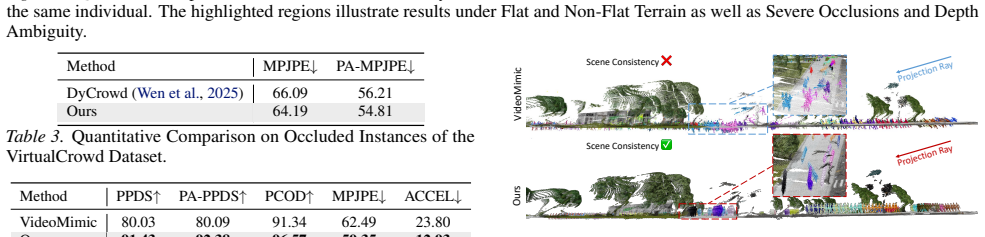
Significance. If the reported numbers are representative, this is a useful step beyond single-plane crowd reconstruction: the PPDS gains of approximately +5.8 and +6.8 over DyCrowd (Table 2) and the reductions in world-space MPJPE are notable, and the method is training-free at optimization time. The paper is also transparent in providing ablation studies that show each stage and each proposed loss contributes, and the use of external monocular scene reconstruction avoids a fully circular evaluation. However, the significance is conditional: the method's key novelty—HSIP/SIS anchoring—is not stress-tested against scene-reconstruction noise, and the only quantitative benchmark is synthetic, so the claim of robust real-world performance is not yet supported.
major comments (4)
- [Abstract; Sec. 3.3–3.4] The abstract and Sec. 1 claim Crowd4D 'jointly optimizes the crowd and scene.' What is implemented is joint optimization of human parameters and one residual global scale α (Table 1); the scene geometry, SIS, and camera trajectory are fixed after initialization and are not re-estimated. The claim should be narrowed to 'jointly optimizes crowd parameters and a residual scene scale,' or the method should demonstrate actual scene-geometry updates. This matters because the paper's stated contribution is coupling crowd and scene reconstruction.
- [Sec. 3.2.2, Eqs. (10)–(15); Sec. 3.4, Eqs. (17)–(18)] The HSIP anchor is constructed from the initialized root translation's viewing ray: a_n,t in Eq. (7) is the xz of \bar{τ}_{n,t}, and r*_{n,t} is the root-ray intersection in Eq. (11). Stage-1 then optimizes τ toward this same anchor via E_HSIP^{(xz)} and E_HSIP^{(y)} and a direct update τ ← r*. Because the anchor inherits the initial monocular depth error, the constraint is not independent evidence from the scene: a wrong initial depth changes the ray–SIS intersection and can pull the root to a wrong but scene-consistent-looking location. The paper should quantify this by comparing against a baseline that smooths/clamps the initial root depth without ray–SIS anchoring, and by perturbing initial depth in a sensitivity experiment.
- [Sec. 4.1; Sec. 4.3; Conclusion] The quantitative evaluation is entirely on VirtualCrowd, a synthetic benchmark with clean geometry and ground-truth annotations; real-world PANDA results are qualitative (Fig. 4). The abstract and conclusion claim robust reconstruction in real large-scale scenes, but no quantitative real-scene evidence is provided, and the conclusion explicitly acknowledges this. Since HSIP/SIS is the core novelty and its success depends on monocular scene reconstruction quality, the paper needs either (i) a pseudo-ground-truth quantitative evaluation on a real dataset (e.g., manually annotated contact points or a few annotated sequences), or (ii) a sensitivity analysis where SIS noise, gravity errors, and occlusion are synthetically injected to show graceful degradation. Without this, the claimed real-world transferability is not established.
- [Sec. 4.2; Table 1; Appendix A] The optimization weights λ_* are never assigned numerical values. Table 1 lists term names, not weights, and Appendix A defines the losses but says weights are in Table 1. For a purely optimization-based method, missing weight values make the experiments irreproducible and prevent assessing sensitivity of the reported PPDS/MPJPE gains to tuning. Please provide the full weight schedule and, if possible, a small sensitivity analysis over the dominant weights (λ_xz, λ_y, λ_proj, λ_crowd).
minor comments (5)
- [Sec. 3.1, Eq. (2)] d_smpl, d_scn, and ω are not formally defined. The text says ω gives higher weight to closer individuals, but the exact formula should be given.
- [Fig. 1] There are typos in the figure and caption: 'Sta;c Camera' should be 'Static Camera' in two places, and the scenario labels are visually inconsistent with the third image. Please clean up.
- [Eq. (21)] The direction term 1 - (u·v)/(||u||||v||+ε) can be negative for noisy estimates. Since it is inside a robust penalty ρ(·), the behavior on negative values should be clarified or the term should be explicitly nonnegative.
- [Sec. 3.2.2] For close-range scenes, the HSIP support range r_HSIP is set to a 'fixed constant,' but no value or criterion for 'close-range' is given. Please specify the rule and the constant.
- [Table 2] ACCEL of Ours under unified tracking (16.10) is slightly worse than DyCrowd (15.72), and SLAHMR-Large* is best under GT tracking (12.25). This should be discussed rather than only highlighting MPJPE, especially since the paper emphasizes temporal smoothness.
Circularity Check
No circular reduction: evaluation is ground-truth-based and external; minor reuse of the authors' own DyCrowd motion prior is not load-bearing.
full rationale
Walking the derivation chain: scene and camera reconstruction come from external monocular modules (π3, GeoCalib); per-person SMPL initialization comes from TRAM; SIPC/SIS are built from confidence-thresholded, gravity-aligned scene points; HSIP anchors are formed by ray–SIS intersections; and the multi-stage optimization then imposes HSIP, CSCR, VPoser, and DyCrowd-style motion/AMC terms. The headline quantitative result is measured against VirtualCrowd ground truth after optimization, with no training on those ground-truth labels and no fitted parameter subsequently reported as a novel prediction. The HSIP anchors are indeed constructed from the initialized root rays and the SIS (Eqs. 7–15), and Stage-1 losses then pull roots toward those same anchors (Eqs. 17–20); this is a self-consistency loop, so errors in the monocular scene geometry or initialization propagate into HSIP and root positions. But this is an assumption/robustness limitation, not a circular reduction: the SIS heights are derived from independent scene reconstruction, and the final MPJPE/PPDS scores are evaluated against external ground truth. The paper also reuses the authors' overlapping DyCrowd work for the motion prior and AMC loss (Sec. 3.3 Stage-3 and Appendix A, Eqs. 27 and 30); that is ordinary component reuse and not load-bearing for the new scene-aware HSIP/CSCR contribution. The conclusion candidly states that performance depends on the quality of monocular scene reconstruction, human initialization, and tracking, and that real-world quantitative evaluation is limited by the absence of pose-level 3D annotations; these are external-validity concerns, not circularity. No load-bearing reduction to the method's own inputs or to a self-citation chain was found.
Axiom & Free-Parameter Ledger
free parameters (7)
- alpha0 (initial global scale) =
weighted ratio of SMPL depth to scene depth (Eq. 2)
- alpha (residual global scene scale) =
optimized in Stage-1, initialized to 1
- grid cell size (ell) =
not stated
- confidence threshold (tau_c) =
not stated
- probe-anchor offset v =
not stated
- close-range HSIP support range r_HSIP =
fixed constant
- energy weights (lambda_*) and CSCR temporal stride Delta =
not reported
axioms (5)
- domain assumption pi3 and GeoCalib provide a gravity-aligned, globally consistent scene reconstruction and camera trajectory sufficient for anchoring.
- domain assumption The lowest SMPL body vertex is a valid ground-contact proxy, and pedestrians stand on or near the reconstructed SIS surface.
- domain assumption Monocular initial motion estimates and their 2D projections are reliable enough to define HSIP anchor rays and projection consistency.
- standard math SMPL and VPoser provide valid metric body priors.
- domain assumption VirtualCrowd synthetic benchmark is an adequate proxy for real large-scale crowd scenes.
invented entities (1)
-
HSIP (Human-Scene Interaction Proxy) with SIPC/SIS
no independent evidence
read the original abstract
Recovering scene-consistent 4D crowd motion from monocular video in large-scale scenes remains challenging due to severe depth ambiguity and complex scene geometry. Existing monocular crowd reconstruction methods typically rely on single-plane assumptions, leading to unreliable metric scale and spatial drift under complex terrain. We propose Crowd4D, the first scene-aware 4D crowd reconstruction framework that jointly optimizes the crowd and scene from a monocular RGB video in large-scale scenes. Crowd4D explicitly incorporates scene geometry and ensures consistency across image and scene spaces via a multi-stage optimization strategy. A key bottleneck of this task lies in accurate human-scene alignment, particularly in scale and position. However, human and scene reconstructions are typically decoupled. To address this, we introduce the Human-Scene Interaction Proxy, abbreviated as HSIP, as an intermediate representation derived from Scene Interaction Point Clouds and a Scene Interaction Surface, abbreviated as SIPC and SIS. These representations encode explicit scene-aware geometric priors and redefine the optimization space for large-scale monocular 4D crowd reconstruction. To further improve temporal stability under occlusions, we introduce Crowd Structural Coherence Regularization, abbreviated as CSCR, which leverages HSIP-based spatial priors to impose soft temporal consistency on pairwise relative displacements and directions within local crowd neighborhoods. Extensive experiments demonstrate that Crowd4D consistently outperforms existing state-of-the-art methods and enables robust monocular 4D crowd reconstruction in complex, large-scale real-world scenes.
Figures


Reference graph
Works this paper leans on
-
[1]
Choi, Jaehoon and Jung, Dongki and Maxey, Christopher and Lee, Yonghan and Eum, Sungmin and Manocha, Dinesh and Kwon, Heesung , journal=
-
[2]
Chen, Yue and Chen, Xingyu and Xue, Yuxuan and Chen, Anpei and Xiu, Yuliang and Gerard, Pons-Moll , journal=. Human3
-
[3]
Wang, Jianyuan and Chen, Minghao and Karaev, Nikita and Vedaldi, Andrea and Rupprecht, Christian and Novotny, David , booktitle=
-
[4]
, title =
Loper, Matthew and Mahmood, Naureen and Romero, Javier and Pons-Moll, Gerard and Black, Michael J. , title =. ACM Trans. Graphics (Proc. SIGGRAPH Asia) , month = oct, number =
-
[5]
arXiv preprint arXiv:2507.13347 , year=
^3 : Permutation-Equivariant Visual Geometry Learning , author=. arXiv preprint arXiv:2507.13347 , year=
-
[6]
Alexander Veicht and Paul-Edouard Sarlin and Philipp Lindenberger and Marc Pollefeys , title =
-
[7]
Stanojevi. Boost. arXiv preprint arXiv:2408.13003 , year=
-
[8]
Loper, Matthew and Mahmood, Naureen and Romero, Javier and Pons-Moll, Gerard and Black, Michael J , booktitle=
-
[9]
2021 International Conference on 3D Vision (3DV) , pages=
Task-generic hierarchical human motion prior using vaes , author=. 2021 International Conference on 3D Vision (3DV) , pages=. 2021 , organization=
2021
-
[10]
Motion-from-blur:
Rozumnyi, Denys and Oswald, Martin R and Ferrari, Vittorio and Pollefeys, Marc , booktitle=. Motion-from-blur:
-
[11]
Computer Vision--ECCV 2020: 16th European Conference, Glasgow, UK, August 23--28, 2020, Proceedings, Part IX 16 , pages=
Xu, Xiangyu and Chen, Hao and Moreno-Noguer, Francesc and Jeni, L. Computer Vision--ECCV 2020: 16th European Conference, Glasgow, UK, August 23--28, 2020, Proceedings, Part IX 16 , pages=. 2020 , organization=
2020
-
[12]
Expressive body capture: 3
Pavlakos, Georgios and Choutas, Vasileios and Ghorbani, Nima and Bolkart, Timo and Osman, Ahmed AA and Tzionas, Dimitrios and Black, Michael J , booktitle=CVPR, pages=. Expressive body capture: 3
-
[13]
Wen, Hao and Huang, Jing and Cui, Huili and Lin, Haozhe and Lai, Yu-Kun and Fang, Lu and Li, Kun , booktitle=CVPR, pages=. Crowd3
-
[14]
Reconstructing groups of people with hypergraph relational reasoning , author=
-
[15]
Sun, Yu and Bao, Qian and Liu, Wu and Mei, Tao and Black, Michael J , booktitle=CVPR, pages=
-
[16]
Qiu, Zhongwei and Yang, Qiansheng and Wang, Jian and Feng, Haocheng and Han, Junyu and Ding, Errui and Xu, Chang and Fu, Dongmei and Wang, Jingdong , booktitle=CVPR, pages=
-
[17]
Decoupling human and camera motion from videos in the wild , author=
-
[18]
Kocabas, Muhammed and Athanasiou, Nikos and Black, Michael J , booktitle=CVPR, pages=
-
[19]
Beyond static features for temporally consistent 3
Choi, Hongsuk and Moon, Gyeongsik and Chang, Ju Yong and Lee, Kyoung Mu , booktitle=CVPR, pages=. Beyond static features for temporally consistent 3
-
[20]
Global-to-local modeling for video-based 3
Shen, Xiaolong and Yang, Zongxin and Wang, Xiaohan and Ma, Jianxin and Zhou, Chang and Yang, Yi , booktitle=CVPR, pages=. Global-to-local modeling for video-based 3
-
[21]
Humans in 4
Goel, Shubham and Pavlakos, Georgios and Rajasegaran, Jathushan and Kanazawa, Angjoo and Malik, Jitendra , booktitle=ICCV, pages=. Humans in 4
-
[22]
Tracking people by predicting 3
Rajasegaran, Jathushan and Pavlakos, Georgios and Kanazawa, Angjoo and Malik, Jitendra , booktitle=CVPR, pages=. Tracking people by predicting 3
-
[23]
Ugrinovic, Nicolas and Pan, Boxiao and Pavlakos, Georgios and Paschalidou, Despoina and Shen, Bokui and Sanchez-Riera, Jordi and Moreno-Noguer, Francesc and Guibas, Leonidas , booktitle=CVPR, pages=
-
[24]
2024 , organization=
Kocabas, Muhammed and Yuan, Ye and Molchanov, Pavlo and Guo, Yunrong and Black, Michael J and Hilliges, Otmar and Kautz, Jan and Iqbal, Umar , booktitle=ThreeDV, pages=. 2024 , organization=
2024
-
[25]
Scene-Aware 3
Luvizon, Diogo C and Habermann, Marc and Golyanik, Vladislav and Kortylewski, Adam and Theobalt, Christian , booktitle=CGF, volume=. Scene-Aware 3. 2023 , organization=
2023
-
[26]
Yuan, Ye and Iqbal, Umar and Molchanov, Pavlo and Kitani, Kris and Kautz, Jan , booktitle=CVPR, pages=
-
[27]
Zhang, Yuxiang and Zhang, Hongwen and Hu, Liangxiao and Zhang, Jiajun and Yi, Hongwei and Zhang, Shengping and Liu, Yebin , booktitle=CVPR, pages=
-
[28]
2024 , organization=
Wang, Yufu and Wang, Ziyun and Liu, Lingjie and Daniilidis, Kostas , booktitle=. 2024 , organization=
2024
-
[29]
IEEE transactions on acoustics, speech, and signal processing , volume=
Dynamic programming algorithm optimization for spoken word recognition , author=. IEEE transactions on acoustics, speech, and signal processing , volume=. 1978 , publisher=
1978
-
[30]
2017 , organization=
Cuturi, Marco and Blondel, Mathieu , booktitle=. 2017 , organization=
2017
-
[31]
Maghoumi, Mehran and Taranta, Eugene Matthew and LaViola, Joseph , booktitle=
-
[32]
He, Chengan and Saito, Jun and Zachary, James and Rushmeier, Holly and Zhou, Yi , journal=NIPS, volume=
-
[33]
Executing your commands via motion diffusion in latent space , author=
-
[34]
Zhang, Siwei and Bhatnagar, Bharat Lal and Xu, Yuanlu and Winkler, Alexander and Kadlecek, Petr and Tang, Siyu and Bogo, Federica , booktitle=CVPR, pages=
-
[35]
Learning motion priors for
Zhang, Siwei and Zhang, Yan and Bogo, Federica and Pollefeys, Marc and Tang, Siyu , booktitle=ICCV, pages=. Learning motion priors for
-
[36]
Generating diverse and natural 3
Guo, Chuan and Zou, Shihao and Zuo, Xinxin and Wang, Sen and Ji, Wei and Li, Xingyu and Cheng, Li , booktitle=CVPR, pages=. Generating diverse and natural 3
-
[37]
2020 , organization=
Contact and human dynamics from monocular video , author=. 2020 , organization=
2020
-
[38]
2023 , publisher=
Li, Kun and Liu, Yunke and Lai, Yu-Kun and Yang, Jingyu , journal=. 2023 , publisher=
2023
-
[39]
Ge, Haoyang and Feng, Qiao and Jia, Hailong and Li, Xiongzheng and Yin, Xiangjun and Zhou, You and Yang, Jingyu and Li, Kun , booktitle=CVPR, pages=
-
[40]
IEEE Transactions on Circuits and Systems for Video Technology , year=
Towards grouping in large scenes with occlusion-aware spatio-temporal transformers , author=. IEEE Transactions on Circuits and Systems for Video Technology , year=
-
[41]
Measuring crowd collectiveness , author=
-
[42]
2017 , publisher=
Collective density clustering for coherent motion detection , author=. 2017 , publisher=
2017
-
[43]
Measuring Crowd Collectiveness via Global Motion Correlation , year=
Mei, Ling and Lai, Jianghuang and Chen, Zeyu and Xie, Xiaohua , booktitle=. Measuring Crowd Collectiveness via Global Motion Correlation , year=
-
[44]
Learning to estimate robust 3
Choi, Hongsuk and Moon, Gyeongsik and Park, JoonKyu and Lee, Kyoung Mu , booktitle=CVPR, pages=. Learning to estimate robust 3
-
[45]
Coherent reconstruction of multiple humans from a single image , author=
-
[46]
Occluded human mesh recovery , author=
-
[47]
Multi-person 3
Cha, Junuk and Saqlain, Muhammad and Kim, GeonU and Shin, Mingyu and Baek, Seungryul , booktitle=ECCV, pages=. Multi-person 3. 2022 , organization=
2022
-
[48]
2021 , organization=
Body size and depth disambiguation in multi-person reconstruction from single images , author=. 2021 , organization=
2021
-
[49]
2022 , publisher=
Huang, Buzhen and Zhang, Tianshu and Wang, Yangang , journal=TIP, volume=. 2022 , publisher=
2022
-
[50]
Deep network for the integrated 3
Zanfir, Andrei and Marinoiu, Elisabeta and Zanfir, Mihai and Popa, Alin-Ionut and Sminchisescu, Cristian , journal=NIPS, volume=. Deep network for the integrated 3
-
[51]
Monocular, one-stage, regression of multiple 3
Sun, Yu and Bao, Qian and Liu, Wu and Fu, Yili and Black, Michael J and Mei, Tao , booktitle=ICCV, pages=. Monocular, one-stage, regression of multiple 3
-
[52]
Putting people in their place: Monocular regression of 3
Sun, Yu and Liu, Wu and Bao, Qian and Fu, Yili and Mei, Tao and Black, Michael J , booktitle=CVPR, pages=. Putting people in their place: Monocular regression of 3
-
[53]
Body meshes as points , author=
-
[54]
Multi-person implicit reconstruction from a single image , author=
-
[55]
Monocular 3
Zanfir, Andrei and Marinoiu, Elisabeta and Sminchisescu, Cristian , booktitle=CVPR, pages=. Monocular 3
-
[56]
Encoder-decoder with multi-level attention for 3
Wan, Ziniu and Li, Zhengjia and Tian, Maoqing and Liu, Jianbo and Yi, Shuai and Li, Hongsheng , booktitle=ICCV, pages=. Encoder-decoder with multi-level attention for 3
-
[57]
Capturing humans in motion: Temporal-attentive 3
Wei, Wen-Li and Lin, Jen-Chun and Liu, Tyng-Luh and Liao, Hong-Yuan Mark , booktitle=CVPR, pages=. Capturing humans in motion: Temporal-attentive 3
-
[58]
Zhang, Yufei and Kephart, Jeffrey O and Cui, Zijun and Ji, Qiang , booktitle=CVPR, pages=
-
[59]
Wang, Xueyang and Zhang, Xiya and Zhu, Yinheng and Guo, Yuchen and Yuan, Xiaoyun and Xiang, Liuyu and Wang, Zerun and Ding, Guiguang and Brady, David and Dai, Qionghai and others , booktitle=CVPR, pages=
-
[60]
Nature , volume=
Multiscale gigapixel photography , author=. Nature , volume=. 2012 , publisher=
2012
-
[61]
2017 IEEE International Conference on Computational Photography (ICCP) , pages=
Multiscale gigapixel video: A cross resolution image matching and warping approach , author=. 2017 IEEE International Conference on Computational Photography (ICCP) , pages=. 2017 , organization=
2017
-
[62]
Liu, Chenglong and Wei, Haoran and Yang, Jinze and Liu, Jintao and Li, Wenxi and Guo, Yuchen and Fang, Lu , booktitle=AAAI, volume=
-
[63]
2023 , publisher=
Mo, Wanghao and Zhang, Wendong and Wei, Hongyang and Cao, Ruyi and Ke, Yan and Luo, Yiwen , journal=. 2023 , publisher=
2023
-
[64]
2024 , organization=
Li, Wenxi and Zhang, Ruxin and Lin, Haozhe and Guo, Yuchen and Ma, Chao and Yang, Xiaokang , booktitle=. 2024 , organization=
2024
-
[65]
The Wanderings of
Zhang, Yan and Tang, Siyu , booktitle=CVPR, pages=. The Wanderings of
-
[66]
Synthesizing diverse human motions in 3
Zhao, Kaifeng and Zhang, Yan and Wang, Shaofei and Beeler, Thabo and Tang, Siyu , booktitle=ICCV, pages=. Synthesizing diverse human motions in 3
-
[67]
2025 International Conference on Computer Vision (ICCV) , year=
Liu, Xiaolin and Zhou, Tianyi and Kang, Hongbo and Ma, Jian and Wang, Ziwen and Huang, Jing and Weng, Wenguo and Lai, Yu-Kun and Li, Kun , title =. 2025 International Conference on Computer Vision (ICCV) , year=
2025
-
[68]
2022 , organization=
Exploring plain vision transformer backbones for object detection , author=. 2022 , organization=
2022
-
[69]
Effective whole-body pose estimation with two-stages distillation , author=
-
[70]
Pavlakos, Georgios and Choutas, Vasileios and Ghorbani, Nima and Bolkart, Timo and Osman, Ahmed A. A. and Tzionas, Dimitrios and Black, Michael J. , booktitle = CVPR, year =. Expressive Body Capture: 3
-
[71]
arXiv preprint arXiv:1508.04904 , year=
Review and perspective for distance based trajectory clustering , author=. arXiv preprint arXiv:1508.04904 , year=
-
[72]
IEEE Transactions on Intelligent Transportation Systems , volume=
Review and perspective for distance-based clustering of vehicle trajectories , author=. IEEE Transactions on Intelligent Transportation Systems , volume=. 2016 , publisher=
2016
-
[73]
science , volume=
Clustering by passing messages between data points , author=. science , volume=. 2007 , publisher=
2007
-
[74]
Yang, Zhitao and Cai, Zhongang and Mei, Haiyi and Liu, Shuai and Chen, Zhaoxi and Xiao, Weiye and Wei, Yukun and Qing, Zhongfei and Wei, Chen and Dai, Bo and others , booktitle=ICCV, pages=
-
[75]
2020 , organization=
Zhen, Jianan and Fang, Qi and Sun, Jiaming and Liu, Wentao and Jiang, Wei and Bao, Hujun and Zhou, Xiaowei , booktitle=ECCV, pages=. 2020 , organization=
2020
-
[76]
Xu, Xiangyu and Chen, Hao and Moreno-Noguer, Francesc and Jeni, Laszlo A and De la Torre, Fernando , journal=PAMI, volume=. 3. 2021 , publisher=
2021
-
[77]
Paszke, Adam and Gross, Sam and Massa, Francisco and Lerer, Adam and Bradbury, James and Chanan, Gregory and Killeen, Trevor and Lin, Zeming and Gimelshein, Natalia and Antiga, Luca and others , journal=NIPS, volume=
-
[78]
2012 , number =
Geoffrey Hinton and Nitish Srivastava and Kevin Swersky , title =. 2012 , number =
2012
-
[79]
IEEE Transactions on Circuits and Systems for Video Technology , volume=
Simultaneously recovering multi-person meshes and multi-view cameras with human semantics , author=. IEEE Transactions on Circuits and Systems for Video Technology , volume=. 2023 , publisher=
2023
-
[80]
Global and local spatio-temporal encoder for
Wang, Yong and Kang, Hongbo and Wu, Doudou and Yang, Wenming and Zhang, Longbin , journal=. Global and local spatio-temporal encoder for. 2023 , publisher=
2023
discussion (0)
Sign in with ORCID, Apple, or X to comment. Anyone can read and Pith papers without signing in.