REVIEW 4 major objections 5 minor 75 references
White dots in generalized toric polygons should be read as instructions to identify parallel zig-zag paths and condense the enclosed N=2 fractional branes.
Reviewed by Pith at T0; open to challenge. T0 means a machine referee read the full paper against a public rubric. the ladder, T0–T4 →
T0 review · deepseek-v4-flash
2026-08-01 09:49 UTC pith:L7MVHVGY
load-bearing objection A well-motivated proposal for GTP quivers via N=2 strip condensation; the counting works on examples, but the key strip-face conjecture in §4.1 is unproved and the mirror-symmetry argument does not force it. the 4 major comments →
Towards Generalized Dimers for GTPs: mathcal{N}=2 Fractional Branes at Infinite Coupling
The pith
A machine-rendered reading of the paper's core claim, the machinery that carries it, and where it could break.
Core claim
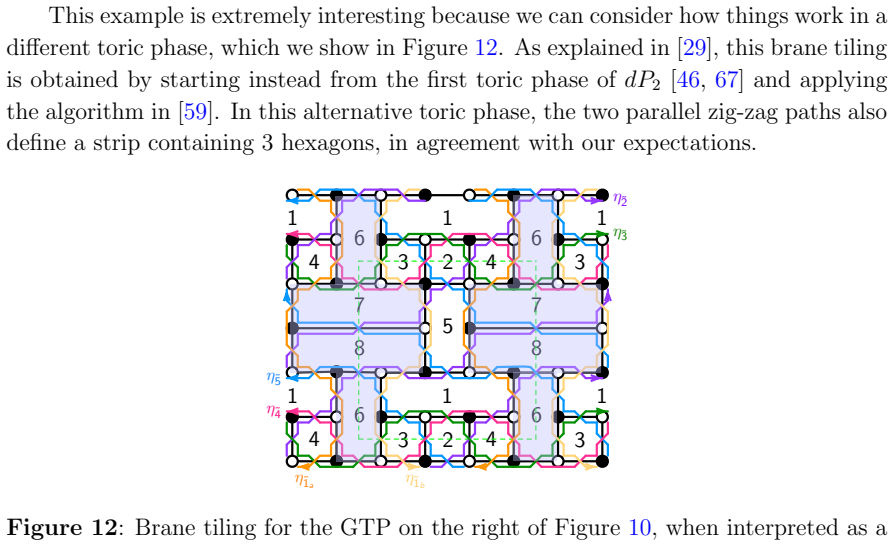
The paper's central claim is that terminating multiple 5-branes on a common 7-brane — equivalently, inserting a white dot in a GTP — is realized in the brane tiling by identifying the associated parallel zig-zag paths. The N=2 fractional brane between the paths shrinks to zero size; this 'strip condensation' sends the corresponding gauge groups to infinite coupling, and their confinement removes them from the quiver. The number of gauge groups removed is exactly n^2−1 for each T^n-cone, matching the number of T-cones in a tessellation of the GTP and the number expected from the mutation-related toric diagram. After condensation, the GTP quiver coincides with the mutation-related toric quiver
What carries the argument
The mechanism is strip condensation: parallel zig-zag paths in a brane tiling (paths tracking the legs of the (p,q) web) are brought together, shrinking the N=2 fractional brane strip between them. The quantitative backbone is a conjecture about T-cones: for a T^n-cone, n−1 of the n parallel-zig-zag strips each contain n+1 faces, giving n(n−1)(n+1)=n^2−1 faces removed — exactly the number of gauge groups that must disappear to go from the toric count to the GTP count. T-cones are the building blocks in a tessellation of the GTP, and polytope mutations connect the GTP to an ordinary toric diagram. Mirror symmetry enters by tuning the coefficients of the Newton polynomial to the GTP point, whe
Load-bearing premise
The counting breaks unless, for every T^n-cone, n−1 of the n parallel strips between zig-zag paths each contain exactly n+1 faces, so that strip condensation removes n^2−1 gauge groups.
What would settle it
Draw the brane tiling for any mutation-related GTP with a T^3-cone, treat the GTP as a toric diagram, and count the faces in the two strips between the three parallel zig-zag paths; if either strip does not contain four faces, the n^2−1 reduction and the gauge-group counting fail.
If this is right
- The count of gauge groups in a GTP quiver is fixed: it equals the number of T-cones in a spider triangulation of the GTP.
- A generalized brane tiling for GTPs exists in the sense that quiver and superpotential can be obtained by starting from the toric tiling, condensing strips, and confining.
- GTP quivers differ from mutation-related toric quivers only by vector pairs and adjoint fields, so Hanany-Witten transitions and polytope mutations should be realizable as relevant deformations in the quiver.
- The construction extends to GTPs of arbitrarily large T-cones, going beyond the examples in the earlier literature.
- Because the resulting quiver variables match those of the GTP cluster integrable systems, these quivers are a natural starting point for deriving those integrable systems directly from a dimer-like construction.
Where Pith is reading between the lines
- Editorial inference: if strip condensation is universal, it predicts that every GTP quiver can be built by a purely combinatorial algorithm — merge the nodes on identified parallel zig-zag paths and confine — which could be implemented and tested on any new mutation-related GTP.
- Editorial inference: the mirror-symmetry tuning suggests the shrinking strip is a continuous deformation, so the condensation could be observed as a family of mirror curves interpolating between toric and GTP points, giving a geometric handle on the infinite-coupling limit.
- Editorial inference: the relevant-deformation correspondence may organize the landscape of 5d SCFTs into a mutation graph, with RG flows between fixed points encoded in GTP combinatorics; one testable consequence is that deformations predicted by the quiver comparison should match known Higgs-branch flows for the same theories.
Editorial analysis
A structured set of objections, weighed in public.
Referee Report
Summary. The paper proposes a generalization of brane tilings to Generalized Toric Polygons (GTPs) that arise from toric diagrams by polytope mutations. The central idea is that white dots in a GTP, which represent multiple 5-branes ending on a common 7-brane, correspond to identifying parallel zig-zag paths in the brane tiling of the GTP viewed as an ordinary toric diagram. This identification is described as condensation of the N=2 fractional brane bounded by the parallel zig-zags. After confinement, the resulting quiver is claimed to have the same number of gauge groups as the mutation-related toric diagram and to coincide with it up to vector pairs and adjoint fields. The paper gives a counting argument in §4.1: for a T^n-cone, n−1 of the n parallel-zig-zag strips each contain n+1 faces, so the total number of faces removed is (n−1)(n+1)=n^2−1, precisely the number of gauge groups that must disappear. This is supported by examples from dP0, dP1, dP2, and a new infinite family of GTPs. Mirror symmetry is invoked in §5 to argue that the condensation follows from tuning Newton-polynomial coefficients, and §6 proposes a map from strip condensation to confinement.
Significance. If the proposed mechanism is correct, it would provide a long-sought quiver description for GTPs, generalizing brane tilings to a broader class of 5d SCFT geometries and connecting Hanany-Witten transitions to relevant deformations. The paper is valuable as a concrete, falsifiable proposal: it makes explicit combinatorial predictions and tests them on all previously known examples plus a new infinite family. It is also honest in labeling the central structural step as a conjecture. The main significance is therefore conditional: the counting agreement is non-trivial and the examples are consistent, but the load-bearing face-count conjecture is not yet derived. The paper would be strengthened considerably by a proof or a clear reduction of the conjecture to an existing algorithm.
major comments (4)
- [§4.1] The claim that for a T^n-cone, n−1 of the n parallel-zig-zag strips each contain exactly n+1 faces is the only quantitative bridge between strip condensation and the required n^2−1 reduction. This statement is explicitly left as a conjecture, with proof deferred to future work using [59]. Because the non-condensing strip is allowed to have arbitrary structure and the conjecture is tailored to reproduce the gauge-group count, the examples do not independently confirm the counting. A failure of this face-count statement for some GTP in the stated class would remove the quantitative support for the central mechanism. Please either prove the conjecture from the construction of [59], or reformulate the paper's central claim as conditional on this unproved combinatorial statement.
- [§3.1] The conjecture that the number of gauge groups equals the number of T-cones is stated, and it is said to be 'equal by construction' to the number of gauge groups of the mutation-related toric diagram. This is not a derivation: the equality relies on the class of spider triangulations and on the unproved assumption that the count is independent of the chosen triangulation and mutation path. Since this T-cone count is one of the two anchors of the consistency checks, the paper should state precisely what evidence forces this equality and whether it is a theorem for the restricted class of GTPs considered.
- [§5] The mirror-symmetry argument is used to justify that tuning Newton-polynomial coefficients condenses the N=2 strips, and in examples it is said to single out the condensing strip. However, the face-count structure of the condensing strips is not derived from mirror symmetry; in particular, mirror symmetry does not by itself imply that n−1 of the n strips contain n+1 faces. The selection of which strip condenses appears to be made by hand in the examples. Please make the mirror-symmetry derivation explicit enough to show that it determines both the number of condensing strips and their face content, or state clearly that this part remains an assumption.
- [§6] The identification of strip condensation with confinement and the claim that the resulting quiver agrees with the mutation-related toric quiver 'up to vector pairs and adjoint fields' is the final consistency check. As presented, the map from a GTP to a quiver and superpotential is illustrated in examples but is not an algorithm. In particular, it is not specified in general which fields become massive, how the superpotential is transformed under condensation, or why the ambiguity ('up to vector pairs and adjoint fields') does not affect the physical equivalence. A precise statement of this map is necessary for the proposal to be a genuine generalized brane tiling rather than a collection of examples.
minor comments (5)
- [§2.1.1] Typo: 'In More recently, it was studied in [38]' should read 'More recently, it was studied in [38]'.
- [§2.3] The two possible mutations in (2.5) are described in words; writing the orientation-reversed transformation explicitly would remove ambiguity about the sign convention.
- [§2.2/§2.4] The symbol η_i is used both for side normals of the polytope and for winding numbers of zig-zag paths. The footnotes clarify, but a single notation table would improve readability.
- [General] The manuscript frequently uses the phrase 'the GTP interpreted as a toric diagram'. This is central to the construction; a short definition at first use would help the reader distinguish the two readings of the same polygon.
- [Figures] Some figure references and captions in the text appear to be from a longer version (e.g. Figures 18–19, 39–42). The final manuscript should ensure all figures are introduced in order and that no orphan figure captions remain.
Circularity Check
No significant circularity: the paper is an explicitly conjectural proposal checked against independent T-cone counting and explicit examples; the §4.1 face-count conjecture is an unproved weak point, not a circular reduction.
full rationale
The derivation chain is not circular. The target number of gauge groups is fixed independently by the tessellation into T-cones and by the mutation-related toric diagram (§3.1, with the equality to the toric count explicitly stated as holding 'by construction'). Strip condensation is then proposed as a mechanism, and the paper checks it in explicit examples (dP0, dP1, dP2 and a new infinite family) rather than imposing the count. The genuine weak point is §4.1, where the paper states a conjecture: 'We conjecture that, when a GTP containing a T^n-cone is interpreted as a toric diagram, n−1 of the n zig-zag strips—namely, those that condense in the GTP limit—have the following structure: Each of the n−1 strips contains n+1 faces. The total number of faces in these strips is then n(n−1)(n+1)=n^2−1, which agrees precisely with the necessary counting of gauge groups to be eliminated.' This is a load-bearing, explicitly unproved structural assumption whose only stated support is examples and a deferred proof ('We believe it could be possible to prove this conjecture using the construction of [59]. We leave this for future work.'). The agreement with n^2−1 is therefore not an independent confirmation for general GTPs; that is a rigor/correctness concern, not circularity, because the strip face count is not derived from the T-cone count, and the T-cone count is not derived from the strip conjecture. Self-citations to [29,30,36] supply prior examples and construction tools, but the present check also uses the independent T-cone counting and explicit tilings, so the result is not forced by a self-citation chain.
Axiom & Free-Parameter Ledger
axioms (5)
- domain assumption Zig-zag paths correspond one-to-one to external legs of the (p,q) web, with winding vector equal to (p,q); parallel zig-zags bound N=2 fractional branes.
- domain assumption White dots in a GTP specify parallel 5-brane legs terminating on a common 7-brane; the s-rule is encoded by T-cone tessellations.
- ad hoc to paper Only GTPs related to toric diagrams by polytope mutations and admitting spider triangulations made only of T-cones are considered.
- ad hoc to paper For a T^n-cone in this class, n−1 of the n parallel-zig-zag strips each contain exactly n+1 faces, so the total number of faces removed is n^2−1.
- domain assumption The zero locus of the Newton polynomial is the mirror curve; untwisting maps zig-zags to punctures, and tuning Newton coefficients to the GTP point implements strip condensation.
invented entities (1)
-
N=2 strip condensation
no independent evidence
read the original abstract
Generalized Toric Polygons (GTPs) extend the geometric realization of $5d$ superconformal field theories beyond toric Calabi-Yau 3-folds to general $(p,q)$ 5-brane webs ending on 7-branes. We take significant steps towards the generalization of brane tilings for GTPs, or equivalently, the corresponding quiver theories. We focus on GTPs connected to ordinary toric diagrams by polytope mutations. Parallel 5-brane legs of a $(p,q)$ web define $\mathcal{N}=2$ fractional branes bounded by the corresponding parallel zig-zag paths in the brane tiling obtained by treating the GTP as an ordinary toric diagram. We propose that terminating multiple 5-branes on a common 7-brane, the defining feature of GTPs, translates into bringing these zig-zag paths together, thereby shrinking the corresponding $\mathcal{N}=2$ fractional branes to zero size in a process we call $\mathcal{N}=2$ strip condensation. We show that strip condensation follows from mirror symmetry when the coefficients in the Newton polynomial are tuned to the GTP point. We further support this proposal through several non-trivial consistency checks. In particular, it correctly reproduces the expected number of gauge groups, given equivalently by that of the mutation-related toric diagram or by the number of $T$-cones in a tessellation of the GTP. We verify this for all examples previously considered in the literature, as well as for a new infinite family of GTPs with arbitrarily large $T$-cones. Strip condensation drives the corresponding gauge groups to infinite coupling. Confinement then yields quivers that coincide with those of the mutation-related toric diagrams up to vector pairs and adjoint fields, suggesting that GTP quivers are related to those of the corresponding toric diagrams by relevant deformations, extending to GTPs the known correspondence between polytope mutations and relevant deformations.
Figures

Reference graph
Works this paper leans on
-
[1]
D. R. Morrison and N. Seiberg,Extremal transitions and five-dimensional supersymmetric field theories,Nucl. Phys. B483(1997) 229–247, [hep-th/9609070]
Pith/arXiv arXiv 1997
-
[2]
M. R. Douglas, S. H. Katz and C. Vafa,Small instantons, Del Pezzo surfaces and type I-prime theory,Nucl. Phys. B497(1997) 155–172, [hep-th/9609071]
Pith/arXiv arXiv 1997
-
[3]
K. A. Intriligator, D. R. Morrison and N. Seiberg,Five-dimensional supersymmetric gauge theories and degenerations of Calabi-Yau spaces,Nucl. Phys. B497(1997) 56–100, [hep-th/9702198]
Pith/arXiv arXiv 1997
-
[4]
M. Del Zotto, J. J. Heckman and D. R. Morrison,6D SCFTs and Phases of 5D Theories,JHEP09(2017) 147, [1703.02981]
Pith/arXiv arXiv 2017
-
[5]
D. Xie and S.-T. Yau,Three dimensional canonical singularity and five dimensionalN = 1 SCFT,JHEP06(2017) 134, [1704.00799]
Pith/arXiv arXiv 2017
-
[6]
S. Alexandrov, S. Banerjee and P. Longhi,Rigid limit for hypermultiplets and five-dimensional gauge theories,JHEP01(2018) 156, [1710.10665]
Pith/arXiv arXiv 2018
-
[7]
P. Jefferson, H.-C. Kim, C. Vafa and G. Zafrir,Towards classification of 5d SCFTs: Single gauge node,SciPost Phys.14(2023) 122, [1705.05836]
Pith/arXiv arXiv 2023
-
[8]
P. Jefferson, S. Katz, H.-C. Kim and C. Vafa,On Geometric Classification of 5d SCFTs,JHEP04(2018) 103, [1801.04036]
Pith/arXiv arXiv 2018
-
[9]
L. Bhardwaj and P. Jefferson,Classifying5dSCFTs via6dSCFTs: Rank one,JHEP 07(2019) 178, [1809.01650]
Pith/arXiv arXiv 2019
-
[10]
L. Bhardwaj and P. Jefferson,Classifying 5d SCFTs via 6d SCFTs: Arbitrary rank, JHEP10(2019) 282, [1811.10616]
Pith/arXiv arXiv 2019
-
[11]
F. Apruzzi, L. Lin and C. Mayrhofer,Phases of 5d SCFTs from M-/F-theory on Non-Flat Fibrations,JHEP05(2019) 187, [1811.12400]
Pith/arXiv arXiv 2019
-
[12]
C. Closset, M. Del Zotto and V. Saxena,Five-dimensional SCFTs and gauge theory phases: an M-theory/type IIA perspective,SciPost Phys.6(2019) 052, [1812.10451]
Pith/arXiv arXiv 2019
-
[13]
Bhardwaj,On the classification of 5d SCFTs,JHEP09(2020) 007, [1909.09635]
L. Bhardwaj,On the classification of 5d SCFTs,JHEP09(2020) 007, [1909.09635]. – 41 –
Pith/arXiv arXiv 2020
-
[14]
F. Apruzzi, C. Lawrie, L. Lin, S. Sch¨ afer-Nameki and Y.-N. Wang,5d Superconformal Field Theories and Graphs,Phys. Lett. B800(2020) 135077, [1906.11820]
Pith/arXiv arXiv 2020
-
[15]
F. Apruzzi, C. Lawrie, L. Lin, S. Sch¨ afer-Nameki and Y.-N. Wang,Fibers add Flavor, Part I: Classification of 5d SCFTs, Flavor Symmetries and BPS States,JHEP11 (2019) 068, [1907.05404]
Pith/arXiv arXiv 2019
-
[16]
F. Apruzzi, C. Lawrie, L. Lin, S. Sch¨ afer-Nameki and Y.-N. Wang,Fibers add Flavor, Part II: 5d SCFTs, Gauge Theories, and Dualities,JHEP03(2020) 052, [1909.09128]
Pith/arXiv arXiv 2020
-
[17]
Bhardwaj,Do all 5d SCFTs descend from 6d SCFTs?,JHEP04(2021) 085, [1912.00025]
L. Bhardwaj,Do all 5d SCFTs descend from 6d SCFTs?,JHEP04(2021) 085, [1912.00025]
Pith/arXiv arXiv 2021
-
[18]
V. Saxena,Rank-two 5d SCFTs from M-theory at isolated toric singularities: a systematic study,JHEP04(2020) 198, [1911.09574]
Pith/arXiv arXiv 2020
-
[19]
F. Apruzzi, S. Schafer-Nameki and Y.-N. Wang,5d SCFTs from Decoupling and Gluing,JHEP08(2020) 153, [1912.04264]
Pith/arXiv arXiv 2020
-
[20]
M. De Marco, M. Del Zotto, M. Graffeo and A. Sangiovanni,Conformal matter,JHEP 05(2024) 306, [2311.04984]
Pith/arXiv arXiv 2024
-
[21]
O. Aharony and A. Hanany,Branes, superpotentials and superconformal fixed points, Nucl. Phys. B504(1997) 239–271, [hep-th/9704170]
Pith/arXiv arXiv 1997
-
[22]
O. Aharony, A. Hanany and B. Kol,Webs of (p,q) five-branes, five-dimensional field theories and grid diagrams,JHEP01(1998) 002, [hep-th/9710116]
Pith/arXiv arXiv 1998
-
[23]
F. Benini, S. Benvenuti and Y. Tachikawa,Webs of five-branes and N=2 superconformal field theories,JHEP09(2009) 052, [0906.0359]
Pith/arXiv arXiv 2009
-
[24]
O. Bergman and D. Rodriguez-Gomez,5d quivers and their AdS(6) duals,JHEP07 (2012) 171, [1206.3503]
Pith/arXiv arXiv 2012
-
[25]
O. Bergman, D. Rodr ´ ıguez-G´ omez and G. Zafrir,5-Brane Webs, Symmetry Enhancement, and Duality in 5d Supersymmetric Gauge Theory,JHEP03(2014) 112, [1311.4199]
Pith/arXiv arXiv 2014
-
[26]
O. DeWolfe, T. Hauer, A. Iqbal and B. Zwiebach,Uncovering the symmetries on [p,q] seven-branes: Beyond the Kodaira classification,Adv. Theor. Math. Phys.3(1999) 1785–1833, [hep-th/9812028]
Pith/arXiv arXiv 1999
-
[27]
B. Feng, Y.-H. He, K. D. Kennaway and C. Vafa,Dimer models from mirror symmetry and quivering amoebae,Adv. Theor. Math. Phys.12(2008) 489–545, [hep-th/0511287]
Pith/arXiv arXiv 2008
-
[28]
O. DeWolfe, A. Hanany, A. Iqbal and E. Katz,Five-branes, seven-branes and five-dimensional E(n) field theories,JHEP03(1999) 006, [hep-th/9902179]. – 42 –
Pith/arXiv arXiv 1999
-
[29]
S. Franco and R.-K. Seong,Twin theories, polytope mutations and quivers for GTPs, JHEP07(2023) 034, [2302.10951]
Pith/arXiv arXiv 2023
-
[30]
G. Arias-Tamargo, S. Franco and D. Rodr ´ ıguez-G´ omez,The geometry of GTPs and 5d SCFTs,JHEP07(2024) 159, [2403.09776]
Pith/arXiv arXiv 2024
-
[31]
A. Bourget, A. Collinucci and S. Schafer-Nameki,Generalized toric polygons, T-branes, and 5d SCFTs,SciPost Phys.18(2025) 079, [2301.05239]
Pith/arXiv arXiv 2025
-
[32]
Collinucci,M-theory geometries from five-brane webs, seven-branes, and T-branes, 2607.05588
A. Collinucci,M-theory geometries from five-brane webs, seven-branes, and T-branes, 2607.05588
-
[33]
S. Franco and D. Rodriguez-Gomez,Quiver tails and brane webs,JHEP10(2024) 118, [2310.10724]
Pith/arXiv arXiv 2024
-
[34]
I. Carre˜ no Bolla, S. Franco and D. Rodr ´ ıguez-G´ omez,The 5d tangram: brane webs, 7-branes and primitive T-cones,JHEP05(2025) 175, [2411.01510]
Pith/arXiv arXiv 2025
-
[35]
I. Carre˜ no Bolla, S. Franco and D. Rodr ´ ıguez-G´ omez,A Hilbert series for generalized toric polygons,JHEP05(2026) 023, [2509.08876]
Pith/arXiv arXiv 2026
-
[36]
M. Kho, K. Lee, N. Lee and R.-K. Seong,Integrable Systems for Generalized Toric Polygons and Higgsed 5d N=1 Theories,2603.19353
-
[37]
A. Hanany and E. Witten,Type IIB superstrings, BPS monopoles, and three-dimensional gauge dynamics,Nucl. Phys. B492(1997) 152–190, [hep-th/9611230]
Pith/arXiv arXiv 1997
-
[38]
O. Bergman and D. Rodr ´ ıguez-G´ omez,The Cat’s Cradle: deforming the higher rank E1 and ˜E1 theories,JHEP02(2021) 122, [2011.05125]
Pith/arXiv arXiv 2021
-
[39]
A. Iqbal,Selfintersection number of BPS junctions in backgrounds of three-branes and seven-branes,JHEP10(1999) 032, [hep-th/9807117]
Pith/arXiv arXiv 1999
-
[40]
N.I., Koll´ ar,Threefolds and deformations of surface singularities.,Inventiones mathematicae91(1988) 299–338
Shepherd-Barron and J. N.I., Koll´ ar,Threefolds and deformations of surface singularities.,Inventiones mathematicae91(1988) 299–338
1988
-
[41]
N. C. Leung and C. Vafa,Branes and toric geometry,Adv. Theor. Math. Phys.2 (1998) 91–118, [hep-th/9711013]
Pith/arXiv arXiv 1998
-
[42]
I. R. Klebanov and E. Witten,Superconformal field theory on three-branes at a Calabi-Yau singularity,Nucl. Phys. B536(1998) 199–218, [hep-th/9807080]
Pith/arXiv arXiv 1998
-
[43]
D. R. Morrison and M. R. Plesser,Nonspherical horizons. 1.,Adv. Theor. Math. Phys. 3(1999) 1–81, [hep-th/9810201]
Pith/arXiv arXiv 1999
-
[44]
S. Benvenuti, S. Franco, A. Hanany, D. Martelli and J. Sparks,An Infinite family of superconformal quiver gauge theories with Sasaki-Einstein duals,JHEP06(2005) 064, [hep-th/0411264]
Pith/arXiv arXiv 2005
-
[45]
A. Hanany and K. D. Kennaway,Dimer models and toric diagrams,hep-th/0503149. – 43 –
-
[46]
S. Franco, A. Hanany, K. D. Kennaway, D. Vegh and B. Wecht,Brane dimers and quiver gauge theories,JHEP01(2006) 096, [hep-th/0504110]
Pith/arXiv arXiv 2006
-
[47]
K. D. Kennaway,Brane Tilings,Int. J. Mod. Phys. A22(2007) 2977–3038, [0706.1660]
Pith/arXiv arXiv 2007
-
[48]
Yamazaki,Brane Tilings and Their Applications,Fortsch
M. Yamazaki,Brane Tilings and Their Applications,Fortsch. Phys.56(2008) 555–686, [0803.4474]
Pith/arXiv arXiv 2008
-
[49]
S. Franco,Bipartite Field Theories: from D-Brane Probes to Scattering Amplitudes, JHEP11(2012) 141, [1207.0807]
Pith/arXiv arXiv 2012
-
[50]
D. Xie and M. Yamazaki,Network and Seiberg Duality,JHEP09(2012) 036, [1207.0811]
Pith/arXiv arXiv 2012
-
[51]
S. Franco, D. Galloni and R.-K. Seong,New Directions in Bipartite Field Theories, JHEP06(2013) 032, [1211.5139]
Pith/arXiv arXiv 2013
-
[52]
J. J. Heckman, C. Vafa, D. Xie and M. Yamazaki,String Theory Origin of Bipartite SCFTs,JHEP05(2013) 148, [1211.4587]
Pith/arXiv arXiv 2013
-
[53]
Franco,Cluster Transformations from Bipartite Field Theories,Phys
S. Franco,Cluster Transformations from Bipartite Field Theories,Phys. Rev. D88 (2013) 105010, [1301.0316]
Pith/arXiv arXiv 2013
-
[54]
S. Franco and A. Uranga,Bipartite Field Theories from D-Branes,JHEP04(2014) 161, [1306.6331]
Pith/arXiv arXiv 2014
-
[55]
S. Franco, D. Galloni and A. Mariotti,Bipartite Field Theories, Cluster Algebras and the Grassmannian,J. Phys. A47(2014) 474004, [1404.3752]
Pith/arXiv arXiv 2014
-
[56]
A. Hanany and D. Vegh,Quivers, tilings, branes and rhombi,JHEP10(2007) 029, [hep-th/0511063]
Pith/arXiv arXiv 2007
-
[57]
Broomhead,Dimer models and Calabi-Yau algebras,Mem
N. Broomhead,Dimer models and Calabi-Yau algebras,Mem. Amer. Math. Soc.215 (2012) viii+86
2012
- [58]
-
[59]
A. Higashitani and Y. Nakajima,Deformations of Dimer Models,SIGMA18(2022) 030, [1903.01636]
Pith/arXiv arXiv 2022
-
[60]
Galkin and A
S. Galkin and A. Usnich,Mutations of potentials,Preprint IPMU 10-0100, 2010. (2010)
2010
-
[61]
Akhtar, T
M. Akhtar, T. Coates, S. Galkin, A. M. Kasprzyk et al.,Minkowski polynomials and mutations,SIGMA. Symmetry, Integrability and Geometry: Methods and Applications 8(2012) 094
2012
-
[62]
S. Franco, A. Hanany, F. Saad and A. M. Uranga,Fractional branes and dynamical supersymmetry breaking,JHEP01(2006) 011, [hep-th/0505040]. – 44 –
Pith/arXiv arXiv 2006
-
[63]
M. Bianchi, S. Cremonesi, A. Hanany, J. F. Morales, D. Ricci Pacifici and R.-K. Seong, Mass-deformed Brane Tilings,JHEP10(2014) 027, [1408.1957]
Pith/arXiv arXiv 2014
-
[64]
S. Cremonesi and J. S´ a,Zig-zag deformations of toric quiver gauge theories. Part I. Reflexive polytopes,JHEP05(2024) 114, [2312.13909]
Pith/arXiv arXiv 2024
-
[65]
A. B. Goncharov and R. Kenyon,Dimers and cluster integrable systems,1107.5588
-
[66]
A. Hanany, P. Kazakopoulos and B. Wecht,A New infinite class of quiver gauge theories,JHEP08(2005) 054, [hep-th/0503177]
Pith/arXiv arXiv 2005
-
[67]
B. Feng, S. Franco, A. Hanany and Y.-H. He,Symmetries of toric duality,JHEP12 (2002) 076, [hep-th/0205144]
Pith/arXiv arXiv 2002
-
[68]
A. Hanany, D. Orlando and S. Reffert,Sublattice Counting and Orbifolds,JHEP06 (2010) 051, [1002.2981]
Pith/arXiv arXiv 2010
-
[69]
J. Davey, A. Hanany and R.-K. Seong,Counting Orbifolds,JHEP06(2010) 010, [1002.3609]
Pith/arXiv arXiv 2010
-
[70]
A. Hanany and R.-K. Seong,Symmetries of Abelian Orbifolds,JHEP01(2011) 027, [1009.3017]
Pith/arXiv arXiv 2011
-
[71]
J. Davey, A. Hanany and R.-K. Seong,An Introduction to Counting Orbifolds,Fortsch. Phys.59(2011) 677–682, [1102.0015]
Pith/arXiv arXiv 2011
-
[72]
Seong,Generative AI for brane configurations and coamoeba,Phys
R.-K. Seong,Generative AI for brane configurations and coamoeba,Phys. Rev. D111 (2025) 086013, [2411.16033]
Pith/arXiv arXiv 2025
-
[73]
C. P. Herzog, I. R. Klebanov and P. Ouyang,D-branes on the conifold and N=1 gauge / gravity dualities, inLes Houches Summer School: Session 76: Euro Summer School on Unity of Fundamental Physics: Gravity, Gauge Theory and Strings, pp. 189–223, 5, 2002.hep-th/0205100
Pith/arXiv arXiv 2002
-
[74]
S. Franco, A. Hanany, D. Martelli, J. Sparks, D. Vegh and B. Wecht,Gauge theories from toric geometry and brane tilings,JHEP01(2006) 128, [hep-th/0505211]
Pith/arXiv arXiv 2006
-
[75]
Franco and D
S. Franco and D. Rodr ´ ıguez-G´ omez,On the Origin of Toric Diagrams, . – 45 –
discussion (0)
Sign in with ORCID, Apple, or X to comment. Anyone can read and Pith papers without signing in.