REVIEW 3 major objections 6 minor 29 references
INSIGHT: Explainable Weakly-Supervised Medical Image Analysis
T0 review · 3 major / 6 minor · reviewed 2026-08-11 · deepseek-v4-flash
Pith's one-line read INSIGHT claims that a weakly supervised aggregator can use only image-level labels to produce both strong classification and built-in diagnostic heatmaps, reporting AUC 0.990 and Dice 74.6% on CAMELYON16.
desk verdict A credible empirical aggregator with a real reproducibility gap: the Otsu threshold step in Eq. (2) has no specified gradient path, and the ablation text contradicts its own table. read the letter →
The pith
A machine-rendered reading of the paper's core claim, the machinery that carries it, and where it could break.
The reading
What carries the argument
The carrying object is the internal heatmap $H$ that INSIGHT produces before pooling. The detection module uses $1\times1$ convolutions to capture fine-grained local evidence, the context module uses $3\times3$ convolutions to build a suppression signal, and the fusion rule $H = \sigma((1-\sigma(H_{\mathrm{Con}}))\odot H_{\mathrm{Det}})$ lets context gate the detection map. Otsu's algorithm selects a threshold $T$ and applies $H' = H\cdot \mathbb{I}(H>T)$ to remove low-activation background, and SmoothMax pooling, $\hat{y}=\sum_i H'_i e^{\alpha H'_i}/\sum_i e^{\alpha H'_i}$, aggregates the thresholded heatmap into a prediction while keeping spatial resolution intact until the final step. The training objective combines binary cross-entropy with spectral decoupling regularization, and the heatmap itself serves as the explanation.
What would settle it
Instrument the gradient of the classification loss with respect to the detection and context module outputs during early training on CAMELYON16. If every below-threshold heatmap position has exactly zero gradient in every batch, then the threshold in Eq. (2) blocks learning and some unstated gradient approximation is carrying the reported result; if nonzero gradients appear, an implementation detail equivalent to a soft threshold is doing the work.
Extended reading notes
Core claim
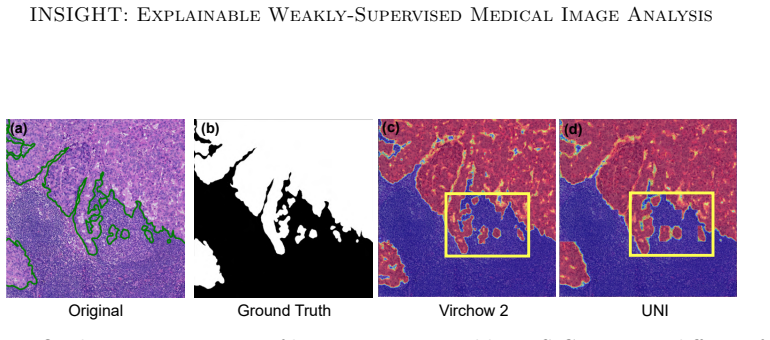
On its own terms, the central discovery is that a weakly supervised aggregator can be designed so that heatmap generation is an inductive bias rather than a post-hoc interpretation, and that this improves both tasks at once. INSIGHT forms a fused heatmap $H = \sigma((1-\sigma(H_{\mathrm{Con}}))\odot H_{\mathrm{Det}})$, where a detection module built from small convolutions highlights fine details and a context module with larger convolutions suppresses false positives; Otsu thresholding then isolates high-saliency regions, and SmoothMax pooling turns the thresholded heatmap into the categorical prediction. With only image-level labels, the paper reports AUC 0.990 and Dice 74.6% on CAMELYON16 using UNI features (Dice 78.3% with Virchow2), AUC 0.962 on MosMed CT, and multi-label AUC gains of 3.3 points for ADH and FEA on BRACS. It also reports that these built-in heatmaps substantially outperform Grad-CAM in Dice on the same encoders, and that the small-lesion Dice advantage over MIL baselines is statistically significant.
Load-bearing premise
The load-bearing premise is that end-to-end training works despite the non-differentiable Otsu threshold in $H' = H\cdot \mathbb{I}(H>T)$; if gradients cannot reach the detection and context modules for below-threshold regions, the described heatmap-learning mechanism would not actually be what is being optimized.
Editorial extensions
If this is right
- On CAMELYON16 with UNI features, INSIGHT reports AUC 0.990 and Dice 74.6%, 6.9 Dice points above the best compared MIL baseline; with Virchow2 features, Dice reaches 78.3%.
- On MosMed COVID-19 CT, INSIGHT reports classification AUC 0.962 versus 0.914 for the best baseline, and volume-level heatmap Dice 42.7%, above both a fully supervised 3D U-Net (40.5%) and a weakly supervised 3D GAN (41.2%).
- On the multi-label BRACS dataset, INSIGHT improves ADH and FEA AUC by 3.3 points over the best compared aggregator while matching or beating it on DCIS and Invasive, indicating that per-class heatmaps can separate coexisting lesion subtypes.
- In the stratified lesion-size analysis, INSIGHT's Dice advantage over MIL baselines is largest for small and moderate lesions—for example, 42.8% versus 20.7% for CLAM-MB with UNI—with differences significant at $p<0.01$.
- The ablation study attributes the localization gain to the two architectural choices: context suppression alone raises CAMELYON16 Dice by 16.6 points, and adding SmoothMax pooling raises it by another 34.6 points.
Reading between the lines
- Because INSIGHT only needs a spatially preserving pretrained encoder, the same detection-context fusion could be dropped onto newer foundation models as they appear; the paper tests two pathology encoders, but a natural extension is to measure whether the Dice gains persist with each new encoder generation.
- The reported small-lesion gains suggest that Otsu thresholding plus SmoothMax pooling is acting as a spatial denoiser; a direct test would be to replace the hard threshold with a differentiable soft threshold and compare Dice, which would also remove the gradient-flow concern in Eq. (2).
- The built-in heatmaps could be used as pseudo-labels to bootstrap fully supervised segmentation or to let clinicians refine, rather than create, annotations; the paper mentions this as future value but does not evaluate it.
- The use of one global Otsu threshold per heatmap may be a limitation when a slide contains lesions with very different intensity profiles; testing per-region or per-scale thresholding would show whether a single threshold is load-bearing for the localization claim.
Editorial analysis
A structured set of objections, weighed in public.
Referee Report
Summary. The paper introduces INSIGHT, a weakly-supervised aggregator for whole-slide images and CT volumes. Starting from pre-trained spatial embeddings, INSIGHT uses a detection module with small convolutional kernels and a context module with larger kernels to produce an internal heatmap, which is then thresholded with Otsu's method and aggregated by SmoothMax pooling to yield classification predictions. Training uses binary cross-entropy plus a spectral-decoupling regularizer. The authors evaluate on MosMed, CAMELYON16, and BRACS, reporting classification AUC and weakly-labeled Dice scores, and compare built-in heatmaps against Grad-CAM. The central claim is that end-to-end learning with image-level labels produces both state-of-the-art classification and high-quality internal heatmaps that align with diagnostically relevant regions without post-hoc visualization.
Significance. If the method works as described, INSIGHT is a useful contribution: it replaces post-hoc saliency methods with a built-in heatmap pathway, demonstrates compatibility with several foundation models (UNI, Virchow2, DINOv2), and reports gains on small-lesion Dice on the held-out CAMELYON16 test set. The evaluation is largely sound in design: it uses external public benchmarks with held-out test labels, hyperparameters are selected on a validation set, and code is publicly available, so the main quantitative claims are not circular. However, the paper currently leaves a load-bearing training detail unspecified: how gradients flow through the non-differentiable Otsu threshold in Eq. (2). In addition, the ablation narrative in Sec. 5.5 is internally inconsistent with Table 6. These issues must be resolved before the central claim can be considered reproducible.
major comments (3)
- [Sec. 3.2, Eq. (2); Appendix D] The paper never specifies how gradients flow through the hard threshold H′ = H · I(H > T). The indicator function has zero derivative almost everywhere, so if this operation is part of the training graph, no learning signal reaches the detection or context modules for any heatmap entry below the Otsu threshold; if the threshold is instead applied only at inference, then the method described in Sec. 3.2 is not the method that was trained and evaluated. The pseudocode in Appendix D places the thresholding before SmoothMax pooling with no training/inference distinction, implying it is in the training forward pass. Because H′ is the only path from the classification loss to the convolutional modules, this is a load-bearing point for the paper's central claim. Please state explicitly whether a straight-through estimator, a soft threshold, or inference-only thresholding is used, and provide evidence about training behavior when lesion activations fall below the threshold.
- [Sec. 5.5, Table 6] The text claims that adding regularization (Row 4) 'improves both AUC and Dice across datasets,' but Table 6 shows that on CAMELYON16 the Dice score decreases from 76.7 ± 15.7 (Row 3) to 74.6 ± 19.1 (Row 4) when the regularizer is added, while AUC increases from 0.969 to 0.990. The narrative also mentions that 'label smoothing' benefits BRACS, but label smoothing is not described in Sec. 3.3 or in the ablation table. Please correct the text to match the numbers and specify exactly which regularizer or combination of regularizers is included in the Rg column.
- [Sec. 5.1, Table 1; Sec. 5.2] On MosMed, the reported segmentation Dice of 42.7 ± 15.3 for INSIGHT overlaps within one standard deviation with the 3D GAN baseline (41.2 ± 14.7) and with 3D U-Net* (40.5 ± 21.3), so the claim of 'state-of-the-art performance' on this dataset is not statistically substantiated. The abstract's broader claim of 'high weakly-labeled semantic segmentation performance' rests mainly on the CAMELYON16 results. Please provide significance testing across the five folds for the MosMed Dice comparison, or temper the claim accordingly.
minor comments (6)
- [Sec. 3.2 and Appendix D] Equation (3) defines SmoothMax pooling over entries H′_i, while the pseudocode in Appendix D pools over the stitched full heatmap H_full; please clarify whether pooling is applied per patch and then aggregated or directly on the full-resolution heatmap.
- [Sec. 3.2] The citation to Maddison et al. (2016) refers to the Concrete distribution paper, which is not the standard reference for the SmoothMax (softmax-weighted average) pooling used here; consider citing a more direct source or defining the operator without that citation.
- [Sec. 4.1] For MosMed-B, please state explicitly how the Dice score is aggregated over the 50 volumes (per-volume mean, slice-wise mean, or pooled over all voxels) so that the reported mean and standard deviation are interpretable.
- [Sec. 4.1 and Appendix A] The input description says CT volumes are resized to 518 × 518 × 32, but the encoder input is 224 × 224; please clarify how slices are sampled or cropped before feature extraction.
- [Sec. 2.3] The sentence ending '...producing calibrated, built-in heatmaps as part of its predictions, as shown in Fig. 3. ensures alignment between the model’s outputs and diagnostic reasoning.' is a fragment and should be rewritten.
- [Sec. 5.5] The claim that SmoothMax pooling 'yields a substantial Dice increase of 34.6 on CAMELYON16' is consistent with Table 6 (from 42.1 to 76.7), but the text later says the increase is 34.6 without specifying the baseline row; please clarify that the comparison is between Row 2 and Row 3.
Circularity Check
No circularity: INSIGHT's classification and heatmap outputs are trained with image-level labels and evaluated on external held-out benchmarks, with no fitted parameter renamed as a prediction.
full rationale
INSIGHT's derivation chain is self-contained against external benchmarks. The classification prediction in Eq. (3) is a SmoothMax pooling of the internally generated heatmap H' defined by Eqs. (1)-(2), and the only training signals are the slide/volume-level binary cross-entropy and spectral decoupling losses in Eqs. (4)-(5); no pixel-level segmentation label enters training. The localization claim is then verified on held-out test sets (CAMELYON16's official 129 slides, BRACS's official test split, and MosMed-B's voxel annotations) using Dice, so the reported heatmap quality is an evaluated output rather than a fitted input. Hyperparameters such as the SmoothMax sharpness alpha, learning rate, and spectral decoupling strength were selected on the Camelyon16 validation set and then applied to BRACS and MosMed without further tuning, which is conventional validation-based tuning rather than fitting to test labels. The paper cites prior work by its own authors (e.g., OccamNets in the context of spectral decoupling and Casson et al. as general MIL background), but none of these citations carries the central derivation; the method's forward equations and loss are stated in the paper, and the encoders (UNI, Virchow 2, DINOv2) are externally published foundation models. The non-differentiable Otsu threshold indicator in Eq. (2) raises a reproducibility and gradient-flow question, but that is a correctness concern rather than evidence that any equation reduces to its inputs. No fitted parameter is renamed as a prediction, no uniqueness theorem is imported from the authors' prior work, and no ansatz is smuggled in via self-citation. The central contribution is therefore not circular.
Assumptions & free parameters
free parameters (4)
- SmoothMax sharpness alpha =
chosen from {4,6,8,10} on Camelyon16 validation
- Spectral decoupling strength lambda_SD =
chosen from {0,0.01,0.05} on Camelyon16 validation
- Learning rate =
chosen from {5e-5, 1e-4, 3e-4} on Camelyon16 validation
- Weight decay =
1e-4
assumptions (5)
- domain assumption Pre-trained ViT feature maps at 14x14 resolution retain enough spatial detail for lesion localization after 1x1 and 3x3 convolutions.
- ad hoc to paper The hard Otsu threshold in Eq. (2) permits end-to-end training without a described gradient approximation.
- domain assumption Lungmask correctly isolates lung parenchyma in MosMed.
- domain assumption QuPath-extracted BRACS subtype labels are accurate enough for supervision.
- domain assumption Spectral decoupling improves generalization as argued by its citations.
Cite this review
Pith. "Pith review of INSIGHT: Explainable Weakly-Supervised Medical Image Analysis." pith.science (2026). https://pith.science/paper/LA5JRLLR
@misc{pith2026241202012,
  author       = {Pith},
  title        = {Pith review of: INSIGHT: Explainable Weakly-Supervised Medical Image Analysis},
  year         = {2026},
  howpublished = {\url{https://pith.science/paper/LA5JRLLR}},
  note         = {Machine review of arXiv:2412.02012}
}
read the original abstract
Due to their large sizes, volumetric scans and whole-slide pathology images (WSIs) are often processed by extracting embeddings from local regions and then an aggregator makes predictions from this set. However, current methods require post-hoc visualization techniques (e.g., Grad-CAM) and often fail to localize small yet clinically crucial details. To address these limitations, we introduce INSIGHT, a novel weakly-supervised aggregator that integrates heatmap generation as an inductive bias. Starting from pre-trained feature maps, INSIGHT employs a detection module with small convolutional kernels to capture fine details and a context module with a broader receptive field to suppress local false positives. The resulting internal heatmap highlights diagnostically relevant regions. On CT and WSI benchmarks, INSIGHT achieves state-of-the-art classification results and high weakly-labeled semantic segmentation performance. Project website and code are available at: https://zhangdylan83.github.io/ewsmia/
Figures


Figures from the paper (6 more)



Reference graph
Works this paper leans on
-
[2]
URL https://arxiv.org/abs/2101.09976. Gabriele Campanella, Matthew G Hanna, Luke Geneslaw, Allen Miraflor, Vitor Werneck Krauss Silva, Klaus J Busam, Edi Brogi, Victor E Reuter, David S Klimstra, and Thomas J Fuchs. Clinical-grade computational pathology using weakly supervised deep learning on whole slide images. Nature medicine,
-
[4]
Joseph Paul Cohen, Paul Bertin, and Vincent Frappier
doi: 10.1016/j.media.2021.102105. Joseph Paul Cohen, Paul Bertin, and Vincent Frappier. Chester: A web delivered locally computed chest x-ray disease prediction system,
-
[6]
URL https://arxiv.org/abs/1802.02212. Alexey Dosovitskiy, Lucas Beyer, Alexander Kolesnikov, Dirk Weissenborn, Xiaohua Zhai, Thomas Unterthiner, Mostafa Dehghani, Matthias Minderer, Georg Heigold, Sylvain Gelly, Jakob Uszkoreit, and Neil Houlsby. An image is worth 16x16 words: Transformers for image recognition at scale,
-
[7]
Jun Fu, Jing Liu, Haijie Tian, Yong Li, Yongjun Bao, Zhiwei Fang, and Hanqing Lu
URL https://arxiv.org/abs/2010.11929. Jun Fu, Jing Liu, Haijie Tian, Yong Li, Yongjun Bao, Zhiwei Fang, and Hanqing Lu. Dual attention network for scene segmentation. In Proceedings of the IEEE/CVF conference on computer vision and pattern recognition , pages 3146–3154,
arXiv 2010
-
[8]
URL https://arxiv.org/abs/2102.06169. Julia Hofmanninger, Florian Prayer, Jianning Pan, et al. Automatic lung segmentation in routine imaging is primarily a data diversity problem, not a methodology problem. European Radiology Experimental, 4(1):50,
-
[9]
doi: 10.1186/s41747-020-00173-2. Maximilian Ilse, Jakub M. Tomczak, and Max Welling. Attention-based deep multiple instance learning,
-
[12]
doi: 10.1093/gigascience/giy065. Xiaoming Liu, Quan Yuan, Yaozong Gao, Kelei He, Shuo Wang, Xiao Tang, Jinshan Tang, and Dinggang Shen. Weakly supervised segmentation of covid19 infection with scribble annotation on ct images. Pattern Recognition, 122:108341,
-
[13]
doi: https://doi.org/10.1016/j.patcog.2021.108341
ISSN 0031-3203. doi: https://doi.org/10.1016/j.patcog.2021.108341. URL https://www.sciencedirect.com/ science/article/pii/S0031320321005215. Fangfang Lu, Zhihao Zhang, Tianxiang Liu, Chi Tang, Hualin Bai, Guangtao Zhai, Jingjing Chen, and Xiaoxin Wu. A weakly supervised inpainting-based learning method for lung ct image segmentation. Pattern Recognition, ...
Show all 29 references
-
[15]
The concrete distribution: A contin- uous relaxation of discrete random variables
Chris J Maddison, Andriy Mnih, and Yee Whye Teh. The concrete distribution: A contin- uous relaxation of discrete random variables. arXiv preprint arXiv:1611.00712 ,
-
[16]
URL https: //arxiv.org/abs/2005.06465. Omar S. M. El Nahhas, Marko van Treeck, Georg W¨ olflein, Michaela Unger, Marta Ligero, Tim Lenz, Sophia J. Wagner, Katherine J. Hewitt, Firas Khader, Sebastian Foersch, Daniel Truhn, and Jakob Nikolas Kather. From whole-slide image to bi...
2005 arXiv
-
[17]
URL https://arxiv.org/abs/2312.10944. Maxime Oquab, Timoth´ ee Darcet, Th´ eo Moutakanni, Huy Vo, Marc Szafraniec, Vasil Khali- dov, Pierre Fernandez, Daniel Haziza, Francisco Massa, Alaaeldin El-Nouby, Mahmoud Assran, Nicolas Ballas, Wojciech Galuba, Russell Howes, Po-Yao Hua...
-
[19]
Joona Pohjonen, Carolin St¨ urenberg, Antti Rannikko, Tuomas Mirtti, and Esa Pitk¨ anen
URL https://arxiv.org/abs/2301.02933. Joona Pohjonen, Carolin St¨ urenberg, Antti Rannikko, Tuomas Mirtti, and Esa Pitk¨ anen. Spectral decoupling for training transferable neural networks in medical imaging.Iscience,
-
[21]
URL http://dx.doi
doi: 10.1117/12.2550857. URL http://dx.doi. org/10.1117/12.2550857. Ramprasaath R. Selvaraju, Michael Cogswell, Abhishek Das, Ramakrishna Vedantam, Devi Parikh, and Dhruv Batra. Grad-cam: Visual explanations from deep networks via gradient-based localization. International Jou...
-
[22]
URL https://doi.org/10.1016/j.compbiomed.2022.106033
doi: 10.1016/j.compbiomed.2022.106033. URL https://doi.org/10.1016/j.compbiomed.2022.106033. Zhuchen Shao, Hao Bian, Yang Chen, Yifeng Wang, Jian Zhang, Xiangyang Ji, and Yong- bing Zhang. Transmil: Transformer based correlated multiple instance learning for whole slide image ...
2022
-
[23]
Robik Shrestha, Kushal Kafle, and Christopher Kanan
URL https://arxiv.org/abs/2106.00908. Robik Shrestha, Kushal Kafle, and Christopher Kanan. An investigation of critical issues in bias mitigation techniques. In WACV, 2022a. Robik Shrestha, Kushal Kafle, and Christopher Kanan. Occamnets: Mitigating dataset bias by favoring sim...
-
[24]
Ostap Viniavskyi, Mariia Dobko, and Oles Dobosevych
URL https://arxiv.org/abs/1706.03762. Ostap Viniavskyi, Mariia Dobko, and Oles Dobosevych. Weakly-supervised segmentation for disease localization in chest x-ray images. In Artificial Intelligence in Medicine , pages 249–259. Springer International Publishing,
-
[25]
doi: 10.1007/978-3-030-59137-3
-
[26]
Eugene Vorontsov, Alican Bozkurt, Adam Casson, George Shaikovski, Michal Zelechowski, Kristen Severson, Eric Zimmermann, James Hall, Neil Tenenholtz, Nicolo Fusi, et al
URL https://doi.org/10.1007/978-3-030-59137-3_23 . Eugene Vorontsov, Alican Bozkurt, Adam Casson, George Shaikovski, Michal Zelechowski, Kristen Severson, Eric Zimmermann, James Hall, Neil Tenenholtz, Nicolo Fusi, et al. A foundation model for clinical-grade computational path...
-
[27]
doi: https://doi.org/10.1016/ j.media.2023.102771
ISSN 1361-8415. doi: https://doi.org/10.1016/ j.media.2023.102771. URL https://www.sciencedirect.com/science/article/pii/ S1361841523000324. Qinghao Ye, Yuan Gao, Weiping Ding, Zhangming Niu, Chengjia Wang, Yinghui Jiang, Minhao Wang, Evandro Fei Fang, Wade Menpes-Smith, Jun X...
2023
-
[28]
doi: https://doi.org/10
ISSN 1568-4946. doi: https://doi.org/10. 1016/j.asoc.2021.108291. URL https://www.sciencedirect.com/science/article/ pii/S1568494621010966. Xin Zhang, Liangxiu Han, Wenyong Zhu, Liang Sun, and Daoqiang Zhang. An ex- plainable 3d residual self-attention deep neural network for ...
2021
-
[29]
doi: 10.1109/jbhi.2021.3066832
ISSN 2168-2208. doi: 10.1109/jbhi.2021.3066832. URL http://dx.doi.org/10.1109/JBHI.2021.3066832. Bolei Zhou, Aditya Khosla, Agata Lapedriza, Aude Oliva, and Antonio Torralba. Learning deep features for discriminative localization,
2021
-
[1979]
doi: 10.1109/TSMC.1979. 4310076. Pushpak Pati, Guillaume Jaume, Zeineb Ayadi, Kevin Thandiackal, Behzad Bozorgtabar, Maria Gabrani, and Orcun Goksel. Weakly supervised joint whole-slide segmentation and classification in prostate cancer,
1979 doi
-
[2015]
Anindo Saha, Fakrul I
URL https://arxiv.org/abs/1505.04597. Anindo Saha, Fakrul I. Tushar, Khrystyna Faryna, Vincent M. D’Anniballe, Rui Hou, Maciej A. Mazurowski, Geoffrey D. Rubin, and Joseph Y. Lo. Weakly supervised 3d classification of chest ct using aggregated multi-resolution deep segmentatio...
2020 arXiv
-
[2017]
Richard J Chen, Tong Ding, Ming Y Lu, Drew FK Williamson, Guillaume Jaume, Bowen Chen, Andrew Zhang, Daniel Shao, Andrew H Song, Muhammad Shaban, et al
URL https://arxiv.org/abs/1606.00915. Richard J Chen, Tong Ding, Ming Y Lu, Drew FK Williamson, Guillaume Jaume, Bowen Chen, Andrew Zhang, Daniel Shao, Andrew H Song, Muhammad Shaban, et al. Towards a general-purpose foundation model for computational pathology. Nature Medicine,
-
[2018]
Issam Laradji, Pau Rodriguez, Oscar Manas, Keegan Lensink, Marco Law, Lironne Kurz- man, William Parker, David Vazquez, and Derek Nowrouzezahrai
URL https://arxiv.org/abs/1802.04712. Issam Laradji, Pau Rodriguez, Oscar Manas, Keegan Lensink, Marco Law, Lironne Kurz- man, William Parker, David Vazquez, and Derek Nowrouzezahrai. A weakly supervised consistency-based learning method for covid-19 segmentation in ct images....
2007 arXiv
-
[2020]
Pierre Courtiol, Eric W
URL https://arxiv.org/abs/ 1901.11210. Pierre Courtiol, Eric W. Tramel, Marc Sanselme, and Gilles Wainrib. Classification and disease localization in histopathology using only global labels: A weakly-supervised ap- proach,
1901 arXiv
-
[2021]
URL https://arxiv.org/ abs/2111.04740. Keno K. Bressem, Stefan M. Niehues, Bernd Hamm, Marcus R. Makowski, Janis L. Vahldiek, and Lisa C. Adams. 3d u-net for segmentation of covid-19 associated pulmonary infiltrates using transfer learning: State-of-the-art results on affordab...
-
[2022]
Available at SSRN: https://ssrn.com/abstract=4230902 or http://dx.doi.org/10.2139/ssrn.4230902
doi: 10.2139/ssrn.4230902. Available at SSRN: https://ssrn.com/abstract=4230902 or http://dx.doi.org/10.2139/ssrn.4230902. 18 INSIGHT: Explainable Weakly-Supervised Medical Image Analysis Tsung-Yi Lin, Piotr Doll´ ar, Ross Girshick, Kaiming He, Bharath Hariharan, and Serge Bel...
-
[2023]
doi: https://doi.org/10.1016/j.patcog.2023.109861
ISSN 0031-3203. doi: https://doi.org/10.1016/j.patcog.2023.109861. URL https://www.sciencedirect.com/ science/article/pii/S0031320323005599. Ming Y Lu, Drew FK Williamson, Tiffany Y Chen, Richard J Chen, Matteo Barbieri, and Faisal Mahmood. Data-efficient and weakly supervised...
2023
Reviewed August 11, 2026 · model on record in the stance chip above.
Discussion (0). Continue with ORCID to comment.