REVIEW 4 major objections 4 minor 143 references
Neurophysiologically Realistic Environment for Comparing Adaptive Deep Brain Stimulation Algorithms in Parkinson Disease
T0 review · 4 major / 4 minor · reviewed 2026-08-16 · deepseek-v4-flash
Pith's one-line read This paper claims to provide the first neurophysiologically realistic benchmark for adaptive deep brain stimulation, a Kuramoto-oscillator environment with 15 previously ignored physiological features, and uses it to compare RL…
desk verdict A genuinely useful, well-built aDBS simulation testbed whose 'realistic' label is over-sold and whose headline algorithm ranking is not yet tested for robustness. read the letter →
The pith
A machine-rendered reading of the paper's core claim, the machinery that carries it, and where it could break.
The reading
What carries the argument
The central object is a spatial Kuramoto model of N phase oscillators (default 512 on an 8×8×8 grid) with phase dynamics dθ_n/dt = ω_n + (K/N) Σ_m W_mn sin(θ_m − θ_n) + V(θ_n) A, where W_mn = cos(α_mn) encodes distance-dependent coupling, V(θ_n) = G(α_n,el) · PRC(θ_n) couples electrode stimulation, and the LFP is a conductance-weighted average of cos(θ_n). Around this core, the environment layers three feature groups—bandwidth (natural frequency distribution producing low and high beta), spatial (beta locus, partial observability, directional multi-contact electrodes), and temporal (STDP-based neural drift, electrode drift, encapsulation, burst modulation)—and exposes them as configurable parameters in a Gymnasium-style RL environment with sliding observation windows, a multi-contact action space, and reward functions trading beta power against energy.
What would settle it
Record simultaneous subthalamic LFP from a cohort of Parkinson's patients under continuous and adaptive DBS, feed the same recorded signals or their statistics into DBS-Gym with the same electrode geometry, and check whether the simulated LFP responses, beta-burst statistics, and PSD changes match the patient data; a systematic mismatch would show that the benchmark's algorithm rankings need not transfer to clinical reality.
Extended reading notes
Core claim
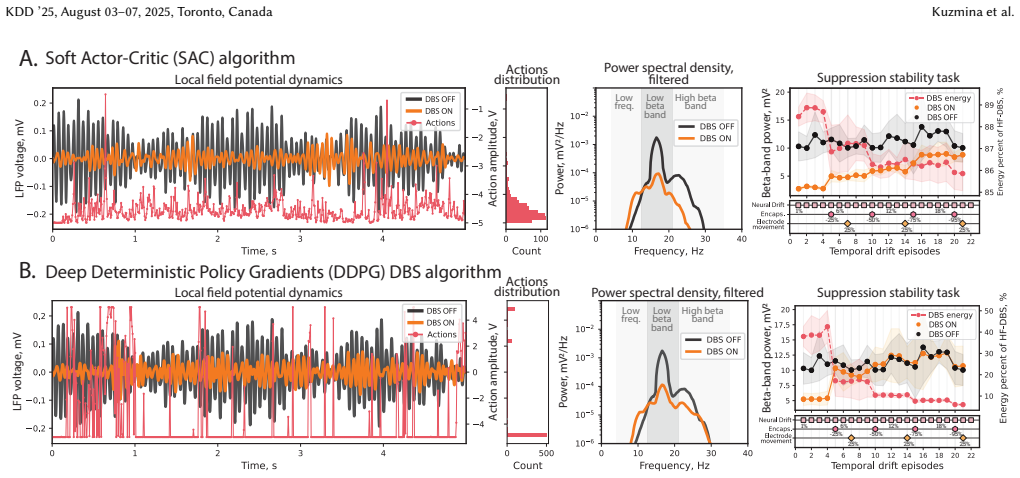
On its own terms, the paper introduces DBS-Gym as the first neurophysiologically realistic benchmark for adaptive deep brain stimulation, integrating 15 previously dismissed physiological attributes across spatial, temporal, and bandwidth feature groups, all modeled through Kuramoto phase oscillators on a 3D grid with distance-dependent coupling and electrode kernels. The environment reproduces PD-relevant LFP phenomena including beta bursting, partial observability, electrode drift, neural drift, and electrode encapsulation, and it supports configurable complexity levels (Env0, Env1, Env2) that isolate each feature group. Using this environment, the authors evaluate PI/PID and RL algorithms and report that Soft Actor-Critic (SAC) maintains the best balance of beta suppression and energy across all levels, while offline methods and DDPG degrade sharply under temporal drift.
Load-bearing premise
The benchmark's realism rests on the unverified assumption that the manually chosen Kuramoto-oscillator dynamics and drift schedules reproduce the patient-relevant phenomena that actually determine how well an adaptive DBS algorithm performs in a living brain.
Editorial extensions
If this is right
- Reinforcement learning agents can be pre-trained in the simulation and later fine-tuned on patient-specific data, addressing the scarcity of invasive aDBS training data.
- The environment provides a standardized benchmark for comparing future aDBS algorithms on a common beta-suppression-versus-energy trade-off, which the authors argue no previous synthetic model unified.
- The three-tiered complexity (Env0, Env1, Env2) allows researchers to isolate which feature domains (bandwidth, spatial, temporal) break which controllers, guiding algorithm design.
- Stochastic-policy algorithms like SAC appear more robust to electrode drift and encapsulation than deterministic or offline policies, suggesting a design guideline for clinically deployed controllers.
- Because the features are configurable, the testbed can be adapted to other stimulation pulse shapes, frequency bands, or neurological disorders without rebuilding the environment.
Reading between the lines
- If the environment's realism transfers to the clinic, this benchmark could make RL-aDBS studies comparable across labs; a natural extension would be a public leaderboard with fixed seeds and standardized hyperparameters.
- The only external validation—matching beta burst durations from one patient cohort—is narrow; a stronger test would compare simulated PSD changes under real cDBS recordings, which the authors do not perform.
- Since all parameters are hand-set, the benchmark's difficulty is somewhat arbitrary; one could invert the framework to tune environment parameters against real patient LFP datasets and thereby calibrate 'realism' quantitatively.
- The paper's suppression-stability task introduces a new evaluation axis—control resilience to progressive degradation—that could generalize to other implantable closed-loop brain-computer interfaces.
Signed reviews
Editorial analysis
A structured set of objections, weighed in public.
Referee Report
Summary. The paper introduces DBS-Gym, a configurable simulation environment for adaptive deep brain stimulation (aDBS) based on a spatially embedded Kuramoto oscillator network. The environment implements three groups of features—bandwidth (beta sub-bands, nonstationary PSD), spatial (beta locus geometry, partial observability, directional/multi-contact electrodes), and temporal (neural and electrode drift, encapsulation, beta-burst modulation)—organized into three environment levels of increasing complexity. The authors benchmark classic HF-DBS, random stimulation, PI/PID controllers, and five RL algorithms (PPO, SAC, DDPG, IQL, CQL-SAC) under three reward functions, reporting beta-power suppression and energy consumption. The main empirical findings are that SAC performs consistently well, IQL performs comparably under the first reward, DDPG degrades under temporal drift, and CQL-SAC fails to learn an effective policy. The paper claims to be the first neurophysiologically realistic benchmark for comparing aDBS algorithms.
Significance. The environment is a potentially valuable open-source contribution: it is computationally efficient (JAX, 512 oscillators), integrates with Gymnasium/Stable-Baselines3, and covers a wider set of features than previous synthetic models (Figure 1F). The algorithm ranking is emergent rather than fitted to a desired outcome, and the paper ships code and uses standard reproducible RL implementations. If the configuration is made fully explicit and the ranking is shown to be robust to parameter variation, DBS-Gym could serve as a useful standard testbed for aDBS controller development. However, the 'neurophysiologically realistic' claim currently rests on a single visual burst-duration comparison, and the benchmark's usefulness for algorithm comparison hinges on the parameter sensitivity analysis that is not yet provided.
major comments (4)
- [§3.1, §3.4, Table A1, Appendix A.5.2] The environment's core parameters are not fully specified, and the reported configuration is internally inconsistent. The coupling constant K in Eq. (1) is stated to control beta bursting (§3.2.3) but is not listed in Table A1 nor given in Appendix A.5.2. 'Beta locus size, %' is 0.55 in Table A1, while Appendix A.5.2 says the locus was about 25% of neurons. In addition, §3.4 states the HF-DBS baseline uses a 90-microsecond pulse, but Table A1 sets 'Electrode stimulation duration' to 0.0015 s (1.5 ms), a 16-fold difference that changes the energy metric and the stimulation effect. These discrepancies make the exact training and evaluation setup unreproducible from the paper; please report K, reconcile the locus size, and correct or justify the pulse duration.
- [§4.2, Tables 1 and A2] The headline ranking (SAC > IQL/DDPG, CQL-SAC failure) is demonstrated at a single hand-set parameter point. No sensitivity analysis over K, beta-locus geometry, electrode distance, drift rates, or reward weights is presented. Because the environment's dynamics depend strongly on these choices (§3.2, Eq. (1)), the reported ranking may be an artifact of one configuration. Please provide a sensitivity sweep over at least K, beta-locus size and position, and electrode drift/encapsulation rates, and report how the algorithm ordering changes or, if it does not, the range over which it is stable.
- [§1, §3.2, Figure 1D] The central claim of 'neurophysiologically realistic' is supported only by a visual comparison of simulated beta burst durations with one patient cohort (Figure 1D); no quantitative goodness-of-fit is reported, and the other modeled attributes are justified by references rather than validated against experimental recordings. The limitations section (Appendix A.2) itself concedes that tissue volume activation, electrode capacitance, and other factors are not fully incorporated. Please add quantitative agreement measures (e.g., burst-duration distribution statistics, PSD peak location and width) and, if such validation is not yet available, soften the realism claim to 'mechanistically motivated' in the abstract and §1.
- [§4.1.2, §4.2] The evaluation protocol trains and evaluates each algorithm on the same environment parameter distributions, so the reported performance differences reflect interpolation within one parameter regime rather than generalization across plausible clinical conditions. Even though Env2 includes drift events during evaluation, the underlying parameters remain in the training regime. For a benchmark whose purpose is to compare aDBS controllers for deployment, please include at least one held-out parameter configuration or an explicit out-of-distribution test to substantiate the claim that the ranking is robust and would transfer to unseen patient conditions.
minor comments (4)
- [Table A2, Figure 3] Units and labels are inconsistent: Table A2 mixes '%' and 'mV^2' for beta power across reward columns, and Figure 3 axis labels contain 'mV/two.numerator' and 'mV/two.numerator/Hz', evidently LaTeX artifacts. Please unify units and fix the axis labels.
- [Eq. (7), Appendix A.6.4] The discrete-time PID update uses t-1 for the integral and derivative terms; please clarify the discretization and report the tuned gains Kp, Ki, Kd for the PI/PID controllers, which are not listed despite being tuned with Optuna.
- [Table A1] The row 'Directed stimulation TURN ON - - -' is ambiguous: the main text says non-directional single-contact stimulation was used, so please replace the entries with explicit True/False values for each environment level.
- [§3.3.1, Table A1] The observation window is described as a user-defined hyperparameter with a 1.2-second recommendation in §3.3.1, while Table A1 lists 'Observation window duration' as 1.17 s; please align these values.
Circularity Check
No significant circularity: benchmark outcomes are emergent and no prediction reduces to a fitted input.
full rationale
Walked the claimed derivation chain: DBS-Gym is a constructed Kuramoto-based simulation environment, and the paper does not derive a physiological result from a fitted parameter. The benchmark rankings (Table 1, Fig. 3) are emergent outputs of running published RL/PID controllers in this environment, so they are not equivalent to the environment's inputs by construction. The realism claim rests on manually chosen coefficients (Sections 3.2.1-3.2.3, Table A1) and on one external visual comparison of beta-burst durations against [114] (Fig. 1D); the text says adjusting K 'controls burst dynamics' but never states K was fitted to that patient distribution, and no equation equates the validation metric to a fitted parameter. The reward r2 (Eq. 5) is attributed to the authors' prior work [64], but the headline comparison uses r1 (Eq. 4); the 'only one prior RL framework' sentence in Section 5 is a novelty assertion, not a load-bearing theorem, and the environment and algorithmic results stand independently of it. Appendix A.2 candidly lists unmodeled factors, and Table A1's omission of K plus the 55% vs 25% beta-locus discrepancy are reproducibility and validity concerns, not circular reductions. No step makes a 'prediction' reduce to its own inputs, so the appropriate finding is no significant circularity.
Assumptions & free parameters
free parameters (7)
- Coupling constant K =
not reported in text (set in code)
- Natural frequency distribution (mean, sd, band layout) =
mean 17 Hz, sd 1 Hz; plus low band 4 to 8 Hz
- Beta locus size and position =
55% of neurons; center [4,4,4] (Env0)
- Electrode kernel scaling and distance scaling =
0.1 for both
- Temporal drift rates (electrode shift, encapsulation, neural drift) =
shift every 7 +/- 2 episodes; 2% encapsulation per event; 2% frequency drift per episode (training Env2)
- Reward weights lambda and kappa =
lambda_r1=1e4, kappa_r1=0.01; lambda_r2=1000, kappa_r2=0.01; lambda_r3=1e4, kappa_r3=0.1
- Observation window and pulse timing =
1.17 s observation window; 0.0015 s stimulation, 0.0075 s pause
assumptions (6)
- domain assumption A Kuramoto phase-oscillator network with cosine spatial coupling is an adequate proxy for basal ganglia / STN LFP dynamics in PD.
- domain assumption Beta-band power suppression (13 to 21 Hz) is the appropriate therapeutic objective and feedback signal for aDBS controllers.
- domain assumption LFP observation as N^-1 sum cos(theta_n) G(alpha_{n,el}) is a valid measurement model.
- domain assumption Simulated non-stationarities (electrode shifts, encapsulation, frequency drift) capture the real-world processes that matter for aDBS robustness.
- ad hoc to paper The evaluation protocol (training and testing on the same environment parameters) is sufficient to rank aDBS controllers.
- standard math Numerical integration with RK45 and the chosen step size yields accurate-enough trajectories for RL training.
Cite this review
Pith. "Pith review of Neurophysiologically Realistic Environment for Comparing Adaptive Deep Brain Stimulation Algorithms in Parkinson Disease." pith.science (2026). https://pith.science/paper/LA6PMXKH
@misc{pith2026250509624,
  author       = {Pith},
  title        = {Pith review of: Neurophysiologically Realistic Environment for Comparing Adaptive Deep Brain Stimulation Algorithms in Parkinson Disease},
  year         = {2026},
  howpublished = {\url{https://pith.science/paper/LA6PMXKH}},
  note         = {Machine review of arXiv:2505.09624}
}
read the original abstract
Adaptive deep brain stimulation (aDBS) has emerged as a promising treatment for Parkinson disease (PD). In aDBS, a surgically placed electrode sends dynamically altered stimuli to the brain based on neurophysiological feedback: an invasive gadget that limits the amount of data one could collect for optimizing the control offline. As a consequence, a plethora of synthetic models of PD and those of the control algorithms have been proposed. Herein, we introduce the first neurophysiologically realistic benchmark for comparing said models. Specifically, our methodology covers not only conventional basal ganglia circuit dynamics and pathological oscillations, but also captures 15 previously dismissed physiological attributes, such as signal instabilities and noise, neural drift, electrode conductance changes and individual variability - all modeled as spatially distributed and temporally registered features via beta-band activity in the brain and a feedback. Furthermore, we purposely built our framework as a structured environment for training and evaluating deep reinforcement learning (RL) algorithms, opening new possibilities for optimizing aDBS control strategies and inviting the machine learning community to contribute to the emerging field of intelligent neurostimulation interfaces.
Figures


Reference graph
Works this paper leans on
-
[1]
Juan A Acebrón, Luis L Bonilla, Conrad J Pérez Vicente, Félix Ritort, and Renato Spigler. 2005. The Kuramoto model: A simple paradigm for synchronization phenomena. Reviews of modern physics 77, 1 (2005), 137–185
2005
-
[2]
Jason Adair, Alexander Brownlee, Fabio Daolio, and Gabriela Ochoa. 2018. Evolv- ing training sets for improved transfer learning in brain computer interfaces. In Machine Learning, Optimization, and Big Data: Third International Confer- ence, MOD 2017, Volterra, Italy, September 14–17, 2017, Revised Selected Papers 3 . Springer, 186–197
2018
-
[3]
Harsh Agarwal and Heena Rathore. 2023. Novel Reinforcement Learning Algo- rithm for Suppressing Synchronization in Closed Loop Deep Brain Stimulators. In 2023 11th International IEEE/EMBS Conference on Neural Engineering (NER) . IEEE, 1–5
2023
-
[4]
Takuya Akiba, Shotaro Sano, Toshihiko Yanase, Takeru Ohta, and Masanori Koyama. 2019. Optuna: A next-generation hyperparameter optimization frame- work. In Proceedings of the 25th ACM SIGKDD international conference on knowl- edge discovery & data mining . 2623–2631
2019
-
[5]
Joshua E Aman, Luke A Johnson, David Escobar Sanabria, Jing Wang, Remi Patriat, Meghan Hill, Ethan Marshall, Colum D MacKinnon, Scott E Cooper, Lauren E Schrock, et al. 2020. Directional deep brain stimulation leads reveal spa- tially distinct oscillatory activity in the globus pallidus internus of Parkinson’s disease patients. Neurobiology of disease 139...
2020
-
[6]
RW Anderson, YM Kehnemouyi, RS Neuville, KB Wilkins, CM Anidi, MN Petrucci, JE Parker, A Velisar, and HM Brontë-Stewart. 2020. A novel method for calculating beta band burst durations in Parkinson’s disease using a physio- logical baseline. Journal of neuroscience methods 343 (2020), 108811
2020
-
[7]
Ramin Azodi-Avval and Alireza Gharabaghi. 2015. Phase-dependent modulation as a novel approach for therapeutic brain stimulation.Frontiers in computational neuroscience 9 (2015), 26
2015
-
[8]
Fatemeh Bahadori-Jahromi, Sina Salehi, Mojtaba Madadi Asl, and Alireza Val- izadeh. 2023. Efficient suppression of parkinsonian beta oscillations in a closed- loop model of deep brain stimulation with amplitude modulation. Frontiers in human neuroscience 16 (2023), 1013155
2023
Show all 143 references
-
[9]
Roberta Balestrino and AHV Schapira. 2020. Parkinson disease. European journal of neurology 27, 1 (2020), 27–42
2020
-
[10]
Thomas S Binns, Richard M Köhler, Jonathan Vanhoecke, Meera Chikermane, Moritz Gerster, Timon Merk, Franziska Pellegrini, Johannes L Busch, Jeroen GV Habets, Allesia Cavallo, et al. 2024. Shared pathway-specific network mecha- nisms of dopamine and deep brain stimulation for t...
2024
-
[11]
Merrill J Birdno, Alexis M Kuncel, Alan D Dorval, Dennis A Turner, Robert E Gross, and Warren M Grill. 2012. Stimulus features underlying reduced tremor suppression with temporally patterned deep brain stimulation. Journal of neurophysiology 107, 1 (2012), 364–383
2012
-
[12]
Bastiaan R Bloem, Michael S Okun, and Christine Klein. 2021. Parkinson’s disease. The Lancet 397, 10291 (2021), 2284–2303
2021
-
[13]
James Bradbury, Roy Frostig, Peter Hawkins, Matthew James Johnson, Chris Leary, Dougal Maclaurin, George Necula, Adam Paszke, Jake VanderPlas, Skye Wanderman-Milne, and Qiao Zhang. 2018. JAX: composable transformations of Python+NumPy programs. http://github.com/jax-ml/jax
2018
-
[14]
Michael Breakspear, Stewart Heitmann, and Andreas Daffertshofer. 2010. Gen- erative models of cortical oscillations: neurobiological implications of the Ku- ramoto model. Frontiers in human neuroscience 4 (2010), 190
2010
-
[15]
Christopher R Butson, Scott E Cooper, Jaimie M Henderson, Barbara Wolgamuth, and Cameron C McIntyre. 2011. Probabilistic analysis of activation volumes generated during deep brain stimulation. Neuroimage 54, 3 (2011), 2096–2104
2011
-
[16]
Aine Byrne, Matthew J Brookes, and Stephen Coombes. 2017. A mean field model for movement induced changes in the beta rhythm. Journal of computational neuroscience 43 (2017), 143–158
2017
-
[17]
Hayriye Cagnan, Timothy Denison, Cameron McIntyre, and Peter Brown. 2019. Emerging technologies for improved deep brain stimulation. Nature biotechnol- ogy 37, 9 (2019), 1024–1033
2019
-
[18]
Hayriye Cagnan, Hil GE Meijer, Stephan A Van Gils, Martin Krupa, Tjitske Heida, Michelle Rudolph, Wytse J Wadman, and Hubert CF Martens. 2009. Frequency-selectivity of a thalamocortical relay neuron during Parkinson’s disease and deep brain stimulation: a computational study. ...
2009
-
[19]
Andrew Campbell and Chengyuan Wu. 2018. Chronically implanted intracranial electrodes: tissue reaction and electrical changes. Micromachines 9, 9 (2018), 430
2018
-
[20]
Chunyan Cao, Dianyou Li, Shikun Zhan, Chencheng Zhang, Bomin Sun, and Vladimir Litvak. 2020. L-dopa treatment increases oscillatory power in the motor cortex of Parkinson’s disease patients. NeuroImage: Clinical 26 (2020), 102255
2020
-
[21]
Kristen Carlson, Jay L Shils, Sahil Patel, Longzhi Mei, and Jeffrey Arle. 2021. Computational Modelling of Deep Brain Stimulation for Parkinson’s Disease: A Critical Review. OBM Neurobiology 5, 2 (2021), 1–31
2021
-
[22]
Michael Cassidy, Paolo Mazzone, Antonio Oliviero, Angelo Insola, Pietro Tonali, Vincenzo Di Lazzaro, and Peter Brown. 2002. Movement-related changes in synchronization in the human basal ganglia. Brain 125, 6 (2002), 1235–1246
2002
-
[23]
Frédéric Chapelle, Lucie Manciet, Bruno Pereira, Anna Sontheimer, Jérôme Coste, Youssef El Ouadih, Ruxandra Cimpeanu, Dimitri Gouot, Yuri Lapusta, Béa- trice Claise, et al. 2021. Early deformation of deep brain stimulation electrodes following surgical implantation: intracrani...
2021
-
[24]
Po-Lin Chen, Yi-Chieh Chen, Po-Hsun Tu, Tzu-Chi Liu, Min-Chi Chen, Hau- Tieng Wu, Mun-Chun Yeap, Chih-Hua Yeh, Chin-Song Lu, and Chiung-Chu Chen. 2022. Subthalamic high-beta oscillation informs the outcome of deep brain stimulation in patients with Parkinson’s disease. Frontie...
2022
-
[25]
Ziqin Chen, Timothy Anglea, Yuanzhao Zhang, and Yongqiang Wang. 2023. Op- timal synchronization in pulse-coupled oscillator networks using reinforcement learning. PNAS nexus 2, 4 (2023), pgad102
2023
-
[26]
David Cumin and CP2296240 Unsworth. 2007. Generalising the Kuramoto model for the study of neuronal synchronisation in the brain. Physica D: Nonlinear Phenomena 226, 2 (2007), 181–196
2007
-
[27]
Mohammad Daneshzand, Miad Faezipour, and Buket D Barkana. 2018. Robust desynchronization of Parkinson’s disease pathological oscillations by frequency modulation of delayed feedback deep brain stimulation. PloS one 13, 11 (2018), e0207761
2018
-
[28]
Per Danzl and Jeff Moehlis. 2007. Event-based feedback control of nonlinear oscillators using phase response curves. In2007 46th IEEE Conference on Decision and Control. IEEE, 5806–5811
2007
-
[29]
Alan D Degenhart, William E Bishop, Emily R Oby, Elizabeth C Tyler-Kabara, Steven M Chase, Aaron P Batista, and Byron M Yu. 2020. Stabilization of a brain–computer interface via the alignment of low-dimensional spaces of neural activity. Nature biomedical engineering 4, 7 (202...
2020
-
[30]
Andrey Dovzhenok, Choongseok Park, Robert M Worth, and Leonid L Rubchin- sky. 2013. Failure of delayed feedback deep brain stimulation for intermittent pathological synchronization in Parkinson’s disease. PLoS One 8, 3 (2013), e58264
2013
-
[31]
Hao Fang, Stephen A Berman, Yueming Wang, and Yuxiao Yang. 2023. Robust adaptive deep brain stimulation control of non-stationary cortex-basal ganglia- thalamus network models in parkinson’s disease. bioRxiv (2023), 2023–08
2023
-
[32]
Behnam Faraji, Korosh Rouhollahi, Akram Nezhadi, and Zahra Jamalpoor. 2022. A novel closed-loop deep brain stimulation technique for Parkinson’s patients rehabilitation utilizing machine learning. IEEE Sensors Journal 23, 3 (2022), 2914–2921
2022
-
[33]
Behnam Faraji, Korosh Rouhollahi, Saeed Mollahoseini Paghaleh, Meysam Gheis- arnejad, and Mohammad-Hassan Khooban. 2023. Adaptive multi symptoms control of Parkinson’s disease by deep reinforcement learning.Biomedical Signal Processing and Control 80 (2023), 104410
2023
-
[34]
AmirAli Farokhniaee and Madeleine M Lowery. 2021. Cortical network effects of subthalamic deep brain stimulation in a thalamo-cortical microcircuit model. Journal of Neural Engineering 18, 5 (2021), 056006
2021
-
[35]
Xiao-Jiang Feng, Eric Shea-Brown, Brian Greenwald, Robert Kosut, and Herschel Rabitz. 2007. Optimal deep brain stimulation of the subthalamic nucleus—a computational study. Journal of computational neuroscience 23 (2007), 265–282
2007
-
[36]
Fabiano Alan Serafim Ferrari, Ricardo L Viana, Sergio Roberto Lopes, and Ruedi Stoop. 2015. Phase synchronization of coupled bursting neurons and the gener- alized Kuramoto model. Neural Networks 66 (2015), 107–118
2015
-
[37]
John E Fleming, Eleanor Dunn, and Madeleine M Lowery. 2020. Simulation of closed-loop deep brain stimulation control schemes for suppression of patholog- ical beta oscillations in Parkinson’s disease. Frontiers in neuroscience 14 (2020), 520710
2020
-
[38]
John E Fleming, Jakub Orłowski, Madeleine M Lowery, and Antoine Chaillet
-
[39]
Alessio Franci, Antoine Chaillet, Elena Panteley, and Françoise Lamnabhi- Lagarrigue. 2012. Desynchronization and inhibition of Kuramoto oscillators by scalar mean-field feedback. Mathematics of Control, Signals, and Systems 24, 1 (2012), 169–217
2012
-
[40]
PK Fung, AL Haber, and PA Robinson. 2013. Neural field theory of plasticity in the cerebral cortex. Journal of Theoretical Biology 318 (2013), 44–57
2013
-
[41]
Qitong Gao, Michael Naumann, Ilija Jovanov, Vuk Lesi, Karthik Kamaravelu, Warren M Grill, and Miroslav Pajic. 2020. Model-based design of closed loop deep brain stimulation controller using reinforcement learning. In 2020 ACM/IEEE 11th International Conference on Cyber-Physica...
2020
-
[42]
Qitong Gao, Stephen L Schmidt, Afsana Chowdhury, Guangyu Feng, Jennifer J Peters, Katherine Genty, Warren M Grill, Dennis A Turner, and Miroslav Pajic
-
[43]
Ro’ee Gilron, Simon Little, Randy Perrone, Robert Wilt, Coralie de Hemptinne, Maria S Yaroshinsky, Caroline A Racine, Sarah S Wang, Jill L Ostrem, Paul S Larson, et al. 2021. Long-term wireless streaming of neural recordings for circuit discovery and adaptive stimulation in in...
2021
-
[44]
Ro’ee Gilron, Simon Little, Robert Wilt, Randy Perrone, Juan Anso, and Philip A Starr. 2021. Sleep-aware adaptive deep brain stimulation control: chronic use at home with dual independent linear discriminate detectors. Frontiers in Neuro- science 15 (2021), 732499
2021
-
[45]
Logan L Grado, Matthew D Johnson, and Theoden I Netoff. 2018. Bayesian adaptive dual control of deep brain stimulation in a computational model of Parkinson’s disease. PLoS computational biology 14, 12 (2018), e1006606
2018
-
[46]
Jitte Groothuis, Nick F Ramsey, Geert MJ Ramakers, and Geoffrey van der Plasse
-
[47]
Song Guo, Ping Zhuang, Mark Hallett, Zhe Zheng, Yuqing Zhang, Jianyu Li, and Yongjie Li. 2013. Subthalamic deep brain stimulation for Parkinson’s dis- ease: correlation between locations of oscillatory activity and optimal site of stimulation. Parkinsonism & Related Disorders ...
2013
-
[48]
Yixin Guo and Jonathan E Rubin. 2011. Multi-site stimulation of subthalamic nucleus diminishes thalamocortical relay errors in a biophysical network model. Neural Networks 24, 6 (2011), 602–616
2011
-
[49]
Tuomas Haarnoja, Aurick Zhou, Kristian Hartikainen, George Tucker, Se- hoon Ha, Jie Tan, Vikash Kumar, Henry Zhu, Abhishek Gupta, Pieter Abbeel, et al . 2018. Soft actor-critic algorithms and applications. arXiv preprint arXiv:1812.05905 (2018)
2018 arXiv
-
[50]
Philip J Hahn and Cameron C McIntyre. 2010. Modeling shifts in the rate and pattern of subthalamopallidal network activity during deep brain stimulation. Journal of computational neuroscience 28 (2010), 425–441
2010
-
[51]
David Hansel, German Mato, and Claude Meunier. 1993. Phase dynamics for weakly coupled Hodgkin-Huxley neurons. Europhysics Letters 23, 5 (1993), 367
1993
-
[52]
Mohammad Hemami, Jamal Amani Rad, and Kourosh Parand. 2021. Phase distribution control of neural oscillator populations using local radial basis function meshfree technique with application in epileptic seizures: A numerical simulation approach. Communications in Nonlinear Sci...
2021
-
[53]
Jeffrey A Herron, Margaret C Thompson, Timothy Brown, Howard Jay Chizeck, Jeffrey G Ojemann, and Andrew L Ko. 2017. Cortical brain–computer interface for closed-loop deep brain stimulation. IEEE Transactions on Neural Systems and Rehabilitation Engineering 25, 11 (2017), 2180–2187
2017
-
[54]
Alan L Hodgkin and Andrew F Huxley. 1952. A quantitative description of membrane current and its application to conduction and excitation in nerve. The Journal of physiology 117, 4 (1952), 500
1952
-
[55]
Abbey B Holt and Theoden I Netoff. 2016. Computational modeling to advance deep brain stimulation for the treatment of Parkinson’s disease. Drug Discovery Today: Disease Models 19 (2016), 31–36
2016
-
[56]
Abbey B Holt, Dan Wilson, Max Shinn, Jeff Moehlis, and Theoden I Netoff
-
[57]
Brady Houston, Margaret Thompson, Andrew Ko, and Howard Chizeck. 2019. A machine-learning approach to volitional control of a closed-loop deep brain stimulation system. Journal of neural engineering 16, 1 (2019), 016004
2019
-
[58]
Luke A Johnson, Shane D Nebeck, Abirami Muralidharan, Matthew D Johnson, Kenneth B Baker, and Jerrold L Vitek. 2016. Closed-loop deep brain stimulation effects on parkinsonian motor symptoms in a non-human primate–is beta enough? Brain stimulation 9, 6 (2016), 892–896
2016
-
[59]
Ilija Jovanov, Michael Naumann, Karthik Kumaravelu, Warren M Grill, and Miroslav Pajic. 2018. Platform for model-based design and testing for deep brain stimulation. In 2018 ACM/IEEE 9th International Conference on Cyber-Physical Systems (ICCPS). IEEE, 263–274
2018
-
[60]
Patrick Kidger. 2021. On Neural Differential Equations . Ph. D. Dissertation. University of Oxford
2021
-
[61]
Ilya Kostrikov, Ashvin Nair, and Sergey Levine. 2021. Offline Reinforcement Learning with Implicit Q-Learning. (2021)
2021
-
[62]
Joachim K Krauss, Nir Lipsman, Tipu Aziz, Alexandre Boutet, Peter Brown, Jin Woo Chang, Benjamin Davidson, Warren M Grill, Marwan I Hariz, Andreas Horn, et al. 2021. Technology of deep brain stimulation: current status and future directions. Nature Reviews Neurology 17, 2 (202...
2021
-
[63]
Dmitrii Krylov, Dmitry V Dylov, and Michael Rosenblum. 2020. Reinforcement learning for suppression of collective activity in oscillatory ensembles. Chaos: An Interdisciplinary Journal of Nonlinear Science 30, 3 (2020)
2020
-
[64]
Dmitrii Krylov, Remi Tachet, Romain Laroche, Michael Rosenblum, and Dmitry V Dylov. 2020. Reinforcement learning framework for deep brain stimulation study. arXiv preprint arXiv:2002.10948 (2020)
2020 arXiv
-
[65]
Karthik Kumaravelu, David T Brocker, and Warren M Grill. 2016. A biophysical model of the cortex-basal ganglia-thalamus network in the 6-OHDA lesioned rat model of Parkinson’s disease. Journal of computational neuroscience 40 (2016), 207–229
2016
-
[66]
Alexis M Kuncel and Warren M Grill. 2004. Selection of stimulus parameters for deep brain stimulation. Clinical neurophysiology 115, 11 (2004), 2431–2441
2004
-
[67]
Mikael Lindahl and Jeanette Hellgren Kotaleski. 2016. Untangling basal ganglia network dynamics and function: Role of dopamine depletion and inhibition investigated in a spiking network model. eneuro 3, 6 (2016)
2016
-
[68]
Simon Little and Peter Brown. 2012. Brain Stimulation in Neurology and Psy- chiatry. Annals of the New York Academy of Sciences 1265, 1 (2012), 9
2012
-
[69]
Simon Little, Alex Pogosyan, Spencer Neal, Baltazar Zavala, Ludvic Zrinzo, Marwan Hariz, Thomas Foltynie, Patricia Limousin, Keyoumars Ashkan, James FitzGerald, et al. 2013. Adaptive deep brain stimulation in advanced Parkinson disease. Annals of neurology 74, 3 (2013), 449–457
2013
-
[70]
Chen Liu, Jiang Wang, Huiyan Li, Meili Lu, Bin Deng, Haitao Yu, Xile Wei, Chris Fietkiewicz, and Kenneth A Loparo. 2016. Closed-loop modulation of the pathological disorders of the basal ganglia network. IEEE Transactions on Neural Networks and Learning Systems 28, 2 (2016), 371–382
2016
-
[71]
Chen Liu, Ge Zhao, Jiang Wang, Hao Wu, Huiyan Li, Chris Fietkiewicz, and Kenneth A Loparo. 2020. Neural network-based closed-loop deep brain stim- ulation for modulation of pathological oscillation in Parkinson’s disease. Ieee Access 8 (2020), 161067–161079
2020
-
[72]
Roxanne Lofredi, Huiling Tan, Wolf-Julian Neumann, Chien-Hung Yeh, Gerd- Helge Schneider, Andrea A Kühn, and Peter Brown. 2019. Beta bursts during continuous movements accompany the velocity decrement in Parkinson’s dis- ease patients. Neurobiology of disease 127 (2019), 462–471
2019
-
[73]
Meili Lu and Xile Wei. 2017. Desynchronizing of noisy neuron networks using reinforcement learning. In 2017 8th International IEEE/EMBS Conference on Neural Engineering (NER). IEEE, 296–299
2017
-
[74]
Meili Lu, Xile Wei, Yanqiu Che, Jiang Wang, and Kenneth A Loparo. 2019. Appli- cation of reinforcement learning to deep brain stimulation in a computational model of Parkinson’s disease. IEEE Transactions on Neural Systems and Rehabili- tation Engineering 28, 1 (2019), 339–349
2019
-
[75]
Xuan Ma, Fabio Rizzoglio, Kevin L Bodkin, Eric Perreault, Lee E Miller, and Ann Kennedy. 2023. Using adversarial networks to extend brain computer interface decoding accuracy over time. elife 12 (2023), e84296
2023
-
[76]
Yuri L Maistrenko, Borys Lysyansky, Christian Hauptmann, Oleksandr Burylko, and Peter A Tass. 2007. Multistability in the Kuramoto model with synaptic plasticity. Physical Review E—Statistical, Nonlinear, and Soft Matter Physics 75, 6 (2007), 066207
2007
-
[77]
Thanos Manos, Sandra Diaz-Pier, and Peter A Tass. 2021. Long-term desyn- chronization by coordinated reset stimulation in a neural network model with synaptic and structural plasticity. Frontiers in physiology 12 (2021), 716556
2021
-
[78]
Timon Merk, Victoria Peterson, Richard Köhler, Stefan Haufe, R Mark Richard- son, and Wolf-Julian Neumann. 2022. Machine learning based brain signal decoding for intelligent adaptive deep brain stimulation. Experimental Neurol- ogy 351 (2022), 113993
2022
-
[79]
Hiroya Nakao. 2016. Phase reduction approach to synchronisation of nonlinear oscillators. Contemporary Physics 57, 2 (2016), 188–214
2016
-
[80]
Wolf-Julian Neumann, Leon A Steiner, and Luka Milosevic. 2023. Neurophysio- logical mechanisms of deep brain stimulation across spatiotemporal resolutions. Brain 146, 11 (2023), 4456–4468
2023
-
[81]
Andreia M Oliveira, Luis Coelho, Eduardo Carvalho, Manuel J Ferreira-Pinto, Rui Vaz, and Paulo Aguiar. 2023. Machine learning for adaptive deep brain stimulation in Parkinson’s disease: closing the loop. Journal of Neurology 270, 11 (2023), 5313–5326
2023
-
[82]
Sindhu Padakandla, Prabuchandran KJ, and Shalabh Bhatnagar. 2020. Reinforce- ment learning algorithm for non-stationary environments. Applied Intelligence 50, 11 (2020), 3590–3606
2020
-
[83]
Michelle Pan, Mariah Schrum, Vivek Myers, Erdem Bıyık, and Anca Dragan. 2024. Coprocessor Actor Critic: A Model-Based Reinforcement Learning Approach For Adaptive Brain Stimulation. arXiv preprint arXiv:2406.06714 (2024)
2024 arXiv
-
[84]
Alejandro Pascual, Julien Modolo, and Anne Beuter. 2006. Is a computational model useful to understand the effect of deep brain stimulation in Parkinson’s disease? Journal of integrative neuroscience 5, 04 (2006), 541–559
2006
-
[85]
Adam Paszke, Sam Gross, Soumith Chintala, Gregory Chanan, Edward Yang, Zachary DeVito, Zeming Lin, Alban Desmaison, Luca Antiga, and Adam Lerer
-
[86]
Alex Pavlides, S John Hogan, and Rafal Bogacz. 2015. Computational models describing possible mechanisms for generation of excessive beta oscillations in Parkinson’s disease. PLoS computational biology 11, 12 (2015), e1004609
2015
-
[87]
Oleksandr V Popovych and Peter A Tass. 2014. Control of abnormal synchro- nization in neurological disorders. Frontiers in neurology 5 (2014), 268
2014
-
[88]
Oleksandr V Popovych and Peter A Tass. 2019. Adaptive delivery of continuous and delayed feedback deep brain stimulation-a computational study. Scientific Reports 9, 1 (2019), 10585
2019
-
[89]
Antonin Raffin, Ashley Hill, Adam Gleave, Anssi Kanervisto, Maximilian Ernes- tus, and Noah Dormann. 2021. Stable-Baselines3: Reliable Reinforcement Learn- ing Implementations. Journal of Machine Learning Research 22, 268 (2021), 1–8. http://jmlr.org/papers/v22/20-1364.html Ne...
2021
-
[90]
Nanditha Rajamani, Helen Friedrich, Konstantin Butenko, Till Dembek, Florian Lange, Pavel Navrátil, Patricia Zvarova, Barbara Hollunder, Rob MA de Bie, Vincent JJ Odekerken, et al. 2024. Deep brain stimulation of symptom-specific networks in Parkinson’s disease. Nature Communi...
2024
-
[91]
Caetano M Ranieri, Jhielson M Pimentel, Marcelo R Romano, Leonardo A Elias, Roseli AF Romero, Michael A Lones, Mariana FP Araujo, Patricia A Vargas, and Renan C Moioli. 2021. A data-driven biophysical computational model of Parkinson’s disease based on marmoset monkeys. IEEE a...
2021
-
[92]
Marcelo R Romano, Renan C Moioli, and Leonardo A Elias. 2020. Evaluation of frequency-dependent effects of deep brain stimulation in a cortex-basal ganglia-thalamus network model of Parkinson’s disease. In 2020 42nd Annual International Conference of the IEEE Engineering in Me...
2020
-
[93]
Manuela Rosa, Gaia Giannicola, Sara Marceglia, Manuela Fumagalli, Sergio Barbieri, and Alberto Priori. 2012. Neurophysiology of deep brain stimulation. International review of neurobiology 107 (2012), 23–55
2012
-
[94]
Robert Rosenbaum, Andrew Zimnik, Fang Zheng, Robert S Turner, Christian Alzheimer, Brent Doiron, and Jonathan E Rubin. 2014. Axonal and synaptic fail- ure suppress the transfer of firing rate oscillations, synchrony and information during high frequency deep brain stimulation....
2014
-
[95]
Jonathan E Rubin. 2017. Computational models of basal ganglia dysfunction: the dynamics is in the details. Current opinion in neurobiology 46 (2017), 127–135
2017
-
[96]
Michael E Rule, Timothy O’Leary, and Christopher D Harvey. 2019. Causes and consequences of representational drift. Current opinion in neurobiology 58 (2019), 141–147
2019
-
[97]
2011.Neural control engineering: the emerging intersection between control theory and neuroscience
Steven J Schiff. 2011.Neural control engineering: the emerging intersection between control theory and neuroscience . MIT Press
2011
-
[98]
Helmut Schmidt, George Petkov, Mark P Richardson, and John R Terry. 2014. Dynamics on networks: the role of local dynamics and global networks on the emergence of hypersynchronous neural activity. PLoS computational biology 10, 11 (2014), e1003947
2014
-
[99]
Stephen L Schmidt, Afsana H Chowdhury, Kyle T Mitchell, Jennifer J Peters, Qitong Gao, Hui-Jie Lee, Katherine Genty, Shein-Chung Chow, Warren M Grill, Miroslav Pajic, et al. 2024. At home adaptive dual target deep brain stimulation in Parkinson’s disease with proportional cont...
2024
-
[100]
Henning Schroll, Julien Vitay, and Fred H Hamker. 2014. Dysfunctional and compensatory synaptic plasticity in P arkinson’s disease. European Journal of Neuroscience 39, 4 (2014), 688–702
2014
-
[101]
John Schulman, Filip Wolski, Prafulla Dhariwal, Alec Radford, and Oleg Klimov
-
[102]
Siavash Shams, Sana Motallebi, and Mohammad Javad Yazdanpanah. 2022. An Optimal Data-Driven Method for Controlling Epileptic Seizures. In 2022 29th National and 7th International Iranian Conference on Biomedical Engineering (ICBME). IEEE, 250–255
2022
-
[103]
Pitamber Shukla, Ishita Basu, Daniela Tuninetti, Daniel Graupe, and Kon- stantin V Slavin. 2014. On modeling the neuronal activity in movement disorder patients by using the Ornstein Uhlenbeck Process. In 2014 36th Annual Interna- tional Conference of the IEEE Engineering in M...
2014
-
[104]
David Silver, Guy Lever, Nicolas Heess, Thomas Degris, Daan Wierstra, and Mar- tin Riedmiller. 2014. Deterministic policy gradient algorithms. In International conference on machine learning . Pmlr, 387–395
2014
-
[105]
Roy M Smeal, G Bard Ermentrout, and John A White. 2010. Phase-response curves and synchronized neural networks. Philosophical Transactions of the Royal Society B: Biological Sciences 365, 1551 (2010), 2407–2422
2010
-
[106]
Rosa Q So, Alexander R Kent, and Warren M Grill. 2012. Relative contributions of local cell and passing fiber activation and silencing to changes in thalamic fidelity during deep brain stimulation and lesioning: a computational modeling study. Journal of computational neurosci...
2012
-
[107]
arXiv preprint arXiv:1707.06347 (2017)
Proximal policy optimization algorithms. arXiv preprint arXiv:1707.06347 (2017)
2017 arXiv
-
[108]
Fei Su, Min Chen, Linlu Zu, Shanshan Li, and Huiyan Li. 2021. Model-based closed-loop suppression of parkinsonian beta band oscillations through origin analysis. IEEE Transactions on Neural Systems and Rehabilitation Engineering 29 (2021), 450–457
2021
-
[109]
Fei Su, Hong Wang, Linlu Zu, and Yan Chen. 2023. Closed-loop modulation of model parkinsonian beta oscillations based on CAR-fuzzy control algorithm. Cognitive Neurodynamics 17, 5 (2023), 1185–1199
2023
-
[110]
Yanan Sui, Huiling Yu, Chen Zhang, Yue Chen, Changqing Jiang, and Luming Li. 2022. Deep brain–machine interfaces: sensing and modulating the human deep brain. National Science Review 9, 10 (2022), nwac212
2022
-
[111]
Nicole C Swann, Coralie De Hemptinne, Margaret C Thompson, Svjetlana Miocinovic, Andrew M Miller, Jill L Ostrem, Howard J Chizeck, Philip A Starr, et al. 2018. Adaptive deep brain stimulation for Parkinson’s disease using motor cortex sensing. Journal of neural engineering 15,...
2018
-
[112]
David Terman, Jonathan E Rubin, AC Yew, and CJ Wilson. 2002. Activity patterns in a model for the subthalamopallidal network of the basal ganglia. Journal of Neuroscience 22, 7 (2002), 2963–2976
2002
-
[113]
Konstantinos Spiliotis, Jens Starke, Denise Franz, Angelika Richter, and Rüdiger Köhling. 2022. Deep brain stimulation for movement disorder treatment: explor- ing frequency-dependent efficacy in a computational network model. Biological Cybernetics 116, 1 (2022), 93–116
2022
-
[114]
Gerd Tinkhauser, Alek Pogosyan, Huiling Tan, Damian M Herz, Andrea A Kühn, and Peter Brown. 2017. Beta burst dynamics in Parkinson’s disease OFF and ON dopaminergic medication. Brain 140, 11 (2017), 2968–2981
2017
-
[115]
Sacha Jennifer van Albada and Peter A Robinson. 2009. Mean-field model- ing of the basal ganglia-thalamocortical system. I: Firing rates in healthy and parkinsonian states. Journal of theoretical biology 257, 4 (2009), 642–663
2009
-
[116]
Tim J Van Hartevelt, Joana Cabral, Gustavo Deco, Arne Møller, Alexander L Green, Tipu Z Aziz, and Morten L Kringelbach. 2014. Neural plasticity in human brain connectivity: the effects of long term deep brain stimulation of the subthalamic nucleus in Parkinson’s disease. PloS ...
2014
-
[117]
Mikkel C Vinding, Panagiota Tsitsi, Josefine Waldthaler, Robert Oostenveld, Martin Ingvar, Per Svenningsson, and Daniel Lundqvist. 2020. Reduction of spontaneous cortical beta bursts in Parkinson’s disease is linked to symptom severity. Brain Communications 2, 1 (2020), fcaa052
2020
-
[118]
JiaYi Wang, XiaoLi Yang, and ZhongKui Sun. 2018. Suppressing bursting syn- chronization in a modular neuronal network with synaptic plasticity. Cognitive neurodynamics 12 (2018), 625–636
2018
-
[119]
Gerd Tinkhauser, Alek Pogosyan, Simon Little, Martijn Beudel, Damian M Herz, Huiling Tan, and Peter Brown. 2017. The modulatory effect of adaptive deep brain stimulation on beta bursts in Parkinson’s disease. Brain 140, 4 (2017), 1053–1067
2017
-
[120]
Jeremy Watts, Anahita Khojandi, Oleg Shylo, and Ritesh A Ramdhani. 2020. Machine learning’s application in deep brain stimulation for Parkinson’s disease: A review. Brain Sciences 10, 11 (2020), 809
2020
-
[121]
Xi-Le Wei, Yu-Lin Bai, Jiang Wang, Si-Yuan Chang, and Chen Liu. 2022. Parkin- sonian oscillations and their suppression by closed-loop deep brain stimulation based on fuzzy concept. Chinese Physics B 31, 12 (2022), 128701
2022
-
[122]
Alik S Widge. 2024. Closing the loop in psychiatric deep brain stimulation: physiology, psychometrics, and plasticity. Neuropsychopharmacology 49, 1 (2024), 138–149
2024
-
[123]
Kevin B Wilkins, Jillian A Melbourne, Pranav Akella, and Helen M Bronte- Stewart. 2023. Unraveling the complexities of programming neural adaptive deep brain stimulation in Parkinson’s disease. Frontiers in Human Neuroscience 17 (2023)
2023
-
[124]
Charles J Wilson, Bryce Beverlin, and Theoden Netoff. 2011. Chaotic desyn- chronization as the therapeutic mechanism of deep brain stimulation. Frontiers in systems neuroscience 5 (2011), 50
2011
-
[125]
Kuanchuan Wang, Jiang Wang, Yulin Zhu, Huiyan Li, Chen Liu, Chris Fi- etkiewicz, and Kenneth A Loparo. 2022. Adaptive closed-loop control strategy inhibiting pathological basal ganglia oscillations. Biomedical Signal Processing and Control 77 (2022), 103776
2022
-
[126]
Ming Yang, Jiang Wang, Shanshan Li, Kuanchuan Wang, Wei Yue, and Chen Liu
-
[127]
Zixiao Yin, Guanyu Zhu, Baotian Zhao, Yutong Bai, Yin Jiang, Wolf-Julian Neumann, Andrea A Kühn, and Jianguo Zhang. 2021. Local field potentials in Parkinson’s disease: a frequency-based review. Neurobiology of Disease 155 (2021), 105372
2021
-
[128]
Ying Yu, David Escobar Sanabria, Jing Wang, Claudia M Hendrix, Jianyu Zhang, Shane D Nebeck, Alexia M Amundson, Zachary B Busby, Devyn L Bauer, Matthew D Johnson, et al . 2021. Parkinsonism alters Beta burst dynamics across the basal ganglia–motor cortical network. Journal of ...
2021
-
[129]
Ying Yu, Xiaomin Wang, Qishao Wang, and Qingyun Wang. 2020. A review of computational modeling and deep brain stimulation: applications to Parkinson’s disease. Applied mathematics and mechanics 41, 12 (2020), 1747–1768
2020
-
[130]
José Alfredo Zavaleta-Viveros, Porfirio Toledo, Martha Lorena Avendaño- Garrido, Jesús Enrique Escalante-Martínez, María-Leonor López-Meraz, and Karen Paola Ramos-Riera. 2023. A modification to the Kuramoto model to simulate epileptic seizures as synchronization. Journal of Ma...
2023
-
[131]
Jingyu Yang and Yanqiu Che. 2022. Beta Oscillations Suppression in a Population Model of Parkinson’s Disease by Linear Delayed Feedback Control. In 2022 37th Youth Academic Annual Conference of Chinese Association of Automation (YAC) . IEEE, 974–978
2022
-
[132]
Zixi Zhao, Aliya Ahmadi, Caleb Hoover, Logan Grado, Nicholas Peterson, Xinran Wang, David Freeman, Thomas Murray, Andrew Lamperski, David Darrow, et al
-
[133]
Neural Networks 165 (2023), 406–419
Adaptive closed-loop paradigm of electrophysiology for neuron models. Neural Networks 165 (2023), 406–419
2023
-
[134]
the further relative distance, the weaker the amplitude of LFP
Yulin Zhu, Jiang Wang, Huiyan Li, Chen Liu, and Warren M Grill. 2021. Adaptive parameter modulation of deep brain stimulation based on improved supervisory algorithm. Frontiers in neuroscience 15 (2021), 750806. A Appendix A.1 Code accessibility The code will be open-access up...
2021
-
[138]
Zhen-Yu Zhang, Zhiyu Xie, Huaxiu Yao, and Masashi Sugiyama. [n. d.]. Test- time Adaptation in Non-stationary Environments via Adaptive Representation Alignment. In The Thirty-eighth Annual Conference on Neural Information Pro- cessing Systems
-
[141]
Shijie Zhou, Peng Ji, Qing Zhou, Jianfeng Feng, Jürgen Kurths, and Wei Lin. 2017. Adaptive elimination of synchronization in coupled oscillator. New Journal of Physics 19, 8 (2017), 083004
2017
-
[143]
and structural plasticity [77]. Structural plasticity allows neu- rons to establish new or delete preexisting synaptic connections; this occurs via the extension or retraction of axons and dendrites, or by modifying the number of axonal boutons or dendritic spines [77]. The RT...
2025
-
[2014]
Brain stimulation 7, 1 (2014), 1–6
Physiological challenges for intracortical electrodes. Brain stimulation 7, 1 (2014), 1–6
2014
-
[2016]
PLoS computational biology 12, 7 (2016), e1005011
Phasic burst stimulation: a closed-loop approach to tuning deep brain stimulation parameters for Parkinson’s disease. PLoS computational biology 12, 7 (2016), e1005011
2016
-
[2017]
Automatic differentiation in PyTorch. (2017)
2017
-
[2020]
Frontiers in neuroscience 14 (2020), 639
Self-tuning deep brain stimulation controller for suppression of beta oscil- lations: analytical derivation and numerical validation. Frontiers in neuroscience 14 (2020), 639
2020
-
[2021]
IEEE Transactions on Neural Systems and Rehabilitation KDD ’25, August 03–07, 2025, Toronto, Canada Kuzmina et al
Optimization of spinal cord stimulation using bayesian preference learning and its validation. IEEE Transactions on Neural Systems and Rehabilitation KDD ’25, August 03–07, 2025, Toronto, Canada Kuzmina et al. Engineering 29 (2021), 1987–1997
2021
-
[2023]
In Proceedings of the ACM/IEEE 14th International Conference on Cyber-Physical Systems (with CPS-IoT Week 2023)
Offline learning of closed-loop deep brain stimulation controllers for parkinson disease treatment. In Proceedings of the ACM/IEEE 14th International Conference on Cyber-Physical Systems (with CPS-IoT Week 2023) . 44–55. KDD ’25, August 03–07, 2025, Toronto, Canada Kuzmina et al
2023
Reviewed August 16, 2026 · model on record in the stance chip above.
Discussion (0). Continue with ORCID to comment.