REVIEW 3 major objections 5 minor 43 references
Style Transfer for Texts: Retrain, Report Errors, Compare with Rewrites
T0 review · 3 major / 5 minor · reviewed 2026-08-14 · deepseek-v4-flash
Pith's one-line read Text style-transfer metrics are noisy and gameable; report error bars
desk verdict The paper's critique of noisy, gameable style-transfer metrics is solid and worth taking seriously, but its own positive claim about new architectures rests on the very single-run comparisons it rightly condemns. read the letter →
The pith
A machine-rendered reading of the paper's core claim, the machinery that carries it, and where it could break.
The reading
What carries the argument
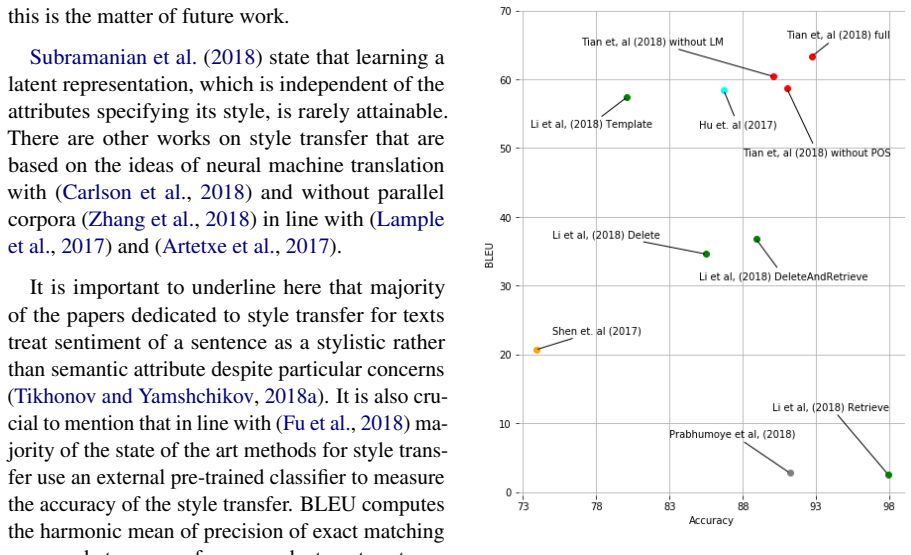
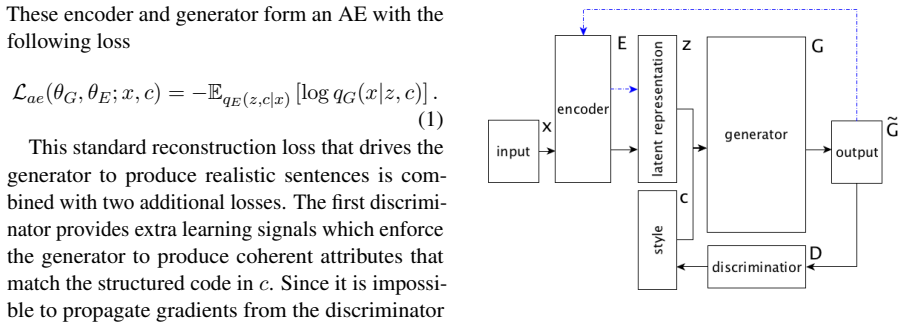
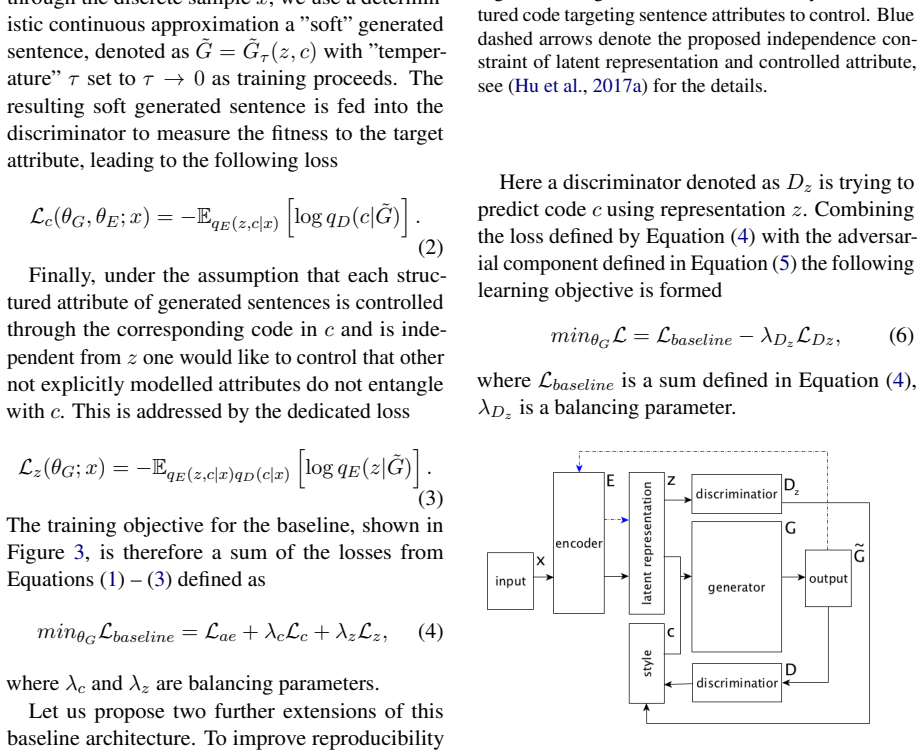
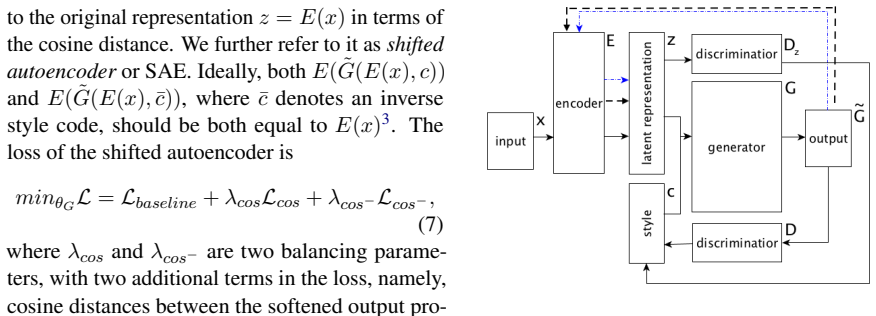
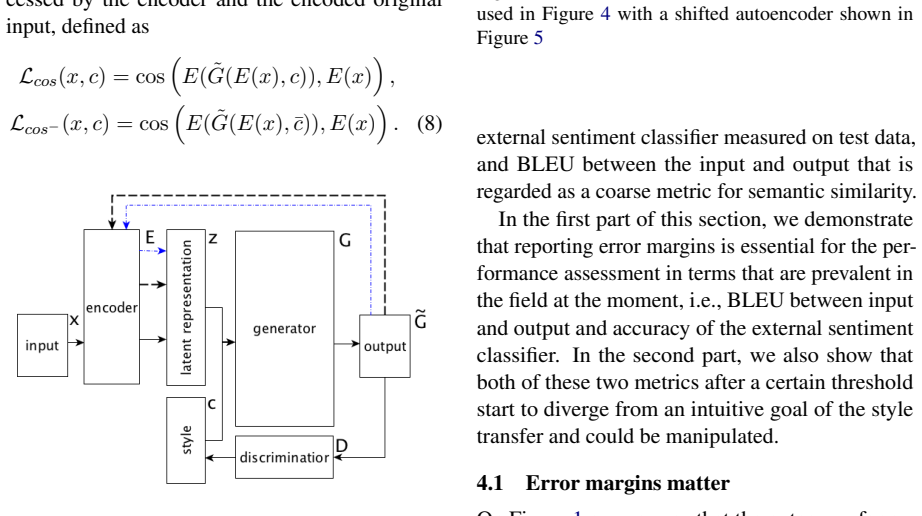
The load-bearing object is the metric pair itself plus the architectures proposed to withstand scrutiny. The paper treats accuracy of an external style classifier and BLEU between input and output as a Pareto-like pair and shows there is an inherent trade-off that can be exploited: under a duplication heuristic, wrong-style outputs are replaced by duplicates of correct high-BLEU outputs, raising accuracy without enlarging BLEU error margins. On the model side, the shifted autoencoder (SAE) enforces consistency by adding cosine-distance losses between the encoder's representation of the input and its representation of the softened output under both the target style code and the inverse style code, while a second variant adds a discriminator that prevents the latent code from carrying style information; a third variant combines both.
What would settle it
Retrain any one of the tested architectures twenty times from scratch on the same Yelp split: if the spread of classifier accuracy stays below one percentage point and the spread of input-output BLEU stays below one point, the claim that error margins are essential is falsified. Likewise, apply the duplicate-replacement heuristic to a modern transformer-based style-transfer model: if reported accuracy cannot be driven towards 100% while BLEU stays within error margins, the manipulability claim is falsified.
Extended reading notes
Core claim
The central discovery is that the two metrics used as the default yardsticks for text style transfer—classifier accuracy and input-output BLEU—are noisy, mutually entangled, and easy to game, so they no longer track the intuitive goal of changing style while preserving content once models reach a certain quality. The paper documents the noise by retraining the same architectures five times from scratch and showing overlapping error margins; it documents the gameability with a 'delete, duplicate and conquer' heuristic that selects classifier-failed outputs and replaces them with duplicates of stylistically correct sentences that have high BLEU with the input, which moves reported accuracy to 100% while BLEU stays within error margins. As a corrective, the paper argues that benchmarks should add BLEU between generated output and human-written reformulations, while acknowledging that even this metric can be manipulated, though less easily. The three proposed architectures—an added discriminator that strips style information from the latent code, a shifted autoencoder with cosine losses that keep the encoded output close to the encoded input, and their combination—are reported to outperform the baseline and other published models on BLEU against human reformulations.
Load-bearing premise
The benchmark recommendation assumes that human-written reformulations are a trustworthy ground truth for style-transfer quality and that BLEU against them is hard to game, but the paper itself shows that duplication can inflate even that BLEU, so the proposed benchmark is only as good as that assumption.
Editorial extensions
If this is right
- Comparisons that report a single retrain's accuracy and BLEU should not be considered decisive; error margins from several retrains are necessary to tell architectures apart.
- Accuracy and input-output BLEU should be optimized as a pair; improving one without the other does not establish better style transfer.
- Even BLEU against human-written reformulations can be inflated by duplication, so benchmarks should treat it as one component rather than a perfect target and should guard against repetitive outputs.
- The proposed discriminator and shifted-autoencoder losses are viable ways to improve semantic preservation, measured as BLEU to human reformulations, on the Yelp sentiment-transfer task.
- Future style-transfer datasets should include multiple human reformulations per sentence, mirroring machine-translation references, to make metric comparisons more stable.
Reading between the lines
- One step beyond the paper: the same instability and manipulation likely affect other automatic text-generation evaluations that rely on classifier accuracy plus n-gram overlap, such as formality transfer or paraphrase generation, since the mechanism is metric-level rather than architecture-level.
- The duplication result implies a simple, cheap safeguard for future benchmarks: enforce diversity or a one-to-one mapping between inputs and outputs so that repeated sentences cannot serve as accuracy boosters.
- If BLEU against human reformulations becomes the benchmark, the number and choice of reformulations will materially change rankings; collecting several rewrites per sentence, as is standard in machine translation, should reduce variance.
- The shifted-autoencoder cosine-loss idea could be transferred to transformer-based generators, but the paper does not test that combination.
Signed reviews
Editorial analysis
A structured set of objections, weighed in public.
Referee Report
Summary. This paper argues that standard evaluation methodology for text style transfer is unreliable: the two most common metrics, accuracy of an external style classifier and BLEU between input and output, vary substantially across retrains, their error margins overlap across architectures, and both can be inflated by a simple duplicate-replacement manipulation. The paper recommends reporting error margins after several retrains and taking BLEU between output and human-written reformulations (from the Tian et al., 2018 dataset) into consideration for benchmarks. It also proposes three modifications of the Hu et al. (2017a) VAE baseline: an additional style-content discriminator, a shifted autoencoder with cosine losses, and a combination of the two, and claims these outperform state of the art on the human-reformulation BLEU metric.
Significance. If its methodological claims hold, the paper makes a valuable contribution by quantifying retrain variance and by demonstrating a concrete, easily implemented manipulation that inflates both standard metrics and also the proposed human-reference BLEU. The five-run retrain protocol for the authors' models and for the Tian et al. (2018) system, the release of code, and the controlled replacement experiment are concrete strengths that make the central critique reproducible. The practical recommendations, however, are only partially supported: the headline comparison in Figure 9 is not reported with the error margins the paper itself demands, and the proposed human-reference metric is shown to be gameable without a stated safeguard or evidence that it tracks human judgments. These gaps are central because the abstract's positive claim rests on Figure 9 and the benchmark recommendation rests on the human-reference metric.
major comments (3)
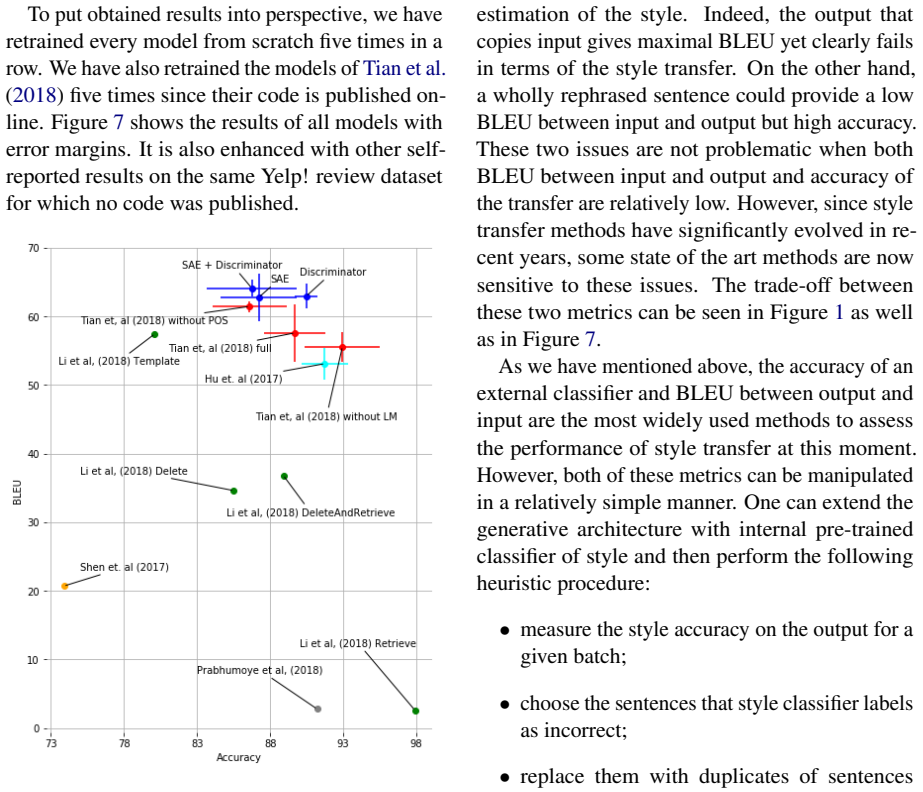
- [Section 4.2 (Figure 9)] The paper's central methodological demand is that single-run comparisons are insufficient: Section 4.1 and Figure 7 show that BLEU and accuracy vary by up to 8 and 5 points across retrains and that error margins of different models overlap. Yet Figure 9, which is the basis for the abstract's claim that the three proposed architectures 'outperform state of the art' in BLEU against human reformulations, is not presented with error margins for the proposed models, and the comparison points for prior work are self-reported single-run numbers. Given the paper's own argument, this comparison cannot support the claim: the five-run intervals for the proposed models may overlap those of the baselines, in which case the headline result would reduce to 'sometimes higher on one run.' The authors should report error margins for all models for which retrains are possible, and for the remaining systems they should explicitly state that the comparison is against self-reported single runs and is therefore provisional.
- [Section 4.2 (Figure 8) and Conclusion] The recommendation to take BLEU against human-written reformulations into consideration is directly undermined by the same section's manipulation experiment: Figure 8 shows that replacing failed outputs with duplicates of stylistically correct sentences increases BLEU against human reformulations as well as accuracy. The text notes that this metric 'can be manipulated' but does not propose a guard against the manipulation or provide evidence that, in the normal operating regime, human-reference BLEU correlates with human judgments of style-transfer quality. Monotonicity of the manipulation effect is not a safeguard against gaming. To justify the benchmark, the authors need either a concrete protection (for example, duplicate detection or a diversity constraint) or a validation experiment showing that the metric tracks perceived quality despite being gameable.
- [Section 4.1 vs. Section 4.2 (architectural comparison)] The paper argues in Section 4.1 that 'improving one of the two metrics is not enough' and that models should be compared in a Pareto-like fashion because accuracy and BLEU trade off. However, the positive comparison of the proposed architectures in Figure 9 is made on a single metric, BLEU against human reformulations, without reporting the corresponding accuracy and input-output BLEU for the same five retrains. Since Figure 7 shows a trade-off between accuracy and BLEU, the 'outperform' claim could reflect a shift along the Pareto frontier rather than an overall improvement. The authors should present the joint performance (style accuracy, input-output BLEU, and human-reference BLEU) of the baseline and the three proposed architectures under the same retrain protocol.
minor comments (5)
- [Abstract and Section 4.2] The abstract's phrase 'outperform state of the art' should be explicitly qualified as 'outperform state of the art on BLEU against human reformulations,' consistent with Figure 9; as written, the claim is broader than the evidence.
- [Figures 7 and 9] The captions of Figures 7 and 9 do not state what the error bars or whiskers represent (standard deviation, min-max range, or confidence interval). Please specify the definition in the captions or in the text.
- [Section 4.1] The phrase 'the outcomes for every single rerun differ significantly' uses 'significantly' without a statistical meaning; reporting the observed ranges (for example, up to 5 accuracy points and 8 BLEU points) is more precise and already present in the text.
- [Equation (7)] The notation λ_cos− in Equation (7) is typeset so that the subscript 'cos−' is visually confusable with a minus sign; consider a clearer notation such as λ_cos_neg.
- [Section 2] The sentence 'for example, in (Li et al., 2018; Kabbara and Cheung, 2016; Xu et al., 2018) estimate the quality...' is grammatically incomplete; please rephrase, for example, 'for example, the authors of (Li et al., 2018; Kabbara and Cheung, 2016; Xu et al., 2018) estimate...'.
Circularity Check
No material circularity: the paper's metric critique and architecture comparison rest on independent empirical measurements; the only self-citation is not load-bearing.
full rationale
The paper's central claims are empirical rather than definitional. Section 4.1 supports the claim that BLEU and style accuracy vary across retrains by reporting results of five retrains from scratch for the authors' models and for Tian et al. (2018), with Figure 7 showing overlapping error margins. Section 4.2 demonstrates manipulability by an explicit procedure: replacing output sentences with duplicates of stylistically correct sentences and measuring the effect on accuracy, input-output BLEU, and BLEU against human-written reformulations. These are external measurements against a pre-trained external sentiment classifier and the human reformulations of Tian et al. (2018), not quantities defined in terms of the paper's conclusions. The proposed architectures are then compared on BLEU against human reformulations in Figure 9; this is an empirical benchmark comparison, not a fitted value relabeled as a prediction. No equation in the paper reduces one claimed output to an input by construction. The only self-citation, Tikhonov and Yamshchikov (2018a), appears in the related-work remark that sentiment is treated as a stylistic rather than semantic attribute despite 'particular concerns'; it is motivational and not the evidence for this paper's findings. The paper itself explicitly concedes a limitation in Section 4.2 and the Conclusion: 'even BLEU on human-written reformulations can be manipulated in a relatively simple way.' That concession undermines the strength of the benchmark recommendation, and Figure 9's lack of reported error margins is inconsistent with the paper's own call to report margins, but these are correctness and reporting weaknesses, not circular reductions. The derivation chain is therefore self-contained with respect to the claims analyzed.
Assumptions & free parameters
free parameters (6)
- lambda_c
- lambda_z
- lambda_Dz
- lambda_cos
- lambda_cos-
- temperature tau =
decreasing to 0
assumptions (4)
- domain assumption Sentiment is treated as a stylistic attribute that can be manipulated independently of content.
- domain assumption The external pre-trained sentiment classifier's accuracy is a valid measure of style-transfer success.
- domain assumption BLEU between output and human-written reformulations (from Tian et al., 2018) is a meaningful semantic-preservation benchmark.
- domain assumption A binary style code c with an inverse style code c-bar is valid for style transfer; style attributes are binary.
Cite this review
Pith. "Pith review of Style Transfer for Texts: Retrain, Report Errors, Compare with Rewrites." pith.science (2026). https://pith.science/paper/LAFTHYNU
@misc{pith2026190806809,
  author       = {Pith},
  title        = {Pith review of: Style Transfer for Texts: Retrain, Report Errors, Compare with Rewrites},
  year         = {2026},
  howpublished = {\url{https://pith.science/paper/LAFTHYNU}},
  note         = {Machine review of arXiv:1908.06809}
}
read the original abstract
This paper shows that standard assessment methodology for style transfer has several significant problems. First, the standard metrics for style accuracy and semantics preservation vary significantly on different re-runs. Therefore one has to report error margins for the obtained results. Second, starting with certain values of bilingual evaluation understudy (BLEU) between input and output and accuracy of the sentiment transfer the optimization of these two standard metrics diverge from the intuitive goal of the style transfer task. Finally, due to the nature of the task itself, there is a specific dependence between these two metrics that could be easily manipulated. Under these circumstances, we suggest taking BLEU between input and human-written reformulations into consideration for benchmarks. We also propose three new architectures that outperform state of the art in terms of this metric.
Figures

Figures from the paper (5 more)

Reference graph
Works this paper leans on
-
[1]
URL: " 'urlintro :=
ENTRY address author booktitle chapter edition editor howpublished institution journal key month note number organization pages publisher school series title type volume year eprint doi pubmed url lastchecked label extra.label sort.label short.list INTEGERS output.state before.all mid.sentence after.sentence after.block STRINGS urlintro eprinturl eprintpr...
-
[2]
write newline
" write newline "" before.all 'output.state := FUNCTION n.dashify 't := "" t empty not t #1 #1 substring "-" = t #1 #2 substring "--" = not "--" * t #2 global.max substring 't := t #1 #1 substring "-" = "-" * t #2 global.max substring 't := while if t #1 #1 substring * t #2 global.max substring 't := if while FUNCTION word.in bbl.in capitalize " " * FUNCT...
-
[3]
Mikel Artetxe, Gorka Labaka, Eneko Agirre, and Kyunghyun Cho. 2017. https://arxiv.org/pdf/1710.11041.pdf Unsupervised neural machine translation . In arXiv preprint
arXiv 2017
-
[4]
Bowman, Gabor Angeli, Christopher Potts, and Christopher D
Samuel R. Bowman, Gabor Angeli, Christopher Potts, and Christopher D. Manning. 2015. https://www.aclweb.org/anthology/D15-1075 A large annotated corpus for learning natural language inference . In Proceedings of the 2015 Conference on Empirical Methods in Natural Language Processing, pages 632--642
work page 2015
-
[5]
Keith Carlson, Allen Riddell, and Daniel Rockmore. 2018. https://doi.org/10.1098/rsos.171920 Evaluating prose style transfer with the bible . Royal Society open science, 5(10):171920
-
[6]
Xi Chen, Yan Duan, Rein Houthooft, John Schulman, Ilya Sutskever, and Pieter Abbeel. 2016. Infogan: Interpretable representation learning by information maximizing generative adversarial nets. Advances in neural information processing systems, pages 2172--2180
work page 2016
-
[7]
Jessica Ficler and Yoav Goldberg. 2017. http://www.aclweb.org/anthology/W17-4912 Controlling linguistic style aspects in neural language generation . In Proceedings of the Workshop on Stylistic Variation, volume 94-104
work page 2017
-
[8]
Zhenxin Fu, Xiaoye Tan, Nanyun Peng, Dongyan Zhao, and Rui Yan. 2018. Style transfer in text: Exploration and evaluation. AAAI
work page 2018
Show all 43 references
-
[9]
Gatys, Alexander S
Leon A. Gatys, Alexander S. Ecker, and Matthias Bethge. 2016. Image style transfer using convolutional neural network. Computer Vision and Pattern Recognition (CVPR), 2016 IEEE Conference, pages 2414--2423
2016
-
[10]
Goodfellow, Jean Pouget-Abadie, Mehdi Mirza, Bing Xu, David Warde-Farley, Sherjil Ozair, Aaron Courville, and Yoshua Bengio
Ian J. Goodfellow, Jean Pouget-Abadie, Mehdi Mirza, Bing Xu, David Warde-Farley, Sherjil Ozair, Aaron Courville, and Yoshua Bengio. 2014. Generative adversarial nets. Advances in neural information processing systems, pages 2672--2680
2014
-
[11]
Ankush Gupta, Arvind Agarwal, Prawaan Singh, and Piyush Rai. 2018. https://www.aaai.org/ocs/index.php/AAAI/AAAI18/paper/download/16353/16062 A deep generative framework for paraphrase generation . In Thirty-Second AAAI Conference on Artificial Intelligence
2018
-
[12]
Hashimoto, Yonatan Oren, and Percy Liang
Kelvin Guu, Tatsunori B. Hashimoto, Yonatan Oren, and Percy Liang. 2018. Generating sentences by editing prototypes. Transactions of the Association of Computational Linguistics, 6:437--450
2018
-
[13]
Zhiting Hu, Haoran Shi, Zichao Yang, Bowen Tan, Tiancheng Zhao, Junxian He, Wentao Wang, Xingjiang Yu, Lianhui Qin, Di Wang, Xuezhe Ma, Hector Liu, Xiaodan Liang, Wanrong Zhu, Devendra Singh Sachan, and Eric P. Xing. 2018. https://arxiv.org/pdf/1809.00794.pdf Texar: A modulari...
2018 arXiv
-
[14]
Zhiting Hu, Zichao Yang, Xiaodan Liang, Ruslan Salakhutdinov, and Eric P. Xing. 2017 a . http://proceedings.mlr.press/v70/hu17e.html Toward controlled generation of text . In International Conference on Machine Learning, pages 1587--1596
2017
-
[15]
Zhiting Hu, Zichao Yang, Ruslan Salakhutdinov, and Eric Xing. 2017 b . https://arxiv.org/pdf/1706.00550.pdf On unifying deep generative models . In arXiv preprint
2017 arXiv
-
[16]
Hughes, Nicholas J
James M. Hughes, Nicholas J. Foti, David C. Krakauer, and Daniel N. Rockmore. 2012. http://www.pnas.org/content/109/20/7682.full Quantitative patterns of stylistic influence in the evolution of literature . Proceedings of the National Academy of Sciences, 109(20):7682--7686
2012
-
[17]
Harsh Jhamtani, Varun Gangal, Eduard Hovy, and Eric Nyberg. 2017. http://www.aclweb.org/anthology/W17-4902 Shakespearizing modern language using copy-enriched sequence-to-sequence models . In Proceedings of the Workshop on Stylistic Variation, pages 10--19
2017
-
[18]
Vineet John, Lili Mou, Hareesh Bahuleyan, and Olga Vechtomova. 2018. https://arxiv.org/pdf/1808.04339.pdf Disentangled representation learning for text style transfer . In arXiv preprint
2018 arXiv
-
[19]
Jad Kabbara and Jackie Chi Kit Cheung. 2016. http://www.aclweb.org/anthology/W16-6010 Stylistic transfer in natural language generation systems using recurrent neural networks . Proceedings of the Workshop on Uphill Battles in Language Processing: Scaling Early Achievements to...
2016
-
[20]
Kingma and Max Welling
Diederik P. Kingma and Max Welling. 2013. https://arxiv.org/pdf/1312.6114.pdf Auto-encoding variational bayes . In arXiv preprint
2013 arXiv
-
[21]
Guillaume Lample, Alexis Conneau, Ludovic Denoyer, and Marc'Aurelio Ranzato. 2017. https://arxiv.org/pdf/1711.00043.pdf Unsupervised machine translation using monolingual corpora only . In arXiv preprint
2017 arXiv
-
[22]
Juncen Li, Robin Jia, He He, and Percy Liang. 2018. http://www.aclweb.org/anthology/N18-1169 Delete, retrieve, generate: A simple approach to sentiment and style transfer . In Proceedings of the 2018 Conference of the North American Chapter of the Association for Computational...
2018
-
[23]
Kishore Papineni, Salim Roukos, Todd Ward, and Wei-Jing Zhu. 2002. https://aclweb.org/anthology/P02-1040 Gbleu: a method for automatic evaluation of machine translation . In Proceedings of the 40th Annual Meeting of the Association for Computational Linguistics (ACL), pages 311--318
2002
-
[24]
Peter Potash, Alexey Romanov, and Anna Rumshisky. 2015. http://www.aclweb.org/anthology/D15-1221 Ghostwriter: Using an lstm for automatic rap lyric generation . In Proceedings of the 2015 Conference on Empirical Methods in Natural Language Processing, pages 1919--1924. Associa...
2015
-
[25]
Black, and Ruslan Salakhutdinov
Shrimai Prabhumoye, Yulia Tsvetkov, Alan W. Black, and Ruslan Salakhutdinov. 2018. https://arxiv.org/pdf/1809.06284.pdf Style transfer through back-translation . In arXiv preprint
2018 arXiv
-
[26]
Hasan, Kathy Lee, Vivek Datla, Ashequl Qadir, Joey Liu, and Oladimeji Farri
Aaditya Prakash, Sadid A. Hasan, Kathy Lee, Vivek Datla, Ashequl Qadir, Joey Liu, and Oladimeji Farri. 2016. http://arxiv.org/abs/1610.03098 Neural paraphrase generation with stacked residual lstm networks . In arXiv preprint
2016 arXiv
-
[27]
Alec Radford, Rafal Jozefowicz, and Ilya Sutskever. 2017. https://arxiv.org/pdf/1704.01444.pdf Learning to generate reviews and discovering sentiment . In arXiv preprint
2017 arXiv
-
[28]
Sudha Rao and Joel Tetreault. 2018. http://www.aclweb.org/anthology/N18-1012 Dear sir or madam, may i introduce the gyafc dataset: Corpus, benchmarks and metrics for formality style transfer . In Proceedings of the Conference of the North American Chapter of the Association fo...
2018
-
[29]
Alexey Romanov, Anna Rumshisky, Anna Rogers, and David Donahue. 2018. https://arxiv.org/pdf/1808.09042.pdf Adversarial decomposition of text representation . In arXiv preprint
2018 arXiv
-
[30]
Aurko Roy and David Grangier. 2019. http://arxiv.org/abs/1905.12752 Unsupervised paraphrasing without translation . In arXiv preprint
2019 arXiv
-
[31]
Rico Sennrich, Barry Haddow, and Alexandra Birch. 2016. http://www.aclweb.org/anthology/N16-1005 Controlling politeness in neural machine translation via side constraints . In Proceedings of the 2016 Conference of the North American Chapter of the Association for Computational...
2016
-
[32]
Tianxiao Shen, Tao Lei, Regina Barzilay, and Tommi Jaakkola. 2017. Style transfer from non-parallel text by cross-alignment. 31st Conference on Neural Information Processing Systems, pages 6833--6844
2017
-
[33]
Smith, Ludovic Denoyer, Marc Aurelio Ranzato, and Y-Lan Boureau
Sandeep Subramanian, Guillaume Lample, Eric M. Smith, Ludovic Denoyer, Marc Aurelio Ranzato, and Y-Lan Boureau. 2018. https://arxiv.org/pdf/1811.00552.pdf Multiple-attribute text style transfer . In arXiv preprint
2018 arXiv
-
[34]
Youzhi Tian, Zhiting Hu, and Zhou Yu. 2018. https://arxiv.org/pdf/1810.06526.pdf Structured content preservation for unsupervised text style transfer . In arXiv preprint
2018 arXiv
-
[35]
Yamshchikov
Alexe Tikhonov and Ivan P. Yamshchikov. 2018 a . https://arxiv.org/pdf/1808.04365.pdf What is wrong with style transfer for texts? In arXiv preprint
2018 arXiv
-
[36]
Yamshchikov
Alexey Tikhonov and Ivan P. Yamshchikov. 2018 b . https://ieeexplore.ieee.org/abstract/document/8639573 Guess who? M ultilingual approach for the automated generation of author-stylized poetry . In IEEE Spoken Language Technology Workshop (SLT), pages 787--794
2018
-
[37]
Yamshchikov
Alexey Tikhonov and Ivan P. Yamshchikov. 2018 c . http://www.aclweb.org/anthology/W18-5813 Sounds W ilde. P honetically extended embeddings for author-stylized poetry generation . In Proceedings of the Fifteenth Workshop on Computational Research in Phonetics, Phonology, and M...
2018
-
[38]
Olga Vechtomova, Hareesh Bahuleyan, Amirpasha Ghabussi, and Vineet John. 2018. https://arxiv.org/pdf/1812.08318.pdf Generating lyrics with variational autoencoder and multi-modal artist embeddings . In arXiv preprint
2018 arXiv
-
[39]
Jingjing Xu, Xu Sun, Qi Zeng, Xuancheng Ren, Xiaodong Zhang, Houfeng Wang, and Wenjie Li. 2018. https://arxiv.org/pdf/1805.05181.pdf Unpaired sentiment-to-sentiment translation: A cycled reinforcement learning approach . In arXiv preprint
2018 arXiv
-
[40]
Wei Xu. 2017. http://www.aclweb.org/anthology/W17-4901 From shakespeare to twitter: What are language styles all about? Proceedings of the Workshop on Stylistic Variation, pages 1--9
2017
-
[41]
Dolan, Ralph Grishman, and Colin Cherry
Wei Xu, Alan Ritter, William B. Dolan, Ralph Grishman, and Colin Cherry. 2012. http://www.aclweb.org/anthology/C12-1177 Paraphrasing for style . Proceedings of COLING, pages 2899--2914
2012
-
[42]
Zhirui Zhang, Shuo Ren, Shujie Liu, Jianyong Wang, Peng Chen, Mu Li, Ming Zhou, and Enhong Chen. 2018. https://arxiv.org/pdf/1808.07894.pdf Style transfer as unsupervised machine translation . In arXiv preprint
2018 arXiv
-
[43]
Rush, and Yann LeCun
Junbo Jake Zhao, Yoon Kim, Kelly Zhang, Alexander M. Rush, and Yann LeCun. 2017. abs/1706.04223 Adversarially regularized autoencoders for generating discrete structures . In Proceedings of the 2015 Conference on Empirical Methods in Natural Language Processing. CoRR
2017 arXiv
Reviewed August 14, 2026 · model on record in the stance chip above.
Discussion (0). Continue with ORCID to comment.